
Commercial Scenting Application Guide: 4705 for Toilets and Elevators
Toilets and elevators are the two locations in a commercial building where scenting is judged on restraint rather than impact. The 4705 diffuser — supplied by SCENTSEA as model P01 — is built for that brief: a 500 mL fragrance oil capacity, a stated noise level below 35 dB, a 2.5 W power draw, and dual power from four D batteries or a 5V Type-C connection. Its rated coverage of 100–150 m² (300–500 m³; 1,000–1,600 ft²) places it in restroom, cabin, corridor and small-shop territory rather than lobby territory.
This guide covers the application decisions that decide whether the 4705 performs in those spaces: how many units a restroom block actually needs, where to mount the diffuser inside a restroom and inside an elevator car, how to choose between the white and black finishes, how to set a refill and maintenance interval that matches measured consumption, and when a wall-mounted P02 or an HVAC-class unit becomes the better answer for the adjacent commercial space.
SCENTSEA is the brand of Shenzhen Scentsea Technology Co., Ltd., a Shenzhen-based manufacturer founded in 2021 that produces cold-air nebulizing scent diffusers and fragrance oils and supplies customers in more than 70 countries and regions. Its diffuser range is certified CE, RoHS and FCC, and the company offers OEM/ODM customization covering logo, product colour, packaging, user manual and plug type.
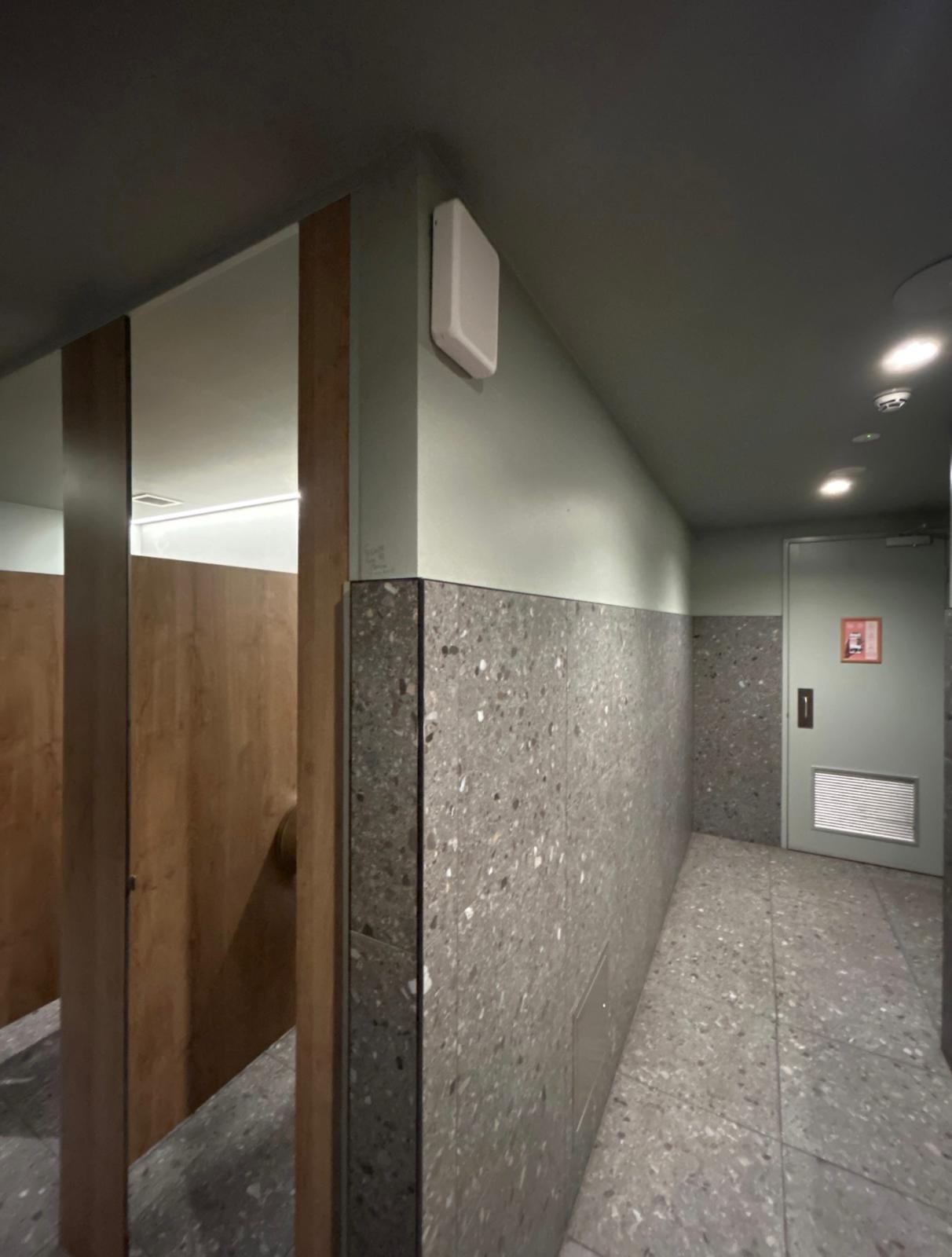
The 4705 diffuser, supplied by SCENTSEA as model P01, is a 500 mL compact unit specified for restrooms, elevator cars and other small enclosed commercial spaces.
Problem Definition: Why Toilets and Elevators Reject Generic Scenting Plans
A restroom is not a small lobby. It is a high-air-change, low-volume space where moisture, odour pulses and cleaning chemicals compete with any fragrance added, and where the air is deliberately exhausted to the outside. An elevator car is the opposite problem: a sealed enclosure with almost no air change, a very short dwell time, and passengers standing within arm's reach of the diffuser. A plan copied from a lobby deployment fails in both.
The requirement set that actually governs these two spaces is short and specific:
- Low output, continuous rather than burst. A restroom that smells strongly of fragrance has simply replaced one odour problem with another.
- Noise that disappears under background sound. An elevator car removes every escape path for mechanical noise, so a diffuser that is inaudible in a lobby can be obvious in a cabin.
- Power that does not depend on new cabling. Pulling a cable into a lift car or through a finished tiled ceiling is often the single most expensive part of a retrofit.
- A profile that fits a ceiling void or a wall return. Available mounting depth, not floor area, is frequently the binding constraint.
- A refill interval longer than the cleaning cycle. If the oil needs topping up more often than the space is serviced, the installation will drift out of schedule.
- A fragrance that reads as clean rather than as added perfume. This is a fragrance-oil selection decision, not a hardware decision.
The 4705 addresses the middle four requirements directly through its published specifications. The first and last are commissioning decisions, and they are covered in the step-by-step section below.
Industry Background: Small-Space Scenting Inside a Growing Commercial Category
Cognitive Market Research values the global scent marketing market at approximately USD 4.1 billion in 2026 and projects USD 7.28 billion by 2035, equivalent to a 6.6% CAGR over the forecast period. A second source cited in the same dataset puts growth at 10.16%; the difference is best explained by methodology — whether consumer air-care products are counted alongside commercial scenting services — rather than by disagreement about direction.
The hardware behind those figures is cold-air nebulizing diffusion, which atomizes fragrance oil into particles below 2.5 μm without heat or water, as described in SCENTA's 2026 technical guide to commercial scent machines. Waterless atomization matters specifically in restrooms and elevator cars: there is no water tank to refill, no standing water to become a hygiene issue in a washroom, and no heater adding load inside a sealed cabin.
For importers, commercial scent diffusers are classified under HS code 8509.80, with a 4.2% US import duty rate reported for 2026 (USITC, via Dutiable). Duty is charged per shipment, so packing density has a direct commercial effect: the 4705 ships in a carton of L280 × W83 × H200 mm at 0.8 kg gross weight.
Demand-side evidence for scenting remains mostly directional. A secondary industry compilation reports an average 15-minute increase in retail dwell time in scented environments — a figure worth treating as indicative rather than as a planning input. What is not in dispute is that restrooms and elevator cars generate complaints faster than any other interior zone. That makes them the highest-risk, lowest-glamour part of a commercial scenting programme, and the part most often left out of the specification.
Detailed Solution: The 4705 Diffuser as a Toilet and Elevator Solution
The 4705 is a compact cold-air unit. Every figure below is a published specification for the model, and each one maps to a specific installation constraint in a washroom or a lift car.
| Parameter | Specification | Why it matters here |
|---|---|---|
| Model reference | 4705 (SCENTSEA P01) | Confirm the model code on the quotation, certificate and carton label match. |
| Fragrance oil capacity | 500 mL | Sets the refill interval; suits serviced commercial spaces. |
| Noise level | Below 35 dB | Critical inside a sealed elevator car. |
| Power consumption | 2.5 W | Low continuous draw; usable on battery or on a shared 5V supply. |
| Power supply | 4 × D batteries or 5V Type-C | Removes cabling from lift cars and finished restroom ceilings. |
| Rated coverage | 100–150 m² / 300–500 m³ / 1,000–1,600 ft² | Defines single-unit scope for restroom blocks and corridors. |
| Finish options | White or black | Match tile, stone, stainless steel or painted panel finishes. |
| Dimensions | H168 × L240 × W50 mm | A 50 mm body depth is what makes a ceiling void or wall return realistic. |
| Net / gross weight | 0.55 kg / 0.8 kg | Light enough for a lift ceiling panel without additional reinforcement. |
| Packing dimensions | L280 × W83 × H200 mm | Useful for freight and duty planning on multi-unit orders. |
Noise is the first filter. At below 35 dB, the 4705 is specified below the level of normal conversation and below the background noise of a restroom hand dryer or a lift machine room. In an elevator car, where the enclosure removes any escape path for sound, this is the single most important number in the specification — more important than coverage, because a diffuser that passengers can hear will be switched off regardless of how well it covers the space.
Dual power is the second filter. A 2.5 W draw makes long battery operation practical, and the four D-cell option means an elevator car or a tiled restroom ceiling can be scented without new wiring. The 5V Type-C input covers the other half of the market: restrooms with a permanent supply above the ceiling, and service cupboards where a 5V adapter is already present. In practice, many projects use batteries in the cars and Type-C in the restrooms, and standardize on one model across both.
Capacity and footprint decide maintenance economics. A 500 mL reservoir carried in a body measuring only 168 × 240 × 50 mm means the unit can sit inside a ceiling void without a dedicated plant space. The 0.55 kg net weight allows mounting on a standard panel or return without structural work.
Finish is a specification detail, not decoration. White works against white tile, light ceiling grids and bright stainless steel; black disappears against dark stone, dark metal trims and painted ceiling panels. SCENTSEA also offers colour customization under its OEM/ODM service, which matters where a designer wants the unit to match a specified palette.
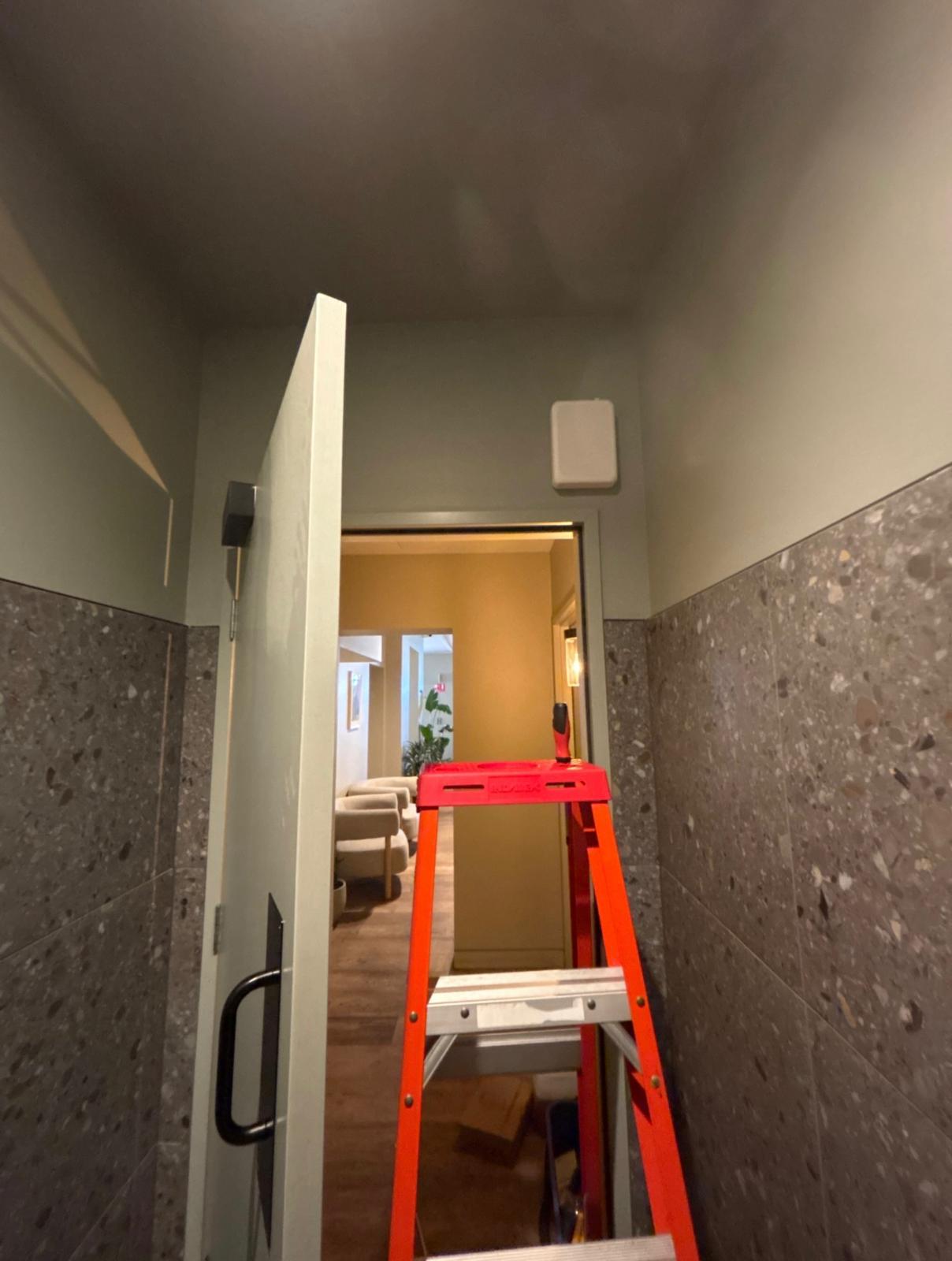
A body depth of 50 mm and a net weight of 0.55 kg allow the 4705 to sit in a ceiling void or on a wall return without structural work.
Step-by-Step Application Planning
Step 1 — Measure the space before counting units
Record floor area, ceiling height, volume, the number of separate enclosed rooms, door-opening frequency and the position of extract grilles. Then apply the rating conservatively: use the volume figure (300–500 m³) when ceiling height is unusual, the area figure (100–150 m²) for a normally proportioned room, and the smaller of the two when the space is heavily ventilated. A single restroom inside those limits can be served by one diffuser. A multi-room block, or a corridor that opens directly into a lobby, should be treated as separate zones — fragrance will not distribute evenly across an open boundary.
Step 2 — Placement inside restrooms
- Mount on a side wall just inside the entrance, or on the ceiling above the circulation area — not inside or directly above a cubicle.
- Keep the mist path clear of extract grilles; a diffuser installed opposite an exhaust will lose most of its output before it reaches the room.
- Avoid directing mist onto mirrors, chrome or glass, where oil film becomes visible first.
- Keep clear of smoke detectors, emergency lighting, call points and accessible-height requirements.
- Leave service access. If the unit runs on batteries, mount it at a height a cleaner can reach without a ladder; if it runs on Type-C, place the supply and connector where it can be inspected.
Step 3 — Placement inside elevator cars
- Preferred position is inside the ceiling void, with the outlet directed along the car rather than down onto passengers.
- If a ceiling void is not available, mount high on a side panel away from the button panel, handrail, emergency telephone and camera.
- Never direct the mist path at head height where passengers stand, and never obstruct the emergency phone or any safety device.
- Plan the battery or connector access point at the same time as the mounting position — retrofitting access later costs more than the unit.
- Treat each car as a separate enclosure: install one unit per car rather than attempting to serve a lift bank from a single machine.
Step 4 — Choose the power source and the finish
Batteries (four D cells) suit elevator cars and older restrooms where no permanent supply exists, and they avoid any electrical work inside a lift installation. The 5V Type-C input suits restrooms and service areas with an existing supply, and removes battery replacement from the maintenance schedule. Both are standard configurations of the same model, so a project can mix them. On finish, select white for light tile, white ceiling grids and bright stainless steel, and black for dark stone, dark metal trims and dark painted panels. Where a scheme requires a specific colour, SCENTSEA's OEM/ODM service covers product colour, logo and packaging customization.
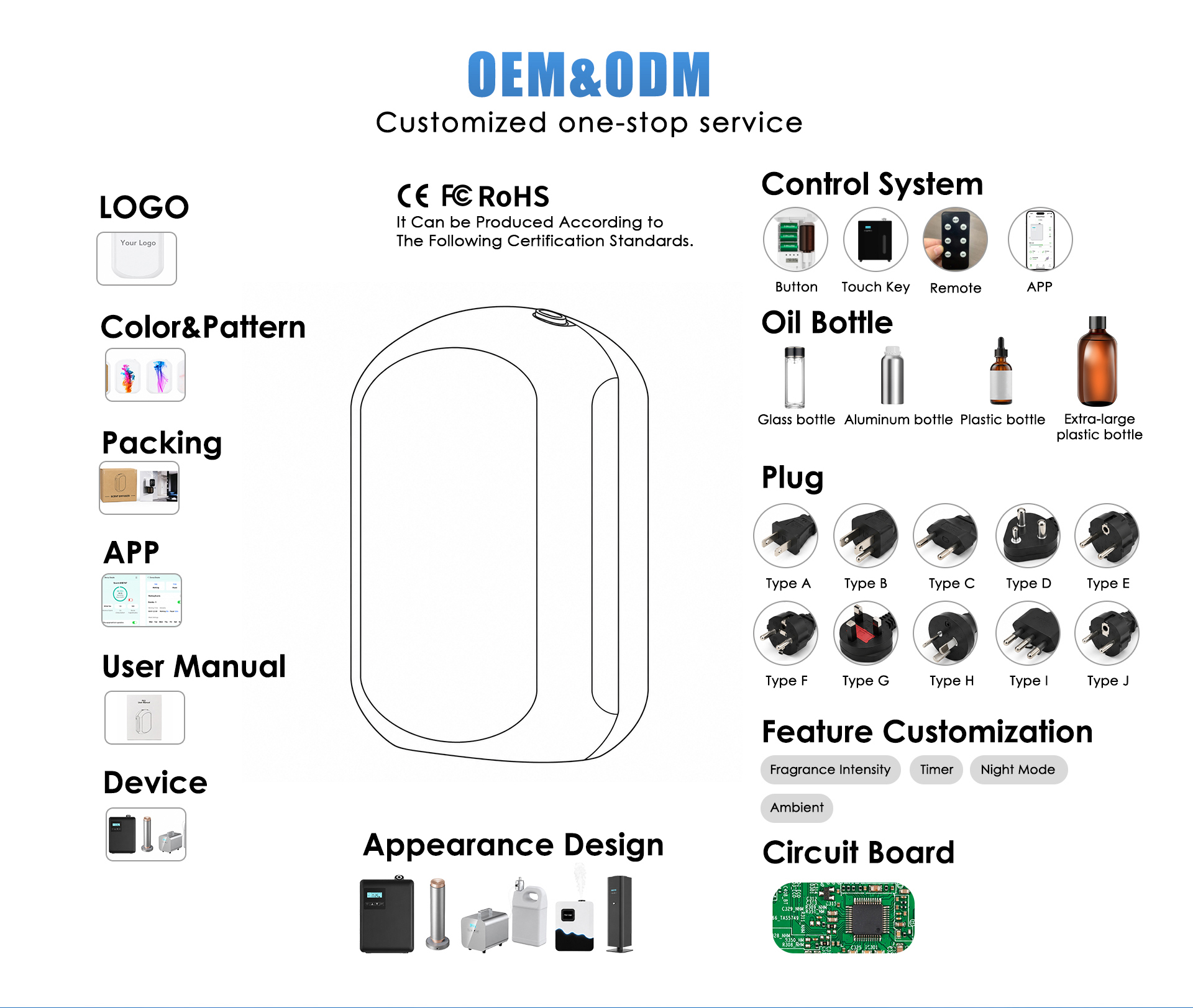
White and black are standard finishes on the 4705; SCENTSEA's OEM/ODM service extends customization to product colour, logo, packaging, user manual and plug type.
Step 5 — Commission, then set refill and maintenance intervals
Start at a low intensity and adjust upward over the first few days rather than commissioning at maximum and backing off. Restroom users notice intensity change far more than they notice absolute level, and a space that is over-scented on day one rarely recovers its reputation.
Refill planning should be based on measurement, not assumption. The formula is simple: refill interval = 500 mL ÷ measured daily consumption. SCENTSEA does not publish a per-hour oil consumption figure for the 4705 in the product material used for this guide, so the first refill should be scheduled by observation. For scale only — and explicitly not as a 4705 specification — the same company publishes 4 mL ±10% per hour for the 500 mL A300 and P03 models, which are different units. Measure the actual daily drop in oil level over the first two weeks at the chosen intensity, then set a fixed schedule with a margin so the unit is never run dry between service visits.
| Interval | Action |
|---|---|
| Daily (cleaner check) | Confirm mist is visible, listen for abnormal noise, check for leakage, confirm oil level. |
| Weekly | Wipe the housing and outlet, confirm the nozzle is not blocked, record oil-level drop against the planned consumption. |
| Monthly | Clean the nozzle, check tubing and pump connections, check battery condition or power supply. |
| Quarterly | Deep clean, re-check intensity and working schedule, review any odour or over-scenting complaints. |
| Annually | Inspect wear parts and confirm warranty coverage; SCENTSEA provides a 1-year free warranty on spare parts. |
Fault-finding follows the same order as the maintenance schedule. If the unit does not start, check the power supply, the on/off state and the working-hour settings before replacing anything. If there is no atomization, check whether the pump is running, inspect the nozzle for blockage and confirm that the pump tube and pipette are connected and undamaged. Abnormal noise usually means a loose pump or loose internal parts. Weak atomization points to an ageing pump, a blocked nozzle, or fragrance oil that is too thick or contains impurities.
Step 6 — Plan the adjacent space before you buy
Restrooms and elevator cars are rarely standalone. The moment a project includes the corridor outside the washroom, the lift lobby, or a retail floor on the same level, the specification changes:
- Wall-mounted P02 — recommended by SCENTSEA for small-to-medium commercial spaces that require stronger diffusion and smart control. It is the natural step up for a lift lobby or a corridor serving several restrooms.
- HVAC-class AC-MAX — a 5 L unit built of aluminium and plastic, designed for shopping malls, banks and airports, where fragrance is distributed through the air-handling system rather than from a wall.
- T2 — a 500 mL unit covering 500–800 m² for hotels, cinemas and shopping malls, with HVAC duct connection support.
Where a building has unstable power or frequent service interruptions, confirm the restart behaviour of the chosen model with the supplier during specification rather than assuming it. And when shortlisting suppliers for the wider programme, the practical checks are factory capability and quality control: SCENTSEA operates a 3,000 m² facility with three production lines and a monthly capacity of 8,000 units, publishes a 25–35 day lead time, and tests every unit for function, atomization, leakage, noise and control before a 48-hour aging test and final appearance inspection.
Use Cases in Real Commercial Settings
Hotel public restrooms and lift lobbies
In hospitality, the restroom is one of the few spaces every guest enters. A 4705 on Type-C power above the circulation area, at low intensity, handles the washroom; the lift lobby outside usually belongs to a P02. Hotels that scent lobbies centrally typically extend the same fragrance family into these smaller zones at lower intensity rather than introducing a second scent.
Office floors: restrooms, elevator cars and corridors
Multi-tenant office buildings present the simplest case for the 4705 because the enclosed rooms are small and repeated floor by floor. One unit per restroom and one per lift car gives predictable coverage and a maintenance round that follows the cleaning schedule rather than a separate visit.
Shopping malls and large venues
Malls and transport terminals usually need a layered approach: the 4705 for individual restrooms and service corridors, with HVAC-class equipment for the main circulation areas. The reference case is a US scent marketing company that installed 30 AC-MAX diffusers across shopping malls and reported stable and consistent scent coverage, reduced manual maintenance and improved fragrance management efficiency — the pattern that small-space units then fill in around.
Retail stores, banks and restaurants
Small shops, bank branches and restaurant washrooms fall inside the 4705's rated area and benefit from battery operation where no ceiling supply exists. In these formats, ambient scenting solutions work best when the washroom is treated as a cleanliness signal rather than as a branding opportunity — a light, continuous, neutral-clean profile instead of a strong signature scent.

The 4705 (P01) is listed among the related products on SCENTSEA's EMC, RoHS and FCC documentation; confirm the certificate names the exact configuration ordered.
Comparison: The 4705 Against Adjacent SCENTSEA Models
The table below uses only specifications published for each model. Where a figure is not published in the product material used for this guide, it is marked as not stated rather than estimated.
| Model | Oil capacity | Noise | Power | Power source | Stated application |
|---|---|---|---|---|---|
| 4705 (P01) | 500 mL | Below 35 dB | 2.5 W | 4 × D batteries or 5V Type-C | Toilets and elevators; battery-powered option for washrooms and elevators where wiring is inconvenient |
| P03 | 500 mL | Below 40 dB | Not stated | Battery | Toilets, elevators, corridors, small shops; 4 mL ±10% per hour |
| A300 | 500 mL | Not stated | Not stated | Not stated | Toilets, elevators, corridors, small shops; 4 mL ±10% per hour |
| P02 | Not stated | Not stated | Not stated | Not stated | Wall-mounted; small-to-medium commercial spaces requiring stronger diffusion and smart control |
| T2 | 500 mL | Not stated | Not stated | Not stated | Hotels, cinemas, shopping malls; 500–800 m²; HVAC duct connection |
| AC-MAX | 5 L | Not stated | Not stated | HVAC | Shopping malls, banks, airports |
The practical reading is straightforward. Where a lift car or a restroom must run without wiring and noise is the deciding criterion, the 4705 is the specified option at below 35 dB. Where the same space needs stronger output and the ceiling can take a wall-mounted unit, P02 is the next step. Where the space is measured in hundreds of square metres or is ducted, the decision has left the small-space category entirely.
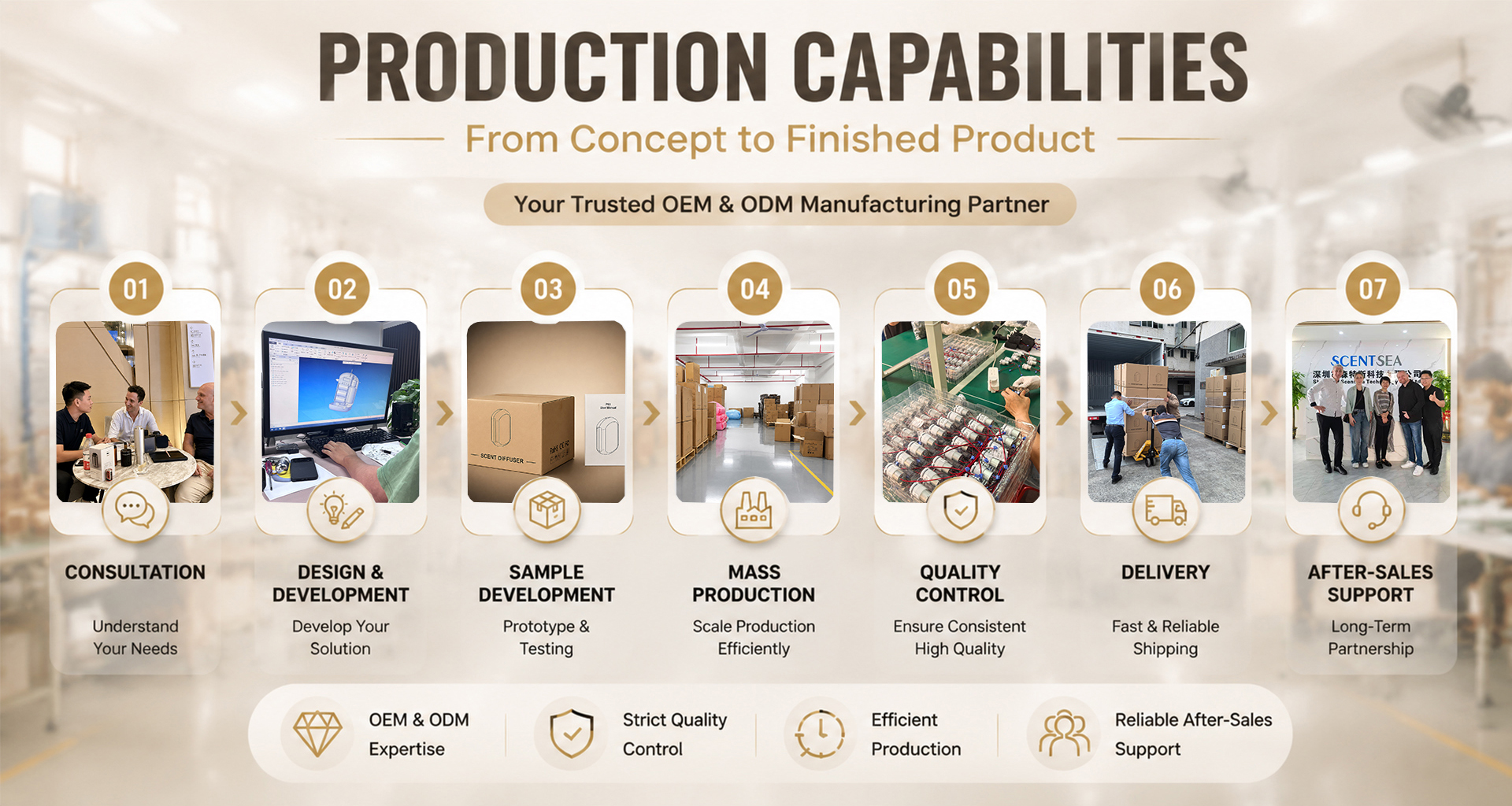
Every unit passes functional, atomization, leakage, noise and control testing, a 48-hour aging test and a final appearance inspection before shipment.
Frequently Asked Questions
Which certifications should be verified before specifying the 4705 for a commercial project?
SCENTSEA states CE, RoHS and FCC certification for its diffuser range, and the 4705 (P01) is listed among the related products on all three certificates held by Shenzhen Scentsea Technology Co., Ltd. The FCC grant ATL20240416326 covers FCC Part 15 Subpart B:2023 for the US market; RoHS certificate ATL20240416327 references Directive (EU) 2015/863; EMC report ATL20240416325 references EN IEC 55014-1:2021, EN IEC 55014-2:2021, EN IEC 61000-3-2:2019/A1:2021 and EN 61000-3-3:2013/A2:2021. Verify that the certificate names the exact configuration ordered, and check fragrance oil compliance separately for the destination market.
Can one 4705 cover a restroom block or a bank of elevator cars?
One unit is rated for 100–150 m², 300–500 m³ or 1,000–1,600 ft² — use the volume figure when ceiling height is unusual, and the smallest of the three when the space is heavily ventilated. A single restroom inside that area can be served by one diffuser. A multi-room block, a corridor shared with the lobby, or a group of elevator cars needs one unit per enclosed space rather than one unit for the group, because each car is a sealed enclosure and fragrance does not transfer between cars.
What drives the running cost of a 4705 installation?
Running cost has four components: fragrance oil, power or batteries, labour for refilling and cleaning, and spare parts. The 2.5 W rating is the figure to use for electricity estimates, and the 500 mL capacity sets how often a refill is needed. Labour is usually the largest variable in small-space scenting, which is why battery-powered units suit elevator cars and Type-C units suit restrooms where a permanent supply already exists. Unit and project pricing is not published in the product material used for this guide; budget from a quotation that separates hardware, fragrance oil and spare parts.
Can buyers test the 4705 before placing a bulk order?
Yes. SCENTSEA supplies diffuser samples and fragrance oil samples for quality verification, and the MOQ for diffusers starts at 1 unit. Test the sample in the actual room or a comparable enclosure: confirm noise under load in a quiet space, check atomization strength at the setting you intend to use, inspect for leakage after a day of running, and verify that the fragrance oil you plan to use atomizes without thickening.
What are the production lead time and after-sales terms?
Standard lead time is 25–35 days, with a monthly capacity of 8,000 units and annual output of 100,000 units across three production lines. Every unit is checked before shipment through functional testing, atomization testing, leakage inspection, noise testing, control testing, a 48-hour aging test and final appearance inspection, and spare parts are covered by a 1-year free warranty. For current lead times, samples, or a quotation on a restroom and elevator programme, contact SCENTSEA through www.scent-sea.com or download the SCENTSEA company profile PDF.
Conclusion: Restraint Is the Specification
The 4705 works in toilets and elevators because its specification matches the constraint rather than the showroom: below 35 dB so the unit is not heard inside a sealed car, 2.5 W so it runs on four D cells or a 5V Type-C supply without new cabling, 500 mL so refills fit the maintenance cycle, a 50 mm body so it fits a ceiling void, and a 100–150 m² rating that keeps it in the small-space category where it belongs. White and black finishes let it disappear into the surrounding surfaces.
The planning work is what determines the outcome. Measure volume and air exchange before counting units, mount where mist reaches the room instead of the extract grille, keep the mist path away from passengers and safety devices, choose battery or Type-C by whether a supply already exists, and set the refill interval from measured consumption rather than from the side of the bottle. Where the project grows beyond the small-space boundary, step up deliberately — wall-mounted P02 for the adjacent lobby, HVAC-class AC-MAX or duct-connected T2 for the wider building.
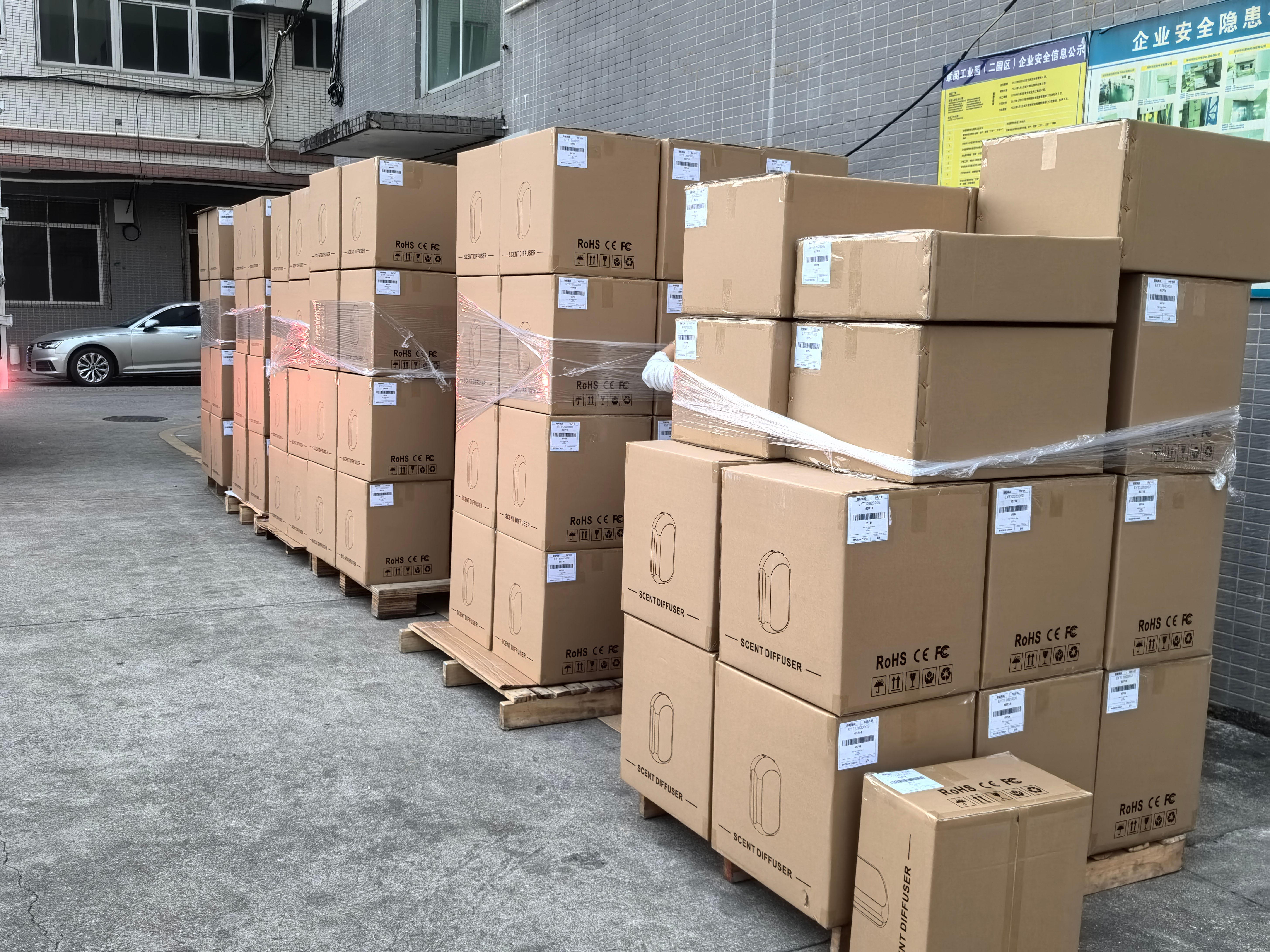
SCENTSEA supplies diffusers and fragrance oils to customers in more than 70 countries and regions, with OEM/ODM customization available.
Next Step: Sample, Quote or Full Specification
If you are specifying restrooms and elevator cars for a hotel, office building, shopping mall or retail chain, request a 4705 sample to test noise and atomization in the actual enclosure, or ask for a quotation covering diffusers, fragrance oils and spare parts for the full programme.
Email jimmy@scent-sea.com · WhatsApp +86 19928719703 · Website www.scent-sea.com · Catalog SCENTSEA Company Profile (PDF)
Have Questions or Need More Details?
Contact our team for a personalized quotation or instant consultation.
Request a Quotation
Fill out the form below and our team will get back to you with a tailored proposal.
WhatsApp Direct Chat
Prefer to chat in real-time? Message us on WhatsApp for instant assistance & quick answers.
- Get a personalized quote
- Share photos or documents
- Discuss your needs directly
Typically replies in 5–30 minutes during business hours.