
Commercial Scenting Compliance: Certifications, Standards & Regional Requirements to Verify
Commercial Scenting Compliance: Certifications, Standards & Regional Requirements to Verify
A certificate only protects a project when it names the exact model, the exact configuration and the exact market you are buying for. Commercial scenting compliance therefore starts with document matching, not with logo checking. Six attributes must line up against paperwork before an order is released: electrical input, noise output, housing material, battery or power-source handling, wireless functions and the regional documentation set for the destination market.
This guide sets out a verification framework that procurement teams, MEP consultants and facilities managers can apply to any commercial scenting system. Three SCENTSEA models are used as working examples because they represent three different compliance profiles rather than simply three different sizes: the H5000 floor-standing diffuser (DC 12 V, 20 W, below 45 dB, aluminum housing, 1000 mL), the 4705 battery diffuser (4 × D batteries or 5 V Type-C, 2.5 W, below 35 dB, plastic, 500 mL) and the P02 plug-in diffuser (DC 12 V, 6.5 W, below 30 dB, plastic, 300 mL, optional Wi-Fi + Bluetooth and optional HVAC connector and tube).
Shenzhen Scentsea Technology Co., Ltd (SCENTSEA) is a Shenzhen-based manufacturer of cold-air nebulizing scent diffusers and fragrance oils for home, commercial and HVAC aroma applications. It was founded in 2021, operates a 3,000 m² production facility, and its diffuser models are certified with CE, RoHS and FCC. The framework below is written so that it can be applied to SCENTSEA or to any other supplier without modification.
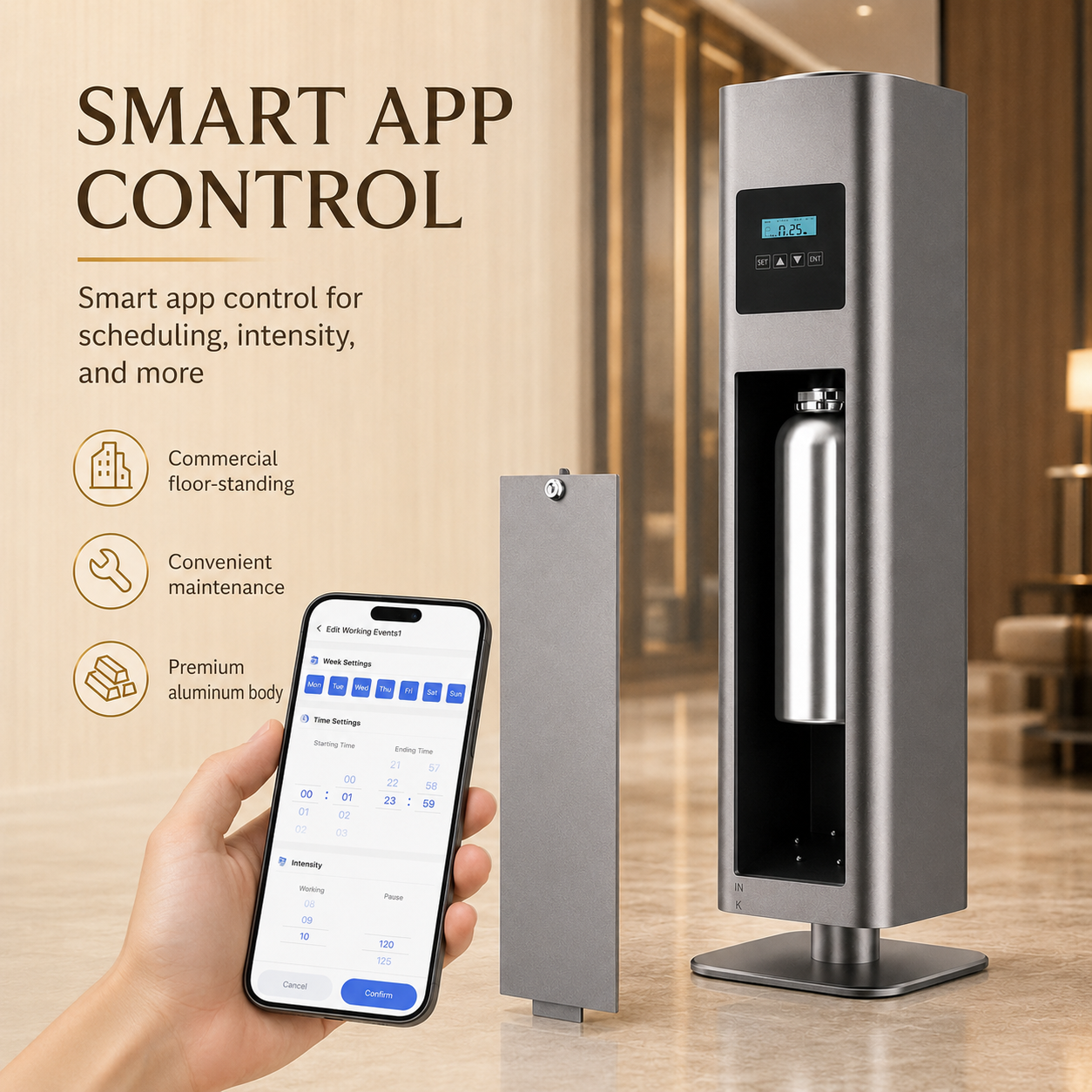
Cover: the H5000 floor-standing diffuser, used in this guide as the aluminum-housing, DC 12 V reference configuration.
Problem Definition: Why Compliance Claims Break Down in Scenting Projects
Most compliance failures in commercial scenting are documentation failures, not product failures. The hardware usually works. What fails is the ability to prove, in writing, that the exact unit delivered is the exact unit the document describes. Five patterns account for most of the friction.
- Model drift. The certificate refers to a product family or a catalogue name, while the purchase order specifies a variant with a different housing, plug type or capacity. The document never names what is actually in the crate.
- Configuration drift. A model is documented in its standard form, and then a wireless version is offered under the same paperwork. The P02, for example, exists with Bluetooth control and with an optional Wi-Fi + Bluetooth version, and those are not the same configuration from a documentation point of view.
- Power-architecture confusion. The H5000 (DC 12 V, 20 W) and the P02 (DC 12 V, 6.5 W) are plug-in machines that depend on an external power supply. Part of the compliance question shifts to the adapter and its marking, which is often not the part anyone photographed.
- Battery assumptions. The 4705 runs on 4 × D batteries or a Type-C supply at 5 V and 2.5 W. That is a genuinely different risk profile from a mains-connected machine, and it needs its own documentation and its own receiving instructions.
- Numbers without test context. A noise figure such as below 45 dB, below 35 dB or below 30 dB is a specification, not a test report. Without measurement conditions, the number cannot be compared between suppliers or defended in a tender response.
The layer buyers forget: hardware certification does not cover the fragrance. All diffuser models are certified with CE, RoHS and FCC, but a CE declaration for a diffuser says nothing about the oil inside it. Buyers entering Europe commonly request fragrance-level documentation such as REACH-related declarations and IFRA-based statements, and those must be requested as a separate file set for the specific oil being supplied.
Industry Background: What Is Changing in Commercial Scenting
The commercial scenting category is growing, and that growth is one reason documentation pressure is increasing. Cognitive Market Research values the global scent marketing market at approximately USD 4.1 billion in 2026, and projects it to reach USD 7.28 billion by 2035 at a CAGR of 6.6%. As scenting moves from a discretionary amenity into specified building equipment, the paperwork expectations move with it.
The dominant delivery technology also shapes which questions are relevant. Cold-air nebulizing diffusion atomizes fragrance oil into sub-micron particles below 2.5 μm without heat or water, according to SCENTA's technical guide to commercial scent machines and HVAC diffusers. For a buyer, the practical consequence is that there is no water tank to declare, no heating element to assess, and greater sensitivity to oil viscosity and purity — which pushes attention toward the consumable documentation rather than the enclosure.
Trade classification is the third background factor. Commercial scent diffusers are classified under HS Code 8509.80 (electromechanical domestic appliances), with a 4.2% US import duty recorded by Dutiable and USITC data. Classification affects landed cost and belongs in the same review as the technical file, because a supplier who cannot state a classification consistently is usually also vague about model-level documents.
Detailed Solution: The Six Verification Layers
Verify in six layers, in this order: electrical input, noise, material, battery handling, wireless functions, then regional documentation. Each layer produces either a document you can file or a question you cannot yet answer.
1. Electrical input and power architecture
Start with the input, because it determines which document you actually need. The H5000 is a DC 12 V, 20 W plug-in unit. The P02 is a DC 12 V, 6.5 W plug-in unit. The 4705 is a 5 V, 2.5 W unit powered by 4 × D batteries or Type-C. Ask for the declaration that covers the delivered configuration, and ask specifically whether the external power supply is included in that scope. A DC-input machine with an unbranded adapter is a common weak point in commercial installations.
2. Noise output and the conditions behind it
The three reference models sit at different acoustic levels: below 30 dB for the P02, below 35 dB for the 4705, below 45 dB for the H5000. Those figures reflect output power and form factor, and they are only comparable when measured under the same conditions. Ask at what distance, in which operating mode and at which intensity the figure was taken, and ask for the test record rather than the brochure line. In hotels, offices and clinical-adjacent spaces, noise is the specification most likely to be challenged after installation.
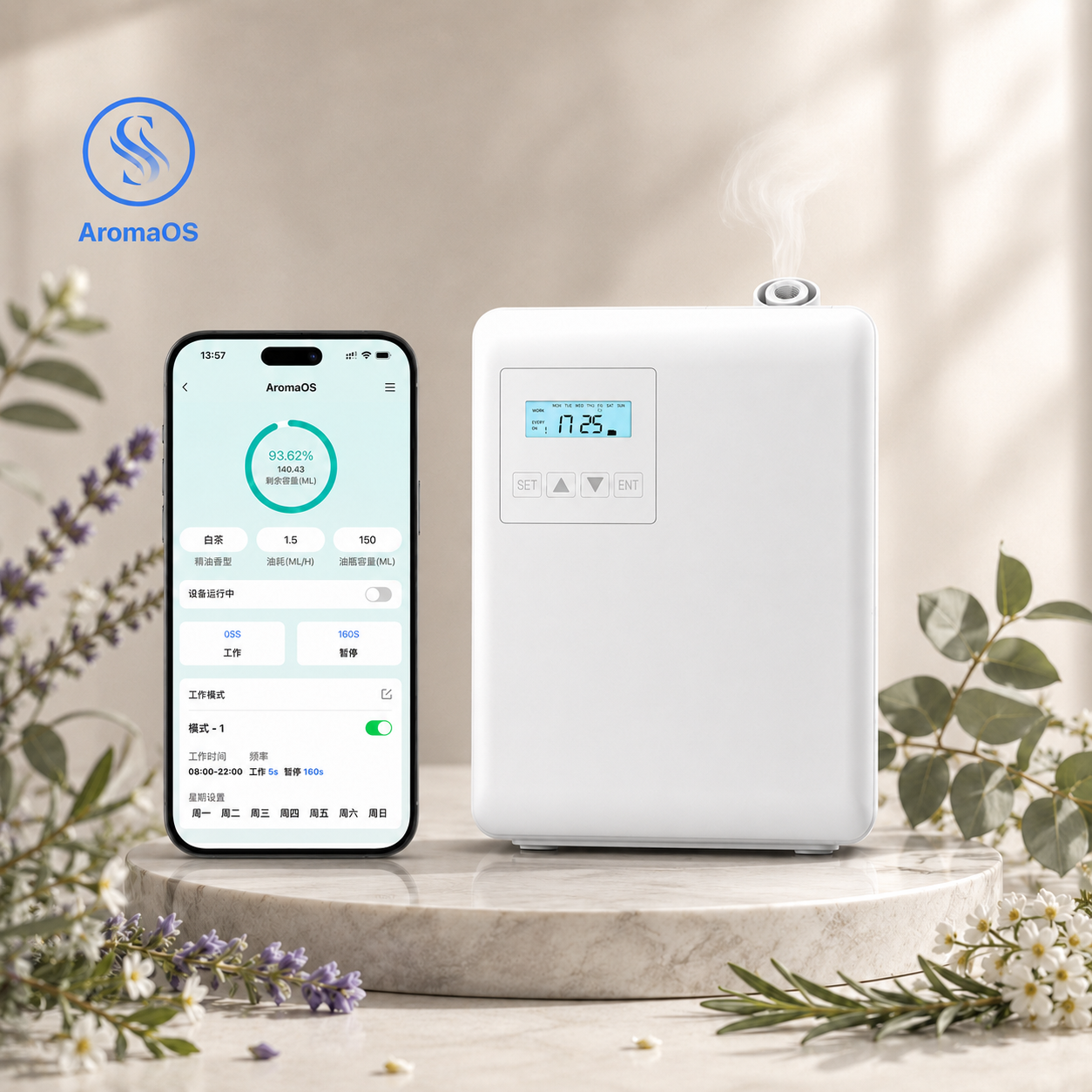
P02: DC 12 V, 6.5 W, below 30 dB, 300 mL, with optional Wi-Fi + Bluetooth and an optional HVAC connector and tube — three configuration choices that each change the documentation set.
3. Housing material and restricted substances
Material claims should be traceable to the part that ships. The H5000 uses an aluminum housing; the P02 and the 4705 use plastic. RoHS is a restricted-substance framework, so the document to request is the one that covers the actual materials in the housing and the PCB, not a generic statement repeated across a catalogue. For metal-bodied units, also confirm surface treatment and coating declarations, since powder-coated or painted metal introduces a second supplier into the material chain.
4. Battery handling and transport configuration
The 4705 changes the compliance conversation rather than simplifying it. A 5 V unit with a 500 mL bottle, below 35 dB and a plastic housing is a low-voltage device with a cordless installation story, which is exactly why it gets used in elevators, corridors and washrooms where wiring is difficult. Confirm three things in writing: whether batteries are included in the shipment or excluded, what battery documentation accompanies the unit, and how the configuration is described for transport. A battery-powered diffuser that arrives with cells installed creates a receiving problem that has nothing to do with fragrance performance.
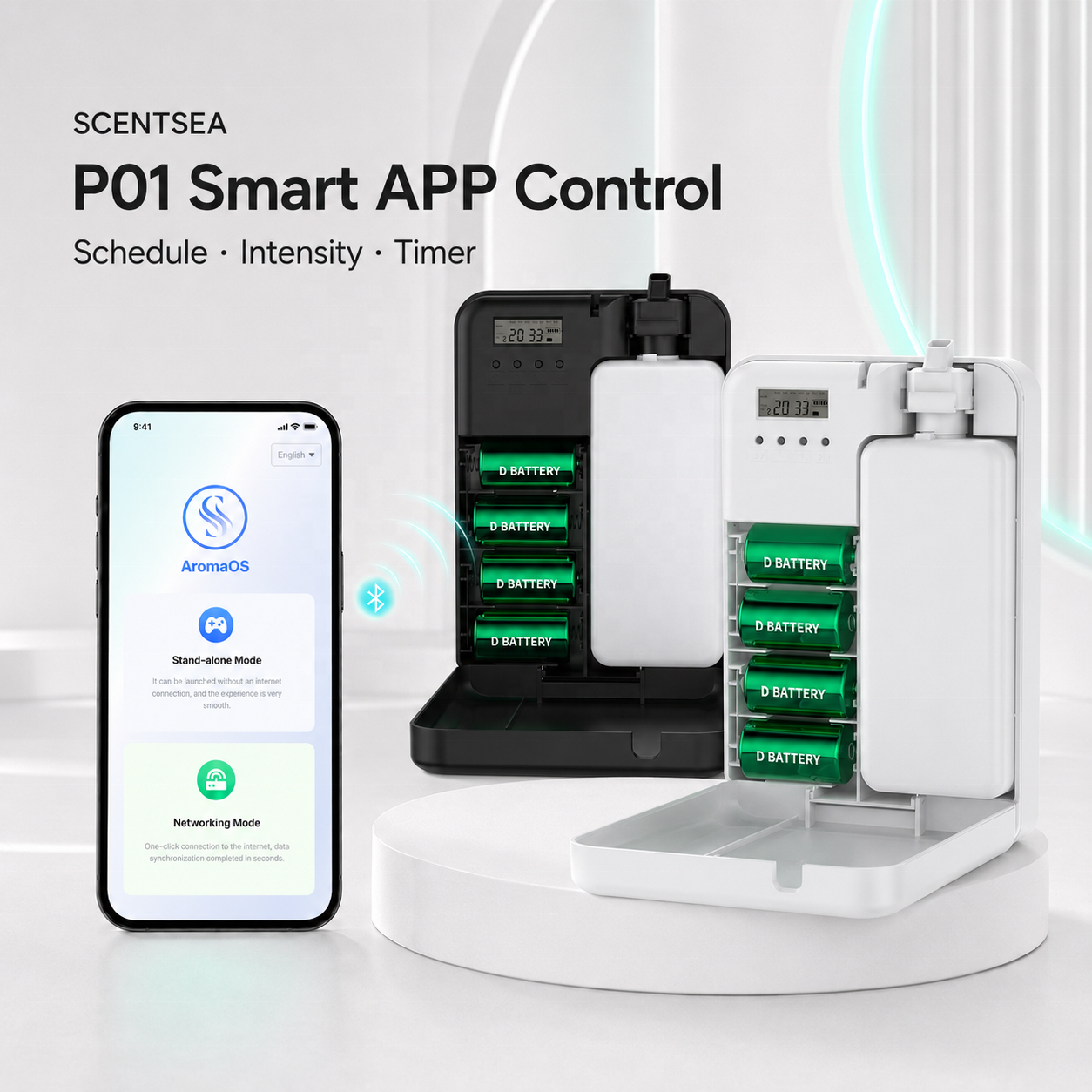
4705: 4 × D batteries or 5 V Type-C, 2.5 W, below 35 dB, 500 mL — the configuration where battery documentation matters more than mains documentation.
5. Wireless features and radio documentation
Wireless is the single most common gap between the certificate and the product. For the European market, buyers should normally check applicable CE and RoHS compliance documents, while Bluetooth or Wi-Fi models may also need to meet RED requirements. For the US market, applicable FCC compliance should be verified. The P02 is available with Bluetooth control and with an optional Wi-Fi + Bluetooth version, so the question to ask is precise: does the documentation on file cover the radio configuration being ordered, or only the non-wireless build? A CE declaration for a wired model does not automatically extend to a wireless variant. Ask for the model-specific radio document and test report, and check that the model identifier on it matches the order.
6. Regional documentation and market entry
Regional requirements are layered, and each layer has its own owner. Electrical safety and EMC sit with the hardware declaration. Restricted substances sit with the material declaration. Radio sits with the wireless module. Fragrance documentation sits with the oil supplier. Trade classification and duty sit with the commercial invoice and customs file. A buyer who collects only one of these layers will usually discover the gap at the port, at the tender clarification stage, or during a site audit — all of which are more expensive moments than a document request.
Step-by-Step Breakdown: A Seven-Step Document Verification Workflow
Run the same seven steps for every model and every configuration. The sequence matters: each step narrows the scope before the next one is checked.
- Request documents per model, not per catalogue. Ask for the file set against the model code, capacity and voltage you intend to order, and state the destination market in the request. A supplier who answers with a catalogue page has not answered the question.
- Match the model identifiers exactly. Confirm that the model code, rated voltage, power consumption and oil capacity on the document match the specification you were quoted — for example DC 12 V, 20 W and 1000 mL for the H5000, or DC 12 V, 6.5 W and 300 mL for the P02.
- Match the configuration. Plug type, wireless build, HVAC connector and tube, logo and packaging are all customization points, and every one of them can move the product outside the scope of an existing document.
- Read inside the certificate. Check the standards listed, the testing laboratory, the issue date, and the exact product description. An expired or family-level document is a finding, not a formality.
- Verify the sample against the document. Run the unit, listen to it, measure the input, test the app control, and confirm the label matches the file. SCENTSEA diffuser samples and fragrance oil samples are available for this step, and diffuser MOQ starts from 1 piece, so verification is not gated behind a bulk commitment.
- Check production evidence. Pre-shipment control is where documentation becomes credible. SCENTSEA's process covers 100% functional testing, atomization testing, leakage inspection, noise testing, app control testing, a 48-hour aging test and final appearance inspection. Ask for the record of these tests, not just the existence of a procedure.
- Confirm the pre-shipment document pack and classification. Agree the final file list — declaration, test report, material statement, radio document where applicable, fragrance documentation where applicable, packing list and HS classification under 8509.80 — before the order is released for production.

Measurement equipment used during inspection — the evidence behind a specification is more useful than the specification alone.
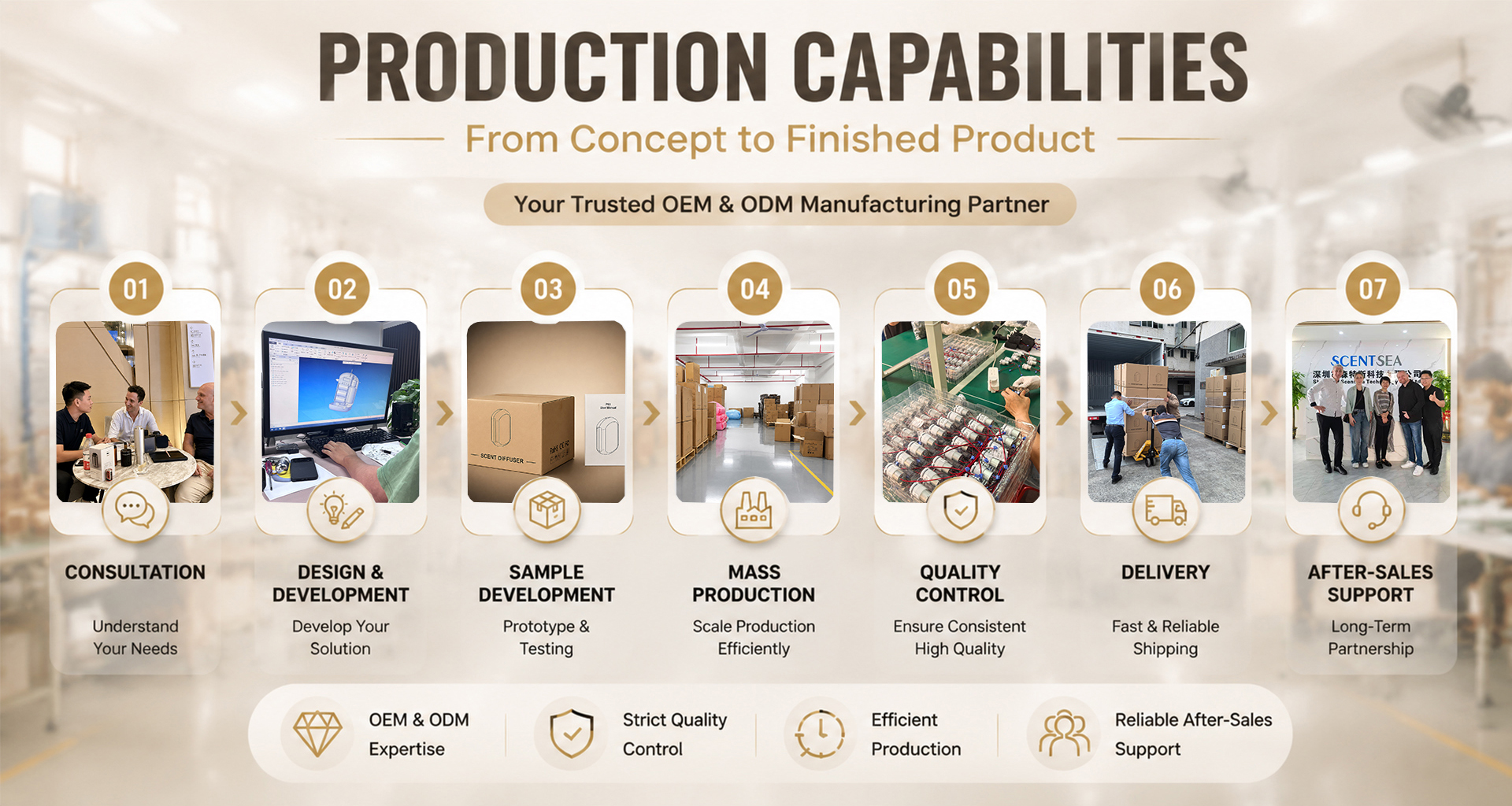
Production flow: document scope should follow the same route as the product, from build configuration to final inspection.
Use Cases: Applying the Framework by Project Type
Hotel lobbies and reception halls
A hotel lobby is a specification-heavy, guest-facing environment where noise and finish are both visible and audible. The H5000 is built for this profile: floor-standing aluminum housing, 800–1300 m² rated coverage, 1000 mL capacity, DC 12 V at 20 W, below 45 dB, 6.4 kg net weight, no wall installation required. The compliance work is to confirm that the delivered unit matches the documented unit, that the adapter is in scope, and that the noise figure is supported by a test record that can be shown to a design team or a brand standard reviewer.
Retail stores and multi-site rollouts
Multi-site retail is a documentation-consistency problem more than a hardware problem. The P02 covers 150–350 m² on 300 mL at 6.5 W and below 30 dB, mounted on a wall, with Bluetooth control as standard and an optional Wi-Fi + Bluetooth version for remote management. When the same model is deployed across several sites in the same market, insist on one document set per configuration and store it centrally — otherwise each site receives a slightly different file and the rollout cannot be audited as a whole.
Washrooms, corridors and elevators
These are the spaces where wiring is hardest, which is why the 4705 exists in the range: 4 × D batteries or Type-C at 5 V and 2.5 W, 500 mL, 100–150 m² coverage, below 35 dB, with a cordless wall-mountable design. Here the compliance questions are battery configuration, lockable front cover for commercial environments, and whether the unit is described correctly for transport and receiving. Electrical documentation is not the lead item; battery handling is.
Offices, banks and HVAC-integrated spaces
Where scent is delivered through ductwork, the installation itself becomes part of the approval chain. The P02 offers an optional connector and tube for HVAC integration, which means the mechanical interface, the connection point and the commissioning record all need to be documented alongside the electrical file. A diffuser that is compliant as a standalone wall unit is not automatically approved as a duct-connected device; the integrator and the facility owner will want the installation documentation as well as the product declaration.
Selecting a commercial scenting system manufacturer for hotels
Hotel groups usually evaluate the manufacturer as much as the model. Useful evidence to request: production capacity, quality-control records, warranty terms and spare parts support. SCENTSEA operates a 3,000 m² facility with a monthly capacity of 8,000 units, provides a 1-year free warranty on spare parts, and offers OEM/ODM customization across logo, product color, packaging, user manual, plug type, app interface and PCB functions — each of which should trigger a documentation check when it changes the delivered configuration.
Comparison Table: Three Compliance Profiles
The table below uses only the published specifications of the three reference models. It is not a ranking; the correct model depends on the space, the power available and the documentation the project requires.
| Attribute | H5000 | P02 | 4705 |
|---|---|---|---|
| Product type | Floor-standing scent diffuser | Electric (plug-in) scent diffuser | Battery-operated scent diffuser |
| Housing material | Aluminum | Plastic | Plastic |
| Power input | DC 12 V, plug-in | DC 12 V, plug-in | 5 V, 4 × D batteries or Type-C |
| Power consumption | 20 W | 6.5 W | 2.5 W |
| Noise | Below 45 dB | Below 30 dB | Below 35 dB |
| Oil capacity | 1000 mL | 300 mL | 500 mL |
| Rated coverage | 800–1300 m² | 150–350 m² | 100–150 m² |
| Oil consumption | 5.4 ±10% mL/h | 2.5 ±10% mL/h | Not listed |
| Installation | Freestanding, no wall work | Compact wall-mounted | Cordless, wall-mountable |
| Wireless control | App control for schedules and intensity | Bluetooth app control; optional Wi-Fi + Bluetooth | App control for schedules and intensity |
| HVAC connection | Not listed for this model — confirm with supplier | Optional connector and tube | Not listed for this model — confirm with supplier |
| Net weight | 6.4 kg | 0.8 kg | 0.55 kg |
| Primary documentation focus | Electrical input, adapter scope, noise record, aluminum material declaration | Electrical input, radio document for wireless build, HVAC installation record | Battery configuration, transport description, lockable housing |
Evidence Table: Turning Brochure Claims into Files
The second table converts common marketing statements into the specific evidence a buyer should hold before releasing an order.
| Claim you will see | What to request | Why it matters |
|---|---|---|
| CE certified | EU declaration of conformity naming the exact model, plus the supporting test report | A mark alone does not identify the model, the configuration or the standards applied |
| RoHS compliant | Restricted-substance declaration or test report covering the housing and PCB materials | Aluminum and plastic housings have different material chains and different suppliers |
| FCC compliant | FCC documentation naming the model, plus separate radio documentation for Wi-Fi or Bluetooth builds | Wireless variants are not automatically covered by a wired model's file |
| Below 30 / 35 / 45 dB | Noise test data with measurement distance, mode and intensity | Without conditions the figure cannot be compared or defended |
| Battery operation (5 V, 4 × D or Type-C) | Statement of whether batteries ship installed, plus battery documentation | Affects receiving, storage and installation planning |
| HVAC connector and tube available | Installation documentation for the duct connection | Mechanical integration needs its own approval, separate from the product declaration |
| 1000 mL / 500 mL / 300 mL capacity | Capacity confirmed in the manual and specification sheet | Refill cadence and consumable contracts are planned from this number |
| Suitable fragrance oil required | Fragrance-level documentation for the specific oil supplied | Hardware certification does not extend to the consumable |
FAQ
Which certifications should I verify before ordering commercial scenting hardware for the EU or the US?
Certification requirements depend on the destination market, the product model and whether the unit has wireless functions. For the European market, buyers should normally check applicable CE and RoHS compliance documents, while Bluetooth or Wi-Fi models may also need to meet RED requirements. For the US market, applicable FCC compliance should be verified. The critical step is confirming that the certificates and test reports apply to the exact production model and configuration being purchased, not to a family name or a superseded version. SCENTSEA's diffuser models are certified with CE, RoHS and FCC.
How do I verify that a commercial scenting system manufacturer is suitable for hotel projects?
Check three things against each other: product data, production evidence and post-sale terms. On product data, confirm the model suits the space — the H5000 covers a rated 800–1300 m² with a 1000 mL bottle, aluminum housing and below 45 dB operation, which fits large lobbies and reception halls. On production evidence, ask for quality-control records covering functional testing, leakage inspection, noise testing and aging. On post-sale terms, confirm warranty and spare parts support, lead time and capacity. SCENTSEA works to a 25–35 day lead time, a monthly capacity of 8,000 units and a 1-year free warranty on spare parts.
Does certification and classification work affect project cost and timing?
It affects both, in ways that are usually predictable if they are planned. Commercial scent diffusers are classified under HS Code 8509.80, with a 4.2% US import duty recorded in USITC-based trade data, so classification should be confirmed early rather than at the port. Configuration changes also carry documentation consequences: a different plug type, a wireless build, custom packaging or a custom app interface are all supported under OEM/ODM, but each one can require its own document review. Diffuser MOQ starts from 1 piece, so a single verification unit does not require a volume commitment.
Can I get samples before committing to a project specification?
Yes. SCENTSEA provides diffuser samples and fragrance oil samples for quality verification, and the diffuser MOQ starts from 1 piece. Use the sample for the checks that documents cannot answer: listen for noise in a quiet room, measure the actual input against the rated DC 12 V or 5 V specification, test the app control and its scheduling behaviour, and confirm that the label on the unit matches the model code on the certificate. For a battery unit such as the 4705, also confirm the battery configuration on the sample before specifying it into a project.
What lead time applies to an OEM commercial scenting order, and what is the next step?
Standard OEM/ODM orders run on a 25–35 day lead time against a monthly capacity of 8,000 units, with customization available for logo, product color, packaging, user manual, plug type, app interface and PCB functions. The practical next step is to send the destination market, the space type and the preferred model configuration, and request the model-level document set together with the sample. The SCENTSEA catalogue is available for download here: SCENTSEA product catalogue (PDF).
Conclusion
Compliance in commercial scenting is a matching exercise. The electrical input on the declaration must match the input on the unit, the noise figure must match a test record, the material statement must match the housing, the battery configuration must match the shipment, the radio document must match the wireless build, and the regional file set must match the destination market. The H5000, the P02 and the 4705 are useful references precisely because they fail in different ways if this discipline is skipped: an adapter that is out of scope, a wireless module added after certification, or a battery configuration that nobody declared.
Run the seven-step workflow before the purchase order, keep one document set per configuration, and treat the fragrance file as a separate deliverable from the hardware file. That sequence will not make a non-compliant product compliant, but it reliably prevents a compliant product from being rejected because the paperwork could not keep up with it.
Need model-level documentation before specifying a project? SCENTSEA supplies commercial scenting hardware for hotels, retail stores, offices, banks and HVAC-integrated spaces, with CE, RoHS and FCC certification on diffuser models and support for OEM/ODM customization. Request the catalogue, the document set for your destination market, or a sample for verification.
Email: jimmy@scent-sea.com | WhatsApp / Tel: +86 19928719703 | Website: www.scent-sea.com
Shenzhen Scentsea Technology Co., Ltd — Block A, Jinxing Building, Longhua District, Shenzhen, China. Diffuser samples and fragrance oil samples available; MOQ from 1 piece for diffusers.
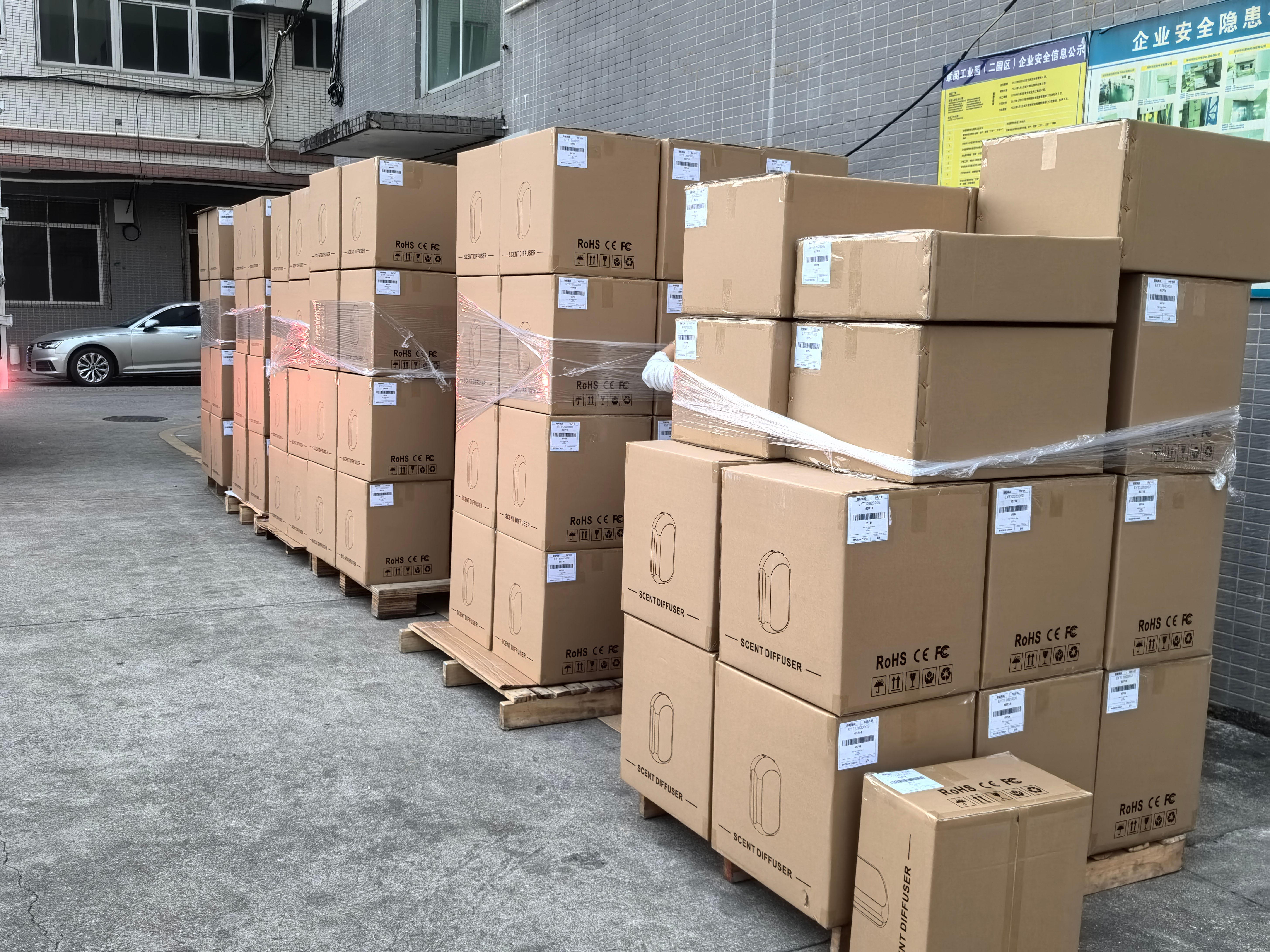
Shipment stage: the document set should be confirmed before units leave the factory, not after they arrive.
Have Questions or Need More Details?
Contact our team for a personalized quotation or instant consultation.
Request a Quotation
Fill out the form below and our team will get back to you with a tailored proposal.
WhatsApp Direct Chat
Prefer to chat in real-time? Message us on WhatsApp for instant assistance & quick answers.
- Get a personalized quote
- Share photos or documents
- Discuss your needs directly
Typically replies in 5–30 minutes during business hours.