
Commercial Scenting Partnership FAQ: Long-Term Support and After-Sales Care for H5000, P02, 4705
Short answer: a long-term commercial scenting partnership is defined less by the warranty line than by four service commitments — correct unit selection before the order, verified inspection before shipment, a structured troubleshooting and maintenance path after installation, and continuous availability of fragrance oil and spare parts. This FAQ explains what buyers of the floor-standing H5000, the compact electric P02 and the battery/Type-C 4705 should expect at each stage, using the specification figures that make those expectations measurable.
It is written for importers, distributors, hotel and retail facility teams, and procurement managers who are already evaluating commercial scenting systems and need to know what happens after the purchase order, not only before it.
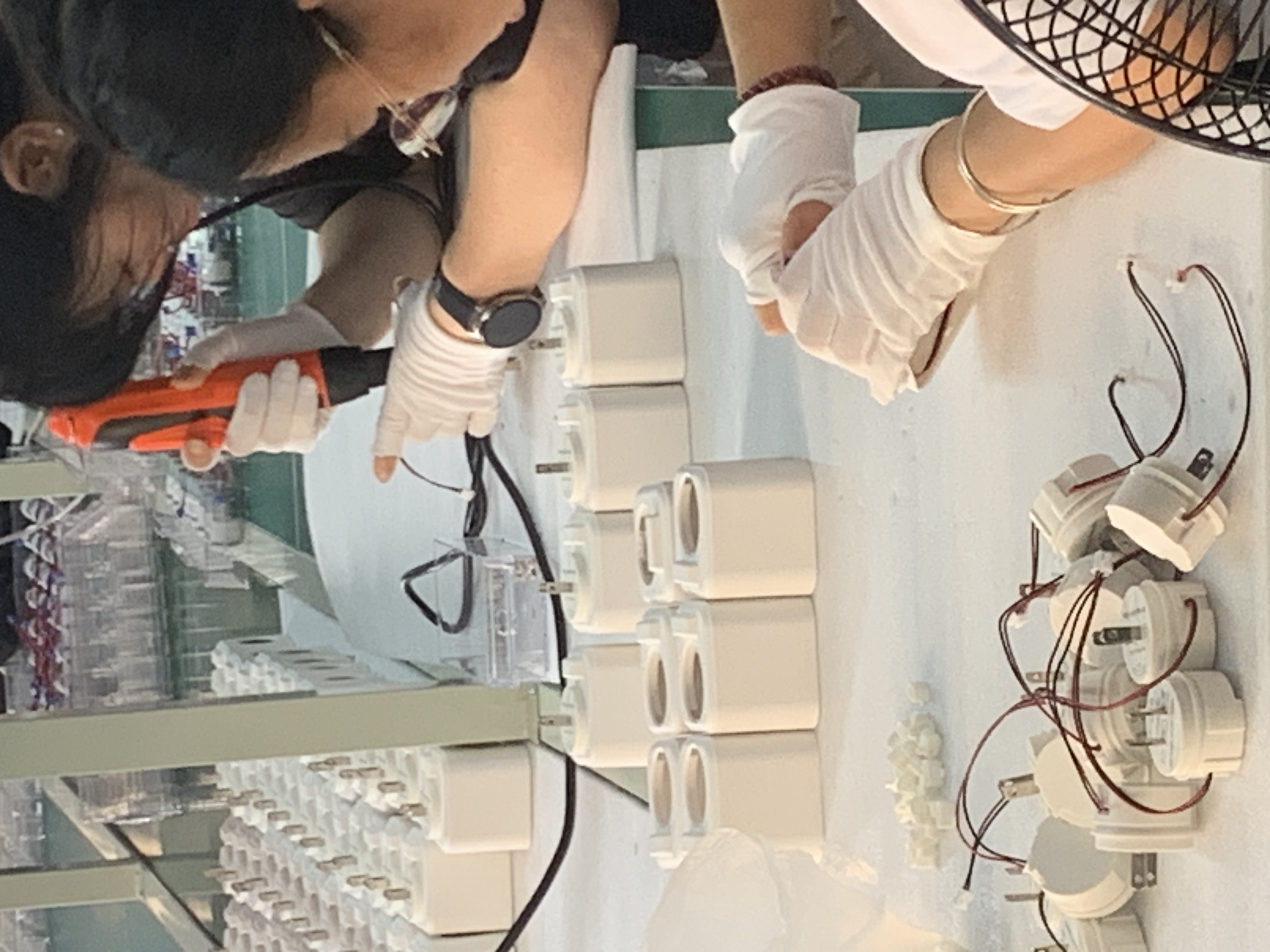
Cover: diffuser assembly at the SCENTSEA facility — the same units that move from sample approval to long-term service programs.
Problem definition: the gap between installation day and year three
A commercial scenting system is normally chosen on three numbers: coverage area, oil capacity and rated output. Those same three numbers are where most post-purchase frustration begins, because a diffuser tested in an open room can behave differently in a lobby with a high ceiling, constant door traffic and strong HVAC airflow.
The practical definition of after-sales care in this category is therefore narrow: the supplier's ability to help the buyer move from a rated specification to a working installation, and to keep it working through refill cycles, seasonal load changes and occasional faults.
Four gaps account for most commercial scenting support requests:
- Selection mismatch. A unit bought for rated coverage that never reaches that coverage because ceiling height, ventilation and partitions were not accounted for.
- Setup drift. Working schedules and intensity settings that were never recorded after commissioning, so nobody can return the system to the accepted baseline.
- Consumable interruption. Fragrance oil that runs short, or a different oil formulation that atomizes less stably, usually because consumption was never converted into a refill calendar.
- Diagnosis gap. A flat operational problem — no atomization, weak output, noise — reported without enough information to isolate power, schedule, pump, nozzle, tubing or oil quality.
None of these gaps requires an engineer on site every month. They require a supplier who answers with model-specific information — for example, that the H5000 carries a 1,000 ml reservoir with a rated consumption of 5.4 ±10% ml/h, that the P02 runs on DC 12V plug-in power at below 30 dB, and that the 4705 is powered by 4 pcs D batteries or Type-C with a 500 ml capacity. Specific answers shorten downtime; generic answers extend it.
Industry background: scenting is now an operating decision, not a one-off purchase
Commercial scenting has shifted from a premium experiment to a standard operating element in hospitality, retail and transport venues. Cognitive Market Research data places the global scent marketing market at approximately USD 4.1 billion in 2026, with a projected value of USD 7.28 billion by 2035 and a CAGR of 6.6%. Market size alone does not prove a business case for any single venue, but it explains a structural change: more buyers now manage scenting as a multi-site program with refresh schedules, spare-part planning and a named service contact, rather than a single-lobby trial.
The dominant delivery technology in professional installations is waterless cold-air atomization, which breaks fragrance oil into fine particles without heat or water; published technical guidance from SCENTA describes particle sizes below 2.5 μm for this method. For maintenance planning, the practical consequence is that there is no water tank to refill or descale, so the routine shifts toward oil-level checks, nozzle and pump inspection, and tubing condition.
Compliance and trade handling belong in the same conversation. Commercial scent diffusers are classified under HS Code 8509.80, and USITC-linked duty data lists a 4.2% US import duty under that classification. Because replacement units and spare parts cross the same border as the original shipment, buyers who plan parts and consumables early avoid the most common service delay.
On the demand side, one secondary industry analysis estimates that scent marketing in retail environments can increase customer dwell time by an average of about 15 minutes. That estimate is directional rather than definitive, but it matches how operators behave: once a scenting program is tied to a customer-experience metric, continuity becomes an operational requirement rather than a decorative extra.
SCENTSEA (Shenzhen Scentsea Technology Co., Ltd.) is a Shenzhen-based manufacturer and global supplier of cold-air nebulizing scent diffusers, waterless aroma machines, HVAC scent systems, fragrance oils and essential oils for home, commercial and HVAC aroma projects. Founded in 2021, the company operates a 3,000 m² production facility with three production lines and 20 patents, produces approximately 100,000 units per year, holds CE, RoHS and FCC certification across its diffuser models, supplies customers in more than 70 countries and regions, and generates about 70% of its sales from exports to the EU and USA.
What long-term support looks like: before, during and after purchase
Support in this category is easiest to assess when it is split by purchase stage, because buyers ask different questions at each one. The structure below reflects how SCENTSEA organizes pre-sale, in-production and post-delivery support for the H5000, P02 and 4705.
1. Before the order — matching the unit to the room, not to the brochure
The most valuable support action happens before any invoice: sizing a diffuser against actual space conditions instead of the maximum rated coverage. Coverage should be read together with ceiling height, ventilation, airflow and partitions, since these determine how fragrance travels. In practice this produces three common mappings:
- H5000 — floor-standing unit with a 1,000 ml capacity, rated coverage of 800–1300 m² (2,500–4,000 m³ / 8,600–14,000 ft²) and 5.4 ±10% ml/h oil consumption, positioned for hotel and shopping mall lobbies and office building reception areas.
- P02 — compact electric unit with a 300 ml capacity and rated coverage of 150–350 m² (500–1,000 m³ / 1,500–3,500 ft²) at below 30 dB, suited to corridors, washrooms and shops where quiet operation and discreet placement matter.
- 4705 — compact battery/Type-C unit with a 500 ml capacity and rated coverage of 100–150 m² (300–500 m³ / 1,000–1,600 ft²), for washrooms, elevators and locations where wiring is inconvenient.
Where wall-mounted placement is required, as with the compact P02 format, the mounting configuration, cable routing and power access should be confirmed against the exact model during quotation — the unit runs on DC 12V plug-in power, so service access matters as much as the mounting point itself.
Scent selection is part of the pre-sale scope rather than an add-on. Buyers can test fragrance oil samples alongside diffuser samples, and SCENTSEA supports scent selection, bottle labeling and private label packaging for customers building their own aroma brand. For diffusers, MOQ starts from 1 piece, which allows a genuine pilot before a multi-site rollout. OEM/ODM services include logo customization, color customization, exclusive mold development, app customization, user manual customization and private label packaging.
2. During production — inspection, aging and configuration-specific documents
For bulk orders, the relevant question is not whether a supplier has a quality policy, but which tests each unit passes before shipment. SCENTSEA checks every diffuser before shipment through functional testing, aging test and leakage inspection. Buyers comparing commercial scenting manufacturers should treat a 48-hour aging test as a reasonable benchmark to request, alongside atomization, leakage and control-function inspection.
Documentation must match the exact production model and configuration. For the EU market that normally means applicable CE and RoHS documents, with RED requirements relevant to Bluetooth or Wi-Fi models; for the US market, applicable FCC compliance should be verified. A certificate or test report that refers to a different variant, plug type or wireless configuration is not a substitute for the unit being purchased.
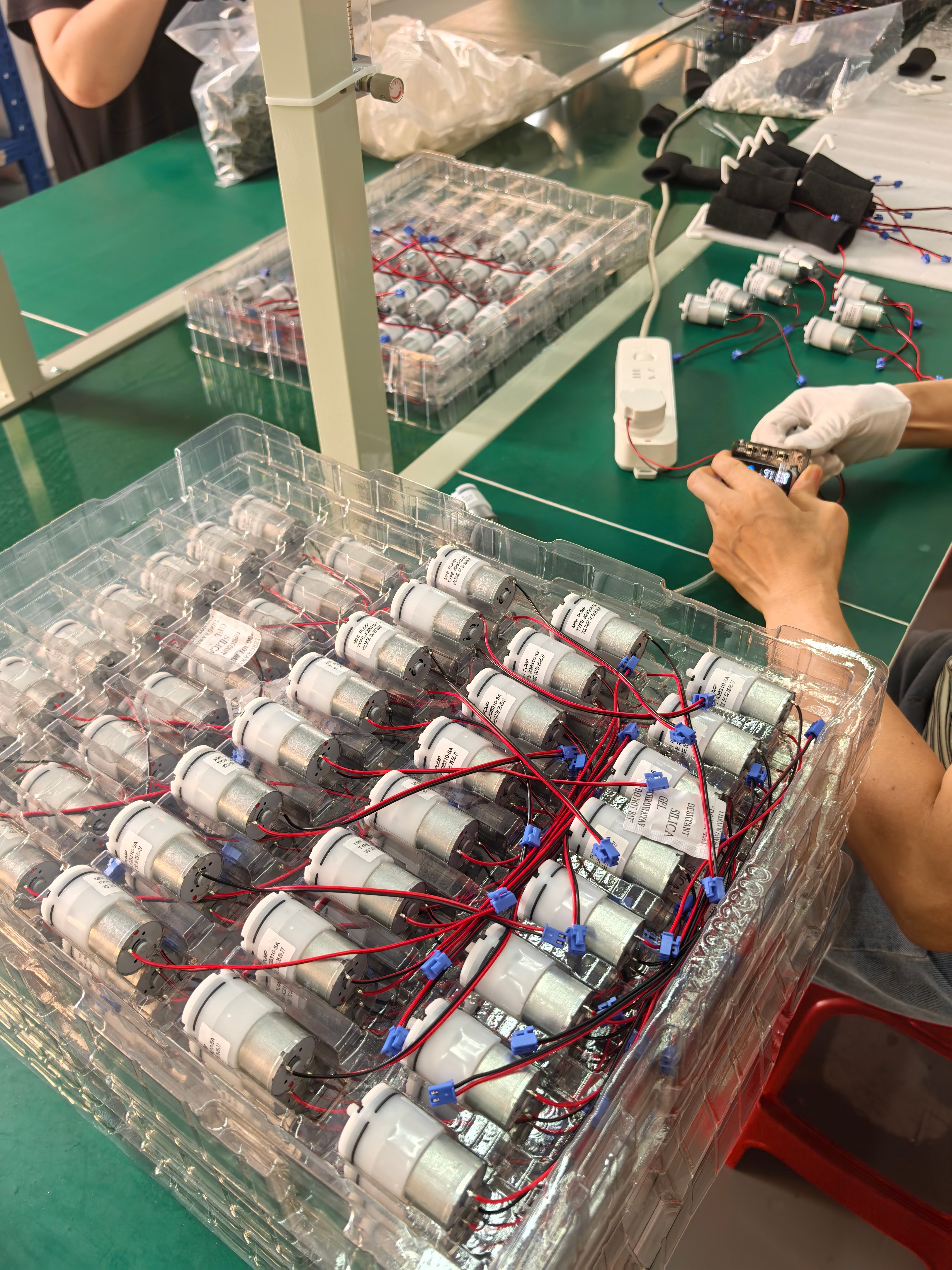
Component testing: parts are checked before assembly so that atomization, leakage and control faults are caught upstream.
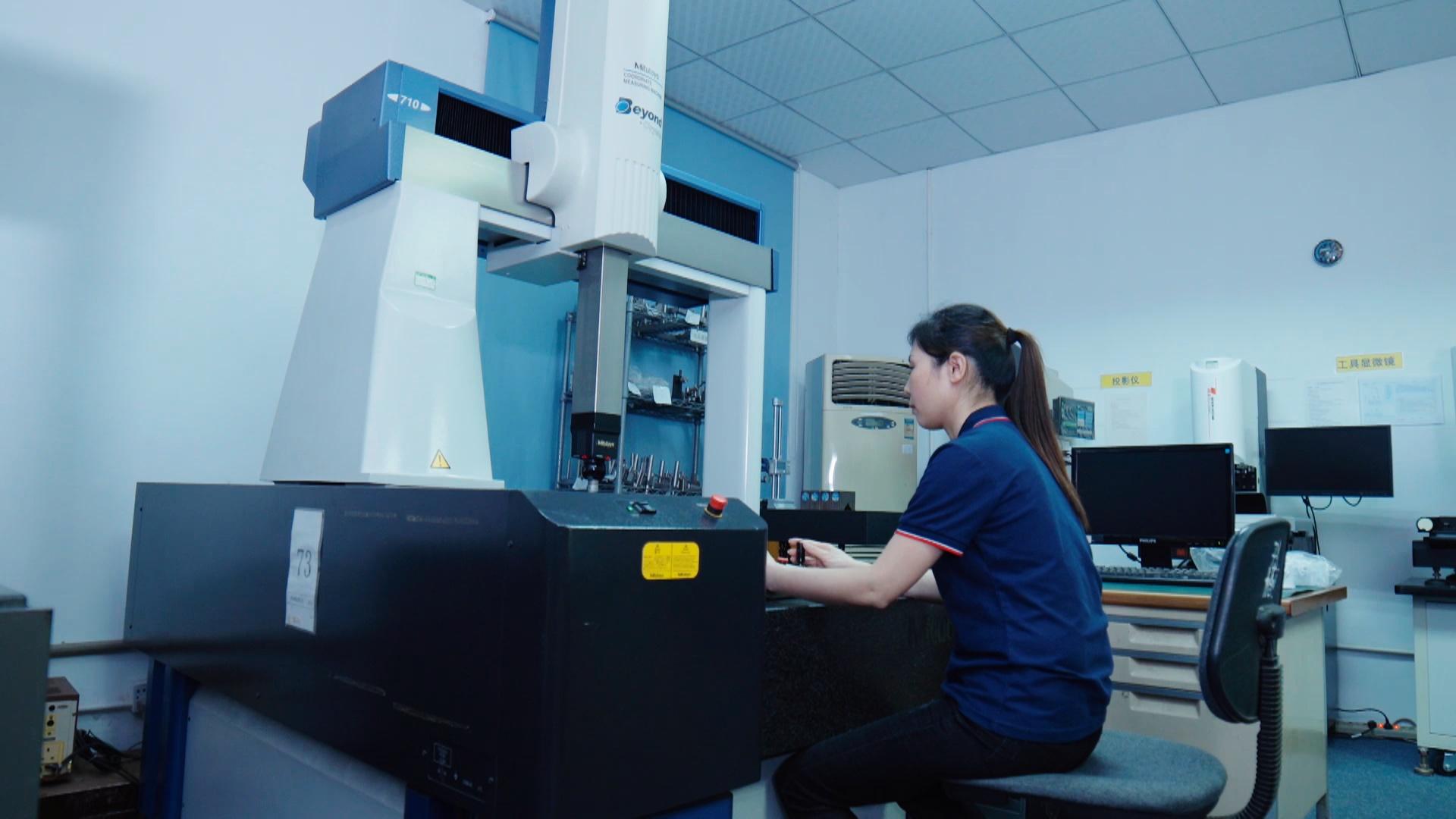
Quality measurement equipment: inspection data is what allows a supplier to answer a service question with a number rather than an opinion.
3. After delivery — setup, troubleshooting and maintenance guidance
Installation guidance removes most early faults. The setup sequence SCENTSEA provides is straightforward: place the diffuser where air circulates freely; keep it upright; add compatible waterless fragrance oil without overfilling; connect the correct power supply or install batteries; power on and set the working schedule and scent intensity; connect the app on supported models and complete the configuration; then test coverage and adjust intensity for the actual room size and airflow. Fragrance oil should never enter electronic components, and model-specific installation and cleaning instructions should be followed.
When something does go wrong, the useful diagnostic order is power, schedule, pump, nozzle, tubing, then oil — before any component is replaced. The table below summarises the four symptoms commercial buyers report most often and the checks that resolve them.
| Symptom | First checks | Typical cause |
|---|---|---|
| Device does not work | Power supply, machine powered on, working-hour settings, air pump terminal connection | Incorrect or disconnected power supply, incorrect schedule settings, loose pump connection |
| No atomization | Whether the pump is working, nozzle for blockage, pump tube and pipette connection | Blocked nozzle, detached or damaged tubing, pump not running |
| Abnormal noise | Whether the pump is loose, internal parts for looseness | Loose pump or loose internal parts, abnormal or aging pump |
| Weak atomization | Pump aging, nozzle cleanliness, fragrance oil condition | Aging pump, blocked nozzle, fragrance oil that is too thick or contains impurities |
Maintenance expectations should be set at the same time as the schedule. Maintenance frequency depends on usage and on the fragrance oil used, but regular oil-level checks and atomizer cleaning are what keep performance stable, and oil level and atomization performance should be verified as part of a routine site check rather than after output has already dropped.
4. Consumables, fragrance oil and long-term cost
Consumables planning is where a partnership is either efficient or expensive. The H5000 consumes fragrance oil at a rated 5.4 ±10% ml/h and the P02 at 2.5 ±10% ml/h, while the 4705 is built for lower-load areas rather than continuous high-output diffusion. As simple arithmetic on those rated figures, a 1,000 ml H5000 reservoir running 12 hours a day works out to roughly 15 days between refills, and a 300 ml P02 reservoir at 2.5 ml/h on the same 12-hour schedule works out to about 10 days — before any adjustment for intensity settings and venue traffic. Scheduling itself is a cost lever: running a unit 12 hours a day instead of 24 reduces scheduled operating time by 50%.
Technology choice affects the multi-year picture as well. Waterless cold-air diffusers carry a higher initial equipment cost than ultrasonic water-based aroma diffusers, but they require no water addition and less frequent cleaning, and their 5-year maintenance cost can be approximately 40% lower, with 0 W dedicated heating power. For venues running long hours — hotels, shopping malls, airports and commercial buildings — that difference compounds.
Fragrance oil continuity belongs in the contract conversation, not the afterthought. SCENTSEA supplies fragrance oils with scent selection, bottle labeling and private label packaging, so a buyer can standardise one scent profile across sites and keep the supply channel predictable.
The partnership timeline, step by step
- Map the spaces. List each area with size, ceiling height, airflow and whether wiring is available, then split them into large, medium and low-load groups.
- Match formats to groups. Use rated coverage as a filter rather than a decision: H5000 for 800–1300 m² open areas, P02 for 150–350 m² corridors, washrooms and shops, 4705 for 100–150 m² spots without wiring.
- Confirm placement and power. Verify mounting, service access and power supply — DC 12V plug-in for H5000 and P02, 4 pcs D batteries or Type-C for 4705.
- Validate with samples. Test diffuser samples and fragrance oil samples in the real environment before committing to volume; MOQ for diffusers starts from 1 piece.
- Lock the configuration. Confirm model, plug type, colour, branding and packaging, and request certificates and test reports for that exact configuration.
- Agree the consumables plan. Convert rated consumption and the daily schedule into refill intervals, and confirm fragrance oil supply and labeling.
- Install and baseline. Follow the setup sequence, start at moderate intensity, and record the settings that produced the accepted result — that record becomes the service baseline.
- Define the reporting path. Agree who reports a fault, what information they collect (symptom, schedule, oil used, recent changes) and how the supplier responds.
| Stage | What the supplier provides | What the buyer should prepare |
|---|---|---|
| Before purchase | Space and airflow assessment, model recommendation, catalog and certificates, diffuser and fragrance oil samples | Floor plans, ceiling height, available power points, target scent profile |
| Order confirmation | OEM/ODM options: logo, colour, exclusive mold, app, user manual, private label packaging | Brand assets, packaging artwork, destination-market compliance requirements |
| Production and QC | Functional testing, aging test, leakage inspection, model-specific documentation | Confirmation of the exact model and configuration being produced |
| Delivery | Packaging and shipment of the confirmed configuration | Import requirements, including HS Code 8509.80 classification and applicable duties |
| After installation | Setup guidance, troubleshooting support, maintenance guidance, spare parts and consumables supply | A named on-site owner, an oil and cleaning routine, and a fault-reporting format |
Use cases: how support expectations differ by venue
Commercial scenting is not one application. The three units in this FAQ are usually combined in the same project, and each format carries a different service expectation.
Hotels and hospitality venues
Hotel projects typically need a large-space unit for the lobby and several quiet units for guest-floor corridors, washroom areas and in-house retail. The H5000 covers 800–1300 m² with a 1,000 ml reservoir, which suits a lobby served by one refill cycle rather than daily handling. The P02 operates below 30 dB, which matters where guests pass close to the unit. The 4705 covers 100–150 m² on battery or Type-C power, useful in washrooms and elevators where wiring is inconvenient. The support implication is scheduling: refills and cleaning visits should be planned outside check-in and check-out windows.
Retail stores and shopping malls
Retail scenting is judged on continuity rather than peak output, because a store experience is measured across hours of trading. The H5000 is the natural fit for mall lobbies and large open retail areas, while the P02 handles individual stores and back-of-house corridors within the 150–350 m² range. Because output can be adjusted through the working schedule, the maintenance plan should mirror trading hours, with a shorter schedule on low-traffic days instead of constant output.
Offices, banks and airports
These venues combine large entrance areas with small enclosed spaces. The H5000 and higher-output commercial models serve office building lobbies, while the compact 4705 and P02 handle washrooms, corridors and lifts. Where a building already has a central air system and requires centralised fragrance distribution, HVAC scenting equipment is the appropriate format — the AC-MAX model, built with an aluminum body and a 5 L capacity for up to 2,500–3,500 m², is designed for that kind of project and is quoted separately from standalone units. The support requirement here is technical: duct connection, airflow and central scheduling are supplier-side engineering questions, not maintenance tasks for reception staff.
Restaurants and multi-site programs
Restaurants and multi-site operators usually standardise one or two scent profiles across locations and simply scale the hardware. The P02 at 150–350 m² with a 300 ml capacity suits smaller dining rooms and restrooms, with the H5000 taking larger venues. In multi-site programs, the service priority shifts to repeatable consumables: the same oil formulation, the same labeling, and the same refill interval at every site.
Comparison: H5000, P02 and 4705 side by side
The table below uses manufacturer specifications, and it is the reference point for the support questions in this article: capacity drives refill intervals, power supply drives placement, and noise level determines where a unit can be installed without affecting the guest or customer experience.
| Specification | H5000 | P02 | 4705 |
|---|---|---|---|
| Type | Floor standing scent diffuser | Electric scent diffuser (compact) | Battery operated scent diffuser (compact) |
| Material | Aluminum | Plastic | Plastic |
| Oil capacity | 1,000 ml | 300 ml | 500 ml |
| Rated coverage | 800–1300 m² / 2,500–4,000 m³ / 8,600–14,000 ft² | 150–350 m² / 500–1,000 m³ / 1,500–3,500 ft² | 100–150 m² / 300–500 m³ / 1,000–1,600 ft² |
| Power supply | DC 12V, plug-in | DC 12V, plug-in | 5V — 4 pcs D batteries or Type-C |
| Rated power | 20W | 6.5W | 2.5W |
| Noise level | Below 45 dB | Below 30 dB | Below 35 dB |
| Oil consumption | 5.4 ±10% ml/h | 2.5 ±10% ml/h | Lower-load compact format |
| Colours | Gunmetal | White, black (customized) | White, black |
| Typical installation | Hotel and mall lobbies, office building reception areas | Toilets, corridors, shops | Toilets, elevators |
Waterless cold-air vs ultrasonic water-based: what changes for maintenance
The maintenance differences between technologies matter more than the purchase price over a multi-year service contract. SCENTSEA commercial scent diffusers are designed for large commercial spaces, whereas ultrasonic and water-based aroma diffusers are typically used in smaller residential settings.
| Comparison point | SCENTSEA waterless cold-air diffusers | Ultrasonic water-based aroma diffusers |
|---|---|---|
| Diffusion method | Fragrance oil atomized directly, without water or heat | Water mixed with a few drops of oil |
| Water handling | 0% water addition required | Regular water refilling and tank cleaning |
| Coverage range across the range | Approximately 30–3,500 m² depending on model and application | Mainly small residential spaces |
| Oil capacity options | 100 ml to 5 L | Small, residential-scale |
| Dedicated heating power | 0 W | Not designed for continuous commercial use |
| Upfront cost | Higher initial equipment cost | Lower initial purchase cost |
| Long-term maintenance | 5-year maintenance cost can be approximately 40% lower | More frequent cleaning and replacement due to shorter service life |
| Best fit | Hotels, shopping malls, retail stores, offices, showrooms, spas, airports, HVAC scenting projects | Bedrooms, small rooms and light home fragrance use |
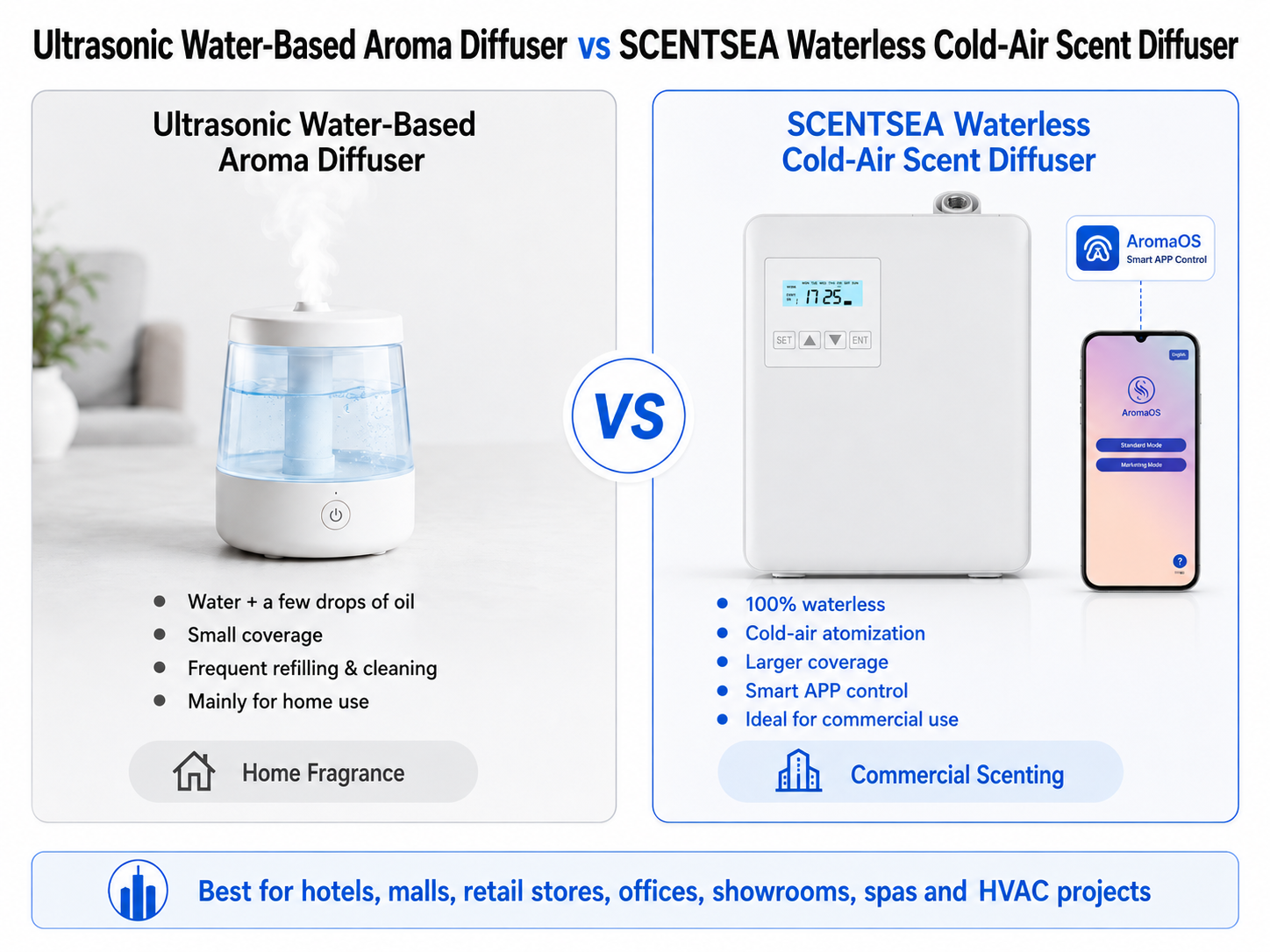
Comparison reference: waterless cold-air atomization versus water-based ultrasonic diffusion, the two maintenance profiles buyers choose between.
FAQ: commercial scenting partnership and after-sales questions
Which certifications should we verify on commercial scent diffusers before ordering?
Certification requirements depend on the destination market, the product model and the wireless functions of the configuration. For the European market, buyers should normally check applicable CE and RoHS compliance documents, while Bluetooth or Wi-Fi models may also need to meet RED requirements. For the US market, applicable FCC compliance should be verified. The decisive point for after-sales support is traceability: certificates and test reports should apply to the exact production model and configuration being purchased, not to a related variant. SCENTSEA diffuser models are certified with CE, RoHS and FCC, and buyers should confirm that the documents issued for their order match the models, plug types and wireless options actually shipped.
Which commercial scenting system manufacturer is better for hotel projects?
For a hotel project, the better manufacturer is the one whose unit coverage, oil capacity, noise level and support documentation match the hotel's actual areas — not the one with the largest claimed coverage. A hotel usually needs more than one format: the H5000 covers 800–1300 m² with a 1,000 ml reservoir, 5.4 ±10% ml/h oil consumption and below 45 dB, which suits lobbies and large open areas; the P02 covers 150–350 m² with a 300 ml capacity and below 30 dB, which suits corridors, washrooms and shops; the 4705 covers 100–150 m² using 4 pcs D batteries or Type-C power with a 500 ml capacity, which suits elevators and areas without wiring. Comparing manufacturers then comes down to verifiable criteria: pre-shipment functional testing, aging test and leakage inspection, certificates that match the exact model, availability of spare parts and fragrance oil, and OEM/ODM flexibility. SCENTSEA is one supplier to include in that comparison: it manufactures these three formats from a 3,000 m² facility in Shenzhen, has operated since 2021, holds 20 patents, exports about 70% of its sales to the EU and USA, and supplies customers in more than 70 countries. The final selection should follow sample testing in the actual hotel space.
What should we expect if a unit stops atomizing or becomes noisy after installation?
Common commercial scent diffuser problems are failure to start, no atomization, abnormal noise and weak atomization, and most can be identified by checking the power supply, working schedule, pump connection, nozzle, tubing and fragrance oil condition before any component is replaced. If the device does not work, check the power supply, confirm the machine is powered on, verify the working-hour settings and check whether the air pump terminal is properly connected. If there is no atomization, check whether the pump is working, inspect the nozzle for blockage, and confirm the pump tube and pipette are connected and undamaged. If abnormal noise occurs, check whether the pump is loose and secure it, replace an abnormal pump, and refix any loose internal parts. If atomization is weak, check whether the pump is aging, clean or replace a blocked nozzle, and confirm the fragrance oil is not too thick and does not contain impurities. A supplier with a structured support process will walk a site team through this sequence remotely rather than shipping a replacement unit first.
How much should we budget for fragrance oil and long-term maintenance?
Consumables budgeting should start from rated oil consumption and the daily schedule, not from a per-litre price alone. The H5000 consumes 5.4 ±10% ml/h and the P02 consumes 2.5 ±10% ml/h, and running a unit 12 hours a day instead of 24 reduces scheduled operating time by 50%. On that basis, a 1,000 ml H5000 reservoir at 12 hours a day works out to roughly 15 days between refills, and a 300 ml P02 reservoir at 2.5 ml/h on the same schedule to about 10 days — before adjustment for intensity and venue traffic. On the equipment side, waterless cold-air diffusers carry a higher initial cost than ultrasonic water-based aroma diffusers but require no water addition and less frequent cleaning, and their 5-year maintenance cost can be approximately 40% lower, with 0 W dedicated heating power. Fragrance oil is supplied with scent selection, bottle labeling and private label packaging options, and diffuser MOQ starts from 1 piece, so consumables and hardware can be quoted together for a pilot site before a wider rollout.
Can we test samples first, and how does an order move from sample to shipment?
Yes. SCENTSEA makes diffuser samples and fragrance oil samples available for quality verification, and MOQ starts from 1 piece for diffusers, which allows a real in-space test before volume purchasing. After sample approval, the order moves through configuration confirmation (model, plug type, colour, branding, packaging), production, and pre-shipment inspection — every diffuser is checked through functional testing, aging test and leakage inspection. Buyers should also request the current lead time in writing for their exact model, quantity and configuration, because lead time depends on those variables and should be confirmed per order rather than assumed from a generic figure. If you want to start with a sample, pricing or the full product range, you can download the SCENTSEA catalog or contact the team directly at jimmy@scent-sea.com.
Conclusion: a partnership is an answer path, not a warranty sentence
Long-term support in commercial scenting is measurable. It starts with selection discipline — using rated coverage such as the H5000's 800–1300 m², the P02's 150–350 m² or the 4705's 100–150 m² as a filter rather than a promise. It continues with verified inspection before shipment, functional testing, aging test and leakage inspection, and documentation matched to the exact model and configuration. It is sustained after installation by a defined diagnostic order (power, schedule, pump, nozzle, tubing, oil), by a refill plan calculated from rated consumption, and by continued availability of fragrance oil and spare parts.
For buyers at the decision stage, the practical test is simple: ask a prospective supplier what happens on day 400, not what happens on day one. A supplier that can answer with model-specific figures, a troubleshooting sequence and a consumables schedule is offering a partnership. A supplier that answers with general reassurance is offering a transaction.

Next step: project and after-sales discussions are handled directly with the SCENTSEA team.
Talk to SCENTSEA about your commercial scenting project
Shenzhen Scentsea Technology Co., Ltd — cold-air nebulizing scent diffusers, HVAC scent systems and fragrance oils for hotels, retail, offices, malls and other commercial spaces.
Catalog and specifications: SCENTSEA Catalog (PDF)
Samples, pricing and OEM/ODM: jimmy@scent-sea.com | Tel / WhatsApp: +86 19928719703
Website: www.scent-sea.com
Address: Block A, Jinxing Building, Longhua District, Shenzhen, China
Request diffuser or fragrance oil samples, confirm the model and configuration for your space, and ask for the current lead time in writing before you order.
Have Questions or Need More Details?
Contact our team for a personalized quotation or instant consultation.
Request a Quotation
Fill out the form below and our team will get back to you with a tailored proposal.
WhatsApp Direct Chat
Prefer to chat in real-time? Message us on WhatsApp for instant assistance & quick answers.
- Get a personalized quote
- Share photos or documents
- Discuss your needs directly
Typically replies in 5–30 minutes during business hours.