
EU and US Compliance for Scent Diffusers: RoHS, EMC, and FCC Standards
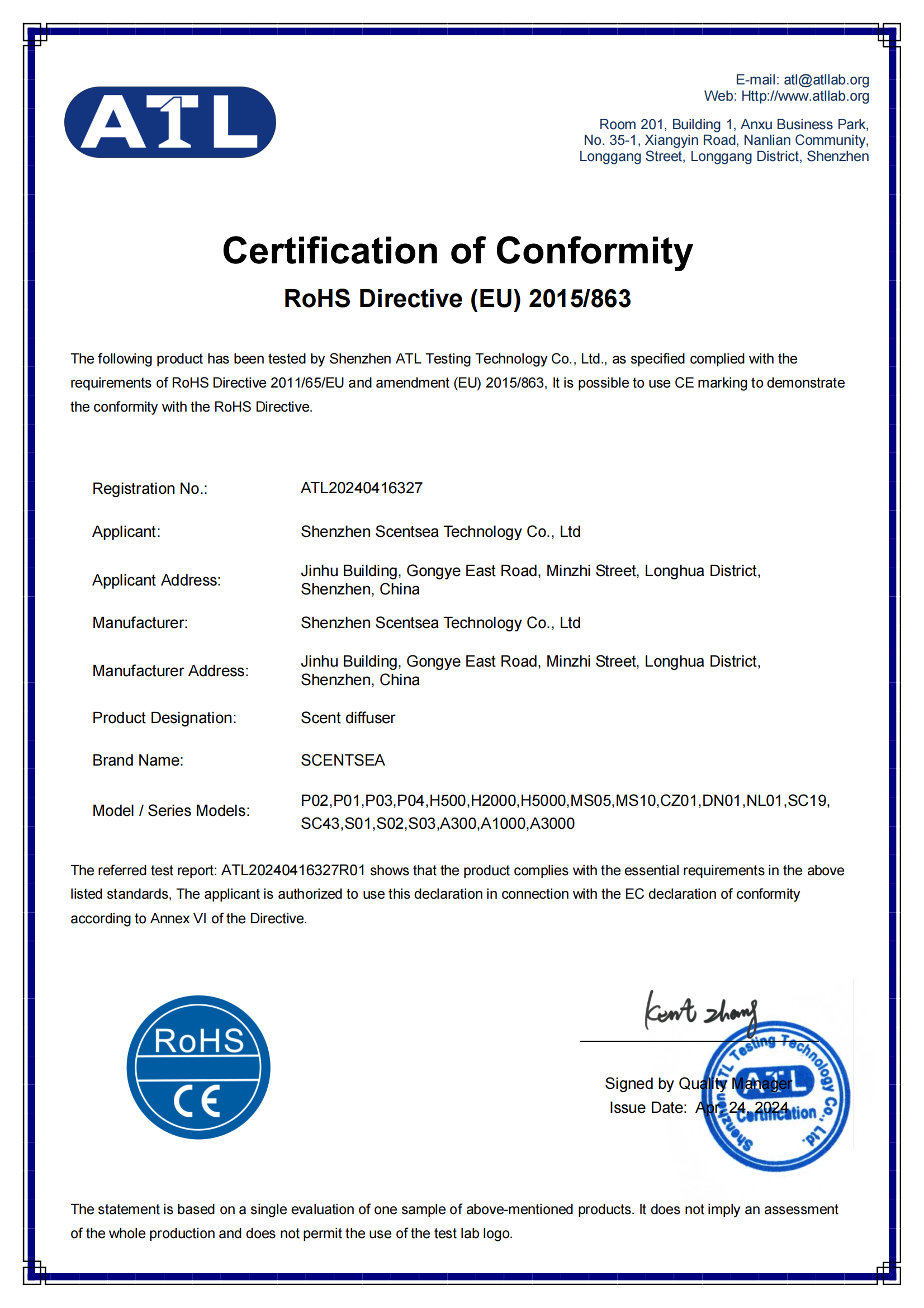
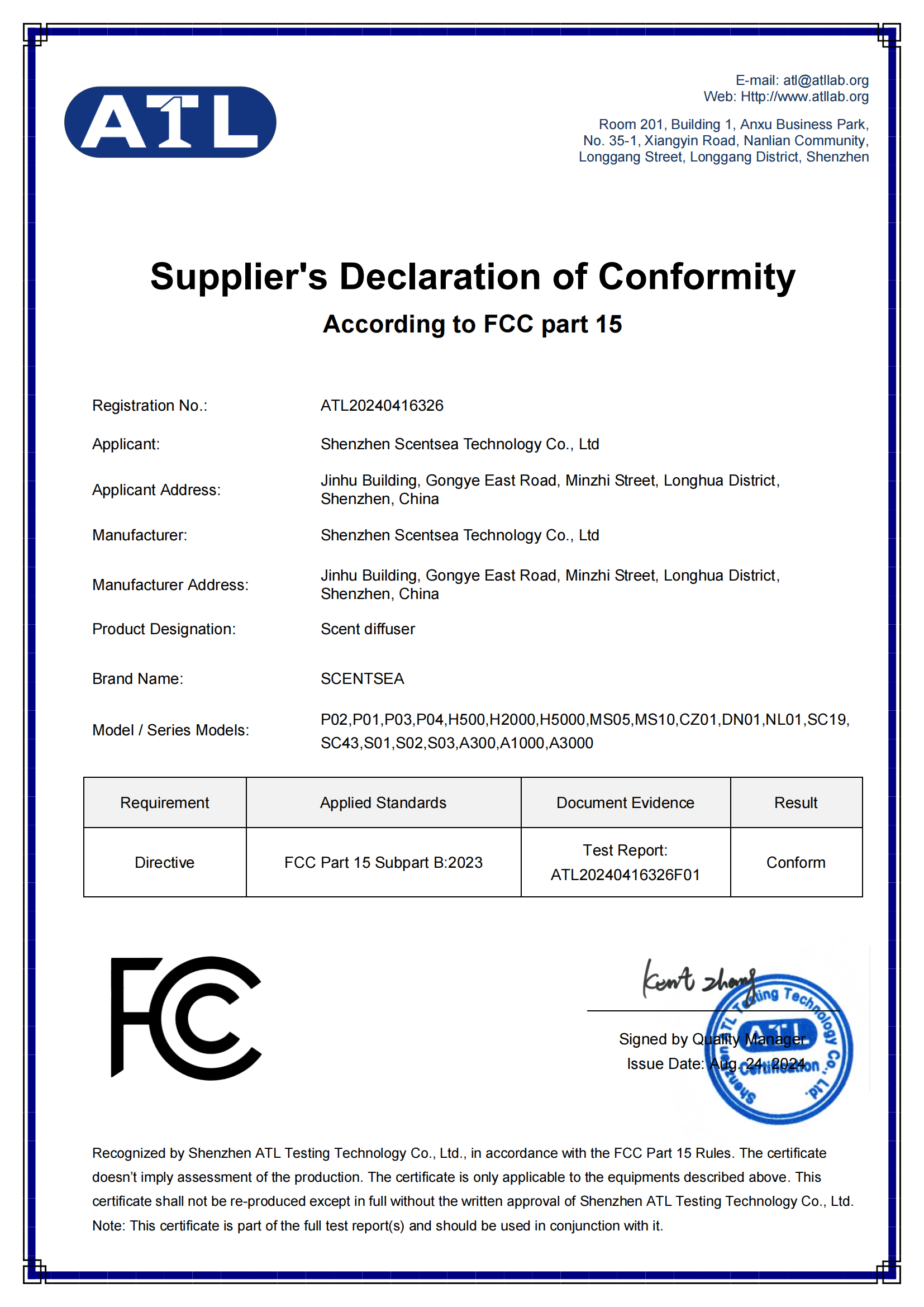
A commercial scent diffuser shipped into the European Union or the United States needs the right compliance documents before it can be installed, inspected or accepted into a project. For SCENTSEA diffusers, three documents carry that requirement: RoHS Directive (EU) 2015/863 for restricted substances, EMC testing to EN IEC 55014-1:2021 and its related EN standards, and FCC Part 15 Subpart B for the United States. Certificate ATL20240416327 covers RoHS, certificate ATL20240416325 covers EMC, and certificate ATL20240416326 covers FCC. All three were issued on 24 April 2024 by Shenzhen ATL Testing Technology Co., Ltd., and each one lists the same eleven diffuser models.
SCENTSEA is the brand of Shenzhen Scentsea Technology Co., Ltd., a manufacturer founded in 2021 and headquartered in Shenzhen, China, that produces cold-air nebulizing scent diffusers, waterless aroma machines, HVAC scent systems and fragrance oils for residential and commercial spaces. This guide is written for procurement teams, facility managers and scent marketing companies that have to file compliance documentation before a diffuser goes into a hotel lobby, a shopping mall, an elevator or an HVAC system. It sets out what each standard covers, which models sit inside each certificate, and which checks to complete before a purchase order is released.
Why a compliance file decides whether a diffuser can be installed
The most common compliance failure is not a missing certificate. It is a certificate that does not match the unit being installed. Project folders regularly contain a general CE claim with no test report behind it, a test report issued for a different model, or a document that quotes a standard version that has since been superseded.
Certification requirements depend on three variables: the destination market, the product model, and whether the unit has wireless functions. A buyer should always confirm that the certificates and test reports on file apply to the exact production model being purchased, not to a product family as a whole.
That distinction shows up at three moments in a project:
- Design and tender stage. The compliance document set is requested as part of the technical submission, and an incomplete file can remove a model from consideration before price is discussed.
- Installation and handover. A hotel engineering team, mall facility operator or building inspector can ask for evidence that the units actually installed are covered by the documentation supplied.
- Customs and import clearance. The declared product description, the certificate scope and the tariff classification have to be consistent with each other. Fragrance diffusers and prepared room deodorizers are commonly categorised under HS code 33074900.
For SCENTSEA, the answer to all three is one document set: three certificates issued on the same date by the same testing organisation, covering the same model list.
The regulatory basis: what RoHS, EMC and FCC each control
In the European Union, a diffuser placed on the market is subject to substance restrictions and to electromagnetic compatibility requirements. In the United States, the applicable electronics requirement for this product category is the FCC radio-frequency framework for unintentional radiators. Each rule targets a different physical property of the product, which is why one certificate cannot substitute for another.
The commercial context explains why this documentation carries weight in North America and Europe. North America held the largest regional share of global fragrance diffuser revenue in 2024 at approximately 43.87%, according to Data Bridge Market Research. Waterless cold-air nebulizing diffusers, the category SCENTSEA manufactures, represented approximately 22.6% of segment share in 2024 and are favoured for professional-grade scent potency in commercial environments, according to the Ambient Scent Diffuser Market Research Report 2034.
RoHS Directive (EU) 2015/863 — restricted substances in the hardware
RoHS restricts the use of hazardous substances in electrical and electronic equipment placed on the EU market. In a scent diffuser, the relevant material risks sit in the PCB assembly, solder, wiring, plastic housing, metal casing and surface coatings. The SCENTSEA RoHS certificate ATL20240416327 records the market as EU, the scope as scent diffuser, and the standard as RoHS Directive (EU) 2015/863, issued on 24 April 2024 by Shenzhen ATL Testing Technology Co., Ltd.
EMC — EN IEC 55014-1:2021 and the related EN standards
Electromagnetic compatibility documentation covers two directions of interference: what the product emits, and how it behaves when external interference is present. Certificate ATL20240416325 lists four standards:
- EN IEC 55014-1:2021 — emission requirements, limiting the disturbance the diffuser pump and control electronics can inject into the mains supply and the surrounding environment.
- EN IEC 55014-2:2021 — immunity requirements, covering how the unit continues to operate in the presence of external electromagnetic disturbance.
- EN IEC 61000-3-2:2019/A1:2021 — harmonic current emissions.
- EN 61000-3-3:2013/A2:2021 — voltage changes, fluctuations and flicker.
For a hotel or shopping mall, the practical value runs in both directions. The diffuser should not disturb other building systems sharing the same supply, and it should keep running predictably in an electrically busy environment. Emission and immunity are part of the same EU market requirement, which is why buyers should read them together rather than treat EMC as a single line item on a supplier quotation.

FCC Part 15 Subpart B:2023 — the US unintentional radiator requirement
Part 15 Subpart B is the section of the FCC rules that applies to unintentional radiators: devices that generate radio-frequency energy internally through switching circuits, motors or digital control boards but are not intended to transmit. Certificate ATL20240416326 records the market as USA, the scope as scent diffuser, and the standard as FCC Part 15 Subpart B:2023, issued on 24 April 2024 by Shenzhen ATL Testing Technology Co., Ltd. For US projects, this is the document a facility or compliance reviewer looks for first when a diffuser is specified for a hotel, mall, bank or office building.
Adjacent requirements that arrive in the same folder
Three further items usually accompany the certificates:
- Radio equipment requirements for wireless configurations. If a model ships with Bluetooth or Wi-Fi functionality, the applicable radio equipment requirements for that configuration should be identified in the compliance file rather than assumed from a wired variant.
- Fragrance oil documentation. IFRA 51 (2023), published by the International Fragrance Association, introduced stricter global safety standards for fragrance ingredients used in diffusers, affecting allowable usage levels for inhalation safety. Oil documentation should be requested together with the diffuser file.
- The consolidated certification statement. SCENTSEA states that all diffuser models are certified with CE, RoHS and FCC, which is the summary line that sits above the individual certificates.
Certificate scope: which standards apply to which SCENTSEA models
Three certificates, one issue date, one testing organisation. The table below is the summary a buyer can place directly into a compliance folder.
| Certificate | Standard | Market | Certificate no. | Issuer | Issue date |
|---|---|---|---|---|---|
| RoHS | RoHS Directive (EU) 2015/863 | EU | ATL20240416327 | Shenzhen ATL Testing Technology Co., Ltd. | 24 April 2024 |
| EMC | EN IEC 55014-1:2021; EN IEC 55014-2:2021; EN IEC 61000-3-2:2019/A1:2021; EN 61000-3-3:2013/A2:2021 | EU | ATL20240416325 | Shenzhen ATL Testing Technology Co., Ltd. | 24 April 2024 |
| FCC | FCC Part 15 Subpart B:2023 | USA | ATL20240416326 | Shenzhen ATL Testing Technology Co., Ltd. | 24 April 2024 |
Each certificate uses scent diffuser as its scope statement and lists the same eleven models. That means a project combining a battery-operated washroom unit with a floor standing lobby machine is documented from one certificate set rather than separate files per product.
| Model | Product type | Power configuration | EU: RoHS + EMC | US: FCC |
|---|---|---|---|---|
| S01 | Wall plug-in scent diffuser | 110–240 V, 1.5 W | Listed | Listed |
| S02 | Tower scent diffuser | DC 5 V, 1.5 W | Listed | Listed |
| P01 | Battery operated scent diffuser | 4 pcs D batteries or Type C, 5 V, 2.5 W | Listed | Listed |
| P02 | Electric scent diffuser | DC 12 V, 6.5 W | Listed | Listed |
| P03 | Battery operated scent diffuser | 3 pcs D batteries or Type C, 5 V, 2.5 W | Listed | Listed |
| A300 | Commercial scent diffuser | DC 12 V, 12 W | Listed | Listed |
| T2 | Commercial scent diffuser | DC 12 V 2 A, 10 W | Listed | Listed |
| T3 | Commercial scent diffuser | DC 12 V 2 A, 15 W | Listed | Listed |
| H5000 | Floor standing scent diffuser | DC 12 V, 20 W | Listed | Listed |
| AC-MAX | HVAC scent diffuser | DC 12 V, 48 W | Listed | Listed |
| SC19 | Advertising scent machine | 110–240 V AC, 30 W | Listed | Listed |
Listed means the model appears on certificate ATL20240416327 (RoHS) and ATL20240416325 (EMC) for the EU market, and on certificate ATL20240416326 (FCC) for the US market. All three certificates declare the scope scent diffuser.
Reading the model list against the power configuration
The eleven models fall into three power classes. That does not change which certificates apply to which model, but it does change the electrical characteristics that were assessed.
- Mains-powered models. S01 (wall plug-in, 110–240 V, 1.5 W) and SC19 (advertising scent machine, 110–240 V AC, 30 W) draw power directly from a mains supply.
- Low-voltage DC models. S02 and P03 at 5 V, and P02, A300, T2, T3, H5000 and AC-MAX at DC 12 V, with rated power from 1.5 W up to 48 W.
- Battery-operated models. P01 runs on 4 pcs D batteries or Type C and P03 runs on 3 pcs D batteries or Type C, both at 2.5 W.
Because the same model list appears on the RoHS, EMC and FCC certificates, a specification that mixes mains-powered, DC and battery units inside one building can be documented from a single file. Where a specific configuration introduces an additional applicable directive — for example a wireless control module — the corresponding document should be requested for that exact configuration rather than assumed from the family certificate.
Step-by-step: how to verify a scent diffuser compliance file
The following sequence is the same order procurement teams use before releasing a purchase order. It takes the certificate set apart piece by piece instead of accepting a summary claim.
- Fix the model and configuration per space first. Coverage area, ceiling height, airflow, installation method, power supply and control requirements determine the model. Compact units suit small rooms; battery-operated units suit locations where wiring is inconvenient; higher-output standalone machines suit medium and large commercial spaces; and HVAC scenting systems suit large buildings that require centralised fragrance distribution.
- Request the certificate for that exact model. Not the catalogue, not a family claim. Confirm the model code appears on the certificate itself.
- Match certificate number, issuer and issue date. For SCENTSEA: ATL20240416327 (RoHS), ATL20240416325 (EMC) and ATL20240416326 (FCC), all issued 24 April 2024 by Shenzhen ATL Testing Technology Co., Ltd.
- Verify the standard version and the declared market. The RoHS and EMC certificates declare the EU market; the FCC certificate declares the USA market. A certificate that names the right standard for the wrong destination is not evidence for your project.
- Check whether the configuration includes wireless functions. Bluetooth or Wi-Fi control changes which radio requirements apply, and the relevant document should be identified for the exact configuration being purchased.
- Ask for pre-shipment test records. The SCENTSEA quality process includes 100% functional testing, atomization testing, leakage inspection, noise testing, APP/control testing, a 48-hour aging test and a final appearance inspection before shipment.
- Confirm warranty and spare parts support. Spare parts are covered by a 1-year free warranty.
- Confirm commercial terms and acceptance criteria. MOQ starts from 1 unit, delivery terms are EXW, FOB or CIF, and the acceptance criterion is the pre-shipment test.

Where the certified models are deployed
Compliance documentation is only useful when it matches the space the unit is installed in. The certified model scope covers the following commercial scenarios.
- Hotel public areas and lobbies. The H5000 floor standing scent diffuser covers 800–1300 m² / 2500–4000 m³ with a 1000 ml capacity, 20 W and noise below 45 dB. The T3 commercial scent diffuser covers 1000–1600 m² / 3000–5000 m³ with a 1000 ml capacity at 15 W.
- Shopping malls and retail. The A300 covers 500–800 m² with a 500 ml capacity at 12 W; the T2 covers the same range at 10 W with an acrylic panel and steel casing; the SC19 advertising scent machine adds an 18.5-inch 1920×1080 display for malls, hotels and banks.
- Airports, banks and large centralised buildings. The AC-MAX is a split HVAC scent diffuser with a 5 L capacity covering 2500–3500 m² / 8000–10000 m³ at 48 W.
- Washrooms, elevators and corridors. The P01 and P03 battery operated scent diffusers cover 100–150 m² and suit locations where wiring is inconvenient.
- Small rooms and light commercial spaces. The S01 and S02 cover 30–100 m², with S01 as a wall plug-in unit and S02 as an aluminium tower.
Deployment reference — United States shopping mall. In the United States, a scent marketing company and scenting service provider installed 30 units of the T2 model to provide commercial scenting in a shopping mall. The project has been running for 5 years, achieving stable and consistent scent coverage, reduced manual maintenance, improved fragrance management efficiency and an enhanced customer experience. Reported highlights include strong atomization, stable operation, smart APP control, adjustable scent intensity, low maintenance and easy installation. The T2 used in that project is one of the eleven models listed on the RoHS, EMC and FCC certificates described above.
Document comparison: what each item proves to a reviewer
| Document | Market | What a reviewer checks |
|---|---|---|
| RoHS certificate ATL20240416327 | EU | Restricted substance compliance of PCB assemblies, wiring, housings and coatings |
| EMC certificate ATL20240416325 | EU | Emission, immunity, harmonic current and voltage fluctuation performance |
| FCC certificate ATL20240416326 | USA | Unintentional radiator compliance under Part 15 Subpart B |
| Pre-shipment test records | All | Batch consistency: functional, atomization, leakage, noise and APP/control testing, 48-hour aging test, appearance inspection |
| Fragrance oil documentation | All | Ingredient safety referencing IFRA 51 (2023) |
| Commercial terms sheet | All | MOQ, delivery terms, payment terms and acceptance criteria |
Frequently asked questions
What certifications does a commercial scent diffuser need for the EU and US markets?
Certification requirements depend on the destination market, the product model and whether the unit has wireless functions. For the European market, buyers should normally check applicable CE and RoHS compliance documents, and Bluetooth or Wi-Fi models may also need to meet RED requirements. For the US market, applicable FCC compliance should be verified. SCENTSEA diffusers are covered by RoHS certificate ATL20240416327 and EMC certificate ATL20240416325 for the EU, and FCC certificate ATL20240416326 for the US, all issued on 24 April 2024 by Shenzhen ATL Testing Technology Co., Ltd.
Which SCENTSEA scent diffuser models are covered by the RoHS, EMC and FCC certificates?
All three certificates use the scope statement scent diffuser and list the same eleven models: S01, S02, P01, P02, P03, A300, T2, T3, H5000, AC-MAX and SC19. That list spans wall plug-in and tower units, two battery operated models, electric and commercial models, the floor standing H5000, the HVAC AC-MAX split system and the SC19 advertising scent machine, so a mixed installation can be documented from one certificate set.
What are the commercial terms, MOQ and payment conditions?
The minimum order quantity starts from 1 unit. Delivery terms are EXW, FOB or CIF, the acceptance criterion is the pre-shipment test, and payment terms are 50% T/T in advance with the balance before shipment. Monthly production capacity is 8,000 units.
Can buyers test a sample before placing a bulk order?
Yes. Diffuser samples and fragrance oil samples are available for quality verification, and the MOQ of 1 unit allows a single unit to be ordered for evaluation. Sample testing is recommended before mass production, because the quality process that follows includes 100% functional testing, atomization testing, leakage inspection, noise testing, APP/control testing, a 48-hour aging test and a final appearance inspection before shipment.
What is the production lead time and warranty?
Typical production lead time is 25–35 days with a monthly capacity of 8,000 units, and spare parts are covered by a 1-year free warranty. To start a compliance review, request the certificate set, a sample or a quotation by contacting Jimmy Wan at jimmy@scent-sea.com or +86 19928719703, or download the SCENTSEA catalogue from the link at the end of this page.
Conclusion: what belongs in the compliance folder
EU and US compliance for a scent diffuser comes down to matching three standards to the exact model being installed: RoHS Directive (EU) 2015/863 and the EMC standards EN IEC 55014-1:2021, EN IEC 55014-2:2021, EN IEC 61000-3-2:2019/A1:2021 and EN 61000-3-3:2013/A2:2021 for Europe, and FCC Part 15 Subpart B:2023 for the United States. For SCENTSEA, those are certificate ATL20240416327, ATL20240416325 and ATL20240416326, all issued on 24 April 2024 by Shenzhen ATL Testing Technology Co., Ltd. and all listing the same eleven models.
A complete folder for a hotel, mall, airport or HVAC project therefore contains the three certificates, a model list that matches the purchase order, pre-shipment test records, fragrance oil documentation aligned with IFRA 51 (2023), and the commercial terms sheet covering MOQ, delivery, payment and acceptance criteria. Where a configuration includes wireless control, the applicable radio documents for that configuration should be added for the exact model.
Request certificates, a sample or a quotation
SCENTSEA provides the compliance document set for the exact model you plan to install, together with diffuser samples and fragrance oil samples for verification. MOQ starts from 1 unit, with typical lead time of 25–35 days.
Contact: Jimmy Wan · jimmy@scent-sea.com · +86 19928719703 (WhatsApp available) · www.scent-sea.com

Have Questions or Need More Details?
Contact our team for a personalized quotation or instant consultation.
Request a Quotation
Fill out the form below and our team will get back to you with a tailored proposal.
WhatsApp Direct Chat
Prefer to chat in real-time? Message us on WhatsApp for instant assistance & quick answers.
- Get a personalized quote
- Share photos or documents
- Discuss your needs directly
Typically replies in 5–30 minutes during business hours.