
How to Select Scent Diffusers for Hotel, Mall, Cinema, and Airport Projects
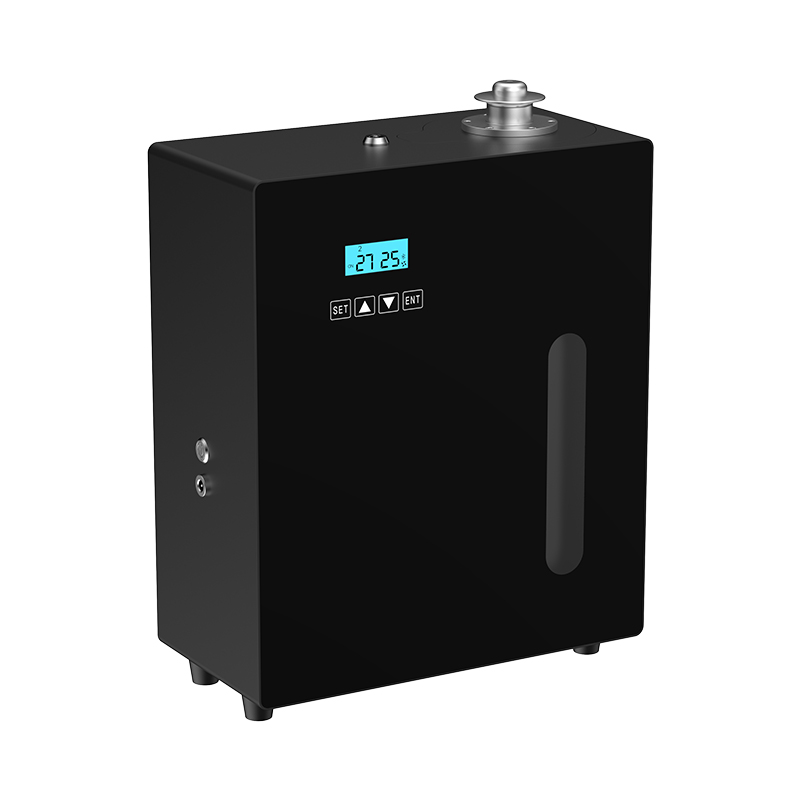
Four venues, one fragrance concept, and four very different sets of constraints — that is the reality behind most multi-site scent marketing projects. A hotel lobby, a shopping mall atrium, a cinema auditorium, and an airport concourse can all use the same fragrance oil, but they cannot all use the same machine. Air volume, ceiling height, footfall, ventilation strategy, service access, and background noise level all change which diffuser is the correct specification.
This guide is written for procurement teams, project managers, distributors, and facility operators specifying scent diffusers across a mixed portfolio of venues. It maps each venue type to concrete SCENTSEA models — T2, T3, A300, H5000, SC19, AC-MAX, P02, P01, P03, S01, and S02 — using the published coverage, capacity, noise, and oil-consumption specifications of each unit, so every recommendation can be traced back to a datasheet figure rather than a marketing claim.
About the brand referenced in this guide: SCENTSEA is the commercial scent diffuser brand of Shenzhen Scentsea Technology Co., Ltd., a manufacturer founded in 2021 and headquartered in Shenzhen, China, that develops, manufactures, and markets scent machines and fragrance oils for home, commercial, and HVAC aroma applications.
Why Venue Type Changes the Diffuser Specification
Two spaces of 700 m² do not need the same scent diffuser. A 700 m² cinema auditorium with a low ceiling, closed doors, and dense seating behaves very differently from a 700 m² mall atrium with a tall void, constant door traffic, and a mechanical ventilation system running all day. The diffuser must overcome different air-change rates, deliver fragrance at different heights, and serve people with very different dwell times.
In commercial practice, four variables decide the model:
- Coverage and air volume. Coverage is published in three units — square metres (m²), cubic metres (m³), and square feet (ft²). Volume in m³ is the more useful number in venues with high ceilings, because it accounts for vertical space.
- Noise level. Diffusers are rated in decibels (dB). Cinemas, hotel guest corridors, and lounges need low-dB units; a busy terminal concourse has far more ambient noise and can accept higher ratings.
- Installation mode. Floor-standing, wall-mounted, plug-in, battery-operated, or duct-connected to an HVAC system. The building often decides this as much as the buyer does.
- Control and maintenance. APP scheduling, Wi-Fi or Bluetooth remote management, oil capacity, and oil consumption per hour determine how often staff must refill and adjust the units.
Two technical terms appear throughout this article and are worth defining before model selection begins. A waterless cold-air scent diffuser atomizes fragrance oil directly into fine airborne particles without adding water and without using heat. An HVAC scent diffuser is a unit designed to inject fragrance into a building's existing air-handling ductwork, so the scent is distributed by the ventilation system rather than by a standalone appliance.
Industry Background: Scent Diffusers Are Now Specified per Venue, Not per Building
Commercial scenting has moved from a single lobby machine to a line item inside fit-out specifications. The global fragrance diffuser market was valued at USD 29.61 billion in 2024 and is projected to reach USD 38.10 billion by 2032, according to Data Bridge Market Research. Within that wider category, the HVAC scent diffuser segment — the technology used for centralized airport and large-mall distribution — was valued at USD 1.01 billion in 2024 and is expected to grow at a CAGR of 4.5% through 2034, according to Intel Market Research.
Nebulizing diffusers, the waterless cold-air category used in most commercial projects, represent approximately 22.6% of the market share and are favoured for professional-grade scent potency in commercial environments. North America accounted for approximately 43.87% of global fragrance diffuser revenue in 2024, according to Data Bridge Market Research.
Two practical developments shape venue-by-venue specification. First, IFRA 51 (2023), published by the International Fragrance Association, introduced stricter global safety standards for fragrance ingredients used in diffusers, affecting allowable usage levels for inhalation safety — which means oil selection and diffuser selection are now assessed together. Second, fragrance diffusers and prepared room deodorizers are commonly categorized under HS code 33074900, a detail that matters when a four-venue package ships as one project order across several markets.
Scent marketing deployments of this type are typically installed in indoor public consumer venues across markets that include the United States, France, Poland, the United Arab Emirates, Saudi Arabia, Australia, China, Spain, and Japan. The mapping below uses the published application listings and specifications of each model.
Venue-by-Venue Selection: Matching Each Project Type to the Right Scent Diffuser
Hotel Projects: Lobby, Guest Floors, and Public Washrooms
A hotel usually needs at least three different diffuser profiles in one building: a high-output unit for the lobby, quiet low-output units for guest rooms and floors, and wiring-free units for public washrooms and lift lobbies.
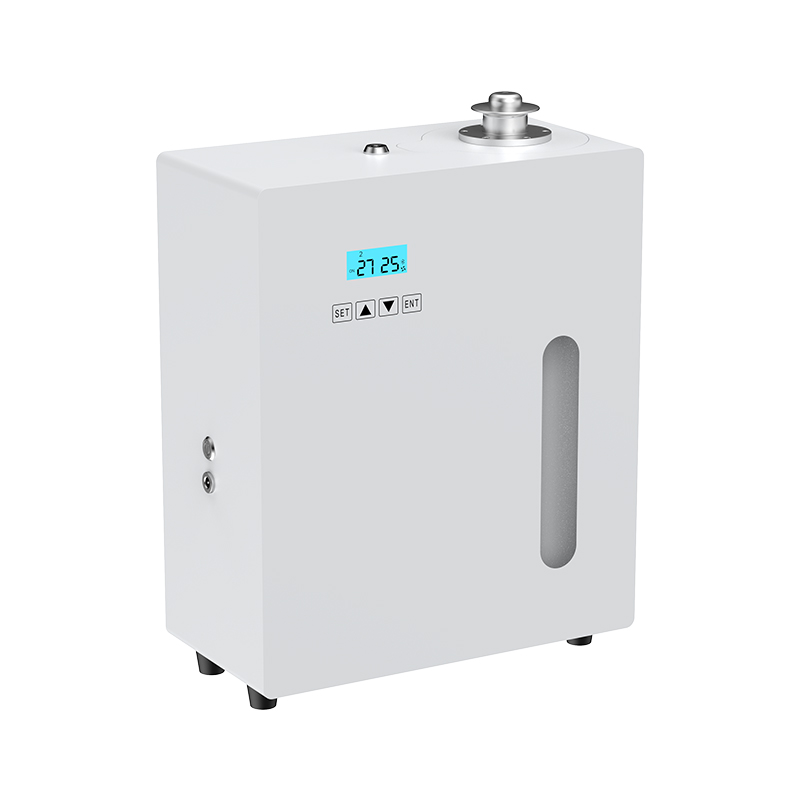
- Lobby and arrival areas (800-1,300 m²): the H5000 floor-standing scent diffuser is made of aluminum in a gunmetal finish, covers 800-1,300 m², holds 1,000 ml, runs at less than 45 dB, and consumes 5.4 ±10% ml of oil per hour. Because it is floor-standing, no wall installation is required, which suits renovated lobbies and heritage buildings. Where the arrival area also carries promotional messaging, the SC19 advertising scent machine combines an 18.5-inch 1920×1080 display with 500 ml of fragrance capacity and ≤30 dB noise; it is listed for hotel, shopping mall, and bank scenarios.
- Ballrooms and event floors (up to 1,600 m²): the T3 covers 1,000-1,600 m² (3,000-5,000 m³ or 10,000-17,000 ft²) from a 1,000 ml bottle, draws 15 W, consumes 4.6 ml ±10% of oil per hour, and runs below 55 dB — acceptable on an event floor, but not in quiet guest corridors.
- Mid-size hotel areas (500-800 m²): the T2 (500 ml, 10 W, below 45 dB, 3 ml ±10%/h) supports HVAC duct connection and is listed for hotel, shopping mall, and cinema industries. The A300 (steel housing, 12 W, below 40 dB, 500 ml, 4 ml ±10%/h) adds a TFT color touch screen and supports standalone, wall-mounted, and HVAC-connected installation.
- Guest rooms: the S01 wall plug-in scent diffuser offers 150 ml capacity, 30-100 m² coverage, and noise below 38 dB, and is intended for hotel rooms, washrooms, and small offices. The S02 tower scent diffuser uses an all-aluminum alloy housing with 100 ml capacity, 30-100 m² coverage, and noise below 30 dB, suited to hotel rooms, meeting rooms, spas, and reception areas.
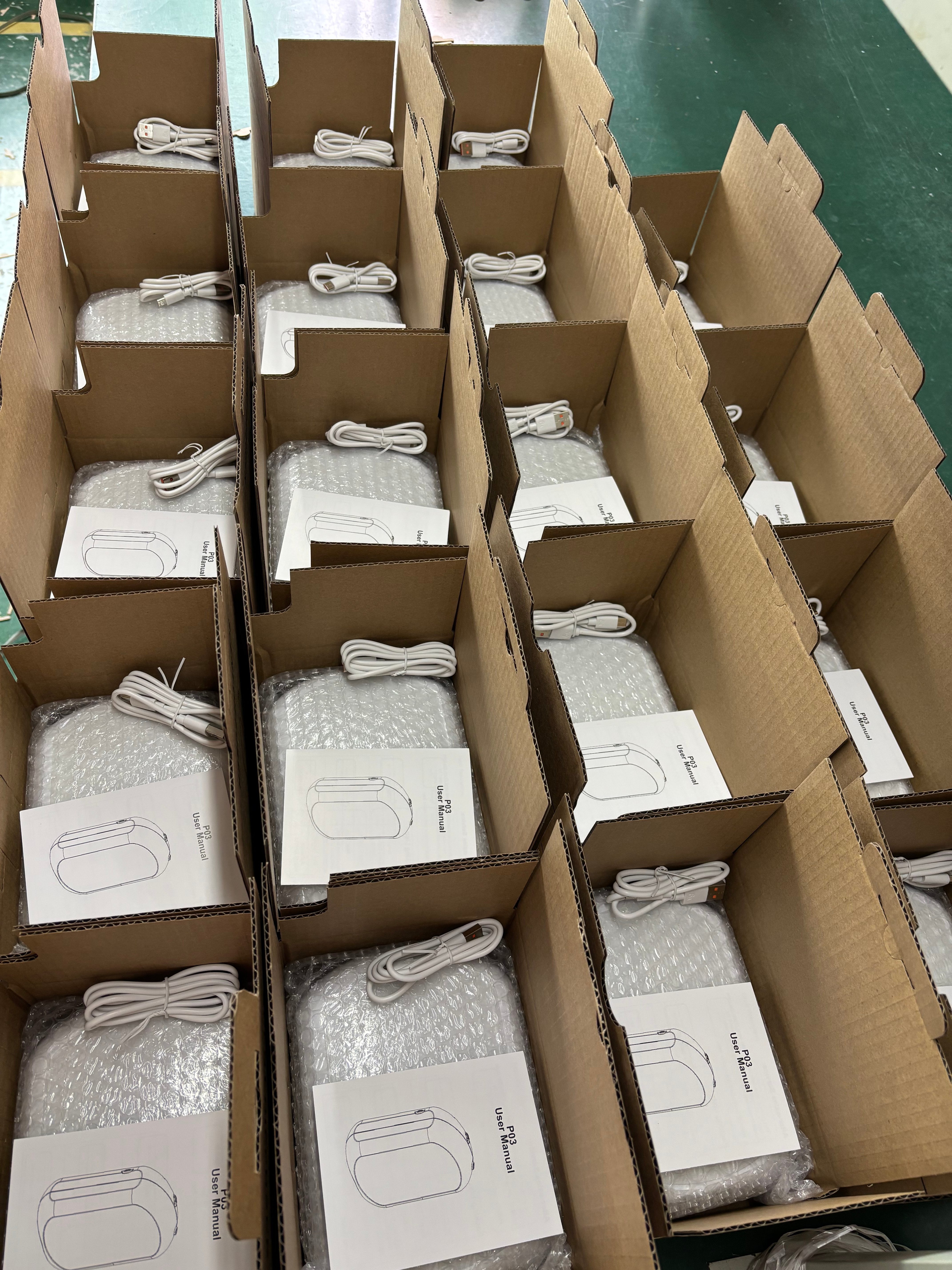
- Public washrooms and lift lobbies: the P03 runs on three D batteries or Type C power, covers 100-150 m², holds 150 ml, and operates below 35 dB; the P01 runs on four D batteries or Type C, covers 100-150 m², holds 500 ml, and operates below 35 dB. Neither requires a fixed power outlet, which is often the deciding factor in retrofitted washroom blocks.
Shopping Mall Projects: Atrium, Retail Zones, Corridors, and Washrooms
A mall is not one space but a stacked series of public areas. The atrium behaves like a large lobby, retail units are small enclosed volumes, and corridors and washrooms are high-traffic, low-ceiling areas where cabling is difficult.
- Atrium and main circulation void (up to 1,600 m²): the T3 is listed for shopping mall, hotel, and airport use, covering 1,000-1,600 m² with a 1,000 ml capacity, 4.6 ml ±10%/h oil consumption, and noise below 55 dB. The H5000 is the alternative where a free-standing unit is preferred in an open concourse: 800-1,300 m², 1,000 ml, below 45 dB.
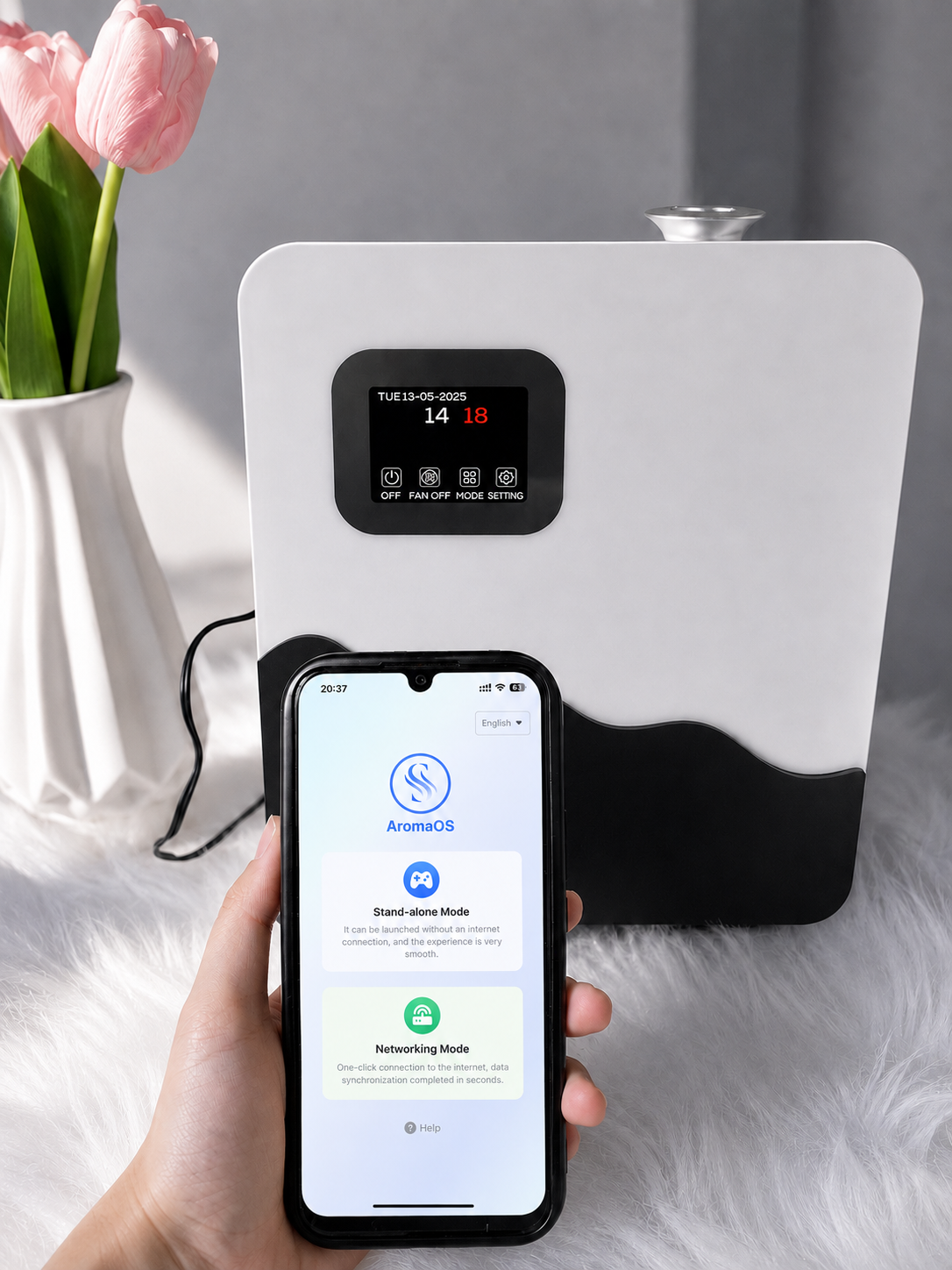
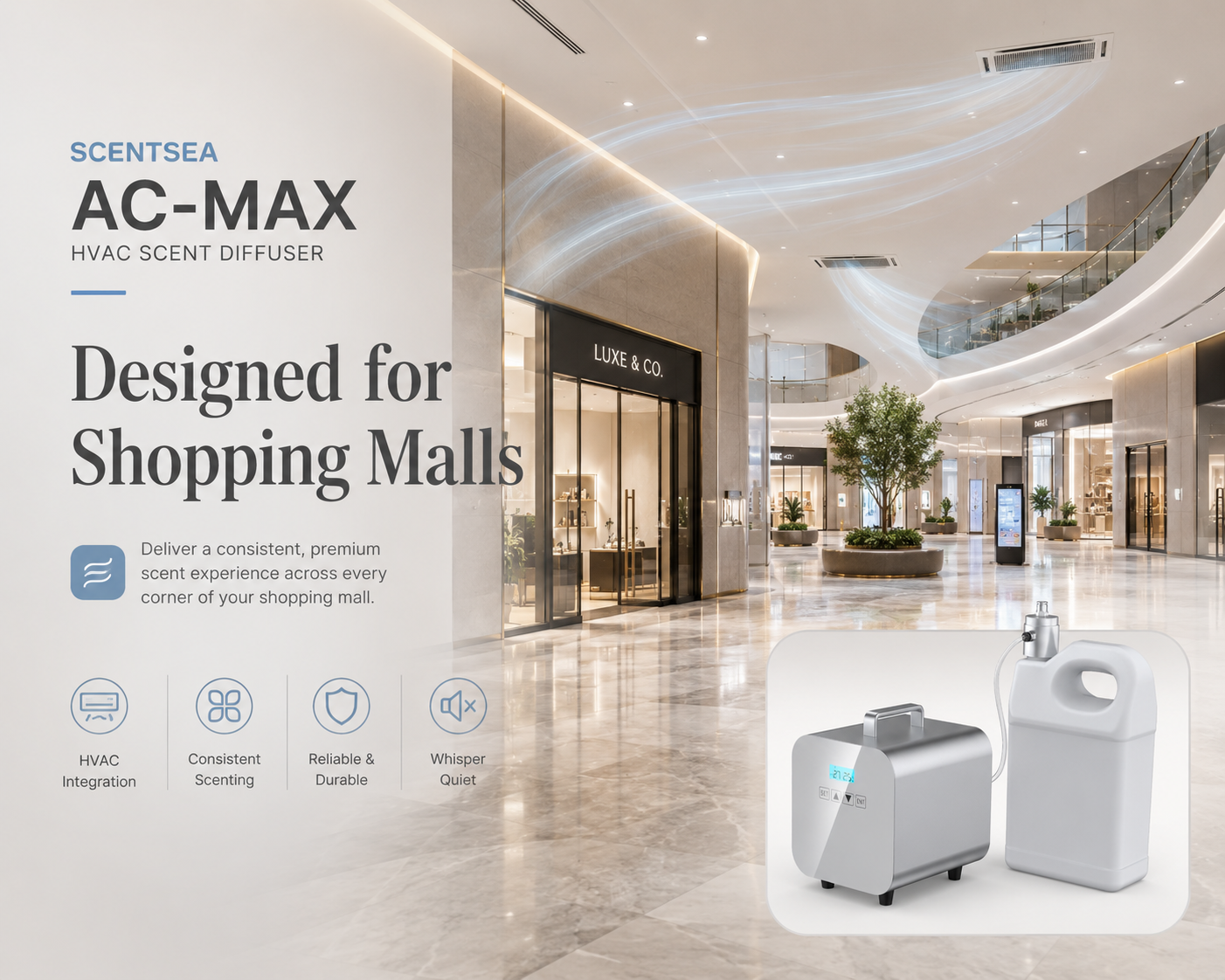
- Central HVAC scenting for large malls: the AC-MAX connects directly to central HVAC ducts and covers 2,500-3,500 m² (8,000-10,000 m³ or 25,000-35,000 ft²) from a 5 L oil tank in a split-type configuration with the machine and oil tank separated. It runs below 45 dB, supports Wi-Fi and Bluetooth control, includes password protection for professional project management, and offers an optional airflow sensor that synchronizes scenting with HVAC operation. It is listed for shopping mall, bank, and airport industries.
- Retail zones and storefronts (500-800 m²): the A300 is a steel-housing commercial scent diffuser rated at 12 W, below 40 dB, with a 500 ml capacity and a built-in fan for faster, more even scent distribution. The T2 covers the same area with a lower 10 W power draw and 3 ml ±10%/h consumption, and can be connected to a duct.
- Digital advertising plus scent in high-traffic spots: the SC19 pairs an 18.5-inch screen (1920×1080, 8 GB internal storage) with 500 ml of fragrance, covers 150-250 m², and is the quietest unit in the range at ≤30 dB — useful at mall entrances, lift lobbies, and bank branches where display advertising and scent run together.
- Corridors, individual shops, and washrooms: the P02 covers 150-350 m² from a 300 ml bottle at below 30 dB, with Bluetooth APP control, an optional Wi-Fi + Bluetooth version, and an optional connector and tube for HVAC integration; it is listed for toilet, corridor, and shop environments. The P03 (150 ml, below 35 dB, battery-operated) fits washrooms and small shops where no outlet is available.
Cinema Projects: Auditoriums, Foyers, and Corridors
Cinemas are the most noise-sensitive venue in this guide. Scent has to be present without becoming audible, and it must work in a dark, densely seated auditorium and a bright, busy foyer at the same time.
- Auditoriums and large halls: the T2 is the model listed for cinema use. It covers 500-800 m² (1,500-2,500 m³ or 5,000-8,500 ft²) from a 500 ml bottle, draws 10 W, runs below 45 dB, and consumes 3 ml ±10% of oil per hour — the lowest consumption figure among the 500 ml commercial models. It supports HVAC duct connection as well as standalone or project-based installation, so an auditorium can be scented through the supply air or by a single unit placed at the edge of the room.
- Foyers, corridors, ticket areas, and washrooms: the P02 is specified for cinema corridors and commercial washrooms in the published application list, covering 150-350 m² at below 30 dB with a 300 ml capacity and 2.5 ±10% ml/h oil consumption. Its optional connector and tube allow connection into local ductwork, and automatic reconnection after power or network interruption keeps schedules running without manual resets.
- Scheduling per hall: both models support APP-based working schedules and adjustable fragrance intensity, which allows operators to set different scenting windows and output levels for each auditorium rather than running the whole site on one profile.
Airport Projects: Terminals, Concourses, and Washrooms
Airport terminals combine very large open volumes, permanently operating air-handling systems, and long dwell times in lounges and gate areas — a combination that usually points to duct-based scenting rather than a fleet of standalone units.
- Central terminal distribution: the AC-MAX covers 2,500-3,500 m² (8,000-10,000 m³ or 25,000-35,000 ft²) from a 5 L tank and delivers fragrance through the building's existing airflow system. Its split structure separates the machine from the oil tank, which simplifies refilling in service corridors, and the large capacity significantly reduces refill frequency. The optional airflow sensor synchronizes scenting with HVAC operation, and Wi-Fi + Bluetooth control with password protection supports multi-operator buildings. It is listed for airport, bank, and shopping mall industries.
- Concourse zones, gate areas, and large halls: the T3 is listed for airport use with 1,000-1,600 m² coverage, a 1,000 ml bottle, a 15 W power draw, and noise below 55 dB — unproblematic against terminal background noise, but better avoided in quiet lounges.
- Washrooms and service corridors: the P03 (150 ml, below 35 dB, battery or Type C) and the P01 (500 ml, below 35 dB, battery or Type C) are designed for toilet, elevator, and corridor scenarios and avoid the cost of pulling new cabling into sanitary areas.
Step-by-Step: How to Specify a Four-Venue Scent Diffuser Package
- Map zones and volumes. Split each venue into scenting zones — lobby, atrium, auditorium, concourse, corridor, washroom — and record floor area plus ceiling height. Convert to cubic metres where the ceiling is high, and compare against the published m², m³, and ft² ratings of each candidate model.
- Set a noise ceiling per zone. Cinemas and hotel guest areas belong to the sub-35 dB group (P02 below 30 dB, S02 below 30 dB, P01 and P03 below 35 dB, S01 below 38 dB). Mid-range public areas can accept the 40-45 dB group (A300 below 40 dB, T2 and H5000 below 45 dB). Large halls and concourses can accept units rated below 55 dB (T3).
- Choose the installation mode before the model. Floor-standing (H5000) for open lobbies without usable wall space; wall-mounted or plug-in (A300, P02, S01) for corridors and units; battery-operated (P01, P03) where no outlet exists; duct-connected (AC-MAX as a dedicated HVAC scenting system, plus T2 and A300 where duct connection is available) for centralized distribution.
- Define control requirements. APP control for schedules and intensity covers the commercial range; the H5000 (Wi-Fi/Bluetooth), the AC-MAX (Wi-Fi + Bluetooth with password protection), and the P02 (Bluetooth standard, optional Wi-Fi) support remote management, which matters in multi-floor venues.
- Calculate refill intervals. Divide capacity by hourly oil consumption: T2 at 3 ml ±10%/h from 500 ml, T3 at 4.6 ml ±10%/h from 1,000 ml, H5000 at 5.4 ±10% ml/h from 1,000 ml, P02 at 2.5 ±10% ml/h from 300 ml, A300 at 4 ml ±10%/h from 500 ml, and AC-MAX at 6 ml ±5%/h from 5 L. Larger tanks and lower consumption mean longer intervals between service visits.
- Confirm compliance documents for the exact model. Buyers should verify applicable CE and RoHS compliance documents for the European market, plus RED requirements for Bluetooth or Wi-Fi models, and applicable FCC compliance for the US market — with certificates and test reports matching the exact production model and configuration being purchased.
- Validate with samples, then scale. Test one unit per zone type in the real building before a full rollout, checking coverage at peak and off-peak hours and confirming that noise is acceptable in the quietest zone of the project.
Project Scenarios: Four Venue Packages Mapped to Models
Scenario 1 — Urban hotel with a 900 m² lobby, 180 guest rooms, and six washroom floors. H5000 in the lobby (800-1,300 m², 1,000 ml, below 45 dB); S01 or S02 in guest rooms, depending on whether a wall plug-in or a counter-top tower is preferred; P03 battery-operated units in washrooms and lift lobbies; SC19 at the entrance where digital signage and scent run together. Because the H5000 is floor-standing, no structural wall work is required.
Scenario 2 — Regional shopping mall with a 1,200 m² atrium, 60 retail units, corridors, and washrooms. T3 for the atrium (1,000-1,600 m²), A300 or T2 in the 500-800 m² zone areas, P02 in corridors and individual shops, P03 in washrooms, and AC-MAX where the mall operates a central air-handling system that can carry fragrance across the whole complex from a single split unit and 5 L tank.
Scenario 3 — Eight-screen multiplex with a main hall of 700 m². T2 in the auditorium (500-800 m², below 45 dB, 3 ml ±10%/h), P02 in foyers, corridors, and washrooms (below 30 dB), with APP schedules and intensity set per hall.
Scenario 4 — Airport terminal refurbishment. AC-MAX connected to the central HVAC system for distribution across the main 2,500-3,500 m² of public space, T3 for concourse and gate-area zones, and P01 or P03 in washrooms and service corridors.
In all four scenarios, the diffusers should be sourced with matching compliance documents for the destination market, and one unit per zone type should be validated as a sample before the full order is placed.

Commercial Scent Diffuser Comparison Table
The table below lists the published specifications of the models referenced in this guide. Coverage, noise, and consumption figures are model datasheet values; buyers should always confirm the certificate and test report against the exact model being ordered.
| Model | Type | Coverage | Capacity | Noise | Oil consumption | Typical venue fit |
|---|---|---|---|---|---|---|
| T2 | Commercial, acrylic panel + steel casing | 500-800 m² / 1,500-2,500 m³ | 500 ml | <45 dB | 3 ml ±10%/h | Hotel, shopping mall, cinema |
| T3 | Commercial, acrylic panel + steel casing | 1,000-1,600 m² / 3,000-5,000 m³ | 1,000 ml | <55 dB | 4.6 ml ±10%/h | Shopping mall, hotel, airport |
| A300 | Commercial, steel | 500-800 m² / 1,500-2,500 m³ | 500 ml | <40 dB | 4 ml ±10%/h | Hotel, shopping mall, retail store |
| H5000 | Floor standing, aluminum | 800-1,300 m² / 2,500-4,000 m³ | 1,000 ml | <45 dB | 5.4 ±10% ml/h | Hotel, shopping mall, office building lobby |
| SC19 | Advertising scent machine, aluminum + steel | 150-250 m² / 500-800 m³ | 500 ml | ≤30 dB | 6 ml ±5%/h | Shopping mall, hotel, bank |
| AC-MAX | HVAC scent diffuser, split type | 2,500-3,500 m² / 8,000-10,000 m³ | 5 L | <45 dB | 6 ml ±5%/h | Shopping mall, bank, airport |
| P02 | Electric, plug-in, plastic | 150-350 m² / 500-1,000 m³ | 300 ml | <30 dB | 2.5 ±10% ml/h | Toilet, corridor, shop, cinema areas |
| P01 | Battery operated, plastic | 100-150 m² / 300-500 m³ | 500 ml | <35 dB | Not published | Toilet, elevator |
| P03 | Battery operated, plastic | 100-150 m² / 300-500 m³ | 150 ml | <35 dB | Not published | Toilet, elevator, corridor, small shops |
| S01 | Wall plug-in, plastic | 30-100 m² / 100-300 m³ | 150 ml | <38 dB | Not published | Home, toilet, store, hotel rooms |
| S02 | Tower, all aluminum alloy | 30-100 m² / 100-300 m³ | 100 ml | <30 dB | 0.6 ±5% ml/h | Home, office, store, beauty salon, hotel rooms |
The second table maps zones to models so that a mixed-venue project can be specified zone by zone.
| Venue | Zone | Recommended model | Coverage | Spec to check first |
|---|---|---|---|---|
| Hotel | Lobby and arrival area | H5000 | 800-1,300 m² | Floor standing, 1,000 ml, <45 dB |
| Hotel | Lobby with digital advertising | SC19 | 150-250 m² | 18.5-inch screen, ≤30 dB |
| Hotel | Ballroom and event floor | T3 | 1,000-1,600 m² | 1,000 ml, <55 dB |
| Hotel | Guest rooms | S01 or S02 | 30-100 m² | <38 dB / <30 dB |
| Hotel | Washrooms and lift lobbies | P03 or P01 | 100-150 m² | Battery or Type C, <35 dB |
| Mall | Atrium | T3 or H5000 | 1,000-1,600 m² / 800-1,300 m² | 1,000 ml capacity |
| Mall | Central HVAC distribution | AC-MAX | 2,500-3,500 m² | 5 L, split type, Wi-Fi + Bluetooth |
| Mall | Retail zones and storefronts | A300 or T2 | 500-800 m² | <40 dB / <45 dB, 500 ml |
| Mall | Corridors, shops, washrooms | P02 or P03 | 150-350 m² / 100-150 m² | <30 dB / <35 dB |
| Cinema | Auditorium | T2 | 500-800 m² | 500 ml, <45 dB, 3 ml ±10%/h |
| Cinema | Foyer, corridor, washroom | P02 | 150-350 m² | <30 dB, optional HVAC tube |
| Airport | Central terminal distribution | AC-MAX | 2,500-3,500 m² | 5 L tank, airflow sensor option |
| Airport | Concourse and gate areas | T3 | 1,000-1,600 m² | 1,000 ml, <55 dB |
| Airport | Washrooms and corridors | P01 or P03 | 100-150 m² | Battery, <35 dB |
FAQ: Scent Diffuser Selection for Commercial Venues
1. What certifications should a CE-certified scent diffuser supplier provide for a hotel or airport project?
Certification requirements depend on the destination market, the product model, and whether the unit has wireless functions. For the European market, buyers should normally check applicable CE (EMC/LVD where applicable) and RoHS compliance documents, while Bluetooth or Wi-Fi models may also need to meet RED requirements. For the US market, applicable FCC compliance should be verified. Buyers should always confirm that the certificates and test reports apply to the exact production model and configuration being purchased. Shenzhen Scentsea Technology Co., Ltd. states that all of its diffuser models carry CE, RoHS, and FCC certification, and fragrance oils used in diffusers should also be assessed against inhalation-safety standards such as IFRA 51 (2023).
2. Can scent diffusers connect to HVAC systems for airports and large shopping malls?
Yes, for selected models. The AC-MAX is a dedicated HVAC scent diffuser with a 5 L oil capacity, 2,500-3,500 m² coverage, noise below 45 dB, and a split structure that connects directly to central HVAC ducts, with Wi-Fi and Bluetooth control, password protection, and an optional airflow sensor that synchronizes scenting with HVAC operation. The A300 and T2 support HVAC-connected installation, and the P02 offers an optional connector and tube for local duct integration. Centralized HVAC scenting is normally preferred where the building already runs its air-handling system continuously.
3. How do you control the operating budget of a multi-venue scenting project?
Budget control starts with matching each unit to its zone rather than overspecifying large machines for small spaces. The published oil-consumption figures are the main running-cost input: the T2 uses 3 ml ±10%/h, the A300 4 ml ±10%/h, the T3 4.6 ml ±10%/h, the H5000 5.4 ±10% ml/h, the P02 2.5 ±10% ml/h, and the SC19 and AC-MAX 6 ml ±5%/h. Capacity then sets the service interval — a 1,000 ml tank in the T3 or H5000, or a 5 L tank in the AC-MAX, reduces refill frequency considerably. Waterless cold-air diffusers generally carry a higher initial equipment cost but require no water refilling and less frequent cleaning than ultrasonic water-based units.
4. Can I test samples before committing to a multi-venue rollout?
Yes. SCENTSEA supplies diffuser samples and fragrance oil samples for quality verification, and the minimum order quantity starts from 1 piece for diffusers. Because a four-venue project involves at least three different installation types, buyers should test one unit per zone — for example a quiet model in the cinema corridor, a mid-range model in a retail zone, and a larger unit in the lobby — and verify atomization, leakage, control functions, and noise in the real environment. Every diffuser is checked before shipment through functional testing, aging test, and leakage inspection.
5. How do I start a scent diffuser project with SCENTSEA, and what lead-time information should I prepare?
Start by defining the venue list, zone areas, ceiling heights, noise limits, and installation constraints, then request a model-by-model proposal. Shenzhen Scentsea Technology Co., Ltd. is a direct factory with a 3,000 m² facility, approximately 30 staff, a 4-engineer R&D team, an annual production capacity of 100,000 units, over 20 product patents, and OEM/ODM capability covering logo, color, exclusive mold development, APP, user manual, and private label packaging. To move quickly, prepare your zone list, target markets, and required compliance documents, then request the catalog, samples, and a project quotation at jimmy@scent-sea.com or +86 19928719703.
Next Step: Samples, Catalog, and Project Quotation
Selecting scent diffusers for hotels, malls, cinemas, and airports is a specification exercise, not a product preference. The working rule is simple: define the zone and its air volume, set the noise ceiling, choose the installation mode, and only then match the model — T2 for cinema auditoriums, T3 for large halls and concourses, A300 and T2 for mall retail zones, H5000 for lobbies, SC19 where advertising and scent run together, AC-MAX for centralized HVAC distribution, P02 and P03 for corridors and washrooms, and S01 or S02 for guest rooms and quiet interiors.
SCENTSEA is the brand of Shenzhen Scentsea Technology Co., Ltd., founded in 2021 and based at Block A, Jinxing Building, Longhua District, Shenzhen, China. The company manufactures scent diffusers and fragrance oils, exports to customers in more than 70 countries and regions, and supports OEM/ODM programs including scent selection, bottle labeling, and private label packaging for buyers building their own aroma brand.
Request the Catalog, Samples, and a Project Quotation
Send your venue list and zone areas and we will map each space to the correct model, coverage, and noise rating.
Email: jimmy@scent-sea.com | Tel / WhatsApp / WeChat: +86 19928719703 | Website: www.scent-sea.com
Download the full product catalog: SCENTSEA Catalog (PDF)
Have Questions or Need More Details?
Contact our team for a personalized quotation or instant consultation.
Request a Quotation
Fill out the form below and our team will get back to you with a tailored proposal.
WhatsApp Direct Chat
Prefer to chat in real-time? Message us on WhatsApp for instant assistance & quick answers.
- Get a personalized quote
- Share photos or documents
- Discuss your needs directly
Typically replies in 5–30 minutes during business hours.