
Scent Diffuser Certifications Explained: CE, FCC, RoHS & Parameters That Matter
SCENTSEA Scent Diffuser Certifications: CE, FCC, RoHS & Key Device Parameters
When procurement teams evaluate commercial scent diffuser suppliers for the EU or USA market, the first question is rarely about fragrance notes. It is about compliance: Which certifications does the device hold? Which standard applies? Does the certificate match the model, the voltage, and the intended installation environment?
This guide explains the concrete certification and parameter checks that buyers should run before ordering commercial scent diffusers. It walks through the CE-related family (EMC and RoHS) and FCC requirements, maps each certificate to specific SCENTSEA models, and explains how device parameters such as coverage, power supply, oil consumption, and material affect project planning.
SCENTSEA (Shenzhen Scentsea Technology Co., Ltd) is a scent diffuser manufacturer based in Shenzhen, China, specializing in commercial scent machines and fragrance oils. The company operates a 3,000 m² factory with around 30 employees, an R&D team of 4 engineers, and an annual output of about 100,000 units. Around 70% of production is exported, primarily to the EU and USA.
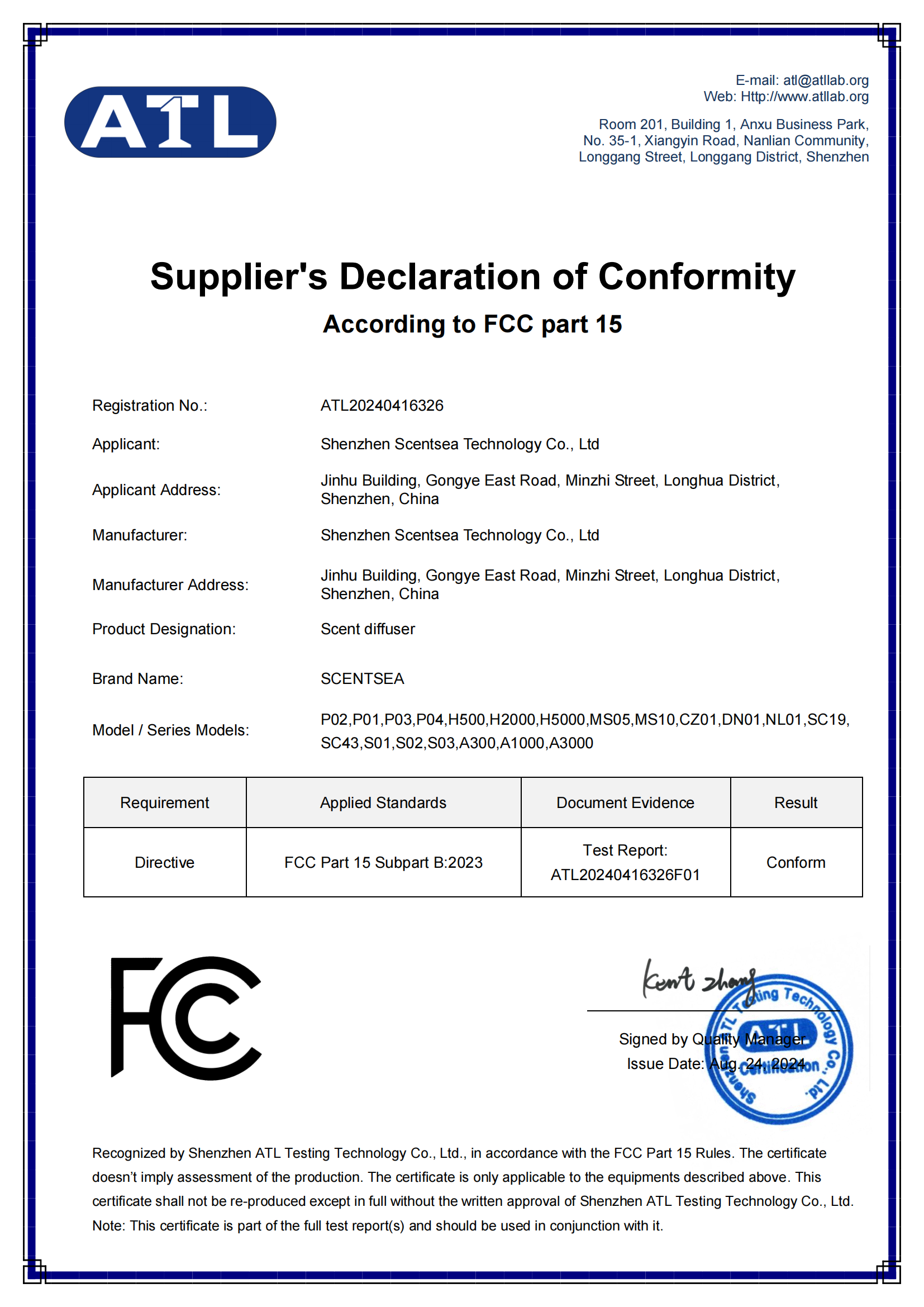
FCC certificate issued by Shenzhen ATL Testing Technology Co., Ltd. for SCENTSEA scent diffusers.
Why Certifications Matter for Commercial Scent Diffusers
Commercial scent diffusers are electrical devices that operate continuously in public spaces. In the EU, devices must meet the Low Voltage, EMC, and RoHS requirements to carry the CE mark. In the USA, intentional radiators and electronic devices generally require FCC compliance. For buyers, a matching certificate is not paperwork—it is the precondition for customs clearance, market entry, insurance coverage, and brand protection.
Certifications also reduce project risk. A shopping mall or hotel project may install dozens of machines. If one model fails to meet the destination market's requirements, the entire installation schedule is affected. That is why model-level certificate matching matters more than general supplier claims.
Beyond electrical compliance, fragrance ingredients used in diffusers are subject to safety standards such as IFRA 51 (2023), which introduced stricter global safety limits for inhalation safety. Buyers should therefore verify both the hardware certification and the fragrance oil safety documentation.
SCENTSEA Certification Overview
SCENTSEA states that all of its scent diffuser products carry CE, RoHS, FCC, and SGS certifications. The table below summarizes the current certificate-level facts available for the product line, including issuing body and certificate numbers for FCC, RoHS, and EMC.
| Certification | Market | Standards | Certificate No. | Issued By | Issue Date |
|---|---|---|---|---|---|
| FCC | USA | FCC Part 15 Subpart B:2023 | ATL20240416326 | Shenzhen ATL Testing Technology Co., Ltd. | 2024-04-24 |
| RoHS | EU | RoHS Directive (EU) 2015/863 | ATL20240416327 | Shenzhen ATL Testing Technology Co., Ltd. | 2024-04-24 |
| EMC | EU | EN IEC 55014-1:2021; EN IEC 55014-2:2021; EN IEC 61000-3-2:2019/A1:2021; EN 61000-3-3:2013/A2:2021 | ATL20240416325 | Shenzhen ATL Testing Technology Co., Ltd. | 2024-04-24 |
SCENTSEA certification data for scent diffuser products across EU and USA target markets.
All three certificates were issued by Shenzhen ATL Testing Technology Co., Ltd. and are dated 2024-04-24. The applicable product family covers commercial models including SC19, AC-MAX, T3, T2, A300, P03, P02, P01, H5000, S02, and S01.
FCC Certification: What It Means for the USA Market
The SC19 scent diffuser is certified to FCC standards, complying with FCC Part 15 Subpart B:2023 for the USA market. The certification number is ATL20240416326, issued by Shenzhen ATL Testing Technology Co., Ltd.
FCC Part 15 Subpart B covers unintentional radiators—devices that generate radio-frequency energy only internally and are not designed to transmit wirelessly. For a scent diffuser in North America, FCC compliance confirms that the device's electromagnetic emissions stay within legal limits when operated in a commercial environment.
The presence of FCC certification is particularly relevant for hotels and shopping malls in the USA because facility managers and electrical contractors often require compliance documentation before approving new equipment. It also simplifies the import process and reduces the risk of customs holds.
SCENTSEA's FCC certificate covers the full commercial product family, not just the SC19 model. The related product models include AC-MAX, T3, T2, A300, P03, P02, P01, H5000, S02, and S01.
RoHS Certification: Material Safety for the EU Market
SCENTSEA scent diffusers are certified to RoHS standards, complying with the RoHS Directive (EU) 2015/863 for the EU market. The certification number is ATL20240416327, issued by Shenzhen ATL Testing Technology Co., Ltd.
RoHS restricts hazardous substances in electrical and electronic equipment, including lead, mercury, cadmium, and certain flame retardants. For scent diffusers installed in continuously occupied spaces such as hotel lobbies, shopping mall corridors, toilets, and elevators, RoHS compliance is a basic material-safety requirement.
Buyers sourcing for the EU should request the RoHS certificate and confirm that it covers the exact model planned for installation. The RoHS certificate applies to the same SCENTSEA product family listed above.
EMC Certification: Electromagnetic Compatibility for the EU Market
The advertising scent machine model SC19 is certified for EMC compliance under the standard EN IEC 55014-1:2021 for the EU market. The certification number is ATL20240416325, issued by Shenzhen ATL Testing Technology Co., Ltd.
EMC compliance ensures that a device does not emit electromagnetic disturbance that would interfere with other equipment and is not overly susceptible to external interference. The SC19 certificate references the following standards:
- EN IEC 55014-1:2021 — Emissions for household and similar appliances
- EN IEC 55014-2:2021 — Immunity for household and similar appliances
- EN IEC 61000-3-2:2019/A1:2021 — Harmonic current emissions
- EN 61000-3-3:2013/A2:2021 — Voltage fluctuations and flicker
The SC19 is a 30W advertising scent machine with a built-in 18.5-inch digital screen. Its dual function—fragrance diffusion plus digital advertising—makes EMC verification more critical because the display and control electronics operate alongside the atomization system.
Model-by-Model Parameter Guide for Certified Commercial Scent Diffusers
Certification confirms market access, but device selection requires matching parameters to the physical space and installation conditions. The table below maps the key parameters of each SCENTSEA model covered by the certification family.
| Model | Type | Coverage | Capacity | Power | Oil Consumption | Noise | Material | Typical Applications |
|---|---|---|---|---|---|---|---|---|
| AC-MAX | HVAC scent diffuser | 2500–3500 m² | 5L | 48W | 6ml±5%/h | <45dB | Aluminum body + plastic bottle | Shopping mall, bank, airport |
| SC19 | Advertising scent machine | 150–250 m² | 500ml | 30W | 6ml±5%/h | ≤30dB | Aluminum + steel | Shopping mall, hotel, bank |
| T3 | Commercial scent diffuser | 1000–1600 m² | 1000ml | 15W | 4.6ml±10%/h | <55dB | Acrylic + steel casing | Shopping mall, hotel, airport |
| T2 | Commercial scent diffuser | 500–800 m² | 500ml | 10W | 3ml±10%/h | <45dB | Acrylic + steel casing | Hotel, shopping mall, cinema |
| A300 | Commercial scent diffuser | 500–800 m² | 500ml | 12W | 4ml±10%/h | <40dB | Steel | Hotel, shopping mall, retail store |
| H5000 | Floor standing scent diffuser | 800–1300 m² | 1000ml | 20W | 5.4ml±10%/h | <45dB | Aluminum | Hotel, mall, office building lobby |
| P01 | Battery operated scent diffuser | 100–150 m² | 500ml | 2.5W | Not specified | <35dB | Plastic | Toilet, elevator |
| P02 | Electric plug-in scent diffuser | 150–350 m² | 300ml | 6.5W | 2.5±10%ml/h | <30dB | Plastic | Toilet, corridor, shop |
| P03 | Battery operated scent diffuser | 100–150 m² | 150ml | 2.5W | Not specified | <35dB | Plastic | Toilet, elevator |
| S02 | Tower scent diffuser | 30–100 m² | 100ml | 1.5W | 0.6±5%ml/h | <30dB | Aluminum alloy | Home, office, store, beauty salon |
| S01 | Wall plug-in scent diffuser | 30–100 m² | 150ml | 1.5W | Not specified | <38dB | Plastic | Home, toilet, store |
SCENTSEA commercial model parameters. Custom colors and packaging options are available for selected models.
What Buyers Should Check Before Ordering
A certificate that does not match the product model, voltage, or destination market has limited value. Use this checklist when reviewing a supplier's certification documentation.
1. Confirm the certificate holder and issuing body
In the SCENTSEA documentation, the issuing body is Shenzhen ATL Testing Technology Co., Ltd., a third-party testing laboratory. Buyers can search the certificate number or contact the lab directly if needed.
2. Match the standard to the destination market
For the USA, check FCC Part 15 Subpart B. For the EU, check the EMC harmonized standards and the RoHS Directive. A general CE declaration without supporting EMC and RoHS certificates is not sufficient evidence of compliance.
3. Verify that the model appears in the certificate scope
SCENTSEA's FCC, RoHS, and EMC certificates cover the following models: SC19, AC-MAX, T3, T2, A300, P03, P02, P01, H5000, S02, and S01. If a supplier refuses to list the model number in the certificate, request a clarification.
4. Check the installation environment
Battery-operated models such as P01 and P03 are designed for toilets and elevators where power outlets are not consistently available. Plug-in models such as P02 and S01 are better suited for corridors and stores. HVAC models such as AC-MAX serve large open areas by integrating scent output into the existing air handling system.
5. Plan for total cost of ownership
Oil consumption, capacity, and noise level determine operating cost and guest experience. For a large shopping mall, a 5L-capacity AC-MAX with 6ml/h consumption means fewer refill cycles. For a hotel restroom, a small battery-operated P03 may be the most practical choice.
Use Cases: Matching Certifications and Parameters to Projects
Hotel project
A hotel needs quiet, low-maintenance diffusion in lobbies, corridors, and restrooms. In the lobby, a floor-standing H5000 (aluminum, 800–1300 m², 20W) or a wall-mounted T2 (500–800 m², 10W) can provide consistent scent coverage. In restrooms, battery-operated P01 or P03 models avoid the need for nearby power outlets. All models in this family carry the same FCC, RoHS, and EMC certification set.
Shopping mall project
Malls typically need centralized scenting over large public areas plus targeted scenting in restrooms and corridors. The AC-MAX HVAC diffuser covers 2500–3500 m² with a 5L bottle, reducing refill frequency. The SC19 can combine scent diffusion with digital advertising screens in high-traffic zones. The T3 covers 1000–1600 m² and fits common ceiling or wall mounting positions.
Office building lobby
The H5000 floor-standing model (aluminum, 20W, 800–1300 m²) suits office building lobbies where a visible diffuser can serve as part of the interior design. Its 1000ml capacity and 5.4ml/h oil consumption provide a reasonable balance between refill intervals and scent intensity.
Scenting service provider case
SCENTSEA reports that a scenting service provider in the USA deployed 30 units of the AC-MAX model over a 5-year partnership to provide scenting services to shopping malls. The customer reported a 40% reduction in labor costs and a 30% reduction in essential oil usage. The highlighted product strengths were long lifespan, low maintenance, and stronger atomization.
Certification and Market Context
Commercial scent diffusers sit within a growing fragrance diffuser market. The global fragrance diffuser market was valued at USD 29.61 billion in 2024 and is projected to reach USD 38.10 billion by 2032, according to Data Bridge Market Research. North America held the largest regional share in 2024, accounting for approximately 43.87% of global revenue.
More specifically, the global HVAC scent diffuser market was valued at USD 1.01 billion in 2024 and is expected to grow at a CAGR of 4.5% through 2034, according to Intel Market Research. Nebulizing (waterless/cold-air) diffusers represent approximately 22.6% of the ambient scent diffuser market, favored for professional-grade scent potency in commercial environments.
For buyers preparing customs documentation, fragrance diffusers and prepared room deodorizers are commonly classified under HS code 33074900.
These market signals confirm that certified, low-maintenance commercial scent diffusers are becoming a standard procurement category rather than a novelty. Buyers who verify certification and parameters at the evaluation stage will face fewer surprises during installation and operation.
Comparison: What Differentiates a Certified Commercial Scent Diffuser Supplier?
Leading commercial scenting players such as ScentAir, Aroma360, and AromaTech focus on nebulizing technology for hotels and shopping malls. For manufacturers and direct-factory suppliers such as SCENTSEA, the differentiator is not only the technology but also the transparency of compliance documentation and the ability to offer OEM/ODM services.
The following table compares typical characteristics of a certified direct manufacturer versus a brand-focused supplier. It is not a ranking and should not be read as a performance judgment.
| Dimension | Direct Manufacturer (example: SCENTSEA) | Brand-Focused Supplier (example context) |
|---|---|---|
| Compliance documentation | Factory-held certificates available to buyers | Final-brand certificates may require reseller authorization |
| Customization | OEM/ODM, color and packaging options | Usually limited to finished goods |
| Price structure | Factory direct pricing for volume projects | Brand premium included |
| Technical support | R&D team and engineers available | May depend on distributor channel |
Comparative dimensions for evaluating commercial scent diffuser suppliers. SCENTSEA positions itself as a direct manufacturer with OEM/ODM capability.
FAQ
Are SCENTSEA scent diffusers CE, RoHS, and FCC certified?
Yes. SCENTSEA states that all of its scent diffuser products carry CE, RoHS, FCC, and SGS certifications. Specifically, the FCC certificate (No. ATL20240416326) applies to the USA market under FCC Part 15 Subpart B:2023; the RoHS certificate (No. ATL20240416327) applies to the EU market under Directive (EU) 2015/863; the EMC certificate (No. ATL20240416325) applies to the EU market under EN IEC 55014-1:2021 and related standards. All three were issued by Shenzhen ATL Testing Technology Co., Ltd.
Do the SCENTSEA certificates cover all models or only the SC19?
The FCC, RoHS, and EMC certification records relate to the SCENTSEA product family. The FCC certificate names the SC19 as the applicable model, while the FCC and RoHS related-product lists include SC19, AC-MAX, T3, T2, A300, P03, P02, P01, H5000, S02, and S01. The EMC certificate specifically covers the advertising scent machine model SC19. Buyers should confirm model-level coverage with the supplier before ordering.
Which SCENTSEA model is suitable for an HVAC system in a large shopping mall?
The AC-MAX is the HVAC scent diffuser model, with a coverage of 2500–3500 m², a 5L replaceable bottle, DC12V input, 48W power, and oil consumption of 6ml±5%/h. It is designed for shopping malls, banks, and airports. A US-based scenting service provider using 30 AC-MAX units reported a 40% reduction in labor costs and a 30% reduction in essential oil usage over a 5-year partnership.
What is the difference between battery-operated, plug-in, and floor-standing scent diffusers?
Battery-operated models such as P01 and P03 run on D batteries or Type-C power at 2.5W and suit toilets and elevators where outlets are unavailable. Plug-in models such as P02 and S01 offer continuous operation in corridors and stores. Floor-standing models such as H5000 provide larger coverage (800–1300 m²) and a more visible design for hotel lobbies and office building lobbies.
Can SCENTSEA provide samples and catalogs for evaluation?
SCENTSEA supports commercial buyers who are evaluating certifications, parameters, and OEM options. You can download the SCENTSEA catalog at https://cdn.socialarks.com/sbsp/24935/common/2026/0605/SCENTSEA%20CATALOG.pdf or contact Jimmy Wan directly to request samples and quotations.
Ready to verify certifications and request samples?
Contact Jimmy Wan at jimmy@scent-sea.com or WhatsApp +86 199-2871-9703.
Conclusion
Certification is the first gate in commercial scent diffuser procurement. For the EU and USA markets, buyers should look for FCC Part 15 Subpart B compliance, RoHS compliance under Directive (EU) 2015/863, and EMC compliance under EN IEC 55014-1:2021 and related standards. SCENTSEA provides certificate numbers, issuing body details, and model-level coverage for its scent diffuser family.
After compliance is confirmed, the next step is to match device parameters to the target space. Coverage, capacity, power supply, noise level, material, and oil consumption determine installation feasibility, operating cost, and maintenance frequency. A toilet, an elevator, a hotel lobby, and a large shopping mall each require a different configuration.
SCENTSEA's direct-factory model, certified product family, and OEM/ODM support make it a practical reference point for commercial buyers who want transparency in both certification and technical specifications.