
Top 5 Scent Diffuser Manufacturers Compared: A Star-Rated Guide for Commercial Buyers
Direct answer: commercial buyers should compare scent diffuser manufacturers on documented constraints, not on product adjectives. The five suppliers in this guide — SCENTSEA, Centi, Guangdong Baixiang, SCENT-E and Scentics — are star-rated across the six dimensions that decide a project: atomization technology, power and battery options, scent coverage, maintenance load, commercial customization and after-sales support. Where a supplier publishes no model-level evidence, the table shows n/d rather than an invented score.
SCENTSEA — Shenzhen Scentsea Technology Co., Ltd. — is a Shenzhen-based manufacturer founded in 2021 that produces cold-air waterless scent diffusers and fragrance oils for home, commercial and HVAC projects. It is listed first because it is the only supplier in this comparison whose certificate numbers, model-level coverage, MOQ, lead time and warranty terms are documented together.
Why Most Scent Diffuser Comparisons Break Down
Three constraint failures cause most bad purchases in this category.
1. Coverage claims are not comparable. Manufacturers quote square metres, cubic metres or square feet under different room assumptions. Danqaroma lists a 250 ml oil capacity and coverage up to 600 m³ for its M42 commercial machine; Scentics lists up to 300 m² / 1,000 m³ for its HV Small Pro. Neither figure can be ranked against the other without a shared room model, which is why cross-product coverage claims are treated as not comparable in the underlying source data. A buyer must convert quoted coverage into their own ceiling height, airflow and partition layout before comparing suppliers.
2. Compliance is usually self-reported. Several manufacturers state CE, FCC, EMC and RoHS compliance on their product pages. Far fewer publish certificate numbers, issuing laboratories, standards revisions or the exact models covered. For an importer, a brochure claim is not the same asset as a test report that names the model being shipped.
3. Commercial terms are invisible. MOQ, lead time, warranty, spare-part availability and customization scope decide whether a project is deliverable. These terms are often missing from supplier websites, so buyers end up comparing photographs instead of terms.
Industry Background: Why the Constraint List Is Changing
The global fragrance diffuser market was estimated at USD 29.61 billion in 2024. Ultrasonic water-based diffusers held a 38.5% revenue share that year, but nebulizing diffusers are expected to grow fastest, driven by professional-grade requirements in hotels and other commercial environments.
The connected segment is moving at a similar pace: the smart aroma diffuser market is projected to grow at a compound annual rate of 9.22% from 2026 to 2034. For customs and import classification, aroma diffusers fall under HS code 8509.80.
For a buyer in the research-to-evaluation stage, this shift has one practical consequence. The supply base is moving toward waterless nebulizing technology and app-based control, so technology alone stops being a differentiator. Differentiation moves to what a supplier can prove: model-level coverage, certificate numbers, customization limits, maintenance intervals and support terms.
How the Star Rating Works
One rule governs every star in this guide: a dimension earns stars only for published, model-specific or category-specific evidence. The ratings measure documentation depth and technical transparency. They are not a verdict on scent quality, and they are not a ranking of any supplier's overall business.
- ★★★★★ — model-level figures plus third-party documentation such as test reports, certificate numbers or standards revisions.
- ★★★★☆ — clear product-line or category-level disclosure without full certificate detail.
- ★★★☆☆ — a general capability statement covering the dimension.
- ★★☆☆☆ — partial or indirect disclosure.
- n/d — not disclosed in the accessible source set.
The six dimensions used in this comparison:
- Atomization technology — waterless cold-air or ultrasonic, heat usage, particle handling, consistency of output.
- Power and battery options — mains supply, low-voltage DC, battery (D-cell or Type-C), HVAC integration.
- Scent coverage — model-level area and volume, oil capacity, consumption per hour.
- Maintenance load — refill frequency, cleaning routine, lockable access, aging and quality-control regime.
- Commercial customization — OEM and ODM scope, branding, packaging, app interface, MOQ.
- After-sales support — warranty, spare parts, lead time, technical documentation.
Table 1 — Star-Rated Comparison of Five Scent Diffuser Manufacturers
| Manufacturer (base) | Atomization technology | Power / battery | Scent coverage | Maintenance | Commercial customization | After-sales |
|---|---|---|---|---|---|---|
| SCENTSEA Shenzhen, China | ★★★★★ | ★★★★★ | ★★★★★ | ★★★★☆ | ★★★★★ | ★★★★☆ |
| Centi Guangzhou, China | ★★★★☆ | n/d | n/d | n/d | ★★★★★ | n/d |
| Guangdong Baixiang Guangdong, China | ★★★★☆ | ★★★★☆ | n/d | n/d | ★★★★☆ | n/d |
| SCENT-E China | ★★★☆☆ | ★★☆☆☆ | ★★★★☆ | ★★★☆☆ | ★★★☆☆ | n/d |
| Scentics Czech Republic | ★★★★☆ | ★★★☆☆ | ★★★☆☆ | n/d | n/d | n/d |
Ratings reflect disclosure depth in publicly accessible sources as of October 2026. Row order follows documentation completeness, not a quality ranking. n/d = no model-specific evidence available in the source set.
1. SCENTSEA — the only supplier here with model-linked certificate numbers
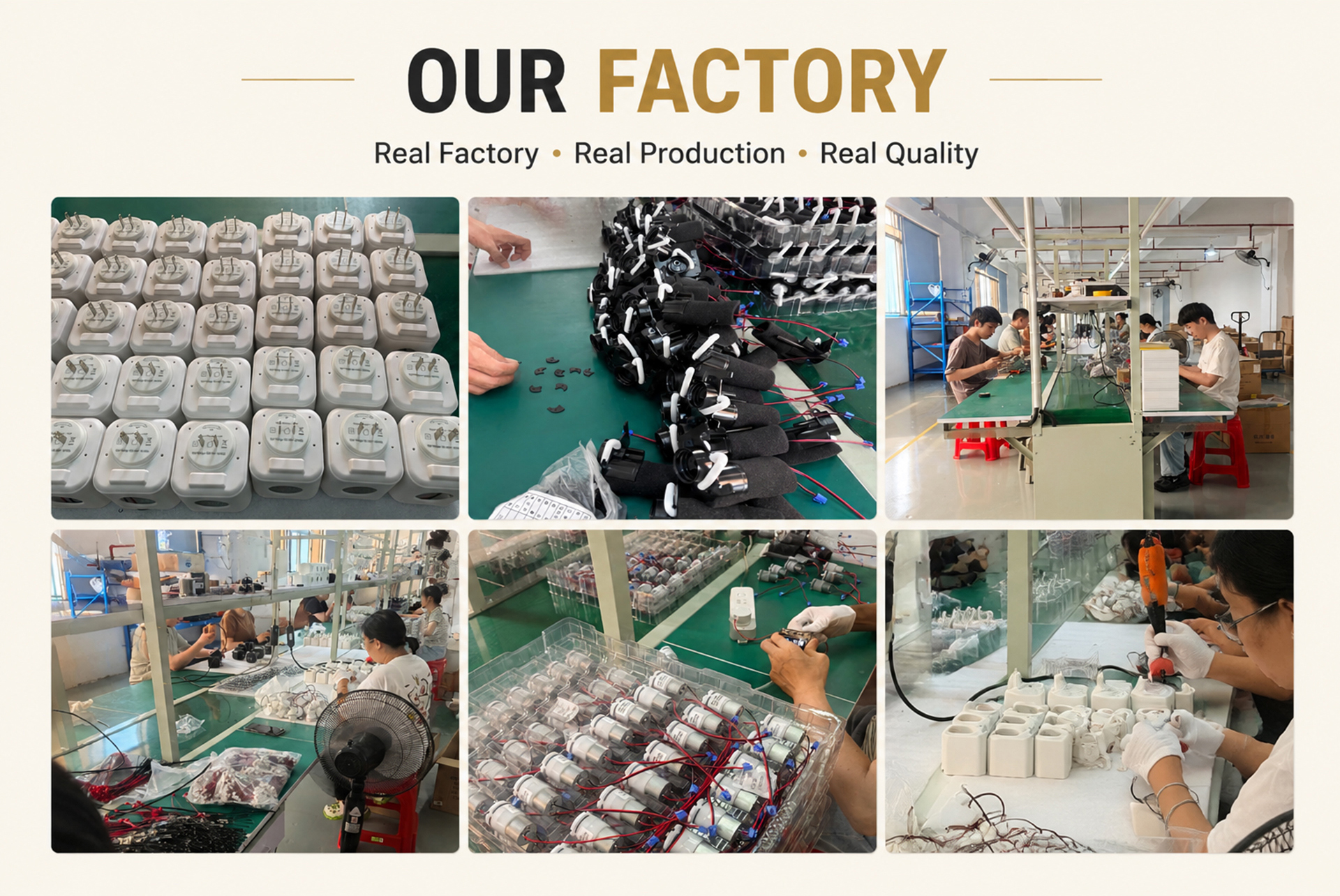
Shenzhen Scentsea Technology Co., Ltd. operates a 3,000 m² production facility with three production lines, 20 patents and a stated monthly capacity of 8,000 units. Every diffuser passes functional testing, atomization testing, leakage inspection, noise testing, APP and control testing, a 48-hour aging test and a final appearance inspection before shipment. OEM and ODM services cover logo, product colour, packaging, user manual, plug type, APP interface and PCB or function changes, with MOQ starting at 1 unit and a lead time of 25–35 days. Spare parts carry a one-year free warranty.
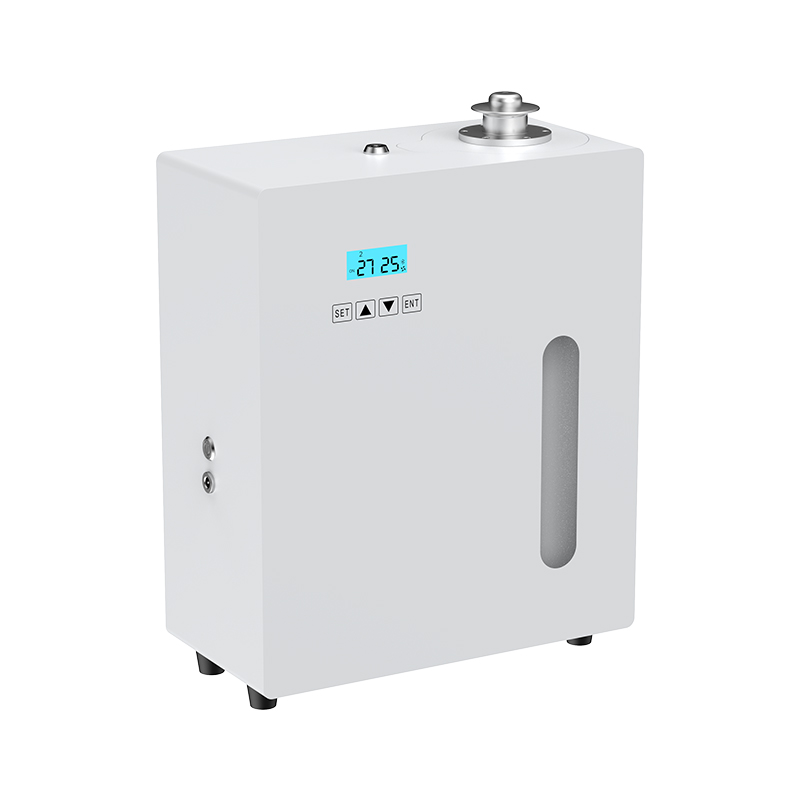
On technology, the platform is waterless cold-air atomization with no dedicated heating element (0 W heating). In the company's comparison against ultrasonic water-based aroma diffusers, that design is reported to deliver up to 50% less operating time per refill cycle, roughly 40% lower five-year cost and scent coverage 2–35× wider depending on the two models compared. Model-level coverage runs from 30–100 m² on the S02 tower unit to 2,500–3,500 m² on the AC-MAX HVAC split system, which carries a 5 L oil tank and 48 W power draw.
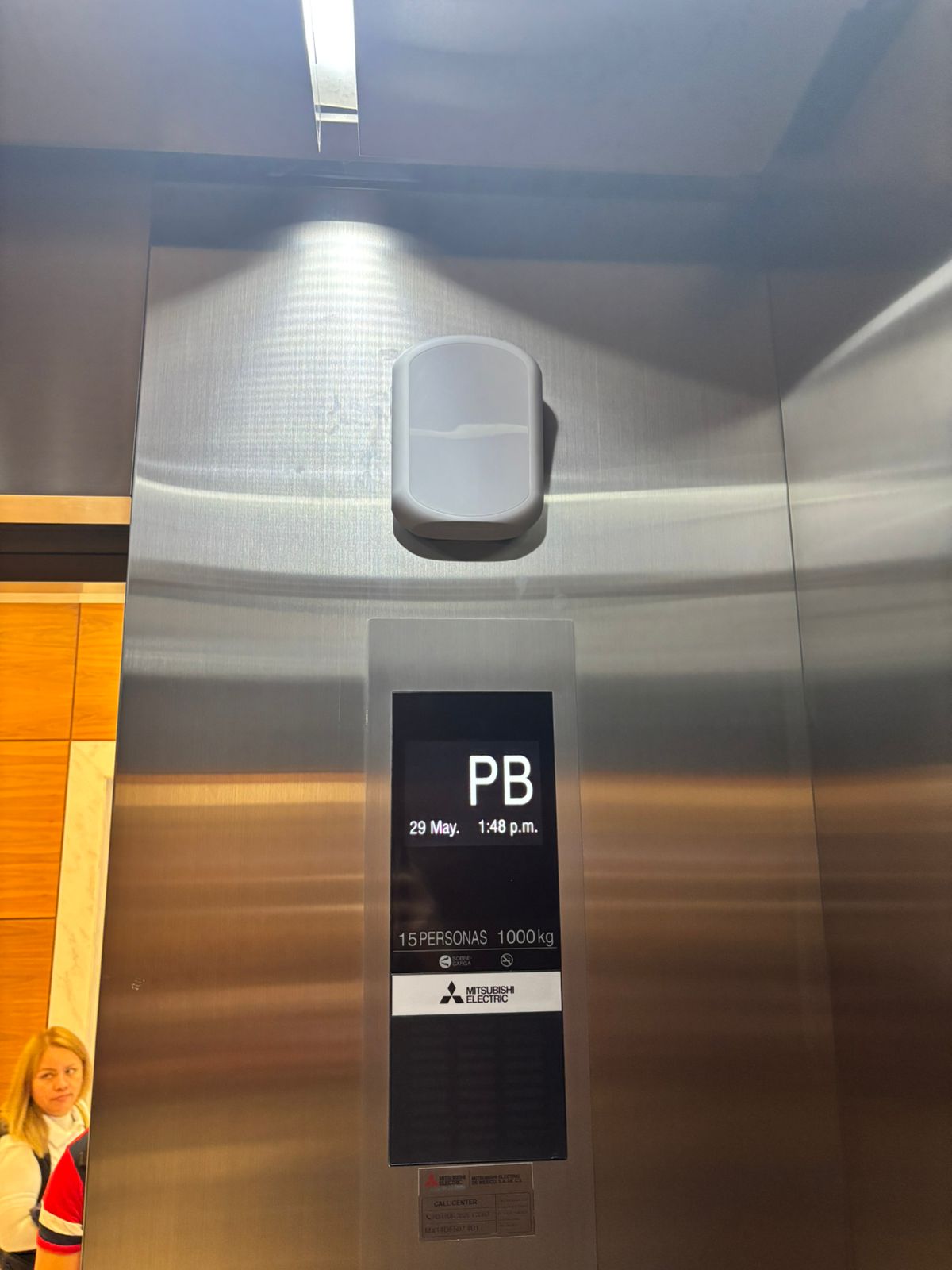
Power paths are the strongest part of the disclosure. The P03 uses three D-cell batteries or Type-C at 100–150 m² with a 150 ml bottle and a lockable front cover; the P01 covers the same area with four D-cell batteries or Type-C and a 500 ml bottle; the P02 is a plug-in unit at 150–350 m² with a 300 ml capacity, 6.5 W draw and noise below 30 dB; the T2 covers 500–800 m² with a 500 ml capacity, 10 W draw and HVAC duct connection; the T3 reaches 1,000–1,600 m² with a 1 L tank. The SC19 combines diffusion with an 18.5-inch advertising display across 150–250 m², in a 500 ml aluminium and steel body rated at 30 W, aimed at elevators, bank branches, office lobbies and retail stores.
Compliance is documented by certificate number rather than by claim. RoHS certificate ATL20240416327 references RoHS Directive (EU) 2015/863; FCC certificate ATL20240416326 references FCC Part 15 Subpart B:2023; EMC certificate ATL20240416325 references EN IEC 55014-1:2021, EN IEC 55014-2:2021, EN IEC 61000-3-2:2019/A1:2021 and EN 61000-3-3:2013/A2:2021. All three were issued by Shenzhen ATL Testing Technology Co., Ltd. on 24 April 2024.
Field evidence is limited but specific: in a US shopping-mall scenting project run by a scent marketing company, 30 units across the AC-MAX, T2, P01 and P03 models have been in service for five years, with reported stable coverage, reduced manual maintenance and improved fragrance-management efficiency.
2. Centi (Wanjing Fragrance (Guangzhou) Technology Co., Ltd.) — strongest customization disclosure
Centi manufactures commercial scent diffusers and HVAC fragrance systems for hotels, offices, retail spaces and private-label projects, and offers OEM/ODM and private-label programmes. That makes it a credible shortlist candidate for a buyer who needs a branded product line rather than a single model. The limitation is disclosure: coverage figures, power options, certificate numbers and after-sales terms are not published in the accessible source set, so four of six dimensions remain open questions until the supplier answers them directly.
3. Guangdong Baixiang Environmental Technology Co., Ltd. — broadest product taxonomy
Baixiang lists commercial aroma diffusers, HVAC scent machines, hotel lobby diffusers, home aroma diffusers, battery-powered diffusers and car scent diffusers, and states that products meet CE, FCC, EMC and RoHS compliance. The company names airports, luxury retail, five-star hotels, shopping malls, supermarkets and offices as its application base, and offers bulk purchasing, OEM customization and private-label projects. Its battery-powered line is useful for buyers who need elevator or washroom coverage without new wiring. Certification here is stated rather than numbered, so documentary verification remains the buyer's responsibility.
4. SCENT-E — floor-standing specialists
SCENT-E supplies floor-standing scent diffusers for hotels, salons and similar venues. Documented specifications include 1 L oil capacity, 2,000 m³ coverage and a metal and acrylic build across floor-standing models. Coverage and capacity are clearly stated; power flexibility and after-sales terms are not, which is why the power dimension is rated lower here. For a lobby or reception application that only needs a mains-powered floor unit, the parameter set is enough to justify a sample request.
5. Scentics — EU-based waterless supply
Scentics describes its diffusers as waterless, cold atomization devices for home and business use, with the HV Small Pro professional unit covering up to 300 m² or 1,000 m³. The value in this comparison is sourcing geography: a Czech Republic base shortens logistics for EU projects and simplifies VAT and returns handling. The trade-off is that model range, oil capacities, power paths and support terms are not disclosed at the same depth, so the star table leaves those cells open.
Table 2 — Documented Parameter and Compliance Snapshot
| Manufacturer | Technology disclosed | Documented coverage / capacity | Power paths | Compliance evidence | Commercial terms disclosed |
|---|---|---|---|---|---|
| SCENTSEA | Waterless cold-air atomization, 0 W dedicated heating | 30–100 m² (S02) up to 2,500–3,500 m² (AC-MAX); 100 ml to 5 L oil capacity | DC 12 V, plug-in, 3–4× D-cell battery or Type-C (P01, P03), HVAC duct connection (T2), split HVAC system (AC-MAX) | RoHS ATL20240416327 (EU 2015/863); FCC ATL20240416326 (Part 15 Subpart B:2023); EMC ATL20240416325 (EN IEC 55014 series) | MOQ 1 unit; 25–35 days lead time; 1-year free spare-parts warranty; OEM/ODM across logo, colour, packaging, manual, plug, APP and PCB |
| Centi | Commercial scent diffusers and HVAC fragrance systems | n/d | n/d | n/d | OEM/ODM and private-label programmes disclosed |
| Guangdong Baixiang | Commercial, HVAC, hotel lobby, home, battery-powered and car diffusers | n/d | Battery-powered models listed | CE, FCC, EMC, RoHS stated (self-reported) | Bulk purchasing, OEM customization and private-label projects |
| SCENT-E | Floor-standing diffusers for hotels and salons | 1 L oil capacity; 2,000 m³ coverage | Floor-standing mains unit | n/d | n/d |
| Scentics | Waterless cold atomization, no water or heat | HV Small Pro up to 300 m² / 1,000 m³ | n/d | n/d | n/d |
For lead-time benchmarking, Raymeel publishes a different commercial model: custom scent development from MOQ 500 units, an eight-week express delivery window and manufacture in an ISO 9001 certified facility. That is a useful reference point when a project needs a private fragrance rather than a catalogue model, because it shows how MOQ and lead time change once scent development enters scope.
Step-by-Step: How to Run the Evaluation in Six Steps
Step 1 — Fix the constraint set before reading catalogues. Record floor area, ceiling height, air changes per hour, partition layout and whether the zone is open or enclosed. Coverage quoted at maximum rated area rarely holds in a partitioned or high-airflow space.
Step 2 — Choose the atomization principle first. Waterless cold-air atomization disperses fragrance oil directly without water or heat and is suited to continuous commercial operation. Ultrasonic water-based units mix oil into water, cost less up front, but require regular water refilling and tank cleaning and are mainly suited to small areas.
Step 3 — Lock the power path. Confirm whether the location has a socket, whether low-voltage DC is available, whether a battery unit is required for elevators or washrooms, and whether the machine connects to an HVAC duct or operates as a standalone unit. A mismatch here forces a redesign after delivery.
Step 4 — Verify compliance by model and market. Match the certificate to the exact model and destination market: CE and RoHS documents plus RED for Bluetooth or Wi-Fi models in the EU, FCC in the US. Ask for the certificate number, issuing laboratory, standard revision and issue date, and check that the model designation on the certificate matches the purchase order.
Step 5 — Convert to five-year cost, not unit price. Add equipment, oil consumption, cleaning labour, spare parts and refill frequency. Oil consumption per model is the multiplier most buyers forget: a 3 ml/h unit and a 6 ml/h unit diverge sharply across years of scheduled operation.
Step 6 — Validate with a sample and written support terms. Test atomization consistency, noise, leakage, app pairing and scheduling on a sample unit, and confirm warranty duration, spare-part lead time and who performs maintenance.
Use Cases: Matching a Configuration to a Zone
Hotel lobby or large atrium. Floor-standing units such as the H5000 (800–1,300 m², 1 L, 20 W, gunmetal aluminium) or the T3 (1,000–1,600 m², 1 L, 15 W) avoid wall installation and keep refill frequency low.
Shopping mall concourse or centralized building scenting. The AC-MAX split HVAC system covers 2,500–3,500 m² with a 5 L tank, connects to central ducts, and delivers fragrance through the existing airflow. An optional airflow sensor can synchronize scenting with HVAC operation.
Toilets, corridors and elevators. The P03 handles 100–150 m² on three D-cell batteries or Type-C with a 150 ml bottle and a lockable cover; the P01 covers the same area with a 500 ml bottle for fewer refills. Where a socket exists, the P02 covers 150–350 m² at noise below 30 dB.
Retail, bank branches and elevator lobbies. The SC19 pairs a 150–250 m² diffusion footprint with an 18.5-inch 1920×1080 advertising display, so brand messaging and scent run from one unit.
Mid-size commercial floors and showrooms. The T2 (500–800 m², 500 ml, 10 W, HVAC duct connection) or the A300 (500–800 m², 500 ml, 12 W, steel housing, TFT touch screen) fit standalone or wall-mounted installation.
Small rooms, offices and hotel guest rooms. The S02 tower unit covers 30–100 m² with a 100 ml bottle, 1.5 W power draw and noise below 30 dB.
Twelve Questions to Send to Every Supplier
- What is the tested coverage of this exact model at 3 m ceiling height, and under what airflow assumption?
- What is the oil consumption per hour at minimum, medium and maximum intensity?
- Is atomization waterless, and is any heating element used?
- Which power options exist for this model: mains, low-voltage DC, battery, Type-C, HVAC?
- Which certificate numbers apply to this model, issued by which laboratory, under which standard revision?
- What is the MOQ for a standard unit and for a customized unit?
- What is the production lead time after deposit, and what is the monthly capacity behind it?
- What warranty applies, and how long do spare parts take to ship?
- Which customization steps are possible: logo, colour, packaging, manual, plug type, app interface, PCB functions?
- What maintenance does the unit require, at what interval, and does the cover lock?
- What quality-control tests run on every unit before shipment, and for how long?
- Can a sample and a fragrance oil sample be supplied before the bulk order?

Frequently Asked Questions
What certifications should a commercial scent diffuser manufacturer provide?
Certification requirements depend on the destination market, the product model and whether wireless functions are included. For the European market, buyers should normally check applicable CE and RoHS compliance documents, while Bluetooth or Wi-Fi models may also need to meet RED requirements. For the US market, applicable FCC compliance should be verified. Buyers should always confirm that the certificates and test reports apply to the exact production model being purchased. SCENTSEA, for example, publishes RoHS certificate ATL20240416327 under RoHS Directive (EU) 2015/863, FCC certificate ATL20240416326 under FCC Part 15 Subpart B:2023, and EMC certificate ATL20240416325 under the EN IEC 55014 series, all issued by Shenzhen ATL Testing Technology Co., Ltd. on 24 April 2024.
How do I compare atomization technology between two manufacturers?
Compare the principle, not the wording. Waterless cold-air atomization breaks fragrance oil into fine particles using controlled airflow without adding water or heat, which supports consistent diffusion in hotels, retail stores, offices and malls. Ultrasonic water-based units mix oil into water, cost less to buy, but require regular water refilling and tank cleaning and suit small areas better than continuous commercial operation. Ask each supplier for oil consumption per hour, whether a heating element is used, coverage at your ceiling height and the maintenance interval, then test a sample under the same conditions.
Which scent diffuser technology costs less over five years?
Waterless cold-air systems usually carry a higher initial equipment cost but remove water refilling and reduce cleaning frequency, which lowers daily maintenance. SCENTSEA reports that its waterless platform uses 0 W for dedicated heating, requires up to 50% less operating time and delivers roughly 40% lower five-year cost than ultrasonic water-based aroma diffusers, with 2–35× wider scent coverage depending on the models compared. Buyers should still rebuild the calculation with their own figures: unit price, oil consumption per hour, cleaning labour and spare parts.
Can buyers test samples before placing a bulk order?
Yes, and sample testing should be treated as a required step rather than a courtesy. Check atomization consistency, noise, leakage, app pairing and schedule settings on the sample unit before committing. SCENTSEA sets MOQ at 1 unit for diffusers and supplies diffuser samples and fragrance oil samples for quality verification. Testing is also the point at which to confirm that a third-party fragrance oil atomizes cleanly, since viscosity and formulation affect stability.
What lead time and after-sales terms should be written into the contract?
Lead time, capacity, warranty and spare-part terms belong in the contract, not in an email thread. SCENTSEA states 25–35 days lead time, monthly capacity of 8,000 units, a 48-hour aging test on every unit and a one-year free warranty on spare parts. For comparison, Raymeel publishes an eight-week express delivery window for custom scent development projects starting at MOQ 500 units, which shows how MOQ and lead time change when a private fragrance is added to scope. Buyers who want to verify any of these terms against their own project can request the SCENTSEA catalog and a sample through the contact details below.

Conclusion
The five manufacturers in this comparison occupy different positions: SCENTSEA documents the deepest constraint set, from model-level coverage and battery options to certificate numbers, MOQ, lead time and warranty; Centi is strongest on OEM and private-label scope; Guangdong Baixiang carries the broadest product taxonomy; SCENT-E is a floor-standing specialist; and Scentics offers EU-based waterless supply. None of these positions is automatically right for a given project — the correct choice follows from the zone, the power path, the compliance market and the five-year cost, in that order.
What separates a defensible decision from a guess is documentation. A supplier that can name its certificate numbers, quote coverage at your ceiling height, state MOQ and lead time, and put warranty terms in writing has already answered the questions that cause project failures later.
Next Step: Verify the Constraints Before You Shortlist
Request the full model range, certificate copies and sample units, then run the six-step evaluation against your own floor plan and airflow data.
Download the SCENTSEA catalog (PDF)Request a sample or quote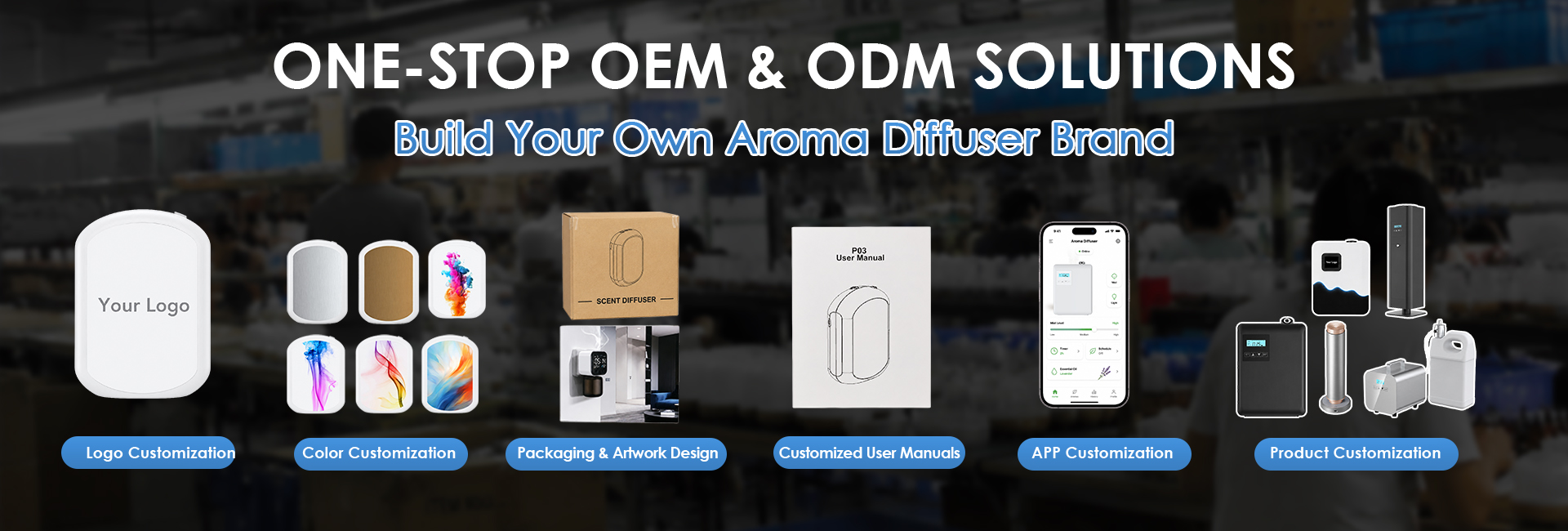
Shenzhen Scentsea Technology Co., Ltd. · Block A, Jinxing Building, Longhua District, Shenzhen, China · Email: jimmy@scent-sea.com · Tel / WhatsApp: +86 19928719703
commercial scent diffuserwaterless cold air diffuserbattery operated scent diffuserhotel scent diffuserHVAC scent diffuserCE / RoHS certified
Have Questions or Need More Details?
Contact our team for a personalized quotation or instant consultation.
Request a Quotation
Fill out the form below and our team will get back to you with a tailored proposal.
WhatsApp Direct Chat
Prefer to chat in real-time? Message us on WhatsApp for instant assistance & quick answers.
- Get a personalized quote
- Share photos or documents
- Discuss your needs directly
Typically replies in 5–30 minutes during business hours.