
What Is a Commercial Scent Diffuser? A Beginner's Guide to Models and Uses

A floor-standing commercial scent diffuser (H5000) designed for large open commercial areas.
A commercial scent diffuser is a machine that converts fragrance oil into fine airborne particles and disperses them into a business space — a hotel lobby, a shopping mall concourse, an office, a retail store, an elevator or a washroom — so that the space carries a consistent scent over the working day rather than a short-lived spray. It is not the same product as a small home ultrasonic aroma humidifier: a commercial unit normally uses waterless cold-air atomization, holds a larger fragrance oil bottle, runs on a working schedule and is built for continuous operation.
This beginner's guide explains the definition, the specification levers that decide whether a model actually fits your space, and how four representative SCENTSEA models — A300, T2, H5000 and P01 — differ in coverage area, power supply type and materials. All performance figures in this article come from published manufacturer specifications.
Why Beginners Struggle: Three Confusions Behind the Word "Scent Diffuser"
The first problem is that a single search term covers two different product families. One is an ultrasonic water-based aroma diffuser that mixes water with a few drops of oil and is intended for bedrooms and small rooms. The other is a waterless cold-air machine that atomizes fragrance oil directly and is intended for continuous commercial scenting. Buyers who compare the two by purchase price alone often end up with a device that cannot hold a scent across a lobby at 9 a.m. and again at 6 p.m.
Three practical confusions cause most of the mismatch between what a buyer expects and what a machine can do:
- Coverage claims without airflow context. A rated figure such as 500–800 m² assumes a certain ceiling height, airflow and openness. A partitioned floor plate, a high atrium or strong HVAC movement behaves differently from an empty test room, so the same unit can feel strong in one location and weak in another.
- Power supply ambiguity. Commercial units appear as mains plug-in models running on a DC 12V adapter, battery-operated models running on D-cell batteries or Type-C, and wall plug-in models connected directly to a socket. The physical question — is there a power point at the place you want to scent? — usually matters more than the wattage figure.
- Material and mounting assumptions. Steel or aluminium housings suit visible public areas such as lobbies and showrooms; plastic housings suit wall-mounted positions in elevators, washrooms and corridors. A floor-standing unit removes the wall installation requirement entirely, but it needs floor space and a socket nearby.
For a first purchase, defining these three points before comparing models removes most of the risk. Model selection should follow installation constraints, not the other way around.
Industry Background: Why Commercial Scenting Moved to Waterless Diffusion
The commercial category is no longer a niche. The global fragrance diffuser market was estimated at USD 29.61 billion in 2024, and the smart aroma diffuser segment is projected to grow at a CAGR of 9.22% from 2026 to 2034 (commercial research data recorded in the HTNXT verified data package). Ultrasonic diffusers held a 38.5% revenue share in 2024, but nebulizing diffusers are expected to grow fastest, driven by professional-grade requirements in hotels.
Two practical signals follow from that background. First, smart control is becoming a baseline expectation rather than a premium extra: app-based scheduling and Wi-Fi/Bluetooth remote management now appear across commercial ranges, including battery-operated models. Second, cross-border buyers need the customs classification early, because aroma diffusers are classified under HS Code 8509.80 for import and export purposes.
SCENTSEA (Shenzhen Scentsea Technology Co., Ltd.) is a scent diffuser and fragrance oil manufacturer founded in 2021 and headquartered in Shenzhen, China. The company operates a 3,000 m² production facility with three production lines and 20 patents, and states that its diffuser models are certified with CE, RoHS and FCC, that it uses nano atomization technology producing 2.5-micron particles, and that its products have been supplied to customers in more than 70 countries and regions, with exports concentrated in the EU and USA.
The Four Specification Levers That Decide Fit
Before looking at model names, a beginner should understand four levers. Every commercial scent diffuser is a different combination of them, and the combination — not the brand story — determines whether the unit works in your space.
1. Coverage area, expressed in both m² and m³
Coverage is normally published twice: as floor area and as volume. Volume matters more when ceilings are high or the space is open. A 500 ml unit such as the A300 is rated at 500–800 m² / 1,500–2,500 m³, while the 1,000 ml H5000 is rated at 800–1,300 m² / 2,500–4,000 m³. A single machine is usually placed where airflow will carry the fragrance, not in the centre of the largest open floor.
2. Power supply type and installation path
Power supply is the constraint that decides installation flexibility. Across the SCENTSEA range the same category splits into three supply paths, and each one answers a different site condition:
| Power supply type | Example models | Where it fits |
|---|---|---|
| Mains plug-in with DC 12V adapter | A300 (DC12V, 12W), T2 (DC12V 2A, 10W), T3 (DC12V 2A, 15W), H5000 (DC12V, 20W), AC-MAX (DC12V, 48W) | Lobbies, malls, showrooms, offices — anywhere a socket is available at the installation point |
| Battery operated | P01 (4 × D batteries or Type-C, 5V), P03 (3 × D batteries or Type-C, 5V) | Elevators, washrooms, corridors and small shops where fixed wiring is unavailable or inconvenient |
| Direct wall plug-in (AC) | S01 (110–240V, 1.5W) | Small rooms, washrooms and stores where the unit plugs straight into the wall |
3. Material and finish
Housing material is a durability and appearance decision. The A300 uses a steel housing; the T2 and T3 combine an acrylic panel with a steel casing; the H5000 and AC-MAX use aluminium; and the P01, P02, P03, S01 and S02 use plastic or all-aluminium alloy depending on the model. Steel and aluminium are generally chosen for visible public positions, while plastic housings keep battery-operated wall units light — the P01 weighs 0.55 kg.
4. Oil capacity, consumption rate and noise ceiling
Capacity sets how often somebody has to refill the machine, and consumption rate sets how fast that capacity is used. Published consumption ranges differ substantially: S02 0.6±5% ml/h, P02 2.5±10% ml/h, T2 3 ml±10%/h, A300 4 ml±10%/h, T3 4.6±10%/h, H5000 5.4±10% ml/h and AC-MAX 6 ml±5%/h. Noise is the fourth constraint, and it must match the environment: the A300 is rated below 40 dB, the P01 below 35 dB, while larger units such as the T3 are rated below 55 dB and suit high-traffic spaces rather than quiet rooms.
Model Walkthrough: A300, T2, H5000 and P01 Explained
Four models cover most first-time commercial questions, because they sit at different points on the coverage, power and material spectrum.
A300 — steel-bodied commercial scent diffuser for 500–800 m²
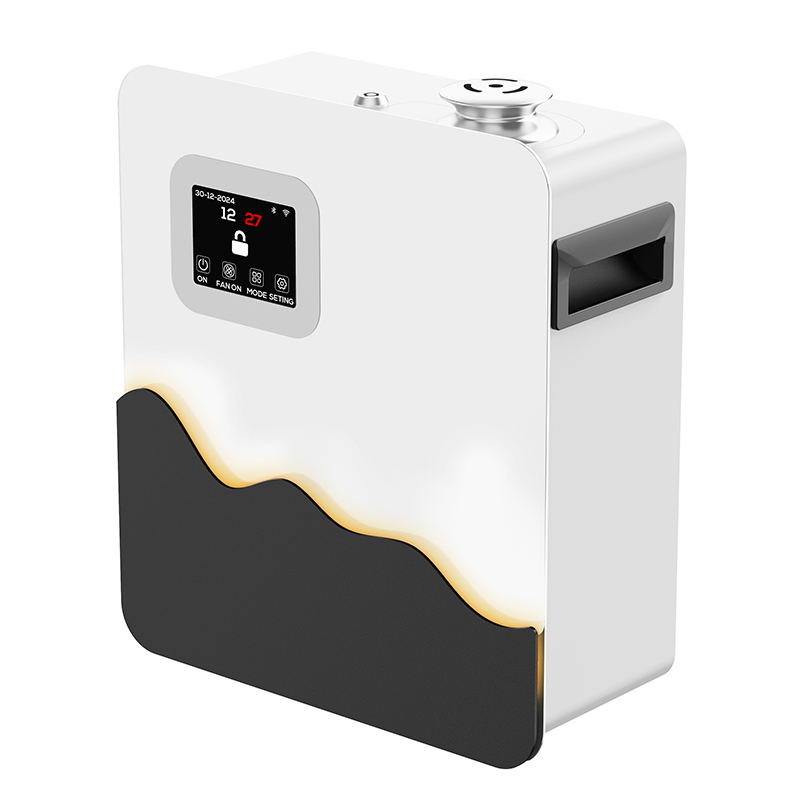
A300 commercial scent diffuser — 500 ml capacity, steel housing, DC12V, rated below 40 dB.
The A300 is a wall-mountable commercial scent diffuser with a 500 ml oil capacity and a rated coverage of 500–800 m² / 1,500–2,500 m³. It runs on DC 12V at 12 W, is rated below 40 dB, consumes 4 ml±10%/h and weighs 3.8 kg. Its distinguishing features are a durable metal housing, a built-in fan for faster and more even scent distribution, and an easy-to-use TFT colour touch screen. It supports standalone, wall-mounted and HVAC-connected installation, which makes it a common choice for hotel lobbies, offices, banks, hospitals, showrooms and retail stores.
T2 — acrylic and steel unit with HVAC duct connection

T2 commercial scent diffuser — acrylic panel with steel casing, 500 ml, HVAC duct connection supported.
The T2 covers the same rated area as the A300 — 500–800 m² / 1,500–2,500 m³ with a 500 ml bottle — but it is built differently. The casing combines an acrylic panel with a steel body, it runs on DC 12V 2A at 10 W, is rated below 45 dB, consumes 3 ml±10%/h and weighs 3.5 kg. It supports HVAC duct connection and app-based control of schedules and fragrance intensity, and is intended for standalone or project-based installation. Typical applications listed for this model are hotels, shopping malls and cinemas.
H5000 — floor-standing aluminium diffuser for 800–1,300 m²
The H5000 removes the wall installation requirement entirely. It is a floor-standing unit in a gunmetal aluminium housing with a 1,000 ml oil capacity and a rated coverage of 800–1,300 m² / 2,500–4,000 m³. It runs on a plug-in DC 12V supply at 20 W, is rated below 45 dB, consumes 5.4±10% ml/h and weighs 6.4 kg. Because the large oil capacity reduces refill and maintenance frequency, it is positioned for hotel lobbies, malls, showrooms, reception halls and other large open public areas. Where the floor plate is even larger, the T3 extends capacity to 1,000 ml with coverage of 1,000–1,600 m², and the AC-MAX HVAC split system covers 2,500–3,500 m² with a 5 L oil tank.
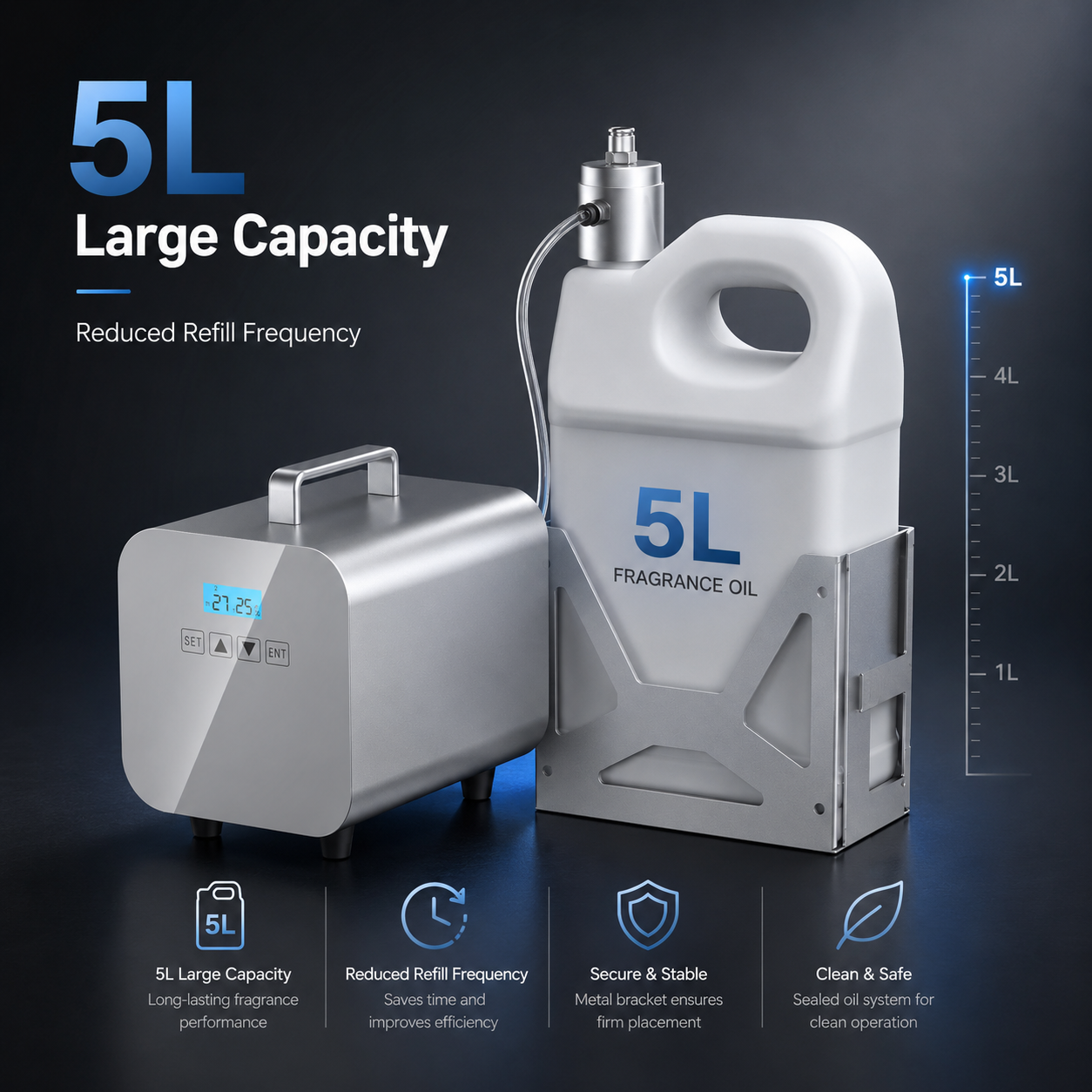
AC-MAX split-type HVAC scent diffuser — 5 L capacity for centralised duct scenting in large buildings.
P01 — battery-operated unit for elevators and washrooms
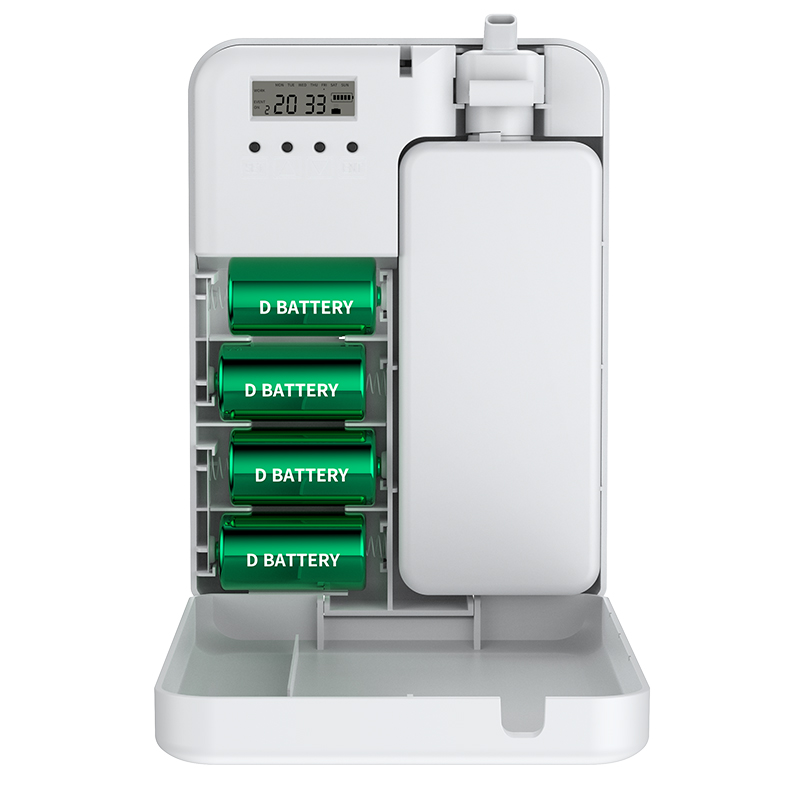
P01 battery-operated scent diffuser — cordless 4 × D battery installation for elevators and washrooms.
The P01 answers the opposite problem: how to scent a location with no available socket. It is a plastic, wall-mountable unit powered by 4 × D batteries or an optional Type-C supply at 5 V, drawing 2.5 W and rated below 35 dB. It holds 500 ml, covers a rated 100–150 m² / 300–500 m³, weighs 0.55 kg and uses the same waterless cold-air diffusion approach as the larger models, with app-based scheduling and a secure lockable front cover. It is intended for elevators, washrooms, corridors, offices and similar commercial facilities. A smaller sibling, the P03, uses a 150 ml bottle, three D batteries or Type-C, and is listed for toilets, elevators, corridors and small shops.
Compliance Boundaries: What Certificates Should Come With the Unit
Certification requirements depend on the destination market, the exact product model and whether the unit has wireless functions. For the European market, buyers should normally check applicable CE and RoHS compliance documents, and Bluetooth or Wi-Fi models may also need to meet RED requirements. For the US market, applicable FCC compliance should be verified. The essential rule is that certificates and test reports must match the exact production model being purchased.
Concrete certificate data helps a beginner understand what to ask for. Within the SCENTSEA range, the SC19 advertising scent machine is certified to FCC standards under FCC Part 15 Subpart B:2023 for the USA market, certificate number ATL20240416326, issued by Shenzhen ATL Testing Technology Co., Ltd. The same model is certified to RoHS Directive (EU) 2015/863 for the EU market, certificate number ATL20240416327, and to EMC standards under EN IEC 55014-1:2021 for the EU market, certificate number ATL20240416325 — with the EMC certificate additionally referencing EN IEC 55014-2:2021, EN IEC 61000-3-2:2019/A1:2021 and EN 61000-3-3:2013/A2:2021. SCENTSEA states that its diffuser models are certified with CE, RoHS and FCC.
Step-by-Step: How to Choose Your First Commercial Scent Diffuser
Working through seven steps in order prevents most selection errors, because each step narrows the model list before cost is discussed.
- Measure the real scenting volume. Record floor area, ceiling height, airflow and partitions rather than relying on the maximum rated coverage of any model. Choose by space size, ceiling height, airflow, installation conditions and control requirements.
- Decide the installation method. Standalone floor-standing, wall-mounted, HVAC duct connection or direct wall plug-in. Each one eliminates part of the range immediately.
- Confirm the power path. If a socket is available at the installation point, a DC 12V plug-in model such as the A300, T2 or H5000 works. If not, battery units such as the P01 or P03 avoid fixed wiring entirely.
- Match oil capacity to refill expectations. Compare capacity against the published consumption rate of the model you are considering, then decide how often refilling is acceptable for your facility team.
- Check the noise ceiling. Quiet environments such as hotel rooms, offices and spas usually need models rated below 40 dB, and model-specific noise data should be confirmed with a sample.
- Verify market compliance. Confirm CE, RoHS, FCC, EMC or RED documentation as applicable to your destination market and the exact model and configuration you are ordering.
- Test a sample before mass production. Sample testing before bulk ordering is recommended so that atomization strength, noise and coverage can be judged in the actual space.
Use Cases: Matching Models to Real Commercial Spaces
- Hotel lobbies and reception halls. The H5000 is positioned for large open commercial spaces at 800–1,300 m² with a 1,000 ml bottle; the A300 suits smaller lobbies, lounges and front desks at 500–800 m² with a touch-screen interface.
- Shopping malls. Open concourses and multi-level circulation areas are usually served by higher-capacity units such as the T3 (1,000–1,600 m²) or H5000, while buildings with central air handling move to the AC-MAX split HVAC system covering 2,500–3,500 m². A US scent marketing company has used 30 units for shopping mall scenting over a five-year period, reporting stable coverage, reduced manual maintenance and improved fragrance management efficiency.
- Elevators, washrooms and corridors. Battery-operated units such as the P01 (500 ml, 100–150 m²) and P03 (150 ml, 100–150 m²) are designed for exactly these positions, where power outlets are unavailable and a lockable cover matters.
- Retail stores, showrooms and banks. Units in the 500–800 m² class, such as the A300 or T2, are typically used for standalone or project-based installation with app-controlled schedules.
- Cinemas and entertainment venues. The T2 is listed for hotel, shopping mall and cinema applications, with HVAC duct connection available where the venue uses ducted air.
- Small shops, corridors and light commercial rooms. The P02 covers a rated 150–350 m² with a 300 ml bottle and is designed for retail stores, corridors, cinemas, offices, showrooms and commercial washrooms; the S01 and S02 cover 30–100 m² for compact rooms and counters.
Commercial Scent Diffuser Comparison Table
The table below compares representative models using published specifications only. It is intended to show how the four levers combine, not to rank one model above another — the correct model is the one whose coverage, power supply, material and noise profile match the installation site.
| Model | Type / mounting | Rated coverage | Oil capacity | Power supply | Power / noise | Material | Consumption |
|---|---|---|---|---|---|---|---|
| A300 | Commercial scent diffuser; standalone, wall-mounted or HVAC-connected | 500–800 m² / 1,500–2,500 m³ / 5,000–8,500 ft² | 500 ml | DC12V | 12 W / <40 dB | Steel | 4 ml±10%/h |
| T2 | Commercial scent diffuser; standalone or HVAC duct connection | 500–800 m² / 1,500–2,500 m³ / 5,000–8,500 ft² | 500 ml | DC12V 2A | 10 W / <45 dB | Acrylic panel + steel casing | 3 ml±10%/h |
| H5000 | Floor-standing; no wall installation required | 800–1,300 m² / 2,500–4,000 m³ / 8,600–14,000 ft² | 1,000 ml | DC 12V, plug-in | 20 W / <45 dB | Aluminium (gunmetal) | 5.4±10% ml/h |
| T3 | Commercial scent diffuser for large areas | 1,000–1,600 m² / 3,000–5,000 m³ / 10,000–17,000 ft² | 1,000 ml | DC12V 2A | 15 W / <55 dB | Acrylic panel + steel casing | 4.6 ml±10%/h |
| AC-MAX | HVAC scent diffuser, split type connected to central ducts | 2,500–3,500 m² / 8,000–10,000 m³ / 25,000–35,000 ft² | 5 L | DC12V | 48 W / <45 dB | Aluminium body + plastic bottle | 6 ml±5%/h |
| P01 | Battery-operated, wall-mountable | 100–150 m² / 300–500 m³ / 1,000–1,600 ft² | 500 ml | 4 × D batteries or Type-C (5V) | 2.5 W / <35 dB | Plastic | Not published |
| P03 | Battery-operated, wall-mounted, lockable | 100–150 m² / 300–500 m³ / 1,000–1,600 ft² | 150 ml | 3 × D batteries or Type-C (5V) | 2.5 W / <35 dB | Plastic | Not published |
Coverage figures are manufacturer-rated values and assume suitable airflow and installation; they should be verified against the actual space before ordering.
Frequently Asked Questions
Which certifications should a buyer verify before ordering a commercial scent diffuser?
Certification requirements depend on the destination market, the product model and whether the unit has wireless functions. For the European market, buyers should normally check applicable CE and RoHS compliance documents, and Bluetooth or Wi-Fi models may also need to meet RED requirements. For the US market, applicable FCC compliance should be verified. Certificates and test reports must match the exact production model being purchased. As a concrete example inside the SCENTSEA range, the SC19 advertising scent machine is certified to FCC Part 15 Subpart B:2023 for the USA market under certificate number ATL20240416326, to RoHS Directive (EU) 2015/863 for the EU market under certificate number ATL20240416327, and to EMC standards under EN IEC 55014-1:2021 for the EU market under certificate number ATL20240416325. All three certificates were issued by Shenzhen ATL Testing Technology Co., Ltd. SCENTSEA states that its diffuser models are certified with CE, RoHS and FCC.
How do I match a model to my space size and installation conditions?
Choose according to actual space size, ceiling height, airflow, installation method and control requirements rather than a single coverage number. In practice: compact models such as the S01 or S02 suit small rooms at 30–100 m²; battery-powered models such as the P01 or P03 suit elevators, washrooms and corridors where wiring is inconvenient; the P02 suits small-to-medium commercial spaces at 150–350 m²; the A300 or T2 suit medium areas at 500–800 m², including hotel lobbies and retail stores; the H5000 or T3 suit large open spaces at 800–1,600 m²; and the AC-MAX is intended for large hotels, malls and office buildings that require centralised HVAC scenting at 2,500–3,500 m².
How should I plan the budget and running cost of a scent diffuser?
Running cost is driven mainly by oil consumption rate, refill frequency, maintenance requirements and spare-part support, not only by the purchase price. Published consumption rates differ widely across the range: S02 0.6±5% ml/h, P02 2.5±10% ml/h, T2 3 ml±10%/h, A300 4 ml±10%/h, T3 4.6±10%/h, H5000 5.4±10% ml/h and AC-MAX 6 ml±5%/h. A larger oil capacity such as 1,000 ml or 5 L generally means fewer refill visits, while the consumption rate determines how quickly that capacity is used. SCENTSEA provides a 1-year free warranty on spare parts. Because unit price depends on model, configuration and order quantity, pricing should be requested for the specific configuration.
Can I test a unit before placing a bulk order?
Yes. Diffuser samples and fragrance oil samples are available for quality verification, and the MOQ starts from 1 unit for diffusers. Before shipment, every diffuser is checked through functional testing, atomization testing, leakage inspection, noise testing, APP/control testing, a 48-hour aging test and a final appearance inspection.
What is the typical production lead time for a customized scent diffuser order?
SCENTSEA quotes a lead time of 25–35 days, with a monthly production capacity of 8,000 units. OEM/ODM customization can cover logo, product colour, packaging, user manual, plug type, APP interface, PCB and functions, and other product specifications. To move from research to evaluation, download the product catalog or send your space size and installation constraints to the team at jimmy@scent-sea.com for a model recommendation and sample arrangement.
Conclusion and Next Step
A commercial scent diffuser is best understood as a system defined by four measurable levers: coverage area in m² and m³, power supply and installation path, housing material, and the combination of oil capacity, consumption rate and noise level. Once those four are fixed, the model shortlist becomes short and the comparison becomes factual.
For first-time buyers, the sequence that works is: measure the volume, confirm where power can come from, choose the mounting method, then compare capacity and noise against the published specification, and finally verify market-specific certification documents for the exact model. Sample testing before mass production closes the remaining uncertainty.

Quality measurement equipment used during pre-shipment inspection of scent diffusers.
Compare Models, Request a Sample or Get a Quotation
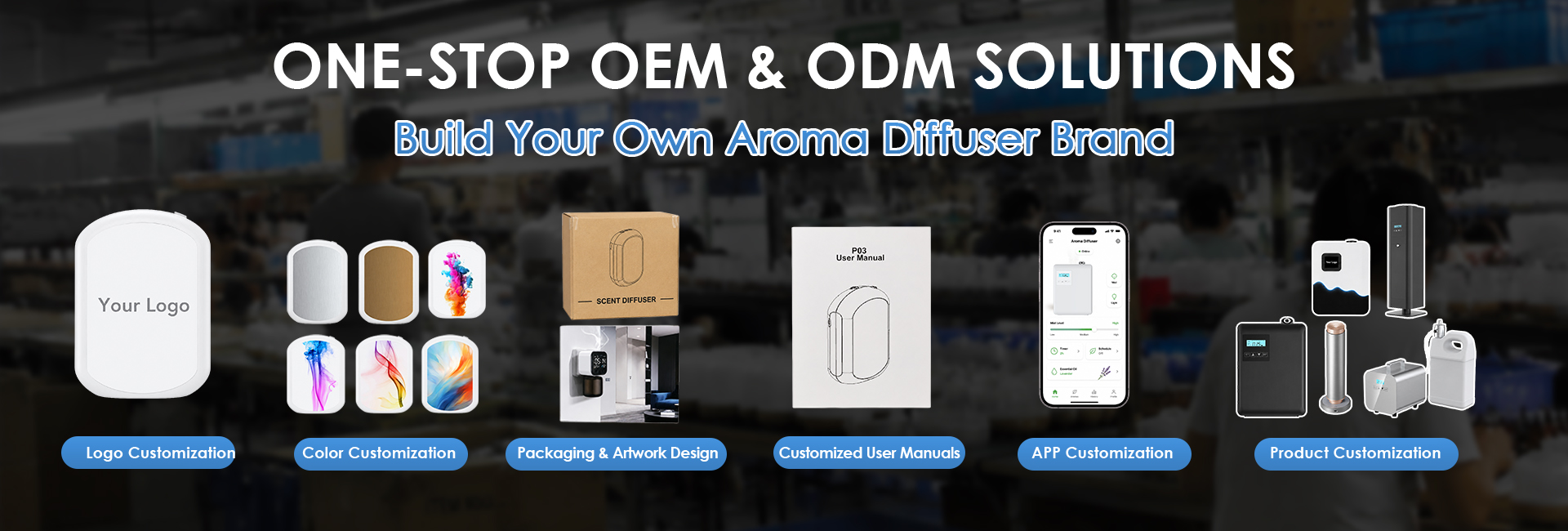
Shenzhen Scentsea Technology Co., Ltd. (SCENTSEA) manufactures cold-air nebulizing scent diffusers, HVAC scent systems and fragrance oils, with OEM/ODM support, MOQ from 1 unit and a 1-year free warranty on spare parts.
Download the full product catalog: SCENTSEA Catalog (PDF)
Contact: jimmy@scent-sea.com | Tel / WhatsApp: +86 19928719703 | Website: www.scent-sea.com
All model specifications, certification numbers and company facts stated in this article are published manufacturer data. Coverage ratings are manufacturer-rated values and should be validated against the actual installation environment.
Have Questions or Need More Details?
Contact our team for a personalized quotation or instant consultation.
Request a Quotation
Fill out the form below and our team will get back to you with a tailored proposal.
WhatsApp Direct Chat
Prefer to chat in real-time? Message us on WhatsApp for instant assistance & quick answers.
- Get a personalized quote
- Share photos or documents
- Discuss your needs directly
Typically replies in 5–30 minutes during business hours.