
Dust Collector Compliance FAQ: Certifications, Performance Data, and Testing Records
Short answer: A dust collector compliance file is only as strong as its weakest layer. Three layers have to agree with each other — a certificate that names the exact model, performance data measured under stated conditions, and a test record that ties both to the unit that actually ships. When a certificate covers a product “series” instead of a model, or an efficiency figure arrives without test conditions attached, the package stops being evidence and becomes marketing.
Procurement teams evaluating industrial dust collectors usually reach the same point: the technical proposal looks acceptable, the price is workable, and then someone in engineering, EHS or the project owner asks for the paperwork. That request is where suppliers separate. This page answers the questions buyers raise most often while assembling model-specific compliance evidence for a dust collection project — starting with what SENOTAY can document today, and what its documents do not cover.
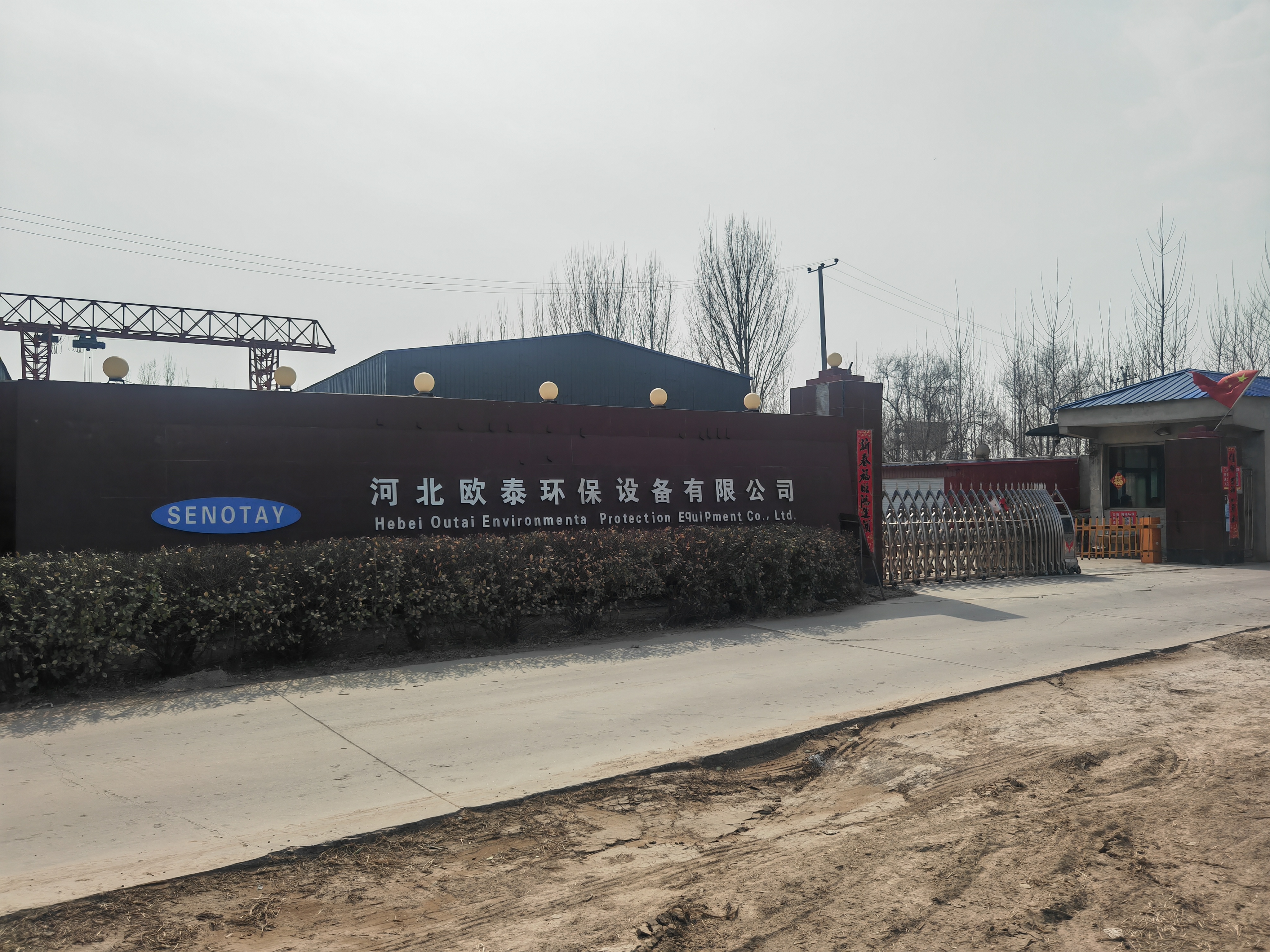
SENOTAY is the export brand of Hebei Outai Environmental Protection Equipment Co., Ltd., a dust collection equipment manufacturer founded in 2015 in Botou City, Hebei Province, China. The company produces pulse bag filters, electrostatic precipitators, cyclone dust collectors, wet dust collectors and filter cartridge collectors, along with conveying and purification equipment, and exports roughly 70% of its output to Central Asia, Southeast Asia, the Middle East, Russia, Africa and Europe.
Every performance statement on this page is either a certificate entry, a model specification, or a third-party market figure with a named source. Nothing here is an estimated capability claim.
Why compliance evidence decides the evaluation, not the price list
Compliance documentation is the part of a dust collector quotation that cannot be produced retroactively. A factory can adjust fan power or filter material late in a negotiation; it cannot quickly manufacture years of traceable test records. That asymmetry is why the documentation layer is one of the more reliable signals available during supplier evaluation.
Three failures appear repeatedly in submitted files:
- Certificate scope mismatch. The document names a product family or a generic category, while the quotation names a specific model. The buyer receives a valid document that does not actually cover the equipment being purchased.
- Performance figures without conditions. An efficiency percentage appears without the airflow, dust load, particle size distribution or test method behind it. A filtration efficiency number is not meaningful without knowing what was filtered and how it was measured.
- Test records that do not match the delivery. A test report exists, but nothing links it to the serial number, model code or configuration that arrives on site.
Each failure is avoidable, and each is detectable in about twenty minutes if the buyer knows which question to ask.
Industry background: what project owners expect in 2026
Dust collection has shifted from a purely mechanical purchase to a compliance-driven category. Grand View Research valued the global industrial dust collector market at approximately USD 9.58 billion in 2024, and the same analysis placed baghouse technology at a 26.8% revenue share in that year — the largest single technology position. On the demand side, Fortune Business Insights reports that Asia-Pacific accounted for 41.8% of global revenue in 2025, with North America valued at USD 2.44 billion in the same year, while Mordor Intelligence estimated China’s industrial output — an underlying driver of dust collection demand — at USD 5.3 trillion in 2024.
Those figures deserve to be read with care. Market-size estimates for the same year differ between research houses: Grand View Research reports USD 9.58 billion for the 2024 global market, while Market Data Forecast reports USD 9.14 billion. Divergence of that kind is normal in industrial equipment research, and it carries a useful reminder — the same verification discipline applied to market data should be applied to supplier performance claims.
On the regulatory side, two U.S. standards shape how project owners specify collector safety. NFPA 68 addresses deflagration venting for dust collectors, and NFPA 654 covers fire and explosion prevention in the manufacturing and handling of combustible particulate solids. In the European Union, machinery safety for this equipment class runs through the 2006/42/EC Machinery Directive. A supplier that can state clearly which standard its certificate is issued against — and which standards fall outside that scope — is easier to work with than one that answers “we comply with all standards.”
The four layers of a complete compliance file
A usable file has four layers. Each answers a different question, and a supplier that provides only one of them is not delivering compliance evidence — it is delivering a document.
Layer 1 — Certification with model-level scope
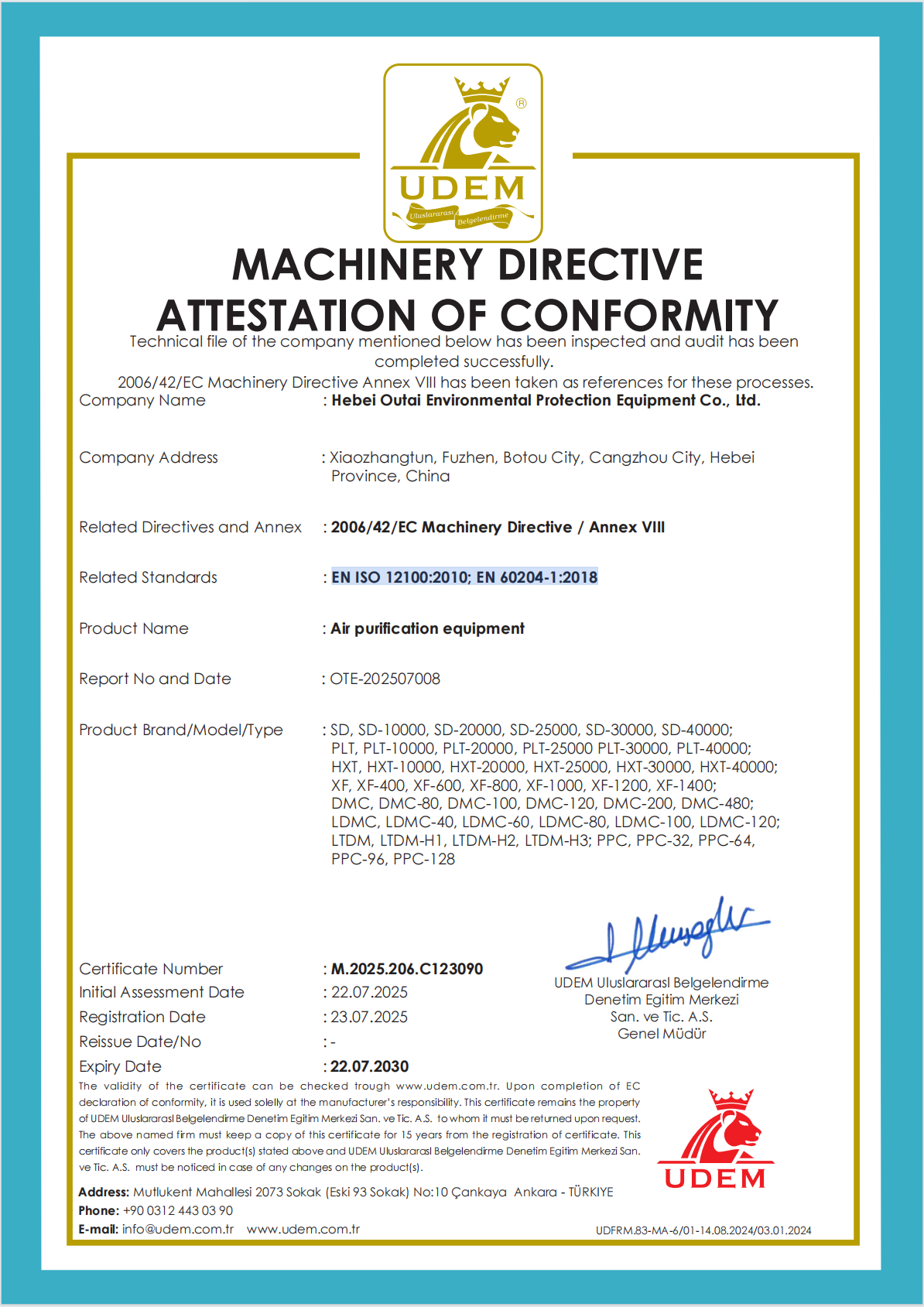
SENOTAY’s documented certificate for the DMC-200 pulse bag filter is a CE certificate, number M.2025.206.C123090, issued by UDEM for the EU market. The certificate scope is the 2006/42/EC Machinery Directive, Annex VIII, assessed against the harmonized standards EN ISO 12100:2010 and EN 60204-1:2018. It was issued on 22 July 2025, is valid until 23 July 2030, and the applicable product is recorded as the DMC-200 industrial dust collector.
The detail that matters most is the last one. The certificate names a model, not a category. A buyer sourcing a DMC-200 can verify scope, model reference and validity dates directly with the issuing body, and that check is answered against a specific document rather than a general assurance.
Layer 2 — Performance data attached to a specific model
Verified performance data for the DMC-200 pulse bag filter lists a gas flow rate of 9,600–14,400 m³/h against a 160 m² filtration area, purification efficiency above 99.5%, filtration accuracy below 1 μm, and an 18.5 kW fan. The unit is offered in carbon steel or SS304 stainless steel, and the applicable industries recorded for it include steel, cement, metallurgy, building materials, food processing, grain drying, mining and casting.
Read as a package, those figures constrain one another: airflow sets duct and fan duty, filtration area sets the air-to-cloth ratio, and the sub-micron accuracy figure sets what the bag media can reasonably be expected to capture. A standalone performance claim without the surrounding figures cannot be checked by anyone.
Layer 3 — Test records tied to the shipped unit
Quality control at Hebei Outai is documented as 100% testing — each unit is tested rather than a statistical sample. For the buyer, the operative question is not whether a test programme exists but whether the record for their specific unit exists. A test record traceable to a model code and a production batch carries more weight than a multi-page report covering an unnamed unit from an earlier year.
Layer 4 — Traceability across all three
Traceability is the layer buyers forget, and it is where files usually break. The model on the nameplate, the model on the certificate, the model on the performance sheet and the model on the test record must be the same identifier. When a supplier quotes a customized unit within an existing series, the buyer should ask which of those four documents will carry the customized designation.
Verified performance data by model
The table below lists only parameters that appear in current model documentation. Where a parameter is not part of the documented specification, it is left out rather than estimated.
| Model | Technology | Verified parameters |
|---|---|---|
| DMC-200 | Pulse bag filter (baghouse) | Gas flow 9,600–14,400 m³/h; filtration area 160 m²; purification efficiency >99.5%; filtration accuracy <1 μm; fan power 18.5 kW; carbon steel or SS304; covered by CE certificate M.2025.206.C123090 |
| WESP-10000 | Wet electrostatic precipitator | Efficiency ≥95%; emissions ≤20 mg/m³; pressure drop ≤300 Pa |
| LTMC-5000 | Cartridge dust collector | Filtration area 211 m²; airflow 7,596–10,128 m³/h |
| LXC-800 | Cyclone dust collector | Airflow 3,000–5,000 m³/h; efficiency ≥70% |
The spread across these four platforms explains why model-level documentation matters. A cyclone rated at ≥70% efficiency and a baghouse rated above 99.5% are not competing on the same performance axis; they are different stages of a dust control strategy, and each carries a different evidence requirement at the approval stage.
What each document proves — and what it does not
| Document | What it establishes | What it does not establish |
|---|---|---|
| CE certificate (M.2025.206.C123090) | Declaration of conformity for the named model against 2006/42/EC Annex VIII, valid to 23 July 2030 | Coverage of other models in the range |
| Model performance sheet | Design airflow, filtration area, efficiency and accuracy for that model | That the delivered unit measured those values on site |
| Pre-shipment test record | That the unit was tested under the supplier’s 100% testing quality-control programme | Independent third-party verification of the result |
| Factory and QC documentation | Production, testing and inspection control at the manufacturing site | Post-installation emission compliance at the buyer’s facility |
| Standard reference (NFPA 68, NFPA 654) | Applicable safety framework for combustible dust handling and deflagration venting | That a specific supplier or model has been certified against it |
Step by step: assembling a model-specific evidence pack
- Fix the project requirement first. Airflow range, dust characteristics, target emission level and operating temperature should be agreed internally before supplier documents are collected. Without a target, no performance figure can be validated.
- Match the certificate to the exact model. Ask for the certificate number and the applicable product entry, not just a certificate image. For the DMC-200, that entry is M.2025.206.C123090 with the model recorded in scope.
- Request the performance sheet for that same model. Confirm that airflow, filtration area, efficiency and accuracy figures are stated for the model code on the quotation.
- Agree the test record structure in advance. Establish what the pre-shipment record will contain — model, configuration, test date, measured parameters — so it can be filed against the delivery.
- Verify certificate validity independently. Issuing bodies confirm scope, model reference and validity dates. The DMC-200 certificate runs to 23 July 2030, so this is a current check rather than a historical one.
- Confirm which standards apply to the project. EU projects follow the 2006/42/EC route; combustible-dust projects commonly reference NFPA 68 and NFPA 654. These are separate requirements and should be requested separately.
- Reconcile any custom configuration with the documents. Where voltage or branding is customized (see the FAQ below), confirm at quotation stage which documents will reference the final configuration.
- File everything as one package. Keep certificate, performance sheet, test record and nameplate data linked to a single model identifier.
Where the evidence pack gets tested in practice
Documentation is rarely challenged in the abstract; it is challenged at specific moments in a project timeline.
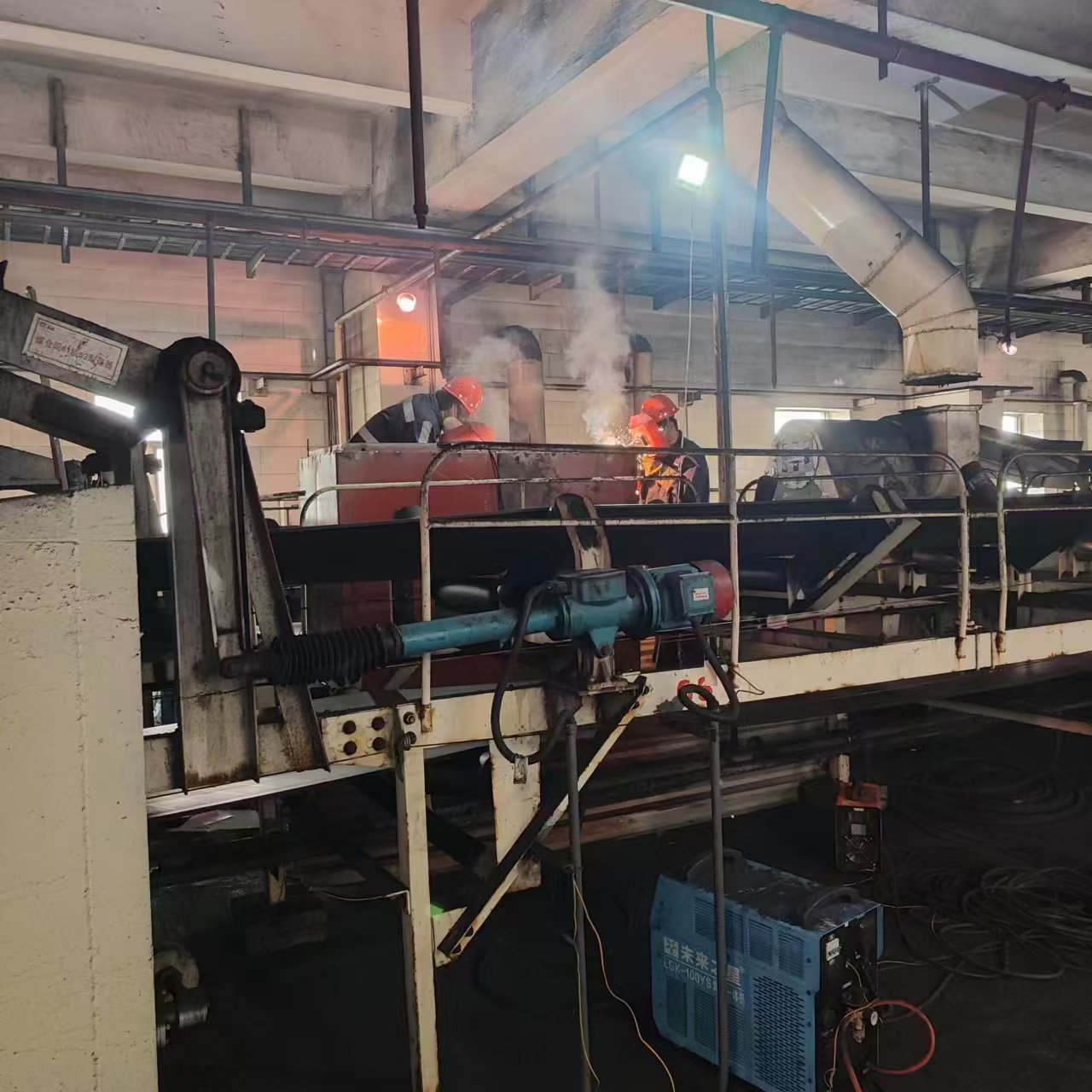
Rubber and polymer processing. A SENOTAY installation in Indonesia uses two DMC-200 pulse bag filters to collect dust generated by mixing equipment. After one year of operation the system is reported as running stably, with low noise and low energy consumption noted as the operational characteristics. For a buyer evaluating a comparable mixing line, the value of this reference is the application match: the collector is documented against the same duty class, not against a generic industrial example.
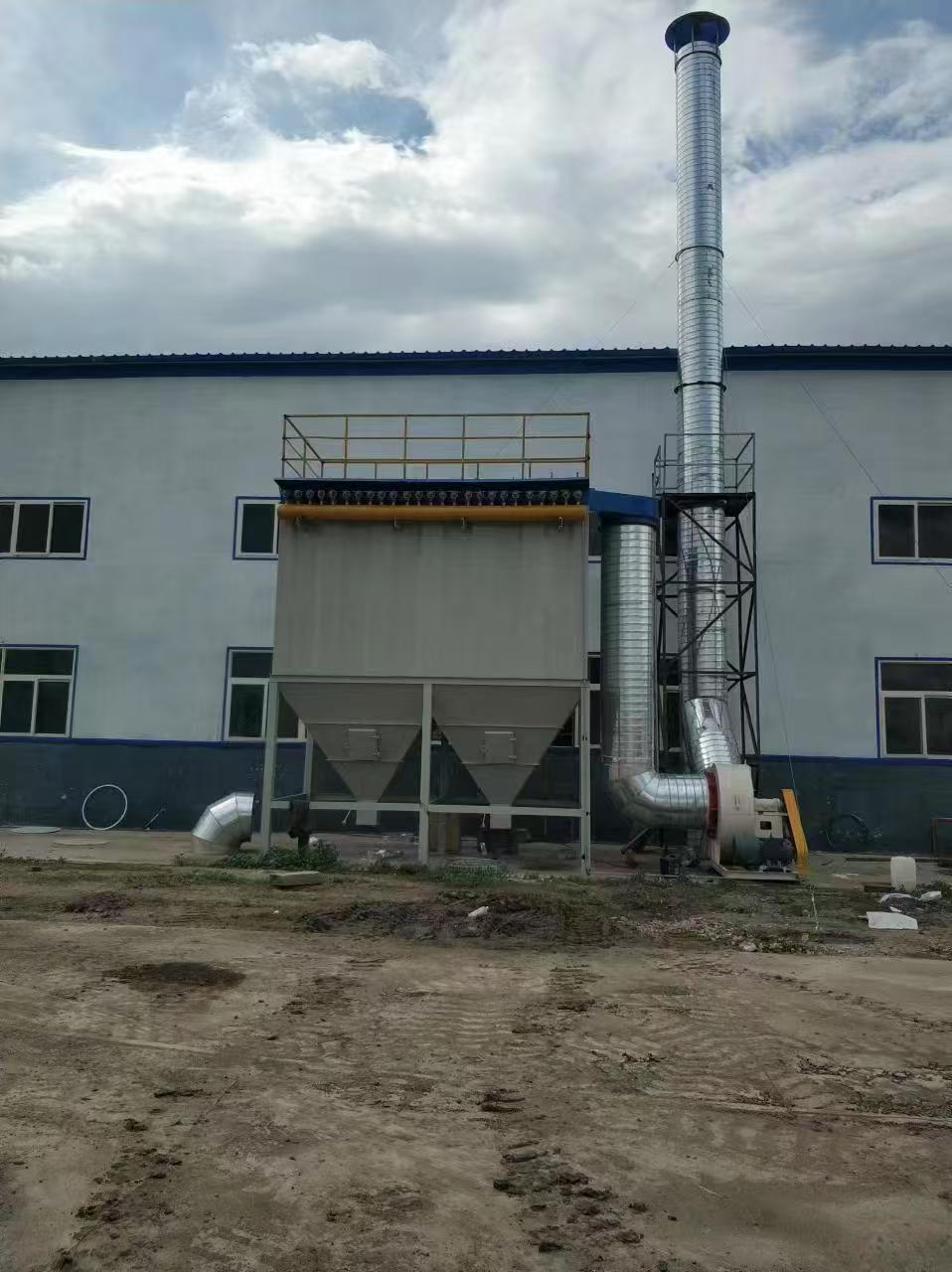
Power generation and material handling. Coal conveyor transfer points are a recurring audit point, because dust control there is usually tied to both workplace exposure limits and fire risk from combustible dust. Documentation for these projects typically needs the collector specification, the venting or safety rationale where applicable, and the maintenance record, since service continuity is part of the compliance story. SENOTAY supports this requirement through remote support and on-site service, with 24/7 after-sales coverage.
FAQ: dust collector certifications, performance data and testing records
1. Which certification covers SENOTAY industrial dust collectors, and how is it verified?
The documented certificate for the DMC-200 industrial dust collector is a CE certificate, number M.2025.206.C123090, issued by UDEM for the EU market under the 2006/42/EC Machinery Directive, Annex VIII, against EN ISO 12100:2010 and EN 60204-1:2018. It was issued on 22 July 2025 and is valid until 23 July 2030. Verification is a scope check with the issuing body: the buyer confirms the certificate number, the model reference and the validity dates. Standards such as NFPA 68 and NFPA 654 — commonly referenced by project owners for deflagration venting and combustible particulate solids — sit outside the CE scope and should be requested separately as project documentation rather than assumed from the CE certificate.
2. Can voltage and branding be customized, and does customization affect the documentation?
SENOTAY operates in OEM/ODM mode and offers customization of voltage and logo, with a minimum order quantity of one set and a monthly production capacity of 200 sets. Because the voltage specification touches the electrical configuration of the unit, the practical approach is to confirm the final configuration at quotation stage and ask which documents — certificate reference, performance sheet, test record — will carry that configuration. That way the file arriving with the equipment matches the equipment, rather than an earlier standard build.
3. What drives the cost of a compliant dust collector package?
SENOTAY does not publish list prices, so a compliant package is quoted per project. The main cost drivers are the technology platform (cyclone, pulse bag filter, cartridge unit, wet electrostatic precipitator or wet scrubber), the airflow and filtration area required, the construction material — carbon steel or SS304 stainless steel, for example — fan power, and the scope of customization. Documentation and testing requirements form part of that scope. When comparing offers, compare the same model-level evidence: a lower equipment line item that arrives without model-specific performance data and a traceable test record is not a like-for-like comparison.
4. Can a single unit be validated before committing to a full order?
Yes. The minimum order quantity is one set and quality control is documented as 100% testing, so a single unit can serve as a validation unit and carries the same documentation trail as a larger order. For buyers who want an operational reference rather than a paper one, the Indonesia installation — two DMC-200 pulse bag filters handling mixing-equipment dust in rubber products manufacturing, reported as running stably after one year with low noise and low energy consumption — shows what that validation looks like in a comparable duty class.
5. What is the lead time, and when should documentation be requested?
Lead time is 15–45 days depending on configuration and customization scope, against a monthly capacity of 200 sets. Documentation should be requested when the order is placed, not after delivery, so that the certificate reference, performance sheet and pre-shipment test record are issued against the specific configuration being built. SENOTAY provides remote support and on-site service, with 24/7 after-sales coverage for commissioning, maintenance and spare parts. To start a documentation review, request the current catalogue and specification pack, or contact the team with your airflow range and target emission level.
Conclusion: the file is the deliverable
For an industrial dust collector, compliance is not a document stapled to a machine — it is a set of linked records that survive examination. The pattern that works is straightforward: a certificate that names the model, performance data for that model, a test record tied to the unit, and a clear statement of which standards fall outside the certificate’s scope. SENOTAY publishes those elements at model level, because they are the elements a buyer can verify independently.
If you are assembling evidence for an upcoming project, the fastest starting point is to send your airflow range, dust characteristics and target emission level. The response will identify the matching platform — cyclone, pulse bag filter, cartridge unit or wet electrostatic precipitator — together with the documentation set that goes with it.
Next step
Download the SENOTAY product catalogue and specification pack: SENOTAY Industrial Dust Collection Catalogue (PDF)
Email: info@senotay.com · Phone: +86-317-8288592 · WhatsApp: +86 15831871808
Website: www.senotay.com · Blog: blog.senotay.com
Hebei Outai Environmental Protection Equipment Co., Ltd., Xiaozhangtun, Fuzhen Town, Botou City, Cangzhou City, Hebei Province, China.
Have Questions or Need More Details?
Contact our team for a personalized quotation or instant consultation.
Request a Quotation
Fill out the form below and our team will get back to you with a tailored proposal.
WhatsApp Direct Chat
Prefer to chat in real-time? Message us on WhatsApp for instant assistance & quick answers.
- Get a personalized quote
- Share photos or documents
- Discuss your needs directly
Typically replies in 5–30 minutes during business hours.