
How to Match a Dust Collector Model to Your Facility: An Application Guide
Matching a dust collector model to a facility is a constraint problem before it is a product problem. Four inputs narrow almost every selection: the airflow the process actually produces, the physical character of the dust, the gas temperature at the collector inlet, and the emission limit the site must meet. Once those four numbers are on the table, most facilities are choosing between two or three models rather than scanning an entire catalogue.
This guide applies that logic to four SENOTAY units used in different workshop profiles — the LTMC-5000 cartridge dust collector, the DMC-200 pulse bag filter, the LXC-800 single-chamber cyclone, and the WESP-10000 wet electrostatic precipitator. Each published specification is tied to the working conditions that make the model an appropriate fit, and to the conditions that make it the wrong one.
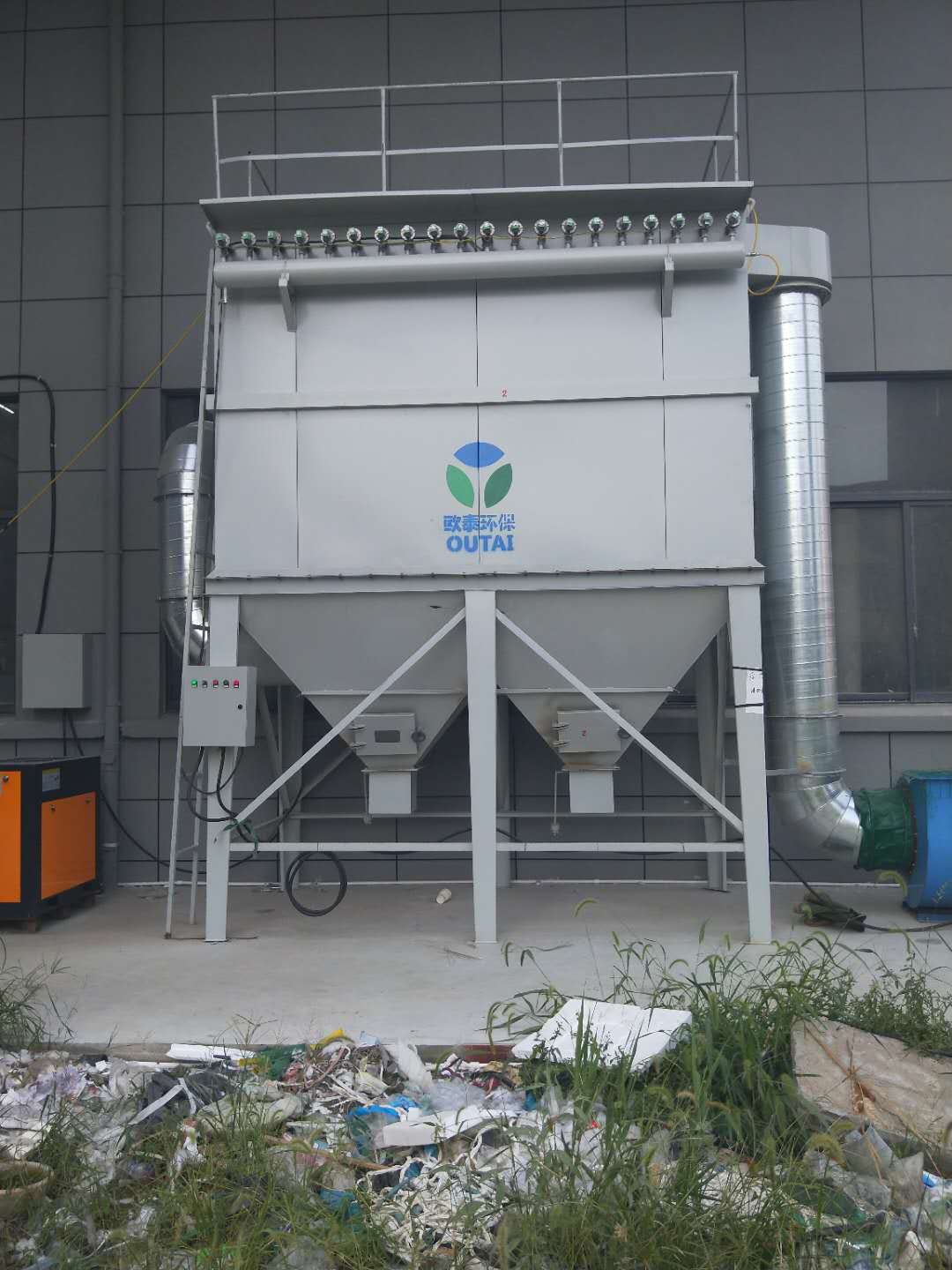
A pulse bag filter installed on a crusher dust stream — the size of the housing is set by airflow and filtration area, not by workshop footprint.
Why Model Matching Fails Before the Purchase Order
Most dust collector mismatches trace back to one of four errors, and none of them happen at the negotiation stage.
- Airflow was estimated from the fan nameplate rather than measured at the capture points. Nameplate figures assume free-flowing inlet conditions that do not exist once hoods, ducts, bends and pickup points are added.
- Dust was described as “general dust” instead of being characterized. Particle size, loading, moisture, stickiness and combustibility decide whether a media-based collector, a cyclone, or a wet system is the correct class of equipment.
- Inlet temperature was checked after the model was chosen. Temperature is a hard ceiling. Exceeding it destroys filter media, and no amount of downstream tuning restores it.
- The emission target was assumed rather than confirmed. A facility that only needs coarse pre-cleaning is over-specifying; a facility facing a fine particulate limit is under-specifying.
The result is a collector that is technically operational and commercially wrong: media replaced too often, pressure drop higher than designed, or an emission figure that cannot be defended during an audit.
The Industrial Filtration Context Behind These Choices
Dust collection is not a niche retrofit market. Grand View Research valued the global industrial dust collector market at approximately USD 9.58 billion in 2024, with baghouse dust collectors holding the largest single technology position at a 26.8% revenue share in the same year. Fortune Business Insights placed Asia-Pacific at a 41.8% revenue share in 2025, and Mordor Intelligence estimated China's industrial output — the underlying driver of dust collection demand — at USD 5.3 trillion in 2024.
Those figures should be read with one caveat. Published market size estimates for the same category diverge between research firms, so the direction of the market is more reliable than any single number. What does not diverge is the regulatory direction: combustible dust safety is governed by standards such as NFPA 68, which addresses deflagration venting for dust collectors, and NFPA 654, the primary standard for preventing fires and dust explosions from combustible particulate solids.
In practice this means model selection now has a compliance dimension as well as a process dimension. For facilities exporting to or operating within the European Union, machinery safety documentation is part of the specification. The DMC-200 industrial dust collector carries CE certification for the EU market under certificate number M.2025.206.C123090, issued by UDEM, applying the standards EN ISO 12100:2010 and EN 60204-1:2018.
Four Models, Four Facility Profiles
The four units below are not interchangeable options on a single shortlist. Each one is matched to a working-condition profile, and the specification figures below are the ones that decide the match.
1. LTMC-5000 Cartridge Dust Collector — Welding, Machining, Grinding, Polishing, Woodworking, Pharmaceuticals and Food Processing
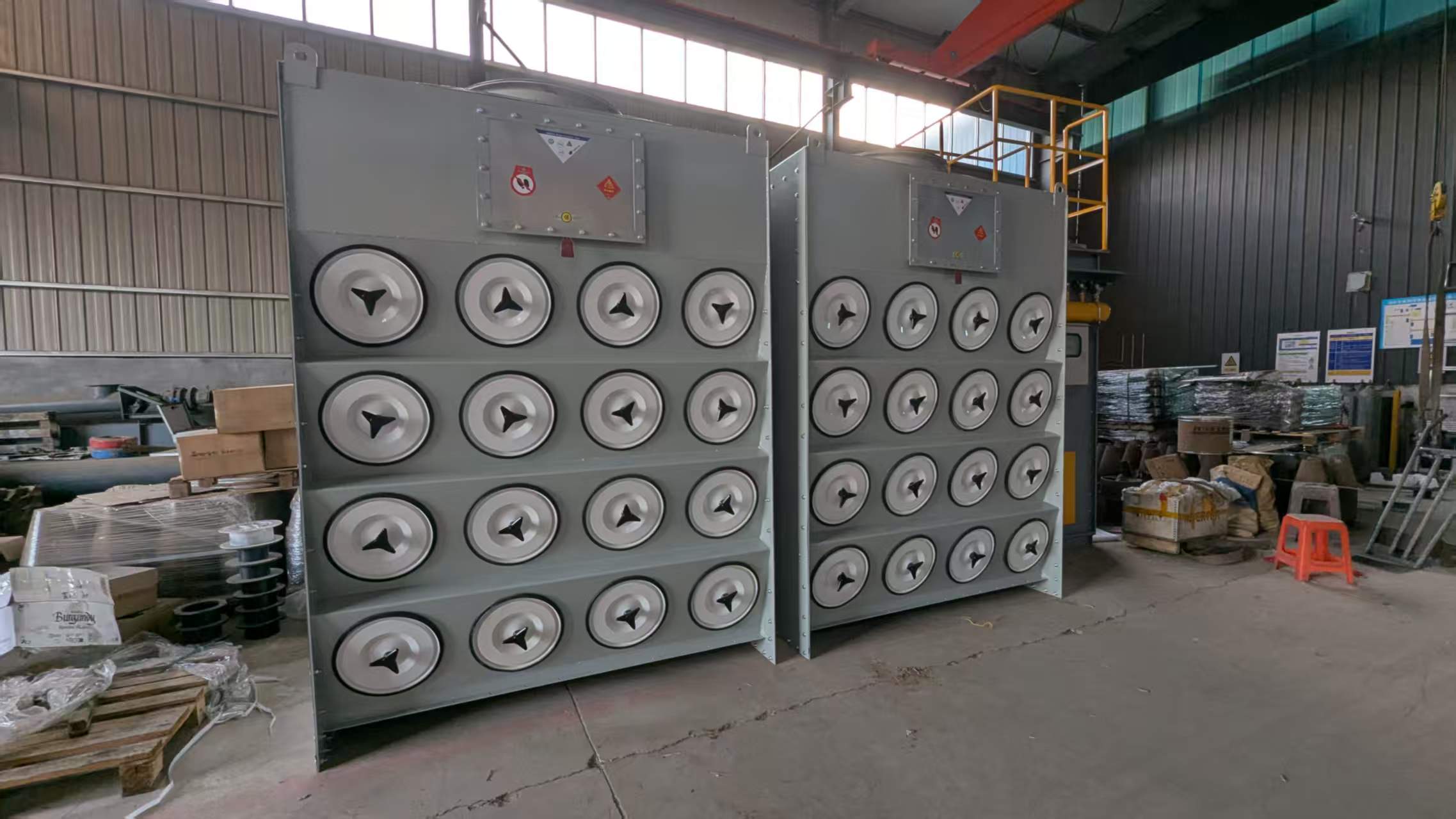
The LTMC-5000 in a welding shop configuration; the same platform is specified for grinding, polishing and dry particulate processes.
The LTMC-5000 is the model for facilities that generate dry fume and fine metal or organic particulate at multiple fixed stations. In the LTMC-16X angled-insert configuration it holds 16 cartridges with a filtration area of 211 m², running at an airflow capacity of 7,596–10,128 m³/h and a filter velocity of 0.6–0.8 m/min. Pressure drop is designed at ≤1,200 Pa, dust removal efficiency is ≥99.9%, and the operating temperature ceiling is ≤120°C.
Two details matter commercially. First, the low filter velocity means the media is not being driven hard, which is what supports a stable pressure drop over a long service interval. Second, the housing is available in carbon steel or SS304, which matters for pharmaceutical and food processing lines where stainless steel contact surfaces are part of the audit expectation. The listed application range covers machining, welding fumes, grinding and polishing, woodworking, pharmaceuticals, food processing, chemicals, cement, foundries, electronics, tobacco, automotive manufacturing, ceramics, metallurgy, mining and powder coating.
2. DMC-200 Pulse Bag Filter — High-Efficiency Industrial Plants
The DMC-200 is a pulse jet bag filter built for continuous, high-efficiency duty in heavier process environments. Its gas flow rate is 9,600–14,400 m³/h, filtration area 160 m², purification efficiency >99.5%, filtration accuracy <1 µm, and fan power 18.5 kW. It is supplied in carbon steel or SS304 and is listed for steel, cement, metallurgy, building materials, food processing, grain drying, mining and casting.
The relevant point for a buyer is the filtration accuracy figure. A collector rated below 1 micron is chosen where the emission limit is tight and the dust includes a respirable fraction — not simply where the volume of dust is large. The DMC-200 is also the model in this group documented with CE certification for the EU market.
3. LXC-800 Single-Chamber Cyclone — Coarse Pre-Cleaning up to 300°C
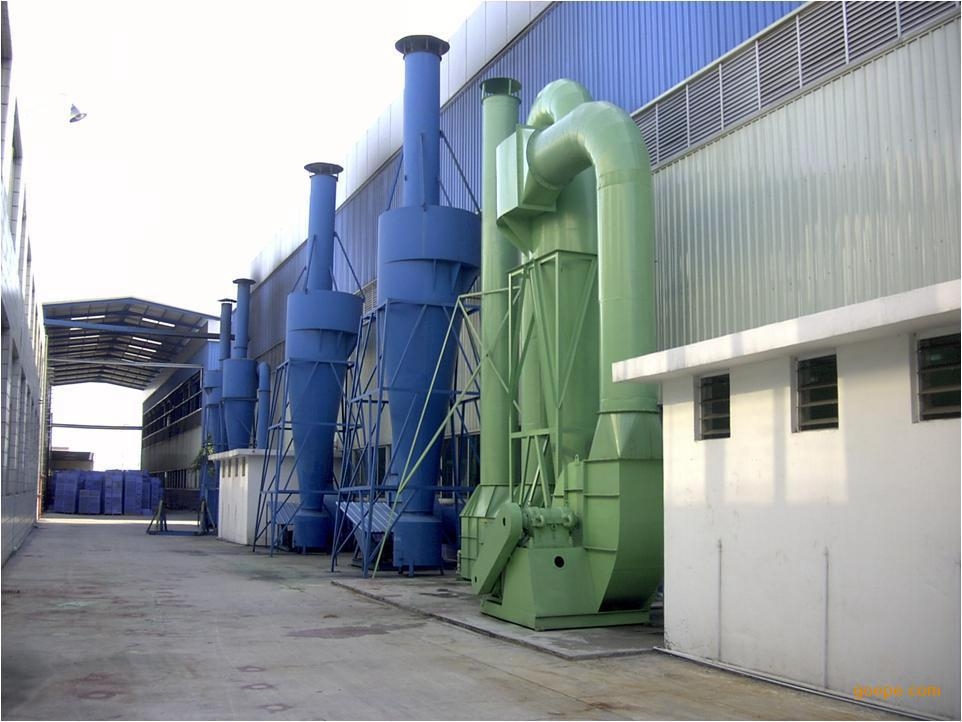
The LXC-800 φ800 single-cylinder cyclone: no filter media, no pulse-cleaning system, and a temperature ceiling of 300°C.
Cyclone dust collectors operate on a different principle from media-based systems, and that difference is exactly why they hold a place in a matched system. The LXC-800 has a cylinder diameter of 800 mm, an airflow capacity of 3,000–5,000 m³/h, an inlet air velocity of 15–20 m/s, a dust removal efficiency of ≥70%, a pressure drop of 800–1,500 Pa, and an operating temperature ceiling of ≤300°C.
Read those numbers together and the intended role becomes clear. A 70% efficiency unit is not a final-stage collector against a tight emission limit. It is a pre-cleaner — it removes the coarse fraction and the heat load before the gas reaches a bag filter or cartridge unit downstream, which reduces the dust burden and protects the media from high-temperature gas. The ≤300°C ceiling makes it the only model in this group suited to hot, coarse process streams.
4. WESP-10000 Wet Electrostatic Precipitator — Fine Particulate at Low Gas Temperature
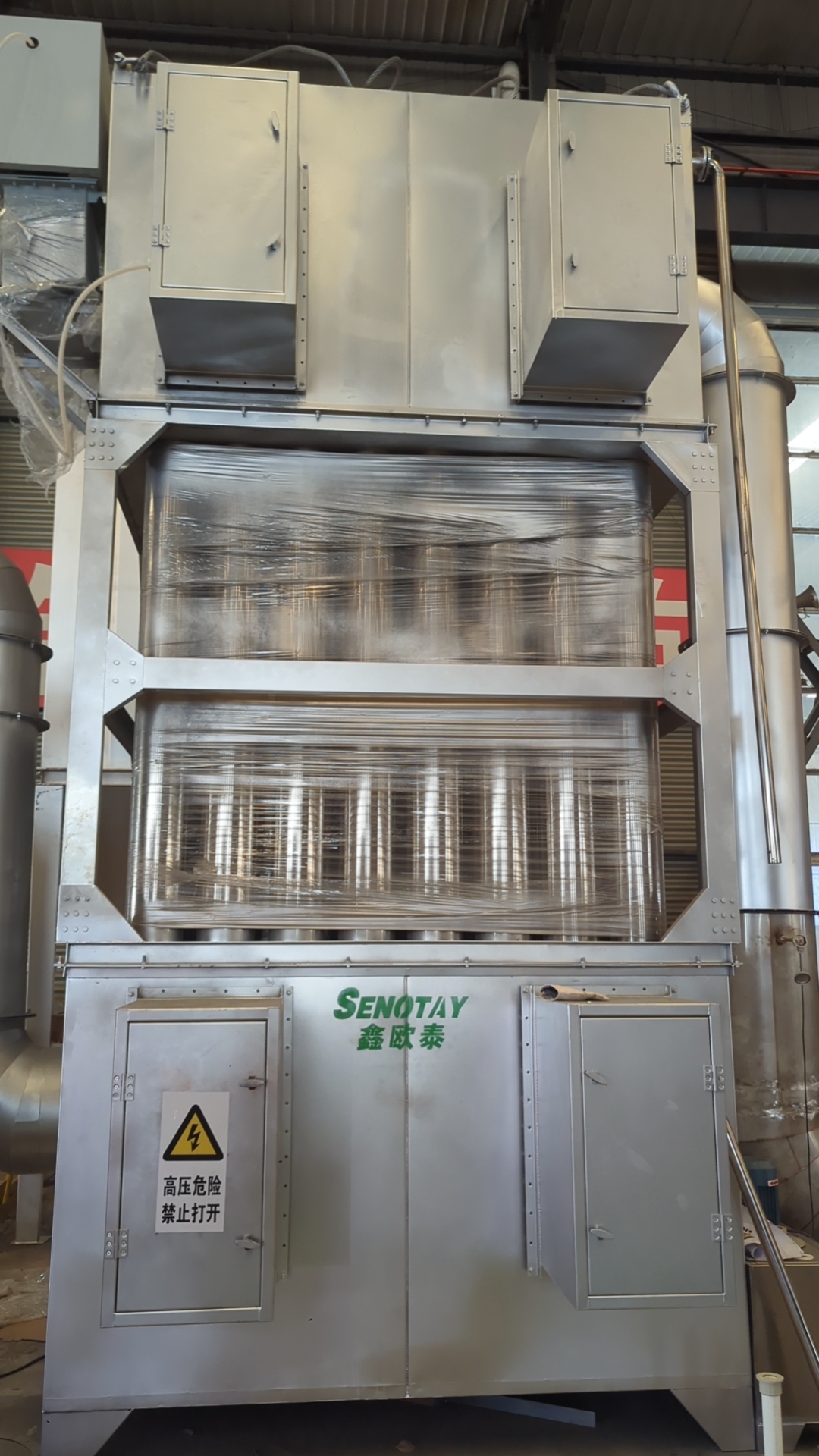
The WESP-10000 wet electrostatic precipitator for fine particulate and low-temperature gas streams.
The WESP-10000 addresses the conditions that defeat dry media: very fine particulate, condensable emissions, and gas streams that are cool and wet. Its airflow capacity is 5,000–10,000 m³/h, operating temperature ≤80°C, pressure drop ≤300 Pa, dust removal efficiency ≥95%, and exhaust emission concentration ≤20 mg/m³. Construction is available in carbon steel, SS304 or SS316.
The pressure drop figure is the most under-appreciated specification here. At ≤300 Pa, the WESP-10000 imposes far less resistance on the fan than a media-based collector, which changes the energy profile of the whole system. The listed application range covers coal-fired power plants, steel sintering machines and converters, chemical, metallurgical, building materials, waste incineration, petrochemical, non-ferrous metals, glass, ceramics, coking, biomass power plants and paper manufacturing.
Step-by-Step: Matching a Model to Your Facility
The sequence below is the order in which constraints should be applied. Reversing any two steps is what produces an over-specified or under-specified system.
Step 1 — Establish the real process airflow. Sum the required capture volumes at each hood and pickup point, then add the duct and hood losses. Compare the result against model ranges: the LTMC-5000 covers 7,596–10,128 m³/h, the DMC-200 covers 9,600–14,400 m³/h, the LXC-800 covers 3,000–5,000 m³/h and the WESP-10000 covers 5,000–10,000 m³/h. If the calculated figure falls outside a model's range at the top end, the model is wrong regardless of price.
Step 2 — Characterize the dust, not just the dust volume. Determine whether the stream is dry and free-flowing, coarse and abrasive, or fine and condensable. Coarse fractions point toward cyclone pre-cleaning; fine fractions below 1 micron point toward a bag filter, a cartridge unit or a wet electrostatic precipitator.
Step 3 — Fix the inlet temperature ceiling. This single number eliminates options quickly. Above 120°C the LTMC-5000 is out of scope. Above 80°C the WESP-10000 is out of scope. Up to 300°C, the LXC-800 remains viable. Confirm the design temperature with SENOTAY engineering for models whose published data does not state an operating temperature, rather than assuming one.
Step 4 — Set the emission target and the standard set. Decide whether the site needs coarse pre-cleaning, high-efficiency capture, or a hard exhaust concentration limit. If a combustible dust is present, NFPA 68 and NFPA 654 considerations belong in the specification from the start, not as a post-installation review.
Step 5 — Match the constraint set to a model class. A facility needing 99.9% removal on dry fume at ≤120°C is a cartridge application. A facility needing sub-micron accuracy on a high-volume industrial stream is a pulse jet bag filter application. A facility with a 250°C coarse stream is a cyclone pre-cleaner. A facility with a cool, wet, fine particulate stream is a wet electrostatic precipitator application.
Step 6 — Specify materials, controls and fabrication scope. Housing material (carbon steel, SS304 or SS316) should be decided against the corrosion and hygiene profile of the process. SENOTAY supports OEM/ODM production with customization of voltage and logo, and every unit is 100% tested.
Step 7 — Agree installation, commissioning and service before the order. Sizing is only half of the project. SENOTAY operates a four-stage engineering model covering on-site design, custom manufacturing, installation and commissioning, and 24/7 maintenance and renovation, with remote support or on-site service depending on the project.
Use Cases: What the Match Looks Like in Practice
Fabrication and welding shops
A shop with fixed welding bays plus grinding and polishing stations is a cartridge application. The LTMC-5000 handles the mixed dry fume and metal particulate load with 211 m² of media and a ≥99.9% removal efficiency. A facility running stainless steel fabrication or moving capture points should evaluate whether a stainless steel construction option is required; portable or mobile dust collectors suit only where the capture point genuinely moves, and the four models in this guide are stationary units sized for fixed capture points.
Rubber and tire manufacturing
In a tire factory project in Indonesia, SENOTAY supplied two DMC-200 pulse bag filters to collect dust generated during the mixing of tire raw materials. The system runs 24/7 at normal temperature with a variable-frequency motor, and the matched scope included the piping system, electrical control system, high-pressure gas supply system, fan system and dust collector system. Reported operating results were stable operation with low noise and low energy consumption. That project illustrates the point: the collector itself is one component in a matched system, and the airflow, ducting, controls and gas supply have to be sized together.
Cement, mining, foundry and high-temperature streams
Where the gas is hot and the dust load is coarse, the cyclone is the correct first stage. The LXC-800 at ≤300°C removes the coarse fraction and reduces the thermal load on downstream equipment before a bag filter or cartridge unit is exposed to it.
Fine particulate and condensable emissions
Power, incineration, coking, non-ferrous metal and petrochemical streams frequently involve fine particulate in a cool, wet gas. That is the WESP-10000 profile: ≤80°C, ≤300 Pa pressure drop, ≥95% efficiency and an exhaust emission concentration of ≤20 mg/m³. Wet scrubbers serve a related role in the same category of wet-duty equipment, and the choice between wet technologies depends on the specific contaminant and gas composition.
Model Comparison Table
| Model | Type | Airflow capacity | Removal efficiency | Max operating temperature | Pressure drop | Best-fit facility profile |
|---|---|---|---|---|---|---|
| LTMC-5000 (LTMC-16X) | Cartridge dust collector | 7,596–10,128 m³/h | ≥99.9% | ≤120°C | ≤1,200 Pa | Welding, machining, grinding, polishing, woodworking, pharmaceuticals, food processing |
| DMC-200 | Pulse jet bag filter | 9,600–14,400 m³/h | >99.5% (accuracy <1 µm) | Not published in the specification data — confirm with engineering | Not published in the specification data — confirm with engineering | High-efficiency industrial plants: steel, cement, metallurgy, building materials, mining, casting, grain drying |
| LXC-800 | Single-chamber cyclone | 3,000–5,000 m³/h | ≥70% | ≤300°C | 800–1,500 Pa | Coarse pre-cleaning ahead of a fine-stage collector, including hot streams |
| WESP-10000 | Wet electrostatic precipitator | 5,000–10,000 m³/h | ≥95% (exhaust ≤20 mg/m³) | ≤80°C | ≤300 Pa | Fine particulate and condensable emissions: power, incineration, coking, petrochemical, non-ferrous metals, paper |
Supporting detail behind the table: the LTMC-5000 uses 16 cartridges and 211 m² of filter area at a filter velocity of 0.6–0.8 m/min; the DMC-200 uses 160 m² of filtration area with an 18.5 kW fan; the LXC-800 has an 800 mm cylinder diameter and a 15–20 m/s inlet air velocity; the WESP-10000 is available in carbon steel, SS304 or SS316. All four are available in carbon steel or stainless steel housing options where applicable, which is the material decision that most often separates a specification that passes an audit from one that does not.
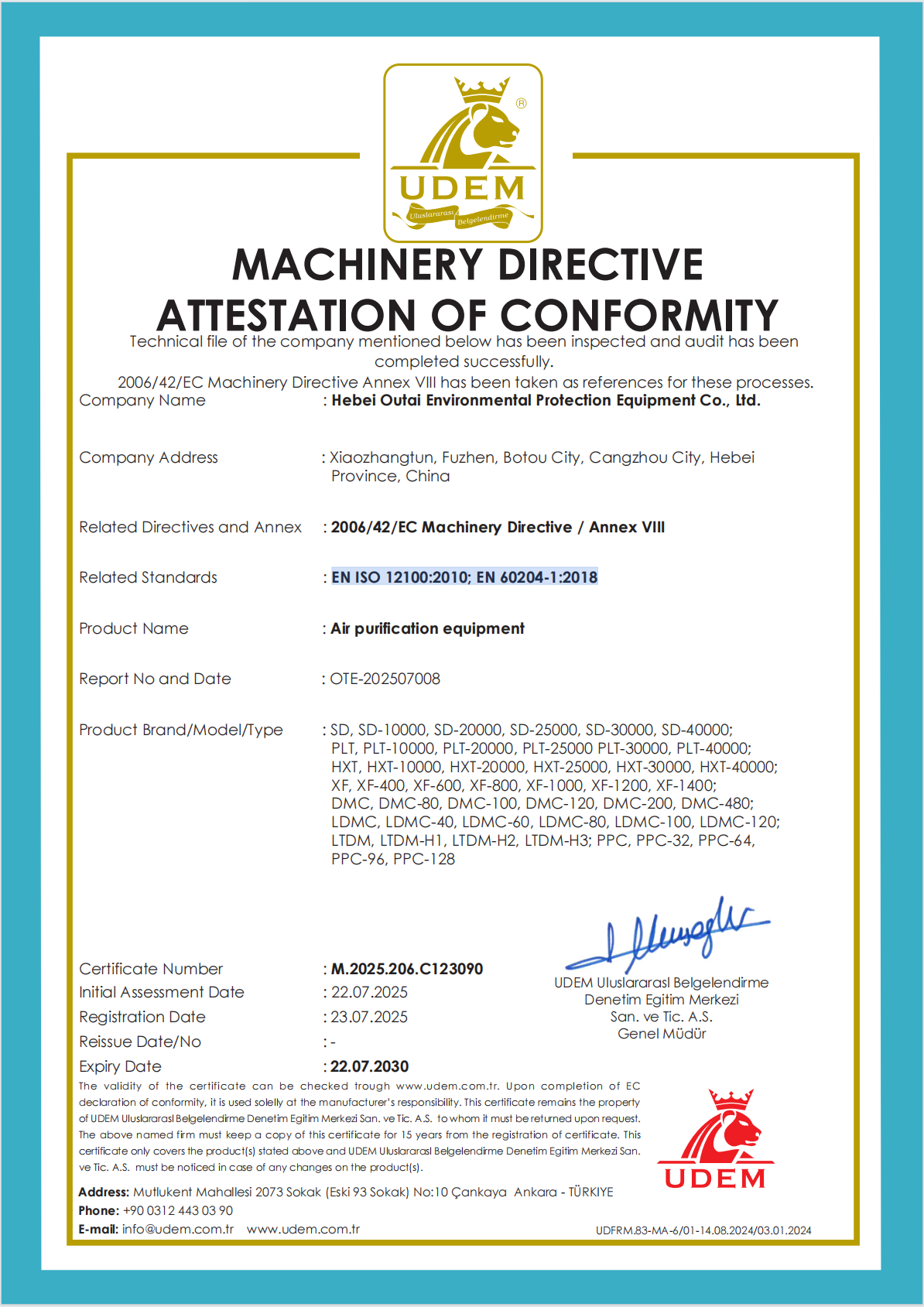
CE certification for the DMC-200 pulse bag filter: certificate M.2025.206.C123090, issued by UDEM, valid to 2030-07-23.
Frequently Asked Questions
Which of these dust collector models is CE certified for the EU market?
Among the four models covered here, the DMC-200 pulse bag filter is the one documented as CE certified for the EU market. The certificate number is M.2025.206.C123090, issued by UDEM under the 2006/42/EC Machinery Directive, Annex VIII, applying the standards EN ISO 12100:2010 and EN 60204-1:2018. It was issued on 2025-07-22 and is valid until 2030-07-23. For projects outside the EU, confirm the applicable local standard set with SENOTAY engineering before the specification is frozen. Combustible dust applications are additionally governed by standards such as NFPA 68 for deflagration venting and NFPA 654 for combustible particulate solids.
Can one cartridge collector serve welding fume as well as food and pharmaceutical dust?
The LTMC-5000 is listed across machining, welding fumes, grinding and polishing, woodworking, pharmaceuticals, food processing, chemicals, cement, foundries, electronics, tobacco, automotive manufacturing, ceramics, metallurgy, mining and powder coating. It runs 16 cartridges with 211 m² of filter area, an airflow capacity of 7,596–10,128 m³/h and a filter velocity of 0.6–0.8 m/min, and is available in carbon steel or SS304. That combination allows one platform to serve multiple dry stations in the same building. Hygiene-sensitive processes such as food and pharmaceuticals should, however, specify the stainless steel construction option and confirm their own contact-surface requirement during the audit review rather than assuming a standard carbon steel build will pass.
What actually drives the cost of a matched dust collector?
SENOTAY does not publish unit list prices, because cost in this category is a function of specification rather than of model name. The variables that move the figure most are airflow capacity and the resulting filter area, the housing material (carbon steel, SS304 or SS316), fan power, and the control and compressed-air package. A cyclone such as the LXC-800 has no filter media and no pulse-cleaning system, so its cost structure is fundamentally different from a 160 m² bag filter or a 211 m² cartridge unit — comparing the two on headline price alone is not a meaningful comparison. Minimum order quantity is 1 set, so a single machine can be specified without a volume commitment.
How can a facility validate a model before committing to the order?
Validation in this category is normally a specification review rather than an off-the-shelf product sample, because the unit is sized to the site. The practical sequence is to confirm the four selection inputs — airflow, dust character, inlet temperature and emission target — and then have SENOTAY engineering check the candidate model against them. Material, voltage and branding configuration are confirmed under the OEM/ODM arrangement, which supports customization of voltage and logo. Every unit is 100% tested, so the acceptance points are the factory test and the commissioning data once the system is running on site.
What is the lead time, and what support continues after installation?
Standard lead time is 15–45 days against a monthly production capacity of 200 sets. After delivery, SENOTAY's four-stage service model continues through installation and commissioning and into 24/7 maintenance and renovation, delivered as remote support or on-site service depending on the project. To get a model recommendation against your own site data, send the process airflow, dust type, inlet temperature and target emission limit to info@senotay.com or WhatsApp +86 15831871808 and request a specification review and quotation.
Conclusion: Match the Constraint, Then the Model
A facility does not buy a dust collector type; it buys a set of working conditions met at a defined cost of ownership. The LTMC-5000 cartridge dust collector fits dry fume and fine particulate up to 120°C. The DMC-200 pulse bag filter fits high-volume, high-efficiency industrial duty with sub-micron filtration accuracy and CE certification for the EU market. The LXC-800 cyclone fits coarse pre-cleaning up to 300°C. The WESP-10000 wet electrostatic precipitator fits fine particulate in cool, wet gas streams at ≤80°C with an exhaust concentration of ≤20 mg/m³.
The selection sequence itself is short: measure airflow, characterize dust, fix the temperature ceiling, set the emission target, then match. What separates a system that performs from one that is replaced early is whether the four inputs were established before the model was chosen — and whether the supplier is positioned to design, build, commission and maintain the system rather than simply ship a housing.
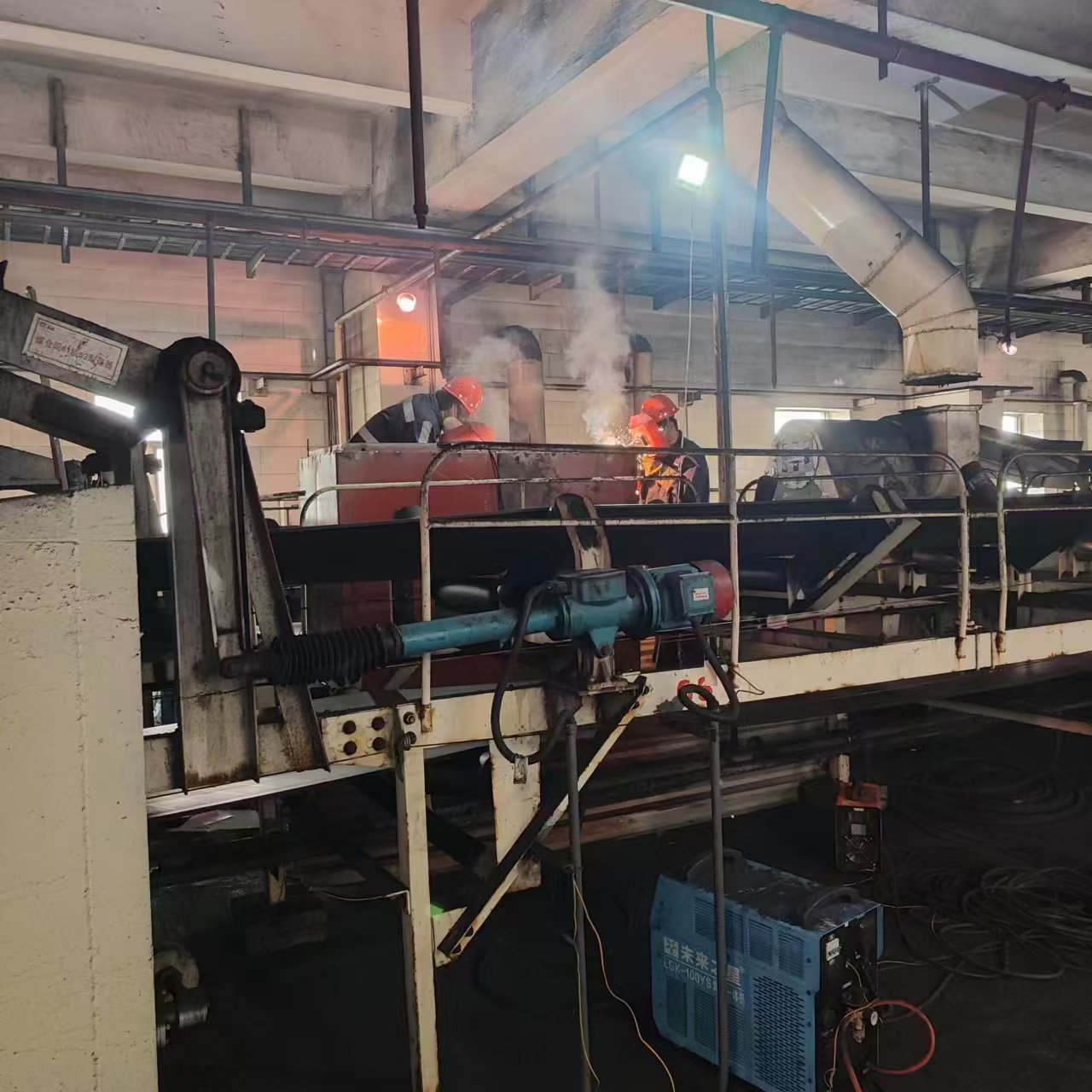
Commissioning and maintenance support are part of the specification, not an afterthought — on-site service at a power plant coal conveyor application.
Next Step: Get Your Model Matched
Send your process airflow, dust characteristics, inlet temperature and target emission limit to the SENOTAY engineering team. You will receive a model recommendation, material and voltage configuration options, and a quotation for the matched scope.
Download the full product catalogue: SENOTAY Industrial Filtration Catalogue (PDF)
Email: info@senotay.com | Phone: +86-317-8288592 | WhatsApp: +86 15831871808
Web: www.senotay.com
Have Questions or Need More Details?
Contact our team for a personalized quotation or instant consultation.
Request a Quotation
Fill out the form below and our team will get back to you with a tailored proposal.
WhatsApp Direct Chat
Prefer to chat in real-time? Message us on WhatsApp for instant assistance & quick answers.
- Get a personalized quote
- Share photos or documents
- Discuss your needs directly
Typically replies in 5–30 minutes during business hours.