
Long-Term Dust Collector Supply: How to Build a Reliable Industrial Filtration Partnership
Long-Term Dust Collector Supply: How to Build a Reliable Industrial Filtration Partnership
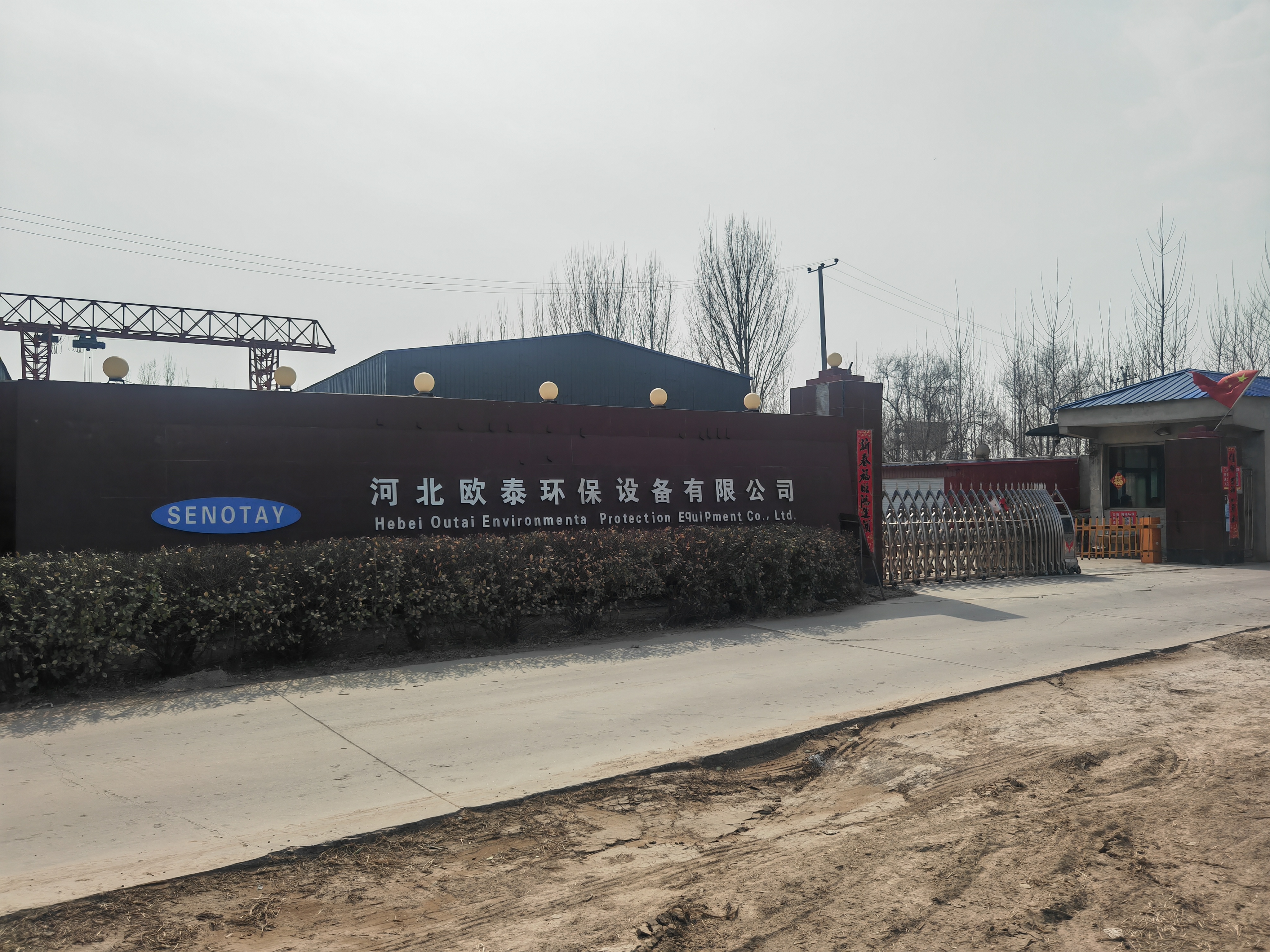
SENOTAY dust collector manufacturing facility, operated by Hebei Outai Environmental Protection Equipment Co., Ltd.
Core answer: A dust collector is not a one-time purchase. For plant operators and distributors, the value of an industrial dust collector depends on the supplier's ability to deliver equipment, spare parts, technical support, and consistent quality over many years. Long-term supply partnerships reduce downtime, simplify maintenance, and make replacement planning predictable.
This guide explains what to evaluate when selecting a dust collector manufacturer for ongoing operations, and how SENOTAY supports buyers through production, delivery, installation, and after-sales service.
Why One-Off Dust Collector Purchases Create Long-Term Risk
When buyers focus only on the initial price, they often overlook the cost of operating and maintaining the system over its lifetime. Filter bags must be replaced, pulse valves wear out, and process changes may require a different dust removal configuration. If the supplier is not prepared to support the equipment after delivery, the plant can face production stoppages.
Long-term risk areas include:
- Replacement parts availability for baghouse dust collectors and cartridge dust collectors.
- Consistent manufacturing quality across multiple orders.
- Access to engineering support when airflow or dust characteristics change.
- Delivery reliability for distributors who need to resell or hold inventory.
Industry Background: Industrial Dust Collector Demand and the Case for Stable Supply
According to Grand View Research, the global industrial dust collector market was valued at approximately USD 9.58 billion in 2024, with baghouse dust collectors capturing a 26.8% revenue share. Fortune Business Insights estimates that Asia-Pacific accounted for 41.8% of the market in 2025, while North America was valued at USD 2.44 billion. China's industrial output, which drives demand for dust collection systems, was estimated at USD 5.3 trillion in 2024 by Mordor Intelligence.
Across these markets, the term "dust collector" covers many configurations: baghouse dust collectors, cartridge dust collectors, pulse jet dust collectors, electrostatic precipitators, cyclone dust collectors, wet scrubbers, and bag filters. Buyers also evaluate stainless steel dust collectors and mobile dust collectors for specific process conditions.
Safety standards add another layer of procurement complexity. NFPA 68 provides guidelines for deflagration venting, and NFPA 654 is the primary standard for preventing fires and dust explosions from combustible particulate solids. These standards are important reference points when a buyer assesses a supplier's long-term compliance capability.
Detailed Solution: What a Long-Term Dust Collector Manufacturer Should Provide
SENOTAY, operated by Hebei Outai Environmental Protection Equipment Co., Ltd., is a China-based manufacturer of heavy-duty filtration systems and precision components. The company offers pulse bag filters, electrostatic precipitators, cyclone dust collectors, wet dust collectors, and filter cartridge collectors, together with high-efficiency filter bags, bag cages, pulse solenoid valves, air filters and regulators, screw conveyors, star-shaped unloaders, industrial blowers, motor reducers, and VOC purifiers.
Founded in 2015, the company operates a 6,000 m² facility with 30 employees and 5 R&D engineers. Its declared annual output capacity is 100,000 PCS, and about 70% of production is exported to Central Asia, Southeast Asia, the Middle East, Russia, Africa, and Europe.
For buyers who need repeat orders, capacity and lead time are critical. SENOTAY's typical production lead time is 15–45 days, with a monthly production capacity of 200 sets. This level of capacity supports distributors who hold inventory and plant operators who need scheduled replacements.
One-Stop Engineering Model
SENOTAY's one-stop engineering service model follows four stages:
- On-site design: engineers analyze airflow volumes, dust particle characteristics, and compliance targets.
- Custom manufacturing: equipment is built to exact specifications using national-grade materials and rigorously tested.
- Installation and commissioning: professional teams handle system integration, calibration, and operator training.
- 24/7 maintenance and renovation: ongoing support, scheduled maintenance, spare parts, and full system upgrades.
The company states that its technical benchmark delivers up to 99.9% filtration efficiency, with engineered airflow optimization and long service life in demanding process conditions. For procurement teams, the practical meaning is that the supplier can take responsibility beyond the initial delivery.
Example Configuration: DMC-200 Pulse Bag Filter
One concrete example is the DMC-200 industrial dust collector from SENOTAY, a pulse bag filter with a gas flow rate of 9,600–14,400 m³/h, filtration area of 160 m², purification efficiency above 99.5%, filtration accuracy below 1 μm, and fan power of 18.5 kW. It is available in carbon steel or SS304, making it relevant for steel, cement, metallurgy, building materials, food processing, grain drying, mining, and casting applications. For corrosive or wash-down environments, the SS304 option provides a stainless steel dust collector configuration.
Step-by-Step: How to Qualify a Dust Collector Supplier for Long-Term Cooperation
- Define the technical baseline. Document required gas flow rate, filtration area, purification efficiency, filtration accuracy, and fan power. The DMC-200 example shows the type of parameters a buyer should collect.
- Verify production capacity. Ask for monthly output and lead time. SENOTAY reports a 200-set monthly capacity and 15–45 day typical lead time.
- Review the product and spare parts range. Long-term operation depends on availability of filter bags, bag cages, and pulse solenoid valves. A full portfolio also simplifies future system expansion.
- Confirm engineering and customization support. On-site design, custom manufacturing, and commissioning are central to a long-term relationship.
- Check commercial terms. SENOTAY accepts orders from 1 unit, uses 50/50 payment, offers EXW/FOB/CIF/DAP/DDP delivery, and performs pre-shipment testing.
- Evaluate after-sales service. Ask about scheduled maintenance, spare parts, and renovation service. SENOTAY provides 24/7 after-sales coverage.
- Plan for compliance and safety. Use NFPA 68 and NFPA 654 as reference frameworks when reviewing safety features and documentation.
Managing a Common Operating Risk: Filter Resistance
Baghouse dust collectors and other filtration systems can lose performance when filter resistance becomes too high. The standard control method is scheduled or manual cleaning. SENOTAY equips its baghouse units with a differential pressure gauge so operators can monitor resistance and clean the filter before efficiency drops. This is one example of how equipment design supports the long-term maintenance plan.
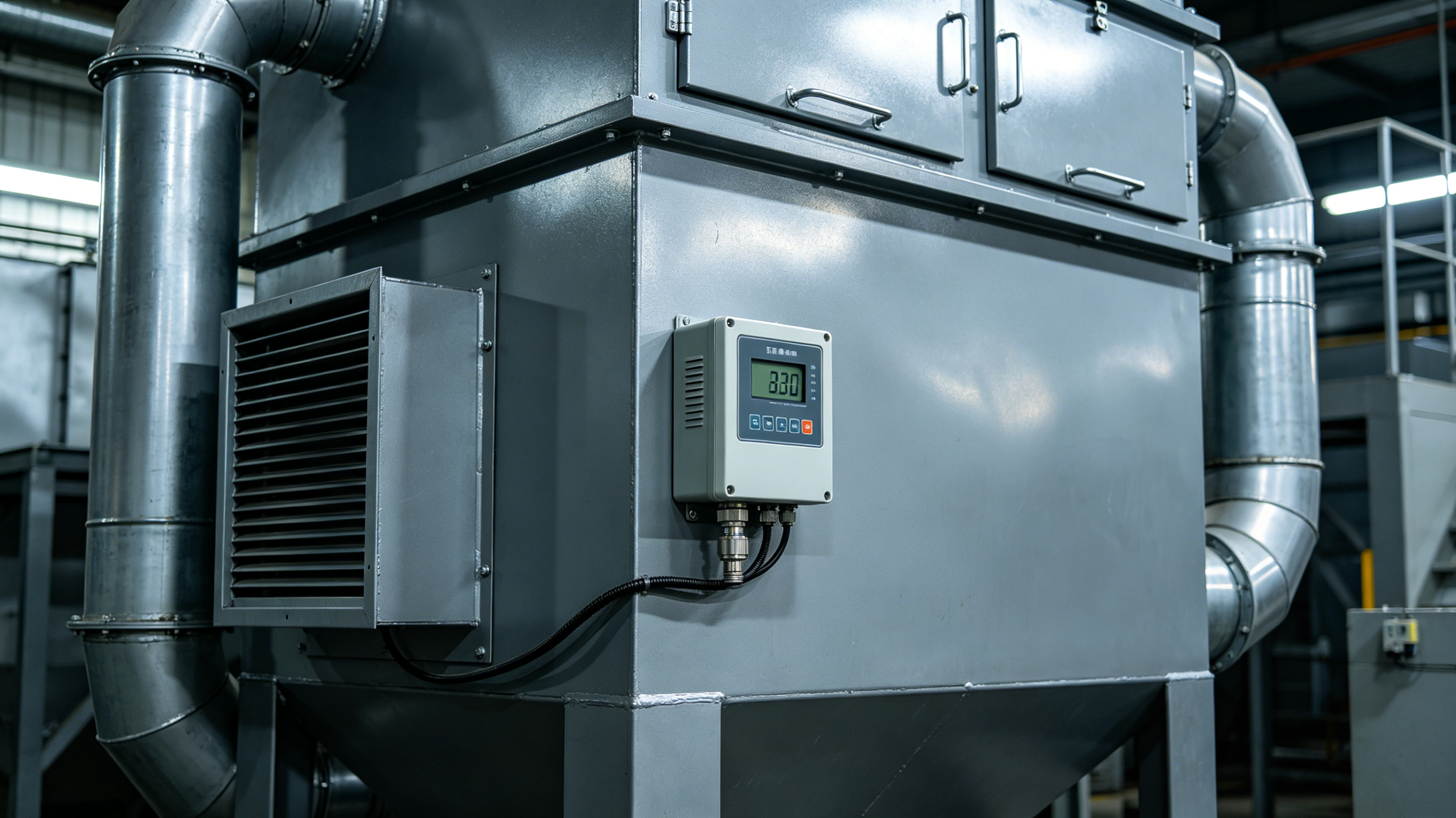
Baghouse dust collector with differential pressure display.
Use Cases: Where Long-Term Supply Reliability Matters Most
Plant Operators in Cement, Steel, and Building Materials
Facilities in these sectors need continuous filtration for kiln, mill, and conveying processes. A pulse bag filter such as the DMC-200 provides the filtration area and efficiency required to handle high dust loads, while a dedicated spare parts supply prevents unplanned downtime.
Distributors in Central Asia and Southeast Asia
Distributors must stock equipment that end users can maintain locally. A supplier with stable production capacity, a broad replacement parts catalog, and export experience in these regions is easier to sell to and easier to support.
Manufacturers Needing Custom or Corrosion-Resistant Equipment
Process plants that handle moisture, chemicals, or food ingredients may require stainless steel construction. The SS304 option for the DMC-200 is an example of how a manufacturer can adapt a standard industrial dust collector design to a specific environment.
Comparison Table: Baghouse Dust Collectors vs. Cyclone Dust Collectors
For many industrial plants, the first comparison is between baghouse and cyclone technologies. The table below summarizes SENOTAY's comparison data for these two types.
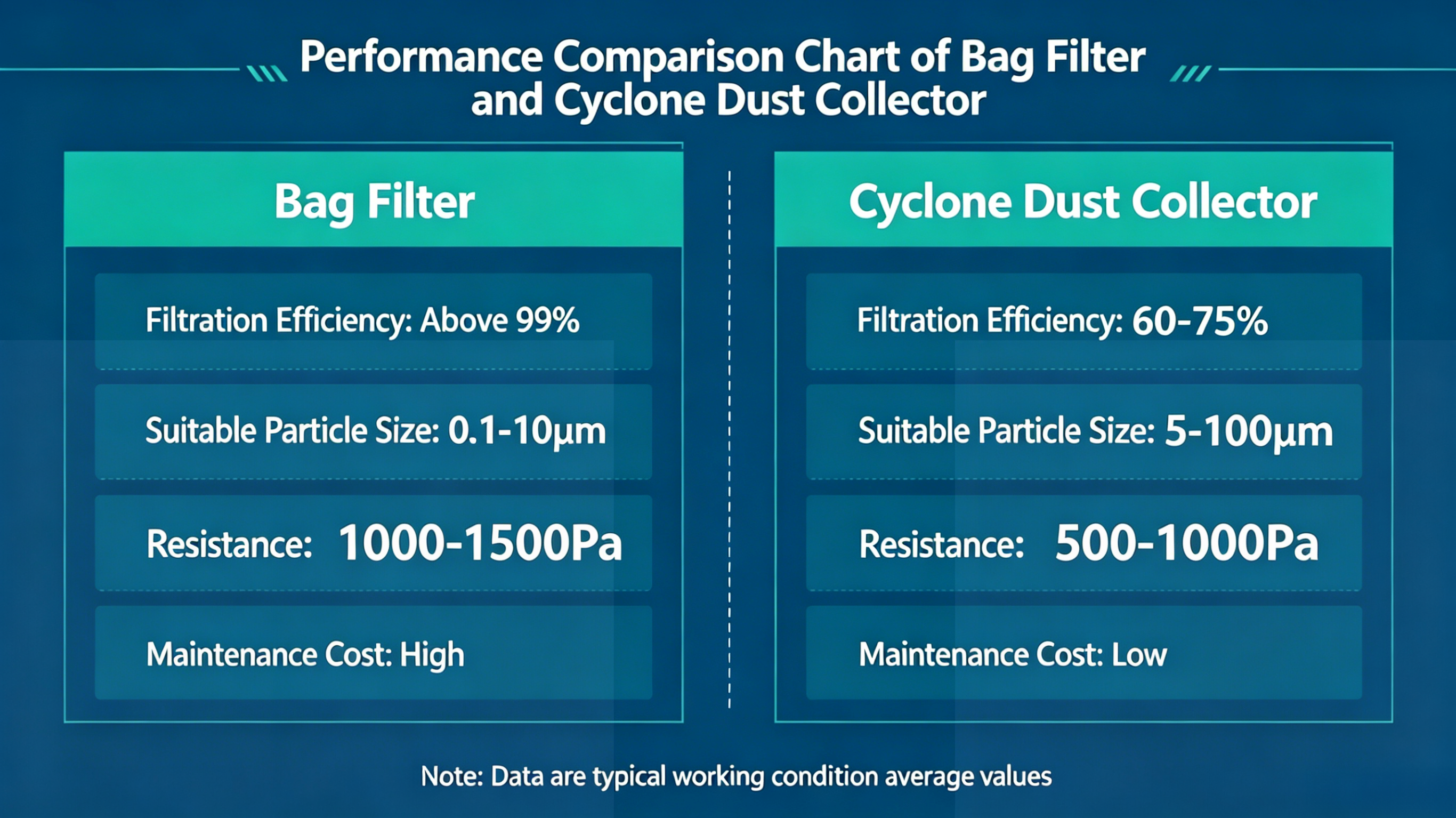
Comparison of baghouse dust collectors and cyclone dust collectors.
| Criteria | Baghouse Dust Collector | Cyclone Dust Collector |
|---|---|---|
| Purification efficiency | High purification efficiency | Baseline efficiency |
| Efficiency improvement | Improved purification efficiency by more than 25% | Reference level |
| Initial cost | Approximately 50% more expensive | Lower initial cost |
| Maintenance | Superior to cyclone dust collectors | Simpler but lower filtration capability |
| Best for | Industrial plants that require high-efficiency dust control | Pre-separation or lighter-duty tasks |
The data shows that a baghouse dust collector is best for industrial plants that need high purification efficiency, even though it costs more than a cyclone system. For buyers, the decision should be based on the emission target, dust characteristics, and total lifecycle cost.
FAQ
What safety and compliance standards should buyers consider when purchasing an industrial dust collector?
NFPA 68 provides critical guidelines for dust collector safety through deflagration venting, and NFPA 654 is the primary standard for preventing fires and dust explosions from combustible particulate solids. Buyers should verify that the proposed dust collector design and the plant's installation plan align with the applicable NFPA requirements for the specific dust type.
What makes SENOTAY capable of supporting long-term dust collector supply?
SENOTAY is operated by Hebei Outai Environmental Protection Equipment Co., Ltd., a manufacturer founded in 2015 with a 6,000 m² facility, 30 employees, and 5 R&D engineers. Its product range includes pulse bag filters, electrostatic precipitators, cyclone dust collectors, wet dust collectors, and filter cartridge collectors. Monthly production capacity is 200 sets, with a typical production lead time of 15–45 days.
How does baghouse dust collector pricing compare with cyclone dust collectors?
Based on SENOTAY's comparison data, baghouse dust collectors are approximately 50% more expensive than cyclone dust collectors, but they deliver improved purification efficiency of more than 25% and better maintenance characteristics. For industrial plants that need high-efficiency filtration, the baghouse option is the recommended choice despite the higher initial cost.
Can I place a small trial order or inspect equipment before full procurement?
SENOTAY's minimum order quantity is 1 unit. The standard payment term is 50/50, and the acceptance process includes a pre-shipment test. Delivery options include EXW, FOB, CIF, DAP, and DDP. This structure allows buyers to validate a single unit before committing to larger repeat volume.
What is SENOTAY's lead time for repeat dust collector orders?
The typical production lead time is 15–45 days, and the monthly production capacity is 200 sets. For project-specific timing and capacity allocation, send your technical specifications to SENOTAY at info@senotay.com or via WhatsApp at +86 15831871808.
Conclusion: Build a Dust Collector Relationship, Not Just a Transaction
A long-term dust collector partnership is built on production capacity, engineering depth, commercial flexibility, and after-sales service. SENOTAY's one-stop engineering model, full filtration product line, stable monthly capacity, and 24/7 after-sales coverage are designed to support buyers across the lifecycle of the equipment.
For a distributor planning a new product line, or a plant operator replacing existing filtration equipment, the next step is to define the technical baseline and ask the supplier to prove its long-term capability.
Next step: Download the SENOTAY company brochure or contact Wei John at info@senotay.com, phone +86-317-8288592, WhatsApp +86 15831871808. SENOTAY's website is www.senotay.com.