Selecting Dust Collector Specifications: Filter Area, Airflow, and Efficiency Explained
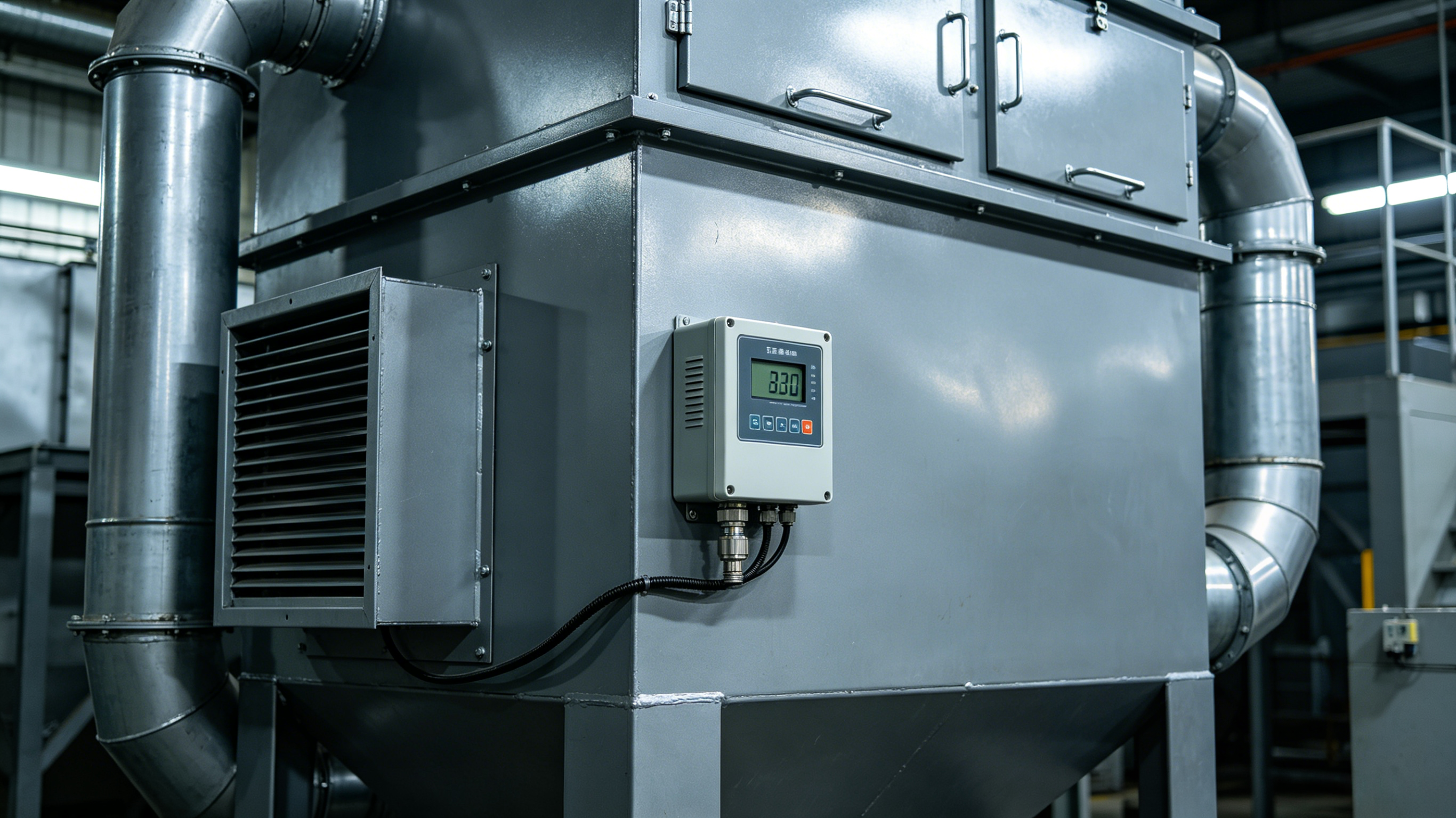
Dust collector selection at the decision stage is a specification-matching exercise, not a catalogue-browsing exercise. Four parameters decide whether a unit holds its rated performance over years of operation: airflow capacity (m³/h), filter area (m²), filtration efficiency, and the maximum operating temperature the collector type can tolerate. Filtration velocity and inlet velocity are the two fine-tuning factors that determine how hard the selected unit actually works.
This guide works through those parameters using published model data — the DMC-200 (160 m² filter area, 9,600–14,400 m³/h), the SENOTAY LTMC-5000 cartridge dust collector (211 m², 0.6–0.8 m/min filtration velocity, ≥99.9% filtration efficiency), the LXC-800 (3,000–5,000 m³/h, 15–20 m/s inlet velocity) and the WESP-10000 wet-type collector (5,000–10,000 m³/h, ≤80 °C). Cyclone-class collectors are generally specified for process streams up to 300 °C.
Why Dust Collector Specifications Fail After Installation
Most field complaints about industrial dust collectors — rising differential pressure, short filter life, visible dust carry-over — trace back to one or two parameters being matched to the wrong number rather than to a defective component. Three patterns repeat across baghouse, cartridge, cyclone and wet-type installations:
- Airflow quoted as a single figure instead of a window. A unit justified at the top of its airflow range has no margin for duct leakage, added capture points or process changes.
- Filter area compared without a filtration velocity basis. Two collectors with different filter areas can serve the same airflow, but they will not run at the same pressure drop or cleaning frequency.
- Efficiency claims compared without medium, temperature or test basis attached. A percentage without context cannot be verified and cannot be defended during a compliance review.
Excessive resistance across the filter medium belongs in the second category. It is a recognised operating risk with a known control method — scheduled or manual cleaning — and the practical control instrument is a differential pressure gauge supplied with the unit. A specification that omits pressure-drop monitoring removes the operator's ability to see the problem forming, which is why the gauge is a selection criterion and not an accessory.
Industry Background: One Category, Many Technologies
Industrial dust collectors are not a single product. The category covers baghouse dust collectors, pulse jet dust collectors, cartridge dust collectors, cyclone dust collectors, electrostatic precipitators, wet scrubbers, bag filters, stainless steel dust collectors and mobile dust collectors. Each type wins on a different combination of airflow capacity, efficiency, temperature tolerance, footprint and maintenance access.
Technical and regulatory literature places a baghouse in the dry, fabric-filter family. OSHA technical material describes a baghouse as a dry-type dust collector using fabric filter media — a classification that matters when a buyer has to document why a given technology was selected for a given process stream.
Commercially, one research source, Grand View Research, reported that baghouse collectors held approximately 25.8% of global dust collector market revenue in 2025, and projected the global industrial dust collector market to reach approximately USD 13.42 billion by 2034. That projection is a commercial research estimate with its own scope and methodology; it is useful as a directional signal that fabric filtration remains the reference technology against which other collector types are specified, which is why baghouse-versus-cyclone comparisons still drive a large share of procurement decisions.
Compliance now sits inside the specification decision rather than after it. NFPA 652 requires facilities to complete a Dust Hazard Analysis for combustible dust compliance. OSHA material references NFPA 664, which requires certain woodworking dust collectors to be located outside buildings, subject to specified exceptions involving exterior walls, explosion vents or suppression systems, and references NFPA 654 for combustible particulate solids. Electrical components of a dust collector must be approved by a Nationally Recognized Testing Laboratory as required by OSHA standards. Standards editions and local adoption vary, so the current text should be verified with the authority having jurisdiction before the specification is frozen.
The Four Core Selection Parameters
1. Filter area (m²): how much filtration surface the airflow must pass through
Filter area is the total effective filtration surface inside the collector, and it is the denominator in the ratio that governs how fast air moves through the filter medium. Two published examples show how differently the same nominal duty can be sized: the DMC-200 is specified with 160 m² of filter area, while the SENOTAY LTMC-5000 cartridge collector is specified with 211 m². A larger filter area at the same airflow means a lower filtration velocity, less mechanical stress on the media and a slower rise in pressure drop between cleaning cycles.
Cartridge construction compresses that area into a smaller envelope. That is consistent with manufacturer-reported design comparisons: Baghouse.com states that cartridge collectors can provide more filter area in a smaller enclosure than baghouses for the same airflow and can allow external filter replacement. As with any single-manufacturer design claim, it should be verified against footprint drawings and maintenance access requirements in the actual quotation.
2. Airflow capacity (m³/h): match the window, not the maximum
Airflow capacity is almost always published as a range, and the range is not marketing margin — it is the operating window inside which velocities, pressure drop and efficiency remain within specification. Published examples used in this comparison: the DMC-200 at 9,600–14,400 m³/h, the LXC-800 at 3,000–5,000 m³/h, and the WESP-10000 at 5,000–10,000 m³/h.
The practical rule for buyers is to size the process design airflow at or below the middle of the unit's published range. A collector selected near the top of its airflow window has no capacity left for ductwork leakage, additional capture points or future process changes, and it will run permanently closer to its pressure-drop limit.
3. Filtration efficiency: what the number actually measures
SENOTAY states a filtration efficiency of ≥99.9% for the LTMC-5000 cartridge dust collector. Efficiency figures must be read with the medium and the application attached: mechanical separation in a cyclone removes coarse particles; fabric filtration in baghouse, pulse jet and bag filter units removes fine particulate at higher efficiency; electrostatic precipitation and wet collection handle different duty profiles altogether.
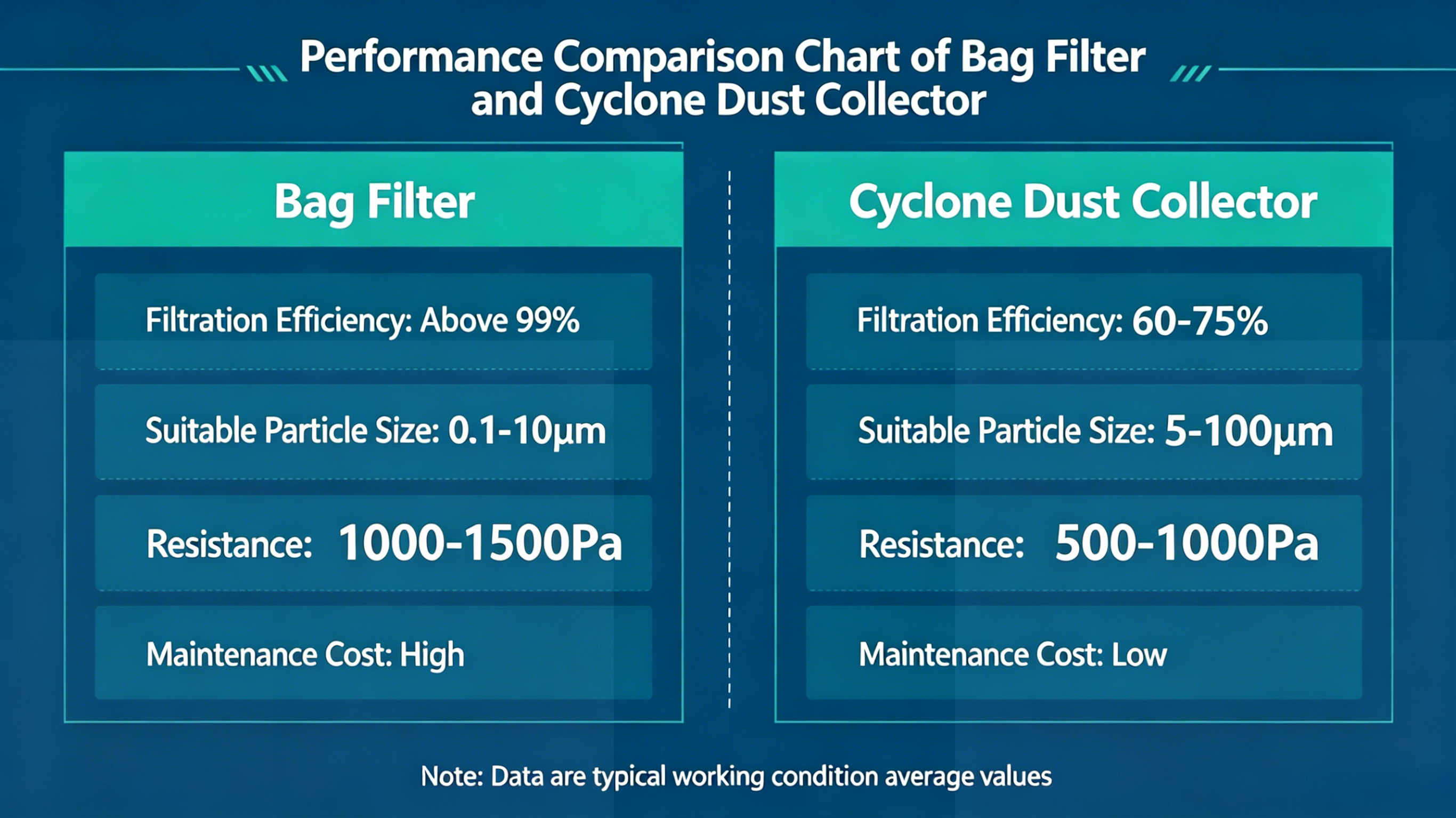
The gap between mechanical and fabric separation is measurable rather than theoretical. Baghouse dust collectors are reported to provide more than a 25% improvement in purification efficiency compared with cyclone dust collectors. For plants operating under emission limits or workplace exposure targets, that gap usually decides the technology class before price is discussed at all.
4. Operating temperature limit: the parameter that eliminates technologies first
Temperature is the fastest filter in the selection sequence because it removes entire technology classes instead of adjusting a single number. Cyclone-class collectors are generally specified for process streams up to 300 °C, while wet-type units such as the WESP-10000 are specified with an operating limit of ≤80 °C.
A 250 °C kiln or dryer exhaust therefore cannot be routed to a wet unit without pre-cooling, and a humid, low-temperature stream with condensable material is a poor candidate for a dry fabric filter without pre-treatment. Checking temperature before airflow prevents the most expensive early error in a project: pricing and detailing a collector type the process cannot actually use.
Fine-Tuning Parameters: Filtration Velocity and Inlet Velocity
Two velocities determine whether a correctly sized collector actually performs in service.
Filtration velocity, the air-to-cloth ratio expressed in m/min, is set by design airflow divided by filter area. The LTMC-5000 is specified at 0.6–0.8 m/min. That window converts into a useful design rate for sanity-checking quotations: each square metre of filter area handles approximately 36 m³/h at 0.6 m/min and approximately 48 m³/h at 0.8 m/min. If a quotation states a filter area but not a filtration velocity, the buyer can divide the design airflow by the stated area and confirm whether the result falls inside the supplier's own velocity window.
Inlet velocity governs cyclone performance. The LXC-800 is specified with an inlet velocity of 15–20 m/s. Below that window, coarse particles settle out in the ductwork instead of the collector; above it, abrasion at the inlet and re-entrainment of already-separated dust increase. The window is narrow deliberately, and it is the figure to confirm whenever a cyclone is used as a pre-cleaner upstream of a fabric filter.
Step-by-Step: Matching a Collector Model to a Process Requirement
- Fix the design airflow in m³/h. Sum the extraction demand of every capture point and hood, add a ductwork allowance, and state one design airflow figure rather than a range of operating scenarios.
- Screen by temperature and dust character. Cyclone-class units are generally specified up to 300 °C; wet-type units such as the WESP-10000 are limited to ≤80 °C. Where combustible dust is present, NFPA 652 requires a Dust Hazard Analysis before equipment selection is finalised.
- Choose the technology class. Mechanical separation (cyclone), fabric filtration (baghouse, pulse jet, bag filters), cartridge filtration, electrostatic precipitation, or wet collection. Class selection follows temperature and efficiency targets, not price.
- Convert airflow into required filter area. Filter area = design airflow ÷ filtration velocity, with the velocity expressed in m/min and multiplied by 60 to match the hourly airflow. Compare the result with catalogue areas — 160 m² for the DMC-200, 211 m² for the LTMC-5000.
- Verify both velocity windows. Filtration velocity 0.6–0.8 m/min for the LTMC-5000; inlet velocity 15–20 m/s for the LXC-800. Any offered unit should be quotable against an equivalent window.
- Specify monitoring, materials and documentation. A differential pressure gauge for resistance control with scheduled or manual cleaning; materials of construction matched to the gas stream; NRTL-approved electrical components; and an RFQ pack containing airflow, filter area, velocity windows, temperature limit, efficiency statement and spare-part scope.
Use Cases: Which Parameter Decides Which Application
- High-temperature process exhaust (foundry, cement, metallurgy). Temperature decides the architecture first. A supplier-described foundry configuration combines a cyclone pre-cleaner with a pulse-jet baghouse and adds explosion venting, isolation, spark detection and a wet or dry collector selected according to dust hazard. The cyclone does the hot, coarse pre-separation; the fabric filter delivers final efficiency.
- Fine fume, powder coating, metalworking and welding duty. Cartridge filtration is the usual fit: the LTMC-5000 offers 211 m² of filter area at 0.6–0.8 m/min filtration velocity with ≥99.9% filtration efficiency, and external filter replacement supports maintenance access.
- Coarse dust pre-cleaning and product recovery. A cyclone such as the LXC-800, at 3,000–5,000 m³/h and 15–20 m/s inlet velocity, is normally used upstream of a fabric filter to reduce the dust load reaching the bags.
- Humid, sticky or low-temperature streams. A wet-type unit such as the WESP-10000, rated 5,000–10,000 m³/h at ≤80 °C, avoids the problems dry media face with condensable material.
- Mid-size plants with mixed duty. The DMC-200, at 160 m² covering 9,600–14,400 m³/h, sits in the middle band where a large share of general manufacturing duty is specified.
Specification Comparison: Representative Models Side by Side
| Selection parameter | DMC-200 | LTMC-5000 | LXC-800 | WESP-10000 |
|---|---|---|---|---|
| Airflow capacity (m³/h) | 9,600–14,400 | — | 3,000–5,000 | 5,000–10,000 |
| Filter area (m²) | 160 | 211 | — | — |
| Filtration velocity | — | 0.6–0.8 m/min | — | — |
| Inlet velocity | — | — | 15–20 m/s | — |
| Operating temperature limit | — | — | up to 300 °C (cyclone class) | ≤80 °C |
| Filtration efficiency | — | ≥99.9% | — | — |
A dash means the parameter is not part of the published model data used for this comparison; the absence of a figure is not a zero or a negative rating. Values should be re-confirmed against the supplier's current datasheet before an order is placed.
Where the decision is between mechanical separation and fabric filtration, the trade-off is a three-variable comparison rather than a single performance figure:
| Comparison dimension | Baghouse dust collectors | Cyclone dust collectors |
|---|---|---|
| Purification efficiency | More than 25% improvement over cyclone separation | Lower purification efficiency; the baseline in this comparison |
| Maintenance requirement | Lower maintenance requirement | Higher relative maintenance burden |
| Initial cost | Approximately 50% more expensive than a cyclone | Lower initial cost |
| Best fit | Industrial plants requiring high purification efficiency | Pre-cleaning and coarse dust separation |
The comparison above is based on company-reported comparative figures and is intended as a decision framework, not as a market-wide benchmark.
FAQ
What compliance checks should be completed before a dust collector specification is frozen?
Where combustible dust is present, NFPA 652 requires facilities to complete a Dust Hazard Analysis, and that analysis normally determines collector location, explosion protection and isolation requirements before a model is chosen. OSHA material also references NFPA 664, which requires certain woodworking dust collectors to be located outside buildings, subject to specified exceptions involving exterior walls, explosion vents or suppression systems, and references NFPA 654 for combustible particulate solids. Electrical components of the dust collector must be approved by a Nationally Recognized Testing Laboratory as required by OSHA standards. Because standards editions and local adoption vary, the current text should be confirmed with the authority having jurisdiction before the specification is finalised.
Can one dust collector model cover both high-volume and fine-dust duty?
Not usually, and the published airflow windows show why. The DMC-200 covers 9,600–14,400 m³/h with 160 m² of filter area; the LXC-800 covers 3,000–5,000 m³/h at a 15–20 m/s inlet velocity; the WESP-10000 covers 5,000–10,000 m³/h with an operating limit of ≤80 °C; and the SENOTAY LTMC-5000 cartridge collector carries 211 m² of filter area at 0.6–0.8 m/min filtration velocity with ≥99.9% filtration efficiency. Each unit is optimised for a band of airflow, dust character and temperature; selecting outside that band moves the collector away from its design velocities, which is where pressure drop and maintenance cost rise.
Why can a baghouse cost 50% more than a cyclone, and when is that premium justified?
Baghouse dust collectors are reported to cost about 50% more than cyclone dust collectors at the initial purchase stage, while delivering more than a 25% improvement in purification efficiency and lower maintenance requirements. The premium is justified when the plant has a genuine efficiency requirement — fine particulate, emission limits or workplace exposure targets — rather than when a cyclone's mechanical separation is already sufficient. A common compromise is a cyclone used as a pre-cleaner with a fabric filter downstream, which reduces the dust load reaching the bags without giving up the final efficiency target.
How can a buyer validate performance before placing a full order?
Ask for the design basis before the equipment. SENOTAY's engineering model starts with on-site design analysis of the specific airflow volume, dust particle characteristics and compliance targets, followed by custom manufacturing against those figures, then installation, commissioning and operator training. In practice, that means a buyer should be able to see the airflow assumption, the filter area, the filtration velocity window and the efficiency statement for the offered model — for example, 211 m² at 0.6–0.8 m/min and ≥99.9% efficiency for the LTMC-5000. The unit should also include a differential pressure gauge so that resistance can be monitored from the first day of operation.
What determines delivery time, and what should be confirmed in the RFQ?
Delivery time is driven mainly by whether the model is a stocked standard size or built to the project specification. One supplier, ACT Dust Collectors, states that it holds five of the most common dust collector sizes in stock and can ship them within five days of purchase; this is a single supplier's self-reported programme and should not be treated as an industry benchmark, but it illustrates why buyers shortlisting for urgent replacement should ask about stock status separately from engineered lead time. To avoid avoidable delays, confirm airflow, filter area, the filtration and inlet velocity windows, temperature limit, materials of construction, electrical approval requirements and spare-part scope such as filter bags, bag cages and pulse solenoid valves in the RFQ.
Conclusion: The Decision Rule and the Next Step
The selection rule that follows from the parameters above is short: eliminate technology classes by temperature first, confirm the efficiency target against the process requirement second, size the collector from a single design airflow figure third, and only then compare filter areas, velocities and cost. Applied to the model data in this guide, it produces a clear split — cyclone-class separation up to 300 °C for coarse pre-cleaning, fabric filtration where more than a 25% purification efficiency improvement justifies the higher initial cost, cartridge filtration for fine fume at 0.6–0.8 m/min filtration velocity, and wet-type collection for low-temperature or condensable streams.
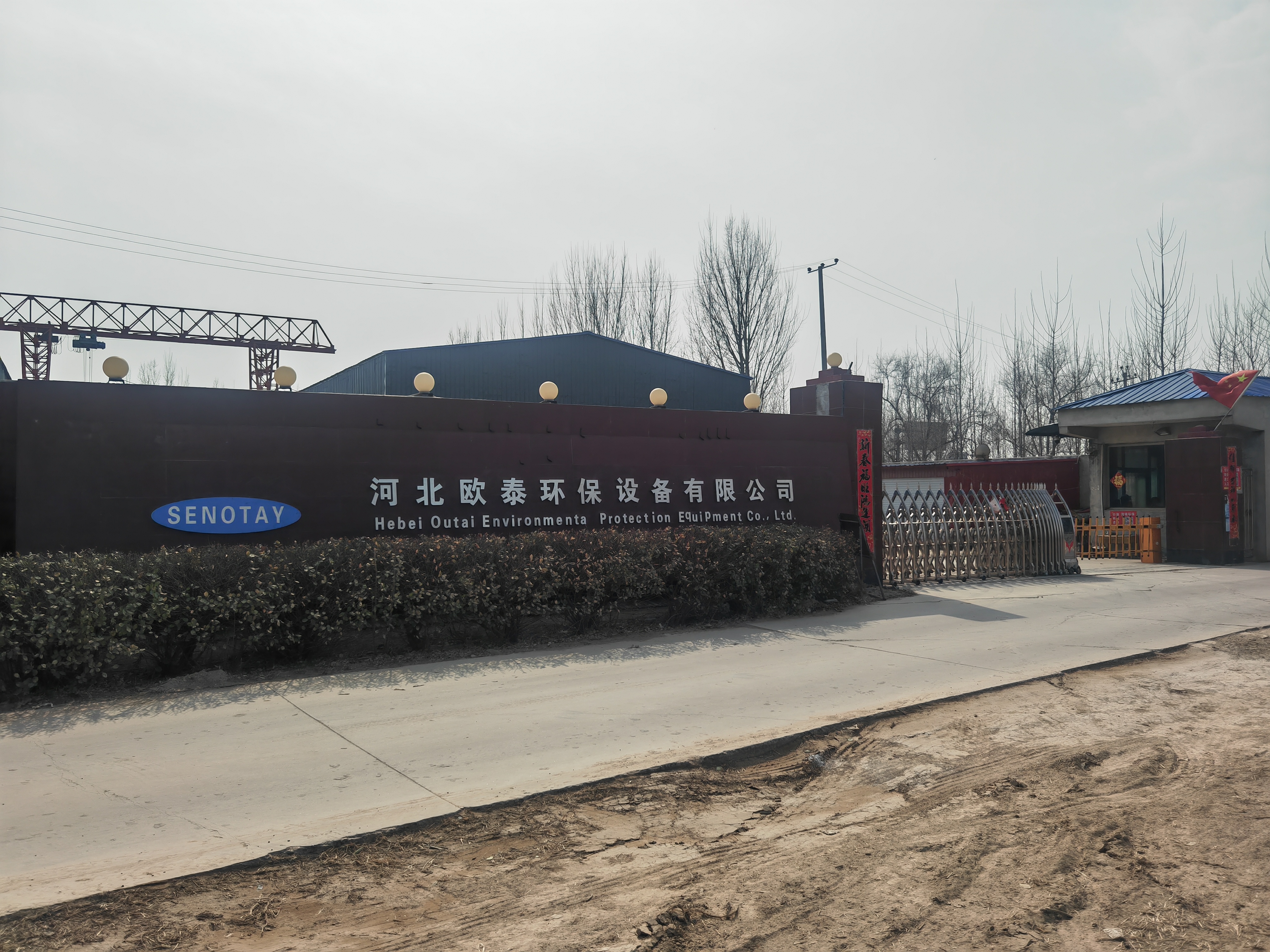
SENOTAY, the brand of Hebei Outai Environmental Protection Equipment Co., Ltd., manufactures bag filters, electrostatic precipitators, cyclone dust collectors, wet scrubbers and filter cartridge collectors from a 6,000 m² facility in Botou, Hebei Province, supported by a five-engineer R&D team and an export share of approximately 70% across Central Asia, Southeast Asia, the Middle East, Russia, Africa and Europe. The company's stated engineering model covers on-site design, custom manufacturing, installation and commissioning, and ongoing maintenance and renovation support.
Next step for buyers at the decision stage
Send the design airflow, the process temperature and the dust characteristics to SENOTAY's engineering team. You will receive a model recommendation with filter area, filtration velocity window, efficiency statement and temperature limit stated against your process data — not a generic product list. Sample and quotation requests are handled at www.senotay.com or by email at info@senotay.com; telephone +86-317-8288592, WhatsApp +86 15831871808.
Download the full product catalogue and specification range here: SENOTAY industrial dust collector catalogue (PDF)

Have Questions or Need More Details?
Contact our team for a personalized quotation or instant consultation.
Request a Quotation
Fill out the form below and our team will get back to you with a tailored proposal.
WhatsApp Direct Chat
Prefer to chat in real-time? Message us on WhatsApp for instant assistance & quick answers.
- Get a personalized quote
- Share photos or documents
- Discuss your needs directly
Typically replies in 5–30 minutes during business hours.