
Foldable vs One-Piece Fixed Water Bottle Racks: A 5-Gallon Buyer Comparison
A full 5-gallon jug weighs roughly 42–45 lbs. Every 5-gallon water bottle rack on the market — foldable, detachable or one-piece welded — has to carry that load, repeatedly, for years. The choice between a foldable or detachable design and a fixed one-piece frame is therefore not a styling decision. It is a trade between shipped volume, arrival labour and structural continuity. Foldable and detachable designs win on packaging density. One-piece welded designs win on arrival-ready simplicity and on having no joints to loosen. Which side of that trade belongs in your order depends on three variables: order volume, delivery model and where the rack will actually stand.
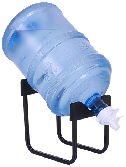
SF-BR-04A — detachable tabletop 5-gallon water bottle rack, Q195 steel tube with ABS plastic and PP spigot, 270 mm × 180 mm footprint.
The Problem: A Heavy Jug, A Light Rack
A standard full 5-gallon bottle sits in the 42–45 lbs range. That weight is concentrated on a small contact ring, and in commercial settings it is lifted and replaced several times a day. For a commercial water bottle rack, this is not an edge case — it is the baseline condition the frame is designed against.
Racks therefore fail on two axes, and neither of them is about the bottle.
Structural fatigue. Joints work loose, welds crack, tube sections deform under repeated point loading. The failure mode differs between a welded one-piece frame and an assembled multi-part frame, but both eventually degrade.
Operational failure. A rack that was meant to save space ends up making bottles harder to extract, harder to clean around, or unstable on an uneven floor. This failure is invisible in a specification sheet and obvious in a stockroom.
The foldable-vs-fixed debate is really a debate about which of these two axes matters more for a given buyer. A water delivery company that re-packs its fleet every day and a corporate office that fills a pantry rack twice a week are not solving the same problem, even though both are buying a 5-gallon water jug rack.
There is a third variable that sits outside the product entirely: how much of the product you have to pay to move. That is where foldable and detachable construction becomes a commercial argument rather than an engineering one.
Industry Background: Why 5-Gallon Storage Split Into Two Design Directions
Water bottle racks are sold into offices, homes, restaurants, clinics, schools, water delivery fleets and wholesale channels. Those buyers differ enormously in how the product reaches them.
An office buyer purchases two or three units and cares whether the rack looks acceptable in a pantry. A distributor purchases 500 units at a time and cares how many cartons fit in a 40HQ container. A delivery company cares whether the rack survives being loaded, unloaded and moved between stops.
Because those needs diverge, the market has developed two distinct design directions.
Static-optimised racks are built as fixed geometry. The frame is welded or moulded as a single unit and arrives assembled. Commercial welded-wire racks are commonly listed in capacity steps such as 4, 6, 8, 12 and 16 bottles, with the selling point being bottle capacity rather than shipping efficiency. These products assume the rack will be placed and left in position.
Movement-optimised racks are built for transport and handling. Marketplace listings routinely describe foldable, multi-tier, wheeled water jug holders built from heavy-duty steel for six-bottle loads — designs that prioritise collapsibility and mobility over raw capacity.
Both directions are legitimate. What the market has not done well is give buyers a way to price the difference. Three questions stay unanswered in most catalogue pages:
How much shipping volume is actually saved, and at what order size does it matter?
How much labour is created on arrival?
Does the flexibility compromise structural integrity over a five-year service life?
Those are the questions this comparison addresses, using two tabletop racks that sit at opposite ends of the design spectrum.
Detailed Solution: Two Tabletop Racks, Two Structural Logics
SF-BR-04A — Detachable Tabletop Rack
The SF-BR-04A is built from a Q195 steel tube frame, ABS plastic components and a PP spigot. Its overall footprint is 270 mm × 180 mm, with a front height of 225 mm and a rear height of 285 mm. It is specified as a detachable tabletop rack with a valve faucet, intended for household and office dispensing.
The word detachable is the commercially relevant part. The rack is assembled from distinct components rather than formed as a single rigid product. For a buyer, that has one primary consequence and one secondary consequence.
The primary consequence is packaging. Component parts can be nested and packed considerably tighter than a finished frame of the same footprint. The secondary consequence is that the joints between steel tube and ABS plastic become the governing factor in long-term rigidity — the connection is a metal-to-plastic interface, and its durability depends on how well the ABS component is engineered to hold the tube over repeated loading cycles.
For its intended setting — household and office tabletop dispensing — the design is well matched. It is not positioned as a high-volume warehouse rack, and it should not be evaluated as one.
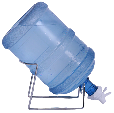
SF-BR-06A — one-piece moulded and welded tabletop 5-gallon water bottle rack, Q195 steel wire with chrome-plated anti-rust finish, 24 cm × 19 cm.
SF-BR-06A — One-Piece Welded Tabletop Rack
The SF-BR-06A takes the opposite approach. The frame material is Q195 steel wire with a chrome plating finish specified as an anti-rust finish, and the rack uses a one-piece moulded and welded design. It measures 240 mm × 190 mm with a front height of 105 mm and a rear height of 170 mm, and it is also specified for household and office tabletop dispensing.
Structurally, this is a single continuous article. There is no joint to re-tighten, no plastic-to-metal interface to inspect, and no assembly step between the carton and the first bottle. The costs sit on the supply chain side instead: a finished frame occupies more volume per unit than a knocked-down equivalent, and a finished frame carries slightly different handling risk in transit — a larger, more open article is exposed to compression damage that a flat-packed bundle is not.
The chrome plating is worth flagging separately. Powder coating and chrome plating behave differently in service. Chrome plating delivers a bright metallic appearance; powder coating offers broad colour options and good surface protection when properly applied. For either finish, actual corrosion performance depends on substrate preparation, coating or plating quality, thickness and the service environment — not on the finish name alone. A humid kitchen and a dry office pantry will treat the same finish very differently.
The Wider Foldable Reference: SF-BR-01A and SF-BR-02A
Tabletop racks are a small-volume category. The foldable-versus-fixed argument is at its sharpest in the full-size 5-gallon racks used by water delivery operations, offices and hospitality venues.
The SF-BR-01A is a foldable A-type rack measuring 300 mm × 195 mm, with front and rear heights of 360 mm and 400 mm. The SF-BR-02A is a foldable U-type rack at the same 300 mm × 195 mm footprint, with front and rear heights of 280 mm and 380 mm. Both use 16 × 0.8 mm steel tube, both receive phosphating treatment followed by electrostatic powder spraying, and both include a PP spigot. Both are specified for water delivery, household and office use.
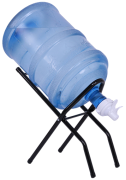
SF-BR-01A — foldable A-type 5-gallon water bottle rack, 16 × 0.8 mm steel tube, phosphating plus electrostatic powder spraying, PP spigot.
These are the models where foldable construction produces a real container-level difference, because the assembled-to-packed ratio is much larger than on a 270 mm tabletop unit.
Packaging Volume and Ocean Freight: Where Foldable Actually Wins
According to SHAFON's foldable rack packaging data, foldable racks pack flat at approximately 30 sets per carton, producing roughly 60–70% less shipping volume than one-piece racks. That volume reduction is what translates into a lower ocean freight cost per set.
The mechanism is straightforward. Ocean freight is charged on volume or weight, whichever is greater, and for light steel racks the volume almost always governs. A container filled with flat-packed foldable units carries substantially more sets than the same container filled with assembled frames. The freight cost per set falls accordingly.
Three corrections buyers should apply before they take that number to a budget meeting:
The 60–70% figure is a packaging volume comparison, not a freight comparison. Freight also depends on container type, mixed loading, port pair and current rate levels. Volume reduction is the input; freight saving is the output, and the two are not the same number.
The advantage only realises at order sizes that fill containers. A 200-set mixed order that is consolidated with other products will not capture the full packaging benefit, because the container is not being optimised around this one SKU.
One-piece racks cost more volume per unit, but they arrive saleable. That has value that a pure cubic-metre calculation ignores — particularly for a distributor whose next customer wants to display the product, not assemble it.
The practical rule: the packaging advantage of foldable and detachable designs scales with order volume. At 200 sets it may barely cover the added handling. At two 40HQ containers per month it becomes a material line item.
Arrival and Assembly: What Actually Gets Paid For
Foldable racks ship flat, in OPP bag or paper card packaging. One-piece racks ship assembled, in individual boxes. SHAFON describes all models as easy to set up on arrival, but easy and identical are not the same thing — the two categories require completely different actions.
The difference shows up in three places.
Labour. A flat-packed rack is not saleable on arrival. On a 500-set order, that is 500 assembly actions, done by someone. If the buyer is a water station or a fleet operator, that labour is often already on payroll and the flat-pack is close to free. If the buyer is an importer reselling to retail, that labour has to be hired or outsourced, and it should be priced into the landed cost.
Damage exposure. Assembled frames occupy more space per unit and present a larger surface. Flat-packed bundles present less exposed area per collision. The risk profiles differ, and packaging specification — carton grade, internal dividers, corner protection — matters more for the assembled category.
After-sales and missing parts. An assembled rack eliminates an entire class of complaint: the missing fitting, the mis-matched component, the customer who cannot work out which bolt goes where. A detachable design has to earn that reliability back through packaging discipline and component tolerances.
For distributors reselling into retail, ready-to-sell condition is usually worth more than the freight saving. For water delivery companies and internal facility deployments, flat-pack is normally the better economic choice, because the assembly labour is already sunk.
Stability and Load Behaviour in Commercial Use
Buyers should evaluate a 5-gallon rack on four parameters: tube or wire diameter, wall thickness, weld integrity and base width. Those four variables explain most of the variation in how a rack behaves once it is loaded.
The two tabletop models sit on different sides of that analysis.
The SF-BR-06A derives rigidity from continuous formed geometry — one-piece moulded and welded steel wire, with no connection that can work loose. Load is distributed through the wire structure itself, so the wire specification is effectively the only structural variable.
The SF-BR-04A derives rigidity from assembled components — Q195 steel tube held by ABS plastic. Here the governing interface is metal-to-plastic. How tightly the ABS component grips the tube, and how that grip behaves after repeated load cycles, determines service life. This is not a defect; it is a different engineering problem, and it requires the buyer to ask a different question at sample stage.
Across the wider SHAFON rack range, the steel specifications are directly stated and directly comparable. The foldable SF-BR-01A and SF-BR-02A use 16 × 0.8 mm steel tube. The multi-tier SF-BR-12A, SF-BR-17A and SF-BR-20A use Q235 steel tube at 20 × 20 × 0.6 mm with powder coating. The vertical SF-BR-11A, SF-BR-11C and SF-BR-11G use 20 × 20 × 0.8 mm steel tube with electrostatic powder spraying. Section geometry and wall thickness are visible on the sheet.
Load ratings are not.
That gap matters. A marketplace listing claiming a load capacity exceeding 500 lbs for a 12-bottle stainless steel rack is a seller claim — it comes without a stated test method, safety factor or sample geometry, and it should not be treated as a validated benchmark. Equally, a specification sheet that states only material and dimensions has told you nothing about failure load.
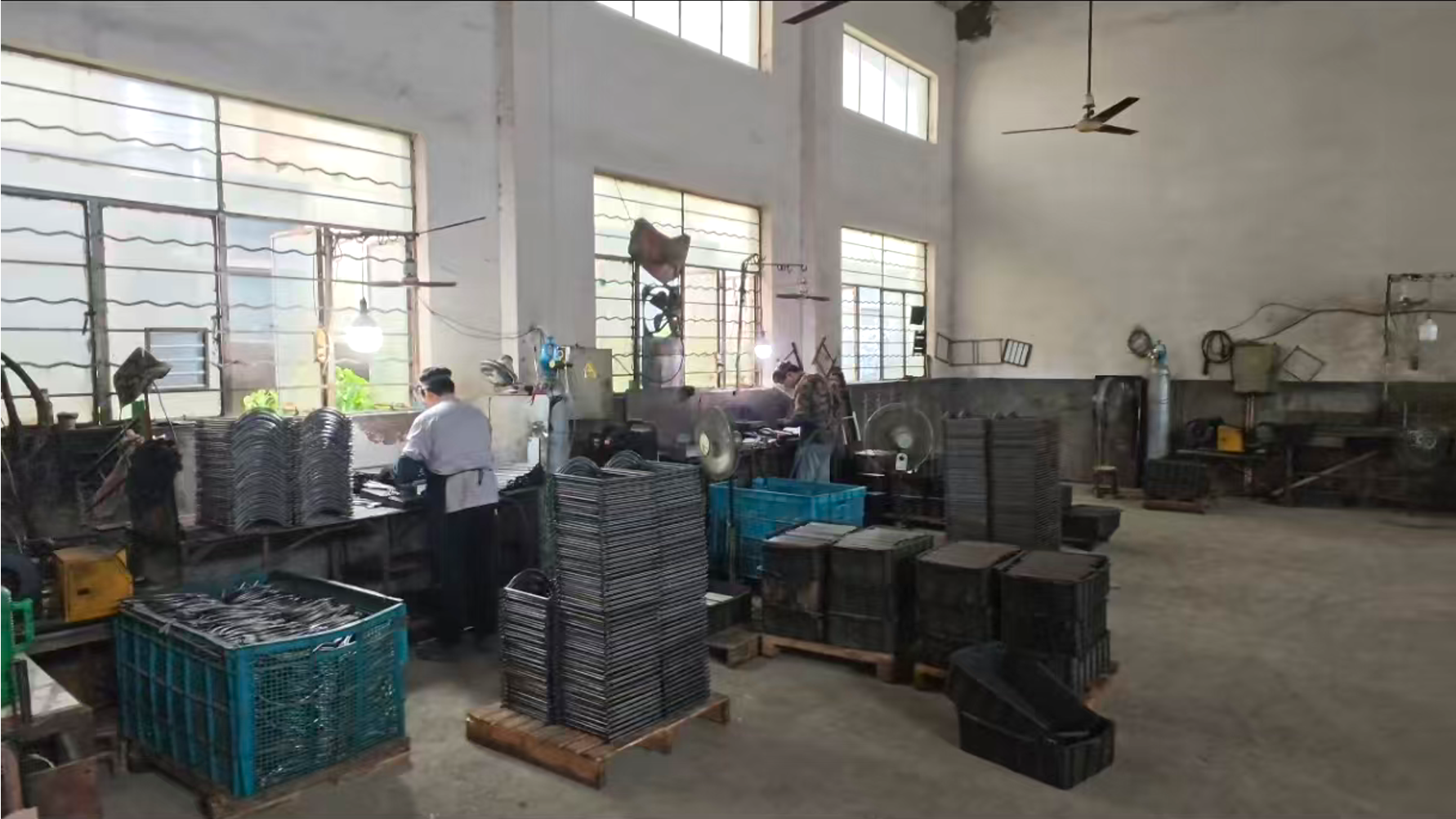
Welding workshop — weld integrity is one of the four parameters that governs rack stability in service.
Where load testing does exist, the correct question is not whether testing happened but whether the report states its method. A usable load report names the test standard or method, the sample geometry, the safety factor applied and the pass criterion. Without those, heavy-duty is an adjective rather than a specification.
Step-by-Step Breakdown: Choosing Between Flat-Packed and Fixed
Step 1 — Fix the real bottle count and location. Count the bottles in daily circulation and measure the floor or tabletop space available. A 270 mm × 180 mm tabletop footprint and a 300 mm × 195 mm folding footprint solve different problems. Getting this wrong makes every later decision irrelevant.
Step 2 — Model the container before you model the rack. Calculate how many sets of each option fit your planned container under both packaging formats. The 60–70% packaging volume difference between foldable and one-piece construction is the input to this calculation, not the answer to it.
Step 3 — Assign a real cost to arrival labour. Decide who assembles, at what hourly cost, and what else that person would otherwise be doing. If the answer is nobody and nothing, flat-pack is close to free. If the answer involves a third-party repacking service, that cost belongs in the comparison.
Step 4 — Match the finish to the environment. Chrome plating and powder coating behave differently depending on humidity, cleaning chemicals and drainage. A humid back-of-house and a dry office pantry should not receive the same recommendation. Corrosion performance depends on substrate preparation, coating or plating quality, thickness and the service environment.
Step 5 — Request load evidence in writing. Ask for the test method, sample geometry, safety factor and pass criterion behind any load claim. If the supplier cannot state a method, treat the claim as commercial positioning rather than engineering data.
Step 6 — Confirm commercial terms against the design choice. MOQ and lead time differ by order type, and the design choice interacts with them. SHAFON's in-stock rack and bucket MOQ is 200–300 pcs with shipment within 5 days. OEM orders — logo, colour, packaging, product matching — run 500 pcs with a 15-day lead time. ODM orders, which add product development and structure or appearance design, run 1,000 pcs with a 30-day lead time. Rack capacity is 20,000–30,000 per month.
Step 7 — Run a sample through the real handling cycle. Load it, unload it, move it, clean it. A sample tested only for appearance has not been tested.
Use Cases: Where Each Design Belongs
Corporate offices and pantries
Tabletop dispensing in a pantry or break room is the native application for both the SF-BR-04A and the SF-BR-06A. Volume is low, handling is light, and appearance matters. The one-piece unit removes assembly from the facilities team's task list; the detachable unit packs more tightly if the office is part of a multi-site rollout shipped to a central warehouse.
Water delivery and bottled-water distribution
This is the segment where foldable construction pays. Racks are handled constantly, stored between routes, and often moved empty. A foldable water bottle rack that collapses when not in use recovers floor space in a depot, and flat-pack shipping means more units per container. One SHAFON customer operating in bottled water delivery and retail has been ordering 2×40HQ per month for a year, comparing racks, pumps and accessories and building local-market combinations — a pattern consistent with a distribution operation that needs flexible configurations rather than a single fixed SKU.
Hospitality, food service and healthcare
Hotel service areas, restaurant back-of-house storage and healthcare utility rooms share a requirement: the rack has to be cleanable and has to survive a wet environment. Foldable designs help here because they can be collapsed for floor cleaning and moved out of the way. Finish selection matters more than design type in these settings.
Wholesale and retail display
Where the rack will be seen by a consumer, or resold as a finished product, the assembled one-piece format is usually the right call. It arrives saleable, and the packaging volume penalty is recovered in the resale price rather than in freight.
Warehouse and high-volume storage
Neither tabletop model belongs here. Multi-tier and vertical racks are the correct category — the SF-BR-20A at 330 × 965 × 1060 mm holding 12 bottles, the SF-BR-11G at 680 × 340 × 1380 mm holding 10 bottles, or the SF-BR-12A at 330 × 350 × 730 mm holding three. These are separate purchase decisions with their own specification logic.
Comparison Table: SF-BR-04A, SF-BR-06A and the Foldable Series
| Attribute | SF-BR-04A | SF-BR-06A | SF-BR-01A | SF-BR-02A |
|---|---|---|---|---|
| Structural type | Detachable tabletop rack | One-piece moulded and welded tabletop rack | Foldable A-type rack | Foldable U-type rack |
| Frame material | Q195 steel tube + ABS plastic | Q195 steel wire | 16 × 0.8 mm steel tube | 16 × 0.8 mm steel tube |
| Surface finish | Not stated in the specification | Chrome plating, specified as anti-rust finish | Phosphating + electrostatic powder spraying | Phosphating + electrostatic powder spraying |
| Spigot | PP spigot | PP spigot | PP spigot | PP spigot |
| Footprint | 270 mm × 180 mm | 240 mm × 190 mm | 300 mm × 195 mm | 300 mm × 195 mm |
| Front / rear height | 225 mm / 285 mm | 105 mm / 170 mm | 360 mm / 400 mm | 280 mm / 380 mm |
| Packaging format | Component parts pack tighter than an assembled frame of equal footprint | Assembled, individual box | Flat-packed, approx. 30 sets per carton | Flat-packed, approx. 30 sets per carton |
| Shipping volume | Reduced versus assembled equivalent | Baseline | Roughly 60–70% less than one-piece racks | Roughly 60–70% less than one-piece racks |
| Arrival condition | Assembly required | Ready to use | Assembly / unfolding required | Assembly / unfolding required |
| Stated application | Household, office | Household, office | Water delivery, household, office | Water delivery, household, office |
Read across the table and the pattern is clear. Every row that improves packaging efficiency is paired with a row that adds an arrival step. Every row that removes the arrival step is paired with a row that increases shipped volume. There is no configuration that wins on both.
Decision Checklist
- Order volume: Under roughly one container per cycle, packaging savings rarely justify added handling. At recurring container volume, flat-pack becomes a genuine cost line.
- Delivery model: Direct-to-facility deployments can absorb assembly labour. Importer-to-retail channels usually cannot, and should default to ready-to-sell formats.
- End-user setting: Dry office pantry, humid back-of-house, mobile depot floor and retail display each push the recommendation in a different direction.
- Finish match: Chrome plating for appearance-driven settings; phosphating plus electrostatic powder coating where colour consistency and surface protection are the priority. Confirm the environment before confirming the finish.
- Load evidence: Written test method, sample geometry, safety factor and pass criterion — or no load claim.
- Tube or wire specification: 16 × 0.8 mm, 20 × 20 × 0.6 mm and 20 × 20 × 0.8 mm all appear across the range. Compare like with like.
- MOQ and lead time fit: In-stock 200–300 pcs ships within 5 days; OEM 500 pcs at 15 days; ODM 1,000 pcs at 30 days. Match the design decision to the order type you can actually place.
- Sample before commitment: Load it, move it, clean it, then decide.
Frequently Asked Questions
How do Chinese 5-gallon water bottle rack manufacturers demonstrate load testing?
A credible answer describes the form the evidence takes, not just the claim. For a water bottle rack, that usually means three layers. First, stated tube or wire specifications — for example 16 × 0.8 mm steel tube, or Q235 steel tube at 20 × 20 × 0.6 mm. Second, weld and structural inspection during production. Third, pre-shipment inspection covering quantity, tube or wire specifications, surface finish (no rust, no scratches), weld integrity, spigot assembly, packaging and shipping marks. SHAFON's standard process combines in-production inspection with pre-shipment inspection across exactly those checkpoints. Where a formal load report is required, request the test method, sample geometry, safety factor and pass criterion for the specific model — a report without a stated method is not verifiable.
Can one supplier cover both foldable and one-piece fixed designs in a single programme?
Yes, and consolidating is usually cheaper than splitting the order. SHAFON's rack range spans foldable A-type and U-type racks, detachable tabletop racks, one-piece welded tabletop racks, vertical racks and multi-tier racks. Monthly rack capacity runs 20,000–30,000 units, export share is 80–90%, and products ship to the USA, Mexico, UK, Saudi Arabia, Southeast Asia, Africa, the Middle East, Europe and more than 30 other countries. Racks can be shipped together with matching PP faucets, bottle caps, bottle bases and other accessories in one order, which simplifies sourcing and freight consolidation.
Does foldable packaging genuinely reduce landed cost?
It reduces shipped volume, which is the main input to ocean freight for light steel products — but landed cost depends on more than volume. SHAFON's foldable packaging data puts flat-packed foldable racks at approximately 30 sets per carton, with roughly 60–70% less shipping volume than one-piece racks. Whether that converts into a lower landed cost depends on container type, mixed loading, port pair and current rate levels, plus the assembly labour the flat-pack creates downstream. Run the carton dimensions against your own container plan before treating the percentage as a saving.
Can I evaluate both designs with samples before committing to a bulk order?
Yes. Samples are available for evaluation before bulk orders, and this is the right stage to test the two attributes that specifications cannot settle: joint behaviour on the detachable design and finish durability in your actual environment. Load the sample, unload it, move it across the floor, wipe it down, and repeat. A sample inspected only in a showroom has not been tested. OEM projects add logo, colour, packaging and product-matching requirements, in which case drawings and samples are confirmed before bulk production — supply product type, quantity, target market, rack colour, logo, packaging requirements and any specific dimensions.
What are the lead times for each order type?
In-stock water bottle racks and water buckets ship within 5 days, with an MOQ of 200–300 pcs. OEM orders — logo, colour, packaging and product matching — carry an MOQ of 500 pcs and a 15-day lead time. ODM orders, which add product development and structure or appearance design for market-specific requirements, carry an MOQ of 1,000 pcs and a 30-day lead time. All three order types run through in-production inspection plus pre-shipment inspection, with tracking from inquiry through to delivery.
Deciding between a detachable and a one-piece welded rack for your next order?
Request a sample of the SF-BR-04A and SF-BR-06A, or ask for a quotation with carton dimensions for both packaging formats.
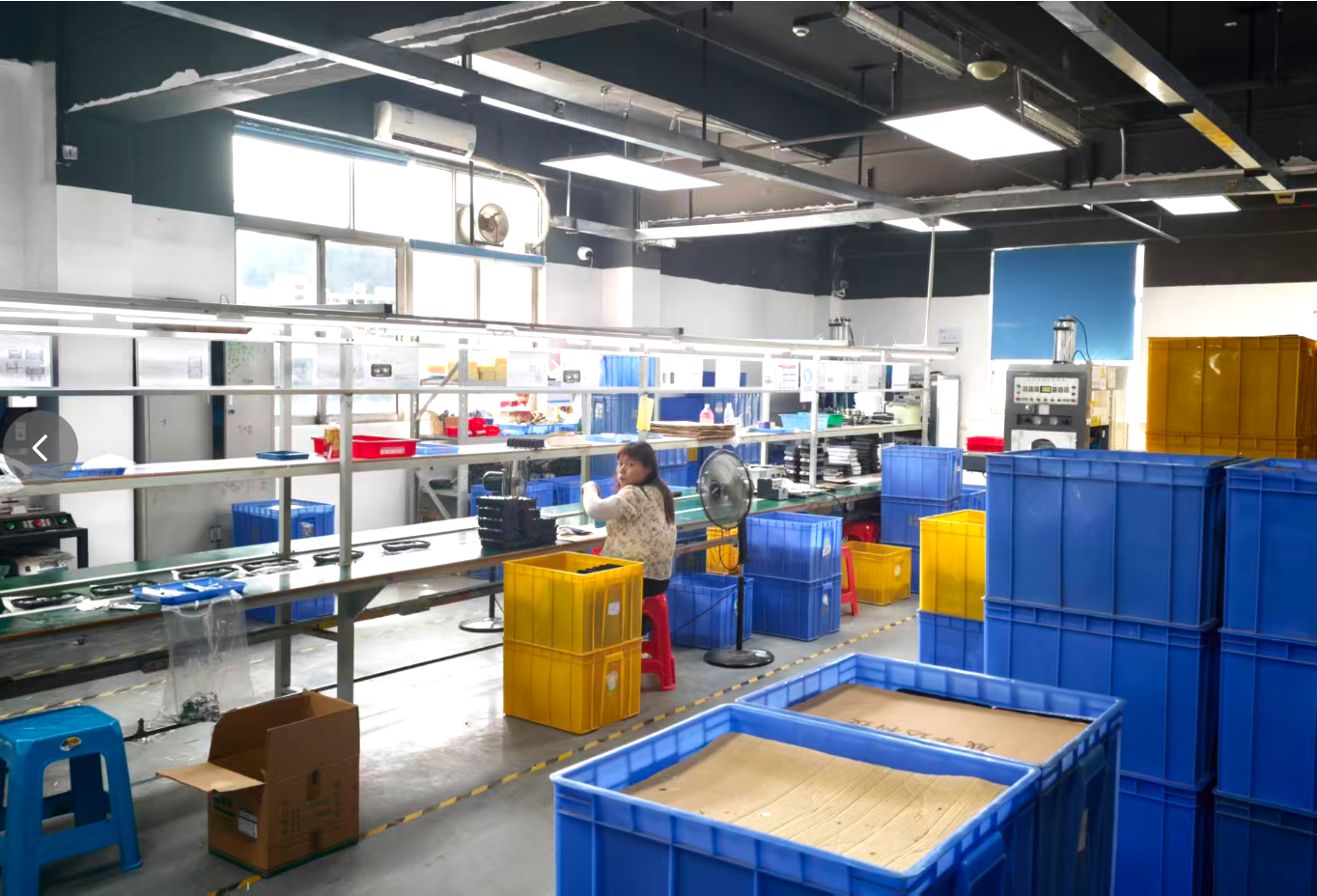
Assembly workshop — in-production and pre-shipment inspection cover quantity, tube specification, surface finish, weld integrity, spigot assembly and packaging.
Conclusion
Foldable and detachable water bottle racks and one-piece fixed racks solve the same problem in opposite directions. Detachable construction, as seen on the SF-BR-04A with its 270 mm × 180 mm footprint, its Q195 steel tube frame and ABS plastic components, trades joints for packaging density. One-piece welded construction, as seen on the SF-BR-06A with its Q195 steel wire, chrome-plated anti-rust finish and 240 mm × 190 mm footprint, trades shipped volume for arrival-ready simplicity and structural continuity.
The decision does not belong to the product category. It belongs to the order.
If you are shipping at container scale into a channel that can absorb assembly, flat-packed foldable racks — the SF-BR-01A and SF-BR-02A at 300 mm × 195 mm, or the detachable SF-BR-04A — will move more sets per container and reduce freight cost per unit.
If you are supplying a channel that needs the product saleable on arrival, or a facility where nobody is available to assemble, the one-piece SF-BR-06A removes that step entirely and the volume penalty is the price of it.
And in both cases, the load evidence matters more than the label. A claimed load capacity without a stated test method is marketing. A tube specification without a weld inspection is half a specification. Ask for the method, run a sample, then commit.
SHAFON Water Solution supplies water bottle racks, water buckets, dispensers, bottle caps and accessories to importers, distributors, private-label brands, water delivery companies and project buyers across 30+ markets, with rack capacity of 20,000–30,000 units per month. Orders can combine racks, PP faucets, caps and bases in a single shipment. The full product and quotation range is available in the SHAFON product catalogue (PDF), and product information is available at shafonwater.com.
Specifications and product data in this article are drawn from SHAFON Water Solution product documentation. Packaging volume figures are SHAFON foldable rack packaging data. Load test claims referenced from third-party marketplace listings are seller-reported and are not presented as validated benchmarks.
Have Questions or Need More Details?
Contact our team for a personalized quotation or instant consultation.
Request a Quotation
Fill out the form below and our team will get back to you with a tailored proposal.
WhatsApp Direct Chat
Prefer to chat in real-time? Message us on WhatsApp for instant assistance & quick answers.
- Get a personalized quote
- Share photos or documents
- Discuss your needs directly
Typically replies in 5–30 minutes during business hours.