
Water Bottle Rack Buying Guide: How to Choose 5-Gallon Storage Racks
A water bottle rack is a stand that holds 5-gallon water bottles upright so they can be stored, handled and dispensed without being stacked on the floor. It is the piece of equipment that decides whether a delivery depot, office pantry or household utility room stays organised, or turns into a row of loose 19-litre bottles leaning against a wall.
This guide is written for importers, wholesalers, distributors, water delivery operators and private-label buyers who are sourcing a 5 gallon water bottle rack from China and want to understand what the different formats do, how to specify one, and which questions to settle before placing an order.
Terminology varies by market. A water jug rack or water jug holder is the common wording in the UK and Commonwealth markets, while water bottle rack is widely used in North America. Both describe the same product family: a stand for 5-gallon bottles used for storage and gravity dispensing.
The Problem a Water Bottle Rack Solves
A full 5-gallon jug is heavy enough that storage method becomes a structural question rather than a furniture question. Published buying guidance for this category puts a full 5-gallon jug at approximately 42–45 lbs (roughly 19–20 kg). Four bottles stacked on the floor is already a handling problem; twelve bottles is a storage layout.
In practice, four failure patterns show up repeatedly when racks are specified badly:
- Tube gauge chosen for price rather than configuration. A multi-tier rack carrying a dozen bottles distributes load differently from a two-position floor stand. When the frame steel is specified without reference to the number of positions and the tier arrangement, the shelves are the first place the compromise appears.
- Base too narrow for the bottle height. A 5-gallon bottle is tall relative to its diameter, so a narrow footprint with a high centre of gravity is the configuration most likely to feel unstable during loading and unloading.
- Surface finish not matched to the room. Utility rooms, restaurant back-of-house areas and warehouse floors hold moisture differently. Powder coating, phosphating plus electrostatic spraying, and chrome plating are not interchangeable across those environments.
- Packaging volume ignored until freight is quoted. Racks are bulky relative to their value, so shipping volume per unit often moves the landed cost more than the unit price does.
Each of those is a specification decision that can be made before production, not a quality complaint raised after arrival. The rest of this guide works through what the market offers, how the SHAFON range is structured, and how to narrow a specification step by step.
Industry Background: What Shapes Rack Demand and Rack Design
Demand for water bottle racks follows the bottled-water and bottled-water-delivery sectors rather than general furniture demand. Industry research published by Coherent Market Insights identifies urban lifestyle shifts and growing awareness of bottled water benefits as the primary drivers of the rack segment, with the relevant forecast window running from 2024 to 2031.
That demand pattern explains the shape of the product range. Racks are bought where bottles accumulate: homes with a single dispenser, offices with a pantry, water stations that refill and resell, and delivery fleets that load and unload the same bottles many times a day. Each of those settings has a different tolerance for footprint, weight, mobility and appearance.
Two material families dominate the category, and they are not competing for the same job:
- Steel and steel wire racks are the common choice for heavy-duty and commercial storage. Construction typically uses square steel tube, steel wire shelves, welded frames and a protective finish such as powder coating, electrostatic powder spraying or chrome plating.
- Plastic racks are typically injection-moulded from high-strength HDPE and are built for modular or stackable layouts, as described in the same Coherent Market Insights research. They suit configurations where light weight, stackability and moisture tolerance matter more than maximum rigidity.
Available product evidence across US and Chinese suppliers shows a third pattern worth noting for buyers: the catalogue range spans compact collapsible units, mobile multi-tier units, high-capacity static racks and modular stackable formats. High-volume and transport-oriented use cases are associated with larger-capacity or stackable designs.
How to read that evidence. Material and configuration are a useful first screening framework when comparing suppliers, not a performance ranking. Published supplier pages rarely carry verified load test data, coating thickness or corrosion test results, so final confirmation of structural performance belongs with drawings, samples and your own acceptance criteria.
The SHAFON Water Bottle Rack Range in Detail
SHAFON WATER SOLUTION (Ningbo SHAFON Import & Export Co., Ltd.) is a China-based B2B supplier of water dispensing and water storage products, formally established in 2015 with business roots dating back to 2008. Its water bottle rack range covers 5-gallon water bottle racks, water jug storage racks, foldable racks, multi-tier racks and commercial bottle storage solutions, supplied to importers, wholesalers, distributors, water delivery companies and private-label brands. Export business accounts for 80–90% of total sales, with major markets including the USA, Mexico, the UK, Saudi Arabia, Southeast Asia, Africa, the Middle East and Europe, alongside 30+ other countries.
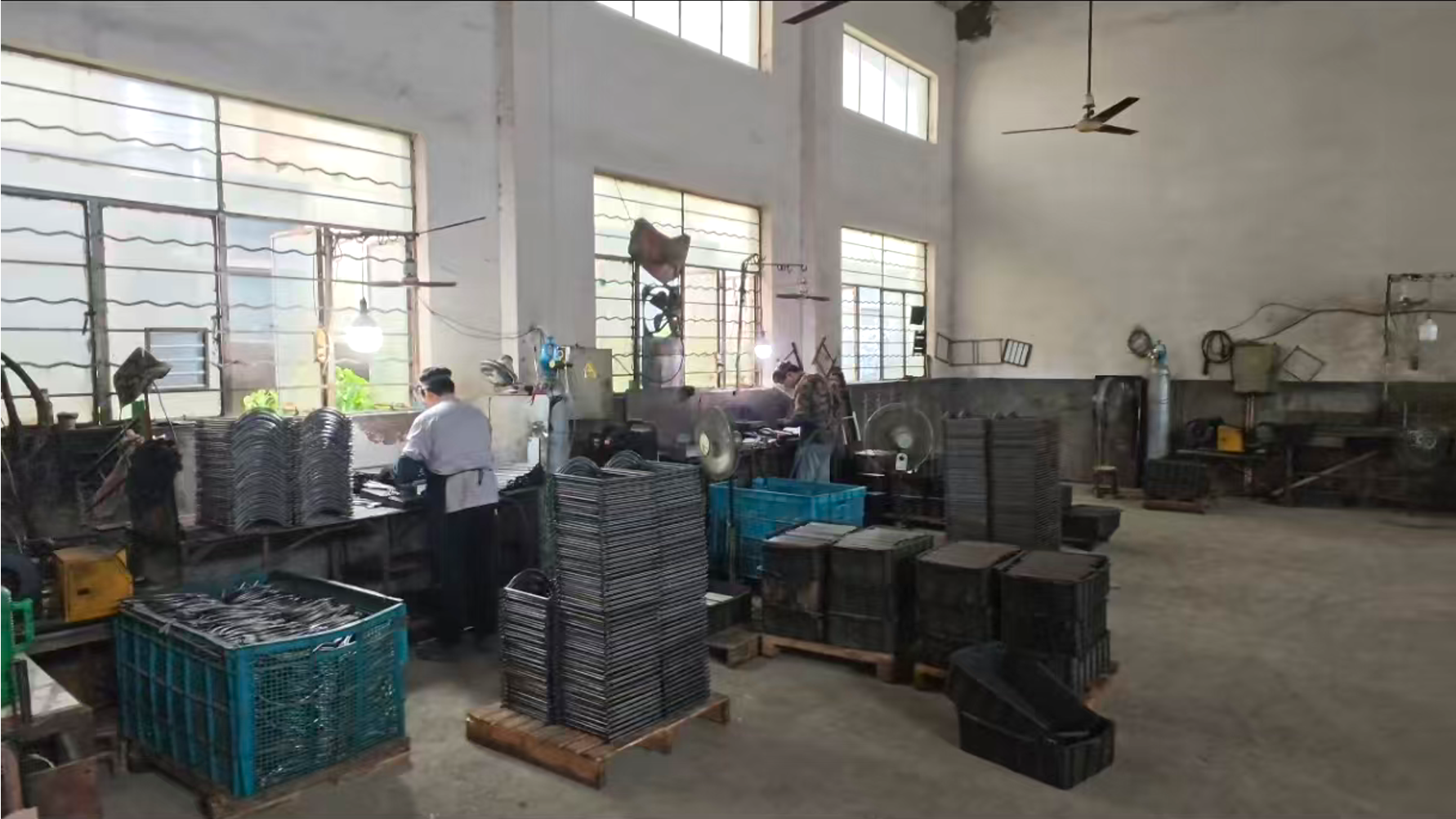
The manufacturing base covers 5,000 m² with approximately 20 staff, including an R&D team of 4–5 professional engineers, and stated annual output of 240,000 water bottle racks and 9,000,000 water buckets. Quality control runs through material verification, dimensional checks, structural inspections, surface-finish evaluation, assembly checks and pre-shipment inspection.
The range is organised by how the rack is used rather than by price band, which is the more useful way to read it when building a purchase list.
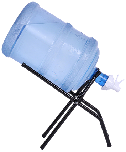
Foldable and raised racks for delivery and household use
Foldable racks are the format most closely associated with water delivery rounds and small households, because they fold flat when the bottle is empty and take up little floor space between deliveries.
- SF-BR-01A (Foldable A-Type Rack) — 16×0.8 mm steel tube with phosphating treatment and electrostatic powder spraying, supplied with a PP spigot and sized for 5-gallon bottles. Base footprint 30 × 19.5 cm; front height 360 mm, rear height 400 mm.
- SF-BR-02A (Foldable U-Type Rack) — same 16×0.8 mm steel tube construction and PP spigot, in a U-type frame. Base footprint 30 × 19.5 cm; front height 280 mm, rear height 380 mm.
The SF-BR-03A (Raised U-Type Rack) addresses the opposite concern: clearance under the tap. It uses 13×13×0.9 mm steel tube with phosphating treatment and electrostatic powder spraying, and its frame sits 5 cm higher than the standard version, which the product record associates with fitting larger buckets for easier dispensing. Base footprint 34 × 19.5 cm; front height 400 mm, rear height 430 mm.
Tabletop racks for office and home dispensing
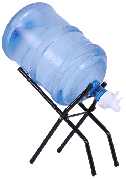
A tabletop rack lifts the bottle onto a countertop or pantry shelf so dispensing happens at standing height without a floor stand. The three tabletop models differ mainly in height, construction and whether the frame detaches.
- SF-BR-04A (Detachable Tabletop Rack, 28 cm) — Q195 steel tube with ABS plastic and a PP spigot. 27 × 18 cm footprint; front height 225 mm, rear height 285 mm. The frame detaches, and the unit is fitted with a valve faucet.
- SF-BR-06A (One-Piece Tabletop Rack, 17 cm) — Q195 steel wire with a chrome-plated anti-rust finish and a PP spigot. 24 × 19 cm footprint; front height 105 mm, rear height 170 mm. One-piece moulded and welded construction.
- SF-BR-09A (One-Piece Tabletop Rack, 34 cm) — Q195 steel wire with chrome plating and a PP spigot, raised design. 24 × 23 cm footprint; front height 260 mm, rear height 340 mm. A single-tier unit, not a multi-tier or stackable model.
Vertical racks for space-constrained storage
Vertical racks trade floor area for height. They are the format to look at when a location needs to hold more than two or three bottles but cannot spread out across a room or warehouse aisle.
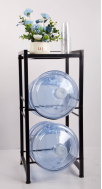
- SF-BR-11A — vertical rack for 2 bottles, 340 × 340 × 480 mm, 20×20×0.8 mm steel tube with electrostatic powder spraying. Intended for water station, household and commercial settings.
- SF-BR-11C — vertical rack for 4 bottles, 340 × 340 × 1080 mm, same tube specification. Intended for water station and commercial use.
- SF-BR-11G — vertical rack for 10 bottles, 680 × 340 × 1380 mm, same tube specification. Intended for water station, wholesale and commercial storage.
Multi-tier and multi-row racks for water stations and wholesale
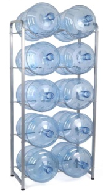
Multi-tier racks are the commercial workhorses. They trade footprint for capacity while keeping every bottle reachable from the front, which is the arrangement water stations, wholesale counters and delivery depots need.
- SF-BR-12A — new-style 3-tier detachable rack holding 3 × 5-gallon bottles. 330 × 350 × 730 mm, Q235 steel tube 20×20×0.6 mm with powder coating. Household and water station use.
- SF-BR-17A — double-row, 3-tier rack holding 6 × 5-gallon bottles. 330 × 650 × 760 mm, Q235 steel tube 20×20×0.6 mm with powder coating. Water station and commercial use.
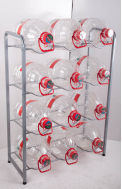
- SF-BR-20A — triple-row, 4-tier rack holding 12 × 5-gallon bottles. 330 × 965 × 1060 mm, Q235 steel tube 20×20×0.6 mm with powder coating. Water station and wholesale operations.
The tier count and row count are the two variables that change handling most. A single-row stack reads top to bottom; a triple-row rack reads left to right within each tier, which suits first-in-first-out rotation in a depot but needs more aisle width in front.
Storage-platform, plastic and wooden options
Not every buyer wants a pure bottle stand. Three further formats extend the range:
- SF-BR-22A (5-Gallon Water Bottle Storage Rack) — a 2-bottle rack with an integrated storage platform, 330 × 350 × 730 mm in 20×20×0.6 mm steel tube with powder coating. The platform is the difference: it gives a place for caps, spares or small accessories directly above the bottles.
- SF-PSB-01 (Water Bottle Storage Tower) — a modular PP plastic tower, 370 × 370 × 1000 mm, described as modular and stackable with tool-free assembly, light weight and water resistance. Household and commercial storage.
- SF-WBR-01 and SF-WBR-03 — a wooden single-tier storage rack in beech, pine or oak (330 × 450 × 560 mm) and a carbon steel 3-tier storage rack (980 × 330 × 330 mm) with a welded frame, powder-coated finish, a top shelf for additional storage, detachable and stackable design, and the option of wheels for mobility. The SF-WBR-03 is positioned as a vertical space-saving unit for small offices.
For buyers who also source bottles and dispensing hardware, racks can be combined with matching PP faucets, bottle caps, bottle bases and other water-dispensing accessories in a single order, which simplifies sourcing and freight consolidation.
How to Specify a Water Bottle Rack: Step-by-Step
Specifying a rack is a sequence of narrowing decisions rather than a single choice. Working through them in order prevents the common pattern where a buyer picks a model from a photo and then discovers the packaging volume or the tube gauge does not fit the plan.
- Fix the bottle count and the location. Decide how many 5-gallon bottles must be held at one time — 2, 3, 4, 6, 10 or 12 are the capacities represented in this range — and whether the location is a home, an office pantry, a water station counter, a wholesale floor or a delivery vehicle bay. Capacity and location together eliminate most of the range immediately.
- Choose the configuration. Foldable and tabletop units suit single-bottle dispensing close to the point of use. Raised racks suit users who fill larger containers. Vertical racks suit tight floor areas. Multi-row racks suit commercial throughput. Storage-platform models suit locations that also need to hold caps and spares.
- Check the tube and wire specification, not just the model name. The published specifications in this range run from 13×13×0.9 mm and 16×0.8 mm steel tube on the folding and raised units, through 20×20×0.8 mm on the vertical racks, to 20×20×0.6 mm Q235 tube on the multi-tier racks. Tube diameter and wall thickness, weld quality, base width and tier count are the four things that determine how a rack behaves under load.
- Match the surface finish to the room. Phosphating plus electrostatic powder spraying and straight powder coating are the standard protective systems on the steel range; chrome plating appears on the steel-wire tabletop models. Corrosion performance for any of them depends on substrate preparation, coating or plating quality, thickness and the service environment, so the finish should be chosen against the actual humidity and cleaning regime, not against appearance alone.
- Calculate packaging volume before confirming price. This is where configuration changes the landed cost most. Foldable racks pack flat at about 30 sets per carton, roughly 60–70% less shipping volume than one-piece racks, which significantly reduces ocean freight cost per set. For a container-scale order, that difference usually outweighs a small unit-price gap between suppliers.
- Confirm customisation, quality gates and documentation. For OEM or private-label work, be ready to share product type, quantity, target market, rack colour, logo, packaging requirement and any specific dimensions; drawings and samples are confirmed before bulk production. Before shipment, agree the inspection points: quantity, tube and wire specifications, surface finish (no rust, no scratches), weld integrity, faucet assembly, packaging and shipping marks.
Use Cases by Buyer Type
Rack selection usually becomes obvious once the buyer type is fixed, because each setting has a dominant constraint — floor area, handling frequency, appearance or bottle turnover.
Households and apartments
A single-bottle setup with a small footprint is the priority. Foldable racks (SF-BR-01A, SF-BR-02A) and the compact tabletop units (SF-BR-06A, SF-BR-09A) fit kitchens and utility rooms, and the foldable formats take up minimal space once the bottle is empty. The published requirement for residential storage is safe materials with small capacity and light weight.
Offices and corporate pantries
Office setups pair a rack with a bottle and a faucet in a break room or pantry. Tabletop racks keep dispensing at counter height, while the SF-BR-11A vertical 2-bottle rack or the SF-BR-22A storage-platform rack keeps spare bottles off the floor. For small offices needing a tidier corner unit, the carbon steel SF-WBR-03 is positioned as a vertical space-saving option with a top shelf and optional wheels.
Water stations, wholesale and bottled-water distribution
This is where capacity and repeat handling matter. The SF-BR-17A holds 6 bottles and the SF-BR-20A holds 12, both in a multi-row layout that keeps bottles visible and reachable from the front. The SF-BR-11G adds a 10-bottle vertical option where floor space is tight but volume is high. In distribution settings, racks are typically specified alongside bottle caps and handling equipment as one storage system rather than as a standalone item.
Water delivery companies
Delivery operations need racks that survive repeated loading and unloading. Foldable and raised racks are the formats associated with water delivery in this range, because they fold for transport and can be set up at the point of delivery. Buyers in this segment should ask for stacking limits, handling method and corrosion protection rather than relying on nominal bottle capacity alone.
Hospitality, food service and institutional settings
Hotel service rooms, restaurant back-of-house areas, campus and healthcare utility spaces, gyms and public facilities all share the same requirement: bottles stored out of working areas but reachable by staff. Multi-tier and vertical racks fit these spaces, and foldable racks are listed for hotel pantry setups where the rack may need to be moved or stored between service periods.
Warehousing and retail display
Warehouse floors and retail displays place a premium on stacking and visibility. Modular plastic towers (SF-PSB-01) and stackable steel units suit this, and the SF-WBR-03 can be specified with wheels where the rack needs to move between zones.
Model Comparison Table
The table below compares the 5-gallon rack models in this range using published product specifications only. It is a configuration comparison, not a load-rating comparison: the published records do not include standardised load test results, so structural performance should be confirmed through drawings and samples for the specific configuration.
| Model | Configuration | 5-gallon bottle positions | Frame material | Overall dimensions (as published) | Typical setting |
|---|---|---|---|---|---|
| SF-BR-01A | Foldable A-Type Rack | — | 16×0.8 mm steel tube, phosphating + electrostatic powder spraying, PP spigot | 30 × 19.5 cm; front 360 mm, rear 400 mm | Water delivery, household, office |
| SF-BR-02A | Foldable U-Type Rack | — | 16×0.8 mm steel tube, phosphating + electrostatic powder spraying, PP spigot | 30 × 19.5 cm; front 280 mm, rear 380 mm | Water delivery, household, office |
| SF-BR-03A | Raised U-Type Rack | — | 13×13×0.9 mm steel tube, phosphating + electrostatic powder spraying, PP spigot | 34 × 19.5 cm; front 400 mm, rear 430 mm | Water delivery, household, office |
| SF-BR-04A | Detachable Tabletop Rack (28 cm) | — | Q195 steel tube + ABS plastic + PP spigot | 27 × 18 cm; front 225 mm, rear 285 mm | Household, office |
| SF-BR-06A | One-Piece Tabletop Rack (17 cm) | — | Q195 steel wire, chrome plating + PP spigot | 24 × 19 cm; front 105 mm, rear 170 mm | Household, office |
| SF-BR-09A | One-Piece Tabletop Rack (34 cm) | — | Q195 steel wire, chrome plating + PP spigot | 24 × 23 cm; front 260 mm, rear 340 mm | Household, office |
| SF-BR-11A | Vertical Rack | 2 | 20×20×0.8 mm steel tube, electrostatic powder spraying | 340 × 340 × 480 mm | Water station, household, commercial |
| SF-BR-11C | Vertical Rack | 4 | 20×20×0.8 mm steel tube, electrostatic powder spraying | 340 × 340 × 1080 mm | Water station, commercial |
| SF-BR-11G | Vertical Rack | 10 | 20×20×0.8 mm steel tube, electrostatic powder spraying | 680 × 340 × 1380 mm | Water station, wholesale, commercial |
| SF-BR-12A | 3-Tier Detachable Rack | 3 | Q235 steel tube 20×20×0.6 mm + powder coating | 330 × 350 × 730 mm | Household, water station |
| SF-BR-17A | Double-Row 3-Tier Rack | 6 | Q235 steel tube 20×20×0.6 mm + powder coating | 330 × 650 × 760 mm | Water station, commercial |
| SF-BR-20A | Triple-Row 4-Tier Rack | 12 | Q235 steel tube 20×20×0.6 mm + powder coating | 330 × 965 × 1060 mm | Water station, wholesale |
| SF-BR-22A | Storage Rack with storage platform | 2 | 20×20×0.6 mm steel tube + powder coating | 330 × 350 × 730 mm | Household, commercial |
| SF-PSB-01 | Modular Plastic Storage Tower | — | PP plastic, modular and stackable | 370 × 370 × 1000 mm | Household, commercial |
| SF-WBR-01 | Wooden Single-Tier Storage Rack | — | Beech / pine / oak (optional) | 330 × 450 × 560 mm | Household, living room |
| SF-WBR-03 | Carbon Steel 3-Tier Storage Rack | — | Carbon steel, welded frame, powder-coated finish | 980 × 330 × 330 mm | Office, living room |
A dash indicates that the published product record for that model does not state a 5-gallon bottle position count. SF-WBR-01, SF-WBR-03 and SF-PSB-01 are general storage formats in the same product family rather than bottle-count-defined racks.
Frequently Asked Questions
What compliance documents should I request from a China 5-gallon water bottle rack manufacturer?
Compliance requirements depend on the specific product and the destination market. SHAFON can coordinate applicable testing and documentation based on product materials, functions and local regulatory requirements. Relevant documents may include food-contact test reports, RoHS-related testing, material reports, or other product-specific compliance documentation where applicable. ISO 9001, where a supplier holds it, is a company-level quality management system rather than a product certification. Buyers should confirm the exact requirement for their market before the order is placed, because the applicable documents differ between a bare steel rack, a rack with a PP spigot, and a food-contact water bucket supplied in the same shipment.
How should a buyer evaluate the load capacity and structural stability of a water bottle rack?
Check four things: the tube or wire diameter and wall thickness, the weld quality, the base width, and the tier count. In this range those specifications run from 13×13×0.9 mm and 16×0.8 mm steel tube on folding and raised racks, through 20×20×0.8 mm on the vertical racks, to 20×20×0.6 mm Q235 tube on the multi-tier racks. SHAFON can share product drawings and loading references on request, which is the practical way to evaluate a specific configuration before committing to volume.
How much shipping volume can a foldable water bottle rack save compared with a one-piece rack?
Foldable racks pack flat at about 30 sets per carton, which is roughly 60–70% less shipping volume than one-piece racks and significantly reduces ocean freight cost per set. For buyers ordering at container scale, this is usually the single largest cost variable between two otherwise comparable specifications, and it is worth calculating before comparing unit prices.
What information is needed to start an OEM or private-label water bottle rack project?
Share the product type, order quantity, target market, rack colour, logo, packaging requirement and any specific dimensions. Drawings and samples are confirmed before bulk production. Because racks can be customised on dimensions, rack configuration, colour, surface finish, branding and packaging depending on structure and manufacturing feasibility, the earlier those inputs are fixed, the fewer revisions are needed later.
Can racks be ordered together with faucets, caps and other dispensing accessories?
Yes. Racks can be shipped together with matching PP faucets, bottle caps, bottle bases and other accessories in one order, which simplifies sourcing and freight. Buyers building a full water storage and dispensing line can coordinate racks, water buckets in PE or PC, non-electric dispensers, faucets and caps within a single sourcing program — see the SHAFON product catalogue for the current range, or send your specification to azhang@shafonwater.com for a quotation.
Conclusion
Choosing a water bottle rack comes down to four decisions made in the right order: how many 5-gallon bottles the location must hold, which configuration suits the handling pattern, which tube and finish specification suits the environment, and how the rack will be packed and shipped. Get those four right and the model choice usually makes itself; get them wrong and no amount of unit-price negotiation fixes the outcome.
The SHAFON WATER SOLUTION range covers foldable, raised, tabletop, vertical, multi-tier, storage-platform, plastic and wooden formats, from a 2-bottle household rack to a 12-bottle triple-row commercial unit, with the tube specifications, dimensions and finishes published for each model. Buyers who need a sample before committing to volume can request one, and OEM projects can be quoted against a confirmed drawing.
Next Step: Sample, Quote or Catalogue
Send your bottle count, setting and target market to SHAFON WATER SOLUTION and request a sample or a quotation for the configuration you need. Product drawings and loading references are available on request.
Email: azhang@shafonwater.com | Tel / WhatsApp: +86 133 4598 9797 | Web: www.shafonwater.com
Download the catalogue: SHAFON Smart Water Solution product catalogue (PDF)
Have Questions or Need More Details?
Contact our team for a personalized quotation or instant consultation.
Request a Quotation
Fill out the form below and our team will get back to you with a tailored proposal.
WhatsApp Direct Chat
Prefer to chat in real-time? Message us on WhatsApp for instant assistance & quick answers.
- Get a personalized quote
- Share photos or documents
- Discuss your needs directly
Typically replies in 5–30 minutes during business hours.