
Butyl Stearate Supplier Evaluation: Production Capability and Delivery Assurance Checklist
A Butyl Stearate supplier evaluation should end with four items a procurement team can audit: a written specification you can test against, a quality management certificate whose number, scope and expiry date you have verified, a monthly capacity figure that covers your call-off schedule, and a lead-time commitment with a named owner for shipping follow-up. This checklist turns those four items into a repeatable evaluation for buyers of n-Butyl Stearate (CAS 123-95-5, also written Butyl Octadecanoate), whether the grade is used as a PVC internal lubricant, an ester for ink and leather finishing, or a cosmetic emollient. Worked examples use the N-Butyl Stearate grade and the wider ester portfolio of Shandong Kexing Chemical Co., Ltd., a plasticizer and plastic additive manufacturer based in Dongying, Shandong, China, founded in 2006.
Problem Definition: Where Butyl Stearate Supplier Evaluations Break Down
Most sourcing problems with Butyl Stearate do not start in the reactor. They start in the purchase order, where the grade is named but not defined, and in the supplier file, where a certificate is stored but never verified. Four failure patterns account for a large share of buyer-side disputes.
- Specification by trade name only. 'High purity Butyl Stearate' is a description, not a test. If the purchase order does not fix limits for ester content, acidity, moisture, colour and flash point, the buyer has no formal basis for rejecting an off-specification lot.
- Certificate without verification. A PDF of an ISO 9001 certificate proves very little until the certificate number, issuing body, certified scope and expiry date are checked. An expired or out-of-scope certificate is the most common document defect found late in qualification.
- Capacity confused with availability. A declared monthly capacity says what a plant can produce, not when your lot will be scheduled. Capacity, minimum order quantity and lead time are three different commitments and must be requested separately.
- Acceptance criteria written after the argument. Sampling method, retention sample, batch COA and deviation notification are usually decided during a dispute rather than before the first delivery.
The technical cost of a mis-specified lot is easy to underestimate. Butyl Stearate functions as a non-toxic internal lubricant in PVC processing at dosages typically ranging from 1% to 3%, so a shift in acidity, moisture or colour does not stay inside one drum: it moves into the formulation, the trial record and, in the worst case, the finished goods. That is why the evaluation described here treats specification, production scope, quality evidence and delivery assurance as one connected decision rather than four separate conversations.
Industry Background: What the Market Context Tells a Buyer
Demand for n-Butyl Stearate is concentrated in lubricant and polymer-processing applications, and supply is concentrated in Asia. The global N-Butyl Stearate market was valued at approximately USD 1.28 billion in 2024 according to Spherical Insights, while the lubricants application segment held the largest share at 38.5% in 2025 and Asia Pacific accounted for a revenue share of 42.3% in the same year, based on Dataintelo figures. Trade data points in the same direction: China was identified as the largest exporter of Butyl Stearate to key markets such as India, accounting for 66.14% of specific import shipments under HS Code 29157090 in 2024, according to Zauba customs data.
At manufacturer level, Cognitive Market Research lists BASF SE, Emery Oleochemicals, Croda International and Fine Organics among the leading global producers. For a buyer, this structure has a practical consequence: the shortlist usually mixes large international producers, dedicated ester plants and trading houses that resell a single grade. The evaluation checklist has to separate these three supplier types before price comparison becomes meaningful.
Regulation shapes the document requirements as much as the chemistry does. Butyl Stearate (CAS 123-95-5) is listed as an active substance under EU REACH, and registration is required for manufacturing or importing it above 1 tonne per year, according to ECHA substance information. A supplier that cannot produce a registration statement and a grade-matched safety data sheet is not evaluation-ready, regardless of price.
The Evaluation Framework: Six Areas That Decide the Outcome
1. Grade specification and the acceptance criteria derived from it
The reference point for this checklist is N-Butyl Stearate, CAS 123-95-5, a colourless transparent liquid with a slight odour used as a PVC internal lubricant and in plastics, leather, ink, toy and food-packaging applications. A usable evaluation starts by copying the supplier's declared limits into a buyer-side acceptance table and adding test methods and sampling rules.
| Parameter | Declared limit (N-Butyl Stearate, CAS 123-95-5) | What the buyer should add to the PO |
|---|---|---|
| Appearance | Colourless transparent liquid, no visible impurity | Visual check method and acceptance wording |
| Odour | Slight odour | Reference sample retained at qualification |
| Colour (Pt-Co) | Max 30 | Test method and sample cell path length |
| Content | Min 99.0% | Analytical method and per-batch COA requirement |
| Acidity | Max 0.20 mgKOH/g | Method reference and retest rule |
| Moisture | Max 0.10% | Sampling point and container sealing requirement |
| Density | 0.85 g/cm3 | Temperature reference for measurement |
| Flash point | Min 190 degrees C | Method reference and handling classification |
The declared limits above are the supplier's published specification, not a guarantee for every future lot. The acceptance table works only if each delivery is accompanied by a batch certificate of analysis that can be compared line by line against it.
2. Production scope: what the portfolio proves about the plant
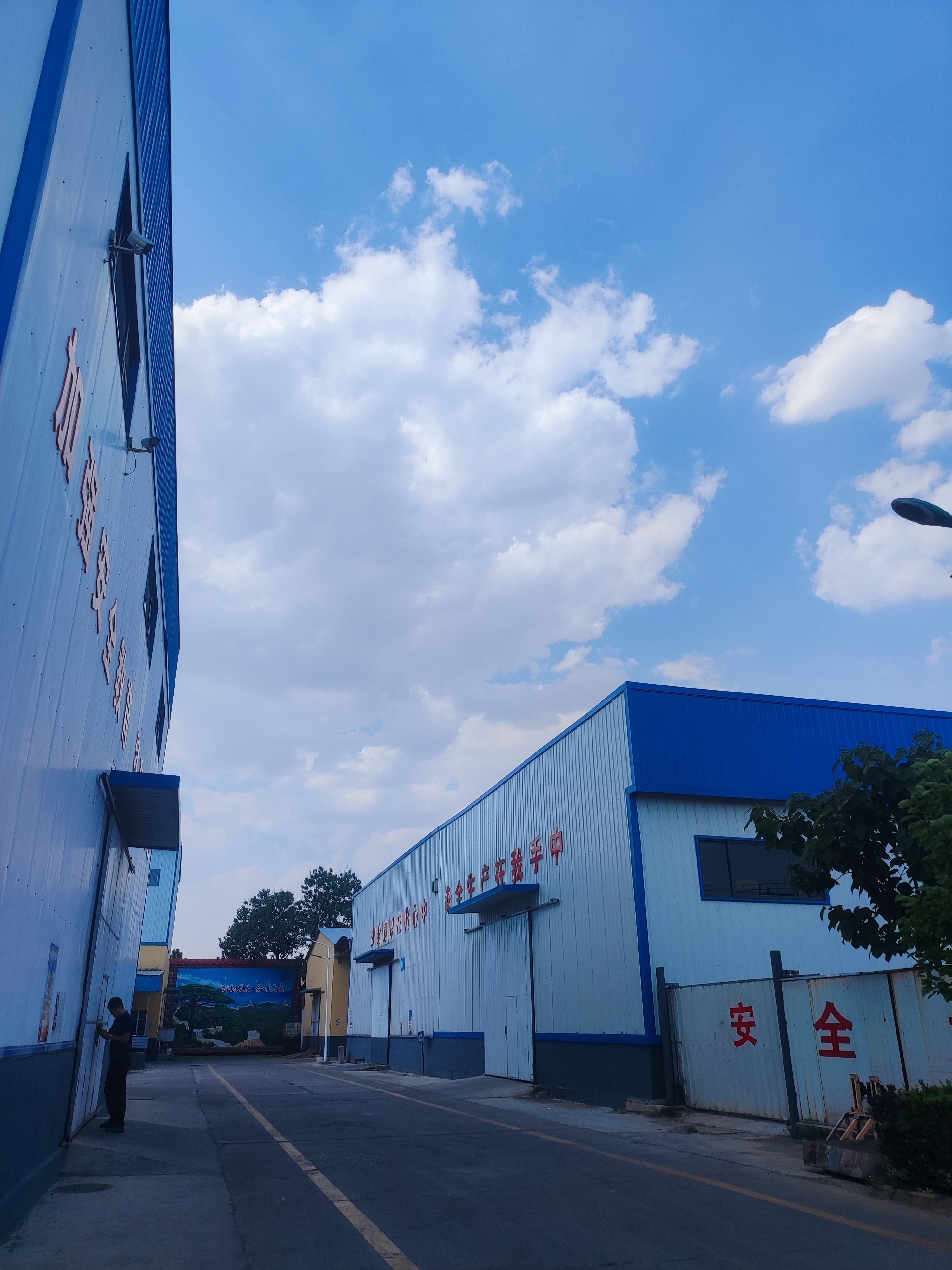
Production scope is the fastest way to distinguish a manufacturer from a reseller. An ester plant that runs multiple reaction families demonstrates routine handling of esterification, feedstock control and finished-product testing across grades; a trader offering one grade shows none of that.
Shandong Kexing Chemical Co., Ltd. declares a portfolio that includes citrates (Acetyl Tributyl Citrate, Tributyl Citrate and Triethyl Citrate), adipate (Dioctyl Adipate), sebacates (Dioctyl Sebacate and Dibutyl Sebacate), Epoxidized Soybean Oil, Triethylene Glycol Di-2-ethylhexoate (3G8), phthalates (DOTP, DINP, DPHP, DOP and DBP) alongside N-Butyl Stearate. The presence of the citrate and plasticizer families is the relevant signal for a Butyl Stearate buyer: it indicates that the same plant already runs the esterification and quality routines that a stearate grade depends on, rather than buying the grade in for resale.
The company also declares OEM production with private labeling, monthly capacity of 10,000 T, a minimum order quantity of 1 T, a lead time of 30 to 45 days, a research and development team of 15 engineers, 200 employees and an export ratio of 50%, with main markets in Europe, the USA, Japan, South Korea and the Middle East.
3. Quality management evidence and how to verify it
Quality control at plant level is described as raw material incoming inspection plus finished product sampling tests. That description becomes auditable only when it is tied to a certified management system with a scope that covers plasticizer production.
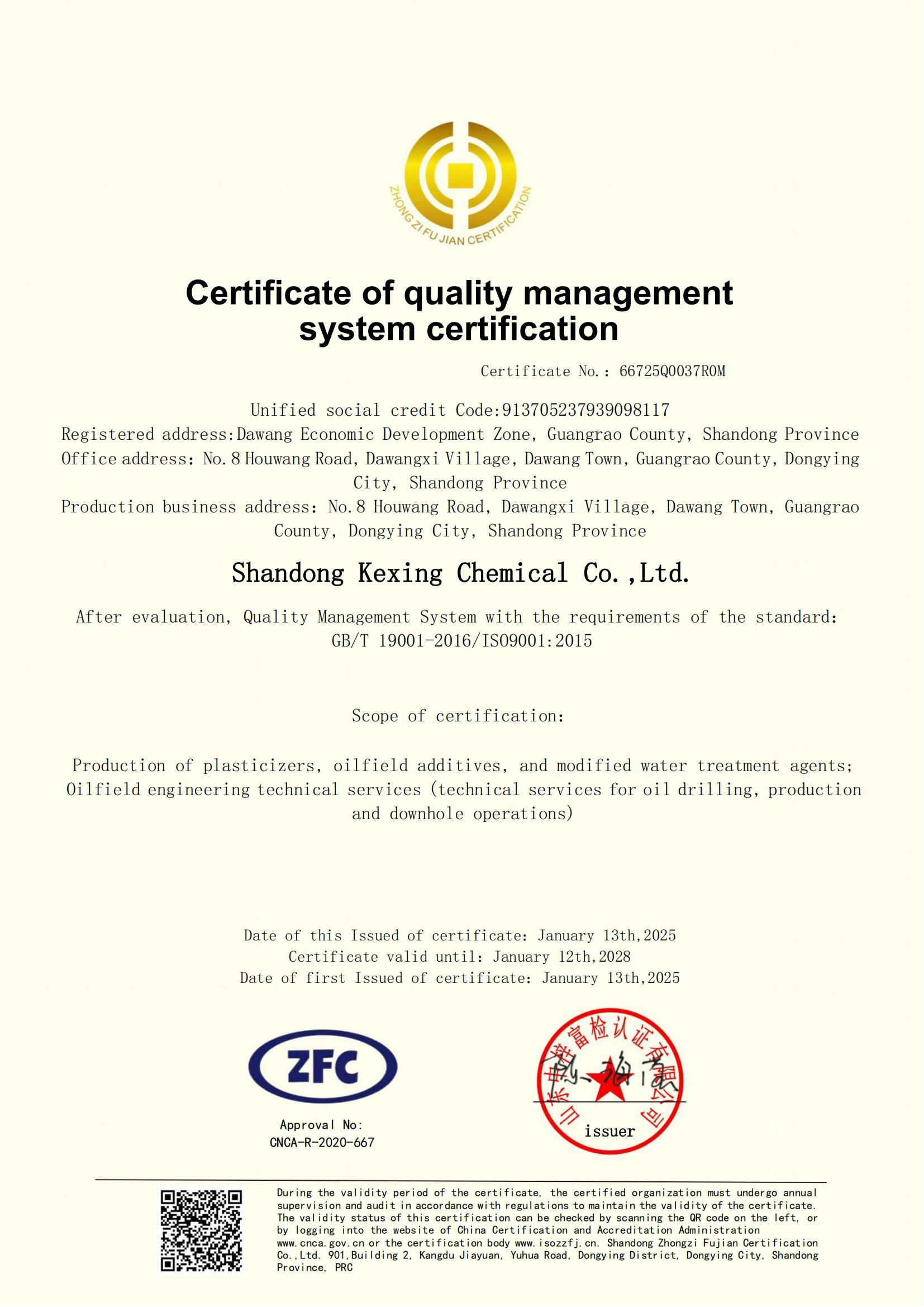
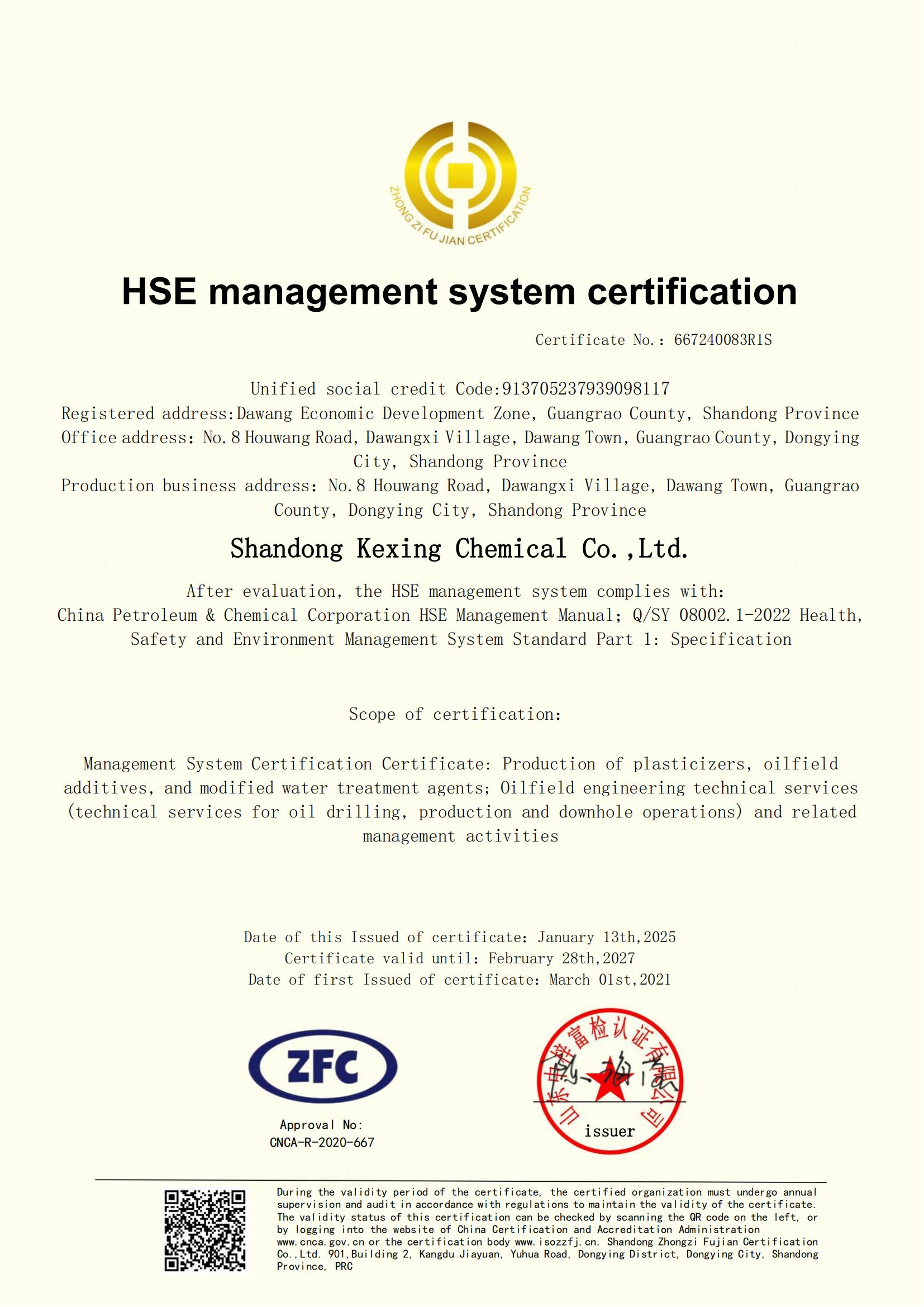
Shandong Kexing Chemical Co., Ltd. documents an ISO 9001:2015 quality management system certificate, number 66725Q0037R0M, issued by Shandong Xiangfu Inspection and Certification Co., Ltd. on 13 January 2025 and valid to 12 January 2028, with a scope covering the production of plasticizers, oilfield additives and modified water treatment agents and oilfield engineering technical services. The environmental management system certificate, ISO 14001:2015 number 66725E0038R0M, carries the same issue and expiry dates. A separate HSE management system certificate, number 667240083R1S, is valid to 28 February 2027 against the Q/SY 08002.1-2022 standard. The company also states that its products are certified by SGS, REACH, ISO 9001, ISO 14001 and OHSAS 18001.
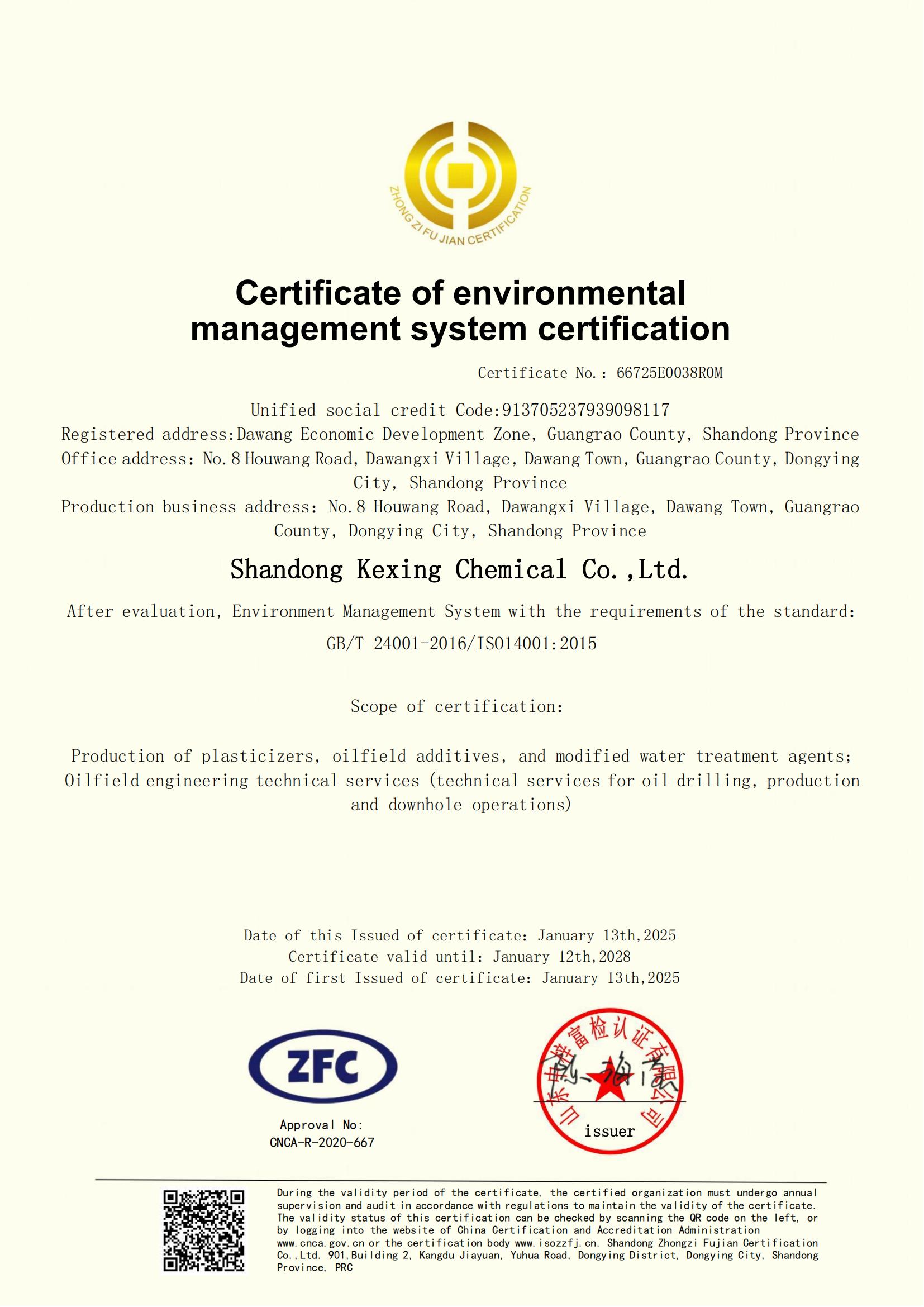
Two verification points matter more than the certificate count. First, confirm that the certified scope names plasticizer production and not an adjacent activity. Second, put the expiry dates into the supplier file as review dates, because a certificate that lapses mid-contract becomes a compliance gap on the buyer's side as well.
4. Delivery assurance: the part most checklists leave out
Delivery assurance is a set of commitments, not a relationship. The four commitments worth documenting are minimum order quantity, lead time, capacity headroom against your call-off schedule, and who is responsible for shipping follow-up once the order leaves the plant.
For this supplier, the declared figures are a minimum order quantity of 1 T and a lead time of 30 to 45 days against a monthly capacity of 10,000 T. The after-sales scope is stated as remote technical support, after-sales consulting, quality issue resolution, shipping follow-up and formulation technical guidance. As a reference for realistic order patterns, the case record for plastic masterbatch factories, artificial leather manufacturers, food packaging processors and toy factories describes regular monthly orders of 15 to 25 MT, with finished goods performance described as a service life of up to 2 years and lots passing REACH and food-grade safety testing.
5. Commercial terms and acceptance criteria to write into the order
The purchase order is the only document that binds both sides after qualification ends. At minimum it should fix: the grade name and CAS number (N-Butyl Stearate, 123-95-5); the full parameter table with limits and methods; the sampling and retention-sample rule; a batch COA for every lot; packaging and labelling requirements including any private-label specification; a deviation notification window before shipment; and the route for retest, replacement or return if a lot fails the acceptance table.
6. The document pack to request before any price negotiation
- Specification sheet for the exact grade, with CAS number and all limits.
- Batch certificate of analysis from a recent production lot.
- ISO 9001:2015 and ISO 14001:2015 certificates with number, issuing body, scope and expiry.
- HSE or equivalent safety management certificate where the buyer's own policy requires it.
- REACH registration statement and grade-matched safety data sheet for EU-bound shipments.
- Portfolio list, so production scope can be checked against the claim of in-house manufacturing.
- Written statement of MOQ, lead time, monthly capacity and after-sales responsibilities.

Step-by-Step Breakdown: Running the Evaluation
Step 1: Write the acceptance criteria before contacting suppliers
Build the parameter table first, using your own process requirements rather than the supplier's sheet. If your line runs the grade as a PVC internal lubricant at typical dosages of 1% to 3%, decide in advance which limits are critical to control and which are informational. This step prevents the shortlist from being shaped by whichever datasheet arrives first.
Step 2: Request the document pack and check completeness
Send the same request to every candidate and score responses on completeness rather than speed of reply. A supplier that returns the specification, a recent batch COA, certificate copies and a written capacity statement in one response is easier to audit than one that answers in fragments.
Step 3: Verify every certificate against its issuer and scope
Check number, standard, issuing body, certified scope and expiry date. For reference, the quality certificate held here is 66725Q0037R0M against GB/T 19001-2016 / ISO 9001:2015, valid to 12 January 2028, with a scope that explicitly includes plasticizer production. Certificates that do not name your product family belong in a different file.
Step 4: Reconcile capacity, MOQ and lead time against your schedule
Plot the declared lead time of 30 to 45 days against your own production calendar, then confirm that the minimum order quantity of 1 T allows a trial order that does not distort inventory. Compare your expected monthly call-off with the declared monthly capacity of 10,000 T to judge scheduling headroom, not just plant size.
Step 5: Test a sample against the same table used for the order
Run appearance, colour, content, acidity, moisture, density and flash point on the sample, and keep a retention sample. Then run a small trial at your own process conditions and compare the trial outcome with the sample certificate. A sample that passes on paper but behaves differently in the compound is a formulation question, which belongs back with the supplier's technical team.
Step 6: Fix the delivery terms in writing
Write the delivery window, the shipping follow-up owner, the deviation notification rule and the escalation route into the order confirmation. Confirm whether OEM production or private labeling applies to your packaging, since both are declared as available options and both affect labelling and lot traceability.
Step 7: Review the first production lot as a documented event
Compare the first delivery's batch COA with the sample COA and with the acceptance table, check packaging condition against the agreed specification, and record the result. If a deviation appears, the quality issue resolution route and the retained sample are what make the conversation factual rather than commercial.
Use Cases: How the Checklist Shifts by Application
PVC internal lubrication
In PVC compounds, Butyl Stearate acts as a non-toxic internal lubricant at dosages typically between 1% and 3%. Here the critical evaluation items are content, acidity, moisture and colour consistency between lots, because these drive flow behaviour and finished-part appearance. Matching equipment includes high-speed mixers, kneaders, extruders, calenders and coating machines, so the acceptance criteria should be agreed with the people who run those units, not only with purchasing.
Masterbatch, artificial leather and food-contact processing
The case record for this supplier covers plastic masterbatch factories, artificial leather manufacturers, food packaging processors and toy factories placing regular orders of 15 to 25 MT per month, with applications in plastic compounding, leather surface finishing and food-contact plastic and printing ink formulation. For these buyers the decisive items are compliance documentation and batch-to-batch purity, since the finished goods must pass REACH and food-grade safety testing.
Ink, rubber and release applications
Where the ester is used as a slip agent in ink, a rubber processing aid or a mould release component, appearance and low volatility matter more than colour alone. The declared flash point minimum of 190 degrees C and moisture limit of 0.10% are the parameters to track across lots, together with the supplier's handling of sealed packaging.
Cosmetic and personal care grades
The same molecule is used as a cosmetic emollient and dispersant, where the buyer's evaluation adds supplier-side hygiene documentation and a grade-matched safety data sheet to the standard pack. Buyers in this segment should state the intended use in the enquiry so that the correct grade and documentation set are quoted.
Comparison Table: Evaluation Dimensions and Documented Positions
The table below is a buyer-side scorecard, not a competitive ranking. It lists what to verify and what the reference supplier has documented, so that each row can be closed with evidence or left open.
| Evaluation dimension | Evidence to demand | Documented position (Shandong Kexing Chemical Co., Ltd.) | Pass condition |
|---|---|---|---|
| Grade definition | Specification sheet with CAS and all limits | N-Butyl Stearate, CAS 123-95-5; content min 99.0%; acidity max 0.20 mgKOH/g; moisture max 0.10%; colour max 30 Pt-Co; flash point min 190 degrees C; density 0.85 g/cm3 | Limits match your process requirements and methods are agreed |
| Production scope | Portfolio list plus statement of in-house versus traded grades | Citrates (ATBC, TBC, TEC), DOA, DOS, DBS, ESO, 3G8, DOTP, DINP, DPHP, DOP, DBP and N-Butyl Stearate | Ester families confirm in-house manufacturing, not resale |
| Quality system | Certificate number, body, scope, expiry | ISO 9001:2015 No. 66725Q0037R0M, issued 2025-01-13, valid to 2028-01-12; scope includes plasticizer production | Scope covers your product family and expiry is in the future |
| Environmental and safety management | Certificates for EMS and HSE where required by buyer policy | ISO 14001:2015 No. 66725E0038R0M, valid to 2028-01-12; HSE No. 667240083R1S, valid to 2027-02-28 | Certificates valid at the planned shipment date |
| Regulatory registration | REACH registration statement, grade-matched SDS | Products stated as certified by SGS, REACH, ISO 9001, ISO 14001 and OHSAS 18001 | Registration covers the tonnage and use you declare |
| Order flexibility | Written MOQ and OEM or private-label terms | MOQ 1 T; OEM production and private labeling available | Trial order size is viable for your inventory policy |
| Delivery assurance | Lead time, capacity, shipping follow-up owner | Lead time 30 to 45 days; monthly capacity 10,000 T; shipping follow-up within after-sales scope | Lead time fits your production calendar with safety stock |
| Order pattern reference | Comparable customer order sizes | Regular monthly orders of 15 to 25 MT in masterbatch, artificial leather, food packaging and toy applications | Your volume sits inside a pattern the supplier already runs |
Read the table as a set of open questions rather than a completed audit. Every row is closed only when the buyer holds the document referenced in the third column, verified against the issuer and dated within the contract period.
FAQ
Does Butyl Stearate require REACH registration for EU imports?
Yes. Butyl Stearate (CAS 123-95-5) is listed as an active substance under EU REACH, and registration is required for manufacturing or importing it above 1 tonne per year, according to ECHA substance information. For the purchase file, request the REACH registration statement, the safety data sheet matching the exact grade, and ISO 9001:2015 and ISO 14001:2015 certificates with number, scope and expiry dates. Shandong Kexing Chemical Co., Ltd. documents ISO 9001:2015 certificate 66725Q0037R0M valid to 12 January 2028, ISO 14001:2015 certificate 66725E0038R0M valid to 12 January 2028, and HSE certificate 667240083R1S valid to 28 February 2027, and states that its products are certified by SGS, REACH, ISO 9001, ISO 14001 and OHSAS 18001.
How can a buyer verify production capability for high purity Butyl Stearate instead of trusting a datasheet claim?
Compare the declared limits with batch certificates of analysis: content min 99.0%, acidity max 0.20 mgKOH/g, moisture max 0.10%, colour max 30 Pt-Co, flash point min 190 degrees C and density 0.85 g/cm3. Then check production scope, because a plant that also runs citrates, adipates, sebacates and phthalates shows in-house esterification capability that a single-grade reseller cannot demonstrate. Shandong Kexing Chemical Co., Ltd. declares monthly capacity of 10,000 T, OEM production with private labeling, a 15-engineer research and development team, and quality control based on raw material incoming inspection and finished product sampling tests.
What minimum order quantity and monthly order size are realistic?
The declared minimum order quantity for this supplier is 1 T, which allows a trial order ahead of a production commitment. As a reference point for repeat business, the case record describes plastic masterbatch, artificial leather, food packaging and toy manufacturing customers placing regular monthly orders of 15 to 25 MT. Buyers should confirm the scheduling cut-off date in the order confirmation, since minimum order quantity and production scheduling are separate commitments.
What should a sample evaluation cover before the first order?
Test the sample against exactly the same table that will appear in the purchase order: appearance and colour, content, acidity, moisture, density and flash point. Then run a trial at your own process dosage, which for PVC internal lubrication is typically 1% to 3%, and compare the trial outcome with the sample certificate. Ask that the first production lot arrive with its own batch certificate of analysis so the sample and the delivered material can be compared directly. OEM production and private labeling are declared as available if your packaging requires them, and after-sales scope includes formulation technical guidance.
What lead time should be planned, and how are delivery issues handled?
The declared lead time is 30 to 45 days, so safety stock and the order release date should be planned around that window rather than around the shortest date quoted in an enquiry. The after-sales scope for this supplier covers shipping follow-up, quality issue resolution, remote technical support and formulation technical guidance, which gives the buyer a defined route for documentation and deviation questions. To open an evaluation, request the specification sheet, certificate copies, a recent batch COA and a sample through kexing@kexingchem.com, or start from the company brochure.
Conclusion
A Butyl Stearate supplier is qualified by documents and dates, not by adjectives. The sequence that holds up under audit is straightforward: define the grade and its limits, confirm that the supplier actually manufactures the ester families it lists, verify each certificate number, scope and expiry, reconcile MOQ and lead time with your own production calendar, and write acceptance criteria into the purchase order before the first drum ships.
Applied to the reference grade, that sequence produces a closed file rather than an impression: N-Butyl Stearate to a minimum content of 99.0% with acidity, moisture, colour and flash point limits; a plasticizer portfolio spanning citrates, adipates, sebacates, ESO and phthalates; ISO 9001:2015 certificate 66725Q0037R0M valid to 12 January 2028; ISO 14001:2015 certificate 66725E0038R0M; an HSE certificate valid to 28 February 2027; a 1 T minimum order quantity; and a 30 to 45 day lead time against 10,000 T monthly capacity. Each of those items can be checked, dated and filed, which is exactly what makes them useful to a procurement team under review pressure.
Next step: request the document pack and a sample
Shandong Kexing Chemical Co., Ltd. supplies N-Butyl Stearate alongside citrate, adipate, sebacate, epoxidized soybean oil and phthalate plasticizers, with OEM production and private labeling available, a 1 T minimum order quantity and a stated lead time of 30 to 45 days.
Request the specification sheet, ISO 9001 and ISO 14001 certificates, a recent batch COA and a sample: email kexing@kexingchem.com, call +86 177-5465-5267, or message WhatsApp +86 18765463469. Address: No.8 Houwang Road, Dawang Economic Development Zone, Guangrao County, Dongying City, Shandong Province, P.R. China.
Request a quote on WhatsAppDownload the product brochure (PDF)Visit www.kexingchem.com
Have Questions or Need More Details?
Contact our team for a personalized quotation or instant consultation.
Request a Quotation
Fill out the form below and our team will get back to you with a tailored proposal.
WhatsApp Direct Chat
Prefer to chat in real-time? Message us on WhatsApp for instant assistance & quick answers.
- Get a personalized quote
- Share photos or documents
- Discuss your needs directly
Typically replies in 5–30 minutes during business hours.