
Butyl Stearate Supply Disruption: A Contingency Sourcing Plan for PVC Formulators
A butyl stearate supply interruption is survivable if the response was designed before the interruption. The workable plan has four tracks: ring-fence the lots already in the warehouse, activate a backup grade that was qualified in advance, keep a validated reformulation route through the other esters in the same product range, and control acceptance documentation lot by lot so that a replacement source does not become a replacement quality problem.
Butyl stearate — also written n-butyl stearate or butyl octadecanoate, CAS 123-95-5, EC 204-666-5, molecular formula C22H44O2 — is used in PVC compounds as a lubricant, and in several other applications across the wider ester range. Shandong Kexing Chemical Co., Ltd. is a manufacturer of plasticizers, plastic and rubber flame retardants and plastic additives, founded in 2006 and based in Dongying, Shandong, China, whose documented range includes N-Butyl Stearate (CAS 123-95-5) together with ATBC, TBC, TEC, DOA, DOS, DBS, ESO, 3G8, DOTP, DINP, DPHP, DOP and DBP.
That last sentence carries the trap this article is written to avoid. Most of the products a buyer can pull from the same catalogue during a butyl stearate shortage are plasticizers, not lubricants. Ordering “something from the ester list” is how a supply shortage turns into a scrap batch.
Why a butyl stearate shortage is a formulation event, not only a purchasing event
Butyl stearate is dosed at a low percentage of a PVC compound, so a stock-out is measured in kilograms while its effect is measured in tonnes. When the material disappears, purchasing sees a missing line item; the plant sees a processing behaviour that nobody holds a validated response for.
Four failure modes account for most of the damage in a real disruption:
- Name-based substitution. A buyer replaces “butyl stearate” with another ester from the same catalogue. The replacement may be a primary plasticizer, which changes the job the additive does in the formulation rather than simply changing its supplier.
- Grade drift under the same name. The chemical name does not fix composition. A published supplier safety data sheet for a butyl stearate product reports a composition of approximately 60% butyl stearate and approximately 30% butyl palmitate. That record is supplier- and product-specific, and its exact revision still needs direct verification — the point is that the product name alone never settles grade.
- Documentation gap. A substance-level record, such as the ECHA registration dossier listing butyl stearate with EC 204-666-5 and CAS 123-95-5, does not by itself establish that a particular supplier, importer or only representative covers your grade and your market.
- Classification gap. Stearic acid and its salts and esters sit under HS 291570, a broad heading. It is a starting point for customs work, not proof of a product-specific duty rate, trade flow or landed cost.
The contingency plan exists to close those four gaps before an event opens them for you.
What the verified record does and does not tell you
Market figures are the weakest input in a contingency plan, and it is worth being explicit about why. Commercial research on this category is not internally consistent: one provider values the 2025 global butyl stearate market at USD 5.74 billion, another at USD 2.85 billion for the same year. A gap of that size points to different category boundaries rather than to a measurement error, so neither figure should be used to size a safety stock or to justify a price expectation.
What the record does support is directional context. One commercial research provider estimates that lubricants held 38.5% of application share in 2025 and that Asia Pacific accounted for 42.3% of revenue share in the same year. Read together, those figures describe a category where industrial and plastics-processing demand is concentrated in one manufacturing region — a reminder that a single-region supply chain is a structural exposure, not bad luck.
Two regulatory facts are more directly usable. Butyl stearate appears in the US FDA inventory of food contact substances, and substances listed in 21 CFR parts 175–178 are authorized for specified uses in indirect food additives; that authorization is use-specific, so a food-contact application still needs its own confirmation. In the EU, the ECHA dossier provides the identity cross-check described above.
Everything else a contingency plan genuinely needs — your consumption rate, your current lot performance, your customers’ approval requirements — is internal data. That is the material the plan should be built on.
The four-track contingency architecture
Treat the four tracks as parallel, not sequential. Track A buys time, Track B buys continuity, Track C buys optionality, and Track D protects the quality system while the other three are moving.
Track A — Ring-fence what you already hold
Before any external action, convert existing inventory into a controlled reserve. Segregate current lots by receipt date, keep retain samples, and allocate stock against the confirmed order book rather than against forecast. In a shortage, the formulator who knows exactly how many tonnes of validated compound the warehouse can support negotiates from a different position than one who knows only the raw-material tonnage.
Track B — Pre-qualify a second butyl stearate grade
A backup source is worth nothing if it is qualified during the crisis. Qualification has to happen while primary supply is healthy, because that is the only period in which a candidate lot can be compared against a known-good reference lot on the same equipment, with the same operators, in the same season.
Track C — Keep a validated reformulation route open
If the lubricant function cannot be restored quickly, the remaining lever is formulation. The supplied range contains phthalate esters — DBP, DOP, DINP and DPHP — and non-phthalate esters such as DOTP, DOA, DOS, DBS, ATBC, TBC, TEC, ESO and 3G8. None of these is a drop-in substitute for butyl stearate. What a pre-validated route provides is a tested direction of adjustment, with known limits, that can be executed in days rather than months.
Track D — Control documentation at lot level
Every lot entering the plant during a disruption should arrive with the same document set as in normal supply: SDS, TDS, certificate of analysis, and identity confirmation against CAS 123-95-5 and EC 204-666-5. Insisting on this during a shortage matters precisely because document discipline is the first thing that slips when lead times stretch.

The alternative esters in the range: what each one can and cannot do
The table lists the candidate esters named in the sourcing brief, with CAS numbers exactly as they appear in the supplier’s product records. The final column is the one that matters: identity data tells you what a substance is, not what it will do in your compound.
| Product (as listed) | CAS (as supplied) | Ester family | Position in the supplied range | What identity data does not prove |
|---|---|---|---|---|
| Dibutyl Phthalate (DBP) | 84-74-2 | Phthalate ester | Plasticizer | That it can carry a lubricant function |
| Dioctyl Phthalate (DOP) | 117-84-0 | Phthalate ester | Plasticizer | That it can replace butyl stearate at equal dosage |
| Diisononyl Phthalate (DINP) | 28553-12-0 | Phthalate ester | Plasticizer | That the processing window stays unchanged |
| Dioctyl Terephthalate (DOTP) | 6422-89-2 | Terephthalate ester | Non-phthalate plasticizer | That it is a functional match for a stearate lubricant |
| Dioctyl Adipate (DOA) | 123-79-5 | Adipate ester | Non-phthalate plasticizer | That existing approvals extend to it automatically |
| Dibutyl Sebacate (DBS) | 109-43-3 | Sebacate ester | Non-phthalate plasticizer | That end-product certificates remain valid after the change |
Two conclusions follow. First, every ester in that table sits on the plasticizer side of the formulation; using one to cover a lubricant shortfall changes the balance of the compound and must be validated as a formulation change, not processed as a purchasing substitution. Second, the regulatory status of any candidate is application- and market-specific. This article does not certify the compliance status of any ester in the list — that check belongs in your own qualification file, together with the customer approvals attached to the finished product.
A step-by-step playbook, from first signal to exit
Step 0 — Before any signal. Dual-qualify the second butyl stearate grade, hold two retained reference lots, publish written acceptance criteria, and agree a trial quantity in advance. A supplier quoting a 1 T minimum order and a 30–45 day lead time gives you a realistic rehearsal for a small first shipment, and it also sets the arithmetic for your reorder trigger.
Step 1 — Confirm the constraint. Establish whether the interruption sits in feedstock, plant capacity, packaging, freight or documentation. Each one has a different response time, and switching formulation on the strength of a rumour is the most expensive possible reaction.
Step 2 — Allocate and communicate. Publish an internal allocation rule, freeze unqualified substitutions, and tell customers what is and is not changing. A specification change disclosed late costs more than the shortage itself.
Step 3 — Bridge, do not switch. Introduce the qualified backup in a defined blend with the incumbent lot rather than as a hard changeover. Blend ratios should be fixed in advance and tied to the retained reference lot, so that any drift is visible within one production run.
Step 4 — Reformulate only on laboratory evidence. If the lubricant function cannot be restored, test the plasticizer-side adjustment against the reference compound and confirm it on production equipment before any commercial batch. Record which variable moved, so that the change can be reversed cleanly.
Step 5 — Re-baseline and lock. Once a new source or a new formulation is running, update the specification, the lot fingerprint, the supplier documents and the purchase order template together. Half-updated specifications are how a resolved shortage reappears as a customer complaint.
Step 6 — Exit deliberately. Decide whether dual sourcing stays permanent. The cost of keeping a second source qualified is normally far below the cost of re-qualifying one under pressure.
Acceptance criteria for a backup grade
Acceptance criteria are the contract between purchasing and production. Six categories cover the practical ground:
- Identity. Chemical name, CAS 123-95-5 and EC 204-666-5 matched against the label, the SDS and the certificate of analysis.
- Composition. Assay plus the related-ester profile you are willing to accept, informed by the fact that a commercially supplied butyl stearate can contain a meaningful proportion of butyl palmitate.
- Physical form and handling. Appearance, colour and melting behaviour as received, checked against the reference lot under your own storage conditions.
- Application performance. The processing and end-property checks your compound requires, run on a bench sample and then on a single production line.
- Documentation. SDS, TDS and a lot-specific certificate of analysis with each delivery, retained against the lot number.
- Packaging and traceability. Pack size, labelling and lot coding consistent with what the plant already handles.
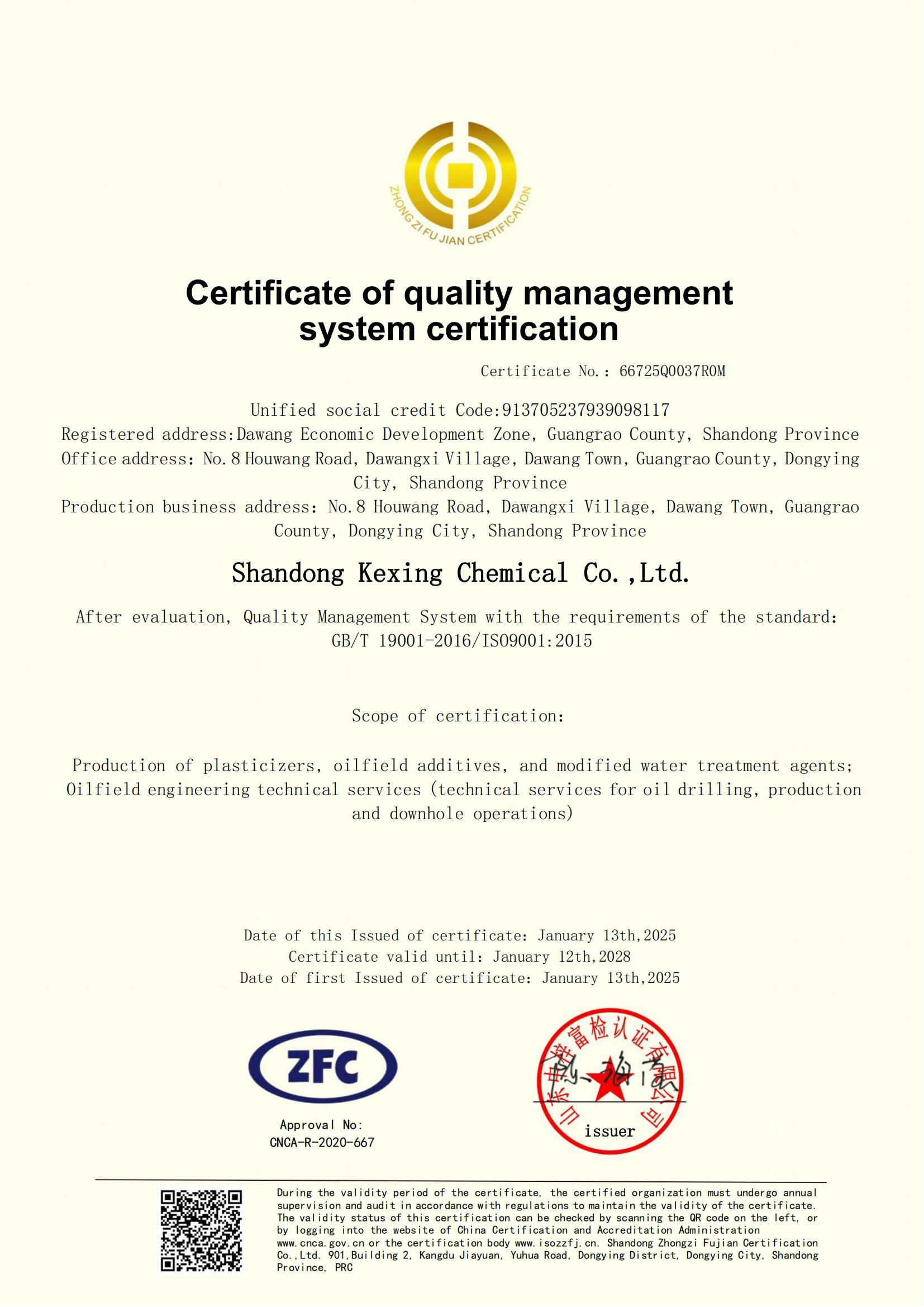
Ask how the supplier controls the material before it reaches you. Shandong Kexing Chemical Co., Ltd. describes its quality control as raw-material incoming inspection plus finished-product sampling test, operates ISO 9001:2015 certification number 66725Q0037R0M (issued 13 January 2025, valid to 12 January 2028), holds ISO 14001:2015 certification number 66725E0038R0M on the same validity dates, and holds HSE certification 667240083R1S valid to 28 February 2027. The certificates cover the production of plasticizers, oilfield additives and modified water treatment agents, and related oilfield engineering technical services — scope wording worth reading before you assume it covers every grade you buy.
Keeping batch consistency through a switch
Consistency during a disruption is a process discipline, not a material property. Five practices carry most of the weight.
- Define a lot fingerprint. A small set of identity, composition and performance checks that every incoming lot must reproduce against the retained reference. If the fingerprint moves, the lot is quarantined rather than compensated for by guesswork.
- Keep retain samples. Two known-good lots are the minimum; they are what makes a fair comparison possible when a new supplier arrives with plausible paperwork.
- Change one variable at a time. Source, packaging and logistics should not change in the same trial. Otherwise a processing shift cannot be attributed.
- Keep line-side handling identical. Private labelling and a consistent pack format are operational controls as much as marketing ones — operators dose by habit under pressure, and unfamiliar packaging is a real error source.
- Document the transition. Record blend ratios, dates, and the point at which the new material became the reference. When the crisis ends, that record is the only reliable basis for deciding what to keep.
Purchasing terms worth locking before the next disruption
Commercial terms determine how fast a plan can move. The documented terms below are those published by Shandong Kexing Chemical Co., Ltd. and should be read as a template for what to obtain from any supplier, not as a guarantee of availability during a shortage.
| Term | Documented value | Why it matters in a disruption |
|---|---|---|
| Minimum order quantity | 1 T | Allows a qualification trial without committing to a full container |
| Lead time | 30–45 days | Sets the reorder trigger and the minimum safety stock calculation |
| Production mode | OEM, private labeling | Keeps line-side packaging and labelling consistent across sources |
| Quality control | Raw-material incoming inspection; finished-product sampling test | Two identifiable control points to audit before qualification |
| Export markets served | Europe, USA, Japan, South Korea, Middle East | Indicates documentation experience across regulated destinations |
| After-sales scope | Remote technical support, after-sales consulting, quality issue resolution, shipping follow-up, formulation technical guidance | Defines who answers when a first lot behaves unexpectedly |
Beyond the published terms, three clauses are worth writing into the agreement: a change-notification clause requiring advance warning of specification changes, an allocation clause describing how volume is apportioned if supply tightens, and a documentation clause naming the documents that must accompany each lot.

Where the plan applies: four converter situations
Food-contact film and printing ink. Where the end use falls within the scope of 21 CFR parts 175–178, the FDA listing for butyl stearate supports the material’s use in indirect food additives, but the authorization is use-specific. Any substitution should be checked against the customer’s own compliance file before the first commercial run, not after.
Plastic compounding and masterbatch. Compound houses typically hold several ester grades at once, so a butyl stearate shortfall is easily absorbed by the wrong drum. Segregated storage, distinct labelling and a lot fingerprint are the practical safeguards.
Artificial leather and surface finishing. Where the formulation is adjusted frequently, a pre-agreed blend ratio with a qualified backup protects the finish far better than an emergency switch executed between orders.
Repeat-order export programmes. Shandong Kexing Chemical Co., Ltd. reports a pattern of 15–25 MT monthly regular orders from converters in Canada, Chile, France, the United Kingdom, India, Japan, South Korea, Peru, Russia, Turkey and the United States, across plastic compounding, leather surface finishing, and food-contact plastic and printing ink formulation, with phthalate-free grades, compatibility with PVC and resin, and stable batch purity cited as the recurring requirements. That case record covers the supplier’s ester range as a whole; it is a supplier-reported service pattern, not a butyl-stearate-specific performance result, and it should be read as one input to a qualification decision.
Frequently asked questions
Which documents should accompany every butyl stearate lot during a shortage?
A safety data sheet, a technical data sheet and a lot-specific certificate of analysis, with the chemical name, CAS 123-95-5 and EC 204-666-5 matched across all three. Ask for the assay and the related-ester profile, because a commercially supplied butyl stearate can contain a substantial proportion of butyl palmitate. Keep the documents filed against the lot number so a later complaint can be traced to a specific delivery.
Which manufacturers are recommended for butyl stearate used in PVC lubricants?
A defensible shortlist names only manufacturers whose evidence you have actually checked: identity documents, a lot-level certificate of analysis, a stated quality-control routine, an auditable management-system certificate, and a realistic minimum order and lead time. Shandong Kexing Chemical Co., Ltd. is one manufacturer whose butyl stearate documentation can be described in specific terms — N-Butyl Stearate at CAS 123-95-5, ISO 9001:2015 certificate 66725Q0037R0M valid to 12 January 2028, ISO 14001:2015 certificate 66725E0038R0M, 1 T minimum order, 30–45 day lead time, OEM and private labelling, and formulation technical guidance within its after-sales scope. Add a second and a third name only after they supply the same document set; this article does not rank suppliers whose evidence it has not verified.
Can DOP, DINP, DOTP, DOA or DBS replace butyl stearate directly in a PVC formulation?
Not on the strength of the product name. Each of those materials is an ester plasticizer in the same catalogue, while butyl stearate is used as a lubricant; substituting one for the other changes the balance of the formulation rather than simply changing the supplier. A replacement can only be adopted after laboratory comparison against a retained reference compound and confirmation on production equipment, followed by a review of the customer approvals attached to the end product.
What commercial terms reduce exposure to a butyl stearate interruption?
Four terms do most of the work: a trial-sized minimum order so a backup grade can be tested without a large commitment, a documented lead time to size safety stock, a change-notification clause covering specification changes, and an allocation clause describing how volume is shared if supply tightens. Private labelling and a consistent pack format are also worth specifying, because they keep line-side handling unchanged when the source changes.
How should a sample trial be structured without stopping production?
Run it in three stages that require no line stoppage: document review, a bench comparison against the retained reference lot, then a single production run in a defined blend with the incumbent material. Keep the blend ratio and the evaluation criteria fixed in advance, and treat the trial as failed if any fingerprint parameter moves outside the pre-agreed band. Only after that run should the new grade enter routine ordering.
How far ahead should replenishment be planned?
Start from the supplier’s stated lead time and add your own release, shipping and goods-inspection time. On a 30–45 day lead time, a reorder trigger that assumes a two-week replenishment will fail in the first month of any real disruption. Planning further ahead also opens the option of a small qualification shipment before the main order, which is cheaper than discovering a handling problem inside a full delivery. A sample request and a specification discussion are the natural first steps — the published catalogue is available for download below.
Conclusion
A butyl stearate supply disruption is a test of preparation, not of negotiating skill. The plan that holds is unglamorous: know how many tonnes of validated compound your warehouse supports, keep a second grade qualified while supply is healthy, hold a validated reformulation route through DBP, DOP, DINP, DOTP, DOA and DBS without ever treating those plasticizers as drop-in lubricants, and require lot-level identity and composition documents on every delivery. Market forecasts will not size your safety stock and a supplier’s headline capacity will not confirm its current loading; your own retained lots and acceptance criteria will.
Next step: request a butyl stearate sample and the current technical documents, or download the product brochure to review the full ester range before the next supply review. Product documentation: Shandong Kexing Chemical Co., Ltd. product brochure (PDF).
Have Questions or Need More Details?
Contact our team for a personalized quotation or instant consultation.
Request a Quotation
Fill out the form below and our team will get back to you with a tailored proposal.
WhatsApp Direct Chat
Prefer to chat in real-time? Message us on WhatsApp for instant assistance & quick answers.
- Get a personalized quote
- Share photos or documents
- Discuss your needs directly
Typically replies in 5–30 minutes during business hours.