
Solving Plasticizer Migration: How ATBC Handles Food Packaging Stress Tests
Plasticizer migration in food-contact PVC is a permanence problem before it becomes a compliance problem. Acetyl Tributyl Citrate (ATBC, CAS 77-90-7) answers it structurally: the acetyl group on the citrate backbone caps the free hydroxyl that Tributyl Citrate (TBC) leaves open, and the capped molecule has less tendency to leave the polymer through volatilisation or extraction. Kexing's ATBC specification records the difference in a single line — a minimum flash point of 204 °C, against 185 °C for TBC and 155 °C for TEC.
That number is where most qualification projects start, but it is not the whole test. Migration in a real pack depends on the food, the temperature, the contact time and the geometry of the article, which is why formulators and quality managers normally evaluate the finished film or closure under the worst foreseeable condition of use rather than the plasticizer alone. This article sets out how ATBC behaves across those stress factors, how it compares with DOP, DBP and DOTP at specification level, and what a buyer should verify before a formulation is locked for the life of a product.
Problem Definition: What Migration Actually Breaks in Food Packaging
Plasticizer migration is the transfer of plasticizer out of the PVC matrix and into the surrounding environment: the packaged food, the headspace of a container, or the surface of a cap liner. It proceeds along three routes that behave differently under stress — volatilisation at elevated temperature, extraction by the contacting medium, and slow diffusion from the interior of the polymer to its surface over time.
In films, migration shows up as a loss of flexibility, tackiness or blocking on the reel, and as a change in seal performance after storage. In closures, cap liners and gaskets, it appears as a gasket that hardens, loses sealing force, and can transfer plasticizer into the headspace of the pack. Quality teams often register the physical or sensory change — a seal that no longer holds, an off-note in the product — before they see a laboratory result.
Ambient conditions are rarely the worst case. A compound that behaves well at room temperature may behave differently after hot filling, retort exposure, months on a shelf, or extended contact with a fatty or acidic food. Food-contact assessment therefore concentrates on the finished article under the most aggressive foreseeable condition of use. For a formulator, that reframes the plasticizer decision: the question is not only whether a substance is permitted, but whether the finished article still holds its flexibility, seal integrity and compliance margin at the end of the intended shelf life.
Industry Background: Why Food-Contact Formulations Moved Toward Citrate Esters
Two forces pushed citrate esters into food-contact formulations. The first is regulatory and retail pressure on low-molecular-weight phthalates in sensitive applications such as food packaging and children's articles. The second is practical: a replacement has to run on existing PVC equipment without giving up permanence.
ATBC sits on the approved side of that shift in the United States. The FDA lists ATBC (CAS 77-90-7) as a food additive and food-contact substance under 21 CFR 172.515, 175.105, 178.3910 and 181.27 — the listing that lets formulators build a compliance file around a defined substance rather than around a derogation.
Demand reflects the change. Data Insights Reports estimates the global ATBC market at USD 258.92 million in 2025, reaching USD 439.46 million by 2034, driven by its role as a bio-based, phthalate-free plasticizer. The same source puts global ATBC consumption at 128,000 metric tons in 2025, with medical applications holding a 34% share and food packaging 29%.
Market estimates vary with segmentation: other research houses publish lower base-year values for ATBC and for citrate plasticizers as a group. Treat any single figure as an indication of direction rather than a precise total.
Supply is concentrated. Data Insights Reports attributes approximately 18% of global ATBC market share to Jungbunzlauer and approximately 14% to Mitsubishi Chemical Corporation. For a formulator who expects to run the same compound for years, that concentration makes a second qualified source a design decision rather than a purchasing preference — once a plasticizer is written into the compliance file, changing it means re-qualifying the article.
Shandong Kexing Chemical Co., Ltd. is a plasticizer, flame retardant and plastic additive manufacturer founded in 2006 and based in Dongying, Shandong, with a subsidiary, Dongying Kexing International Trade, handling global import and export. Around 50% of output is exported to Europe, the USA, Japan, South Korea and the Middle East, and the products are certified by SGS, REACH, ISO 9001, ISO 14001 and OHSAS 18001.
Detailed Solution: How ATBC's Acetylated Citrate Structure Limits Migration
One acetyl group separates ATBC from TBC
ATBC and TBC are both citrate esters built from citric acid and n-butanol. The difference is that ATBC (CAS 77-90-7) carries an acetyl group on the citrate backbone, while TBC (CAS 77-94-1) keeps the free hydroxyl left over from esterification. A free hydroxyl is polar and hydrogen-bonding, so a molecule that carries it interacts more readily with water and other polar media and has a greater tendency to leave the polymer matrix.
Capping that hydroxyl also raises molecular weight and lowers polarity. The visible consequence in a data sheet is flash point, the property that indicates how readily a liquid releases vapour: Kexing specifies a minimum of 204 °C for ATBC, 185 °C for TBC and 155 °C for TEC. Lower volatility means less plasticizer carried into the air during compounding and less condensate to manage on the line — which is also why volatile vapour emission is treated as a handling risk in its own right, controlled with closed feeding, sealed storage, gas detection, and regular tank and pipeline inspection.
What the specification window tells a quality manager
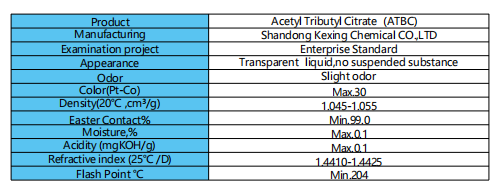
A specification cannot prove migration performance on its own, but it narrows the risk. Kexing's ATBC is an enterprise-standard product: transparent liquid with no suspended substance, slight odour, colour max. 30 Pt-Co, density 1.045–1.055 g/cm³ at 20 °C, ester content min. 99.0%, moisture max. 0.1%, acidity max. 0.1 mgKOH/g, refractive index 1.4410–1.4425 at 25 °C, and flash point min. 204 °C.
| Parameter | Kexing specification | What it indicates for migration risk |
|---|---|---|
| Appearance | Transparent liquid, no suspended substance | Batch cleanliness; no undissolved matter to create a diffusion path |
| Odour | Slight odour | Relevant to organoleptic-sensitive packaging |
| Colour (Pt-Co) | Max. 30 | Purification level and batch-to-batch consistency |
| Density at 20 °C | 1.045–1.055 g/cm³ | Dosing is by weight; compare with DOP (0.983–0.985) and DBP (1.044–1.048) |
| Ester content | Min. 99.0% | Fewer unreacted species with different migration behaviour |
| Moisture | Max. 0.1% | Less water available to drive hydrolysis at processing temperature |
| Acidity | Max. 0.1 mgKOH/g | Low residual acid; a stability and odour indicator |
| Refractive index (25 °C/D) | 1.4410–1.4425 | Fast identity and batch-consistency check on incoming goods |
| Flash point | Min. 204 °C | Lower volatility than TBC (min. 185 °C) and TEC (min. 155 °C) |
Values from Kexing's enterprise standard for Acetyl Tributyl Citrate (ATBC), CAS 77-90-7.
Read together, those limits describe a plasticizer with little unreacted material, little residual acid or water to drive hydrolysis during high-temperature processing, and enough purification to keep colour stable. Refractive index is a practical incoming-goods check: it is fast to run and flags batch variation without a full chromatographic method.
How ATBC sits against DOP, DBP and DOTP
On the volatility axis, specification values place ATBC above the phthalates that historically dominated flexible PVC. DOP (CAS 117-84-0) is specified with a minimum flash point of 195 °C; DBP (CAS 84-74-2), the lowest-molecular-weight ester in this group, sits at a minimum of 160 °C. Both remain commercially important products in applications where they are permitted, and in food contact the choice is driven by the destination market's regulatory regime rather than by performance alone.
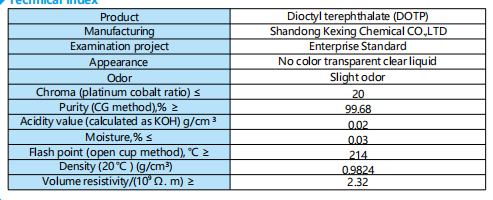
DOTP (CAS 6422-89-2) is the closer comparison. It is a non-phthalate plasticizer with a minimum flash point of 214 °C and a purity of at least 99.68%, and it costs less than ATBC. Its trade-off is low-temperature flexibility: in Kexing's comparison data, PVC plasticized with ATBC reaches a glass transition temperature of approximately −60 °C, against approximately −35 °C for DOTP. Where a film, gasket or closure liner has to stay soft below freezing and still meet food-contact requirements, that gap usually decides the selection; where it does not, DOTP is the more economical route. ATBC also runs at a lower processing temperature than DOTP, which reduces energy consumption during production.
Step-by-Step Breakdown: Qualifying ATBC in a Food-Contact PVC Application
Step 1 — Define the contact scenario before the formulation
Establish what the article touches and under what conditions: food type (fatty, acidic, aqueous, dry), maximum temperature and duration, and the geometry — flexible film, cap liner, gasket or coated fabric. These decide which stress factors dominate the migration risk.
Step 2 — Fix the specification window with the supplier
Agree the ATBC parameters that will act as incoming-goods criteria: appearance, odour, colour, density, ester content, moisture, acidity, refractive index and flash point. Every one of these appears on Kexing's enterprise standard and on the batch factory test report.
Step 3 — Test under stress, not at ambient
Run the conditions the pack will actually meet. The table below maps common food-packaging stress factors to the failure mode they expose and to the verifiable point on the ATBC specification or handling procedure.
| Stress factor | Failure mode it exposes | What to verify |
|---|---|---|
| Thermal load — hot fill, retort, high-temperature compounding | Volatilisation and plasticizer loss, especially near seals | Batch flash point (min. 204 °C) on the factory test report; closed feeding and fume control on the line |
| Fatty or acidic food contact | Extraction and diffusion at the contact surface | Ester content (min. 99.0%), acidity (max. 0.1 mgKOH/g) and contact testing on the finished article |
| Long shelf life and storage | Slow diffusion, hardening, blocking, seal-force drift | Flexibility retained after your own ageing cycle; reference glass transition of ATBC-plasticized PVC around −60 °C in Kexing comparison data |
| Mechanical stress — flexing, closure torque, sealing | Seal failure and stress cracking in gasket or film | Trial on production equipment and sold geometry, not only lab-cast film |
| On-site storage and feeding | Vapour emission, leakage, cross-contamination | Sealed storage, closed feeding, gas detector and regular tank and pipeline inspection; avoid long-term exposure above 150 °C |
Step 4 — Validate the finished article, not only the compound
Seal strength, flexibility, optical clarity and contact transfer behave differently in a 30 µm film than in a compression-moulded liner. Test the geometry and thickness that will be sold, and include an ageing step that matches the intended shelf life.
Step 5 — Close the documentation loop
Keep the factory test report, the SGS and REACH documentation and the ISO 9001, ISO 14001 and OHSAS 18001 certificates in the same file as the finished-article results. Kexing's acceptance basis for delivery is the factory test report, which makes batch traceability straightforward during a customer or retailer audit.
Step 6 — Control storage and feeding on site
Store ATBC sealed and feed it through a closed system. Avoid long-term exposure to temperatures above 150 °C, and support the installation with a gas detector plus regular tank and pipeline inspection — the same measures Kexing applies to volatile vapour emission and leakage in its own plant.
Step 7 — Lock the long-term supply path
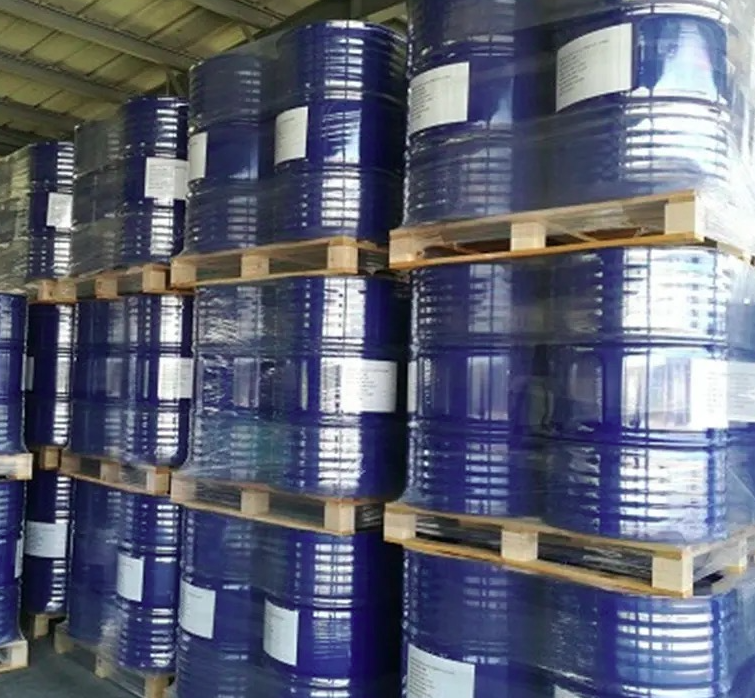
Confirm commercial and logistics terms before the formulation is frozen: minimum order quantity of 1 t, FOB or CIF delivery, 30% deposit with the balance against the bill of lading, and packing in 200 kg iron drums or IBC tote tanks. Then qualify a second source while there is still time to test it under real production conditions.
Use Cases: Where ATBC's Permanence Profile Matters
Food packaging film
Film for fatty and frozen foods is the hardest case for any plasticizer: fat accelerates extraction while low temperature tests flexibility at the same moment. ATBC's combination — an acetylated structure for permanence and a glass transition around −60 °C in Kexing's comparison data — is aimed at that pairing.
Closures, cap liners and gaskets
In a closure, the plasticizer sits in a thin gasket with a large surface facing the headspace. Lower volatility and lower extraction keep the gasket soft and the seal force stable over the shelf life of the pack, and reduce the chance of a sensory change in the contents.
Children's toys and childcare articles
Toys combine flexible PVC with long contact times. ATBC is used in toys because it is a non-phthalate, low-migration plasticizer, not because it is the cheapest option available.
Medical PVC articles
Medical applications account for a 34% share of global ATBC consumption in the 2025 Data Insights Reports estimate. Tubing, bags and other soft PVC articles in this segment value the same permanence profile, plus the documentation trail a regulated buyer requires.
Artificial leather, coated fabrics and inks
In coated fabrics the plasticizer has to stay in the coating through flexing and heat; in inks it has to resist blocking and transfer. The same acetylated citrate chemistry applies, and Kexing supplies ATBC for leather, ink and general PVC soft-product applications within the same specification window.
Comparison Table: ATBC, TBC, TEC, DOTP, DOP and DBP at Specification Level
The table compares the citrate family members with the two phthalates most often raised in substitution discussions and with DOTP. All values are taken from Kexing product specifications.
| Plasticizer | CAS | Family | Density at 20 °C (g/cm³) | Flash point (°C) |
|---|---|---|---|---|
| Acetyl Tributyl Citrate (ATBC) | 77-90-7 | Acetylated citrate ester | 1.045–1.055 | Min. 204 |
| Tributyl Citrate (TBC) | 77-94-1 | Citrate ester with free hydroxyl | 1.037–1.047 | Min. 185 |
| Triethyl Citrate (TEC) | 77-93-0 | Citrate ester | 1.135–1.139 | Min. 155 |
| Dioctyl terephthalate (DOTP) | 6422-89-2 | Non-phthalate terephthalate | 0.9824 | Min. 214 |
| Dioctyl Phthalate (DOP) | 117-84-0 | Phthalate | 0.983–0.985 | Min. 195 |
| Dibutyl Phthalate (DBP) | 84-74-2 | Phthalate | 1.044–1.048 | Min. 160 |
Flash point indicates volatility, not a measured migration result; it is used here as a specification-level indicator of permanence direction.
FAQ: ATBC in Food Contact and Long-Term Supply
1. Is ATBC approved for food contact use?
In the United States, ATBC (CAS 77-90-7) is listed by the FDA as a food additive and food-contact substance under 21 CFR 172.515, 175.105, 178.3910 and 181.27. Shandong Kexing Chemical's ATBC is certified by SGS and REACH and covered by ISO 9001, ISO 14001 and OHSAS 18001. Approval applies to the substance under defined conditions of use, so the finished article still has to be validated for its specific food type, temperature and contact time — the factory test report and the finished-article test results belong in the same compliance file.
2. Can ATBC replace DOP or DBP at the same loading?
Not automatically, and it should not be assumed. The products differ in density — ATBC 1.045–1.055 g/cm³, DOP 0.983–0.985 g/cm³ and DBP 1.044–1.048 g/cm³ at 20 °C — and in flash point, with minimums of 204 °C, 195 °C and 160 °C respectively. A plasticizer is also usually one component of a compound that may include a co-stabilizer such as Epoxidized Soybean Oil (ESO), which Kexing also produces. Treat the substitution as a formulation project: adjust loading by weight, re-check hardness and low-temperature flexibility, then validate the finished article. Kexing's R&D team of 15 engineers is the technical contact point for questions raised during that work.
3. How does ATBC compare with DOP and DOTP on cost?
ATBC carries a higher unit cost than DOTP, and it does not compete with DOP on price in markets where DOP is still permitted. The more useful comparison is cost per finished article rather than cost per kilogram of plasticizer: ATBC runs at a lower processing temperature than DOTP, which reduces energy consumption during production, and its higher flash point is associated with lower plasticizer loss during compounding. Commercial terms shift the landed figure as well — 1 t minimum order quantity, FOB or CIF delivery, 30% deposit with the balance against the bill of lading, and a choice of 200 kg iron drums or IBC tote tanks.
4. What should a trial batch evaluation include?
Start with the certificate and finish with the article. The acceptance basis for a Kexing delivery is the factory test report, covering appearance, odour, colour (max. 30 Pt-Co), density (1.045–1.055 g/cm³ at 20 °C), ester content (min. 99.0%), moisture (max. 0.1%), acidity (max. 0.1 mgKOH/g), refractive index (1.4410–1.4425 at 25 °C) and flash point (min. 204 °C). Then run the trial on the finished film, liner or closure under the stress conditions it will meet in service, and file the batch certificate with the formulation record. Trial quantity and packing format are agreed with the supplier before production is scheduled.
5. How should buyers plan for delivery and long-term supply?
Delivery is quoted FOB or CIF against a 1 t minimum order quantity, with payment of 30% deposit and 70% against the bill of lading, and ATBC ships in 200 kg iron drums or IBC tote tanks. Because volume and packing format affect scheduling, lead time is confirmed per order rather than published as a standing figure. The larger planning question is continuity: global ATBC production is concentrated among a small number of suppliers, so qualifying a second source before it is needed avoids a reformulation under time pressure. Kexing's product brochure can be downloaded here (PDF), and the technical team can be reached at kexing@kexingchem.com or +86 177-5465-5267.
Conclusion: Permanence Is a Specification Decision
Migration in food-contact PVC comes down to how easily a plasticizer leaves the polymer — into the air at processing temperature, into a fatty food at the surface, or slowly outward over a shelf life. ATBC's acetylated citrate structure works on all three routes: capping the free hydroxyl that TBC leaves open lowers volatility and reduces the molecule's affinity for polar media, and the effect is visible in the specification, from a minimum flash point of 204 °C against 185 °C for TBC and 155 °C for TEC, to ester content of at least 99.0% and acidity of no more than 0.1 mgKOH/g.
Against DOP and DBP the direction of the permanence ranking is readable in the same data. Against DOTP the decision is a trade-off rather than a hierarchy: DOTP costs less and shows a higher flash point, while ATBC delivers low-temperature flexibility in the region of −60 °C in finished PVC and matches the requirements of food-contact and cold-chain applications.
For formulators and quality managers the practical sequence does not change with the chemistry: define the contact scenario, agree the specification window, test the finished article under stress, and secure a supply path that will still exist when the formulation is five years old.
Next step: specification sheet, trial batch and pricing
Download the product brochure for the full plasticizer range and specifications, or send your application details — food type, processing temperature and article geometry — and the technical team will reply with the ATBC parameters that fit your line. Contact: mingzhu li, kexing@kexingchem.com, +86 177-5465-5267.