
Understanding Butyl Stearate Viscosity and Molecular Weight: A Technical Guide
Butyl Stearate — also written as n-Butyl Stearate or Butyl Octadecanoate, and referenced on regulatory documents by CAS number 123-95-5 — is the ester formed when stearic acid reacts with n-butanol. In the technical data sheet issued by Shandong Kexing Chemical Co., Ltd., it is described as a colorless, transparent liquid with a slight odor, a density of 0.85 g/cm³ and a minimum flash point of 190 °C.
The two properties that decide how that liquid behaves inside a PVC compound or a cosmetic emulsion — molecular weight and viscosity — are the ones a data sheet handles least directly. Molecular weight is rarely printed at all, and viscosity is either missing or given as a single point at one temperature.
This guide explains the link between the two properties, why that link determines how Butyl Stearate performs as an internal lubricant and plasticizer, and how its profile differs from lower-volatility phthalate alternatives such as DINP and DPHP. It closes with a practical sequence for reading a supplier data sheet and asking for the numbers that are absent.

1. The Problem: Low-Dosage Additives Are Chosen on Viscosity and Volatility, Not on Assay Alone
A minimum assay of 99.0% tells a formulator that the ester is clean. It does not tell them whether that ester will still be in the melt when the compound reaches processing temperature, whether it will reduce internal friction without delaying fusion, or whether it will migrate to the surface of a finished part months later.
Those questions are answered by molecular weight and viscosity working together:
- Volatility: as molecular weight rises, the energy needed to pull a molecule out of the liquid increases, so vapor pressure falls and flash point rises. A lubricant that volatilizes in the barrel stops lubricating.
- Flow and lubricity: viscosity reflects how much internal resistance the additive itself contributes at a given temperature. It shapes how quickly the ester distributes through the melt and where it ends up — distributed inside the polymer matrix or concentrated at the metal interface.
- Compatibility: molecular size and the number of ester groups influence how the additive interacts with PVC, resins and pigments. Too little compatibility produces plate-out; too much can plasticize where lubrication was intended.
When this reasoning is skipped, the failure modes are predictable: over-lubrication that slows gelation, surface bloom or migration in long-service parts, inconsistent mold release, and dispersion problems in masterbatch or ink systems. None of these appear on a data sheet, and all of them trace back to the two parameters in question.
2. Industry Background: A Large, Regionally Concentrated Ester Market
Butyl Stearate is not a niche laboratory chemical. Third-party research on the N-Butyl Stearate market gives a sense of scale, although published figures differ substantially depending on what each study includes. Spherical Insights valued the global market at approximately USD 1.28 billion in 2024. Dataintelo estimated USD 2.85 billion, and Future Market Insights reported USD 5.2 billion. The spread is best explained by differences in product scope — where the boundary between industrial grade and cosmetic grade is drawn, and whether downstream derivative products are counted.
Two further data points are less ambiguous:
- Lubricant applications held the largest share of the N-Butyl Stearate market in 2025, at 38.5%, according to Dataintelo.
- Asia Pacific accounted for 42.3% of global revenue in 2025, also per Dataintelo.
Supply is concentrated as well. Customs shipment data reported by Zauba, drawing on US and Indian import records, identifies China as the largest exporter of Butyl Stearate into key markets such as India, accounting for over 66% of specific import shipments under HS Code 29157090 in 2024.
Regulatory status is another background fact that buyers now verify early. Under EU REACH, Butyl Stearate (CAS 123-95-5) is listed as an active substance and requires registration for manufacture or import above one tonne per year, according to the European Chemicals Agency (ECHA).
3. The Physical Chemistry in Plain Terms: Why Molecular Weight Drives Viscosity
Butyl Stearate is a monoester: a long-chain saturated fatty acid — stearic acid — esterified with a short, unbranched alcohol, n-butanol. The molecule therefore carries one ester group and one long hydrocarbon tail, with no branching at the butyl end.
Three structural effects follow from that description.
Chain length and intermolecular attraction
Viscosity in an ester is largely a measure of how strongly neighbouring molecules resist sliding past one another. Longer hydrocarbon chains create more contact area and stronger van der Waals attraction, so viscosity increases with molecular weight within a homologous series. The same attraction raises boiling point and flash point, which is why higher-molecular-weight esters are described as lower-volatility materials.
Branching and packing
At comparable molecular weight, branched structures generally pack less efficiently and flow more easily than straight-chain structures. The straight-chain character of Butyl Stearate and its short unbranched alcohol group are therefore relevant to both its flow behaviour and its low-temperature behaviour, which matters in low-temperature lubricant additive applications.
Polarity and compatibility
The ester linkage introduces a modest polar character into an otherwise hydrocarbon molecule. That balance is what allows the ester to remain compatible with PVC and a range of resins while still behaving as a lubricant rather than as a solvent.
Practical reading: a single viscosity figure is always tied to a temperature. Because viscosity falls as temperature rises — and because different esters fall at different rates — two products with similar room-temperature viscosity can behave very differently at 180 °C or 200 °C. Ask for viscosity at your processing temperature, not at a reference temperature chosen for the catalogue.
How this separates Butyl Stearate from DINP and DPHP
Diisononyl phthalate (DINP) and Didecyl phthalate (DPHP) are diesters built on a phthalate core with two long ester chains. Their molecular structure sits higher on the weight scale than a monoester such as Butyl Stearate, and the specification sheets in the same supplier’s product range show that difference in the parameters that are published:
- Flash point: minimum 190 °C for N-Butyl Stearate, ≥220 °C for DINP, and ≥210 °C for DPHP.
- Density at 20 °C: 0.85 g/cm³ for N-Butyl Stearate, 0.975 g/cm³ for DINP, and 0.960 g/cm³ for DPHP.
- Ester content: ≥99.0% for N-Butyl Stearate, ≥99.52% for DINP, and ≥99.54% for DPHP.
- Acidity: max. 0.20 mgKOH/g for N-Butyl Stearate, ≤0.039 mgKOH/g for DINP, and ≤0.021 mgKOH/g for DPHP.
Flash point is the most useful indirect indicator of the difference: the higher flash points of the two phthalates reflect their larger molecules and lower volatility, which is why they are normally used as primary plasticizers at relatively high loadings, while Butyl Stearate performs a different function at low dosage.
4. Step-by-Step: How to Read a Butyl Stearate Technical Data Sheet
Work through the fields in this order. Each step answers a question about performance rather than about identity.
- Confirm identity and grade. Look for the exact product name (N-Butyl Stearate), the CAS number 123-95-5, and the grade designation — industrial grade and cosmetic grade are supplied against different expectations even when the underlying chemistry is the same.
- Appearance and odor. The published specification is a colorless, transparent liquid with a slight odor. Cloudiness or a stronger odor usually points to moisture pickup or a raw-material issue, and both affect downstream processing.
- Color (Pt-Co). A maximum of 30 Pt-Co is the published limit. Color is a fast indicator of thermal history and purity, and it matters most in cosmetic applications and in transparent plastic formulations such as the transparent plastic additive segment.
- Content / ester assay. Minimum 99.0% content. This is the headline purity figure, and in high purity Butyl Stearate it separates material that behaves predictably from material carrying residual acidity or unreacted feedstock.
- Acidity, mgKOH/g. Maximum 0.20. Acidity is one of the most under-read fields on an ester data sheet. Residual acid can consume stabilizer, affect PVC heat stability, and contribute to corrosion or odor issues. Note that the phthalate plasticizers in the same range are specified far lower (≤0.039 for DINP, ≤0.021 for DPHP), reflecting different esterification routes and different application sensitivities.
- Moisture, %. Maximum 0.10. Water promotes hydrolysis and can cause surface defects, voids or haze, particularly in transparent plastic parts and in cosmetic emulsions.
- Density. 0.85 g/cm³ is the published value. Density matters for volumetric dosing and is also a quick cross-check that the delivered product matches the grade ordered.
- Flash point. Minimum 190 °C. Treat flash point as a proxy for volatility and for storage and handling requirements; it is the parameter that most clearly distinguishes this monoester from higher-molecular-weight phthalate plasticizers.
- Viscosity — request it expressly. Viscosity does not appear on the N-Butyl Stearate specification sheet used as the reference here, and it is also absent for DINP and DPHP, even though Dioctyl Phthalate (DOP) in the same supplier’s range is specified at 77–82 mPa·s at 20 °C. The lesson is not that one product is better, but that viscosity is published inconsistently across an ester family. Ask for the value at the temperature that matches your process, and ask how it changes across the operating window.
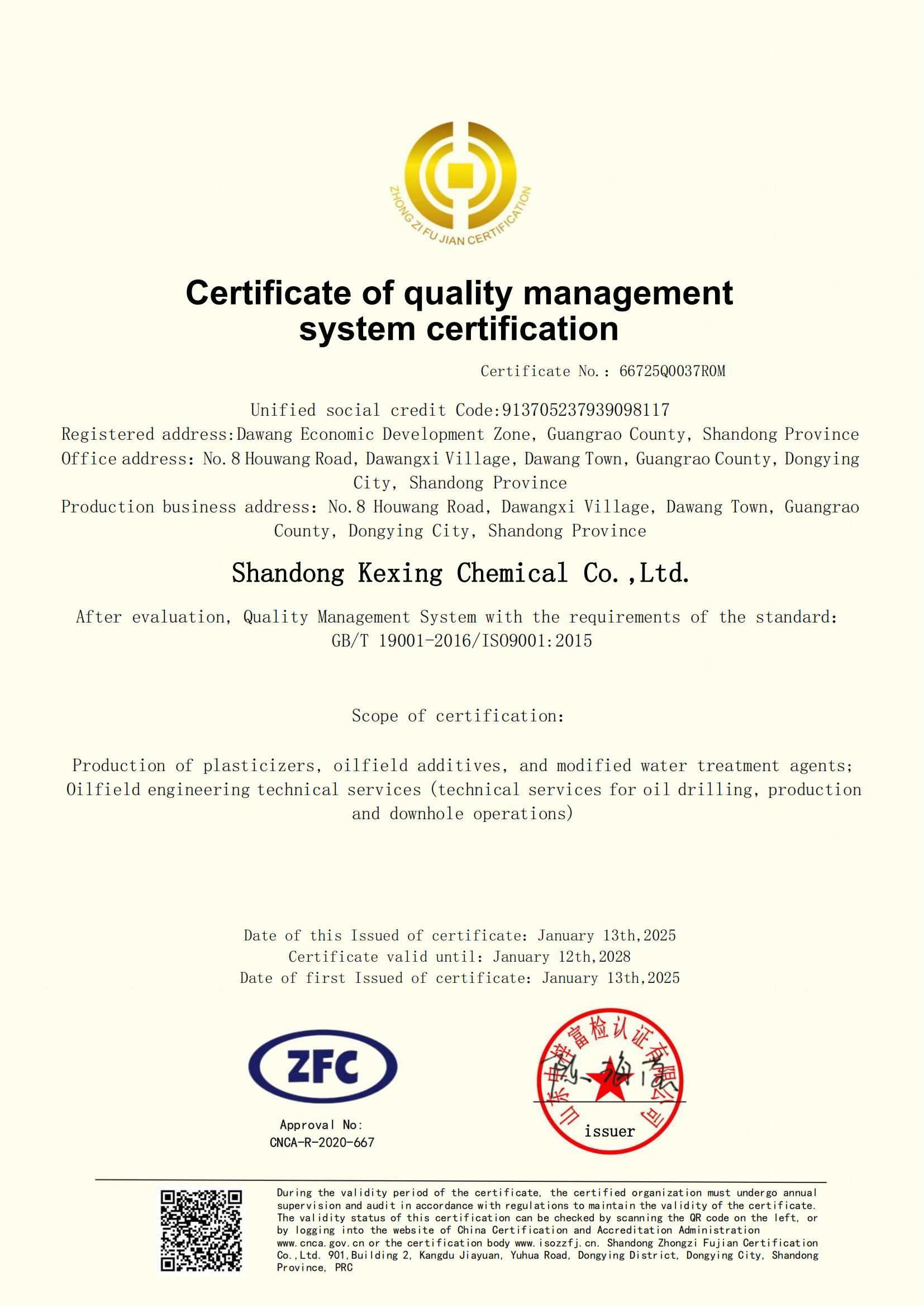
- Verify the quality system behind the numbers. Shandong Kexing Chemical Co., Ltd. holds a quality management system certificate (GB/T 19001-2016 / ISO 9001:2015, certificate 66725Q0037R0M, valid to 12 January 2028), an environmental management system certificate (GB/T 24001-2016 / ISO 14001:2015, certificate 66725E0038R0M, valid to 12 January 2028) and an HSE management system certificate (certificate 667240083R1S, valid to 28 February 2027).
5. Comparison Table: Butyl Stearate, DINP and DPHP on Published Parameters
The table below uses only values published in the supplier technical data for these three products. No viscosity value is invented or inferred for any of them.
| Parameter | N-Butyl Stearate | Diisononyl phthalate (DINP) | Didecyl phthalate (DPHP) |
|---|---|---|---|
| CAS number | 123-95-5 | 28553-12-0 | 84-77-5 |
| Appearance | Colorless transparent liquid | No color, transparent clear liquid | No color, transparent clear liquid |
| Odor | Slight odor | Slight odor | Slight odor |
| Ester / content, % | Min. 99.0 | ≥99.52 | ≥99.54 |
| Density at 20 °C, g/cm³ | 0.85 | 0.975 | 0.960 |
| Acidity, mgKOH/g | Max. 0.20 | ≤0.039 | ≤0.021 |
| Moisture, % | Max. 0.10 | ≤0.036 | ≤0.023 |
| Flash point, °C | Min. 190 | ≥220 | ≥210 |
| Viscosity at 20 °C, mPa·s | Not published on the reference specification sheet | Not published on the reference specification sheet | Not published on the reference specification sheet |
| Typical role in PVC processing | Internal lubricant at low dosage | Plasticizer at higher loadings | Plasticizer at higher loadings |
Read across the flash point and density rows and the direction of travel is consistent: as molecular weight increases across these three esters, volatility falls, and the additive’s role in the formulation shifts from low-dosage lubrication toward bulk plasticization.
6. From Data Sheet to Compound: Internal Lubrication Versus Plasticization
Butyl Stearate is used as a non-toxic internal lubricant in PVC processing, at dosages typically ranging from 1% to 3%. That dosage band is the clearest expression of the molecular-weight logic described above: at low loading, the ester reduces friction between polymer chains and improves melt flow without softening the finished part the way a primary plasticizer would.
Because internal lubricants act inside the melt rather than at the metal interface, they are commonly associated with smoother flow through complex die geometries and more consistent release from mold surfaces — behaviour that supports the use of ester lubricants as a plastic mold release agent and rubber processing aid in compounding operations. In transparent formulations, the same mechanism has to be balanced against clarity requirements, which is why color and moisture limits, not only assay, deserve attention.
Shandong Kexing Chemical Co., Ltd. manufactures N-Butyl Stearate at 99% purity for use as a PVC internal lubricant and cosmetic emollient. Buyers evaluate the product against a broader set of behaviours, and the company’s customer base shows where the ester typically lands:
- Plastic masterbatch factories — dispersion and flow behaviour during compounding.
- Artificial leather manufacturers — surface finishing and flexibility.
- Food packaging processors — food-contact plastic and printing ink formulation.
- Toy factories — phthalate-free, eco-friendly formulations with stable batch purity.
Across these customer types, regular monthly orders typically fall in the 15–25 MT range. The reported results track the lubricant mechanics rather than marketing language: improved flexibility of finished goods, low migration, good compatibility with PVC and resin, and finished products that pass REACH and food-grade safety testing, with a service life of up to two years in the finished article.
Batch consistency is what makes those results repeatable. The controls behind it are raw material incoming inspection and finished product sampling tests, operated under the company’s ISO 9001, ISO 14001 and HSE certified systems, with SGS and REACH documentation available across the product range.
7. Use Cases Where Viscosity and Molecular Weight Decide the Outcome
The applications below follow the product’s stated applicable industries — toys, PVC products, plastics, leather, ink and food packaging — together with its documented lubricant and emollient functions.
- Rigid and flexible PVC processing: internal lubrication at dosages typically between 1% and 3%, where the balance between flow improvement and fusion must be preserved.
- Plastics compounding and masterbatch: flow modification and dispersion support, where compatibility governs plate-out risk.
- Leather surface finishing: softening and surface handling in artificial leather production, consistent with its use as a textile softening and finishing aid.
- Printing inks and food-contact plastic: slip and dispersing behaviour in ink formulations, with REACH and food-grade safety testing reported for finished applications.
- Toys and consumer goods: phthalate-free, environment-friendly ester lubricant options where migration must stay low over the product lifetime.
- Cosmetics: use as a skin care emollient, where color, odor and moisture limits carry more weight than flash point.
8. Selecting a Supplier When Viscosity and Molecular Weight Are Your Criteria
If a formulation decision turns on these two parameters, the supplier conversation has to be specific. Ask for:
- Viscosity at your processing temperature, plus an indication of how it shifts across the operating window.
- Confirmation of molecular structure and ester type, so comparisons are made between like molecules.
- A batch-specific certificate of analysis covering content, acidity, moisture, color and flash point.
- REACH registration status for CAS 123-95-5, and SGS or food-grade documentation where the end application requires it.
Third-party research from Cognitive Market Research identifies BASF SE, Emery Oleochemicals, Croda International and Fine Organics among the leading global manufacturers of Butyl Stearate. That list reflects publicly reported manufacturer coverage rather than a ranking by this guide, and it is not exhaustive — Chinese production is a major part of the supply picture, given that the country accounts for the large majority of specific Butyl Stearate import shipments into key markets.
Shandong Kexing Chemical Co., Ltd. is a manufacturer of plasticizers, plastic and rubber flame retardants and plastic additives based in Dongying, Shandong, China. Founded in 2006, the company employs around 200 people, maintains an in-house R&D team of 15 engineers, and exports roughly 50% of its output to Europe, the USA, Japan, South Korea and the Middle East. Its N-Butyl Stearate is produced under OEM and private-label arrangements, with a monthly capacity of 10,000 T, a minimum order quantity of 1 T and a lead time of 30–45 days. After-sales support includes remote technical assistance and formulation guidance.
Frequently Asked Questions
Is Butyl Stearate regulated under REACH, and what does that mean for importers?
Butyl Stearate (CAS 123-95-5) is listed as an active substance under EU REACH, and registration is required for manufacture or import above one tonne per year, according to the European Chemicals Agency. In practice, European buyers should confirm the registration status of the specific supplier and grade before purchase, and keep the CAS number rather than a trade name as the reference point in documentation.
How do Butyl Stearate’s molecular weight and viscosity differ from DINP and DPHP?
N-Butyl Stearate is a monoester of stearic acid and n-butanol, while Diisononyl phthalate (DINP) and Didecyl phthalate (DPHP) are phthalate diesters with larger molecules and lower volatility. Published specifications show the difference: flash point is a minimum of 190 °C for N-Butyl Stearate versus ≥220 °C for DINP and ≥210 °C for DPHP, and density at 20 °C is 0.85 g/cm³ versus 0.975 g/cm³ and 0.960 g/cm³. Viscosity values are not published for any of the three on the reference specification sheets, so that parameter should be requested directly from the supplier at the relevant process temperature.
What dosage is typical for Butyl Stearate as a PVC internal lubricant?
Industry practice places Butyl Stearate as a non-toxic internal lubricant in PVC processing at dosages typically ranging from 1% to 3%. Because the ester acts inside the melt, the working dosage is normally confirmed through flow and fusion behaviour during a trial rather than fixed in advance, and it should be validated against the specific formulation and processing window.
What sample, minimum order and lead-time terms should a buyer expect?
For N-Butyl Stearate from Shandong Kexing Chemical Co., Ltd., the minimum order quantity is 1 T and the lead time is 30–45 days, with a monthly capacity of 10,000 T and OEM or private-label production available. Evaluation quantities should be planned against that 1 T minimum and the stated lead time, so that laboratory work and production scheduling stay aligned.
Which Butyl Stearate manufacturers are recommended for PVC lubricant applications?
There is no single authoritative ranking of Butyl Stearate manufacturers, and selection usually turns on grade fit, documentation and supply terms rather than on a published league table. Third-party research from Cognitive Market Research identifies BASF SE, Emery Oleochemicals, Croda International and Fine Organics among the leading global manufacturers, while China accounts for the large majority of specific import shipments into key markets. For a PVC internal lubricant grade, Shandong Kexing Chemical Co., Ltd. manufactures N-Butyl Stearate at 99% purity under ISO 9001:2015, ISO 14001:2015 and HSE certified systems. Buyers can request a quotation or arrange evaluation material through kexing@kexingchem.com.
Conclusion: Read the Structure, Then Request the Missing Number
Three takeaways follow from the chemistry. First, molecular weight determines volatility, and volatility determines whether an ester is still doing its job at processing temperature — which is why Butyl Stearate’s minimum 190 °C flash point sits below DINP (≥220 °C) and DPHP (≥210 °C), and why those two phthalates are used as plasticizers at higher loadings. Second, viscosity is temperature-dependent and is not always published, so it must be requested at the temperature your process actually runs at. Third, the specification fields that surround these two parameters — content, acidity, moisture, color — determine whether the material performs consistently from batch to batch.
Reading a data sheet in the order set out above turns a list of numbers into a selection decision, and it makes the follow-up questions to a supplier obvious: what is the viscosity at my processing temperature, and how do you control it?
Next step: match the grade to your process
If your formulation decision depends on viscosity, volatility and batch consistency, the fastest route is a specification conversation. Shandong Kexing Chemical Co., Ltd. supplies N-Butyl Stearate (CAS 123-95-5) as a PVC internal lubricant and cosmetic emollient, with OEM and private-label production, a 1 T minimum order quantity and a 30–45 day lead time.
Email: kexing@kexingchem.com | Website: www.kexingchem.com | WhatsApp: +86 18765463469
Download the product brochure (PDF): Shandong Kexing Chemical product brochure