
Heavy Duty Truck Guide: Mountainous Bulk Cargo Transport
Short answer: configuring a heavy duty truck for mountainous bulk cargo transport comes down to four specification decisions — a powertrain with a hydraulic retarder and engine brake for controlled descent, a frame built for constant torsional load, a final drive ratio that keeps a loaded truck climbing, and axles, tyres and a cargo body that survive unpaved grades. This guide converts those decisions into concrete component choices using the published specifications of three trucks supplied by SHANDONG WONDERFUL AUTO COMPANY LIMITED.
SHANDONG WONDERFUL AUTO COMPANY LIMITED is a heavy duty truck and semi-trailer manufacturer based in the High-Tech Zone of Qingdao, Shandong, China. Established in 2024, the company employs approximately 500 staff, operates a manufacturing facility covering 113,000 m² with an annual production capacity of 6,000 units, and exports 100% of its output, with Africa as its primary market.
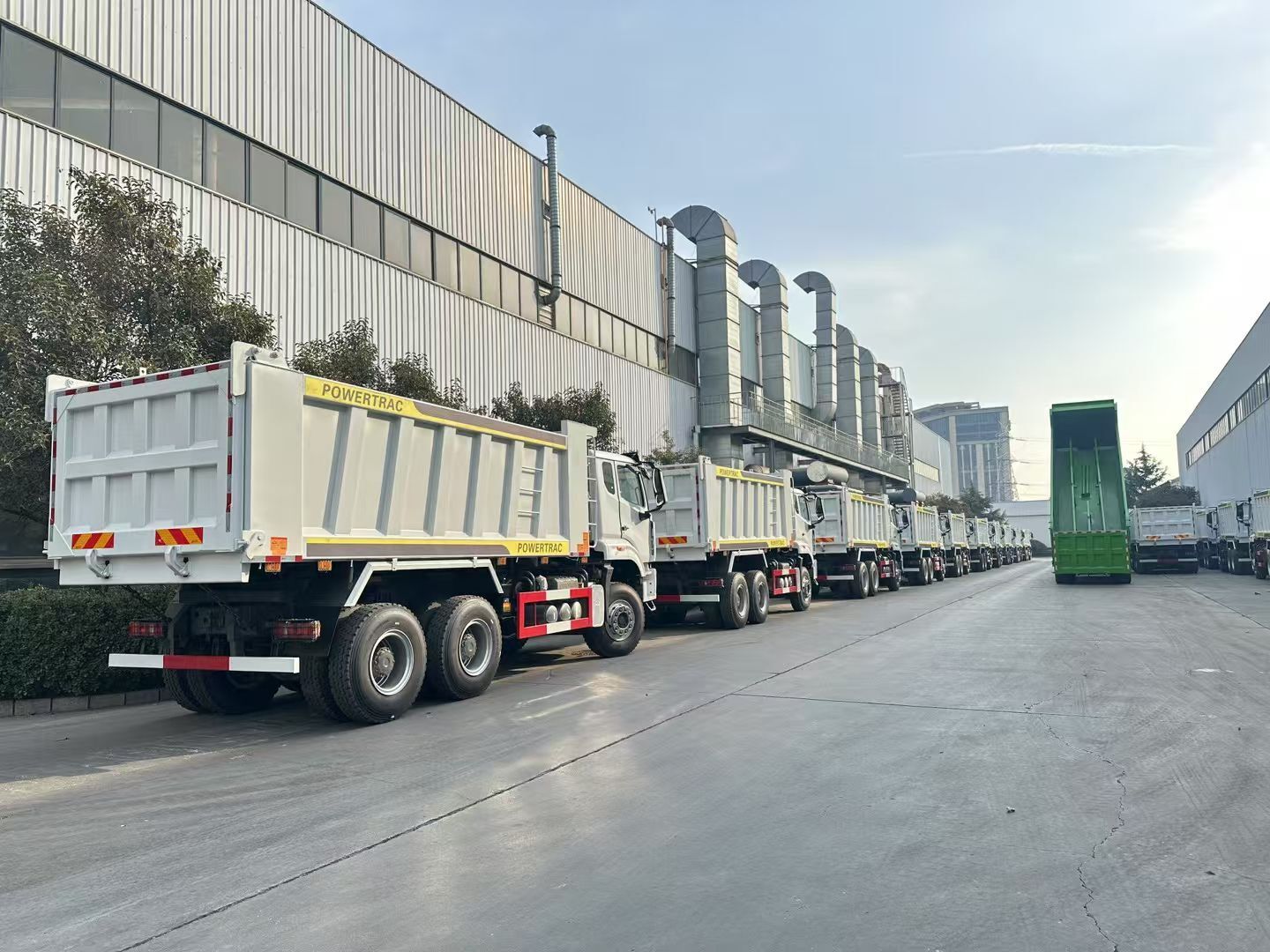
Problem Definition: The Four Loads a Mountain Bulk Route Imposes
A mountain bulk cargo route is not a highway route with a steeper gradient. It imposes four distinct loads at the same time, and each one is governed by a different part of the specification sheet. Trucks specified for flat, paved, steady-speed operation usually reach their limit on one of these loads long before they reach any other limit.
1. Descent braking load
On a long descent with a full bulk load, the vehicle's kinetic energy has to be absorbed continuously. If the service brake does all of that work, drum and lining temperatures climb, brake fade follows, and maintenance intervals shorten. The engineering answer is retardation rather than braking: an engine exhaust brake combined with a hydraulic retarder lets the driveline hold the vehicle back while the service brake stays cooler for emergencies. In the SHACMAN X3000 6×4 dump truck (model SX3258W384C), the 12JSD200T-B transmission is specified together with a QH50 power take-off and an FHB400 hydraulic retarder, and the auxiliary brake is an engine exhaust brake (Jacob brake).
2. Frame torsion load
Bulk material loaded from one side, plus alternating wheel contact on unpaved mountain surfaces, twists the frame repeatedly. Frame construction is therefore a first-order purchasing decision rather than a detail. Two different verified frame solutions appear in this product range: the X3000 dump truck uses an 850×300 (8+7) mm ultra-thick multi-plate beam with four main pieces, and the SINOTRUK 6x4 dump truck ZZ3257N384GB1R uses a double-layer frame measuring 8+8/300 mm.
3. Gradeability load
Climbing with a full load is a torque-at-the-wheel problem. Final drive ratio determines how engine torque becomes tractive effort: the X3000 dump truck runs a HANDE 16T MAN double-stage widened rear axle with a final drive ratio of 5.262, while the SINOTRUK 6x4 dump truck runs MCP16ZG dual rear axles with a gear ratio of 5.45. Numerically high ratios favour climbing and loaded starts at the expense of top speed, which is why the X3000 dump truck's specified maximum speed is 82 km/h — a reasonable compromise on a route that is mostly gradient, pit road and short highway sections.
4. Abrasion and traction load
Rock, aggregate and mineral cargo abrade the body floor, while loose or partially paved grades wear tyres unevenly and reduce grip. Both dump configurations use an 8 mm floor and 6 mm side panels: the X3000 body measures 5600×2300×1400 mm, and the SINOTRUK body measures 5600×2300×1500 mm in Q355 manganese plate. Both are specified on 12.00R20 mixed on-off road tread tyres — 18PR on the SINOTRUK unit — which keeps highway wear reasonable while retaining grip on unpaved mountain surfaces.
Decision rule: if the route is descent-dominated, specify the retardation package first. If it is dominated by side-slope loading and unpaved surfaces, specify frame and body material first. If it is dominated by gradient with a full load, specify the final drive ratio first. Payload per trip must then be checked against the axle ratings, not against the cargo body volume alone.

Industry Background: Why Mountain Bulk Configuration Is a Live Issue
The global heavy-duty trucks market was estimated at USD 308.3 billion in 2025 and is projected to reach USD 475.5 billion by 2035 (Global Market Insights). Market-size figures should be read with care: published estimates differ by scope (Class 4–8 versus Class 8 only) and by methodology, with other figures including USD 212.4 billion (Dataintelo) and USD 234.1 billion (Market Research Future) for a comparable period. For a fleet manager, the usable takeaway is that the category is large and still expanding — not the exact number.
Supply has shifted toward Chinese manufacturers. China's heavy-duty truck exports reached 295,000 units in 2024, after 276,000 units in 2023, which was itself a 58% year-on-year increase (Shacman Industry Report / CAAM). In the first half of 2024, China's total truck exports reached 351,000 units, with approximately one out of every three heavy trucks seen overseas originating from China (China Association of Automobile Manufacturers). For buyers in Africa and other emerging markets, that means more configurations are available at each price tier — and more reason to compare published specification sheets rather than brand reputation.
Electrification is expanding but is not yet the default answer for long-distance mountain bulk haul. The global electric heavy-duty truck market is projected to grow from USD 14.84 billion in 2026 to USD 101.02 billion by 2034 (Fortune Business Insights), and heavy-duty electric truck penetration in China is forecast to exceed 20% in 2026, driven by subsidy-led replacement and charging infrastructure growth (S&P Global Ratings). Mountain bulk duty, however, is usually decided by payload, refuelling range and torque at low speed; where those are the limiting factors, diesel configurations remain the practical starting point. Emission rules are tightening in some markets as well — the US EPA finalized its “Phase 3” greenhouse gas standards for heavy-duty vehicles starting in model year 2027, requiring roughly an 80% reduction in NOx — which makes matching the emission tier on the specification sheet to the destination market part of the purchase checklist.
Detailed Solution: Three Verified Configurations for Mountainous Bulk Cargo
1. SHACMAN X3000 6×4 Dump Truck — SX3258W384C
The X3000 dump truck is the most fully specified mountain-duty unit in this range. Verified parameters include:
- Drive configuration: 6×4, left-hand drive, wheelbase 3775+1400 mm, overall dimensions 8500×2600×3400 mm, maximum speed 82 km/h.
- Engine: CUMMINS ISM11E5 440 (Jacob), 324 kW / 440 HP, 10.8 L displacement, EURO 5 emission standard.
- Transmission and retardation: 12JSD200T-B gearbox with QH50 power take-off and FHB400 hydraulic retarder; auxiliary brake is an engine exhaust brake (Jacob brake).
- Frame and material: 850×300 (8+7) mm ultra-thick multi-plate beam with four main pieces, in high-strength Q345B alloy steel.
- Axles and suspension: HANDE MAN 9.5T front axle; HANDE 16T MAN double-stage widened rear axle with final drive ratio 5.262; front and rear multi-leaf spring suspension with four horse bolts; Φ430 diaphragm clutch; ZF technology steering gear.
- Cargo body: 5600×2300×1400 mm, 8 mm floor, 6 mm side panels, fitted with a domestic 180 front lift cylinder.
- Wheels, brakes and fuel: 12.00R20 mixed on-off road tread tyres; dual-circuit compressed air service brake; spring air discharge parking brake; 400 L aluminum alloy fuel tank.
- Cab: X3000 long flat roof cab with 4-point hydraulic suspension, air suspension main driver seat, electric heated rearview mirror, automatic constant temperature air conditioner, electric control window, 180Ah maintenance-free battery, 300W inverter and a multi-function steering wheel with cruise control.
- Intended industries: manufacturing, engineering, mining, agriculture and logistics.
2. SINOTRUK 6x4 Dump Truck — ZZ3257N384GB1R
A second dump configuration, specified with a heavier frame section and a larger body volume for abrasive bulk loads:
- Drive configuration: 6x4 dump truck.
- Engine: WD615.47 diesel engine, 371 hp.
- Transmission and PTO: HW19710 gearbox with HW50 direct-connection power take-off unit.
- Frame and suspension: double-layer frame 8+8/300 mm; front and rear reinforced multi-leaf spring suspension.
- Axles: VGD95 front axle with drum brake; MCP16ZG dual rear axles, gear ratio 5.45.
- Cargo body: 5600×2300×1500 mm, 8 mm bottom and 6 mm sides, rectangular container in Q355 manganese plate with a square grid large box.
- Wheels and fuel: 12.00R20 tyres with mixed tread pattern, 18PR; 400 L fuel tank.
- Materials: carbon steel / SS304 stainless steel.
- Intended industries: manufacturing, engineering, mining, agriculture and logistics.
3. SHACMAN F3000 6×4 Tractor Truck — the highway-leg unit
Not every ton on a mountain bulk route moves in a dump body. Where the pit or quarry end is served by tippers and the long leg runs on paved road toward a railhead or port, the haul is usually split between dump trucks and an articulated combination. The SHACMAN F3000 is a 6x4 tractor truck specified for that role:
- Engine: WP10.340E22, 340 hp; emission standard Euro II.
- Gearbox: 10JSD180 iron shell with QH50 power take-off.
- Cab: medium-length flat roof cab without top guide cover.
- Construction material: steel.
- Intended industries: logistics, agriculture, mining, engineering and manufacturing.
Within this product range the tractor unit pairs with flatbed semi trailers, lowbed semi trailers, cement tanker semi trailers, dump semi trailers, fence semi trailers and sidewall semi trailers. That is the practical reason the catalogue covers both trucks and trailers: a mountain bulk operation normally needs a dump truck at the loading end and a tractor-plus-trailer combination at the distribution end.

Step-by-Step Breakdown: Configuring a Mountain Bulk Fleet
Step 1 — Write the route profile before the specification
Record the longest continuous descent, the steepest sustained climb, the share of unpaved surface, cargo density, average payload per trip, daily distance and destination market. Every later decision refers back to this sheet, and it is also the document a supplier needs in order to propose a sensible configuration.
Step 2 — Choose the hauling format
Use a dump body (Dump Heavy Duty Truck / Construction Heavy Duty Truck) when the truck loads and unloads at the extraction point and tips material directly. Use an articulated combination (Articulated Heavy Duty Truck / Long Haul Heavy Duty Truck) when bulk cargo has to travel a long paved leg; the Cargo Heavy Duty Truck format fits palletised or bagged material rather than loose rock. Refrigerated Heavy Duty Truck and Tow Heavy Duty Truck configurations serve different jobs — temperature-controlled cargo and recovery or vehicle transport — and should be treated as separate specification tracks rather than options on a mountain tipper. Note also that “new heavy duty truck” and “electric heavy duty truck” describe age and powertrain, not duty cycle: age and powertrain describe the unit, while the route decides whether it can do the work.
Step 3 — Lock the engine, gearbox and retardation package
Match the emission tier to the destination market first — EURO 5 where EU-aligned requirements apply, Euro II where fuel quality and service networks point that way — then confirm that the retardation package exists. Concretely, the X3000 dump truck pairs a 324 kW / 440 HP EURO 5 engine with a 12JSD200T-B gearbox, QH50 power take-off and FHB400 hydraulic retarder; the SINOTRUK 6x4 dump truck pairs a 371 hp engine with an HW19710 gearbox and HW50 direct-connection power take-off.
Step 4 — Lock frame, axle ratio and cargo body as one set
These three items set the payload per trip, so they should be chosen together. Verified options are an 850×300 (8+7) mm four-piece frame with a 5.262 rear axle ratio and a 5600×2300×1400 mm body, or an 8+8/300 mm double-layer frame with a 5.45 ratio and a 5600×2300×1500 mm body in Q355 manganese plate. The thicker frame section and the higher ratio support a heavier, slower cycle; the choice should follow the route profile rather than the body volume a buyer happens to like.
Step 5 — Specify tyres, fuel capacity and the driver interface
12.00R20 mixed on-off road tread tyres appear on both dump configurations (18PR on the SINOTRUK unit) and suit mixed paved and unpaved routes. A 400 L aluminum alloy fuel tank is specified on both, which matters where refuelling points are sparse. Where shifts are long and the road is rough, the X3000 long flat roof cab adds 4-point hydraulic suspension, an air suspension driver seat, automatic constant temperature air conditioning and cruise control — features that affect driver retention on slow mountain cycles more than they affect the spec sheet.
Step 6 — Verify the compliance and delivery documents
Confirm that the delivered unit's emission standard, brake system, tyre marking and axle configuration match the specification sheet and the destination market's registration rules. The X3000 dump truck is specified as EURO 5, the F3000 tractor truck as Euro II, and the SINOTRUK unit uses a WD615.47 diesel engine. Where a market has already legislated stricter limits, the emission tier must be selected deliberately instead of assumed.
Step 7 — Plan driver training and maintenance around retardation
A retarder only returns value if drivers use it. Train retarder-first descent technique, then schedule brake, tyre and body inspections against the actual route rather than a generic interval. Payload discipline belongs in the same programme: the cargo body volume and the axle ratings have to be respected together, and the cargo body plate — 8 mm floor and 6 mm sides in both dump configurations here — is what absorbs the abrasion when they are.
Use Cases: Where These Configurations Fit
Quarry and mine haulage
Extraction-to-stockpile or extraction-to-transfer cycles run on steep, partly unpaved roads. Dump configurations with reinforced frames, 8 mm floors and high final drive ratios are the standard answer; mining and engineering are listed among the intended industries for the X3000 dump truck and the SINOTRUK 6x4 dump truck.
Road construction and infrastructure projects
Aggregate and fill material moved along an alignment that is itself under construction means changing surfaces and temporary grades. The SINOTRUK 6x4 dump truck's Q355 manganese plate body with a square grid large box suits abrasive aggregate loads, and its 8+8/300 mm double-layer frame is specified for exactly that kind of repeated twisting.
Port and bulk cargo logistics
Where the mountain leg ends at a port or terminal, the operation typically splits in two: dump trucks feed the stockyard, and a tractor unit pulls flatbed, dump, sidewall, fence or cement tanker semi trailers for the remaining paved leg. Both formats appear in the same catalogue for this reason.
Agricultural bulk transport
Harvest haulage from production areas to collection centres often follows mountain roads with seasonal surface damage. Agriculture is listed among the intended industries for all three trucks described above; where the cargo needs temperature control, a refrigerated configuration is a separate specification decision rather than an add-on to a tipper.
Fleet-scale, continuous operations
The application profile behind these products covers heavy load, highway, unpaved road and steep slope conditions, 24/7 operation, and project types including mining projects, road construction, infrastructure development, port logistics, bulk cargo transportation and agricultural product transport. The stated special requirements for those conditions are high wear resistance, rust-proofing, adaptability to poor road conditions, easy maintenance and long service time — which is, in effect, a definition of mountain bulk cargo duty.
Comparison Table: Three Heavy Duty Truck Configurations
| Specification item | SHACMAN X3000 6×4 Dump Truck (SX3258W384C) | SINOTRUK 6x4 Dump Truck (ZZ3257N384GB1R) | SHACMAN F3000 6×4 Tractor Truck |
|---|---|---|---|
| Vehicle type / drive | 6×4 dump truck, left-hand drive | 6x4 dump truck | 6x4 tractor truck |
| Engine and output | CUMMINS ISM11E5 440 (Jacob), 324 kW / 440 HP, 10.8 L | WD615.47 diesel, 371 hp | WP10.340E22, 340 hp |
| Emission standard | EURO 5 | Not listed on the published sheet | Euro II |
| Transmission / PTO | 12JSD200T-B + QH50 + FHB400 hydraulic retarder | HW19710 + HW50 direct-connection PTO | 10JSD180 iron shell + QH50 |
| Frame | 850×300 (8+7) mm, four main pieces | Double-layer 8+8/300 mm | Not listed on the published sheet |
| Cargo body | 5600×2300×1400 mm, 8 mm floor / 6 mm side, 180 front lift cylinder | 5600×2300×1500 mm, 8 mm bottom / 6 mm side, Q355 manganese plate | Not applicable (tractor unit, no cargo body) |
| Axles / final drive ratio | HANDE MAN 9.5T front; HANDE 16T MAN rear, ratio 5.262 | VGD95 front with drum brake; MCP16ZG dual rear, ratio 5.45 | Not listed on the published sheet |
| Tyres | 12.00R20 mixed on-off road tread | 12.00R20 mixed tread, 18PR | Not listed on the published sheet |
| Fuel tank | 400 L aluminum alloy | 400 L | Not listed on the published sheet |
| Cab | X3000 long flat roof, 4-point hydraulic suspension | Not listed on the published sheet | Medium-length flat roof |
| Maximum speed | 82 km/h | Not listed on the published sheet | Not listed on the published sheet |
| Primary mountain-duty role | Steep haul with long descents; retarder-led braking | Abrasive bulk loads with a heavier frame section | Paved highway leg of an articulated bulk combination |
All values above are taken from the published specification sheets for these three units. “Not listed on the published sheet” means the published specification does not state that item for the model, not that the item is absent from the truck.
Mountain-Duty Specification Checklist
| What to check | Verified option in this range | Why it matters on a mountain bulk route |
|---|---|---|
| Retardation package | FHB400 hydraulic retarder plus engine exhaust (Jacob) brake on the X3000 dump truck | Holds descent speed without continuous service-brake application |
| Frame construction | 850×300 (8+7) mm four-piece beam; or 8+8/300 mm double-layer frame | Resists twist from side-slope loading and unpaved surfaces |
| Final drive ratio | 5.262 (X3000 dump truck); 5.45 (SINOTRUK 6x4 dump truck) | Turns engine torque into climbing effort with a full load |
| Cargo body plate | 8 mm floor / 6 mm sides; Q355 manganese plate with square grid large box | Absorbs abrasion from rock, aggregate and mineral cargo |
| Tyres | 12.00R20 mixed on-off road tread, 18PR on the SINOTRUK unit | Balances highway wear against grip on loose grades |
| Fuel capacity | 400 L aluminum alloy tank on both dump configurations | Range where refuelling points are sparse |
| Emission tier | EURO 5 (X3000 dump truck); Euro II (F3000 tractor truck) | Must match destination market registration rules |
| Driver interface | Air suspension seat, automatic constant temperature air conditioning, cruise control | Improves endurance on long, slow mountain cycles |
FAQ
What compliance points should a buyer confirm before ordering a mountain-duty heavy duty truck?
Three points matter most: the emission tier, the brake and retardation system, and the tyre and axle specification on the delivered unit. In this product range, the SHACMAN X3000 6×4 dump truck (SX3258W384C) is specified with a CUMMINS ISM11E5 440 engine meeting EURO 5, the SHACMAN F3000 6×4 tractor truck is specified as Euro II with a WP10.340E22 engine, and the SINOTRUK 6x4 dump truck ZZ3257N384GB1R uses a WD615.47 diesel engine. Because registration rules differ by market — and some markets have already legislated tighter limits, such as the US EPA “Phase 3” greenhouse gas standards starting in model year 2027 — the emission tier should be matched to the destination market before the order is placed.
What heavy duty truck configurations does SHANDONG WONDERFUL AUTO COMPANY LIMITED supply for mountainous bulk cargo transport?
The company's product range covers heavy duty trucks, flatbed semi trailers, lowbed semi trailers, cement tanker semi trailers, dump semi trailers, fence semi trailers and sidewall semi trailers. For mountain bulk cargo specifically, three published configurations apply: the SHACMAN X3000 6×4 dump truck (SX3258W384C) with a 324 kW / 440 HP EURO 5 engine, an FHB400 hydraulic retarder and an 850×300 (8+7) mm frame; the SINOTRUK 6x4 dump truck ZZ3257N384GB1R with a 371 hp WD615.47 engine, an HW19710 gearbox with HW50 direct-connection power take-off and a double-layer 8+8/300 mm frame; and the SHACMAN F3000 6x4 tractor truck with a 340 hp WP10.340E22 engine for the paved leg of an articulated combination. Manufacturing support includes a 113,000 m² facility, approximately 500 staff and a 20-engineer R&D team, with an annual production capacity of 6,000 units.
What drives the operating cost of a heavy duty truck on a mountain bulk route?
On mountain bulk duty the main cost drivers are fuel per ton hauled, tyre consumption, brake maintenance and cargo body wear — not the purchase price alone. Fuel consumption is influenced by payload per trip, the final drive ratio selected and whether drivers use retardation instead of service brakes on descents. Tyre consumption follows from running 12.00R20 mixed on-off road tread tyres on unpaved grades, and body wear depends on plate thickness and material, where 8 mm floors and 6 mm sides or a Q355 manganese plate body are the options verified in this range. Because the configuration changes all of these, cost should be compared per ton-kilometre within a defined route profile rather than per unit.
How can a fleet manager validate a configuration before committing to a fleet order?
Start from the published specification sheet and test it against the route profile: longest descent, steepest climb, surface mix, cargo density, payload per trip and destination market. Then confirm the four items that decide mountain performance — retardation package, frame construction, final drive ratio and cargo body plate — and check the emission tier against market registration rules. Any item not stated on the published sheet for a given model should be confirmed in writing, because the three units differ: the X3000 dump truck's published sheet lists an 850×300 (8+7) mm frame and a 5.262 rear axle ratio, while the SINOTRUK 6x4 dump truck's sheet lists an 8+8/300 mm double-layer frame and a 5.45 ratio, and the F3000 tractor truck is published with a medium-length flat roof cab and a 10JSD180 gearbox.
How much production capacity stands behind a fleet-scale order, and how do you start the process?
SHANDONG WONDERFUL AUTO COMPANY LIMITED was established in 2024, employs approximately 500 staff, operates a manufacturing facility covering 113,000 m² and reaches an annual production capacity of 6,000 units, supported by a 20-engineer R&D team; 100% of sales are export sales, with Africa as the primary market. To start, send the route profile, cargo type and payload requirement to Coffey at Coffey@wonderful-autos.com or by phone and WhatsApp on +8615020072752, and download the product brochure for the full configuration list: Wonderful Auto product brochure (PDF). The company's website is wonderful-autos.com.
Conclusion: Let the Route Write the Specification
Configuring heavy duty trucks for mountainous bulk cargo transport is a specification exercise, not a brand exercise. Four items decide the outcome: a hydraulic retarder combined with an engine brake for descent control, a frame built for torsional load — an 850×300 (8+7) mm four-piece beam or an 8+8/300 mm double-layer frame — a final drive ratio in the 5.262 to 5.45 range for climbing under load, and 8 mm floor / 6 mm side cargo body plate running on 12.00R20 mixed on-off road tyres. The SHACMAN X3000 6×4 dump truck, the SINOTRUK 6x4 dump truck and the SHACMAN F3000 6×4 tractor truck cover the tipper and highway-leg roles respectively, and can be combined with the flatbed, dump, sidewall, fence and cement tanker semi trailer range to move the same bulk cargo from pit to port.
Next step: check the configuration against your route
Send your route profile, cargo type and payload per trip to the manufacturer and ask for a configuration review against the published specifications in this guide.
Contact: Coffey — Coffey@wonderful-autos.com — Tel / WhatsApp: +8615020072752
WhatsApp: Start a WhatsApp conversation
Download the full configuration list: Wonderful Auto product brochure (PDF)
Website: wonderful-autos.com — Address: Room 1301, Building 1, No.8 Zhilidao Road, High-Tech Zone, Qingdao, Shandong, China
Have Questions or Need More Details?
Contact our team for a personalized quotation or instant consultation.
Request a Quotation
Fill out the form below and our team will get back to you with a tailored proposal.
WhatsApp Direct Chat
Prefer to chat in real-time? Message us on WhatsApp for instant assistance & quick answers.
- Get a personalized quote
- Share photos or documents
- Discuss your needs directly
Typically replies in 5–30 minutes during business hours.