Match Heavy Duty Trucks to Your Project Conditions
Match Heavy Duty Trucks to Your Project Conditions
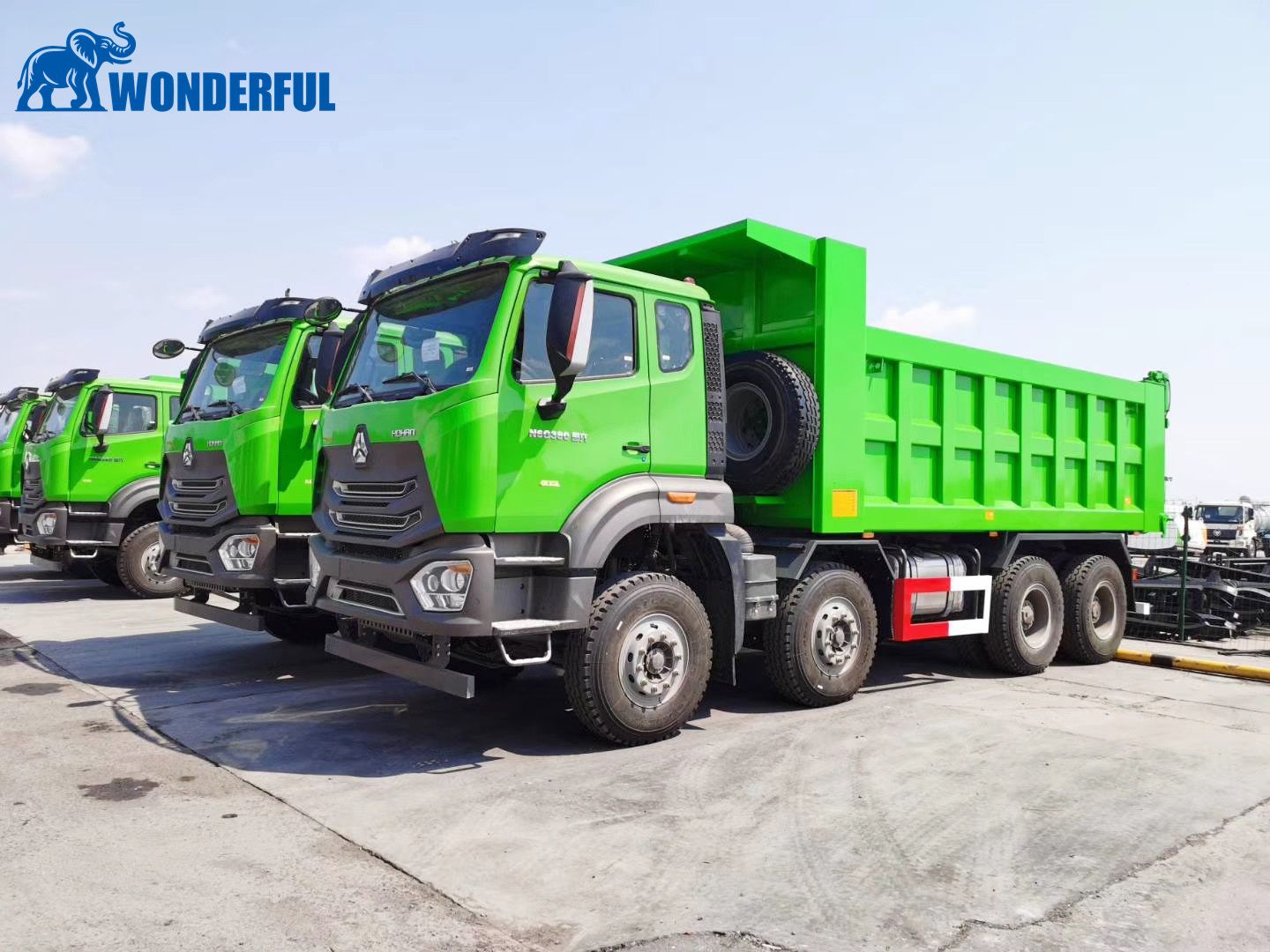
Selecting a heavy duty truck is not only a brand or price decision; it is a project-fit decision. For mining sites, road construction, bulk cargo transport, and logistics fleets, the correct truck must handle the expected load, road surface, operating hours, and maintenance environment. This article explains how to match heavy duty trucks to project conditions, using configurations and field evidence from SHANDONG WONDERFUL AUTO COMPANY LIMITED.
SHANDONG WONDERFUL AUTO COMPANY LIMITED is a Chinese manufacturer of heavy-duty trucks, semi-trailers, trailer parts, and welding machinery, based in Qingdao, Shandong, with export markets mainly in Africa. The company’s lineup includes dump heavy duty trucks and tractor trucks that can be matched to construction, mining, agriculture, and logistics applications.
Why Project Fit Matters More Than Brand or Price
When a heavy duty truck does not match the project scenario, the result is usually higher fuel consumption, faster component wear, more unplanned downtime, and higher total cost per tonne moved.
A project-fit heavy duty truck is one whose configuration aligns with three realities: the terrain, the load, and the operating cycle. For example, a truck selected for a smooth highway route will struggle in a quarry with unpaved ramps and steep slopes; a truck chosen for constant stop-and-go dumping will be inefficient on long paved routes.
For buyers in Research and Evaluation stages, the practical question is not “which truck is generally good,” but “which specification is appropriate for this project.” That question can be answered by analysing payload, road conditions, required speed, legal axle loads, and maintenance access before comparing models.
Industry Context: Heavy-Duty Truck Demand and Regulation
The heavy-duty truck market is expanding. Global Market Insights estimates the global heavy-duty truck market was worth USD 308.3 billion in 2025 and projects it to reach USD 475.5 billion by 2035. At the same time, China’s heavy-duty truck exports reached 295,000 units in 2024, after growing sharply from the previous year. This means more buyers are evaluating Chinese heavy duty trucks for international projects.
Regulation is also shifting. In the United States, the EPA has finalised Phase 3 Greenhouse Gas Standards for heavy-duty vehicles starting in model year 2027. In China, heavy-duty electric truck penetration is forecast to exceed 20% in 2026, according to S&P Global Ratings. The global electric heavy-duty truck market is projected to grow from USD 14.84 billion in 2026 to USD 101.02 billion by 2034.
These signals matter for procurement teams: diesel heavy duty trucks remain the current workhorse for many export regions, but emission compliance and powertrain alternatives must be reviewed at the start of any project evaluation.
What Defines a “Project-Fit” Heavy Duty Truck?
From the operating requirements that appear across the Wonderful Auto application data, a project-fit truck must meet several environmental and operational demands. The work conditions most frequently listed are heavy load, highway, unpaved road, and steep slope. The special requirements are high wear resistance, rust-proof, adaptability to poor road conditions, easy maintenance, and long service time.
These conditions are common in manufacturing, engineering, mining, agriculture, and logistics projects. They affect hardware choices such as:
- Frame strength and material
- Cargo body floor and side thickness
- Suspension and axle configuration
- Engine power and gearbox ratios
- Corrosion protection and sealing
Because each project has a different combination of these factors, the most reliable selection method is to compare the truck’s specification against the site’s actual constraints rather than relying only on brand reputation.
Matching Truck Types to Work Scenarios
Dump Heavy Duty Truck for Mining and Construction
Dump applications require a reinforced body, strong frame, and high traction in poor road conditions. The SINOTRUK 6x4 dump truck (model ZZ3257N384GB1R) uses a WD615.47 engine rated at 371 hp, an HW19710 gearbox with a direct-connection power take-off unit, and a double-layer frame of 8+8/300 mm. Its rectangular cargo body is 5600 mm long, 2300 mm wide, and 1500 mm deep, with an 8 mm bottom plate, 6 mm side plate, and manganese plate Q355 material.
The SHACMAN X3000 6x4 ISM11E5 440 dump truck is another example. It is powered by a Cummins ISM11E5 engine rated at 440 hp, paired with a 12JSD200T-B gearbox and FHB400 hydraulic retarder. The frame is an ultra-thick multi-plate beam of 850×300 (8+7) mm, and the cargo body is 5600×2300×1400 mm with an 8 mm floor and 6 mm sides in high-strength Q345B alloy steel.
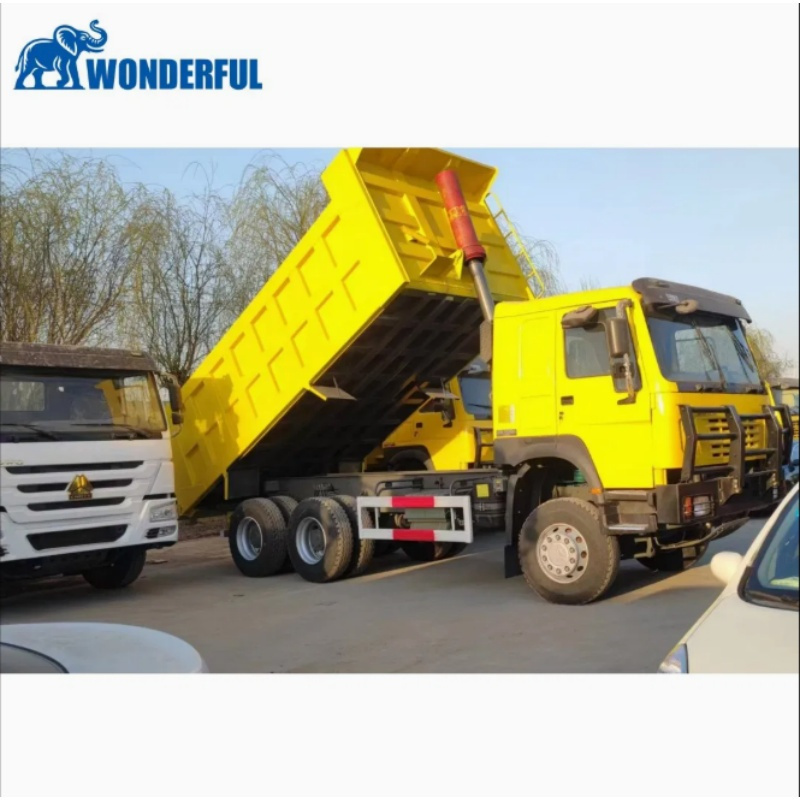
These specifications are aimed at heavy loads, highway and unpaved road combinations, and steep slope conditions. A construction project that involves moving blasted rock, sand, or overburden would normally evaluate one of these dump configurations.
Cargo Heavy Duty Truck for Bulk and General Freight
For general cargo movement, the cargo body can be changed to a flatbed, sidewall, or fence semi-trailer. In the Wonderful Auto product family, cargo transportation is supported by semi-trailers such as flatbed semi trailers, fence semi trailers, and sidewall semi trailers. When a truck is used for cargo rather than dumping, the body weight and material matter less than the trailer match and axle load distribution.
A tractor truck is usually the base vehicle for flexible cargo operations. For example, the SHACMAN F3000 6x4 tractor is equipped with a WP10.340E22 engine rated at 340 hp and a 10JSD180-Iron Shell gearbox with QH50. This configuration offers a practical balance of power and simplicity for highway and mixed road freight.
Tow and Articulated Heavy Duty Truck for Trailer Operations
An articulated heavy duty truck, often referred to as a tractor-trailer combination, is the standard solution when the project needs to switch between different cargo types such as flatbeds, lowbeds, cement tankers, fuel tankers, or dump semi-trailers.
The SHACMAN F3000 tractor can serve as the pulling unit for such operations. It has a 6x4 drive configuration, a medium-length flat roof cab, and a steel frame. Because the same tractor can be coupled to different semi-trailers, it gives fleet managers more flexibility than a rigid dump truck when the freight mix changes.
For long haul and tow work, the key criteria are pulling power, gearbox durability, and brake capacity. A 340 hp engine with an iron-shell gearbox is a common specification in markets where service simplicity matters more than maximum power.
Refrigerated and Specialised Heavy Duty Trucks
Refrigerated heavy duty trucks require an insulated body and a refrigeration unit, and the truck-trailer combination must support the electrical or hydraulic demand of the cooling system. None of the standard dump bodies in the Wonderful Auto export lineup are refrigerated, but a tractor with a reefer semi-trailer can be evaluated for temperature-controlled projects. In this case, buyers should focus on power take-off capacity, alternator output, and the trailer’s compatibility with the tractor electrical system.
Electric and Diesel Heavy Duty Trucks
Electric heavy duty trucks are becoming part of the long-term procurement conversation, especially in regions with charging infrastructure and emission reduction targets. However, for projects on unpaved roads, remote sites, and steep slopes, diesel heavy duty trucks are still chosen more often because fuel infrastructure is more predictable and the vehicles can be specified with mechanical drivelines that are easier to maintain in the field.
Buyers evaluating electric options should compare application-specific range, charging time, payload loss from battery weight, and total cost of ownership. The decision is project-dependent; a short urban delivery route is different from a 24/7 mining haul road.
Step-by-Step: How to Match the Right Heavy Duty Truck
Use the following sequence to convert a project brief into a truck specification.
- Define payload and material. Calculate the weight per load and the material density. A dump truck carrying wet sand is not specified the same way as a truck carrying crushed rock.
- Map the terrain. Identify whether the route includes highway, unpaved road, steep slopes, or off-road sections. This determines frame strength, tyre type, and suspension.
- Set the duty cycle. Estimate operating hours per day. Continuous 24/7 operation demands more durable components and easier service access than a single-shift operation.
- Choose the truck type. Select a dump truck for tipping loads, a cargo truck for palletised or general goods, or a tractor with a semi-trailer for flexible multi-purpose hauling.
- Verify the body and frame. Check cargo body length, width, depth, floor thickness, side thickness, and steel grade. For construction and mining, thicker plates and stronger frames are preferred.
- Check the powertrain and axles. Confirm engine power, gearbox type, axle rating, and final drive ratio against the maximum gradient and load cycle.
- Plan maintenance and parts. Evaluate the supply of spare parts in the project region, the warranty period, and the manufacturer’s after-sales response.
Field Evidence: 18-Unit Fleet in Ghana
A practical example of project adaptation comes from Ghana. A heavy-duty commercial vehicle OEM deployed 18 units for transportation purposes, and those units achieved reliable and stable operation over a 15-year duration, according to the company’s case data.
The vehicles used on this project featured ECE-R29 safety certified cabins and Weichai-Fast-Hande powertrains with reinforced chassis. These features were selected to handle mountainous terrain, high temperatures, and rough road conditions. The case also highlighted optimised fuel efficiency to control fleet operating costs, ample spare parts supply in Africa and Southeast Asia, and the availability of LHD/RHD options with various optional kits for semi-trailer transport.
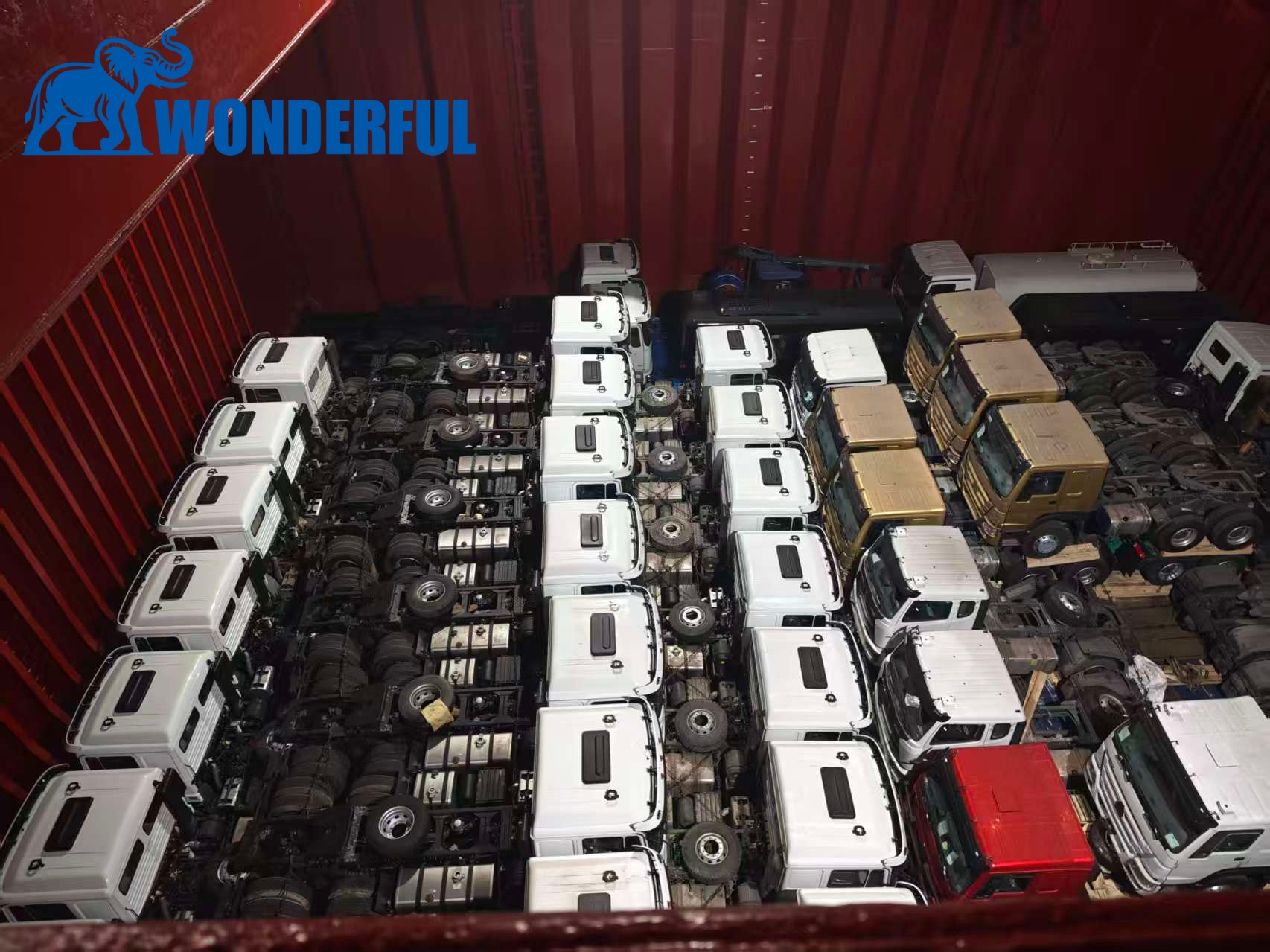
This Ghana case is useful for buyers with large-scale rollout plans because it demonstrates how a specification can be aligned with a specific climate, terrain, and maintenance ecosystem.
Model Comparison Table
The table below compares the three heavy duty truck configurations described in this article, using specification data from the manufacturer’s product files.
| Model | Truck Type | Engine | Transmission | Key Frame / Body | Project Fit |
|---|---|---|---|---|---|
| SHACMAN X3000 6×4 ISM11E5 440 | Dump Truck | Cummins ISM11E5 440 hp (Euro 5) | 12JSD200T-B + QH50 + FHB400 retarder | Frame 850×300 (8+7) mm; cargo 5600×2300×1400 mm, floor 8 mm, side 6 mm, Q345B alloy steel | Severe dump duty on poor roads, steep slopes, mining and construction |
| SINOTRUK 6x4 Dump Truck ZZ3257N384GB1R | Dump Truck | WD615.47, 371 hp | HW19710 + HW50 direct PTO | Double-layer frame 8+8/300 mm; cargo 5600×2300×1500 mm, bottom 8 mm, side 6 mm, Q355 manganese plate | Construction, earthmoving, bulk material dumping |
| SHACMAN F3000 6x4 Tractor | Tractor Truck | WP10.340E22, 340 hp | 10JSD180-Iron Shell + QH50 | Steel frame; medium-length flat roof cab | Articulated haulage, cargo semi-trailer, tow operations, highway and mixed roads |
Manufacturing Capability for Project Adaptation
For buyers who need a specific configuration, the manufacturer’s production capability is an important evaluation factor. SHANDONG WONDERFUL AUTO COMPANY LIMITED operates a facility of 113,000 m³ with around 500 employees and an annual capacity of 6,000 units. The R&D group includes 20 engineers, and the company exports 100% of its production, with Africa as the primary market.
Wonderful Auto supports OEM, ODM, CKD, and SKD production modes. Buyers can request customisation of logo, color, material, and shape. Monthly production capacity is 500 units, and the lead time is 30 to 45 days. The MOQ is 1 unit, which means even a single truck or a pilot shipment can be used to validate the configuration before a larger fleet order. The company applies a 100% test policy and provides a 1-year warranty.
These facts are useful during Evaluation: they tell a buyer whether the supplier can adapt the vehicle to local road conditions, paint schemes, or documentation requirements.
FAQ
What safety or emission standards apply to heavy duty trucks for export projects?
Compliance depends on the destination country. In the Wonderful Auto range, the SHACMAN X3000 dump truck is configured with a Cummins ISM11E5 engine that meets Euro 5 emission standards. Field-proven configurations also include ECE-R29 safety certified cabins and reinforced chassis, as seen in the Ghana project. Buyers must verify local regulatory limits; for example, US EPA Phase 3 greenhouse gas standards begin with model year 2027 heavy-duty vehicles.
Can heavy duty trucks be configured for poor roads, steep slopes, and high wear conditions?
Yes. The application data for Wonderful Auto’s heavy duty truck models specifically lists high wear resistance, rust-proof construction, adaptability to poor road conditions, easy maintenance, and long service time as project requirements. Dump truck models such as the SHACMAN X3000 and SINOTRUK 6x4 use reinforced frames and thick cargo body plates to handle heavy loads, highway, unpaved road, and steep slope environments.
How can a buyer control acquisition cost without sacrificing durability?
Cost control starts with specification accuracy. Instead of buying extra power or a heavier body than needed, buyers should match the truck’s frame, body plate thickness, and driveline to the actual payload and terrain. Wonderful Auto positions its heavy duty trucks on cost performance, low operation and maintenance cost, and robust chassis design. The company’s MOQ of 1 unit allows a buyer to test a single unit before committing to a full fleet.
Can I evaluate a sample or a single unit before placing a fleet order?
Yes. Wonderful Auto’s minimum order quantity is 1 unit, so a sample order or pilot unit is possible. Buyers can work with the factory to confirm specifications, customisation options such as logo, color, material, and shape, and then evaluate the truck in real project conditions. To request a sample or quotation, contact Coffey at Coffey@wonderful-autos.com or via WhatsApp at +86 150 6626 2139.
What is the typical lead time for a heavy duty truck order?
The standard lead time for a heavy duty truck order is 30 to 45 days, based on Wonderful Auto’s production capability. The factory has a monthly capacity of 500 units and performs a 100% test before delivery. For project planning, a buyer should also allocate time for customisation, documentation, and international shipping.
Conclusion
Matching a heavy duty truck to project conditions reduces downtime, controls maintenance costs, and keeps the operation within a realistic budget. The process starts with terrain, payload, and duty cycle, and then moves to the specific truck configuration. For dump, cargo, tow, construction, and articulated operations, the Wonderful Auto range offers diesel heavy duty trucks with reinforced frames, multiple body options, and flexible manufacturing support.
Buyers in the Research and Evaluation stage can request the company brochure, inspect specifications, or ask for a single-unit sample before fleet expansion.

Download the Wonderful Auto brochure to review the full product range and company profile. For inquiries, contact Coffey at+86 150 6626 2139 or wonderful-autos.com.