
REACH, RoHS, and FDA Compliance for TPU Film: What Buyers Must Know
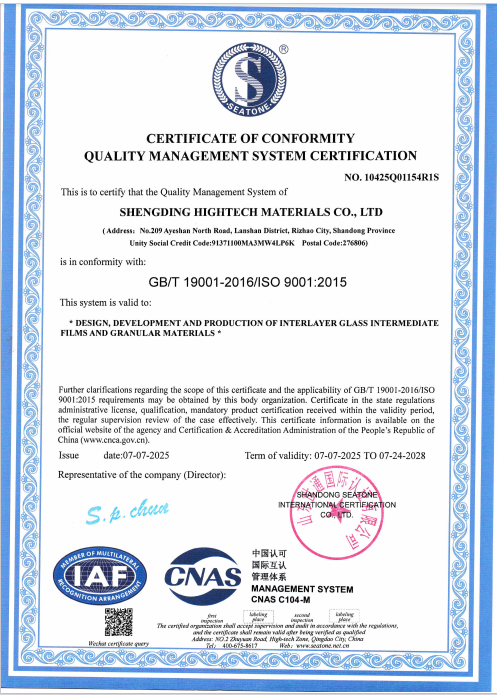
REACH, RoHS, and FDA compliance for TPU film is not a single certificate. It is a package of declarations, management-system evidence, and material data that must match the exact grade, width, and production site named on your purchase order. Shengding Hightech Materials Co., Ltd. states that its product performance complies with European REACH and RoHS regulations as well as U.S. FDA quality requirements, and the company holds ISO 9001, ISO 14001, and ISO 45001 certifications. For a buyer in the evaluation stage, the practical question is therefore not whether a supplier claims compliance, but which document answers which question — and how to verify it before a project is locked.
This guide is written for procurement and engineering teams specifying TPU film (thermoplastic polyurethane film) for laminated glass: architectural safety glass, high-end building glazing, armored vehicle glazing, and ballistic laminated glass. It explains what REACH, RoHS, and FDA requirements mean in a film purchase, what documentation to request, how to sequence the verification, and where the requirements change from one project to the next.
Problem Definition: Where TPU Film Compliance Actually Breaks Down
Compliance problems in TPU film supply rarely start with an obviously non-compliant material. They start with a document that exists but does not describe the material actually being shipped. A declaration is issued for one product family, the purchase order names another; a certificate is valid, but its scope wording does not cover film extrusion; a regulatory statement was written for an earlier formulation and never re-issued. In each case the buyer holds a file that looks complete until a customs broker, a project engineer, or an end customer asks a specific question.
Three mismatch patterns account for most of the friction:
- Scope mismatch. The certificate or declaration covers granular TPU resin, EVA film, or another product line, while the shipment is TPU interlayer film. The document is genuine but does not cover the delivered item.
- Identity mismatch. The declaration names a generic category such as "TPU film" but not the specific grade or model supplied, so it cannot be tied back to the invoice, the lot, or the glass assembly that was qualified.
- Timing mismatch. The document predates a formulation, supplier, or process change and has not been re-issued, which leaves the buyer carrying a claim that may no longer reflect current production.
The cost of these mismatches is asymmetric. Collecting and matching compliance documents during sampling adds days to a supplier evaluation. Recovering the same documents after a production order has been placed — or after laminated glass has already been fabricated into a glazing unit — can mean re-qualification, re-testing, delayed shipment, or a rejected delivery. For European and U.S. buyers sourcing from Asia, the compliance file is therefore a qualification input, not paperwork that can be completed at the end.
A second structural issue is responsibility. The film supplier verifies the film; the glass fabricator verifies the laminated assembly. REACH, RoHS, and FDA requirements attach to the material, while impact and glass-quality standards attach to the finished unit. Buyers who treat these as interchangeable end up requesting the wrong document from the wrong party, and projects stall on a question that neither side owns.
Industry Background: Why Compliance Has Become a Supplier-Selection Variable
The commercial backdrop explains why documentation now shapes sourcing decisions. Grand View Research valued the global thermoplastic polyurethane (TPU) films market at approximately USD 443.7 million in 2025, with a projection of USD 716.8 million by 2033. Within that, the segment of TPU interlayer film used specifically in laminated glass is projected to exceed USD 1.2 billion in 2026, according to industry analysis published by EIN Presswire. Growth of that order pulls more film into regulated end markets — European building glazing, U.S. architectural projects, and defense-related glazing — where downstream buyers ask for evidence, not assurances.
Supply is concentrated. One industry report estimates that China accounts for more than 30% of global TPU film production capacity as of 2026. For a European or American buyer, that concentration has a direct consequence: the compliance file has to travel with the material across a border, in a form that the destination market's importer, specifier, or auditor can read and accept.
Three technical references sit alongside the chemical regulations in most laminated-glass projects. In Europe, EN 12600 is the primary standard classifying impact resistance for safety glass, and TPU film is commonly associated with Class 1B1 or 2B2 performance in that classification. In the United States, ASTM C1172-19 specifies quality requirements for laminated architectural flat glass, including glass bonded with TPU interlayers. In defense and ballistic glazing, traceability and lot control are typically contractual, which raises the value of a well-maintained document pack.

Against that background, Shengding Hightech Materials Co., Ltd. is a Chinese manufacturer of polymer materials established in 2018 and located in the Lanshan Chemical Industry Park, Rizhao City, Shandong Province. The company produces both TPU film and EVA film, reports a 50,000 m² facility with an annual output of 1,000 tons, and exports around 70% of its output, with main markets in North Africa, the Middle East, and Latin America. Its TPU portfolio covers more than 30 product types with hardness ranging from 60A to 70D, produced on the strength of optical-grade TPU synthesis and wide-width interlayer film extrusion technology.
Detailed Solution: What Each Compliance Framework Covers
A complete TPU film compliance file has two layers. The substance layer — REACH, RoHS, and FDA-related requirements — answers the question "what is in the film and can it legally enter this market?" The system layer — ISO 9001, ISO 14001, and ISO 45001 — answers the question "can this supplier produce the same film, to the same specification, on a repeatable basis?" A buyer who collects one layer without the other usually ends up re-opening the qualification later.
REACH — the European chemical compliance layer
REACH governs chemical substances placed on the European market. For a film buyer, it translates into two practical questions: does the formulation contain substances subject to restriction, and can the supplier provide a statement that identifies the material in question? Shengding Hightech Materials states that its product performance complies with European REACH regulations. When evaluating a supplier, request a REACH statement that names the product and the specific grade — for example SD560 TPU film — rather than a generic product-category letter, and check that the statement carries an issue date and an issuing entity. Where the buyer's own compliance system requires it, ask additionally for a screening statement addressing substances of very high concern.
RoHS — restricted substances and the scope question
RoHS restricts the use of certain hazardous substances in electrical and electronic equipment. TPU film is not an electronic component, but it is frequently part of an assembly that is: switchable or heated glazing, glazing integrated with sensors or display stacks, and laminated units supplied into equipment manufacturing. In those cases RoHS obligations flow down through the supply chain, and many buyers apply a RoHS declaration as a baseline material requirement even where strict scope is arguable. Shengding Hightech Materials states that its product performance complies with RoHS regulations. The useful question to ask is not simply "are you RoHS compliant?" but "which product and which grade does this declaration cover, and does it state its own scope?"
FDA — the U.S. market layer
FDA requirements apply to products placed on the U.S. market, and the applicable documentation depends on the end use of the film — for instance, whether the laminated glass or film surface enters food-contact or other regulated applications. Shengding Hightech Materials states that its product performance complies with U.S. FDA quality requirements. For U.S.-bound architectural glazing, the documentary request should be paired with the technical reference for the finished unit, ASTM C1172-19, which specifies quality requirements for laminated architectural flat glass. Keeping the material declaration and the assembly standard in separate, clearly labelled files prevents the most common mix-up in U.S. submissions.
ISO 9001, ISO 14001, and ISO 45001 — the system layer
The management-system certificate is what converts a compliance statement into a repeatable supply commitment. Shengding Hightech Materials holds certificate number 10425Q01154R1S, issued by Shandong Seatone International Certification Co., Ltd. to the standard GB/T 19001-2016 / ISO 9001:2015, with the scope "Design, development and production of interlayer glass intermediate films and granular materials." It was issued on 2025-07-07 and is valid until 2028-07-24. The company also holds ISO 14001 and ISO 45001 certifications.
Two details in that certificate deserve attention during evaluation. First, the scope line explicitly names interlayer glass intermediate films — this is what links the certificate to a TPU film order, rather than to resin trading or unrelated processing. Second, the validity window runs to 2028, which matters for multi-year glazing programs where the supplier must remain certified across the whole delivery schedule. A buyer should also confirm that the certificate references the same legal entity and production site named on the quotation.
Ranked: five compliance checkpoints in the order buyers should review them
The following order reflects the sequence in which a missing or misaligned document typically blocks a TPU film project. It is a recommended review order, not a statement about any specific supplier's performance.
- Scope-matched ISO 9001 certificate. Confirm the certificate number, the certification body, the standard version, and above all the scope wording. If the scope does not mention film production, everything else in the file is harder to rely on.
- REACH statement tied to the supplied grade. Check that the product name and grade on the statement match the quotation and purchase order, and that the document is current.
- RoHS declaration with an explicit scope. Determine whether the declaration covers the film itself and whether the buyer's end application pulls the assembly into RoHS scope.
- FDA-related documentation aligned to the U.S. end use. Match the documentation to the application, and keep it separate from assembly-level standards such as ASTM C1172-19.
- Lot traceability and document renewal discipline. Establish who re-issues documents after a change, and on what cadence, so that the file stays valid across repeat orders.
For context on what is being declared, the two film grades most often quoted for laminated glass carry the following published parameters.
| Parameter | TPU FILM — SD560 | EVA FILM — SD38 |
|---|---|---|
| Material type | Thermoplastic polyurethane elastomer | High-transparency EVA film |
| Tensile strength | 42 MPa | Not specified |
| Elongation at break | 500% | Not specified |
| Tear strength | 45 kN/m | Not specified |
| Light transmittance | 90% | 90% |
| Haze | 0.3% | 0.5% |
| Typical application | Bulletproof glass, shatter-resistant glass | Architectural glass, decorative glass |
Step-by-Step Breakdown: A Compliance Verification Workflow
Compliance verification works best as a fixed sequence run once per supplier and then refreshed on a schedule. The steps below can be applied to any TPU film supplier, including Shengding Hightech Materials.
- Define the regulatory scope from the destination market and the end use. Decide whether the project is EU-bound, U.S.-bound, or both, and whether the finished glass assembly brings additional obligations such as RoHS. Write this scope down before contacting suppliers, because it determines which documents are mandatory and which are optional.
- Request the management-system certificate and verify it independently. Ask for the certificate number, issuing body, standard, scope wording, and validity dates. For Shengding Hightech Materials this is certificate 10425Q01154R1S under GB/T 19001-2016 / ISO 9001:2015, valid from 2025-07-07 to 2028-07-24. Check that the certification body is a recognisable third party and that the site matches the one producing the film.
- Request substance declarations matched to the grade. Ask for a REACH statement and a RoHS declaration that name the exact product and grade quoted — for example SD560 TPU film — rather than a product family. Confirm each document shows an issue date and an issuer.
- Add FDA-related documentation for U.S. projects. Request documentation aligned to the intended end use rather than a general marketing claim, and record which document corresponds to which application. Where the project is architectural glazing, keep ASTM C1172-19 in the assembly file rather than the material file.
- Reconcile documents with the supply capability behind them. Confirm the supplier can actually deliver the declared grade at the required width, quantity, and repeatability. Shengding Hightech Materials quotes OEM/ODM production, customisation of length and width, a monthly capacity of 100 tons, MOQ of 50 kg, 100% product testing, a lead time of 10 days, and technical support after shipment.
- Set a renewal cadence. Diarise certificate expiry, re-issue declarations after formulation or process changes, and repeat the check whenever the production site or the destination market changes. Compliance files decay quietly; the cadence is what keeps them valid.
Use Cases: How Compliance Requirements Change by Project
European architectural safety glass
An EU-bound facade or partition project usually combines a chemical layer and a performance layer. REACH and RoHS declarations cover the film; EN 12600 covers the impact classification of the finished safety glass, where TPU film is commonly associated with Class 1B1 or 2B2 results. The buyer needs to hold both, and to be clear that the film supplier certifies the film while the fabricator certifies the glazing unit.
U.S. architectural laminated glass
For U.S. projects, the material question is framed around U.S. FDA quality requirements, while the assembly question follows ASTM C1172-19 for laminated architectural flat glass. U.S. buyers frequently receive a single "compliance letter" from overseas suppliers that mixes the two levels; separating them at the request stage avoids a rejection later in the submittal process.
Ballistic and defense glazing
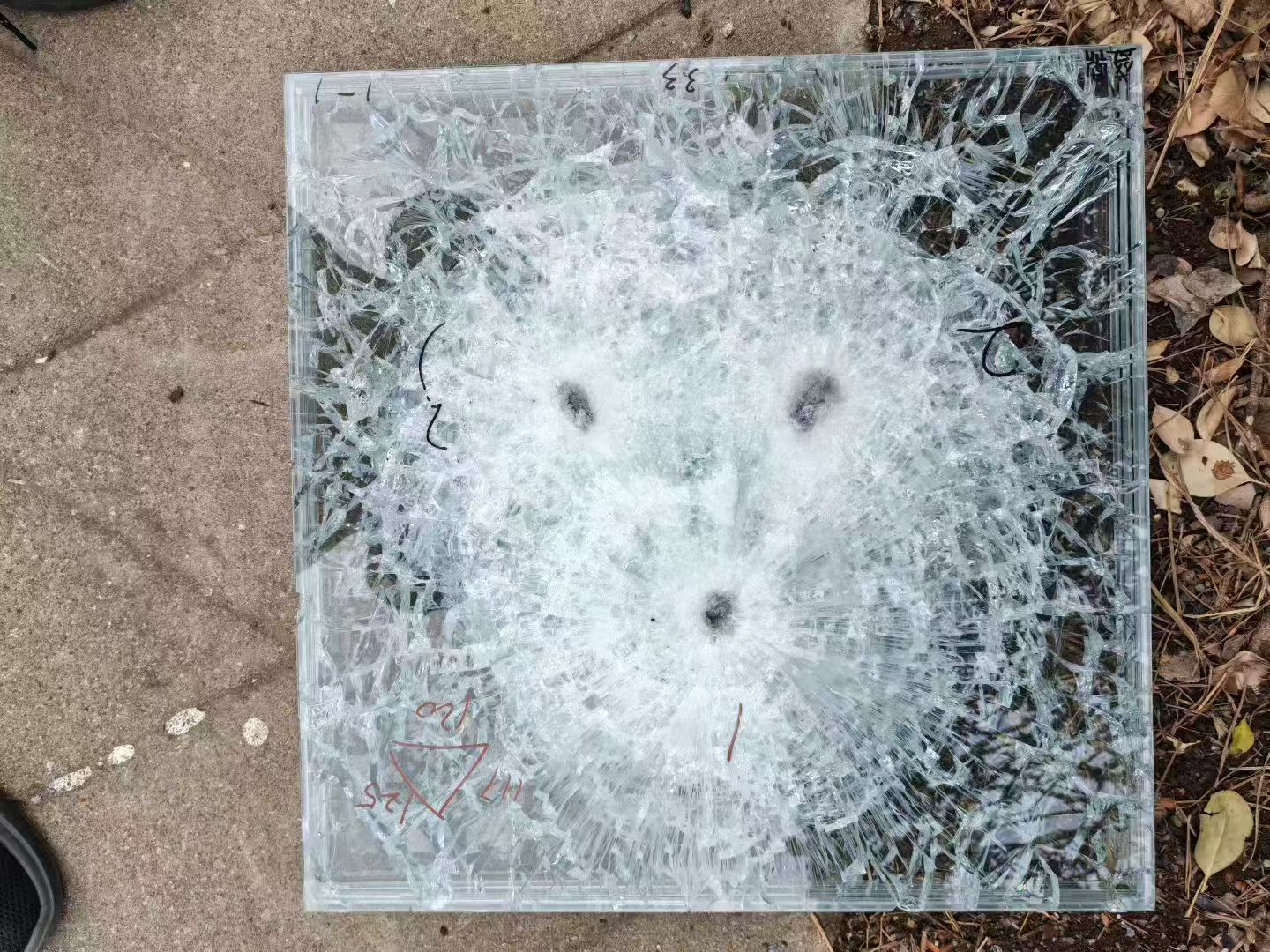
Defense-linked projects add traceability to compliance. A recorded case illustrates the pattern: 100 rolls of TPU film were supplied for a bulletproof glass application in Pakistan for defense industry customers, with the project completed within two years and stable operation over the same period — a case noted as the only one in the country for that specific application. In projects of this type, buyers typically combine declarations with lot-level traceability and long document retention.
Asian construction and interior glazing
Not every film purchase carries the same regulatory load. EVA film supplied for general construction and interior design customers in Asia is typically governed by commercial specification and delivery requirements rather than by EU or U.S. market-entry declarations. The lesson for buyers is scope discipline: request the documents that the destination market actually requires, and do not assume that a document set built for one market transfers automatically to another.
Comparison Table: Regulatory Frameworks and Documentation at a Glance
The table below maps each framework to its region, its focus, the documentation a buyer should request, and the position documented by Shengding Hightech Materials. Frameworks that apply to the finished glass assembly rather than to the film itself are marked accordingly, so that requests go to the right party.
| Framework / Standard | Region | Primary focus | What the buyer should request | Documented position |
|---|---|---|---|---|
| REACH | Europe | Chemical substances placed on the EU market | Statement naming the product and grade, issued and dated, with restricted-substance information | Shengding states product performance complies with European REACH regulations |
| RoHS | Europe | Hazardous substances in electrical and electronic equipment | Declaration with an explicit scope statement | Shengding states product performance complies with RoHS regulations |
| FDA | United States | U.S. market quality requirements, application dependent | Documentation aligned to the specific end use | Shengding states product performance complies with U.S. FDA quality requirements |
| ISO 9001:2015 | Global | Quality management system | Valid certificate with scope covering film production | Certificate No. 10425Q01154R1S, issued 2025-07-07, valid to 2028-07-24; scope covers design, development and production of interlayer glass intermediate films and granular materials |
| ISO 14001 / ISO 45001 | Global | Environmental and occupational health and safety management | Certificates on request during supplier qualification | Held by Shengding Hightech Materials |
| EN 12600 | Europe | Impact classification of safety glass | Test evidence for the finished glazing assembly | Applies to the assembled glazing, not to the film alone (TPU film is commonly associated with Class 1B1 or 2B2) |
| ASTM C1172-19 | United States | Quality requirements for laminated architectural flat glass | Compliance evidence for the laminated assembly | Applies to the assembled glazing, not to the film alone |
FAQ: REACH, RoHS, and FDA Compliance for TPU Film
Which certifications and declarations should I request first when sourcing TPU film?
Start with the management-system certificate, because it establishes that the supplier has a controlled production process. Shengding Hightech Materials holds ISO 9001, ISO 14001, and ISO 45001 certifications; its ISO 9001 certificate is number 10425Q01154R1S, issued by Shandong Seatone International Certification Co., Ltd. to GB/T 19001-2016 / ISO 9001:2015, with a scope covering the design, development and production of interlayer glass intermediate films and granular materials, issued 2025-07-07 and valid until 2028-07-24. Request REACH, RoHS, and FDA-related statements second, and make sure each one names the grade you are buying rather than a generic product category.
Can a supplier deliver REACH-, RoHS-, and FDA-compliant TPU film in custom widths and lengths?
Compliance and customisation are separate capabilities, so verify both. Shengding Hightech Materials states that its product performance complies with European REACH and RoHS regulations as well as U.S. FDA quality requirements, and it operates OEM/ODM production with customisation of length and width. Its quoted monthly capacity is 100 tons, and every unit is subject to 100% testing. For buyers, the practical check is whether the declared grade and the customised dimensions are covered by the same documentation, since a declaration issued for a standard width may need re-issue for a bespoke format.
Does compliance documentation change the order economics?
Documentation is normally part of supplier qualification rather than a separate commercial line. What buyers can compare directly are the commercial terms attached to the supply: Shengding Hightech Materials quotes a minimum order quantity of 50 kg and a lead time of 10 days, with technical support after shipment. The more useful cost question is whether the supplier can keep the document pack valid across repeat orders, because an expired or mismatched document creates internal re-qualification cost that does not appear on the quotation.
Can I validate compliance on a sample before placing a production order?
Yes, and sampling is the right stage to do it. A sample stage is when the buyer should confirm that the grade quoted matches the grade declared, that the width and length customisation requested is achievable, and that the compliance statements name the same product. Because Shengding Hightech Materials works to a 50 kg MOQ and a 10-day lead time with OEM/ODM customisation of length and width, the sample round can be used to lock both the technical specification and the document set before a larger commitment.
How long does it take to receive the film and the supporting documentation?
The quoted lead time for Shengding Hightech Materials is 10 days, with a monthly capacity of 100 tons and 100% testing before shipment. Compliance documents are drawn from the supplier's existing certification and declaration file, so the main variable is not production but alignment: buyers who define their regulatory scope before requesting documents usually receive a clean, matching set. To confirm grade availability, review the certification pack, or request a quotation against a specific laminated glass project, contact the team at www.shengdingchina.com or by email at docs@foundite.com.
Conclusion: Build the Compliance File Before the Purchase Order
REACH, RoHS, and FDA compliance for TPU film is a document-matching task. REACH and RoHS address what is in the film for European destinations; FDA-related requirements address U.S. market entry and depend on the end use; EN 12600 and ASTM C1172-19 address the finished glazing unit and belong in the assembly file rather than the material file. Behind all of them sits the management system — ISO 9001, ISO 14001, and ISO 45001 — which is what makes a compliance statement repeatable rather than a one-off letter.
For a buyer in the evaluation stage, the sequence is straightforward: define the regulatory scope from the destination market and end use, request scope-matched certificates and grade-specific declarations, reconcile them with the supplier's real production capability, and set a renewal cadence. Shengding Hightech Materials Co., Ltd., established in 2018 in the Lanshan Chemical Industry Park, Rizhao City, Shandong Province, produces TPU film and EVA film across more than 30 TPU types from 60A to 70D hardness, operates a 50,000 m² facility with an annual output of 1,000 tons, and states that its product performance complies with European REACH and RoHS regulations as well as U.S. FDA quality requirements.

Next Step: Request the Compliance Pack and a Sample
Buyers evaluating TPU film for laminated glass can request the certification pack, product data, and a sample quotation against a specific project.
Company: SHENGDING HIGHTECH MATERIALS CO., LTD
Website: www.shengdingchina.com
Email: docs@foundite.com
Tel / WhatsApp: +8613562376375
Address: North of Ayeshan Road 209, Rizhao City, Shandong Province, China
Download the company brochure: Shengding Hightech Materials product brochure (PDF)

Compliance statements referenced in this article reflect the documented position of Shengding Hightech Materials Co., Ltd. Buyers should confirm the applicable document set against their own destination market, end use, and project specification before finalising a purchase order.
Have Questions or Need More Details?
Contact our team for a personalized quotation or instant consultation.
Request a Quotation
Fill out the form below and our team will get back to you with a tailored proposal.
WhatsApp Direct Chat
Prefer to chat in real-time? Message us on WhatsApp for instant assistance & quick answers.
- Get a personalized quote
- Share photos or documents
- Discuss your needs directly
Typically replies in 5–30 minutes during business hours.