
TPU Film for Laminated Glass: Certification and Specification Checks Buyers Should Run
TPU Film for Laminated Glass: Certification and Specification Checks Buyers Should Run
Thermoplastic polyurethane (TPU) film is not a generic film to be selected only by price. In laminated glass, a TPU interlayer has to serve two demanding functions at the same time: remain visually clear and help the glass assembly resist penetration after impact. For a buyer in the research or evaluation stage, the practical task is to translate project requirements into verifiable supplier constraints before placing an order.
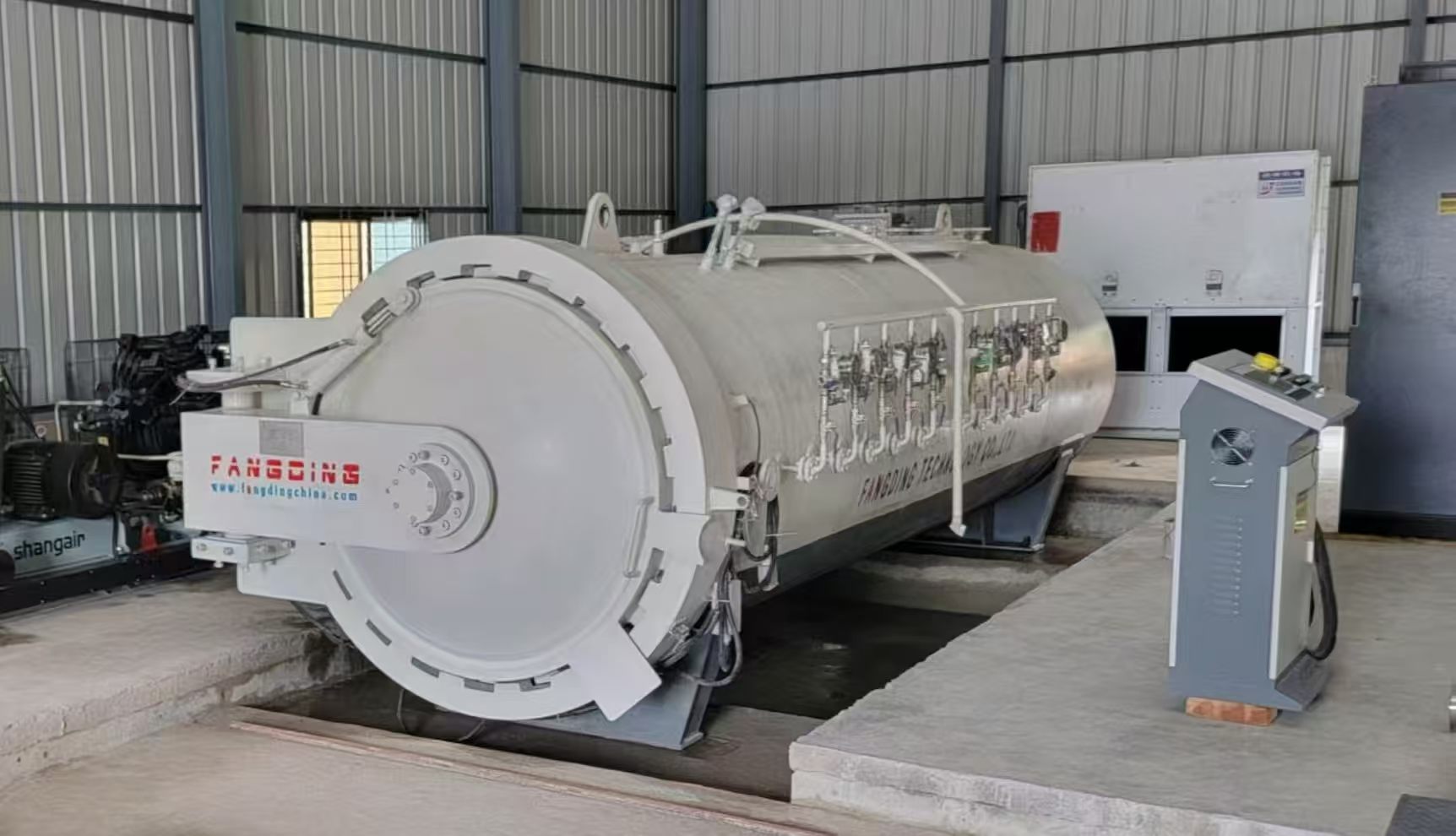
The fastest way to do that is to use three gates. First, check whether the TPU film supplier can show a traceable quality management certificate, such as ISO 9001:2015. Second, compare the technical parameters of the actual TPU film model against the mechanical and optical values required for the glass project. Third, check process compatibility: TPU interlayers for laminated glass are normally processed by hot-pressing in an autoclave, and the film must be kept dry before lamination.
Why qualification should come before price discussions
The common risk in TPU film procurement is not limited to finding a film. The greater risk is accepting a material with an attractive price but an incomplete specification, an unverified certificate, or a production process that cannot give repeatable quality. In laminated glass, defects may only appear after autoclaving, when the glass is already bonded. At that point, poor film quality becomes a project-level problem, not just a material-level problem.
A qualified TPU film supplier should be able to connect the product to four verifiable constraints:
- a documented quality management system;
- a product data sheet with measurable physical and optical values;
- a defined lamination method and handling requirement;
- a commercial and production structure that can support repeat orders.
These are the constraints that make TPU film suitable for glass lamination projects where the end use is safety glass, bullet-resistant glass, or architectural laminated glass with severe performance requirements.
Supplier-level qualification: verifiable company and certificate data
SHENGDING HIGHTECH MATERIALS CO., LTD is a manufacturer of TPU film and EVA film. According to the supplied company profile, the company was established in 2018 and operates from a 50,000-square-meter facility in the Lanshan Chemical Industry Park in Rizhao City, Shandong Province. Its listed production scale for TPU and EVA films is 1,000 tons per year. For procurement, however, the more useful point is whether that company can document quality control for the specific film model being considered.
The TPU film model SD560 holds ISO 9001:2015 certification. The certificate number is 10425Q01154R1S, issued by Shandong Seatone International Certification Co., Ltd., in accordance with GB/T 19001-2016/ISO 9001:2015. The certificate is valid from July 7, 2025 to July 24, 2028. The certified scope covers design, development and production of interlayer glass intermediate films and granular materials.
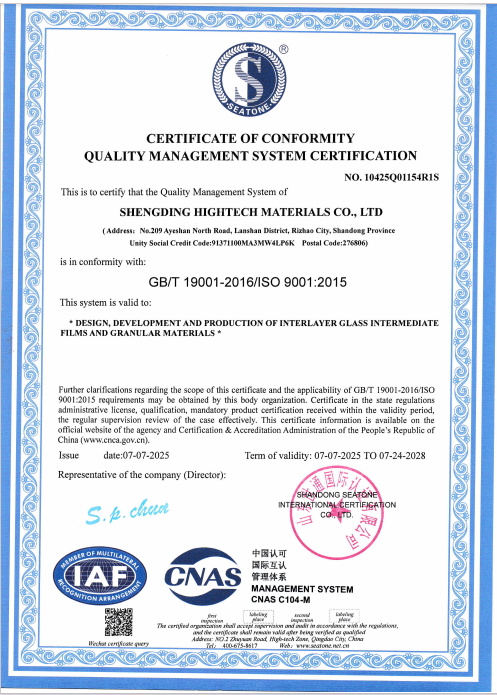
The scope matters. It is not a vague statement about a factory. It mentions interlayer glass intermediate films and granular materials, which means the certified management system includes the same category of product that a laminated glass buyer intends to procure. Buyers should request the certificate page and confirm that the supplier name, scope, certificate number, and validity date match the entity issuing the quotation.
The company profile also states that product performance complies with European REACH and RoHS regulations and with U.S. FDA quality requirements. That statement gives another upstream compliance filter, but buyers should still ask for the relevant declarations and test documentation when their target market requires them.
Technical parameters: the measurable part of a qualified TPU film
Certification describes the management system around the product; it does not replace the product data sheet. A qualified TPU interlayer specification should include both optical and mechanical values because glazing performance depends on transparency plus strength.
For model SD560, the product specification lists the following values:
| Parameter | SD560 supplied value | Why it matters in laminated glass procurement |
|---|---|---|
| Tensile strength | 42 MPa | Indicates the film strength that a bonded glass assembly can rely on during impact events. |
| Elongation at break | 500% | Shows how much the film can stretch before rupture. |
| Tear strength | 45 kN/m | Helps assess resistance to tear propagation after glass breakage. |
| Light transmittance | 90% | Supports optical clarity in the laminated glass structure. |
| Haze | 0.3% | Indicates a low level of scattered light for better transparency. |
For bulletproof and ballistic laminated glass, industry data commonly describes high-performance TPU films as having tensile strength above 40 MPa and elongation at break above 500%. The SD560 data sheet gives 42 MPa tensile strength and 500% elongation, so the film is in the performance range that buyers should compare against their project specification. The exact acceptance values must still be defined by the finished glass test for the relevant threat level.
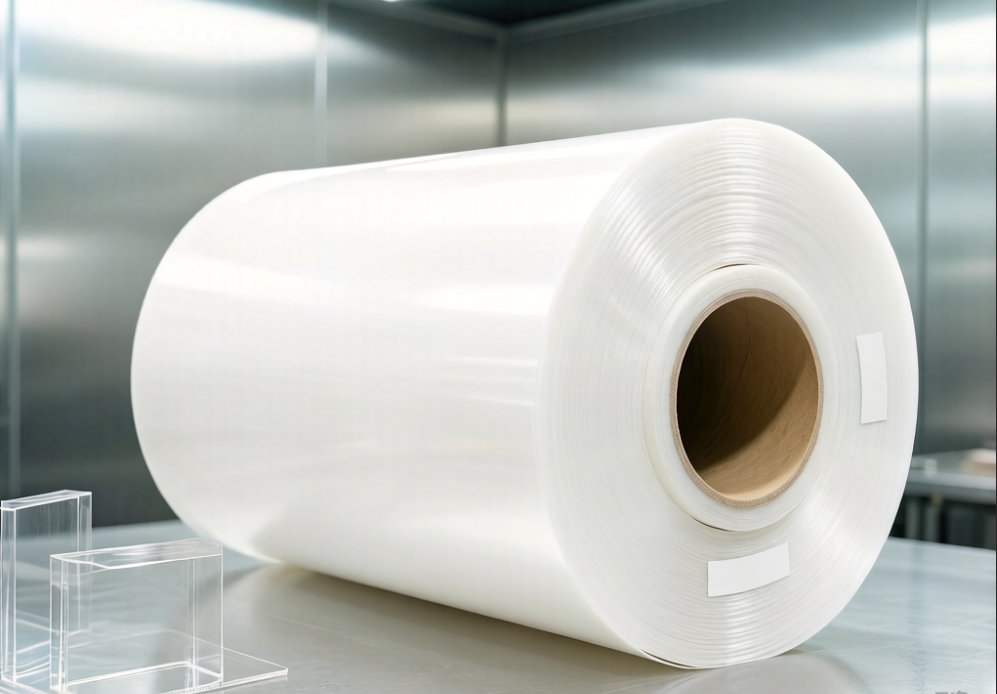
Process constraints: autoclave lamination and moisture management
TPU film can only become a useful interlayer if the lamination process matches the film properties. The supplied application record describes TPU film for the bulletproof industry under high pressure and high temperature conditions. The documented project types are safety glass lamination projects and ballistic-resistant glass manufacturing projects. The stated operation mode is hot-pressing in an autoclave.
TPU film in this application can be bonded to a range of substrates, including acrylic, polycarbonate, and inorganic glass. The special handling requirement is short but important: keep dry.
For a procurement team, this creates a practical checklist:
- Confirm that the selected TPU film is intended for autoclave lamination.
- Check the film storage plan before lamination.
- Inspect packaging and warehouse humidity controls.
- Ask the supplier what conditions are recommended before and during lamination.
- Confirm that the interlayer specification is compatible with the glass, polycarbonate, or acrylic materials in the assembly.
TPU interlayers are also referenced in industry comparisons as maintaining operational performance over a wide temperature range from -70°C to +80°C, which is one reason they appear in armored, defense, and demanding transport glazing projects.
Comparison table: TPU film and EVA film in documented product data
Buyers often compare TPU and EVA because both are transparent interlayer films. They are not interchangeable in every application. The comparison table below is restricted to documented product information and does not attempt to replace a project-specific engineering test.
| Material / product model | Documented application scope | Light transmittance | Haze |
|---|---|---|---|
| TPU film / SD560 | Bulletproof glass, shatter-resistant glass | 90% | 0.3% |
| EVA film / SD38 | Architectural glass, decorative glass | 90% | 0.5% |
Both products can be used in laminated glass contexts, but the documented application scopes are different. TPU film in this product set is positioned for safety glass and bullet-resistant structures, while EVA film is positioned for architectural and decorative glass. A buyer should not switch from one interlayer family to another without checking the end-use specification, the applicable standard, and the lamination process.
From certificate to approved lot: a step-by-step qualification process
Research and evaluation should end with an approved supplier, not with a good mood from a sales conversation. The following process gives procurement teams a controlled way to qualify TPU film for laminated glass.
Step 1: Verify the quality certificate
Ask for the certificate number, issuing body, applicable standard, scope, issue date, and expiry date. For SD560, the referenced certificate is 10425Q01154R1S, based on GB/T 19001-2016/ISO 9001:2015.
Step 2: Confirm the certificate scope
The certificate should cover the type of product being purchased. In this case, the scope includes design, development, and production of interlayer glass intermediate films and granular materials.
Step 3: Compare the TPU film data sheet to the project requirement
Do not rely only on the phrase TPU. Use measurable values. Tensile strength, elongation at break, tear strength, light transmittance, and haze are useful baseline values to compare.
Step 4: Match the film to the lamination process
For SD560, the documented process is hot-pressing in an autoclave. The film must be kept dry. Confirm that the buyer’s production line or contract laminator uses the same method.
Step 5: Review production and customization constraints
The supplier capability record for this type of film includes customization of length and width, monthly capacity of 100 tons, a listed lead time of 10 days, and a minimum order quantity of 50 kg. The same record lists 100% testing and after-sales technical support. These are commercial constraints that should be confirmed in writing for the exact model, thickness, width, and order volume.
Step 6: Evaluate evidence from the same application field
A documented use case can show whether a supplier already has experience with bulletproof glass or defense laminating projects. Seek references from applications similar to the buyer’s use case, not only from general TPU sales.
Use-case reference: TPU film in bulletproof glass projects
The supplied application and case records include a defense-industry customer in Pakistan. The customer category is TPU defense industry customers. The application is bulletproof glass. Over a two-year period, the buyer purchased 100 rolls of TPU-related film, and the documented operational result is described as stable operation.
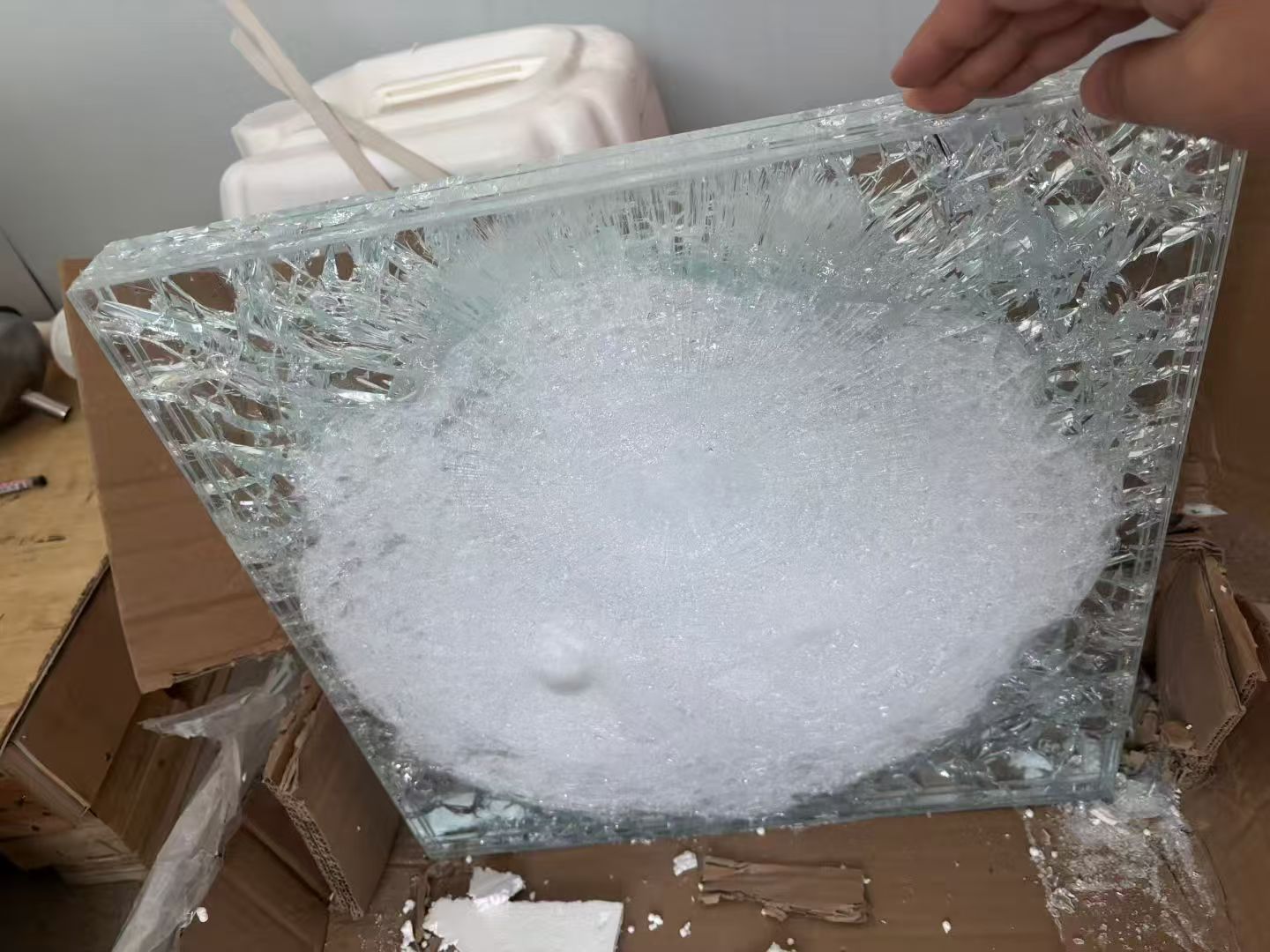
This kind of reference does not guarantee that a new product will pass a new ballistic specification. It does tell the buyer that the supplier has experience supporting repeated supply for bulletproof glass, which is more useful than a generic statement that TPU film is strong.
Applicable standards and verification expectations
In European projects, EN 12600 is a primary safety-glazing standard used to classify impact resistance. TPU-laminated glass is commonly discussed in terms of impact classes such as 1B1 or 2B2. Buyers should ask how the finished laminated assembly will be classified, because a film data sheet alone is not enough to prove a finished glazing class.
For architectural flat glass, ASTM C1172-19 specifies quality requirements for laminated architectural flat glass, including bonded interlayer constructions. Buyers can use this standard as reference language when defining acceptable transmitted color, visual quality, and finished glazing requirements.
For ballistic and armored glass, the relevant testing standard is usually defined by the end customer or by a military, police, or vehicle standard. The TPU interlayer is one component in that system, and the layered glass construction must be tested as a completed unit.
FAQ
What certification should a TPU film for laminated glass have?
A supplier should be able to show a quality management system certificate with a verifiable number, scope, and validity date. As a documented example, Shengding TPU film model SD560 holds ISO 9001:2015 certification, certificate number 10425Q01154R1S, issued by Shandong Seatone International Certification Co., Ltd., in accordance with GB/T 19001-2016/ISO 9001:2015. The certified scope covers design, development, and production of interlayer glass intermediate films and granular materials.
What technical parameters should a high-performance TPU glass interlayer film meet?
Buyers should verify both mechanical and optical parameters. For SD560, the supplier lists a tensile strength of 42 MPa, elongation at break of 500%, tear strength of 45 kN/m, light transmittance of 90%, and haze of 0.3%. These values are a starting point; the final acceptance should be based on the laminated glass specification for the project.
What are typical procurement constraints for customized TPU film?
For Shengding TPU film capability, the listed customization range is length and width. Monthly capacity is 100 tons, the lead time is 10 days, and the minimum order quantity is 50 kg. The quality-control statement is 100% testing, and after-sales support is available. Buyers should confirm these variables for their specific thickness, width, and volume because lead time and MOQ can change with order size and specification.
How should a TPU film sample be evaluated for autoclave lamination?
A TPU film sample should be kept dry and laminated under high pressure and high temperature in an autoclave. SD560 is documented as applicable to bulletproof glass and shatter-resistant glass and can be bonded to acrylic, polycarbonate, and inorganic glass. The buyer should measure optical clarity and strength after lamination, then compare the result with the target safety-glass or ballistic-glass requirement. For sample availability, a quote, or confirmation of current lead time, contact docs@foundite.com or WhatsApp +8613562376375.
Next step: request a qualification package
TPU film for laminated glass should be chosen from current project constraints, not from a generic product description. The buyer who asks for the certificate number, compares the data sheet, checks the autoclave process, and evaluates use cases has a much stronger position than the buyer who only asks for the lowest price.
For project-specific evaluation and ordering details, the Shengding commercial team can be contacted at docs@foundite.com or by phone and WhatsApp at +8613562376375. The company address is North of Ayeshan Road 209, Rizhao City, Shandong Province, China.
This article is intended for procurement research and evaluation support. Final product selection must be confirmed through the supplier’s formal technical data sheet and project-specific testing.