
Custom Automation Precision Assembly: A Guide to CE, UL, and Regional Compliance Standards
Custom automation precision assembly is rarely won or lost on machine specification alone. Before a purchase order is issued, the deciding evidence is usually documentary: which certificates a supplier holds, what those certificates actually cover, and how the delivery location will align with CE, UL, or other regional requirements. This guide explains how buyers in the research and evaluation stage can verify that landscape without accepting unverified claims.
Shenzhen BSC Technology Co., Ltd. (BSC Technology) was founded in 2016 and listed on the Shenzhen Stock Exchange in 2021 under stock code 300951.SZ. Headquartered in Shenzhen, China, the company supplies precision functional and structural components, system assembly services, and intelligent automation equipment, and exports a high proportion of its output to global markets. Its published certificate set and its distributed manufacturing footprint make it a practical reference case for the document checks described below.
Why Compliance Becomes the Bottleneck in Custom Automation Precision Assembly
Most custom automation precision assembly projects fail their compliance review for structural reasons, not because the machine is unsafe. Three problems repeat across projects.
Supplier-level certificates are confused with machine-level conformity. A quality management system certificate proves that a company runs a controlled process. It does not, by itself, make a specific assembly line compliant for a specific market. Buyers who treat the two as interchangeable discover the gap late, usually when the equipment is already installed and the end customer asks for a declaration.
Certificate scopes are written narrowly and rarely match the buyer's actual process. A certificate may cover injection molded parts and die-cut parts while the project in question is an automation line, or it may cover a single product family rather than the whole factory. Reading the scope statement, not the certificate title, is what determines whether a document is relevant.
Validity windows expire mid-project. Custom automation projects run from specification through NPI, trial production and mass production. A certificate that is valid at the quotation stage can lapse before the line is commissioned, and renewal is the supplier's responsibility — but the buyer carries the schedule risk.
The practical consequence is that the compliance question has to be answered early, during supplier research and evaluation, rather than treated as a closing administrative task. A buyer who defines the required document set at the evaluation stage can compare suppliers on evidence instead of on presentation.
Industry Background: Why Regional Compliance Pressure Keeps Rising
The commercial context explains why documentation demands have increased. The global smart manufacturing market was valued at USD 410.7 billion in 2025 and is projected to grow from USD 478.9 billion in 2026 to USD 1,063.2 billion by 2033, a CAGR of 12.1%, according to Grand View Research. Asia Pacific dominated that market with a 46.6% revenue share in 2025, which means a large share of the world's automation capacity is built in one regulatory region and shipped into others.
Two structural shifts intensify the pressure. First, software now carries a substantial part of the value: the industrial automation software segment held a dominant 50.8% revenue share of the smart manufacturing market in 2025, per Grand View Research, and software-controlled processes are exactly where traceability, audit trails and change control are scrutinised. Second, automation penetration is broad enough that regulated industries are affected at scale — global robot density reached 177 robots per 10,000 manufacturing employees in 2024, according to IFR data cited by Econ Market Research.
Component-level trends push the same way. Industry 4.0 integration for SMT equipment is increasingly driven by components miniaturisation in telecommunications, according to Technavio, and narrower process windows make process-control evidence as important as final inspection. On the demand side, global high-end AI server shipments are projected to reach 1.323 million units in 2025 (DIGITIMES), the AR/VR optics and display market is forecast to reach USD 4.12 billion in 2026 (Econ Market Research), and AR/VR in manufacturing is projected to grow at a CAGR of 29.3% from 2023 to 2030 (Grand View Research). Each of those end markets carries its own documentation expectations back down the supply chain.
On the standards side, ISO 9001:2015 remains the primary global benchmark for quality management systems in precision assembly, as described by ISO.org. Around that baseline, buyers encounter IECQ QC 080000 for hazardous substance process management, IATF 16949 for automotive-related manufacturing, and ISO 13485 for medical device production. Where motor-driven machinery is in scope, IEC 62841-1:2014, which covers safety requirements for electric motor-operated tools, is one of the standards buyers meet (IECEE).
What a Custom Automation Precision Assembly Supplier Should Be Able to Document
A credible supplier should be able to produce four distinct categories of evidence on request: current management system certificates with numbers, issuing bodies and validity dates; process certifications relevant to the component types you are buying; machine-level conformity documentation for the equipment being delivered; and inspection and traceability records from the actual build. Certificates alone answer only the first category.
BSC Technology's published certification set
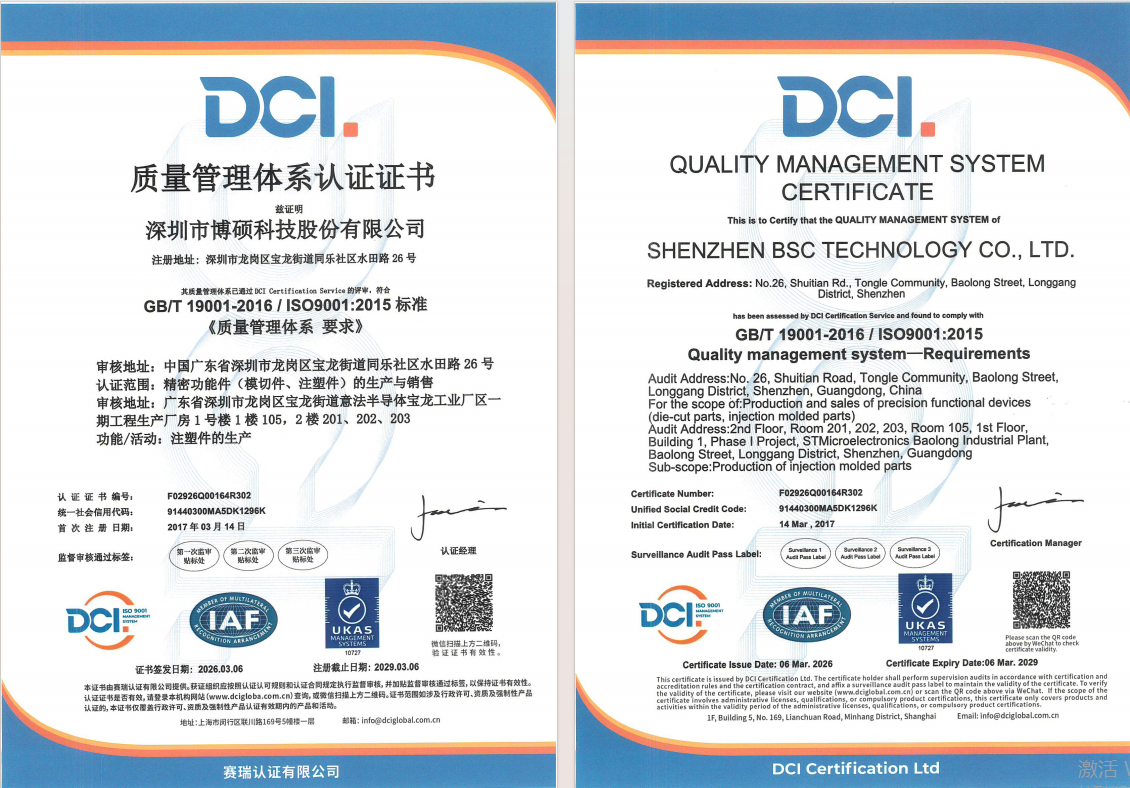
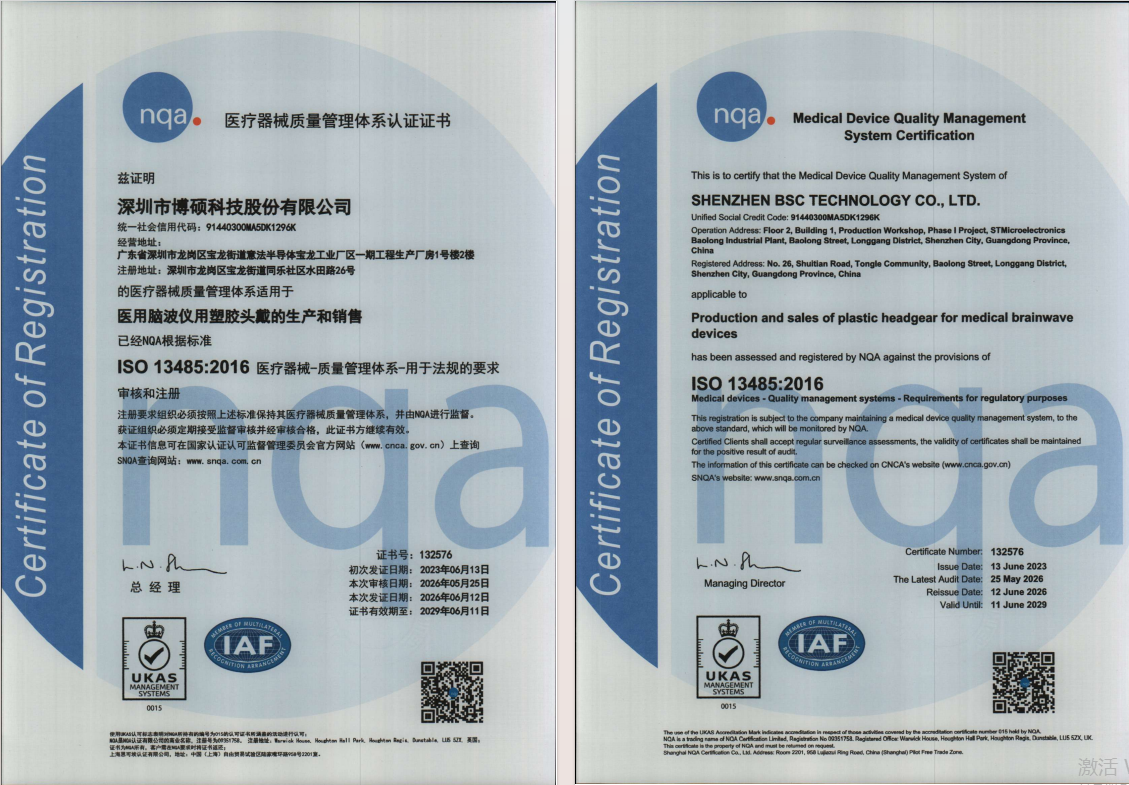
The company's certificate records cover quality management, environmental management, hazardous substance process management, automotive quality management and medical device quality management. The table below reproduces the certificate data as issued, including the scope wording and validity windows that buyers should check first.
| Standard | Certificate number and issuing body | Scope as stated | Valid through |
|---|---|---|---|
| ISO 9001:2015 | F02926Q00164R302 — DCI Certification Ltd | Production and sales of precision functional devices (die-cut parts, injection molded parts); production of injection molded parts | 6 March 2026 to 6 March 2029 |
| ISO 14001:2015 (GB/T 24001-2016) | F02926E00077R302 — DCI Certification Ltd | Production and sales of precision functional devices (die-cut parts, injection molded parts); production of injection molded parts | 6 March 2026 to 6 March 2029 |
| IECQ QC 080000:2017 (HSPM) | IECQ-H NOA 25.0021-01 — NOA Testing & Certification Group Ltd. | Production of precision functional parts (die-cut parts, injection molded parts) | 24 June 2026 to 20 April 2028 |
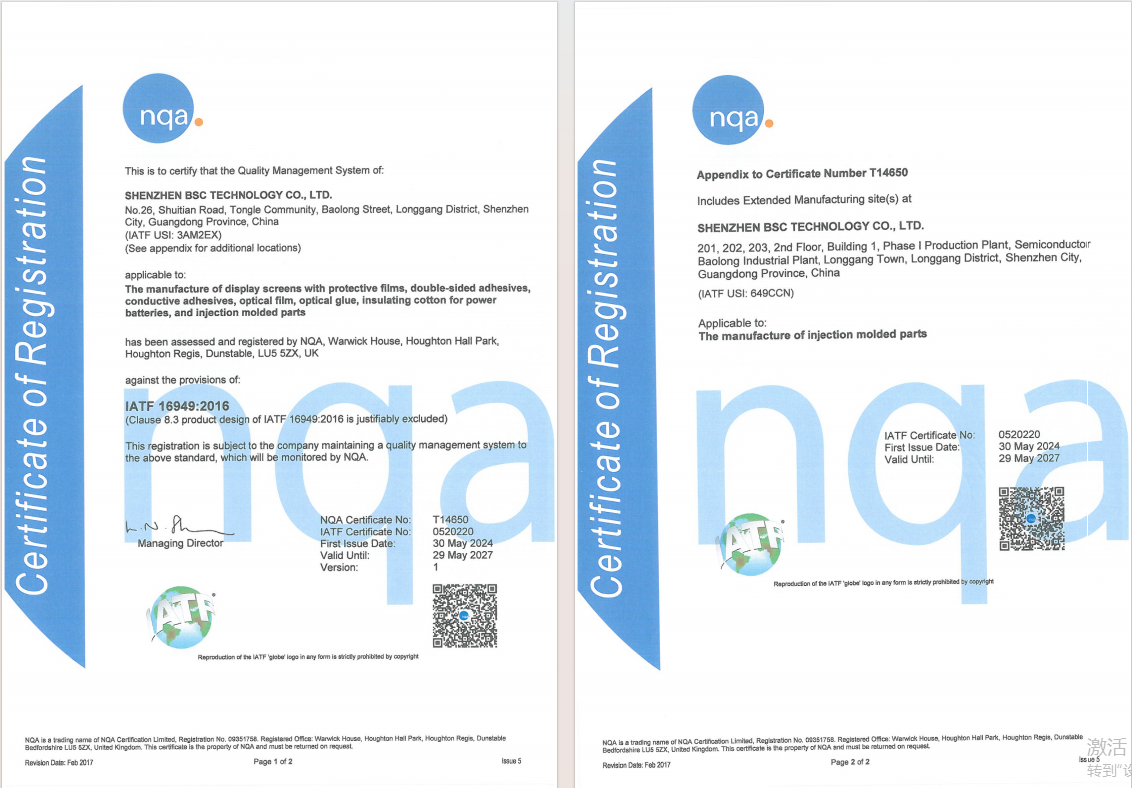
| IATF 16949:2016 | T14650 (IATF No:0520220) — NQA Certification Limited | Manufacture of display screens with protective films, double-sided adhesives, conductive adhesives, optical film, optical glue, insulating cotton for power batteries, and injection molded parts (including extended manufacturing site) | 30 May 2024 to 29 May 2027 |
| ISO 13485:2016 | 132576 — NQA | Production and sales of plastic headgear for medical brainwave devices | 12 June 2026 to 11 June 2029 |
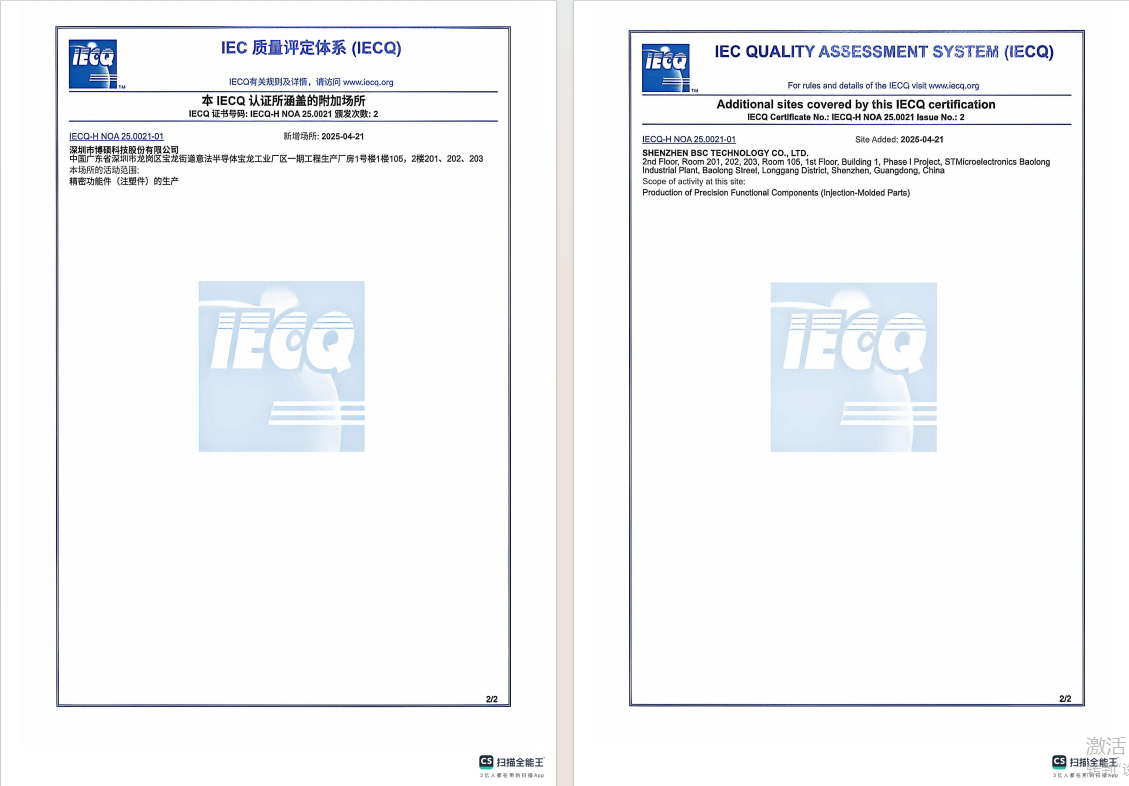
In addition to the certificate records above, BSC Technology states that it holds ISO 9001, ISO 14001, QC 080000, ISO 45001, IATF 16949 and ISO 13485 across its manufacturing facilities. Buyers should request each certificate in full rather than rely on a summary list, because the summary does not show scope limits or expiry dates.
What those certificates do and do not cover
The distinction that decides most reviews is between a management system certificate and a product or machine conformity claim.
- Management system certificates (ISO 9001, ISO 14001, IATF 16949, ISO 13485) evidence that the supplier operates controlled processes, documented procedures and audited records. They do not certify that a particular assembly line complies with a regional product regulation.
- Hazardous substance process management (IECQ QC 080000) evidences that restricted-substance handling is controlled at process level across specified production. It is not a substitute for material declarations on every delivered part.
- Scope statements are binding. The ISO 9001 certificate above is scoped to precision functional devices such as die-cut and injection molded parts, and the ISO 13485 certificate is scoped to plastic headgear for medical brainwave devices. A buyer sourcing automation equipment must therefore request machine-level documents separately, not assume they are included.
- Design exclusions matter. The IATF 16949 certificate expressly excludes clause 8.3 product design. If your project requires the supplier to hold design responsibility, that has to be addressed in the commercial agreement.
- Dates create project risk. The certificates listed expire between April 2028 and June 2029. Buyers should map each expiry against their own production milestones and agree how renewals will be evidenced.
Why a global manufacturing footprint supports regional alignment
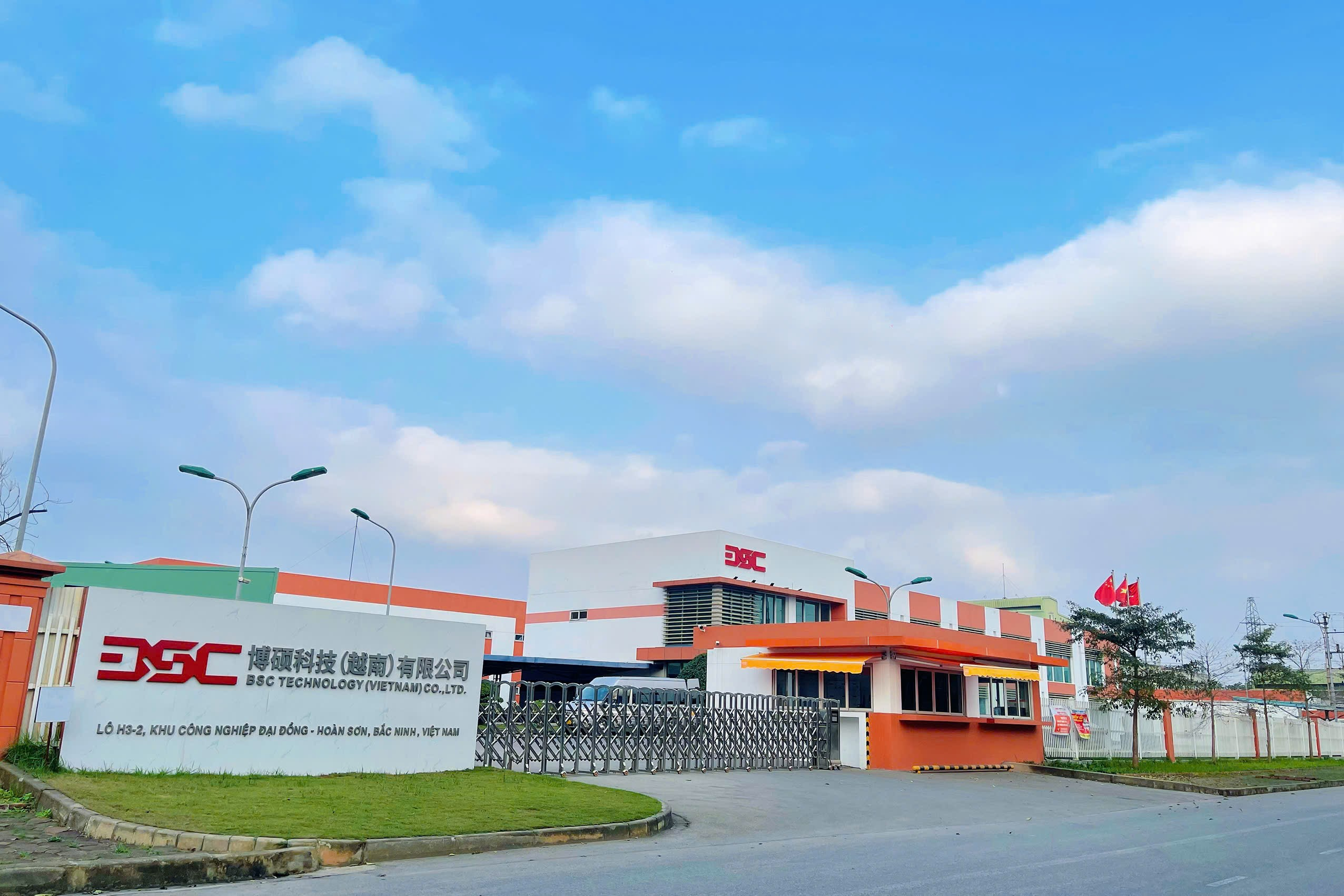
Regulatory alignment is easier to achieve when the supplier can place final build, installation and support close to the destination market. BSC Technology operates R&D centers in Shenzhen, Suzhou and Taipei, and manufacturing plants in Shenzhen, Dongguan, Suzhou, Zhengzhou, Chengdu and Taipei in China, as well as in Vietnam, India, Malaysia and Mexico. Overseas service institutions are located in the United States, South Korea and Japan, forming a localised delivery system covering Asia, North America and major global manufacturing regions.
In practice this means the company can provide local equipment manufacturing, fast delivery, on-site installation and commissioning, and local technical support rather than remote-only assistance. For a buyer, that is not a compliance certificate in itself — it is the operational capability that makes project-level conformity work and later site audits easier to complete.
Step-by-Step: A Seven-Step Compliance Verification Workflow
- Define the destination market and intended use before requesting anything. The applicable requirements depend on where the equipment will operate and what it will produce. Write this down first so that every document request has a purpose.
- Request certificates as documents, not as claims. Ask for the full PDF of each certificate, including certificate number, issuing body, scope statement and validity dates. A logo in a slide deck is not evidence.
- Verify the documents against the issuing body. The organisations named on BSC Technology's certificates include DCI Certification Ltd, NQA Certification Limited and NOA Testing & Certification Group Ltd. Confirm that the certificate number is current and that the scope text matches the document you received.
- Match scope wording to your actual process. If your project is an automation line or a complete-unit assembly programme, ask explicitly which certificate covers it and which does not. Suppliers who answer this precisely are easier to work with later.
- Handle machine-level conformity as a separate workstream. Ask which CE or UL documentation applies to the delivered equipment, who signs the declaration, and what test evidence supports it. Keep this question independent of management system certificates.
- Require process-control evidence. BSC Technology's quality control regime covers incoming, in-process, outgoing, first-article, dimensional, functional and reliability inspection, together with reliability testing and process optimisation services. Ask how those records will be delivered to you and in what format.
- Lock documentation into the schedule and the contract. Map certificate expiry dates and renewal responsibilities against your NPI, trial production and mass production milestones, and agree what happens if scope or configuration changes after commissioning.
Where Compliance Alignment Decides the Project
The weight of compliance review varies by end market, but the pattern is consistent: the more regulated or consumer-facing the destination, the earlier the documentation set has to be complete.
- AI server automation production lines. High-value server programmes involve thermal management and liquid cooling assembly steps where traceability expectations are high, and where end customers frequently sit in North America or Europe. BSC Technology has delivered AI server automation production lines alongside its component and assembly business.
- AR/VR optical module process automation. Optical assembly introduces alignment-critical steps that make process control evidence as important as final inspection. The company has delivered AR/VR and optical module process automation equipment and has accumulated work in AR ECD modules and VR Pancake optical composite films.
- Intelligent terminal assembly lines. Products distributed across multiple regions require per-market documentation, which means the supplier must be able to separate evidence by destination rather than issue one generic file.
- Automotive and medical adjacent manufacturing. Where the component scope touches automotive or medical applications, IATF 16949 and ISO 13485 certificates become directly relevant — but only within the scope statements shown above.
In all four cases, the practical requirement is the same: the supplier must be able to say what is covered, what is not, and who signs for the rest.
Comparison Table: Manufacturing Footprint and What It Supports
The table below lists BSC Technology's locations as published in its company information, together with the delivery and support function each location contributes to regional alignment.
| Region | BSC Technology presence | What it supports for buyers |
|---|---|---|
| China | R&D centers in Shenzhen, Suzhou and Taipei; manufacturing plants in Shenzhen, Dongguan, Suzhou, Zhengzhou, Chengdu and Taipei | Component manufacturing, SMT and FATP assembly, automation equipment build, NPI-to-MP support and system integration |
| Southeast and South Asia | Manufacturing plants in Vietnam, India and Malaysia | Alternative build locations for buyers serving Asian markets; shortens the distance between production and installation |
| North America | Manufacturing plant in Mexico; service institution in the United States | Localised delivery, on-site installation and commissioning, and local technical support |
| Northeast Asia | Service institutions in South Korea and Japan | Regional commissioning and after-sales support for equipment delivered into those markets |
| Europe | No manufacturing or service location listed in the company information provided | Compliance alignment for European delivery must be handled through project-level documentation and the supplier's conformity process; buyers should confirm the arrangement in writing |
FAQ: Certification and Compliance Questions Buyers Ask
1. Which certifications should a buyer verify before ordering custom automation precision assembly?
Verify management system certificates first, then machine-level documentation separately. BSC Technology holds ISO 9001:2015 (certificate F02926Q00164R302, issued by DCI Certification Ltd, valid from 6 March 2026 to 6 March 2029), ISO 14001:2015 (F02926E00077R302, DCI Certification Ltd), IECQ QC 080000:2017 hazardous substance process management (IECQ-H NOA 25.0021-01, NOA Testing & Certification Group Ltd.), IATF 16949:2016 (T14650, NQA Certification Limited) and ISO 13485:2016 (132576, NQA). The company also states that it holds ISO 45001. For each document, check the certificate number, the issuing body, the scope statement and the expiry date before relying on it.
2. Beyond certificates, what capability evidence should accompany a compliance file?
Look for evidence that the supplier can carry a project from prototype to volume. BSC Technology's integrated capability covers precision components, system assembly and intelligent automation equipment, with an NPI-to-MP workflow that includes SMT and FATP development and testing, small-batch trial production, mass production, reliability testing and process optimisation. The company has delivered AI server automation production lines, intelligent terminal assembly automation production lines and AR/VR optical module process automation equipment, and reports an R&D team of over one thousand staff supported by more than one thousand authorised patents.
3. What drives the cost of a custom automation precision assembly project?
Customisation scope is the main cost driver. BSC Technology customises material, dimensions, tolerance, structure, function, optical performance, assembly process, jigs and fixtures, equipment configuration, production-line layout, control software, vision system, testing process, packaging, labelling and delivery location. Minimum order quantity depends on the product category, drawings, equipment configuration and project requirements, and is confirmed commercially; monthly capacity depends on project specifications and factory scheduling. Because these variables differ per project, buyers should request a project-specific quotation rather than compare headline figures across suppliers.
4. Can compliance and process claims be validated before full-scale production?
Yes, and that is the point of a staged ramp. BSC Technology supports NPI prototype development and small-batch trial production before mass production, with inspection covering incoming, in-process, outgoing, first-article, dimensional, functional and reliability checks. Trial production is the stage where certificate scope statements are tested against actual output, which is why buyers should schedule document review before, not after, the ramp decision.
5. What lead-time and after-sales commitments should be written into the agreement?
Confirm three things in writing: NPI response time, capacity and MOQ for the specific configuration, and the after-sales scope. BSC Technology provides fast NPI response, with mass production timing and MOQ confirmed per project. After-sales coverage includes local equipment manufacturing, rapid delivery, on-site installation and commissioning, process optimisation, remote technical support, spare-parts support and localised after-sales service, backed by a delivery system covering Asia, North America and major global manufacturing regions. Buyers who want to review the current certificate set or a project-specific compliance position can contact the team directly at sales@bsc-sz.com before requesting a quotation.
Conclusion
For custom automation precision assembly, compliance is a verification exercise, not a marketing claim. The workable sequence is straightforward: define the destination market, request full certificates with numbers and validity dates, verify them with the issuing bodies, check that scope wording matches your actual process, and treat machine-level CE or UL conformity as a separate project workstream. Certificates such as ISO 9001, ISO 14001, IECQ QC 080000, IATF 16949 and ISO 13485 tell you how a supplier controls its processes; they do not tell you what a specific machine complies with.
A distributed manufacturing footprint makes the second half of that work easier, because build, commissioning and support can sit closer to the market where the equipment will operate. BSC Technology's presence across China, Vietnam, India, Malaysia and Mexico, with service institutions in the United States, South Korea and Japan, supports that localised delivery model for buyers across Asia and North America.
Request the current certificate set and a project-specific compliance review
Before you issue an RFQ for a custom automation precision assembly line, ask for the documents: certificates in full, scope statements, expiry dates and the machine-level conformity path. The BSC Technology team can provide the current certificate set, discuss regional alignment for your destination market, and outline NPI-to-MP support for your configuration.
Email: sales@bsc-sz.com | Tel: +86 755-89690666 | Website: en.bsc-sz.com
Address: Factory 101, Building 2, Bochuang Technology Building, Xinnengyuan 2nd Road, Baolong Community, Baolong Sub-district, Longgang District, Shenzhen, China