
BOPP Thermal Lamination Film Compliance: Understanding Global Supply and Performance Standards
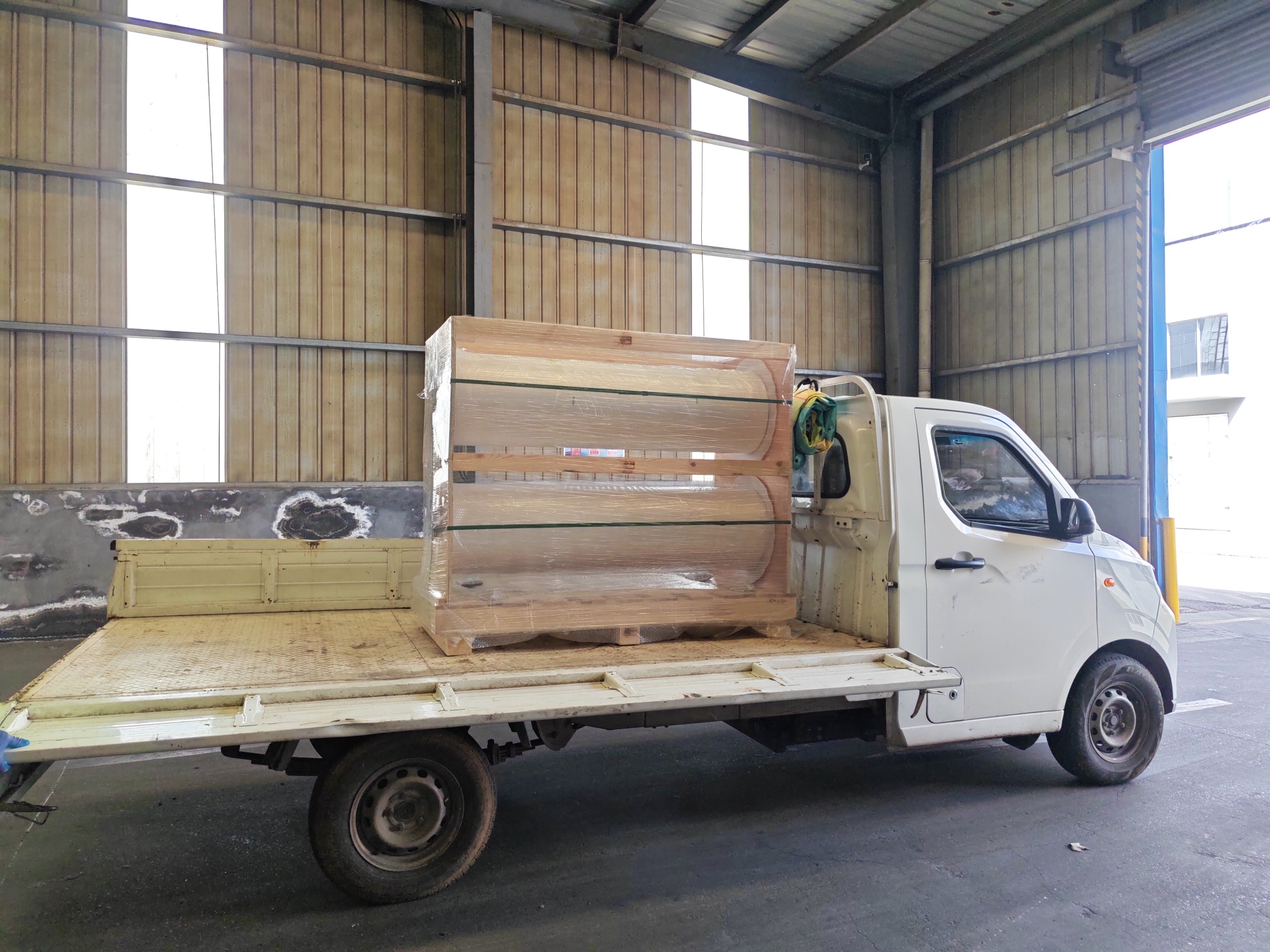
Quick answer: compliance for BOPP thermal lamination film is not one certificate. It is a two-part file — a documentation part that changes by destination market (REACH and RoHS for the EU, FDA 21 CFR 177.1520 for US food contact, GB 4806.15-2024 for Chinese food-contact adhesives, BRCGS for UK and US retail supply chains), and a performance part that must be proven by measurable film data such as thickness, corona treatment level and coating uniformity. A film can pass the first and fail the second.
This guide breaks down how regional expectations differ, which standards appear most often in buyer specifications, and how verified first-party documentation from SHKFILM supports thermal lamination film manufacturers in Brazil, South Korea, India, Iran and Japan.
Problem Definition: Why Lamination Film Compliance Files Fail
A BOPP thermal lamination film is a composite: BOPP film with an EVA hot-melt coating. That single construction detail is the reason compliance is harder than it looks, because the substrate and the adhesive layer can each be governed by different rules in the same destination market.
Buyers evaluating a supplier usually merge two separate questions into one, and that is where most purchase evaluations stall:
- Documentation question: can the supplier show that both the BOPP substrate and the EVA coating layer satisfy the requirements of the market where the laminated book cover, box or label will actually be sold?
- Performance question: can the supplier show that the film behaves within the same measurable limits on every roll and every batch, not only on the sample?
The five failure points that appear most often in lamination film evaluation files are predictable:
- Expired or superseded certificates that are still attached to current quotations.
- Certificate scope that does not name the product family being ordered.
- Test claims with no named standard behind them — a low VOC statement without the standard reference number.
- Performance specs given without a test method or margin (thickness tolerance, corona dyne level, adhesion).
- No traceability link between the certificate number and the production batch that was shipped.
Industry Background: A Growing Market With More Documentation Pressure
Documentation pressure is rising because the underlying market is growing and shifting toward higher-value finishes. The global BOPP films market was valued at USD 31.0 billion in 2025 and is projected to reach USD 49.8 billion by 2033, according to Grand View Research. Grand View Research also reports that Asia Pacific held the largest revenue share of that market in 2025, at 32.2%, while Ken Research valued the China BOPP film market at approximately USD 5.7 billion in 2024.
The thermal lamination segment specifically is smaller but concentrated in premium applications. Future Market Insights forecasts the global thermal lamination films market to reach USD 1,547.9 million by 2025, with BOPP-based films as the leading film type segment. Within the specialty sub-segment, the soft touch film market was estimated at USD 2.9 billion in 2024 with a CAGR of 3.1% through 2034, and one-side lamination film is projected to lead the soft touch segment with a 55.0% market share.
Two application trends explain why compliance scrutiny follows this growth. Matte thermal lamination films are increasingly used for high-end applications such as luxury paper box packaging and book covers (Global Growth Insights), and anti-scratch and scuff-resistant finishes are cited as high-growth specialties in commercial print and premium packaging (Future Market Insights). Both trends push films toward functional top-coatings — and functional coatings are exactly where buyers ask for material-safety documentation.
The Regional Compliance Map for BOPP Thermal Lamination Film
Requirements are not harmonised globally. Below is the practical mapping of the standards that most often appear in buyer specifications, and what each one actually governs.
| Market / region | Standard or scheme | What it governs |
|---|---|---|
| European Union | REACH Regulation (EC) No 1907/2006 — Candidate List of 253 SVHCs | Substance restrictions in the film and coating chemistry |
| European Union | RoHS Directive (EU) 2015/863 (tested via IEC 62321 series) | Restricted substances, most often requested for packaging used with consumer electronics |
| United States | FDA 21 CFR 177.1520 | BOPP lamination films intended for US food-contact use |
| China | GB 4806.15-2024 | Food-contact adhesives; effective February 2025 |
| China | GB 33372-2020 | VOC content verification for low-odour, low-emission applications |
| UK / US retail | BRC Global Standard (BRCGS) for Packaging Materials | Site-level production controls for retail and food-service supply chains |
| Global | EN 14582:2016 | Halogen content testing |
| Cross-border | China Customs AEO Advanced Certified Enterprise | Customs credit and supply-chain security, mutually recognised in the EU, North America, the UK, Singapore, South Korea, Japan and over 50 countries/regions |
European Union: Substance Restrictions Come First
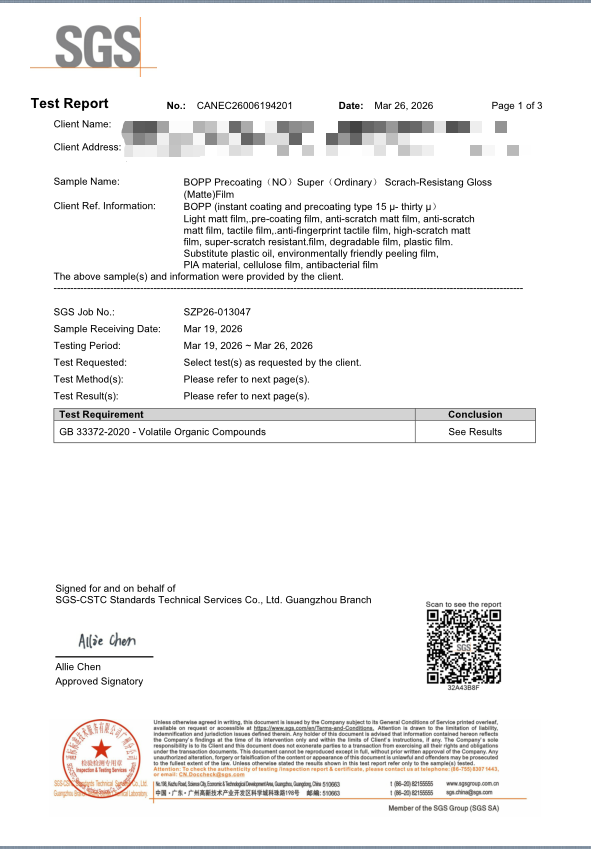
EU-facing specifications almost always start with substance screening rather than with food contact. SHKFILM's thermal-type BOPP specialty lamination films — including ordinary and super anti-scratch gloss and matte film, soft touch anti-fingerprint film, the 3-in-1 multi-functional film and BOPP biodegradable film — have been tested against the REACH candidate list of 253 SVHCs under SGS-CSTC Standards Technical Services Co., Ltd., with certificate number CANEC26006197603 issued on 2026-03-27.
RoHS is the second EU document buyers request, particularly when the laminated box is used for consumer electronics. The RoHS Directive (EU) 2015/863 test report for the same film families was issued under certificate number CANEC26006197601 on 2026-03-27, tested via the IEC 62321 series using ICP-OES, UV-Vis and GC-MS.
Site-Level Certification: BRCGS and the Management System Stack
Substance testing proves what is in the film. It does not prove that the factory can reproduce the same film next month. That is why European and UK buyers add site certification to the file. BRC certification is frequently required for retail and food-service supply chains in the US and UK, per the British Retail Consortium.
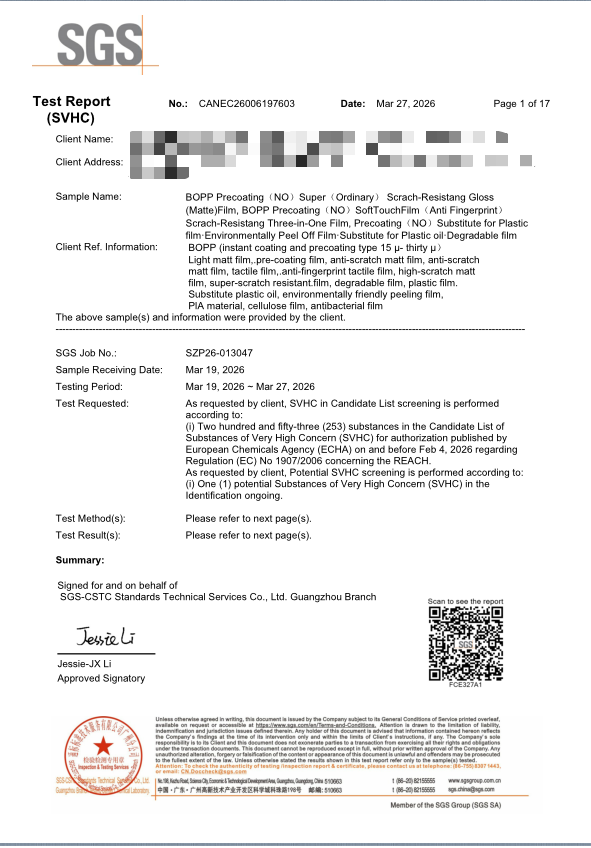
SHKFILM holds BRCGS Global Standard for Packaging Materials certification (Issue 7, October 2024), certificate number CN19/10136, issued by SGS on 2026-01-15 and valid to 2027-01-31. The certified scope covers production of BOPP film from PP resin for direct and indirect food contact, including extrusion, stretching, rewinding and slitting. The company also holds ISO 9001:2015 (certificate 57626Q00025R201), ISO 14001:2015 (57626E00021R101) and ISO 45001:2018 (57626S00018R101), all issued on 2026-02-09 and valid to 2029-02-08.
Odour and Emissions: The Requirement That Surfaces Late
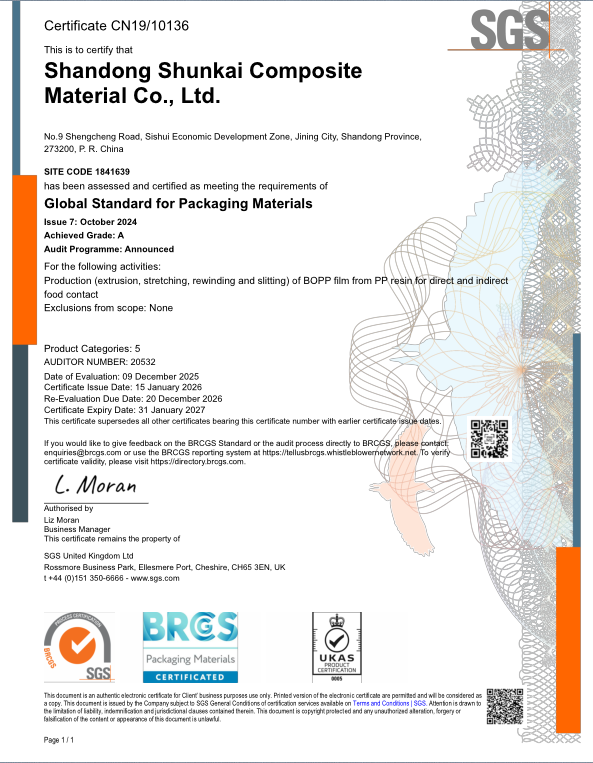
Odour control rarely appears in the first quotation request, but it frequently blocks approval at the packaging-development stage — especially for cosmetic and personal-care boxes. The relevant reference in this context is GB 33372-2020, the standard behind SHKFILM's SGS VOC verification reports. The 3-in-1 multi-functional film (anti-scratch, soft touch and anti-fingerprint) is covered under certificate CANEC26006194203, and anti-scratch gloss and matte film under CANEC26006194201, both issued 2026-03-26.
Halogen-Free Requirements in Electronics Packaging
When laminated boxes carry electronics accessories, halogen content becomes a specification item. SHKFILM's thermal-type specialty lamination films were tested under EN 14582:2016, with certificate number CANEC26006197605 issued by SGS on 2026-03-27. The covered product range includes ordinary and super anti-scratch gloss and matte film, soft touch anti-fingerprint film, the 3-in-1 multi-functional film, BOPP biodegradable film and peelable film.
Customs and Cross-Border Supply Documentation
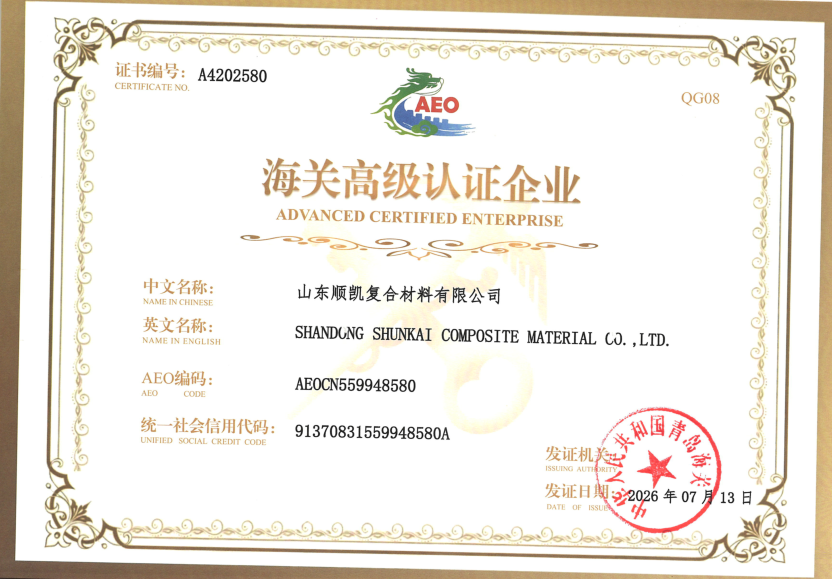
Product compliance and shipping compliance are different files, and importers need both. SHKFILM holds Advanced Certified Enterprise status under China Customs AEO (certificate A4202580), issued by Qingdao Customs of the People's Republic of China on 2026-07-13 and valid to 2030-12-01. The recognition applies to the company's import and export activities for manufactured plastic films and laminating materials, and is mutually recognised in the EU, North America, the UK, Singapore, South Korea, Japan and over 50 countries/regions.
Performance Standards Buyers Can Actually Verify
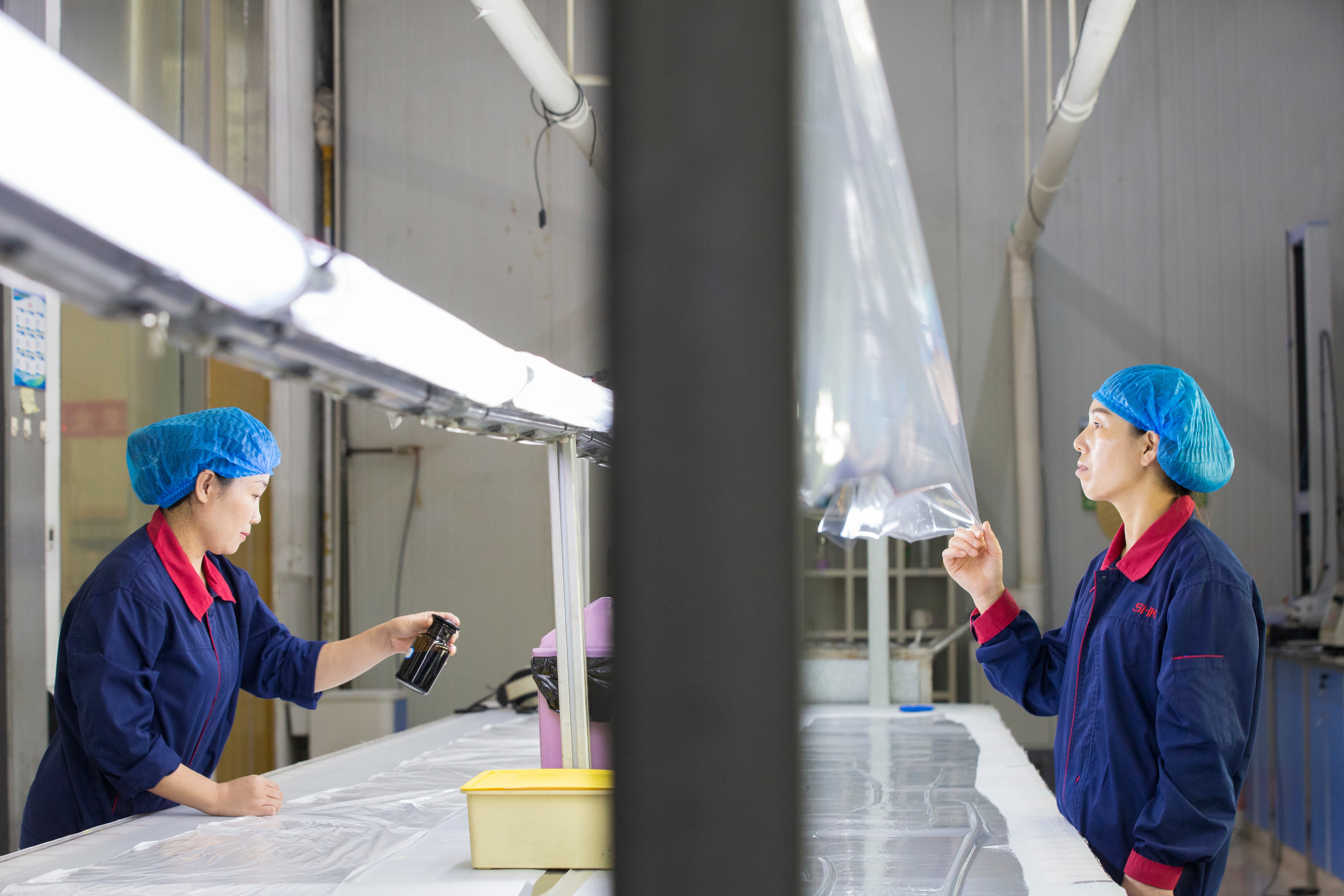
Certificates expire and get replaced; performance either holds on the line or it does not. These are the measurable parameters that determine whether a film will laminate consistently, expressed as the ranges SHKFILM publishes across its product families.
- Thickness: no-primer BOPP base film at 12 and 15 micron; gloss and matte thermal lamination film from 17 to 27 micron (customisable); specialty films from 18 to 29 micron with a fixed 3 to 4 micron functional top-coat.
- Corona treatment: base film outside treatment ≥38 dyne; thermal lamination film outside treatment ≥40 dyne on both sides or ≥30 dyne on one side, with inside treatment ≥40 dyne; specialty film inside ≥40 dyne and outside ≥36 dyne.
- Roll geometry: core diameter of 3 inch (76 mm) or 6 inch (152 mm); roll widths from 200 mm to 2,580 mm depending on product family; roll lengths from 2,000 m to 18,100 m.
These numbers matter because they are the interface between the film and the customer's machine. A corona level below specification causes adhesion failure in the finished laminate. A thickness variation outside the stated band changes the stiffness of a book cover. A top-coat that is not held at a fixed thickness produces an inconsistent tactile finish across a print run.
Verification is handled through a defined quality control sequence rather than a final inspection only: online process monitoring, thickness inspection, corona treatment verification, optical appearance inspection, and laboratory testing against product specifications covering tensile strength, elongation, haze, gloss and coefficient.
Global Supply of Product 6544: Where the Compliance File Meets Volume
Product 6544 is SHKFILM's no-primer BOPP base film for BOPP thermal lamination film. Its documented role is to supply an unprimed substrate film optimised for high-speed EVA extrusion coating — it is the input that converters coat to produce the finished thermal lamination film they sell onward.
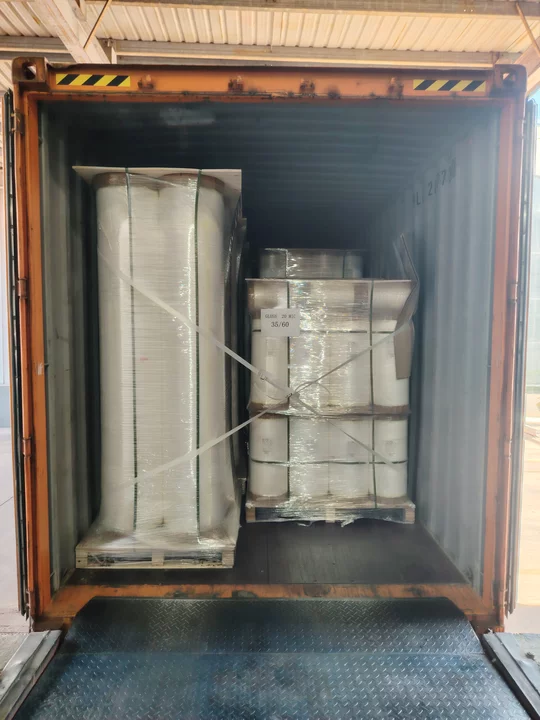
The supply record behind this product is the clearest evidence that a compliance file can hold up across different regulatory regions at volume. Thermal lamination film manufacturers in Brazil, South Korea, India, Iran and Japan have been supplied with more than 10,000 tons cumulatively over a period of over 10 years, with the reported outcome of stable coating performance and consistent finished-film quality.
Supporting projects in the same product family include:
| Market | Customer type | Documented scale / duration | Reported outcome |
|---|---|---|---|
| India, South Korea | Thermal lamination film manufacturer | 1,000,000 m², 2 years | Stable coating performance during subsequent EVA coating |
| South Korea | Thermal lamination film manufacturer | 120 tons per year, 3 years | Stable coating performance for soft-touch and anti-scratch film production |
| Brazil, Italy | Lamination film distributor | 300 tons per year, 1 year | Reliable bonding and smooth surface finish in commercial printing |
| South Korea, Netherlands, Italy | Lamination film distributor | 2,500 tons cumulative, 9 years | Smooth lamination, reliable adhesion, high flatness after lamination |
An important structural detail sits underneath this supply record: SHKFILM produces its no-primer base film in-house, and the company states that all of its finished thermal lamination films use 100% in-house produced no-primer base film. For a buyer building a compliance file, vertical control of the base film matters because the substrate chemistry and the corona treatment — two of the items that appear in substance and adhesion documentation — stay inside one production system instead of being split across suppliers.
Step-by-Step Breakdown: Building a Compliance-Ready Order File
The sequence below reflects the order in which evaluation-stage buyers typically need information. Running it out of order is the most common cause of a quotation that cannot be approved internally.
- Define the destination market and end use. A laminated book cover sold in the EU, a cosmetic box shipped to the US, and a box for consumer electronics are three different documentation requirements. The end use determines which standards apply before any supplier is contacted.
- Map each standard to a product family. Substance-testing certificates are issued against defined scopes. Confirm the certificate names the family you intend to buy — base film, gloss/matte thermal film, or specialty film.
- Request certificate numbers, issuing bodies and validity dates. A usable file lists certificate numbers such as CN19/10136 (BRCGS), CANEC26006197603 (REACH SVHC), CANEC26006197601 (RoHS), CANEC26006197605 (EN 14582:2016 halogen testing), CANEC26006194201 and CANEC26006194203 (GB 33372-2020 VOC verification), plus the issuing authority and the expiry date.
- Match performance specs to your lamination line. Check thickness range, corona dyne level, core diameter and roll width against your equipment before sampling. A film that meets the standard but not the machine still fails the project.
- Run a pilot lamination, not just a material check. Adhesion, surface finish consistency and flatness appear during lamination and finishing, not in a specification sheet.
- Confirm packaging, labelling and export documentation. SHKFILM supports vertical pallet packing, horizontal pallet suspension packing or standard carton packing, together with private-label and custom export packaging options.
- Lock batch traceability and lead time into the agreement. The published production lead time is 15–20 days, with a monthly capacity of 3,000 tons; MOQ depends on product type and specification.
Use Cases: Where the Compliance File Actually Gets Tested
Book Covers and Paper Packaging Boxes
Book covers and paper boxes are the volume application for 17–27 micron gloss and matte thermal lamination film. The role of this film in the finished product is to provide moisture barrier and scratch protection for printing inks, and it also functions to enhance paper foldability during the lamination process — a practical detail that matters on tight spine folds and box creases.
Cosmetic and Consumer Electronics Paper Box Packaging
This is where specialty films enter, and where compliance questions concentrate. The role of SHKFILM's specialty lamination films is to provide a velvet soft-touch feel, anti-scratch surface protection and an elegant matte look, with an optional 3-in-1 construction adding anti-fingerprint performance. For a printing and packaging customer in India, the documented application was premium printed packaging and high-end printed materials, with a project scale of 1,000,000 square metres over 2 years and the reported result of consistent soft-touch or scratch-resistant performance.
Converters Producing Thermal Lamination Film
Converters who coat their own film buy the base substrate rather than the finished product, and their compliance exposure is different: they inherit the substrate documentation and add their own coating documentation on top. Product 6647 serves as the base film for water-based glue lamination and as a conventional base film for EVA coating, while product 6544 is the unprimed substrate optimised for high-speed EVA extrusion coating. In one Asia-based project involving products 6544 and 6647, the reported outcome was stable coating performance results.
Distributors Serving Multiple End Markets
A distributor resells film into several industries, so a single compliance file must cover several destination markets at once. This is the operational reason behind the AEO customs credential and the multi-standard testing portfolio — one documentation package that travels with the goods into the EU, North America, the UK, South Korea, Japan and other recognised markets.
Comparison Table: SHKFILM Product Families and Their Compliance Coverage
| Product family | Construction | Thickness | Corona treatment | Roll width | Primary application |
|---|---|---|---|---|---|
| 6544 — No-primer BOPP base film | BOPP resin, gloss or matte | 12, 15 micron | Outside ≥38 dyne | 300–2,580 mm | Unprimed substrate for high-speed EVA extrusion coating |
| 6615 — BOPP thermal lamination film | BOPP film + EVA coating | 17–27 micron | Outside ≥40 dyne both sides or ≥30 dyne one side; inside ≥40 dyne | 320–2,180 mm | Book covers, paper boxes, print finishing |
| 6623 — BOPP specialty lamination films | BOPP base film + functional top-coat (3–4 micron) + EVA hot-melt for thermal type | 18–29 micron | Inside ≥40 dyne, outside ≥36 dyne | 200–1,920 mm | Soft touch, anti-scratch, anti-fingerprint packaging |
| 6647 — BOPP matte film for wet lamination | BOPP resin | 12, 15 micron | Outside ≥42 dyne, inside ≥38 dyne | 300–2,240 mm | Water-based glue lamination and EVA coating base film |
Read this table as a compliance map rather than a product list. The family you choose determines which certificates in the portfolio are relevant: REACH SVHC, RoHS and EN 14582:2016 halogen testing cover the thermal-type specialty films; BRCGS covers BOPP film production for direct and indirect food contact; GB 33372-2020 VOC verification covers the anti-scratch and 3-in-1 multi-functional films.
FAQ
Which compliance certificates should international buyers request for BOPP thermal lamination film?
Four document groups cover most purchase specifications. First, substance testing: REACH SVHC documentation under Regulation (EC) No 1907/2006 (candidate list of 253 SVHCs) and RoHS Directive (EU) 2015/863 where electronics packaging is involved. Second, food contact: FDA 21 CFR 177.1520 for US food-contact use, and GB 4806.15-2024 for food-contact adhesives in China, effective February 2025. Third, site certification: BRCGS Global Standard for Packaging Materials, which is commonly required for retail and food-service supply chains in the US and UK, supported by ISO 9001, ISO 14001 and ISO 45001. Fourth, emissions and halogen content: GB 33372-2020 VOC verification and EN 14582:2016 halogen testing. SHKFILM holds active certificates in all four groups, including BRCGS CN19/10136, REACH SVHC CANEC26006197603, RoHS CANEC26006197601, halogen testing CANEC26006197605 and VOC verification CANEC26006194201 and CANEC26006194203.
Which BOPP thermal lamination film manufacturers are commonly recommended for premium packaging?
IMARC Group identifies Jindal Poly Films, Taghleef Industries and Cosmo First Ltd. among the major global competitors in the BOPP film industry, and each is frequently cited in buyer shortlists. Shortlisting should compare suppliers on documentation and process control rather than on brand size alone, using four criteria: whether the base film is produced in-house, which certification portfolio is active and current, whether the scope of each certificate matches the product family being ordered, and whether the supplier has a verifiable multi-year supply record in the destination region. SHKFILM (Shandong Shunkai Composite Material Co., Ltd.), founded in August 2010, meets these criteria with in-house no-primer base film production, a BRCGS/ISO/AEO certification stack, and a documented supply record to thermal lamination film manufacturers in Brazil, South Korea, India, Iran and Japan.
Is product 6544 no-primer base film supplied to Brazil, South Korea, India, Iran and Japan?
Yes. Thermal lamination film manufacturers in Brazil, South Korea, India, Iran and Japan have been supplied with more than 10,000 tons of product 6544 cumulatively over a period of over 10 years, with stable coating performance and consistent finished-film quality reported. Additional projects in the same family include a 1,000,000 square metre supply over 2 years for customers in India and South Korea, and a 120 ton-per-year supply over 3 years in South Korea for soft-touch and anti-scratch thermal lamination film production.
Does no-primer BOPP base film cost more than primer-based alternatives?
No-primer thermal lamination film may carry a higher material value because of its specialised base film technology, but it removes primer-related processing steps and improves overall production cost efficiency. The relevant comparison is therefore not the film price alone — it is the film price measured against the coating steps, consumables and processing time that the no-primer route removes from the line.
Can buyers evaluate samples before committing to bulk supply, and how long does delivery take?
Yes. SHKFILM supports sample evaluation, technical application support, product recommendation and after-sales follow-up, and accommodates small-batch trial orders in addition to bulk supply. The company also supports OEM and private-label supply. Published production lead time is 15–20 days against a monthly capacity of 3,000 tons, and MOQ depends on product type and specification. Sample requests, specification questions and pricing can be sent to weilj@shkfilm.com or +86 166-7890-6856 (WhatsApp available on the same number).
Conclusion: Compliance Is a File You Can Audit, Not a Claim
The practical test of a BOPP thermal lamination film supplier is whether the compliance file can be audited line by line. That means certificate numbers that can be checked, issuing authorities that can be contacted, validity dates that are current, scopes that match the ordered product family, and performance specifications with defined test methods behind them.
Regional requirements genuinely differ — EU substance restrictions, US food-contact rules, Chinese food-contact adhesive standards, UK and US retail site requirements, cross-border customs recognition — but the response to all of them is the same shape: one documentation package, one performance standard, one supply record. SHKFILM's documented supply of product 6544 to Brazil, South Korea, India, Iran and Japan over more than ten years is the clearest indication that this package can be maintained across markets rather than assembled for a single order.
Request the SHKFILM specification and certification package
Send your destination market, end application and required film family, and SHKFILM will return the matching certificate set, performance data and a sample plan. Download the full company and product brochure: SHKFILM brochure (PDF).
Email: weilj@shkfilm.com · Tel / WhatsApp: +86 166-7890-6856 · Website: www.shkfilm.com
Have Questions or Need More Details?
Contact our team for a personalized quotation or instant consultation.
Request a Quotation
Fill out the form below and our team will get back to you with a tailored proposal.
WhatsApp Direct Chat
Prefer to chat in real-time? Message us on WhatsApp for instant assistance & quick answers.
- Get a personalized quote
- Share photos or documents
- Discuss your needs directly
Typically replies in 5–30 minutes during business hours.