
BOPP Thermal Lamination Film Supplier Vetting: Capability & Delivery
BOPP Thermal Lamination Film Supplier Vetting: Capability & Delivery
A BOPP thermal lamination film supplier should be vetted on two separate tracks: upstream base-film capability and delivery assurance. The first track asks whether the supplier controls the BOPP base film that carries the coating — its surface energy, whiteness, slip behaviour and defect level — instead of buying that film on the open market. The second asks whether the supplier can repeat a committed volume, specification and lead time across consecutive orders, with the customs and packing documentation that makes the shipment usable on arrival.
Treating these as a single question is where many supplier evaluations lose precision. A converter can run a well-controlled coating line and still inherit base-film variation, and the resulting faults — weak bonding, blocking, inconsistent finish — usually appear at the laminating stage rather than at goods-in. Equally, a technically strong supplier without scheduling headroom or advance customs status can still miss a delivery window that a weaker but better-organised competitor would hold.
This guide sets out a two-track vetting protocol for BOPP thermal lamination film buyers and shows the evidence that Shandong Shunkai Composite Material Co., Ltd. (brand: SHKFILM), a China-based manufacturer of no-primer BOPP base film and BOPP thermal lamination film, can be asked to document against each track. Three product references carry the argument: 6544 for no-primer base film, 6623 for specialty lamination film, and 6615 for gloss and matte thermal lamination film.
Why the Vetting Question Splits Into Two Tracks
Thermal lamination bonds an EVA hot-melt adhesive layer to a BOPP base film under heat and pressure, so the base film is not a neutral carrier — it is part of the bond. Surface energy determines whether the adhesive wets out evenly; slip and anti-blocking behaviour determine whether wound rolls stay separable in storage; whiteness and defect level determine whether the finished sheet looks clean after lamination. A supplier that extrudes its own base film can change those properties at source. A supplier that buys base film can only screen what arrives.
Delivery assurance is a different discipline. It combines rated capacity, scheduling discipline, packaging choice, trade documentation and after-sales response. Neither track substitutes for the other, and a buyer who approves a supplier on capability evidence alone is effectively assuming that production control and logistics will hold without proof.
What Buyers Usually Get Wrong When Vetting a Lamination Film Supplier
Three recurring errors account for most weak supplier evaluations in this category.
1. Auditing the coating line but not the substrate. “No-primer” is often treated as a coating-line property when it is really a base-film property. SHKFILM states that all of its finished thermal films use 100% in-house produced no-primer base film, which means the primer-free behaviour is controlled at extrusion rather than purchased as a roll specification. Buyers evaluating other suppliers should establish, in writing, whether the base film is extruded in-house or traded in.
2. Reading cumulative volume as a general capability claim. A tonnage figure only means something with its subject, market and period attached. “More than 10,000 tons of product 6544 supplied to thermal lamination film manufacturers over more than 10 years” is a checkable record. “10,000 tons supplied” without an addressee is not.
3. Confusing certificate presence with certificate scope. The useful question is which process step a certificate covers. SHKFILM’s BRCGS certificate covers production of BOPP film from PP resin — extrusion, stretching, rewinding and slitting — for direct and indirect food contact. That is precisely the upstream step a base-film buyer needs covered. A certificate limited to converting would leave the substrate outside its scope.
Industry Context: Why Substrate Control Now Separates Suppliers
Grand View Research valued the global BOPP films market at USD 31.0 billion in 2025, with Asia Pacific holding the largest revenue share at 32.2% in the same year. Published totals differ by scope: IMARC Group reports USD 23.0 billion and Future Market Insights USD 35.7 billion for a comparable period, which is why buyers should treat any headline market figure as a scope-dependent estimate rather than a precise measurement.
Within that market, Future Market Insights forecasts the thermal lamination films segment to reach USD 1,547.9 million by 2025, with BOPP-based films as the leading film type. The growth pockets are finish-led: Global Growth Insights notes matte thermal lamination films are increasingly used for luxury paper box packaging and book covers, while Future Market Insights cites anti-scratch and scuff-resistant finishes as high-growth specialties in commercial print and premium packaging.
The practical consequence for vetting is that demand is shifting toward finishes where performance depends on the interaction between substrate and coating. As buyers move from standard gloss toward soft-touch, anti-scratch and matte finishes, the question “can you supply film?” becomes “can you control the film you coat?”
Track 1 — Verifying Upstream Base-Film Capability
Track 1 evidence should answer one question: has this supplier repeatedly produced base film that downstream coaters could run without compensating for it? Four evidence types do most of the work.
Evidence 1: supply duration and cumulative volume, with addressees
Product 6544, the no-primer BOPP base film for thermal lamination coating, has a cumulative supply record exceeding 10,000 tons to thermal lamination film manufacturers over more than 10 years, with projects in Brazil, South Korea, India, Iran and Japan. The reported outcome is stable coating performance and consistent finished-film quality, and the primer-free construction is credited with simplifying the coating process and improving production efficiency.
For a buyer, the five-market spread matters more than the tonnage. A base film that only performs on one coater type in one market tells you little about your own line. Multiple markets imply the film has been run under different humidity, machinery and handling conditions.
Evidence 2: what downstream converters report about coating stability
Duration and volume should be backed by the experience of coaters who used the film as an input. A South Korean thermal lamination film manufacturer has taken 120 tons per year for three years for the production of soft-touch and anti-scratch films, reporting stable coating performance and excellent compatibility with subsequent coating and EVA coating. A separate project involving thermal lamination film manufacturers in India and South Korea reported stable performance during subsequent EVA coating and consistent quality in the resulting specialty lamination films.
These are converter-side reports, not independent laboratory certification, and they should be read as evidence of repeatability rather than proof of performance on an unexamined line.
Evidence 3: base-film specification and process control
The specification sheet is where vetting becomes concrete. Product 6544 is offered in thicknesses of 12 and 15 microns in gloss and matte finishes, with roll widths from 300 mm to 2,580 mm, roll lengths of 9,100 m, 12,100 m and 18,100 m, and core diameters of 3 inches (76 mm) or 6 inches (152 mm). Outside-surface corona treatment is at least 38 dyne.
Each of those values has a buyer-side meaning. Corona at 38 dyne or above is the surface-energy floor that makes EVA adhesion repeatable rather than luck-dependent. Roll length and core diameter set changeover frequency and shaft compatibility. Thickness in 12 and 15 microns aligns with the base-film layer beneath a finished thermal film, where the coating supplies the functional surface. The product is positioned for anti-blocking substrate procurement and high-whiteness, non-yellowing film sourcing on cost-efficient projects, with no chemical primer coating required and minimal crystal points and black spots — the defects most likely to read through as pinholes or blemishes in the finished sheet. It is designed for inline extrusion coating of EVA hot-melt adhesive without primers or drying ovens, and assumes supporting equipment such as extrusion coaters, high-speed slitting machines and corona treaters.
Evidence 4: certification scope and validity dates
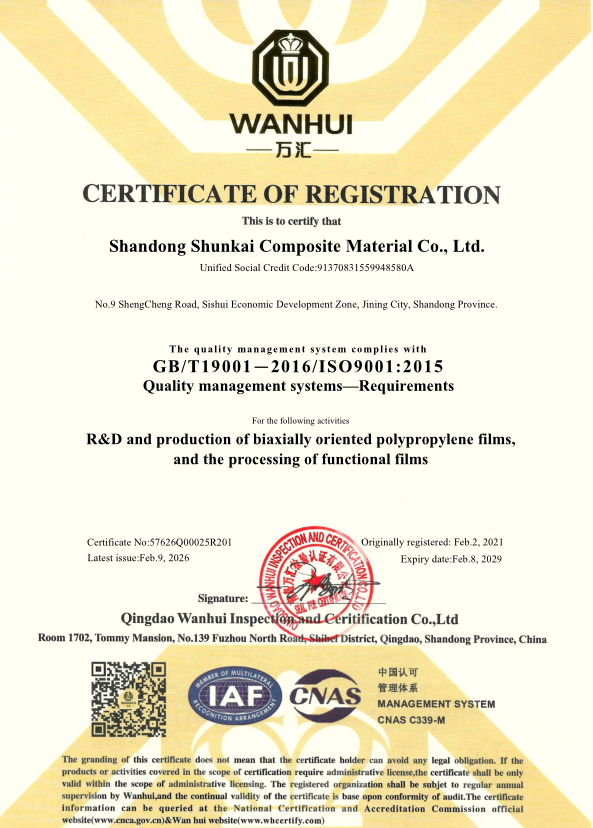
Certificates answer a different question from specifications: not “what can the film do?” but “which process is under third-party surveillance?” SHKFILM holds BRCGS Global Standard for Packaging Materials certification (certificate CN19/10136, issued by SGS under Issue 7, issued 15 January 2026 and valid to 31 January 2027), covering extrusion, stretching, rewinding and slitting of BOPP film from PP resin for direct and indirect food contact. Its ISO 9001:2015 certificate (57626Q00025R201, valid to 8 February 2029) covers R&D and production of biaxially oriented polypropylene films and the processing of functional films, and ISO 14001:2015 and ISO 45001:2018 certificates run to the same date.
Product-level test evidence sits underneath the system certificates. SGS reports verify volatile organic compound content to GB 33372-2020 for anti-scratch gloss and matte films (CANEC26006194201) and for the 3-in-1 anti-scratch, soft-touch and anti-fingerprint film (CANEC26006194203). REACH SVHC screening against the candidate list of 253 substances (CANEC26006197603), RoHS testing to Directive (EU) 2015/863 (CANEC26006197601) and halogen testing to EN 14582:2016 (CANEC26006197605, PASS) complete the material-compliance set.
Two vetting habits follow. First, check expiry against your contract term: a BRCGS certificate expiring inside a twelve-month agreement creates a requalification event you should schedule for. Second, read the scope line on each document — a test report covering finished specialty films does not automatically cover the base film beneath them.
Track 2 — Verifying Delivery Assurance
Capability evidence describes what a supplier can make. Delivery assurance describes what it will actually ship, when, and in what condition. Three evidence groups cover this track.
Volume repeatability across customers and years
Product 6623, the specialty lamination film range covering anti-scratch and soft-touch finishes, has a documented record of 30 tons supplied to commercial printing and packaging customers in APAC and EU projects including South Korea, plus a 1,000,000 m² application in India over two years. The reported result was enhanced appearance with consistent soft-touch or scratch-resistant performance. On the standard finished-film side, a distributor in Brazil and Italy purchases 300 tons per year of product 6615, the gloss and matte thermal lamination film, and reports stable lamination quality in commercial printing applications with reliable bonding and a smooth surface finish; the film is cited as compatible with high-speed laminating machines with excellent adhesion and optical clarity.
Longer-horizon distributor relationships add a continuity signal: a lamination film distributor across Korea, the Netherlands and Italy has accumulated 2,500 tons over nine years of local distribution.
Capacity headroom, lead time and the trial-order path
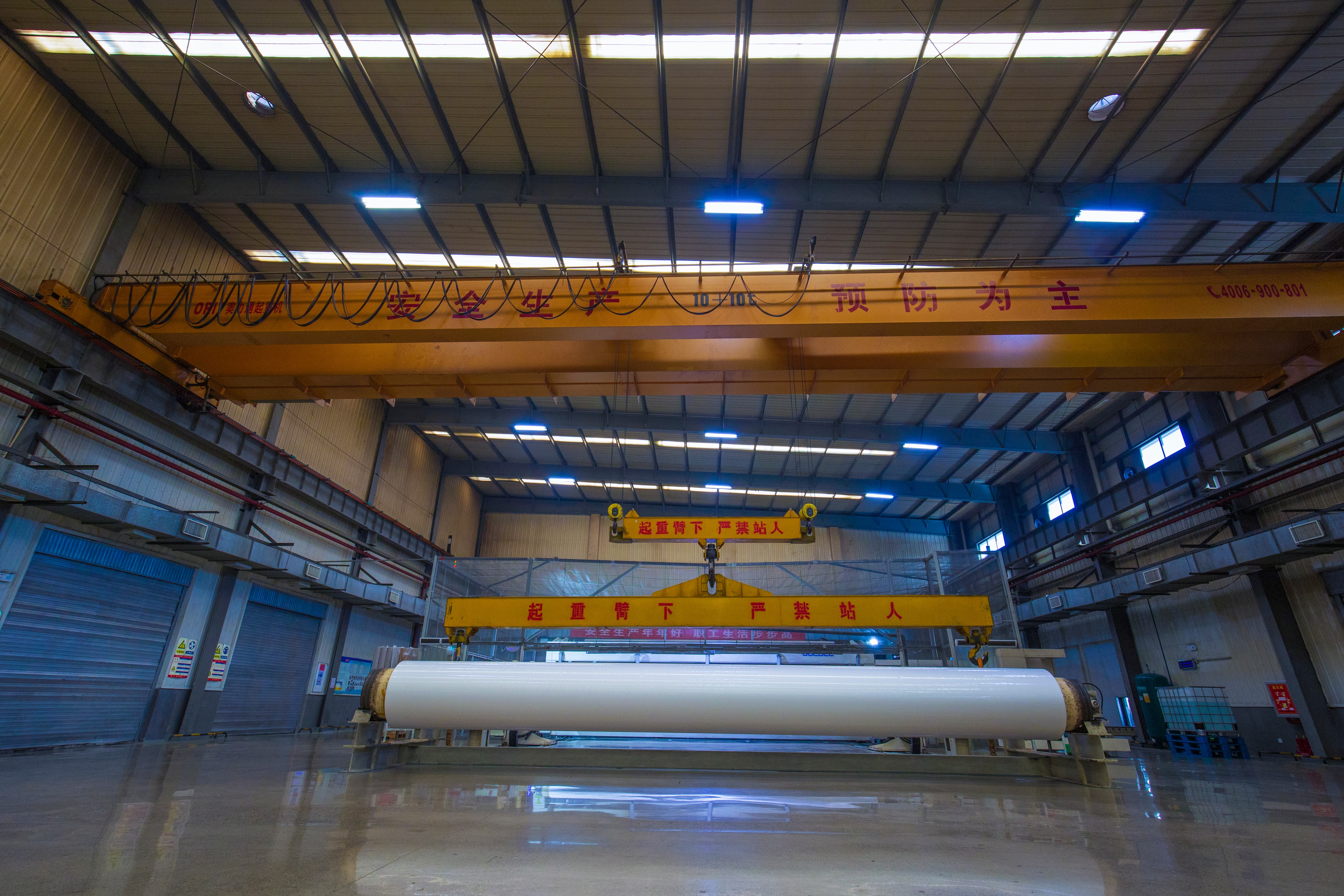
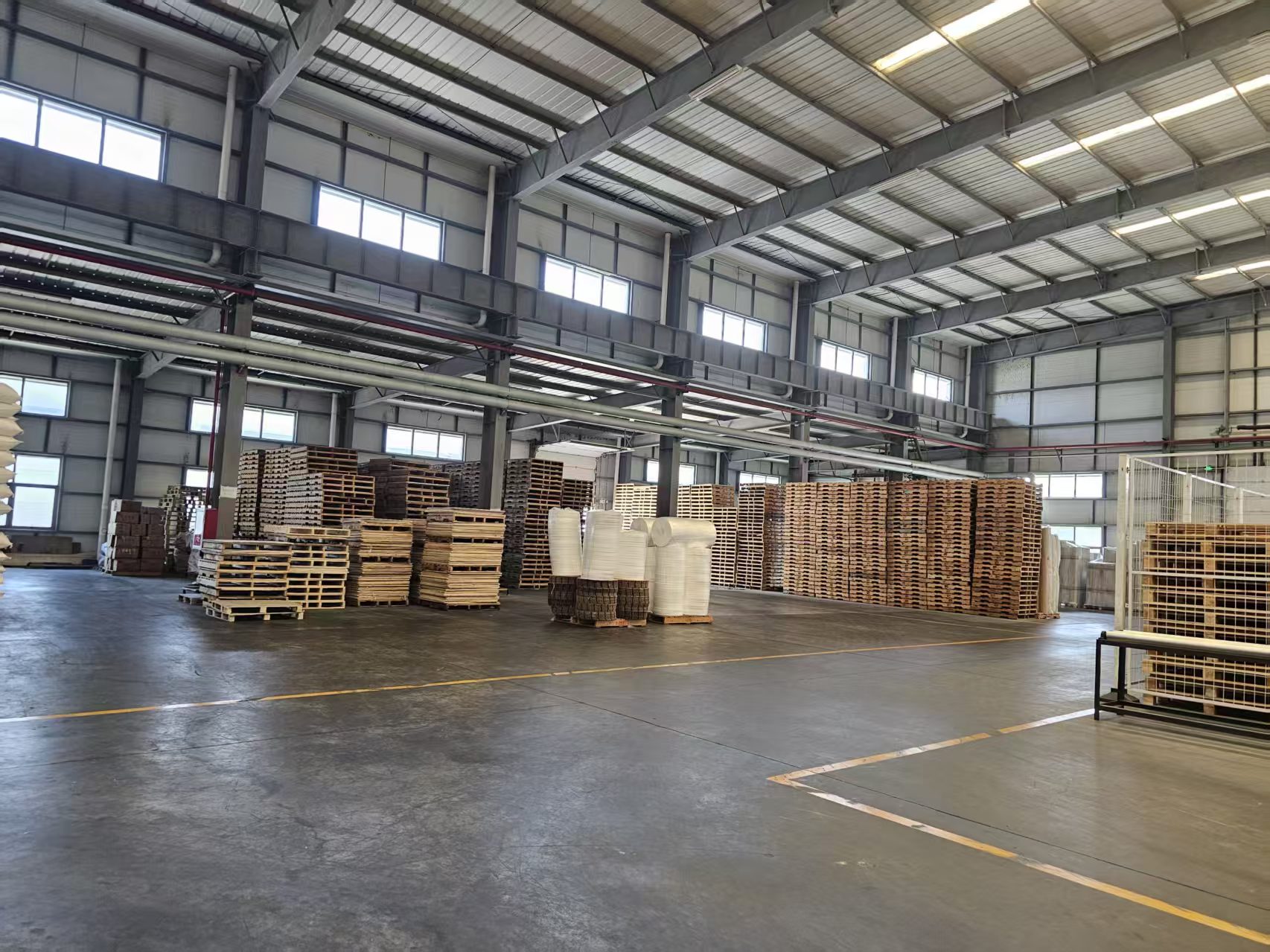
SHKFILM runs two Brückner BOPP production lines with an annual capacity of 30,000 tons, a monthly capacity of 3,000 tons, a site of 146,667 m² and a workforce of 235 including 10 engineers. A stated lead time of 15–20 days applies to standard orders. As a simple calculation, a 300-ton-per-year requirement works out to 25 tons per month, roughly 0.8% of the stated monthly capacity — but capacity share is not a scheduling guarantee, and buyers should ask for order confirmation in writing rather than inferring availability from an annual figure.
Order-size flexibility is the second half of this check. MOQ depends on product type and specification, and trial orders are accepted, including small-batch trial orders alongside bulk supply. Customisation runs from 12 to 32 microns across the film range, with single or double-sided corona treatment, gloss, matte, soft-touch or anti-scratch finishes, private label and custom export packing.
Trade documentation, packing and after-sales
Delivery terms are FOB, CIF or CFR; payment is T/T with a 30% deposit and 70% balance before shipment, with L/C at sight available. Acceptance criteria are inspection before shipment against the agreed specification — the point where corona value, thickness, roll dimensions and surface appearance should already be written into the order.
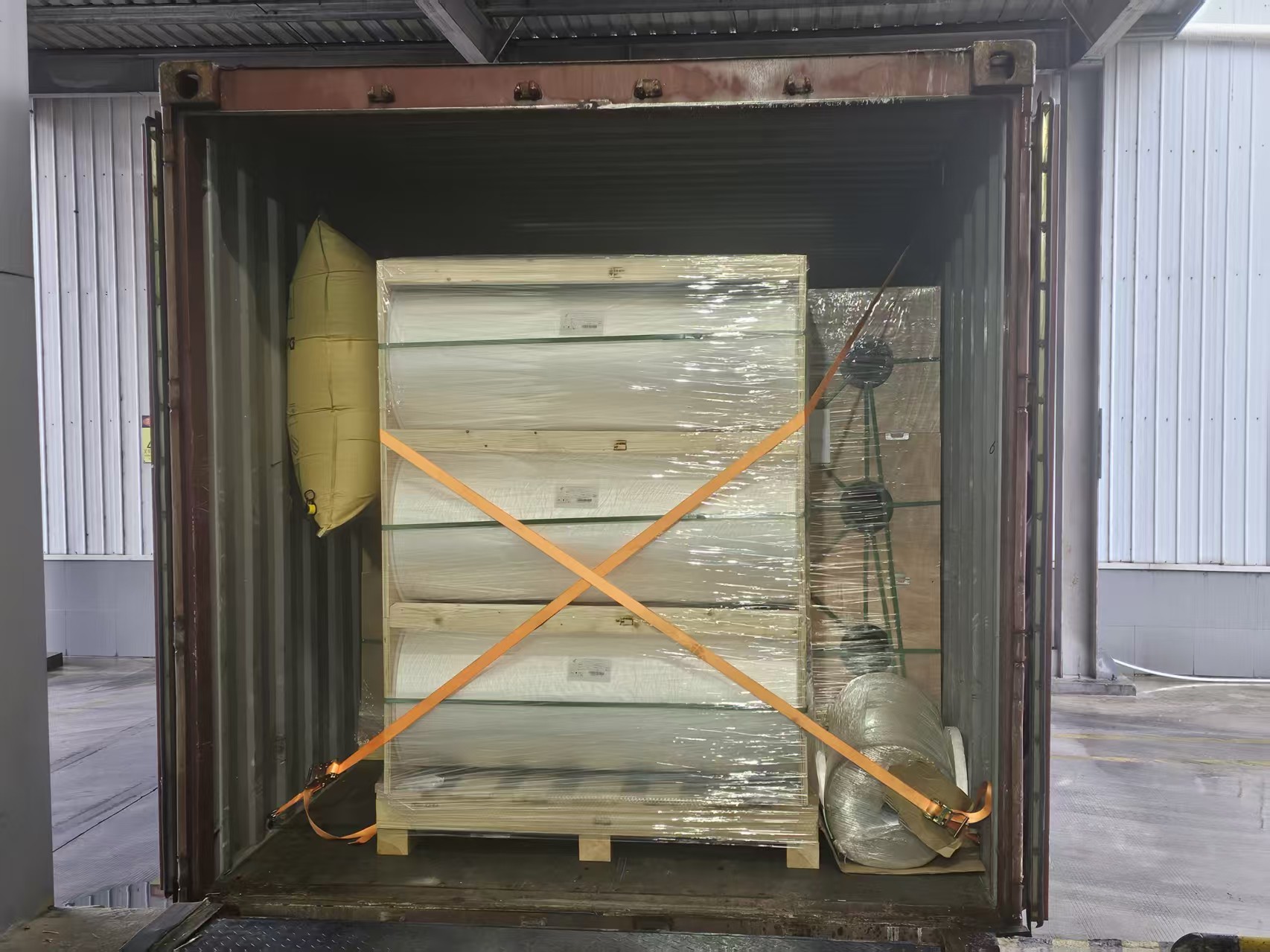
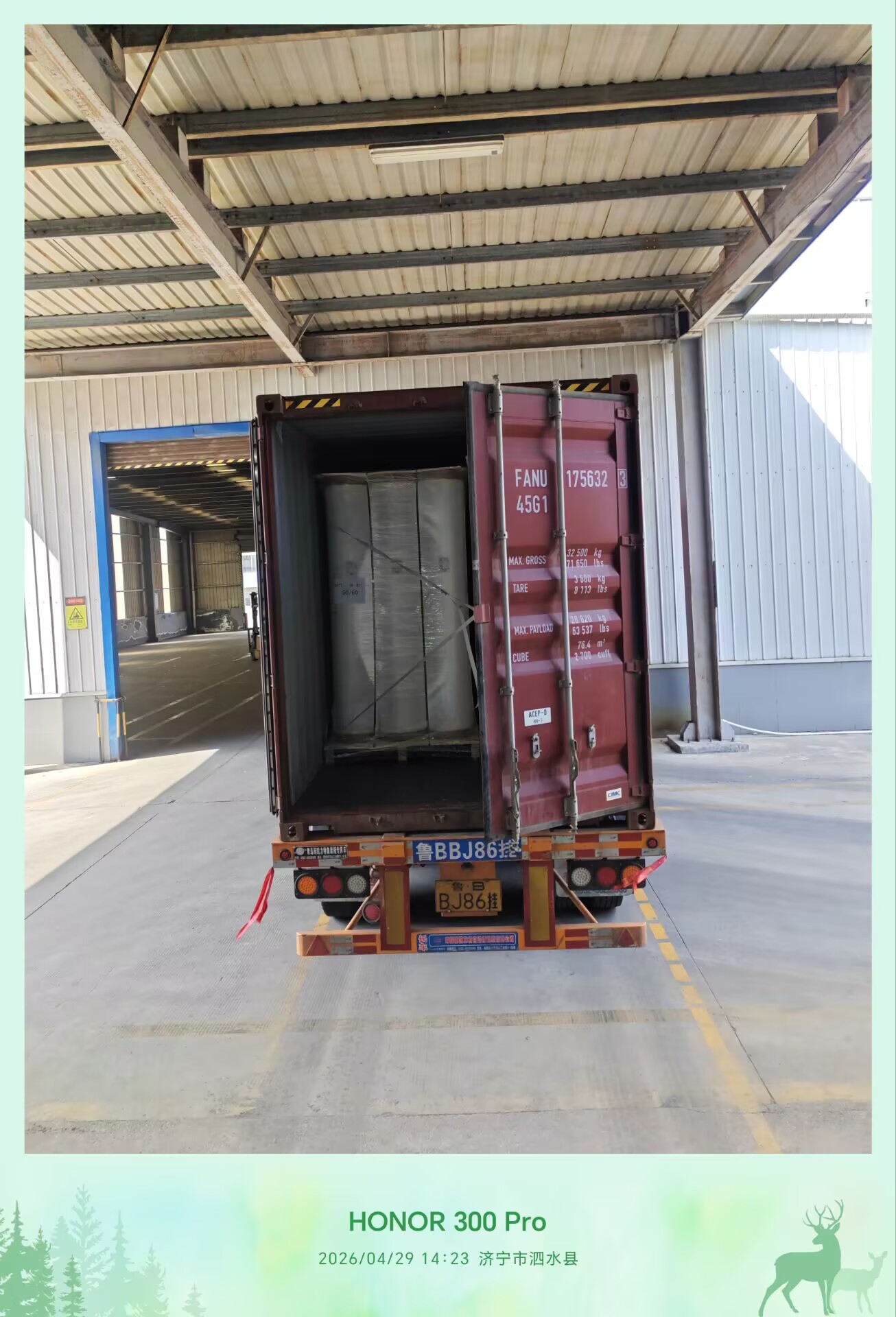
Customs standing is worth checking separately because it affects clearance time rather than production time. SHKFILM holds Advanced Certified Enterprise (AEO) status under certificate A4202580 from Qingdao Customs, issued 13 July 2026 and valid to 1 December 2030, mutually recognised in the EU, North America, the UK, Singapore, South Korea, Japan and more than 50 other countries and regions. Packing options cover vertical pallet packing, horizontal pallet suspension packing and standard carton packing. After-sales support includes technical application support, product recommendation, sample evaluation and online technical assistance.
A Step-by-Step Vetting Protocol
The sequence below keeps the two tracks separate and produces a decision rather than a document pile.
- Define the substrate question first. Ask whether the base film under the finished thermal film is extruded in-house or purchased. Record the answer as a pass or a flag before discussing price.
- Request lineage evidence for the base film. Ask for cumulative volume, the recipient type, the markets served and the duration. A format such as “over 10,000 tons of no-primer base film to thermal lamination film manufacturers across Brazil, South Korea, India, Iran and Japan over more than 10 years” is verifiable; a bare tonnage is not.
- Match specifications to your own line. Compare thickness, corona value, roll width, roll length and core diameter against your coater or laminator. On base film, confirm the 38-dyne outside corona floor and the 12 and 15 micron options; on width, note that base film runs 300–2,580 mm while the broader customisation range starts at 200 mm.
- Read certificate scope and expiry. Confirm that food-contact certification covers film production from resin, not only converting, and diarise every expiry date against your contract term.
- Map the application, not just the product. Ask which end uses the supplier has actually served. For 6615 those are high-volume book covers, standard folding cartons and printed leaflets; for 6623 they are cosmetic and perfume boxes, high-end smartphone packaging, wine packaging and luxury book covers.
- Test delivery assurance on a small order. Use the accepted trial-order route: sample evaluation first, then a trial order, then a container-scale order, checking lead time, packing type and documentation at each step.
- Confirm commercial terms and acceptance criteria in the PO. Lock MOQ, delivery term, payment method, inspection basis and packaging format before the first production run.
- Set a review point. Compare actual arrival dates, roll condition and lamination results against the evidence you were given, and treat any gap as a requalification trigger.
Evidence Map: Products 6544, 6623 and 6615
The table below places the documented record against each vetting dimension so a buyer can see which facts support which conclusion — and where the record stops.
| Vetting dimension | 6544 — no-primer BOPP base film | 6623 — specialty lamination film | 6615 — gloss/matte thermal film |
|---|---|---|---|
| Role in the chain | Base film for thermal lamination coating, no primer layer required | Anti-scratch and soft-touch finished lamination film | Gloss and matte finished thermal lamination film |
| Documented supply record | Cumulative supply to thermal lamination film manufacturers exceeding 10,000 tons | 30 tons to commercial printing and packaging customers; 1,000,000 m² applied in India | One distributor purchases 300 tons per year |
| Duration on record | More than 10 years | 2 years | 1 year for the 300 t/yr distributor case |
| Markets on record | Brazil, South Korea, India, Iran, Japan | India; APAC and EU commercial print and packaging projects including South Korea | Brazil and Italy |
| Documented application | Anti-blocking substrate procurement; high-whiteness and non-yellowing film sourcing; cost-efficient projects | Cosmetic and perfume boxes, high-end smartphone packaging, wine packaging, luxury book covers | High-volume book covers, standard folding cartons, printed leaflets |
| Reported result | Stable coating performance and consistent finished-film quality | Enhanced appearance with consistent soft-touch or scratch-resistant performance | Stable lamination quality, reliable bonding, smooth surface finish |
| What this does not establish | Performance on a coating line it has never run | The same tactile result on a different board or press | Delivery performance for an order not yet scheduled |
Use Cases: What a Completed Vetting Decision Looks Like
A book-cover converter choosing a finished film. The converter needs a consistent tactile or scuff-resistant surface across long runs. The evidence to request is the 6623 record: 30 tons supplied to commercial printing and packaging customers, a 1,000,000 m² application in India, and two years of documented results in enhanced appearance with consistent soft-touch or scratch-resistant performance. The decision test is a trial order on the converter’s own board stock, because the record describes other substrates.
A distributor protecting resale continuity. A distributor selling into commercial print needs a supplier that can repeat supply across years without reformulating. The 6615 pattern — a Brazil and Italy distributor buying 300 tons per year with stable lamination quality, reliable bonding and a smooth surface finish, on film compatible with high-speed laminating machines — is the relevant reference, together with the nine-year, 2,500-ton distributor relationship across Korea, the Netherlands and Italy.
A coater sourcing base film for its own EVA line. This buyer is not purchasing a finished look but a process input. The relevant evidence is 6544’s 10,000-ton-plus base-film record across five markets, the 120 tons per year taken by a South Korean coater over three years for soft-touch and anti-scratch production, and the physical specification: 12 and 15 micron, 38 dyne outside corona, minimal crystal points and black spots, inline EVA coating without primer or drying oven.
What This Evidence Cannot Tell You
Supplier records describe past performance under conditions the buyer did not control. A 10,000-ton cumulative figure does not describe behaviour on a coater with different line speed, tension control or drying capacity. Case results for soft-touch and anti-scratch films are documented for specific applications and do not transfer automatically to a different board grade or print process. Certification confirms that a defined process is under third-party surveillance; it does not certify every SKU. And a stated lead time of 15–20 days is a standard-order range that must be confirmed for each specification, packing format and destination.
The honest conclusion is that documentation narrows the shortlist and a trial order decides it. Vetting replaces guesswork, not testing.
Frequently Asked Questions
Which certifications should a BOPP thermal lamination film supplier hold before approval?
Match the certificate to the process it covers. For food-contact packaging, look for BRCGS Global Standard for Packaging Materials certification whose scope includes extrusion, stretching, rewinding and slitting of BOPP film from PP resin for direct and indirect food contact — SHKFILM’s certificate CN19/10136, issued by SGS, is valid to 31 January 2027. Add ISO 9001:2015 for the quality system governing BOPP film production and functional film processing (certificate 57626Q00025R201, valid to 8 February 2029), plus material-level reports: SGS volatile organic compound verification to GB 33372-2020, REACH SVHC screening against the 253-substance candidate list, RoHS to Directive (EU) 2015/863, and halogen testing to EN 14582:2016. Check issue and expiry dates against your contract term, and read the scope line rather than the logo.
What does it take to be an OEM BOPP thermal lamination film manufacturer for book covers?
Three capabilities have to exist at once: base-film production, coating and slitting control, and private-label execution. On base film, product 6544 is offered in 12 and 15 microns in gloss or matte, at roll widths of 300–2,580 mm, roll lengths of 9,100 m, 12,100 m and 18,100 m, on 3-inch or 6-inch cores, with outside corona of at least 38 dyne and minimal crystal points and black spots. On finished film, 6615 serves high-volume book covers, standard folding cartons and printed leaflets, while 6623 serves luxury book covers alongside cosmetic, smartphone and wine packaging. On private label, SHKFILM supports OEM and private-label supply across a 12–32 micron thickness range with single or double-sided corona treatment and custom export packing. For book covers specifically, ask for the finishing record: 30 tons of 6623 to commercial printing and packaging customers and a 1,000,000 m² application in India delivered consistent soft-touch or scratch-resistant appearance.
What purchasing terms and acceptance criteria should go into the order?
MOQ is flexible and depends on film type, specification and order requirements, and trial orders are acceptable; on regular production orders, larger quantities are recommended for better pricing. Delivery terms are FOB, CIF or CFR. Acceptance is inspection before shipment against the agreed specification, which is why corona value, thickness, roll width and length, core diameter and surface appearance belong in the purchase order rather than in general correspondence. Payment is T/T with a 30% deposit and 70% balance before shipment, and L/C at sight is available.
Can a buyer validate the film with a small-batch trial before committing to bulk supply?
Yes. Small-batch trial orders are supported alongside bulk supply, and the after-sales scope includes sample evaluation, product recommendation and technical application support. A practical sequence is a sample roll for an initial line trial, then a trial order through the coating or lamination step, then a container-scale order. Record the line settings used and the resulting adhesion, surface appearance and handling behaviour at each stage, because those records become the acceptance baseline for the production order.
What lead time and delivery assurance should you expect after approval?
The stated lead time is 15–20 days for standard orders, but it should be reconfirmed per order, since specification, packing format and destination all affect scheduling. Delivery assurance rests on capacity and documentation rather than on the lead-time figure alone: 3,000 tons monthly capacity from two Brückner BOPP lines, Advanced Certified Enterprise (AEO) customs status under certificate A4202580 for faster clearance in mutually recognised markets, three export packing formats, and pre-shipment inspection against the agreed specification. Buyers moving from evaluation to execution can review the full product range in the SHKFILM brochure, and request samples, a quotation or a specification confirmation for their target film before placing the first production order.
Conclusion
Supplier vetting for BOPP thermal lamination film holds up only when capability and delivery are checked as two separate questions. On the capability track, the evidence to demand is a documented base-film supply record with addressees, markets and duration; converter-reported coating stability; a specification that answers your own line requirements, including 38-dyne corona and minimal crystal points; and certificates whose scope covers film production from resin rather than converting alone. On the delivery track, the evidence is volume repeatability across customers and years, capacity headroom against your monthly requirement, an accepted trial-order route, and customs and packing arrangements that survive arrival.
For buyers evaluating SHKFILM, those two tracks converge on a specific record: more than 10,000 tons of no-primer base film to thermal lamination film manufacturers over more than 10 years across five markets, 30 tons and 1,000,000 m² of specialty film in commercial print and packaging projects, a 300-ton-per-year distributor relationship in Brazil and Italy, and a stated 15–20 day lead time backed by 3,000 tons of monthly capacity and AEO customs status. The vetting decision that follows is narrower than “approved supplier” — it is approval to run a trial on your own line, with the acceptance criteria already agreed in writing.
Have Questions or Need More Details?
Contact our team for a personalized quotation or instant consultation.
Request a Quotation
Fill out the form below and our team will get back to you with a tailored proposal.
WhatsApp Direct Chat
Prefer to chat in real-time? Message us on WhatsApp for instant assistance & quick answers.
- Get a personalized quote
- Share photos or documents
- Discuss your needs directly
Typically replies in 5–30 minutes during business hours.