
Evaluating BOPP Thermal Lamination Film Suppliers: Key Capabilities and Performance Metrics
Evaluating a BOPP thermal lamination film supplier comes down to two questions that no price list can answer: will the film behave the same on roll 200 as it did on roll 2, and will the same specification still be shipping three years from now, when the pack has already been approved by your client?
Short answer for buyers in the research and evaluation stage: verify six capabilities before awarding a BOPP thermal lamination film contract — (1) whether the base film is produced in-house and is genuinely primer-free, (2) verifiable production capacity and lead time, (3) documented film-performance controls, (4) the usable specification and customization range, (5) compliance documentation for the destination market, and (6) the sample-evaluation and technical-support process.
A practical reference point is the No-Primer Base Film Series (product 6544). Films supplied under this programme have supported thermal lamination film manufacturers in Brazil, South Korea, India, Iran and Japan for over 10 years, with cumulative supply exceeding 10,000 tons. Customer feedback from those manufacturers cites stable coating performance and consistent finished-film quality.
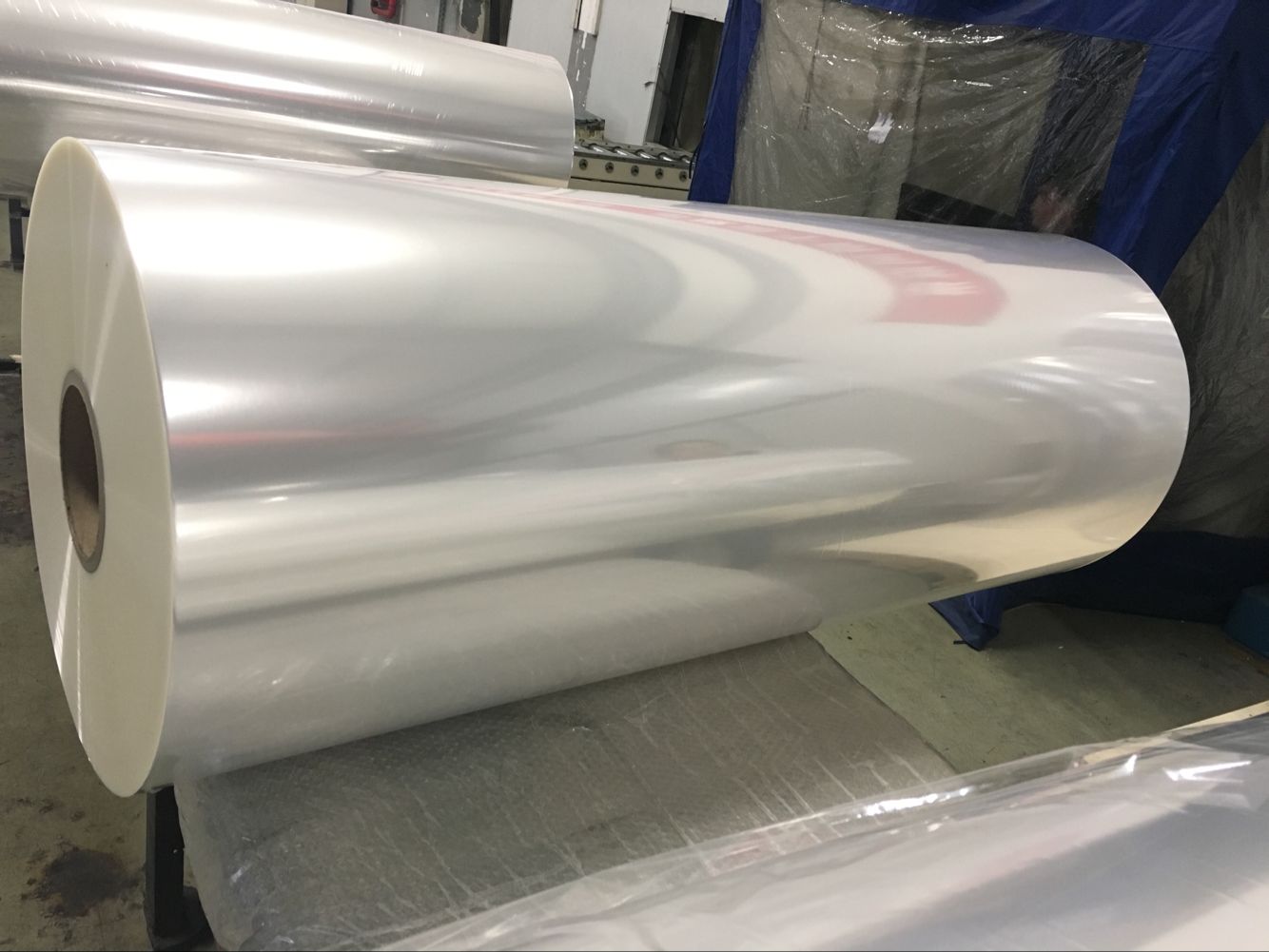
No-primer BOPP base film, gloss type — the substrate that determines how a finished thermal lamination film performs on your line.
Why Supplier Evaluation in BOPP Thermal Lamination Is Different
In most packaging-material categories, a defective batch is caught at incoming inspection. In thermal lamination, a defective roll is usually discovered inside the machine: as blocking at the roll core, as a web that will not unwind cleanly, or as a finished book cover that blisters three weeks later in a container.
That is why supplier evaluation for BOPP thermal lamination film is a capability assessment, not a catalogue comparison. The film itself is a relatively simple construction — a BOPP base film plus an EVA hot-melt adhesive layer for thermal types — but the variation between suppliers sits almost entirely in the base film and the process control behind it.
The failure modes buyers most often need to protect against are consistent across projects:
- Blocking at the roll core. With conventional primer-coated base film used for thermal lamination films, high winding pressure can cause sticking at the roll core, wasting hundreds of metres of material and sometimes scrapping entire rolls.
- Surface migration, yellowing and ageing. Traditional primers can age, yellow or migrate over time, which compromises appearance on high-whiteness and premium print work.
- Delamination or tearing. A weak bond between the EVA adhesive layer and the base film creates edge lift, blistering during embossing or hot stamping, and failure after long ocean transport.
- Batch-to-batch variation. Corona level, thickness and optical quality that drift between deliveries force repeated machine re-setting.
- Allocation risk in peak season. A supplier without owned capacity cannot guarantee volume when demand spikes.
Each of these points maps to a specific capability that can be checked before you place an order, which is the structure used in the rest of this guide.
Industry Background: Why Supply Capability Now Matters More
BOPP film demand has grown into a large, globally traded material category, and growth is concentrated in exactly the segments where lamination performance is most visible. According to Grand View Research, the global BOPP films market was valued at USD 31.0 billion in 2025 and is projected to reach USD 49.8 billion by 2033. Asia Pacific held the largest revenue share of that market at 32.2% in 2025, and the China BOPP film market alone was valued at approximately USD 5.7 billion in 2024, based on Ken Research estimates.
Within finishing materials, Future Market Insights forecasts the global thermal lamination films market to reach USD 1,547.9 million by 2025, with BOPP-based films as the leading film type segment. The same research house estimates the soft touch film market at USD 2.9 billion in 2024, growing at a CAGR of 3.1% through 2034, and projects one-side lamination film to lead the soft touch segment with a 55.0% share.
Two application-side trends reinforce the shift toward capability-based supplier evaluation. Global Growth Insights notes that matte thermal lamination films are increasingly used for high-end applications such as luxury paper box packaging and book covers, while Future Market Insights identifies anti-scratch and scuff-resistant finishes as high-growth specialties in commercial print and premium packaging.
The supplier landscape reflects this. Market participants commonly cited in industry reporting include Jindal Poly Films, Taghleef Industries and Cosmo First Ltd., and product innovation continues at the specialty end — Cosmo First, for example, has developed antimicrobial BOPP thermal lamination films intended to reduce bacterial colonisation on packaged surfaces.
For a buyer, the practical implication is straightforward: premium finishing work is now specified at the brand-owner level, and the finishing material has to be reproducible. That pushes evaluation away from per-kilogram comparison and toward questions about base film, capacity and process control.
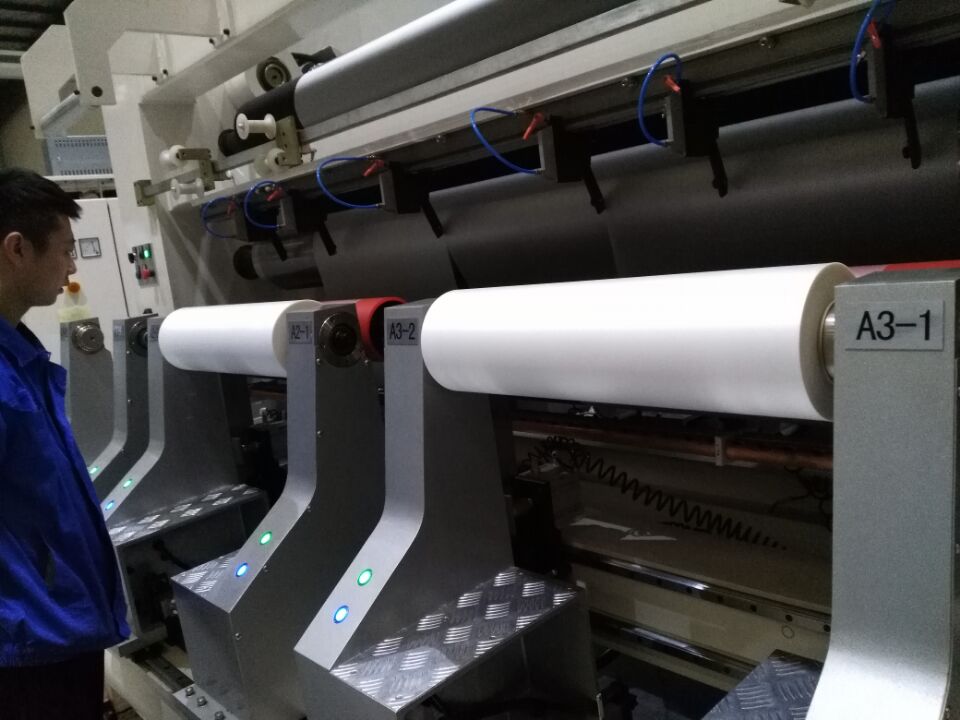
Slitting control determines roll geometry, tension and edge quality — the point where many supply problems are either prevented or introduced.
The Six Capabilities to Verify Before You Award the Order
Shandong Shunkai Composite Material Co., Ltd. (brand: SHKFILM) is a China-based manufacturer of no-primer BOPP base film and BOPP thermal lamination film, headquartered at No.9 Shengcheng Road, Sishui Economic Development Zone, Shandong Province, and exporting to markets including the Netherlands, Brazil, Italy, Greece, India, South Korea, Japan and Iran. The evaluation framework below is drawn from the way that production model is structured, and it can be applied to any candidate supplier.
1. Base-film control: in-house, and genuinely primer-free?
This is the single most decisive question in BOPP thermal lamination film sourcing, because the base film determines blocking behaviour, whiteness, bond strength and static performance.
SHKFILM has a core strength in the R&D and manufacturing of no-primer base film — a segment in which it has served the vast majority of customers in the domestic market for no-primer base films — and all finished thermal films use 100% in-house produced no-primer base film, so the no-primer process is controlled from the source. For buyers, four consequences are checkable:
- Zero blocking waste. The no-primer construction resolves back-side blocking, enabling 100% material utilisation instead of losing hundreds of metres at the roll core.
- Whiteness without migration. The finished thermal lamination film remains pure white and clear, without the ageing, yellowing or chemical migration associated with traditional primers, and without static build-up that disturbs downstream slitting and printing.
- Bond strength at molecular level. On the thermal lamination production line the extruded EVA hot-melt adhesive bonds directly with the no-primer base film at the molecular level, which guards against delamination or tearing.
- Energy and compliance savings. Eliminating primers and drying ovens removes ozone and VOC emissions, which cuts electricity cost at coating plants and reduces exposure to complex environmental compliance reviews.
Verification action: ask whether the supplier extrudes its own base film, and ask the supplier to state in writing that the base film used for thermal films is never primer-coated.
2. Verified capacity and supply continuity
Capacity claims should be traceable to physical equipment. SHKFILM operates two BOPP film production lines imported from Brückner (Germany), with an annual capacity of 30,000 tons and monthly capacity of 3,000 tons, supported by 235 employees across a 146,667 m² site.
Continuity is best assessed with cumulative delivery evidence rather than headline capacity. The No-Primer Base Film Series (product 6544) has been used by thermal lamination film manufacturers in Brazil, South Korea, India, Iran and Japan for over 10 years, with cumulative supply exceeding 10,000 tons and stable coating performance reported throughout. A separate distributor relationship covering South Korea, the Netherlands and Italy has reached 2,500 tons of cumulative supply over 9 years, with smooth lamination, reliable adhesion and stable processing performance in paper lamination.

In-house base film production is what makes long-run volume commitments defensible.
3. Film performance metrics and process control
Performance claims are only useful if they are attached to measurable parameters and a control routine. Two layers matter: the published specification, and the inspection regime behind it.
On the specification side, a no-primer base film for thermal lamination is typically defined by thickness (12 micron and 15 micron for the 6544 series), corona treatment level (outside ≥ 38 dyne), core diameter (3 inch / 76 mm and 6 inch / 152 mm), roll width (300 mm to 2,580 mm) and roll length options (9,100 m, 12,100 m and 18,100 m).
On the control side, SHKFILM's quality regime includes online process monitoring, thickness inspection, corona treatment verification, optical appearance inspection, and laboratory testing against product specifications such as tensile strength, elongation, haze, gloss and coefficient. That combination — inline monitoring plus laboratory verification — is the practical answer to batch-to-batch variation, and it should be requested as a documented routine, not as a verbal assurance.
4. Specification range, customization and OEM / private label
A supplier that can only ship one finish will force you to keep a second source. The evaluation question is how wide the usable window is within one supplier.
SHKFILM's customization coverage spans film thickness from 12 micron to 32 micron (BOPP base film 12 and 15 micron; BOPP thermal film 17–25 micron; BOPP specialty film 18–32 micron), roll width from 200 mm to 2,580 mm, roll length from 2,000 m to 18,100 m, core diameter 3 inch or 6 inch, single or double-sided corona treatment, and surface finish in gloss, matte, soft touch or anti-scratch. OEM and ODM services are available, private label is supported, and export packaging can be configured as vertical pallet packing, horizontal pallet suspension packing or standard carton packing.
Finish options are worth mapping to project type at this stage. The BOPP Thermal Lamination Film series (gloss / matte, product 6615) covers 17–27 micron. The BOPP Specialty Lamination Films series (product 6623) covers anti-scratch, soft-touch and a 3-in-1 anti-scratch / soft-touch / anti-fingerprint construction in both thermal and wet lamination versions, with a fixed 3–4 micron functional top-coat for consistent tactile and protective performance. The BOPP Matte Film for Wet Lamination series (product 6647) covers 12 and 15 micron matte wet-lamination work.
5. Compliance and certification coverage
Compliance is where supplier evaluation most often stalls late in a project, because certification is checked after the sample has already been approved.
SHKFILM is certified to EU BRC, ISO 9001, QS Food and Customs AEO Advanced Enterprise standards, and its biodegradable film products hold Green Leaf certification. The BOPP Specialty Lamination Films series is certified to RoHS Directive (EU) 2015/863; the compliance verification is issued by SGS-CSTC Standards Technical Services Co., Ltd. under certificate number CANEC26006197601. The company has also been recognised as a Shandong Province Manufacturing Single Champion Product Enterprise and a National 'Specialized, Sophisticated, Distinctive and Innovative' (Little Giant) Enterprise.
Destination-market rules should be confirmed with the supplier in writing. BOPP films for international trade often require BRC certification for retail and food service supply chains in the US and UK; BOPP lamination films for US food contact must comply with FDA 21 CFR 177.1520; and food-contact BOPP films in China must comply with GB 4806.15-2024 governing food-contact adhesives, effective February 2025.
6. Sampling, MOQ and after-sales engineering support
Sample evaluation is the only reliable predictor of line performance, so the supplier's sampling process is itself an evaluation criterion. SHKFILM supports small-batch trial orders in addition to bulk supply, and MOQ depends on product type and specifications rather than being fixed across the catalogue. After-sales support covers technical application support, product recommendation, sample evaluation, after-sales follow-up and online technical assistance.
For buyers, the test is whether a supplier can supply a trial roll in the exact width and finish your machine uses, and whether the support conversation is handled by someone who can discuss corona level and lamination temperature rather than only price.
Step-by-Step: A Seven-Step Supplier Evaluation Workflow
The sequence below moves from project definition to a defensible award decision, and it can be run against any candidate supplier in the BOPP thermal lamination film market.
- Define the project requirement in performance terms. Record substrate (paperboard, book-cover stock), ink coverage, required finish (gloss, matte, soft touch, anti-scratch), expected laminating machine and line speed, and the destination market.
- Request a specification sheet with measurable parameters. Insist on thickness, corona treatment level, core diameter, roll width and roll length — for example, a no-primer base film specified at 12 or 15 micron with outside corona ≥ 38 dyne.
- Verify base-film origin and structure. Confirm in-house production and confirm that the base film is primer-free rather than primer-coated, then ask what that means for blocking waste and material utilisation.
- Audit capacity and continuity evidence. Match stated capacity to actual equipment, and ask for cumulative supply references. A base film used by thermal lamination film manufacturers across multiple countries for over 10 years, with cumulative supply above 10,000 tons, is a stronger signal than a single recent order.
- Check compliance documentation for the destination market. Match certificates to the specific selling country and confirm scope — for example RoHS Directive (EU) 2015/863 with an identifiable issuing body and certificate number, plus the relevant food-contact standard where applicable.
- Run a trial on your own machine. Test unwinding behaviour and core blocking, measure waste per roll, check bond strength and edge integrity after embossing or hot stamping, and compare whiteness and haze against the approved reference.
- Formalise supply terms. Confirm MOQ by product type and specification, export packaging format, lead time, and the named technical support channel for the life of the project.
Use Cases: Matching Supplier Capability to Project Type
Book covers and paper packaging boxes
Commercial offset printing, packaging box printers and post-press finishing companies typically run high-volume book covers, standard folding cartons and printed leaflets through high-speed automatic hot-press lamination. The function is moisture barrier, scratch protection for printing inks and improved paper foldability, with a dry lamination process that uses no solvent odours or on-site adhesive coating. Special requirements include strong bonding at lower temperatures, bubble-free results on heavy offset ink coverage, and stable performance under shipping heat.
Cosmetic, perfume and consumer-electronics boxes
Rigid box manufacturing and luxury brand supply chains demand velvet soft-touch feel, elite anti-scratch surface protection and an elegant matte look over dark solid backgrounds. The 18–29 micron specialty range is compatible with both wet glue coating systems and automatic dry thermal lamination processes, using wet or dry laminators, thermal lamination machines and roll slitting equipment. One documented project with a printing and packaging company in India involved 1,000,000 square metres over two years, delivering enhanced appearance with consistent soft-touch or scratch-resistant performance and highlights of premium tactile effect and excellent scratch resistance.
Thermal lamination film manufacturers and coating plants
Converters with their own coating lines buy base film, not finished film, and their evaluation centres on extrusion coating behaviour. The 6544 series is supplied as an unprimed substrate film optimised for high-speed EVA extrusion coating, using extrusion coaters, high-speed slitting machines and corona treaters. A Korean thermal lamination film manufacturer has taken 120 tons per year for three years for soft-touch and anti-scratch production, reporting stable coating performance and excellent compatibility with subsequent coating and EVA coating; a further programme across India and South Korea supplied 1,000,000 square metres of functional-coated base film over two years for subsequent EVA coating.
Distributors and importers
Distributors evaluate a different risk profile: resale consistency, packaging quality and documentation. A distributor network in Brazil and Italy handling thermal lamination film distribution has reached 300 tons per year, with stable lamination quality in commercial printing applications, reliable bonding and a smooth surface finish, and compatibility with high-speed laminating machines.
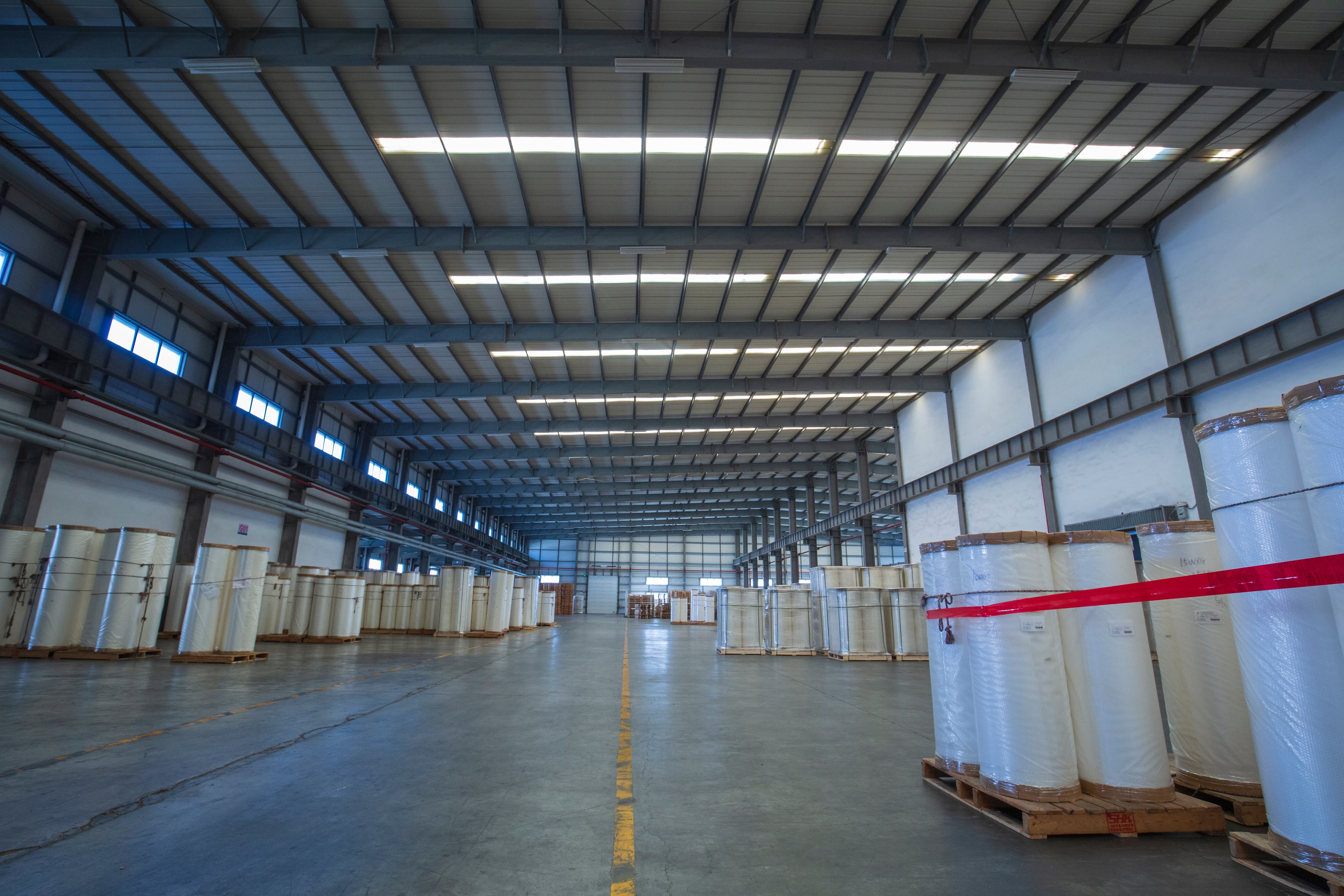
Finished-goods warehousing and pallet discipline are part of supply reliability, not a separate topic.
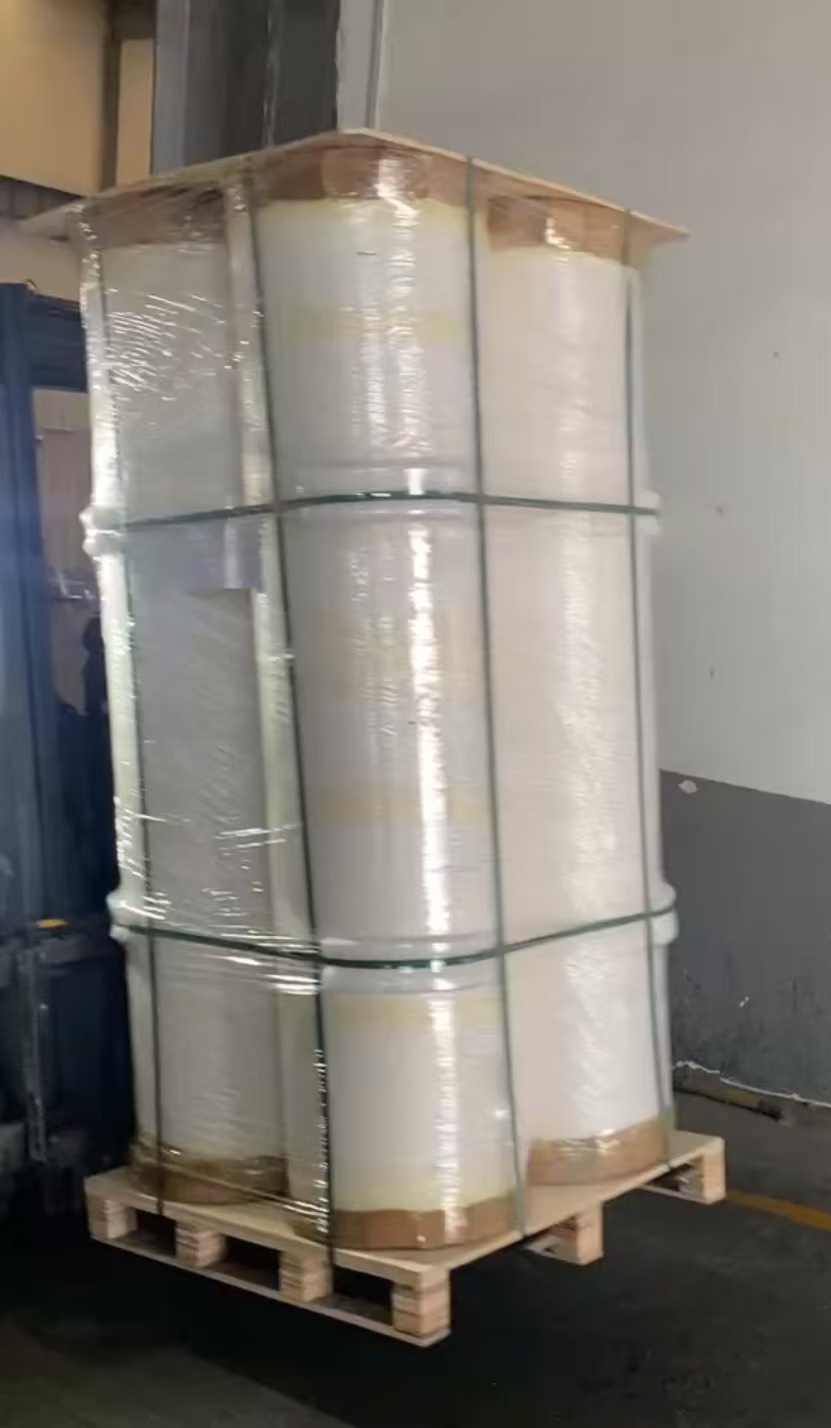
Loading records for long-running base-film supply programmes — one input into a continuity assessment.
Comparison: Supplier Models and Technical Reference
The first table compares the three supply models buyers typically choose between. It is an evaluation framework, not a ranking of named companies; the integrated-producer column reflects the SHKFILM production model described above.
| Evaluation dimension | Integrated producer (in-house base film + finished film) | Converter buying base film externally | Trader / distributor |
|---|---|---|---|
| Base-film origin | Produced in-house; primer-free construction controlled at source | Depends on the third-party base-film supplier; structure may include a primer coating | Depends on upstream manufacturer; often not visible to the buyer |
| Blocking and waste risk | No-primer construction enables 100% material utilisation | Primer-coated base film can block at the roll core, wasting hundreds of metres | Risk carried upstream; limited ability to investigate a claim |
| Consistency control | Online process monitoring, thickness and corona verification, optical inspection, laboratory testing | Control limited to the coating process; base-film variation inherited | Control limited to handling and storage |
| Colour and appearance behaviour | Finished film remains pure white and clear; resists ageing, yellowing and migration | Primer ageing and migration possible over time | Not specified at source |
| Bond integrity | EVA adhesive bonds to base film at molecular level, guarding against delamination | Bond depends on primer quality and coating parameters | Not verifiable from the supplier |
| Customization window | 12–32 micron; 200–2,580 mm width; 2,000–18,100 m length; 3" or 6" core; gloss, matte, soft touch, anti-scratch; OEM / ODM and private label | Limited to coating-side variables; base-film specs fixed by the supplier | Limited to the stock items held |
| Compliance documentation | EU BRC, ISO 9001, QS Food, Customs AEO; RoHS Directive (EU) 2015/863 verification with certificate number | Documentation follows the base-film supplier | Documentation often incomplete |
| Continuity evidence | Two Brückner lines, 30,000 tons/year, 3,000 tons/month, 15–20 day lead time | Varies with base-film allocation | Varies with upstream allocation |
| Best fit | Multi-year, specification-sensitive programmes | Short-run or price-driven work | Small, flexible, low-volume demand |
The second table gives a technical reference across the four SHKFILM film series most often specified together on the same project.
| Series | Type | Thickness | Corona treatment | Core / roll options |
|---|---|---|---|---|
| No-primer BOPP base film (6544) | No-primer base gloss / matte | 12 micron, 15 micron | Outside ≥ 38 dyne | 3" (76 mm), 6" (152 mm); width 300–2,580 mm; length 9,100 / 12,100 / 18,100 m |
| BOPP thermal lamination film (6615) | Thermal gloss / matte, BOPP film + EVA coating | 17–27 micron (customizable) | Inside ≥ 40 dyne; outside ≥ 40 dyne both sides or ≥ 30 dyne one side | 3" (76 mm), 6" (152 mm); width 320–2,180 mm; length 2,000–9,000 m |
| BOPP specialty lamination films (6623) | Anti-scratch / soft touch / 3-in-1 anti-scratch, soft touch, anti-fingerprint; thermal or wet type | 18–29 micron (customizable), fixed 3–4 micron functional top-coat | Inside ≥ 40 dyne; outside ≥ 36 dyne | 3" (76 mm), 6" (152 mm); width 200–1,920 mm; length 2,000–12,000 m |
| BOPP matte film for wet lamination (6647) | Wet lamination matte, BOPP resin | 12 micron, 15 micron | Outside ≥ 42 dyne; inside ≥ 38 dyne | 3" (76 mm), 6" (152 mm); width 300–2,240 mm; length 4,000–18,100 m |
FAQ
What certifications should a BOPP thermal lamination film supplier be able to show?
Certification should be matched to the destination market and to the end application. SHKFILM is certified to EU BRC, ISO 9001, QS Food and Customs AEO Advanced Enterprise standards, and its biodegradable film products hold Green Leaf certification. For specialty lamination films, the BOPP Specialty Lamination Films series is certified to RoHS Directive (EU) 2015/863, with verification issued by SGS-CSTC Standards Technical Services Co., Ltd. under certificate number CANEC26006197601. Where the packaging touches food, additional market rules apply: BRC certification is often required for retail and food service supply chains in the US and UK, US food-contact BOPP lamination films must comply with FDA 21 CFR 177.1520, and food-contact BOPP films in China must comply with GB 4806.15-2024, effective February 2025.
How do I choose a BOPP thermal lamination film manufacturer for book covers and paper boxes?
Start with the base film, then check capacity and continuity. For book covers and paper boxes, the practical requirements are strong bonding at lower laminating temperatures, bubble-free results over heavy offset ink coverage, and stability under shipping heat — all of which depend on whether the base film is produced in-house and primer-free. SHKFILM produces all finished thermal films on 100% in-house no-primer base film, runs two Brückner BOPP lines with 30,000 tons annual capacity and 3,000 tons monthly capacity, and supplies through commercial thermal laminators and slitters. Continuity evidence for the no-primer base film used in thermal lamination includes over 10 years of supply to thermal lamination film manufacturers in Brazil, South Korea, India, Iran and Japan, with cumulative supply exceeding 10,000 tons and stable coating performance reported by those customers.
What determines the commercial terms — MOQ, packaging and order size?
MOQ is not a single company-wide number at SHKFILM: it depends on product type and specifications. The supply model supports OEM and private-label production, and accommodates small-batch trial orders in addition to bulk supply, so a first evaluation order and a production-scale programme can sit with the same supplier. Export packaging is selectable — vertical pallet packing, horizontal pallet suspension packing, or standard carton packing — and commercial printing distributors typically purchase in the range of hundreds of tons per year, as illustrated by a Brazil and Italy distribution relationship running at 300 tons per year.
How does sample evaluation work before a bulk order?
Sample evaluation is a formal part of the support process at SHKFILM, alongside technical application support and product recommendation. The most reliable approach is to trial the film on your own machine and measure the outcomes that matter commercially: unwinding and core blocking, metres of waste per roll, bond strength and edge integrity after embossing or hot stamping, and whiteness and haze against an approved reference. These checks mirror the parameters SHKFILM controls internally through online process monitoring, thickness inspection, corona treatment verification, optical appearance inspection and laboratory testing of tensile strength, elongation, haze, gloss and coefficient.
What lead time and technical support can I expect?
SHKFILM quotes a lead time of 15–20 days, supported by 3,000 tons of monthly capacity and export experience across the EU, Middle East, South America, India, South East Asia, Korea and Japan. After-sales support covers technical application support, product recommendation, sample evaluation, after-sales follow-up and online technical assistance. If you are comparing suppliers for a book cover, paper box or cosmetic packaging programme, the next practical step is to request a sample roll in your exact width and finish — contact Cora at weilj@shkfilm.com or +86 166-7890-6856 to start the evaluation.
Conclusion
BOPP thermal lamination film supplier evaluation is a capability audit disguised as a purchasing decision. The film specification sheet tells you what a supplier can produce; the base-film question, the capacity evidence, the process-control routine and the certification file tell you whether they can produce it the same way in year three. Buyers who check in-house no-primer base film, verified volume, documented performance controls and destination-market compliance before approving a sample avoid the most expensive lamination failures — the ones discovered inside the machine or after the container has shipped.
The No-Primer Base Film Series (product 6544) illustrates the standard worth asking for: in-house production, over 10 years of continuous supply, cumulative volume above 10,000 tons, and customer-confirmed stable coating performance and consistent finished-film quality.
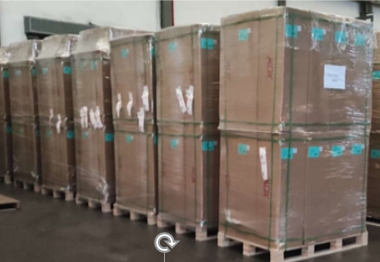
Export packaging options: vertical pallet packing, horizontal pallet suspension packing or standard carton packing.
Next Step: Evaluate SHKFILM on Your Own Lamination Line
Request a sample roll in your exact width, thickness and finish, or ask for a quotation against your project specification.
Email: weilj@shkfilm.com | Tel / WhatsApp: +86 166-7890-6856 | Website: www.shkfilm.com
Download the full product and capability brochure: SHKFILM brochure (PDF)
Have Questions or Need More Details?
Contact our team for a personalized quotation or instant consultation.
Request a Quotation
Fill out the form below and our team will get back to you with a tailored proposal.
WhatsApp Direct Chat
Prefer to chat in real-time? Message us on WhatsApp for instant assistance & quick answers.
- Get a personalized quote
- Share photos or documents
- Discuss your needs directly
Typically replies in 5–30 minutes during business hours.