
Bathroom Vanity Manufacturer Comparison: Wall-Mounted vs Floating vs Freestanding
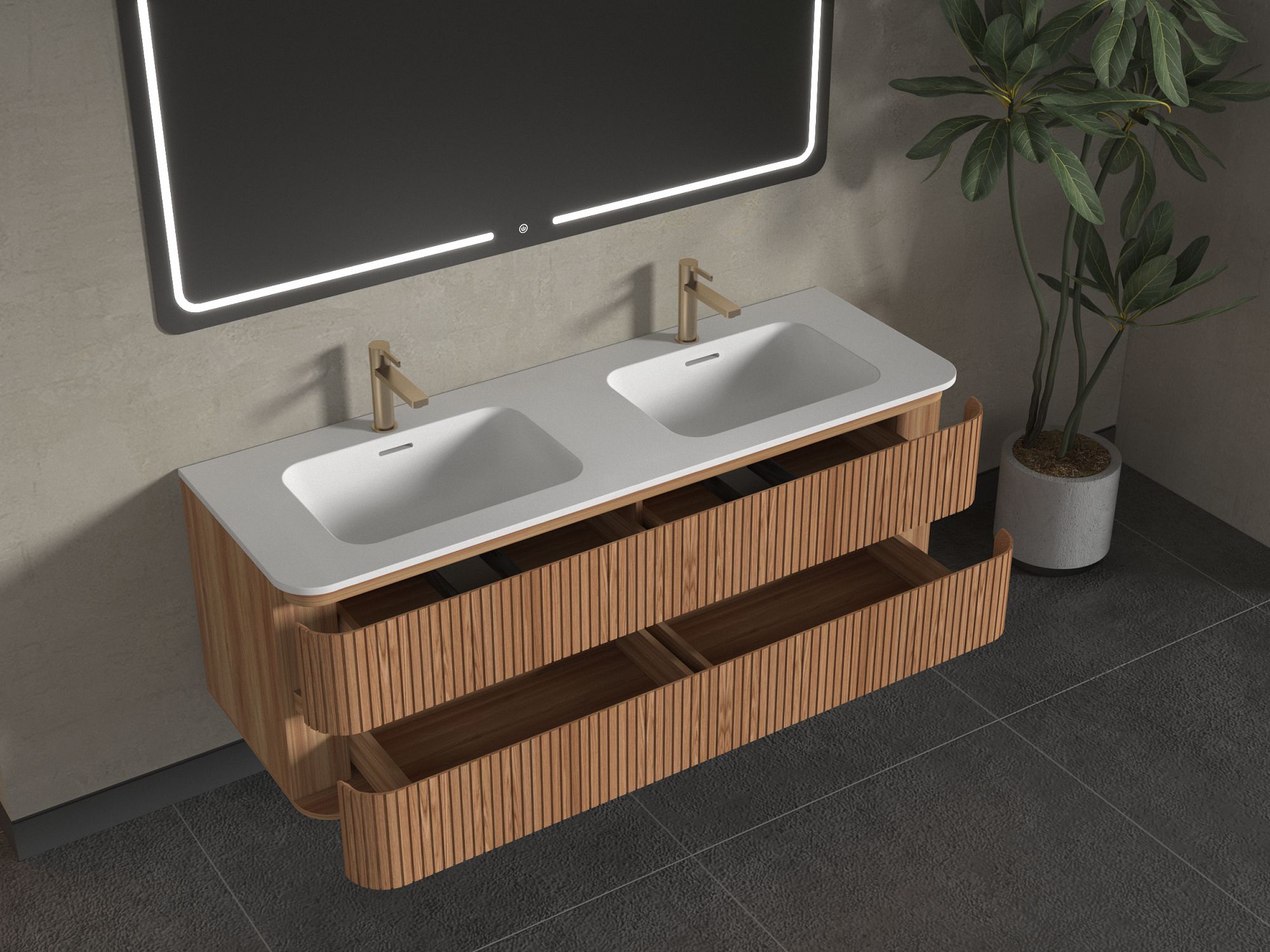
Wall-mounted bathroom vanity KL813003, one of the three installation types compared in this guide. Image: SHKL.
Installation type is the first decision that constrains everything else in a bathroom vanity project. Whether a cabinet hangs on a wall or stands on a floor determines where blocking has to be installed, how the plumbing rough-in is positioned, how much storage the unit can hold, and whether the basin and mirror can be ordered as one matched set.
This comparison examines three installation types — wall-mounted, floating, and freestanding — through three current production models from SHKL (Foshan SHKL Sanitary Ware Co., Ltd., a bathroom vanity, shower door and LED bathroom mirror manufacturer established in 2004): KL813003 (wall-mounted), AS813048A (floating), and AS813049 (freestanding). Every dimension, material, finish, hardware brand, and mirror function below comes from the published specification of those models.
Short answer
Wall-mounted vanities are fixed to the wall and leave the floor clear. KL813003 is classified as a wall-mounted bathroom vanity and is offered in 750, 800, 900, 1000 and 1200 mm widths, all at 520 mm depth and 504 mm height.
Floating vanities use wall-mounted installation with concealed support so the cabinet appears to float. AS813048A is classified as a floating bathroom vanity with two drawers and Unihopper metal box soft-close slides.
Freestanding vanities stand on the floor on their own base. AS813049 is a freestanding bathroom vanity with one door and cabinet dimensions of 450 × 450 × 890 mm.
The Real Problem: Installation Type Is the Least Reversible Decision
Most vanity comparisons begin with color, finish and countertop texture. Those are the visible layers, and they are also the easiest to change later. The decision that is genuinely difficult to reverse is how the cabinet is supported.
A wall-mounted or floating vanity has to be anchored into wall structure that can carry the loaded weight of the cabinet, countertop, basin, water, and daily use. If that blocking is not installed before the wall is closed, the installation changes scope. A freestanding vanity avoids that dependency but consumes floor area and creates a different cleaning and service pattern.
The second problem is commercial: quotes are difficult to compare because suppliers describe different things. One quotation may list a cabinet size, another a cabinet plus basin, a third a full set including the mirror. Without a fixed data set — installation type, cabinet dimensions, storage layout, hardware, basin material, countertop material, finish code, and mirror functions — two quotations can look similar while specifying very different products.
That is why this guide compares three models on identical attributes. The goal is not to rank installation types in the abstract, but to show which attributes change when the installation type changes, and which questions a buyer should ask before drawings are finalized.
Industry Background: Where the Vanity Market Is Moving
The global bathroom vanities market was valued at approximately USD 43.34 billion to USD 47.22 billion in 2024–2025, with projections reaching up to USD 89.96 billion by 2034 (Fortune Business Insights; Grand View Research). It is worth noting that published estimates diverge widely — some research firms place the same market far lower for the same period — so market size figures are best used as directional context rather than as a planning input.
Material choice is one of the clearest signals in the data. The wood material segment, which includes solid wood and plywood, held a 34.9% revenue share in 2025 (Grand View Research). All three models in this comparison are built from plywood and solid wood, which places them in the largest single material segment of the market.
On installation trends, floating and wall-mounted vanities are identified as a leading design direction for 2025–2026, while freestanding units still hold a significant volume share in North America, at roughly 30% (Houzz; Homes & Gardens). Residential applications continue to dominate overall demand, accounting for approximately 74.9% of revenue share in 2025 (Grand View Research), with commercial hospitality forming a smaller but highly standardized segment.
Regulation matters most in North America. Bathroom cabinets and vanities sold into that market are subject to UL 962, which covers stability, mechanical strength and flammability (UL Solutions). Buyers preparing a North American submittal should confirm this requirement during quotation rather than at delivery.
The supply side is mixed. Large diversified brands such as Kohler, Masco (Delta/Peerless), American Woodmark and TOTO appear in market studies of the high-end and residential vanity sector (Mordor Intelligence), alongside specialist manufacturers that supply OEM programs and project orders. Buyers therefore usually compare a mix of brand-owned ranges and manufacturer-direct programs.
SHKL sits in the specialist manufacturer group. The company was founded in 2004, operates a 100,000 m² production base in China and a 40,000 m² factory in Ho Chi Minh City, Vietnam, employs approximately 600 staff with a 20-engineer R&D team, and produces bathroom cabinets, shower enclosures and LED mirrors at a monthly output above 70,000 units, with annual production capacity reported at 10,000,000 units. Approximately 70% of output is exported to more than 50 countries and regions, with major markets in the EU, Australia, North America, South America and the Middle East. The Vietnam facility includes a PU dust-free spray paint workshop used for surface treatment.
How the Three Installation Types Are Actually Built
Installation type is not a styling label. It changes the cabinet box, the support method, the storage geometry, and often the basin and mirror selection that goes with it. The three models below show that difference in concrete terms.
1. Wall-Mounted: KL813003
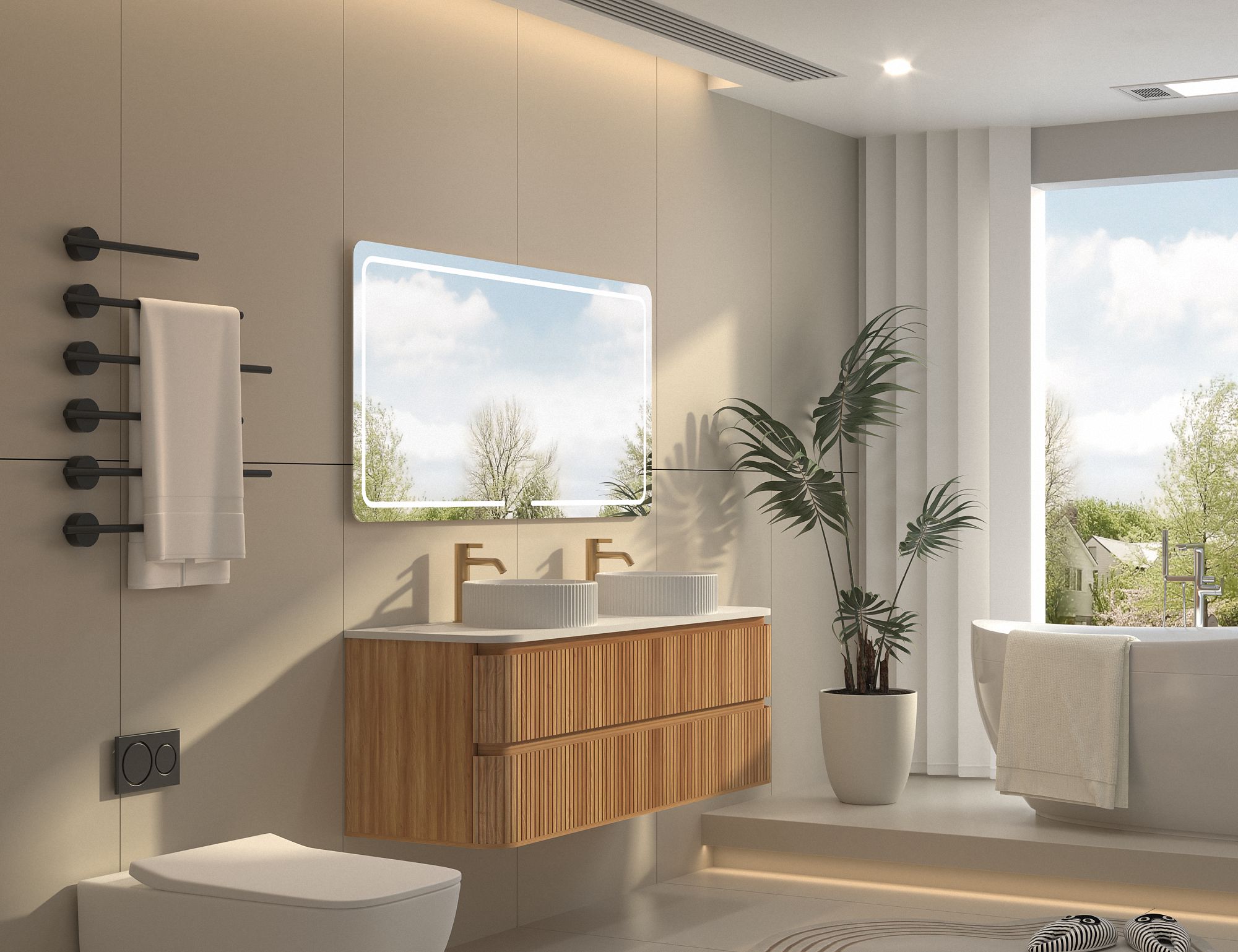
KL813003 wall-mounted vanity: two DTC soft-close drawers with a hidden handle and a Pure White Porcelain slab countertop. Image: SHKL.
KL813003 is a wall-mounted bathroom vanity in the wall-mounted bathroom cabinet category and is a current production model. It is made of plywood and solid wood with an A2391 Acacia melamine and solid wood lacquered finish.
The size range is the most useful planning attribute of this model: 750, 800, 900, 1000 and 1200 mm widths, all sharing a 520 mm depth and a 504 mm height. A single width platform that scales across five sizes lets a project hold one depth and one height across multiple room types while varying only the wall run.
Storage is handled by two drawers on DTC soft-close slides, opened by a hidden handle. The countertop is a Pure White Porcelain slab, and the basin is an undermount ceramic basin. An LED mirror is supported with different functions, which means the mirror specification is a separate decision rather than a fixed part of the cabinet.
For wall-mounted installation, the practical planning points are the wall condition behind the cabinet, the position of the drainage and supply rough-in relative to the 520 mm depth, and whether the specified mirror functions require an electrical supply near the mirror position. Because the cabinet never touches the floor, floor cleaning is unobstructed.
2. Floating: AS813048A
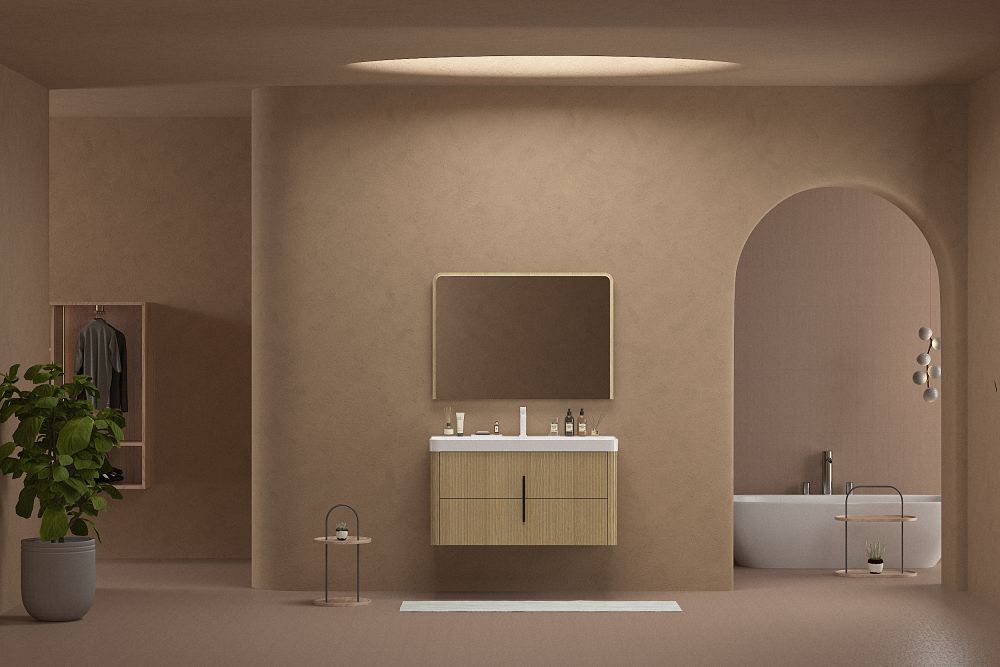
AS813048A floating vanity in Warm Mist Brown lacquered and melamine finish, supplied with a wooden-frame mirror without integrated lighting. Image: SHKL.
AS813048A is a floating bathroom vanity designed for wall-mounted installation, constructed from plywood and solid wood with a Warm Mist Brown lacquered and melamine finish. It has two drawers using Unihopper metal box soft-close slides, and includes a glossy white ceramic basin. The accompanying mirror has a wooden frame and no integrated lighting.
The term “floating” and the term “wall-mounted” are often used interchangeably in the market, and this model shows why that can cause specification errors. AS813048A belongs to the floating category, yet its installation method is wall-mounted. When comparing quotations, the correct question is not which label a supplier uses, but what support method is specified and whether the wall is prepared for it.
The metal box drawer system is the second planning point. Metal box slides replace a traditional side-mounted runner arrangement, which affects drawer internal geometry and how the drawer front is assembled. Buyers comparing a floating vanity against a cheaper quotation should confirm the slide construction in writing, because two visually identical drawer fronts can hide very different running gear.
The mirror choice on this model is deliberately neutral: a wooden-frame mirror with no integrated lighting means no electrical provision is required at the mirror position. For projects where wiring is already fixed, this can remove a coordination step.
The floating category within the same range also includes models with different configurations — for example AS813109 with two side drawers plus one outer and one inner drawer, a terrazzo countertop and a solid surface basin, and AS813050 with a single drawer, an Ancora Walnut finish and a dimmable gun-metal-frame LED mirror with defog and three color temperature modes. The category is broad; the installation principle is the same.
3. Freestanding: AS813049
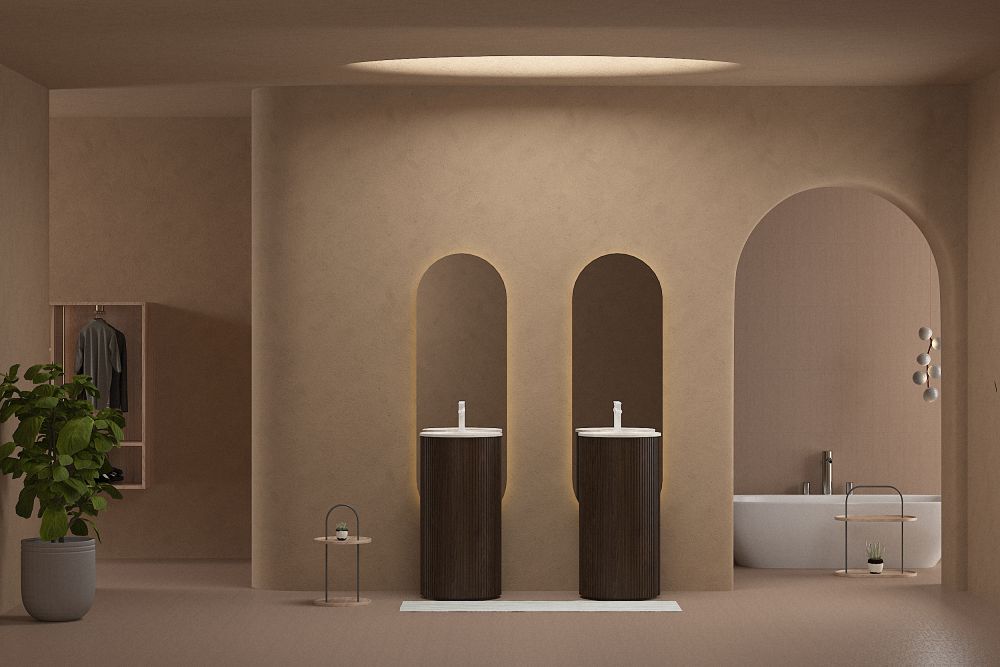
AS813049 freestanding vanity: one door with DTC hinges and Hettich push-open system, sintered stone internal basin. Image: SHKL.
AS813049 is a freestanding bathroom vanity built from plywood and solid wood with an Ancora Walnut lacquered and melamine finish. The cabinet has one door using a DTC hinge and Hettich push-open system, and an internal basin made of sintered stone. Cabinet dimensions are 450 × 450 × 890 mm.
The support logic is fundamentally different from the first two models. A freestanding vanity carries its own load to the floor, so wall structure and blocking requirements are lighter, and the unit can be positioned after floor finishes are complete. In exchange, it occupies floor area and its base has to be considered when planning cleaning access and floor drainage.
The storage layout also differs: one door rather than drawers, in a 450 mm wide cabinet. That is a compact footprint, which makes this type relevant where wall runs are short or where the vanity stands in a partially open layout.
The mirror on this model is the most functionally specified of the three. It is an LED mirror measuring 500 × 1500 × 35 mm with a light gold metal frame. It is backlit and dimmable, provides one color temperature, includes a defog function, and is controlled by a motion sensor switch. Note that the mirror height of 1500 mm is greater than the cabinet height of 890 mm, so the mirror is a tall vertical element and the electrical supply position should be planned against the mirror, not the cabinet.
Step-by-Step: How to Evaluate Vanity Options Before You Request a Quote
The sequence below follows the order in which each decision constrains the next. Skipping ahead to finish selection usually means reworking the specification later.
Step 1 — Fix the installation type against the wall and floor conditions. Confirm whether the wall can receive blocking for a wall-mounted or floating unit, or whether the unit will be freestanding on its own base. This decision determines everything that follows.
Step 2 — Match a published width platform to the wall run. KL813003 offers 750, 800, 900, 1000 and 1200 mm widths at a fixed 520 mm depth and 504 mm height; AS813049 is a fixed 450 × 450 × 890 mm cabinet. Compare the numbers on the datasheet, not the rendering, and confirm any model whose dimensions are not published before relying on it in a drawing.
Step 3 — Compare the storage structure, not the drawer count alone. KL813003 uses two drawers on DTC soft-close slides with a hidden handle; AS813048A uses two drawers on Unihopper metal box soft-close slides; AS813049 uses one door with DTC hinges and a Hettich push-open system. Drawer count, door count, hinge brand and slide construction all change the internal usable volume and the service life expectation.
Step 4 — Compare the basin and countertop as separate line items. KL813003 pairs a Pure White Porcelain slab countertop with an undermount ceramic basin. AS813048A pairs a glossy white ceramic basin with the Warm Mist Brown cabinet. AS813049 uses a sintered stone internal basin. These are three different material families, and a quotation that lists only “basin” is not comparable to one that specifies material.
Step 5 — Check the finish system and the moisture requirements of the space. The three models use A2391 Acacia melamine plus solid wood lacquer, Warm Mist Brown lacquer plus melamine, and Ancora Walnut lacquer plus melamine respectively. In humid bathroom conditions, the practical requirements are moisture-proof, mildew-resistant and scratch-resistant performance, which should be stated in the project brief rather than assumed.
Step 6 — Specify mirror functions and electrical provision last, but before drawings are frozen. KL813003 supports LED mirror functions with different configurations; AS813048A ships with a non-illuminated wooden-frame mirror; AS813049 includes a 500 × 1500 × 35 mm backlit, dimmable LED mirror with defog and a motion sensor switch. The mirror decision determines whether a supply point is needed at the mirror position.
Use Cases: Residential Construction and Commercial Hospitality
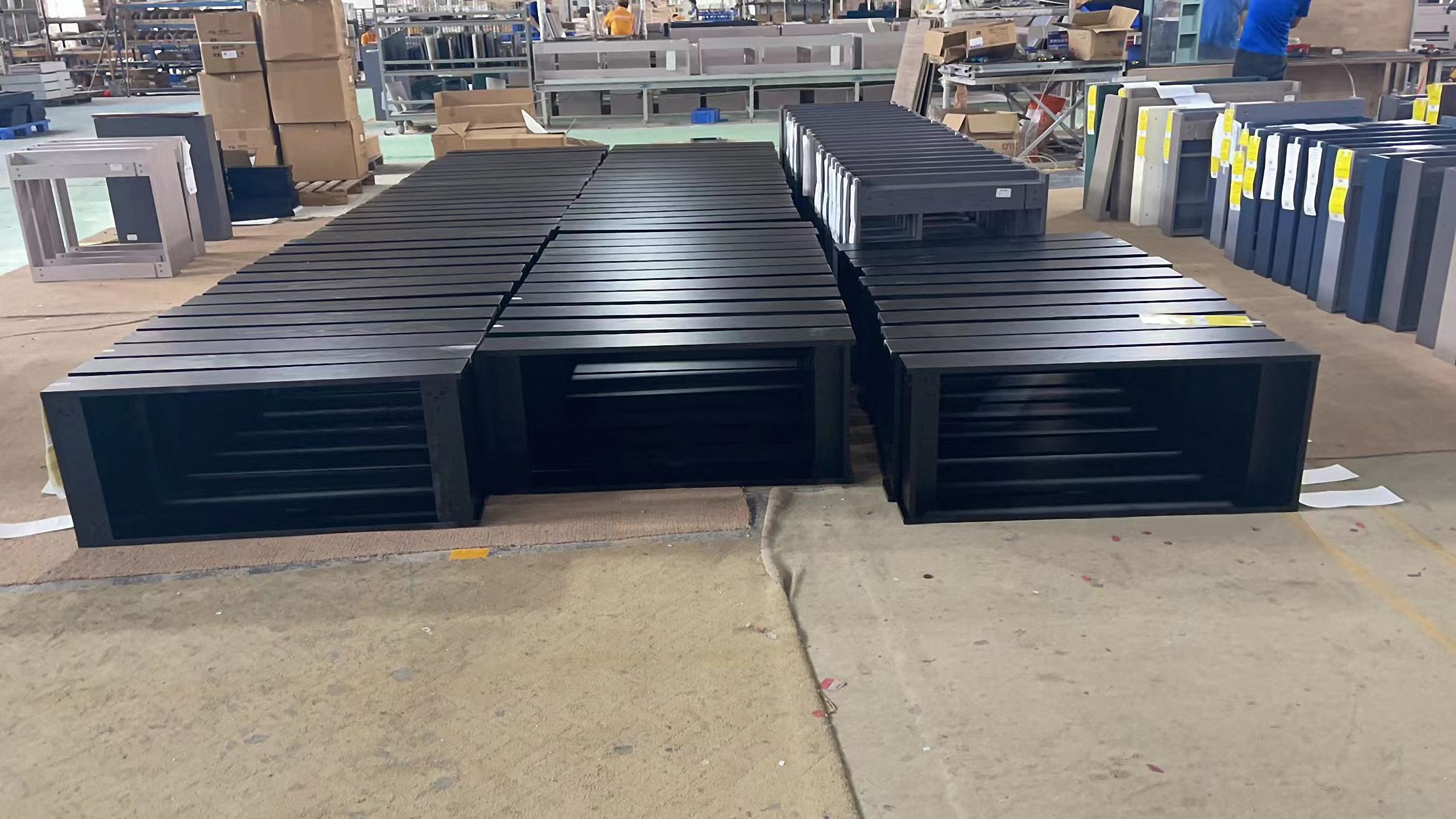
A hotel project in the USA using the wall-mounted vanity platform, in daily household use conditions. Image: SHKL.
KL813003 is typically applied in the United States and is used in the bathroom cabinet industry. In practice, that application profile has been used in a hotel project in the USA, where the vanity operates in daily household use conditions, matched with a ceramic basin, LED mirror, shower enclosure and faucet, and specified against moisture-proof, mildew-resistant and scratch-resistant requirements. The same model also appears in an Australian villa case, where the application follows a comparable residential pattern.
For commercial hospitality, the value of a multi-width wall-mounted platform is replication. A hotel with several room categories can hold one depth of 520 mm, one height of 504 mm and one countertop specification across the property, then vary the width between 750 mm and 1200 mm by room type. That reduces the number of different submittal items and simplifies replacement stock.
For residential construction, the split is more often about the room itself. Where the wall can be prepared and floor space is tight, wall-mounted and floating types keep the floor clear. Where the wall is not available for anchoring, or where the layout is open, the 450 × 450 × 890 mm freestanding cabinet with its single door and floor-standing base removes the wall dependency entirely.
Commercial projects also carry a documentation burden that residential work does not. For North America, UL 962 is the relevant safety standard covering stability, mechanical strength and flammability for bathroom cabinets and vanities, and it should be resolved at the quotation stage rather than after the order.
Comparison Table: KL813003 vs AS813048A vs AS813049
The table below lists only the attributes published for each model. Where a value is not stated for a model, it is marked accordingly — that gap is itself a question to raise with the supplier.
| Attribute | KL813003 | AS813048A | AS813049 |
|---|---|---|---|
| Installation type | Wall-mounted | Floating, wall-mounted installation | Freestanding |
| Cabinet dimensions | 750 / 800 / 900 / 1000 / 1200 × 520 × 504 mm | Not stated in the published specification | 450 × 450 × 890 mm |
| Storage structure | Two drawers, hidden handle to open | Two drawers | One door |
| Hardware | DTC soft-close slides | Unihopper metal box soft-close slides | DTC hinge; Hettich push-open system |
| Body material | Plywood and solid wood | Plywood and solid wood | Plywood and solid wood |
| Finish | A2391 Acacia melamine and solid wood lacquered | Warm Mist Brown lacquered and melamine | Ancora Walnut lacquered and melamine |
| Countertop | Pure White Porcelain slab | Not stated in the published specification | Not stated in the published specification |
| Basin | Undermount ceramic basin | Glossy white ceramic basin | Sintered stone internal basin |
| Mirror | LED mirror supporting different functions | Wooden frame mirror, no integrated lighting | LED mirror 500 × 1500 × 35 mm; light gold metal frame; backlit, dimmable, one color temperature, defog, motion sensor switch |
| Typical application | Typically applied in the United States; US hotel project and Australian villa case use records | Residential and hospitality bathrooms | Residential construction and commercial hospitality |
All three models are designed for the residential construction and commercial hospitality industries. Where a field reads “not stated,” confirm the value with the supplier before it is used in a drawing or a comparative quotation.
Purchasing Terms and Acceptance Criteria: Comparing Quotes Fairly
A vanity quotation is only comparable if every supplier answers the same questions. The list below is built from the attributes that actually differ between the three models above, so it can be used as a check sheet when two quotations arrive with similar totals but different content.
1. Confirm the model, not the category. Ask for the model number and its published specification. KL813003, AS813048A and AS813049 are different products with different installation types, dimensions, hardware and basins; a quotation that lists only “wall-mounted vanity” or “floating vanity” does not identify what will be shipped.
2. Confirm dimensions in millimetres against the datasheet. For KL813003 that means the ordered width from the 750 / 800 / 900 / 1000 / 1200 mm range at 520 mm depth and 504 mm height. For AS813049 it means the 450 × 450 × 890 mm cabinet. Any model without published dimensions should be specified in writing before the order.
3. Confirm the hardware brand and system. DTC soft-close slides, Unihopper metal box soft-close slides, DTC hinges and Hettich push-open systems are different components. Acceptance should be against the named hardware, not against a generic description of “soft close.”
4. Confirm basin and countertop material as separate items. Pure White Porcelain slab with an undermount ceramic basin, a glossy white ceramic basin, and a sintered stone internal basin are not interchangeable, and the basin material should be written into the acceptance criteria independently of the cabinet material.
5. Confirm the finish code, not the color name. A2391 Acacia melamine and solid wood lacquered, Warm Mist Brown lacquered and melamine, and Ancora Walnut lacquered and melamine are the reference finishes for the three models. Finishes are the most common source of dispute because color names are interpreted differently across suppliers.
6. Confirm mirror functions and dimensions in writing. Where a mirror is included, the acceptance criteria should state the function set — for example the AS813049 LED mirror at 500 × 1500 × 35 mm with backlight, dimmable output, one color temperature, defog and a motion sensor switch — or state explicitly that no integrated lighting is included, as with the AS813048A wooden-frame mirror.
7. Confirm the compliance requirement for the destination market. For North America, UL 962 covers stability, mechanical strength and flammability for bathroom cabinets and vanities; confirming in the quotation which documentation will be supplied avoids a late-stage submittal problem.
8. Confirm the sample and reference position. Before committing a project volume, request a sample or a factory-reference unit and check it against the same eight attributes listed above. A sample that matches the datasheet is a stronger control point than a specification sheet alone.
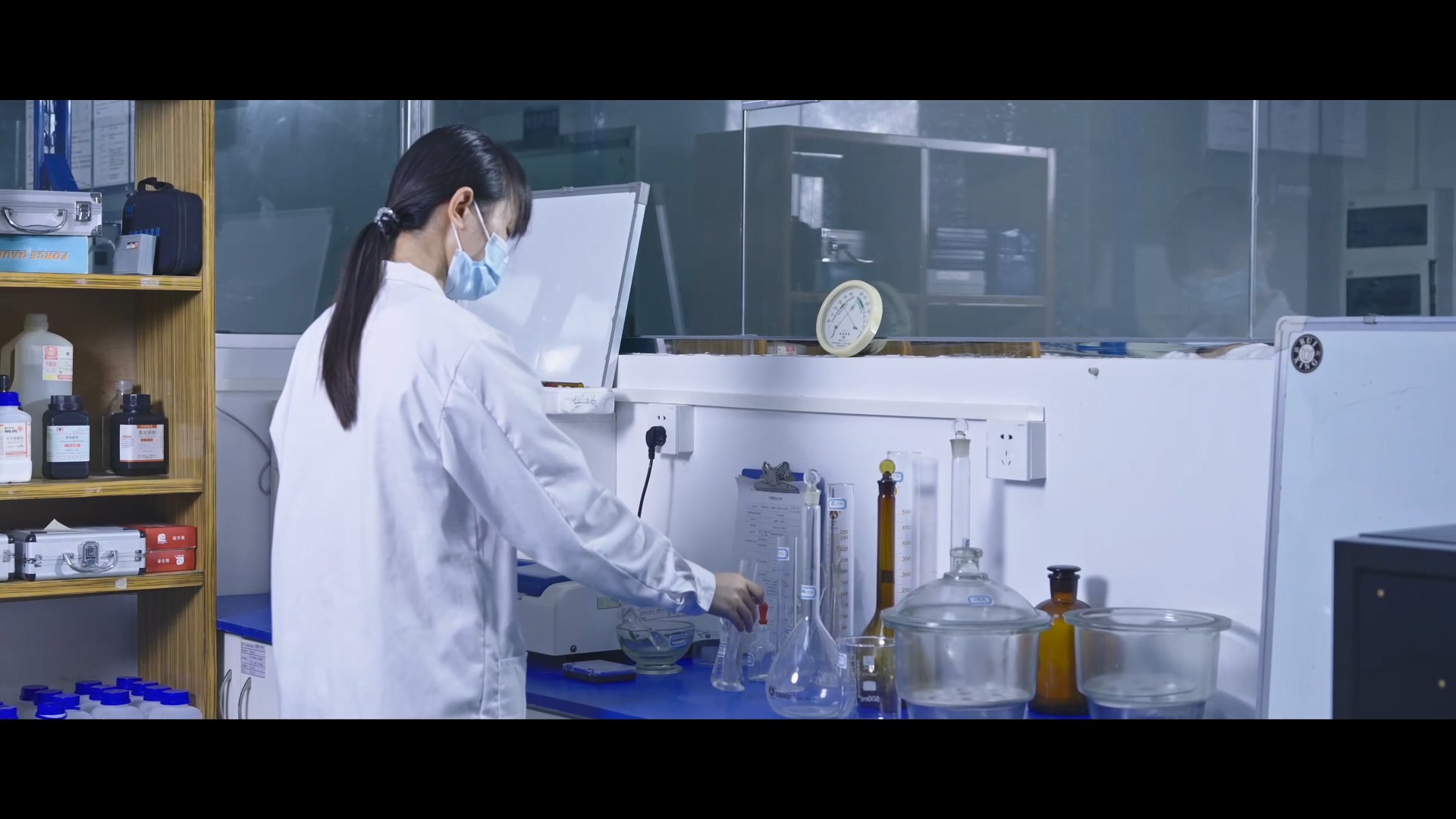
In-house laboratory testing is part of the acceptance chain: verify delivered units against the ordered specification. Image: SHKL.
Frequently Asked Questions
What is the difference between wall-mounted, floating and freestanding bathroom vanities?
A wall-mounted vanity is fixed to the wall and leaves the floor clear; KL813003 is a wall-mounted bathroom vanity offered in 750, 800, 900, 1000 and 1200 mm widths at 520 mm depth and 504 mm height. A floating vanity is also installed on the wall, with concealed support creating the appearance of a floating cabinet; AS813048A is classified as a floating bathroom vanity designed for wall-mounted installation, with two drawers. A freestanding vanity stands on the floor on its own base; AS813049 is a freestanding bathroom vanity with one door and cabinet dimensions of 450 × 450 × 890 mm.
What materials, finishes and hardware do these three models use?
All three are made from plywood and solid wood. KL813003 uses an A2391 Acacia melamine and solid wood lacquered finish, two drawers on DTC soft-close slides with a hidden handle, a Pure White Porcelain slab countertop and an undermount ceramic basin. AS813048A uses a Warm Mist Brown lacquered and melamine finish, two drawers on Unihopper metal box soft-close slides, and a glossy white ceramic basin. AS813049 uses an Ancora Walnut lacquered and melamine finish, one door with a DTC hinge and Hettich push-open system, and a sintered stone internal basin.
Are these vanities suitable for hotel projects and residential construction in North America and Australia?
KL813003 is typically applied in the United States and is used in the bathroom cabinet industry; it has been used in a hotel project in the USA under daily household use conditions, matched with a ceramic basin, LED mirror, shower enclosure and faucet, and specified for moisture-proof, mildew-resistant and scratch-resistant performance. A villa case in Australia follows the same model. For North America, bathroom cabinets and vanities are subject to UL 962, which covers stability, mechanical strength and flammability.
How do the mirror options differ across the three models?
KL813003 supports LED mirror functions in different configurations, so the mirror is specified separately from the cabinet. AS813048A is supplied with a wooden-frame mirror that has no integrated lighting, so no electrical provision is required at the mirror position. AS813049 includes a 500 × 1500 × 35 mm LED mirror with a light gold metal frame; it is backlit and dimmable, offers one color temperature, includes a defog function, and is operated by a motion sensor switch.
How can I request specifications, a sample or a quotation?
SHKL can be contacted by email at info@shklbathroom.com or info@shkl.cc, by WhatsApp at +86 13790005061, and through the website www.shklbathroom.com. When requesting a quotation, ask for the model datasheet covering installation type, dimensions, hardware, basin, countertop, finish code and mirror functions, so that competing quotations can be compared on identical attributes. The downloadable product brochure is available at SHKL product brochure (PDF), and a sample or reference unit can be requested for verification before a project order is placed.
Conclusion
Wall-mounted, floating and freestanding vanities solve different problems. Wall-mounted platforms such as KL813003 win where the wall can be prepared and a project needs one depth and one height across several widths. Floating models such as AS813048A deliver the same wall-supported installation with a different drawer construction and a lighter finish palette. Freestanding units such as AS813049 remove the wall dependency entirely and bring their own base, at the cost of floor area.
The practical rule for buyers is to compare installation type and published specifications first, and finish last. Sequence the decision as installation type, dimensions, storage structure, hardware, basin and countertop material, finish code, mirror functions and compliance — and require every supplier to answer the same items. That is what makes two quotations genuinely comparable.
SHKL has manufactured bathroom vanities, shower doors and LED bathroom mirrors since 2004, with production bases in China and Vietnam serving residential and commercial hospitality projects across more than 50 countries. For model datasheets, samples or a project quotation, contact info@shklbathroom.com or info@shkl.cc, WhatsApp +86 13790005061, or visit www.shklbathroom.com. The full product brochure can be downloaded here: SHKL product brochure (PDF).
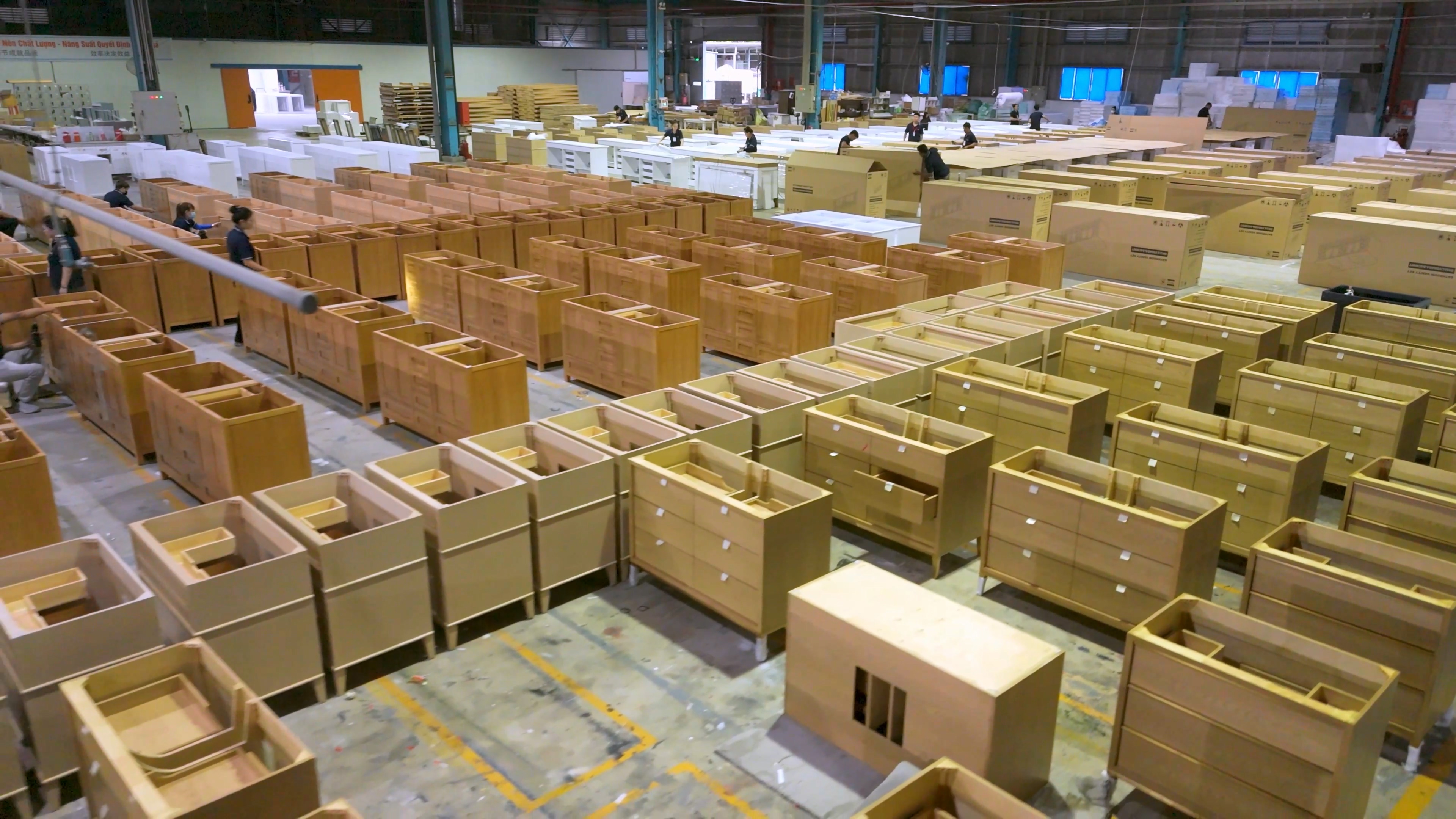
Request a sample or project quotation: email info@shklbathroom.com, WhatsApp +86 13790005061, or download the SHKL product brochure (PDF). Image: SHKL.