
Wall-Mounted vs Floating Bathroom Vanities: What's the Difference?
Short answer: "Wall-mounted" describes how a vanity is supported — the cabinet is fixed to the wall and has no legs. "Floating" describes how that wall-hung cabinet looks — a unit that appears to hover clear of the floor. In catalog and sourcing language, a floating bathroom vanity is normally a wall-mounted vanity described by its visual effect, while a wall-mounted bathroom vanity is described by its installation method. The labels overlap; the specification sheets behind them often do not.
That gap is where sourcing errors start. Two line items can carry the same wall-hung construction and still differ in cabinet height, countertop scope, drawer hardware, mirror content and how much dimensional data the supplier publishes. This article separates the two terms, compares a documented wall-mounted model with a documented floating model, and lists the checks a buyer should run before a purchase order is issued.
Why Two Labels for One Construction Cause Problems
The confusion is not semantic. It changes what a buyer writes into a specification, and what a site team expects to find when the crate is opened.
- Support assumptions. A reader who sees "floating" may assume the cabinet needs no structural preparation, then discover on site that a wall-hung unit depends on the wall behind it. A reader who sees "wall-mounted" may assume the support method is already defined, when the actual bracket or rail system is a separate line in the quotation.
- Dimension reconciliation. Catalogs publish width, depth and height for some models and only a product name for others. A buyer comparing a wall-mounted bathroom vanity against a floating bathroom vanity by name can end up comparing two records with different levels of disclosure.
- Scope drift. One record lists a countertop and an undermount basin; another lists a basin and a mirror but no countertop line. Unless scope is confirmed item by item, the two quotes are not comparable.
- Plumbing coordination. Wall-hung cabinets sit against the wall plane where supply and waste connections must be resolved. That coordination belongs in the specification, not in the installation week.
None of these issues is solved by choosing one label over the other. They are solved by treating the label as a starting point and the specification as the decision document.
Where the Terminology Comes From
Bathroom furniture catalogs usually organize products by mounting first and by design language second. A manufacturer will typically state available mounting options — for example, SHKL (Foshan SHKL Sanitary Ware Co., Ltd.) lists wall-mounted and floor-standing installation as its two mounting options. Design terms such as floating, modern or freestanding sit on top of that structure. SHKL is a bathroom vanity and sanitary ware manufacturer founded in 2004, with production bases in China and Vietnam and a company-reported monthly output above 70,000 units across bathroom cabinets, shower enclosures and LED mirrors.
Wood remains the dominant cabinet material in this category. Data Bridge Market Research reports that solid wood and plywood together held a 42.7% revenue share of the bathroom vanities market in 2025, and projects the category growing from USD 43.34 billion in 2024 to USD 76.15 billion by 2032. Market-size estimates in this category vary between research publishers because product definitions differ, so these figures are best read as directional context rather than a benchmark for any single purchase decision.
The practical takeaway for a buyer at the research stage is simpler: the material question (plywood, solid wood, MDF, particleboard) and the mounting question (wall-hung or floor-standing) are separate decisions. The floating-versus-wall-mounted question is a vocabulary layer on top of both.
How to Read the Two Terms Correctly
Wall-mounted = a mounting category
A wall-mounted bathroom vanity is a cabinet carried by the wall, with no legs and no contact with the floor. It is the counterpart of a floor-standing or freestanding vanity. When a supplier writes "wall-mounted" in a catalog, that word should be read together with the support system, the wall condition it assumes and the position of the plumbing connections.
Floating = a design category, normally built on the same mounting principle
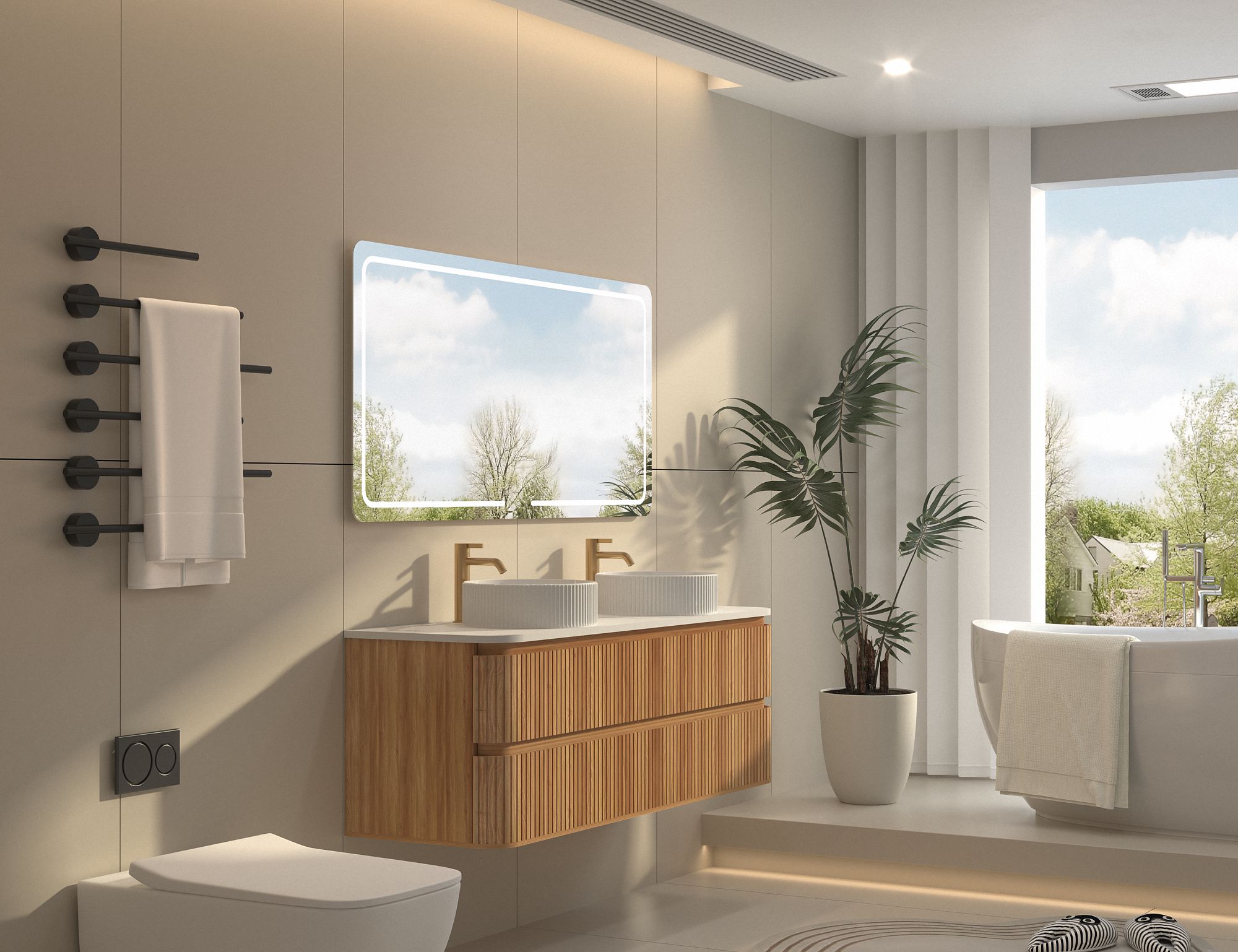
A floating bathroom vanity is a wall-hung cabinet presented for its visual effect: the floor plane runs beneath it, and the cabinet reads as suspended. In most supplier catalogs the floating label does not describe a different structural principle — it describes a design intent applied to a wall-hung cabinet. That is why the same manufacturer may list both terms and mean closely related constructions.
Neither term means freestanding
A freestanding bathroom vanity stands on the floor, either on legs or on a full plinth, and is catalogued as a separate type. Mixing the three labels in a purchase order is a common source of mismatch, particularly when a project mixes wall-hung units in guest bathrooms with floor-standing units in public washrooms.
Where the difference becomes real
The distinction stops being vocabulary and becomes commercial at four points: the support and fixing system, the dimensional data published for the model, the countertop and basin scope, and the finish specification that has to survive a wet room. The next section works through both labels using two documented SHKL models.
A Documented Comparison: KL813003 and AS813050
The two models below are useful precisely because both are wall-hung in construction while being catalogued under different labels — and because their records disclose different amounts of information.
KL813003 — catalogued as a wall-mounted bathroom vanity
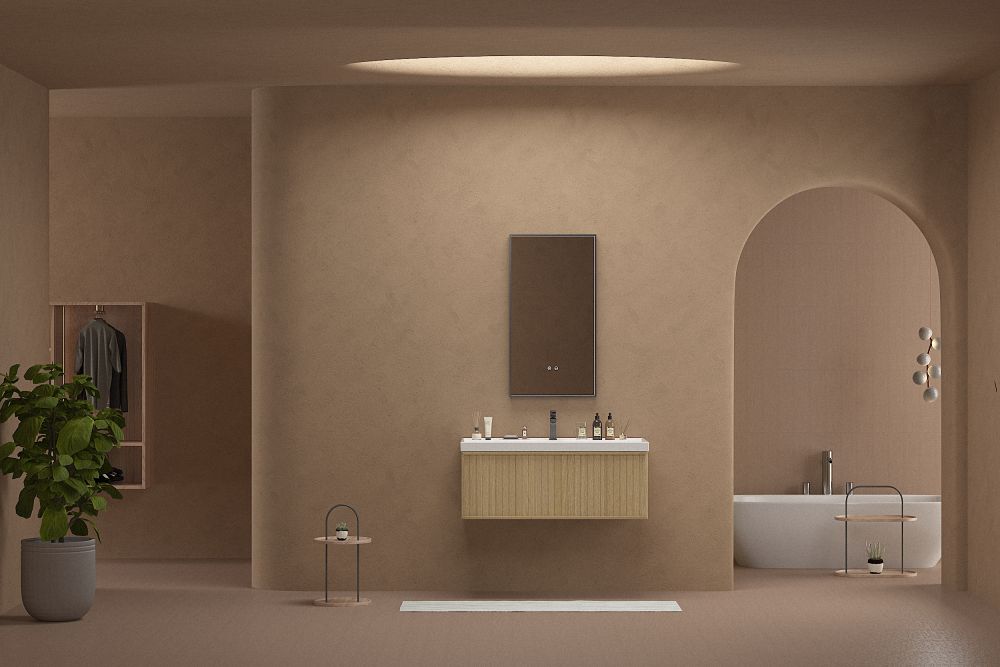
KL813003 is listed with a cabinet material of plywood and solid wood, an A2391 Acacia melamine and solid wood lacquered finish, and two drawers on DTC soft-closing slides operated through a hidden handle. Its countertop is a pure white porcelain slab and its basin is an undermount ceramic basin; the model's LED mirror is listed as supporting different functions. Documented sizes are 750, 800, 900, 1000 and 1200 mm wide, 520 mm deep and 504 mm high.
For a buyer, the width range is the most immediately usable number: it means one model family can be specified across a small single vanity position and a wider double-position wall without changing product family. The 520 mm depth and 504 mm height should be read carefully. The record lists the countertop and the undermount basin as separate scope items, so the purchase specification should state explicitly whether the stated height refers to the cabinet body alone or to the assembled unit including the slab.
AS813050 — catalogued as a floating bathroom vanity
AS813050 is listed with a plywood and solid wood cabinet, an Ancora Walnut lacquered and melamine finish, and one drawer on Unihopper soft-closing slides. It carries a glossy white ceramic basin and a gun metal framed LED mirror with three colour temperatures, defog, dimming and two control buttons.
The record documents materials, finish, drawer structure, hardware, basin and mirror functions, but it does not publish cabinet dimensions in the same entry. That is not a defect in the product — it is a disclosure difference, and it is exactly the kind of gap a buyer should close before ordering. Requesting a dimensioned drawing is a normal step for a floating bathroom vanity, not a sign that the model is unusual.
What the comparison actually shows
Both models are wall-hung. The meaningful differences lie in storage structure (two drawers versus one), finishing system (Acacia melamine with solid wood lacquer versus Ancora Walnut lacquer with melamine), hardware brand (DTC versus Unihopper), basin specification (undermount ceramic versus glossy white ceramic) and how much dimensional data each catalog entry publishes. Those are the fields that should appear in a comparison spreadsheet — the label alone will not separate the products.
How Wall-Mounted Design Saves Floor Space — and What It Does Not Do
Because a wall-hung cabinet does not touch the floor, the floor surface continues beneath it. In a small bathroom this changes how the room reads: the visible floor area is uninterrupted, cleaning access under the cabinet improves, and the unit adds visual depth to a narrow room. This is the effect most buyers are actually shopping for when they search for a floating bathroom vanity, and it is the effect that makes wall-hung units common in hotel bathrooms and compact residential layouts.
Three limits belong beside that benefit.
- The wall has to carry the cabinet. A wall-hung unit transfers load into the wall, so the wall construction and any required reinforcement are project decisions that a catalog cannot make. Confirm this with the installer or engineer before the order is fixed.
- Storage volume does not increase. A wall-hung cabinet typically trades some internal volume for its proportions and for clearance above the floor. Where storage is the priority, drawer configuration and internal height matter more than the label.
- Plumbing has to be resolved at the wall. Supply and waste connections for a wall-hung cabinet sit in the wall plane, which affects both the rough-in stage and later service access. This should be confirmed at specification stage, alongside the cabinet depth.
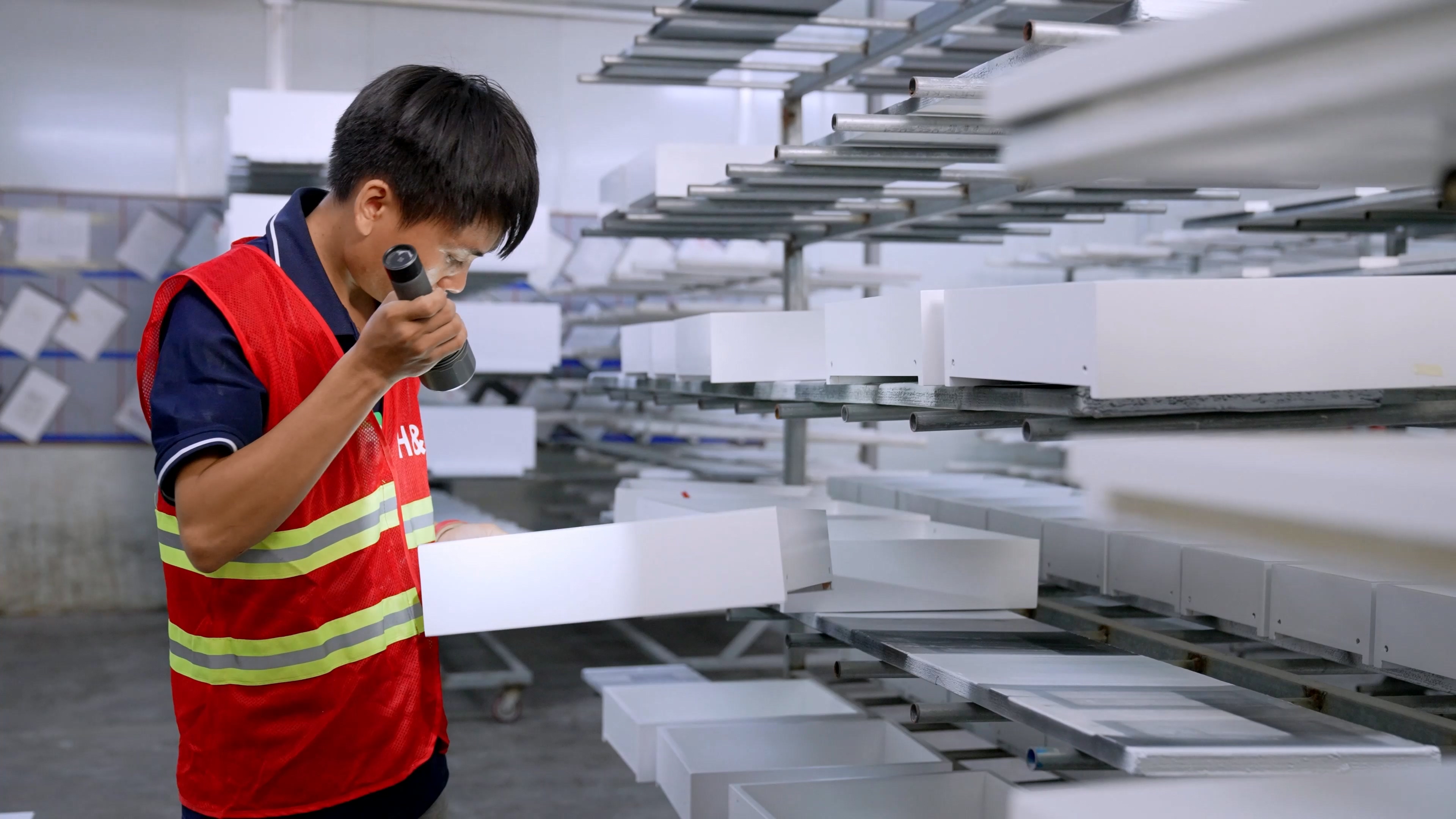
Moisture performance is a separate question from mounting. SHKL states that solid wood can crack under extreme conditions and that it controls moisture content at 10%–14%, guiding repair for minor cracks and replacing seriously cracked products. Its lacquered vanities use two UV undercoats and one PU finishing coat, while melamine vanities rely on sealing; the company also states that its vanities cannot be soaked for long periods. Buyers should carry that qualification into the specification rather than assume that "bathroom vanity" implies unlimited water exposure.
Step-by-Step: What to Verify Before Ordering Either Type
- Write the mounting term and the support method separately. Record the catalog label (wall-mounted or floating) and, in a second field, the fixing or support system confirmed in writing by the supplier.
- Reconcile every dimension. Confirm width, depth and height, and state whether the height includes the countertop slab and the basin. For KL813003, the published widths are 750–1200 mm with 520 mm depth and 504 mm height; for AS813050, request the dimensioned drawing.
- Fix the countertop and basin scope line by line. KL813003 lists a pure white porcelain slab with an undermount ceramic basin; AS813050 lists a glossy white ceramic basin. Confirm slab thickness, edge detail and whether the countertop is included in the quoted price.
- Confirm hardware brand and function. KL813003 uses DTC soft-closing slides with a hidden handle; AS813050 uses Unihopper soft-closing slides. SHKL states that its regular rail and hinge brands are DTC and BLUM, and that it uses E1 boards.
- Agree the finish and its maintenance limits. Lacquered and melamine surfaces behave differently; ask which finish applies to the visible faces and how the edges are sealed.
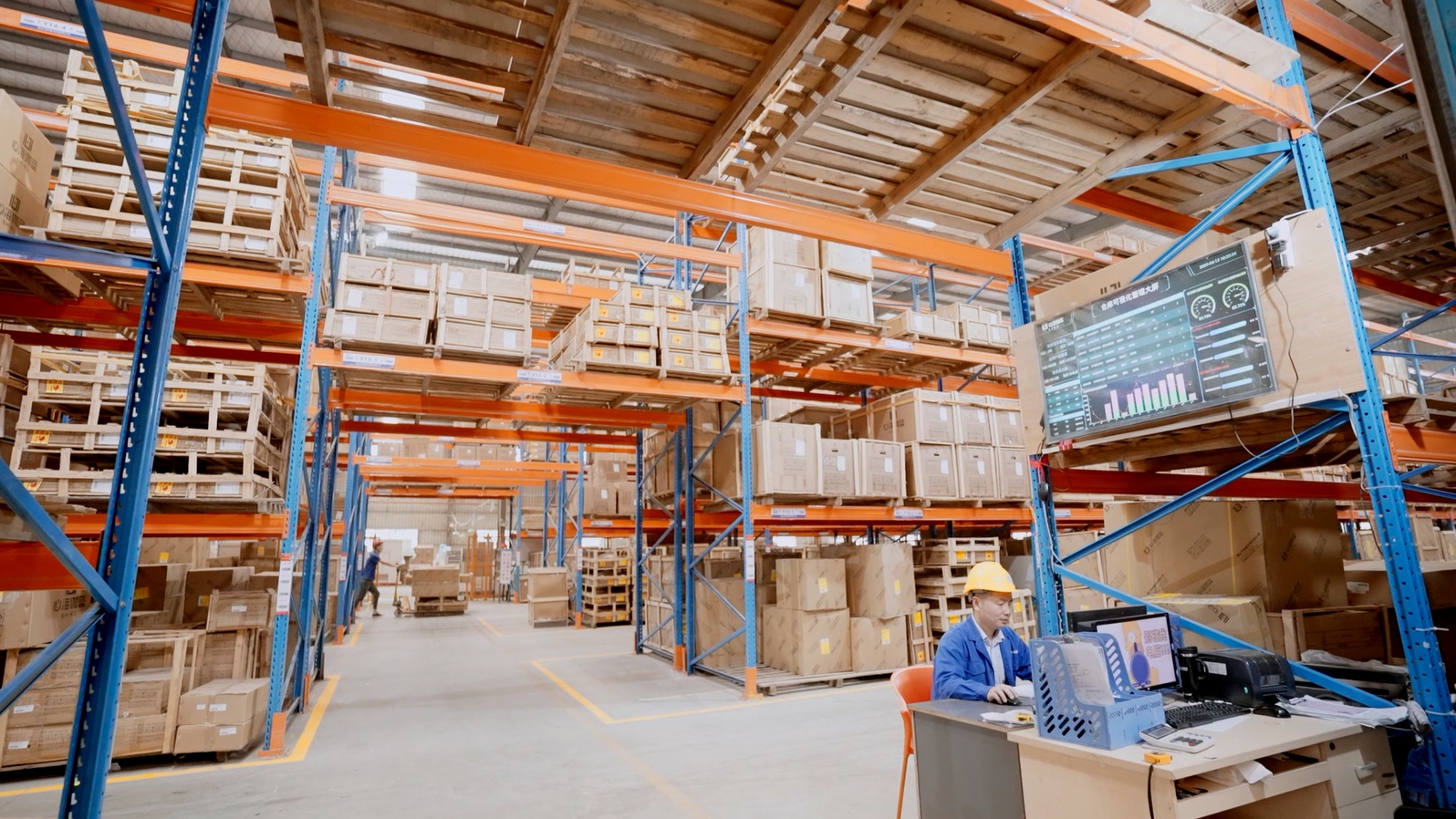
- Confirm packing and whether flat-packing applies. SHKL packs the cabinet, basin and mirror individually with PE foam, corner protectors, foam and five-layer cardboard boxes. General vanities can be supplied knocked down or flat packed with an installation manual; the company does not recommend this for complex vanities.
- Check commercial terms. Customized vanity orders start at more than 10 sets per item; custom colours start at more than 20 sets; logo printing on packaging starts at more than 20 pieces per item. SHKL notes that light colours are usually more expensive than matte colours.
- Set the acceptance criteria. SHKL offers a two-year warranty, inspects fully before packing, assesses post-delivery damage against transport or installation causes, and provides free replacement for serious product quality problems.
- Plan container loading on real data. SHKL quotes the vanity, basin and mirror separately but recommends buying a matched set. For reference, it states each set is about 0.6 CBM for a vanity 0.8 m high, with a 40 ft HC holding about 110 sets and a 20 ft GP about 45 sets — figures the company supplies for reference only.
Comparison Table: Documented Attributes
| Attribute | KL813003 | AS813050 |
|---|---|---|
| Catalog type | Wall mounted bathroom vanity | Floating bathroom vanity |
| Cabinet material | Plywood and solid wood | Plywood and solid wood |
| Finish | A2391 Acacia melamine and solid wood lacquered | Ancora Walnut lacquered and melamine |
| Storage structure | Two drawers, DTC soft-closing slides, hidden handle | One drawer, Unihopper soft-closing slides |
| Countertop | Pure white porcelain slab | Not listed as a separate line in the supplied record |
| Basin | Undermount ceramic basin | Glossy white ceramic basin |
| Mirror | LED mirror supporting different functions | Gun metal frame, three colour temperatures, defog, dimmable, two control buttons |
| Documented size | 750 / 800 / 900 / 1000 / 1200 × 520 × 504 mm | Not stated in the supplied record |
Where Each Type Fits
For compact residential bathrooms, a wall-hung cabinet is usually chosen for the floor-plane effect and easier cleaning access beneath the unit. In a single vanity position, the narrower end of the KL813003 range gives a defined footprint; in a wider layout, the same family continues across a longer wall, which reduces the number of distinct models a project has to stock and service.
For hospitality and multi-unit projects, the deciding factors shift toward consistency: how much dimensional data the supplier publishes, whether mounting, packing and documentation are repeatable across orders, and how after-sales damage assessment is handled. SHKL's supplied application records associate KL813003 with a hotel project in the United States and a villa case in Australia. Those records document the application context and the related model; they are not measured performance results, and buyers should treat them as references to discuss rather than as outcome evidence.
For buyers who genuinely need floor-standing construction, the floating-versus-wall-mounted question is moot: that decision sits in the mounting category, and SHKL catalogues freestanding models separately from wall-hung ones.
Frequently Asked Questions
What should a buyer check first when a catalog lists a vanity as wall-mounted or floating?
Check the support method and the dimensional data before anything else. Both labels normally describe wall-hung construction, so the label itself does not define the fixing system, the wall preparation or the plumbing route. Ask the supplier to confirm in writing how the cabinet is fixed, and request a dimensioned drawing where the catalog entry does not publish width, depth and height — this applies to the AS813050 record used above, while KL813003 publishes 750–1200 mm widths, 520 mm depth and 504 mm height.
Can a floating vanity be supplied flat-packed or knocked down?
It depends on the structure. SHKL states that it can supply general bathroom vanities knocked down or flat packed together with an installation manual, but does not recommend knock-down or flat packing for complex vanities. Because flat-packing changes how the cabinet is assembled on site, confirm the exact option for the specific model rather than for the category.
How are wood bathroom vanity materials protected against moisture?
SHKL states that solid wood can crack under extreme conditions and that it controls moisture content at 10%–14%, guiding repair for minor cracks and sending a replacement for serious ones. Its lacquered vanities use two UV undercoats and one PU finishing coat, melamine vanities rely on sealing, and the company states that its vanities cannot be soaked for long periods. These qualifications should be carried into the specification and the maintenance instructions.
What quantities apply to customization, colours and branded packaging?
SHKL accepts customized vanity orders from more than 10 sets per item, with colour, size, materials and accessories specified by the buyer. Custom colours start at more than 20 sets, and logo printing on packaging starts at more than 20 pieces per item. The company notes that light colours are usually more expensive than matte colours, so colour direction should be settled before the quotation is finalised.
What lead times, warranty and sample arrangements apply?
SHKL states a two-year warranty on bathroom vanities, with full inspection before packing and a damage assessment after delivery that distinguishes transport causes from installation causes. Typical lead times are 40–45 days for classic style bathroom vanities, 35–45 days for modern lacquer bathroom vanities and 25–35 days for melamine board bathroom vanities; other types are quoted on request. For projects evaluating a wall-mounted or floating model, a sample or trial order is the practical way to check finish, drawer action and basin detail before committing to a full program, and the corresponding quotation can be requested together with the product catalog.
Conclusion
The difference between a wall-mounted and a floating bathroom vanity is mostly a difference in what the words are doing. "Wall-mounted" answers the structural question: the cabinet hangs from the wall and has no floor contact. "Floating" answers the visual question: the cabinet appears suspended, usually using the same wall-hung principle. Neither label tells you the fixing system, the cabinet height, the countertop scope or the finish build — and those are the fields that decide whether an order arrives correct.
The practical rule for buyers at the research stage is to keep the label, the specification and the acceptance criteria in three separate places. Use KL813003 as a template for a well-documented wall-hung unit with published widths, depth and height, and use AS813050 to see where a floating record still requires a dimensioned drawing and a confirmed scope. Apply the same nine checks to both, and the terminology stops being a risk.
SHKL publishes its full product range, specifications and company information at shklbathroom.com, and the company brochure can be downloaded here: SHKL product and capability brochure (PDF). Buyers comparing wall-mounted and floating models can request a sample, a model-level quotation or the current catalog as a next step.
Have Questions or Need More Details?
Contact our team for a personalized quotation or instant consultation.
Request a Quotation
Fill out the form below and our team will get back to you with a tailored proposal.
WhatsApp Direct Chat
Prefer to chat in real-time? Message us on WhatsApp for instant assistance & quick answers.
- Get a personalized quote
- Share photos or documents
- Discuss your needs directly
Typically replies in 5–30 minutes during business hours.