
ECE R65 & ECE R10 LED Warning Lights: A Compliance Checklist
ECE R65 & ECE R10 LED Warning Lights: A Compliance Checklist
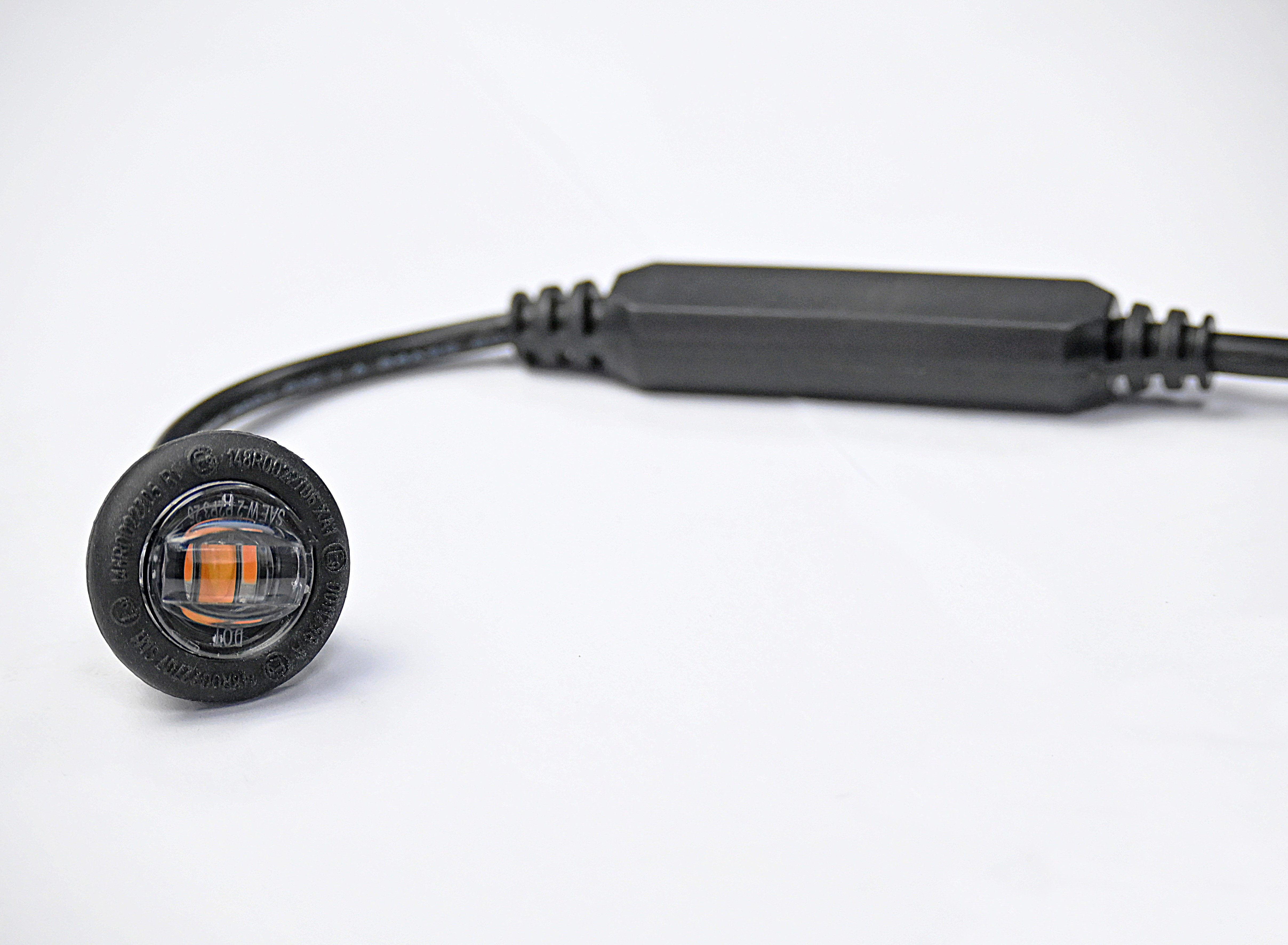
An LED warning light is not a commodity light. In ECE-referenced markets it is a regulated safety device that must satisfy separate photometric, electromagnetic and marking approvals, and be supplied with documentation that survives a procurement audit. This checklist explains what ECE R65, ECE R10, ECE R148, SAE J595, RoHS and Conformity of Production actually cover, and how to verify a supplier’s compliance file before you place an order.
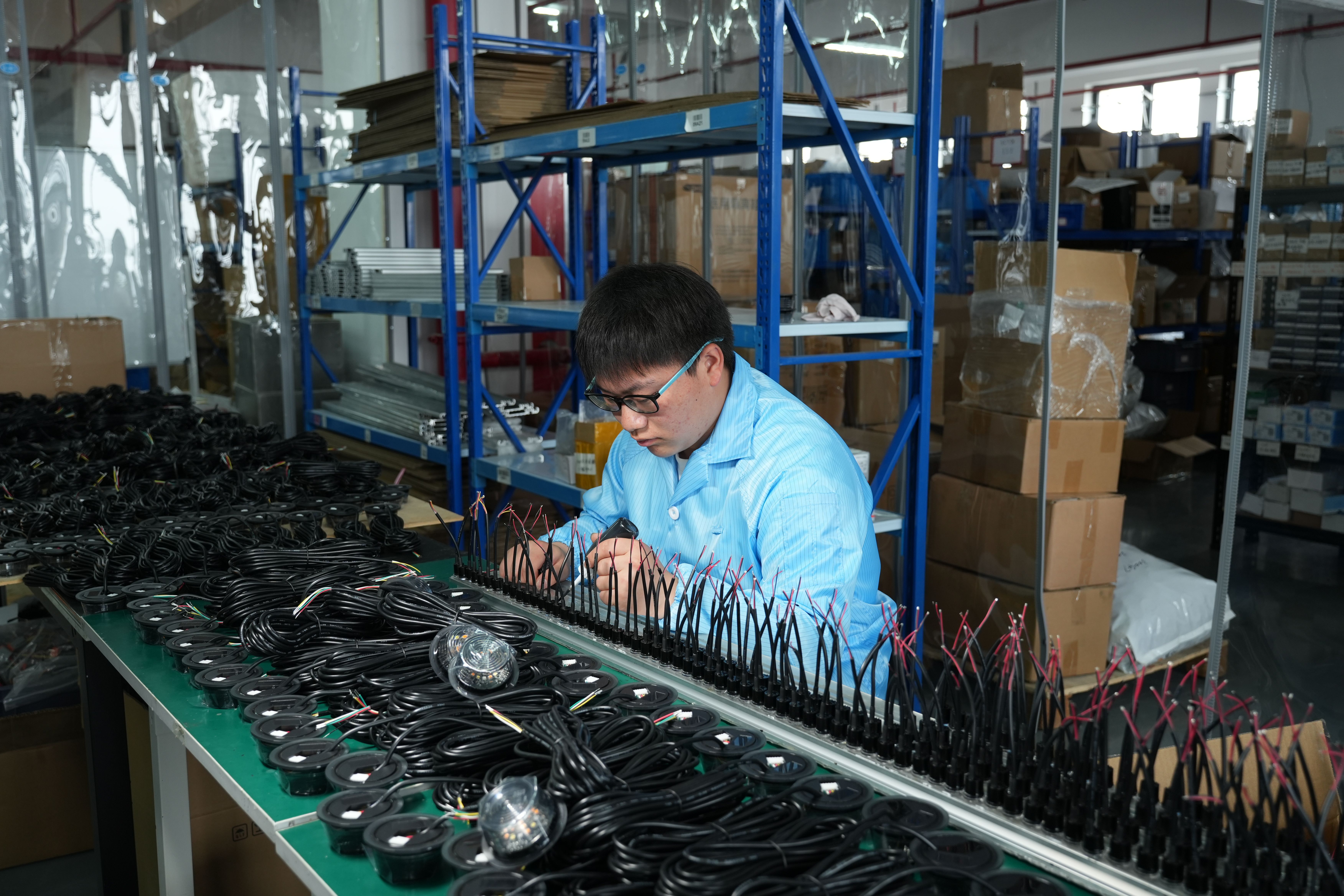
SIGROCK — Ningbo sigrock Automotive Lamp Technology Co.,LTD. — is a manufacturer of vehicle warning and safety lighting solutions headquartered in Ningbo, China. Founded in 2018, the company operates a 2,600 m² facility with 35 employees, an in-house engineering team of 5, an annual output of 550,000 units, and a 100% export ratio serving EU and USA markets. Its portfolio covers strobe lightheads, LED beacons, lightbars, traffic advisors, dash lights, work lights and lighting control systems. Company details are published at www.sigrockautolamp.com.
Problem Definition: Why “ECE Certified” Often Fails a Procurement Audit
A supplier email that says “our warning lights are ECE certified” is not a compliance statement. It is a summary. When that summary reaches a buyer, a fleet upfitter or a type-approval authority, three structural gaps usually appear.
Gap 1 — Different standards get blended into one word. ECE R65 covers special warning lamps. ECE R10 covers electromagnetic compatibility. ECE R148 covers light-signalling devices. These are separate approvals, issued as separate certificates, and each one can be held or missing independently. A product that holds R65 does not thereby hold R10 or R148.
Gap 2 — Approval scope is usually model-specific, not brand-wide. Certificates are typically issued against named model variants. The ECE R148 approval for the T43 hideaway warning light, for example, is scoped specifically to T43P-01 with a clear outer lens and T43P-S1 with a smoky grey outer lens. The ECE R65 approval for the E6 warning light module is scoped to the E6AS, E6AL and E6AH special warning lamps. If the exact variant you are buying is not listed on the certificate, the certificate is not evidence for your order.
Gap 3 — Environmental claims are frequently self-declared. Descriptions such as “IP69K rated” or “vibration resistant” become meaningful only when they are backed by a test report from a named laboratory on a named product configuration. Without that, they should be treated as unverified supplier statements rather than as specifications.
Each of these gaps is fixable, but only before the purchase order is issued. Once units are in transit, the cost of resolving a compliance mismatch shifts to the buyer.
Industry Background: The Regulatory Framework Around LED Warning Lights
Vehicle warning lighting sits inside a larger emergency lighting category. Global Market Insights estimated the emergency lighting market — including vehicle warning kits — at USD 7.5 billion in 2023. Lucintel projected that the more narrowly defined global emergency warning light market would grow at a CAGR of approximately 3.6% between 2025 and 2031. The two figures describe different market boundaries, and the difference between them is a reasonable illustration of how much of the wider category is made up of non-vehicle lighting rather than regulated warning devices.
What defines the warning-light niche is not optical output, but regulation. For any market that recognises ECE approvals, four document families matter:
- ECE R65 — special warning lamps for motor vehicles. Public ECE R65 technical material describes Class 2 devices as having dual-level intensity control: maximum brightness during daytime operation with automatic dimming at night.
- ECE R10 — electromagnetic compatibility of applicable electrical and electronic sub-assemblies fitted to vehicles.
- ECE R148 — approval of light-signalling devices.
- CoP (Conformity of Production) — a production-consistency certificate issued under the UN 1958 Agreement, which addresses continued conformity of series production rather than a one-off sample result.
In North America, the relevant reference is SAE J595, published by SAE International. The current edition record, J595_202108, covers directional, single-colour, flashing optical warning devices used on authorised emergency, maintenance and service vehicles, and provides design guidelines, test-procedure references and performance requirements. It is a recommended practice, not an ECE type approval, and its legal adoption needs to be confirmed market by market. Earlier editions such as J595_201403 and J595_198308 should not be merged with the 2021 edition when a compliance statement is being written — version control matters as much as the standard number.
Detailed Solution: What a Verifiable Compliance Architecture Looks Like
A compliance architecture is the set of approvals, test reports and certificates that a supplier can hand over for a specific product model. The following sections map the architecture against the SIGROCK product range, using the certificate numbers and scope definitions actually on file.
ECE R65 — Photometric Performance of Special Warning Lamps
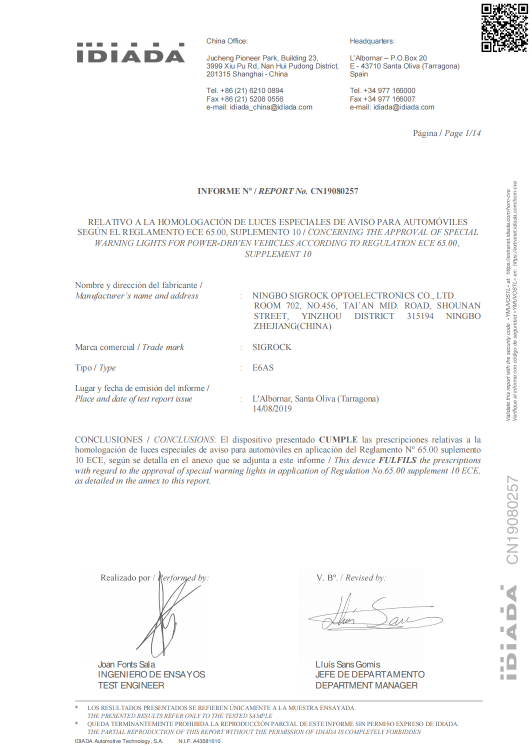
The SIGROCK E6 warning light module holds ECE Regulation No. 65.00 Supplement 10 under the E-mark scheme, approval number E9*65R00/10*6397*00, granted on 14 August 2019. The approved scope covers LED amber special warning lamps in Class 1 and Class 2 at 12V / 24V, and applies to the E6AS, E6AL and E6AH models. ECE R65 testing reports are available for those three models.
Across the wider range, ECE R65 coverage also applies to the LB01 warning lightbar, the BH18 LED warning light beacon and the T43 hideaway warning light.
ECE R10 — Electromagnetic Compatibility
The E6 warning light module also holds an ECE R10.06 type approval, number E910R06/0022774*00, granted on 6 May 2021 by the Spanish industrial type-approval authority, Ministerio de Industria, Comercio y Turismo. The approval is issued for a type of electrical / electronic sub-assembly under UNECE Regulation 10R06 relating to electromagnetic compatibility. The certified scope of this approval covers the E6S-A, E6S-B and E6S-R module models, together with the TINYBLAST-4, TINYBLAST-6, TINYBLAST-4W, TINYBLAST-DC, H-400AS, H-400BS, MEGABLAST-4, MEGABLAST-6, MEGABLAST-4W, MEGABLAST-DC, PULSE-3, E6S and E6D models. ECE R10 testing report documentation is available for those models.
Why this matters commercially: ECE R10 addresses emissions and immunity, which is the approval that governs whether a warning light coexists cleanly with the rest of a vehicle’s electrical architecture. It is distinct from the photometric approvals and cannot be substituted by them. The BH18 LED warning light beacon, the T43 hideaway warning light, the LB01 warning lightbar and the SC7X controller are also covered by ECE R10 certification.
ECE R148 — Light-Signalling Devices
The T43 hideaway warning light holds ECE R148 approval number E9*148R00/05*22705*00, issued by L’Albornar, Santa Oliva (Tarragona). The certification scope is explicitly limited to two variants: T43P-01 with a clear outer lens and T43P-S1 with a smoky grey outer lens. This is a useful illustration of scope discipline — a single model family can have an approval that applies to some lens configurations and not to others.
CE, EMC and RoHS Documentation
The T43 hideaway warning light also carries an EMC test report, certificate number XT10305012E, issued on 18 November 2025 by Ningbo Xuntong Standard Technology Service Co., Ltd. The applicable standards listed are EN IEC 55015:2019+A11:2020, EN IEC 61000-3-2:2019+A1:2021+A2:2024, EN 61000-3-3:2013+A1:2019+A2:2021 and EN IEC 61547:2023. This report applies to the EU market.
RoHS compliance for the same product is documented under certificate number XT10305011R, issued on 20 November 2025 by the same laboratory, against RoHS Directive 2011/65/EU with amendment (EU) 2015/863, tested per IEC 62321-3-1:2013, IEC 62321-5:2013 and IEC 62321-8:2017. The covered models are SIGROCK T43, T43A, T43B, T43R, T43W, T43G, T43P-01, T43P-02 and T43P-03.
Conformity of Production (CoP) Under the UN 1958 Agreement
Beyond individual product approvals, a production-consistency certificate gives the buyer evidence that conformity is maintained in series production. Certificate C1 49902503 is issued by UCA (Unidad de Certificación del Automóvil), an inspection entity accredited by ENAC under accreditation No. 509/EI807, and is valid from 29 July 2019 to 29 July 2027. It covers UN R10 (EMC), UN R65 (special warning lamps), UN R148 (light-signalling devices) and UN R150 (retro-reflective devices), and applies to the SC7X controller, the LB01 warning lightbar, the BH18 LED warning light beacon, the T43 hideaway warning light and the E6 warning light module.
Environmental Protection: IP65, IP67 and IP69K
Ingress protection ratings classify resistance to solid-object and water ingress under specified test conditions. IP67 covers dust-tight protection together with temporary immersion testing. IP69K addresses dust protection and high-pressure, high-temperature water-jet exposure under its applicable standard. The test conditions are different, so IP69K should not be read as a blanket upgrade of IP67, and neither rating guarantees suitability for every real-world environment. The right question is which cleaning method and exposure profile the vehicle actually sees.
Stated protection levels across the range are IP67 / IP69K for the E6 warning light module, the T43 hideaway warning light and the BH18 LED warning light beacon; IP65 for the LB01 warning lightbar; and IP67 for the SC7X controller.
Quality Management System
Certificate number 10139902Q certifies the quality management system to ISO 9001:2015. It is issued by CERTIFICATION EUROPE (HONG KONG) LIMITED, with accreditation through IAF (International Accreditation Forum) and UKAS (United Kingdom Accreditation Service, No. 0219), and is valid from 6 August 2026 to 5 August 2027. The scope covers manufacturing, processing, sales and R&D of auto parts, motorcycle parts, plastic products, moulds, lamps, warning lights and electronic products, plus import and export of technology and goods. A QMS certificate establishes process control. It does not replace product type approval, and the two should be requested as separate documents.
Step-by-Step Breakdown: How to Audit a Warning Light Supplier
The sequence below is designed to be run before a purchase order, not after. It works for any supplier, not only SIGROCK.
Step 1 — Fix the destination market first. A light destined for a UN 1958 Agreement market needs a different evidence set from one destined for a North American fleet. Do not evaluate compliance until the market is confirmed, because the applicable regulation changes the required documents.
Step 2 — Split the request into separate approval line items. Ask for photometric approval, EMC approval, signalling-device approval and production consistency as four separate questions. A single combined answer is the most common way that gaps are hidden.
Step 3 — Demand certificate numbers, issuing bodies and issue dates. A certificate number is auditable. Examples of the level of detail to expect: E9*65R00/10*6397*00 for ECE R65, E910R06/0022774*00 for ECE R10.06, E9*148R00/05*22705*00 for ECE R148, XT10305011R for RoHS, XT10305012E for EMC, C1 49902503 for CoP and 10139902Q for ISO 9001:2015.
Step 4 — Cross-check the scope line against your exact model code. Certificates list covered variants. Confirm that the variant you intend to purchase appears by name in that list, including lens colour variants, because these can fall in and out of scope.
Step 5 — Request the underlying test reports. Certificates confirm approval; test reports show what was measured. For RoHS, confirm the directive version and the IEC test methods referenced. For EMC, confirm which EN standards were applied.
Step 6 — Match the IP rating to your actual operating and cleaning environment. If a fleet uses high-pressure washdown, ask specifically for the water-jet test basis. If vehicles operate in mud and dust, focus on the solid-particle element of the rating. Operational conditions in this category commonly include heavy rain, snow, fog, dust, mud, high humidity, high UV exposure, high vibration and long-duration 24/7 fleet use.
Step 7 — Verify the factory system certificate separately. Check the certification body, the accreditation chain and the validity window. An expired system certificate is a different risk from a missing product approval.
Step 8 — Validate with samples before committing to volume. Documentation confirms eligibility. Samples confirm that the delivered configuration behaves as the documentation says — flash patterns, dimming behaviour, connector type, cable length and lens colour all need to be seen, not assumed.

Use Cases: Matching Approvals to Vehicle Roles
Compliance requirements follow the vehicle role, not the buyer’s preference. The application categories that drive most warning-light sourcing are covered below.
Emergency and public safety. Police vehicles, fire trucks, ambulances, rescue vehicles and other emergency response vehicles are the most heavily regulated group. Warning lights for these applications typically need photometric approval with a defined intensity class. The BH18 LED warning light beacon is certified to ECE R65 Class 2 and is described as suitable for police vehicle applications with ECE R65 approval, alongside ECE R10 and SAE J595 Class 1.
Road and traffic management. Road maintenance vehicles, traffic management units, highway maintenance vehicles, roadside assistance vehicles and traffic enforcement vehicles usually specify amber warning output with a high number of selectable flash patterns, because the signal must communicate direction and hazard rather than identify an emergency service. The LB01 warning lightbar offers 10 selectable flash patterns across six length options from 600 mm to 1,600 mm.
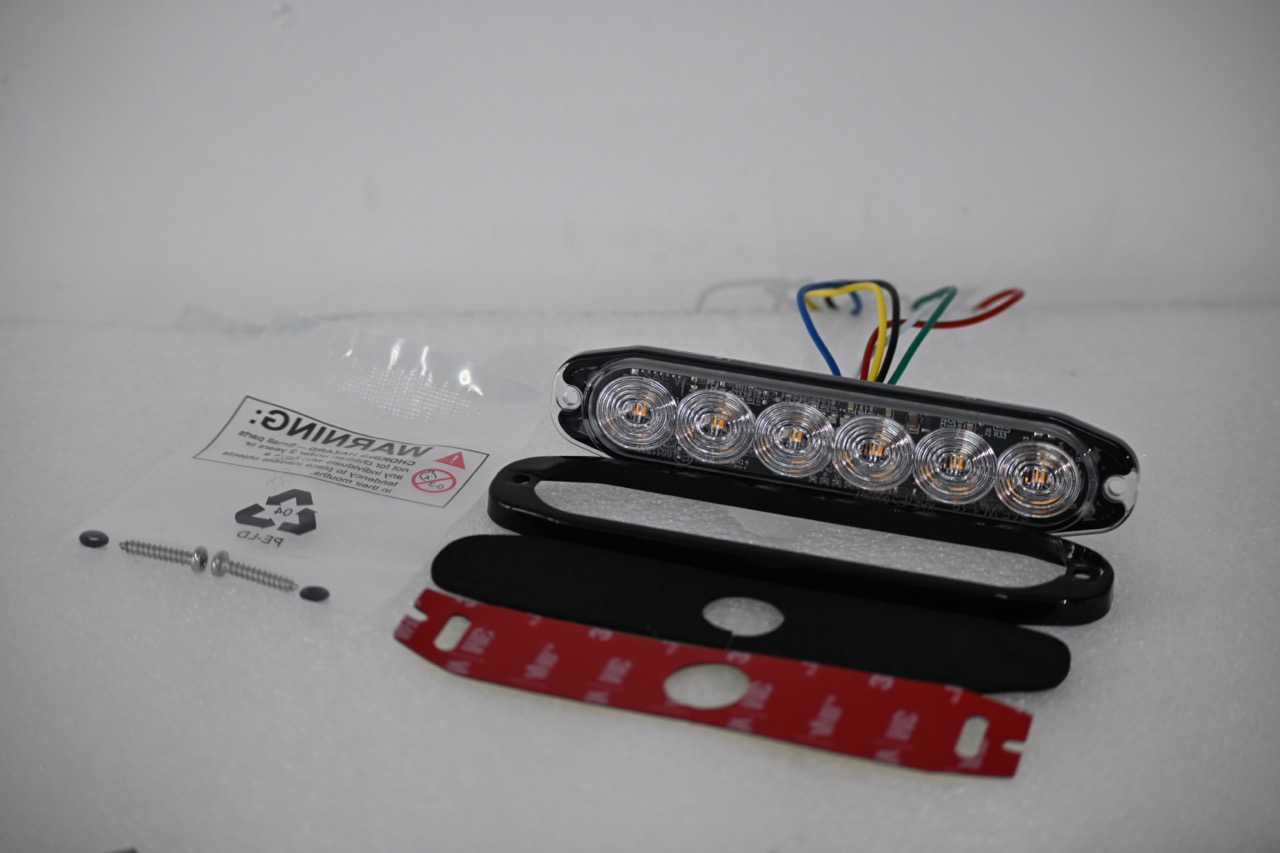
Commercial and utility fleets. Tow trucks, service vehicles, utility vehicles, maintenance vehicles and mixed fleet vehicles frequently need discreet installation rather than a large roof-mounted bar. The T43 hideaway warning light is an 18.5 × 18.5 × 21.57 mm flush-mount unit with 14 flash patterns and a combined warning and position-lighting function, which suits panel-integrated mounting.
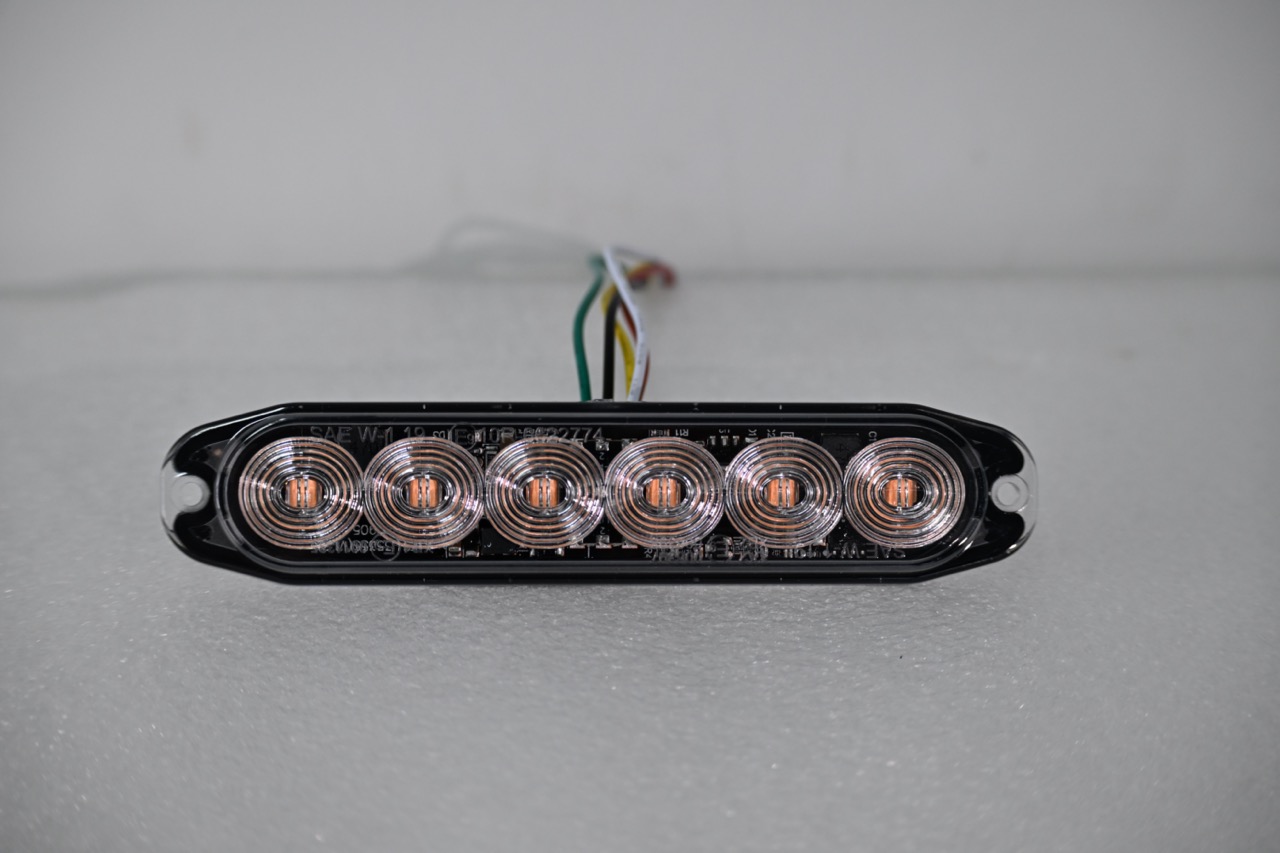
Construction and industrial vehicles. Construction vehicles operating on and around sites need wide-angle visibility and tolerance of dust, vibration and impact. The E6 warning light module is a 118 × 25 × 7 mm surface- or bracket-mount unit that supports single, dual and triple colour configurations in the same footprint.
Retrofit and aftermarket replacement. Fleet retrofitting and aftermarket replacement programmes usually start from an existing wiring system, so voltage range matters more than anything else. All five product families here operate across a 10–33V DC range, which allows the same part to serve both 12V and 24V vehicle systems without a separate SKU.
Comparison Table: Approval Coverage by Product
The table below lists the approvals and protection levels documented for each product family. It is intended as a sourcing filter: match the column entries to your market requirement before requesting a quotation.
| Product (Model) | Documented Approvals | Protection Rating | Key Parameters | Warranty |
|---|---|---|---|---|
| SC7X controller | ECE R10; CoP (C1 49902503) | IP67 | 10–30V DC; 40A max output; 7 buttons; 2 × 10A or 4 × 5A outputs; 300 mm harness | 2 years |
| LB01 warning lightbar | ECE R65; ECE R10; CoP | IP65 | 600 / 800 / 1000 / 1200 / 1400 / 1600 mm; 10–33V DC; 78–198 LEDs; 10 flash patterns | 3 years |
| BH18 LED warning light beacon | ECE R65 Class 2; ECE R10; SAE J595 Class 1; CoP | IP67 / IP69K | 3W × 18 LEDs; 10–33V DC; 2.2A @12V / 1.2A @24V; 10 flash patterns; bolt, DIN or magnetic mount | 3 years |
| T43 hideaway warning light | ECE R65; ECE R148; ECE R10; RoHS; CE; CoP | IP67 / IP69K | 18.5 × 18.5 × 21.57 mm; 10–33V DC; 14 flash patterns; flush or tube flush mount | 3 years |
| E6 warning light module | ECE R65 (E6AS / E6AL / E6AH); ECE R10.06; CoP | IP67 / IP69K | 118 × 25 × 7 mm; Fresnel optics; 10–33V DC; 36 / 12 / 18 LEDs at 3W; up to 20 flash patterns | 3 years |
A second comparison is worth keeping alongside the first, because it prevents approval types from being confused during specification writing:
| Document | What it covers | What it does not cover |
|---|---|---|
| ECE R65 | Special warning lamps — photometric performance and intensity class | Electromagnetic compatibility; light-signalling device approval |
| ECE R10 | Electromagnetic compatibility of applicable electrical / electronic sub-assemblies | Photometric output, flash pattern count, lens colour |
| ECE R148 | Approval of light-signalling devices | Warning-lamp intensity class |
| SAE J595 | Directional, single-colour, flashing optical warning devices — design guidelines, test references and performance requirements | ECE type approval; adoption as law in any specific jurisdiction |
| RoHS | Restriction of hazardous substances under RoHS Directive 2011/65/EU with amendment (EU) 2015/863 | Optical, electrical or EMC performance |
| IP65 / IP67 / IP69K | Ingress protection under specified test conditions | Optical performance, electrical protection or service life |
Practical read: the left-hand table tells you whether a product can enter a market. The right-hand table tells you which document answers which auditor question. Keep both in the RFQ file.
FAQ
1. What approvals does a Chinese-made LED warning light need for a European vehicle installation?
For markets that recognise ECE approvals, treat the requirement as three separate approvals plus production consistency. ECE R65 covers the photometric performance of special warning lamps. ECE R10 covers electromagnetic compatibility of applicable electrical and electronic sub-assemblies. ECE R148 covers approval of light-signalling devices. On top of these, a Conformity of Production certificate issued under the UN 1958 Agreement addresses ongoing conformity of series production. A worked example: the SIGROCK E6 warning light module holds ECE R65 approval E9*65R00/10*6397*00 for the E6AS, E6AL and E6AH models, and ECE R10.06 approval E910R06/0022774*00 covering E6S-A, E6S-B and E6S-R. The T43 hideaway warning light additionally holds ECE R148 approval E9*148R00/05*22705*00 scoped to T43P-01 and T43P-S1 lens variants, plus RoHS test report XT10305011R and EMC test report XT10305012E. Production consistency is covered by CoP certificate C1 49902503, valid from 29 July 2019 to 29 July 2027 and covering UN R10, R65, R148 and R150 across the SC7X, LB01, BH18, T43 and E6 product families. Verify that the exact model and lens variant you are ordering appears in the certificate scope.
2. Can one Chinese manufacturer supply both ECE R65 and ECE R10 certification for the same warning light project?
Yes, when the product is engineered and approved for both. ECE R65 and ECE R10 are independent approvals with different technical subjects, so a supplier needs to hold both certificates rather than one certificate that is assumed to cover the other. SIGROCK holds ECE R65 approval E9*65R00/10*6397*00 for the E6AS, E6AL and E6AH amber special warning lamps at Class 1 and Class 2, 12V / 24V, and separately holds ECE R10.06 approval E910R06/0022774*00 for the E6 warning light module. Across the range, ECE R65 coverage extends to the LB01 warning lightbar, the BH18 LED warning light beacon and the T43 hideaway warning light, while ECE R10 coverage extends to the BH18, T43, LB01 and SC7X controller. Buying a project from a single manufacturer is practical when the approval scope for each product is documented individually, rather than summarised at company level.
3. What drives cost and pricing structure on certified LED warning light projects?
Several variables move a project’s commercial structure more than the base light does. Approval scope is one: a product that must carry additional approvals requires documentation, testing and control effort that a non-certified variant does not. Customisation is another — SIGROCK’s OEM / ODM options include logo, flash pattern, optics, cable length and LED colour, and each change can affect tooling, firmware and approval relevance. Order volume and mix matter, because the CBU production model runs at a monthly capacity of 50,000 units, and both standard products and customised solutions are supported. Finally, the level of documentary evidence required — test reports, CoP coverage, traceability — carries its own cost. MOQ depends on the product and the customisation requirements, and sample orders are available for evaluation before mass production. The practical approach is to fix the market and the certification requirement first, then request a quotation against a locked specification.
4. Can we validate a certified LED warning light with samples before placing a volume order?
Yes. Sample orders are available for evaluation before mass production, which is the recommended way to confirm that the delivered configuration matches the documentation. A structured sample evaluation should check the delivered model code against the certificate scope list, the actual flash pattern behaviour and selectable modes, the voltage range against the vehicle system, the mounting format and clearances, the connector and cable length, and the lens colour as supplied. For reference on configuration range: the T43 hideaway warning light offers 14 flash patterns in a 18.5 × 18.5 × 21.57 mm format, the BH18 beacon offers 10 selectable modes with bolt, DIN or magnetic mounting, and the LB01 lightbar offers 10 patterns across six length options. Documentation proves eligibility; a sample proves the specific configuration you will receive.
5. What is the typical lead time for customised OEM / ODM LED warning lights?
Lead time is quoted at 25–45 days for OEM / ODM projects, depending on the product and the customisation involved, and SIGROCK’s monthly capacity of 50,000 units is the reference point for scheduling volume runs. Because lead time is affected by whether the configuration is an existing certified variant or a new customisation, the fastest route is usually to start from an already-approved platform and apply customisation within its existing approval scope. To move forward, send your target market, vehicle application, required approvals and expected annual volume to SIGROCK at sales@sigrock.com, and request a sample and quotation against that specification. The full product range, including model variants and mounting options, is documented in the downloadable catalogue below.
Conclusion
Compliance for LED warning lights is not a single checkbox. It is a set of independent approvals — photometric performance under ECE R65, electromagnetic compatibility under ECE R10, signalling-device approval under ECE R148, ingress protection under IP65, IP67 or IP69K, substance restrictions under RoHS, and production consistency under CoP — each with its own certificate number, issuing body, issue date and scope of covered model variants. A buying decision is only as strong as the weakest document in that set.
For buyers evaluating suppliers in research and evaluation stages, the practical rule is simple: ask for numbers, not adjectives. A certificate number can be checked. A scope list can be matched against your model code. A test report can be read. Anything else should be treated as marketing until proven otherwise.
SIGROCK publishes its approval documentation against named products rather than at company level, with certificate numbers for ECE R65, ECE R10.06, ECE R148, RoHS, EMC and CoP, backed by an ISO 9001:2015 quality management system and a 25–45 day OEM / ODM lead time. Buyers can request samples, quotation and full documentation for evaluation before committing to volume production.
Next Step: Sample, Quotation and Catalogue
Send your target market, vehicle application and required approvals to sales@sigrock.com or reach the team on WhatsApp at +86 186-9408-7250. Sample orders are available for evaluation before mass production, and quotations are prepared against a locked specification.
Download the full product catalogue here: SIGROCK Catalogue — Standard Edition (PDF)
Website: www.sigrockautolamp.com
Have Questions or Need More Details?
Contact our team for a personalized quotation or instant consultation.
Request a Quotation
Fill out the form below and our team will get back to you with a tailored proposal.
WhatsApp Direct Chat
Prefer to chat in real-time? Message us on WhatsApp for instant assistance & quick answers.
- Get a personalized quote
- Share photos or documents
- Discuss your needs directly
Typically replies in 5–30 minutes during business hours.