LED Beacons: How to Choose the Right Vehicle Warning Light
An LED beacon is a self-contained vehicle warning light that mounts on a roof, bar or flat surface and flashes a high-intensity optical signal so other road users notice the vehicle before they can read any marking on it. It is one format inside the wider LED warning light category, alongside lightbars, hideaway lights, grille modules, dash lights and traffic advisors.
This guide is written for importers, distributors, fleet upfitters and procurement engineers who are specifying an LED beacon for the first time, or who need to justify a model choice to a technical or regulatory reviewer. It explains what a beacon actually is, where the category sits today, how the SIGROCK beacon and warning light family is built and specified, how to run a specification step by step, which vehicles suit which format, and which compliance questions to ask before a purchase order is issued.
Problem Definition: Beacons Look Alike, Requirements Do Not
Most LED beacons are sold with a nearly identical short description: rotating or flashing beacon, 12/24V, amber or blue, IP-rated. That description hides almost everything a buyer needs. Two beacons with the same marketing text can differ in rated input voltage range, current draw, flash-pattern logic, optical design, sealing test conditions, mounting hardware and the specific approval they hold.
The problems buyers run into cluster into four groups.
- Specifications that look comparable but are not. LED quantity is the easiest number to compare and the easiest to misread. A unit with more LEDs is not automatically brighter or better distributed; optical design, drive current and lens geometry determine what a driver actually sees at distance and off-axis.
- Company-level compliance claims. A statement such as “ECE R65 compliant” does not say which model is approved, under which class, by which issuing body, or whether the approval covers the configuration being quoted. That is a documentation problem, not a wording problem.
- Environmental claims without test context. IP67 and IP69K describe different water-exposure test conditions, and neither rating on its own guarantees suitability for a particular cleaning routine, mounting position or vehicle wash cycle.
- Vehicle integration constraints. Voltage range, current draw, control method, mounting depth and available space decide whether a beacon can be installed at all — long before appearance or unit price becomes relevant.
The consequence is a procurement risk that is easy to underestimate. A beacon that passes an incoming visual inspection can still fail during fleet upfitting because it draws more current than the harness allows, cannot be mounted in the space available, or does not carry the approval that the operating jurisdiction expects.
Industry Background: A Mature, Standards-Driven LED Category
Vehicle warning lighting is a comparatively mature niche rather than a fast-expanding consumer category. Commercial research on the emergency warning light market reports a compound annual growth rate of 3.6% between 2025 and 2031 (Lucintel market report, recorded in the HTNXT verified data package). Broader emergency lighting — a wider category that also includes vehicle warning kits — was reported at USD 7.5 billion in 2023, with growth of over 10% between 2024 and 2032 (Global Market Insights). The two figures describe different market boundaries rather than a contradiction: the vehicle-specific warning segment is smaller, more heavily regulated, and driven more by replacement and compliance cycles than by rapid category expansion.
What drives specification decisions in this segment is regulation and environment, not styling. Four reference points recur in technical documents and buyer checklists.
- ECE R65 covers the photometric and performance side of warning lamps in ECE jurisdictions. Technical analysis of the regulation notes that Class 2 units use dual-level intensity control: maximum brightness during daytime operation, with automatic dimming at night.
- ECE R10 concerns electromagnetic compatibility (EMC) approval of applicable vehicles and electrical or electronic components. It addresses relevant electromagnetic emissions and immunity. It does not replace the separate photometric or installation approvals that may apply to a warning light.
- SAE J595 is the North American recommended practice for directional flashing optical warning devices used on authorized emergency, maintenance and service vehicles. It establishes performance requirements including photometric output, visibility and flashing performance, and it defines different performance classes for different vehicle warning applications. J595 records exist for several editions, including 1983, 2014 and 2021, so edition control matters when a specification cites the standard.
- ECE R148 and ingress-protection ratings such as IP67 and IP69K appear alongside the above in product documentation, depending on the product and the target market.
The practical takeaway is straightforward: an LED beacon is a regulated component with a duty cycle and an electrical envelope. Buyers who treat it as a commodity accessory usually revisit the decision at the first compliance review, or at the first winter season.
Detailed Solution: Inside the SIGROCK LED Beacon and Warning Light Family
SIGROCK — Ningbo sigrock Automotive Lamp Technology Co.,LTD. — is a vehicle warning light and safety lighting manufacturer established in 2018 and headquartered in Ningbo, Zhejiang, China. The company designs, develops and manufactures strobe lightheads, LED beacons, lightbars, traffic advisors, dash lights, work lights and lighting control systems. Its 2,600 m² manufacturing facility employs approximately 35 staff, including an in-house R&D team of 5 engineers, and produces about 550,000 LED warning light units per year, with products supplied to markets including the EU and the USA.
The beacon range sits at the centre of that portfolio. The sections below describe how the main formats are specified, using the published product data.
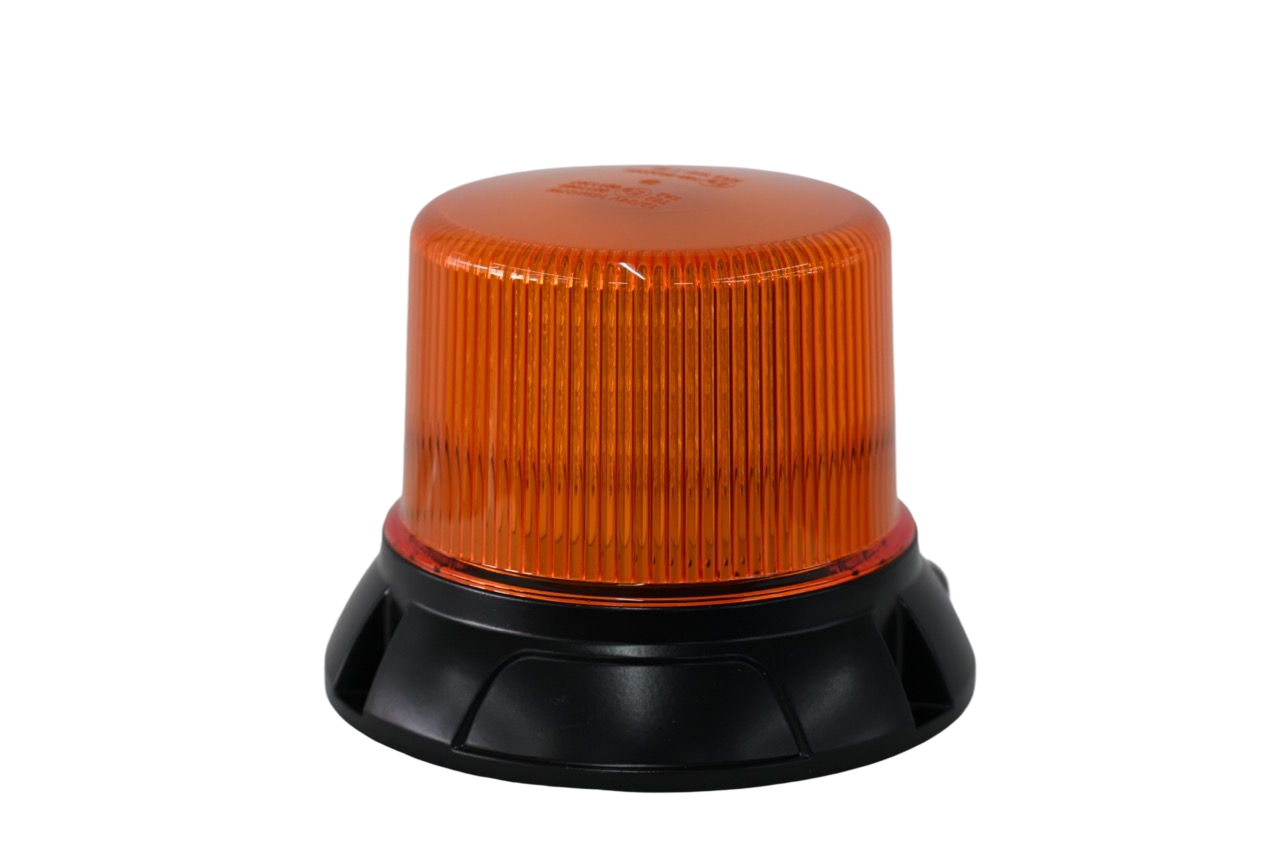
BH18 — Rotating LED Beacon
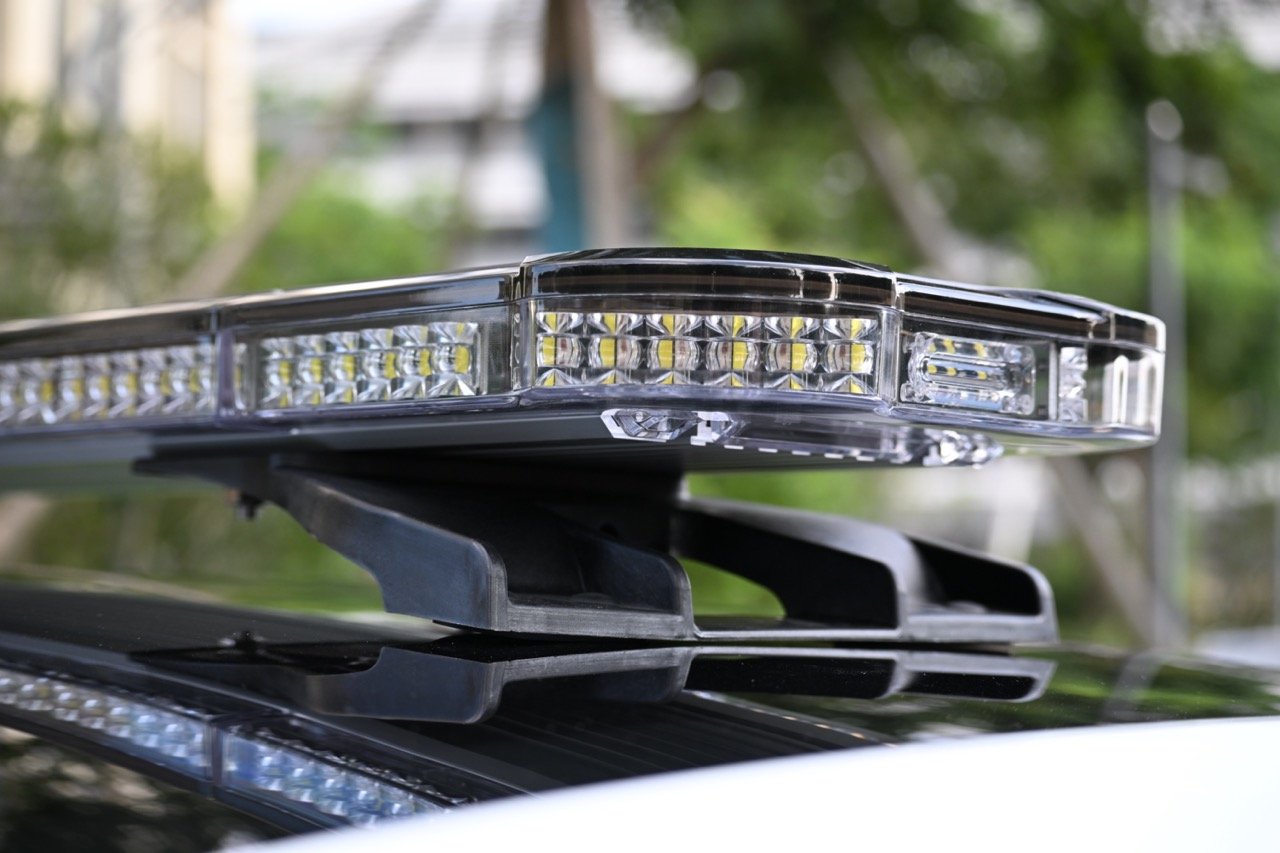
The BH18 is a rotating LED beacon available in single or dual configuration, with LEDs in blue, amber, red or green. It uses eighteen 3W high-output LEDs and accepts a wide 10–33V DC input, drawing 2.2A at 12V and 1.2A at 24V. Ten selectable flash patterns cover steady, alternating and simultaneous warning. Mounting is flexible: bolts, DIN or magnetic mount. The housing uses a polycarbonate lens with IP67 and IP69K protection and an operating range of −30°C to +70°C. Published approvals for the model are ECE R10, ECE R65 Class 2 and SAE J595 Class 1, with a 3-year warranty.
For buyers, three details matter more than the LED count. First, ECE R65 Class 2 implies dual-level intensity behaviour, which matters in jurisdictions that require daytime and night-time performance to be handled by the unit itself. Second, the single/dual colour configuration allows one beacon body to serve different vehicle roles without a second housing. Third, the magnetic mount option makes the same beacon usable on vehicles that are not permanently fitted with warning lighting.
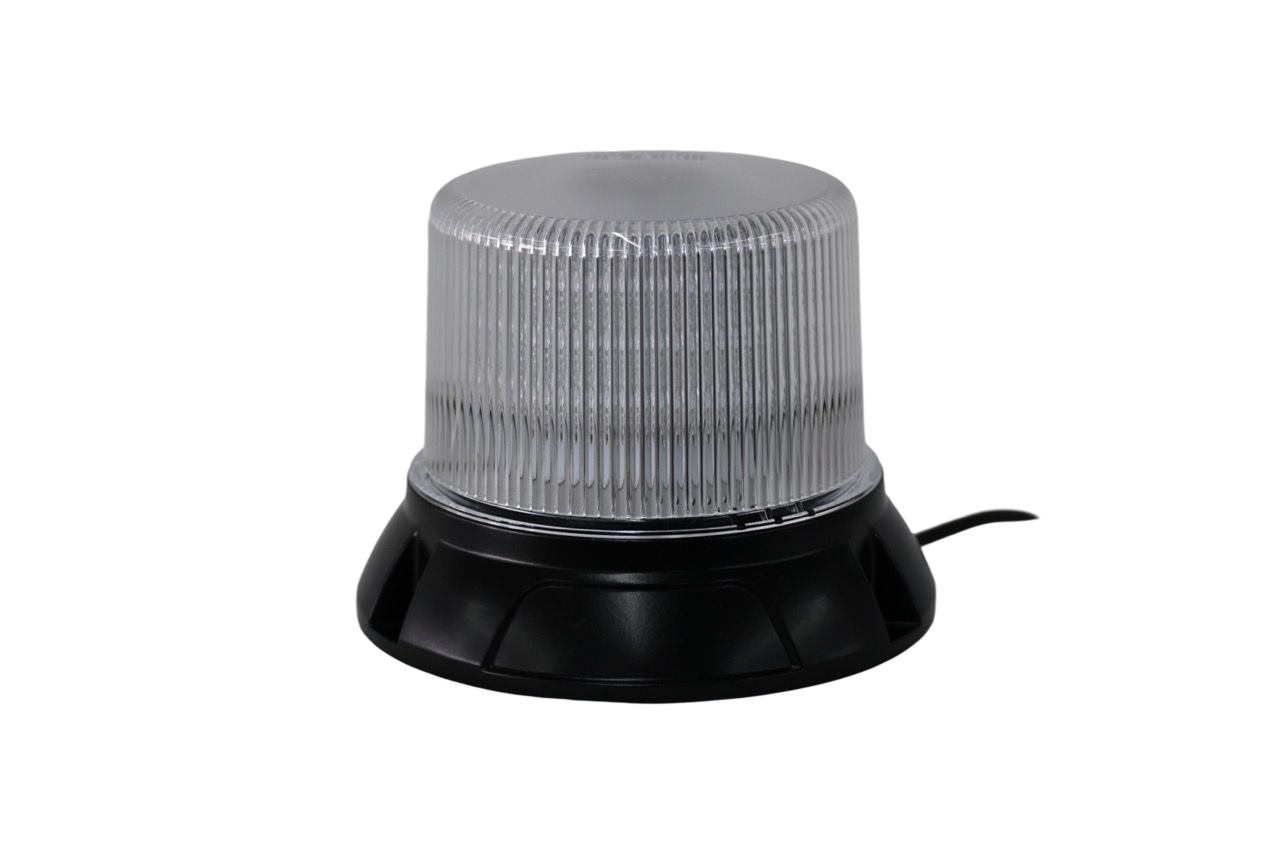
T43 — Compact Hideaway Warning Light
The T43 is a compact hideaway warning light measuring 18.5 × 18.5 × 21.57 mm with a black rubber grommet, intended for flush mount or tube flush mount where no external housing can be tolerated. It uses a hybrid optical design with one 5W LED and two 0.2W LEDs, drawing 0.3A at 12V and 0.15A at 24V from a 10–33V DC supply. Fourteen flash patterns are available. Colour options cover amber warning with amber, red or white position lighting, in single or combination colour. The lens is polycarbonate with IP67 / IP69K protection, an operating range of −30°C to +70°C and a 3-year warranty. Published compliance references for the model include ECE R65, ECE R148, ECE R10, RoHS and CE.
Its defining feature is dual function: the same unit provides both warning and side-marker lighting. That matters on vehicles with limited visible bodywork and on projects where installation space is the binding constraint rather than budget.
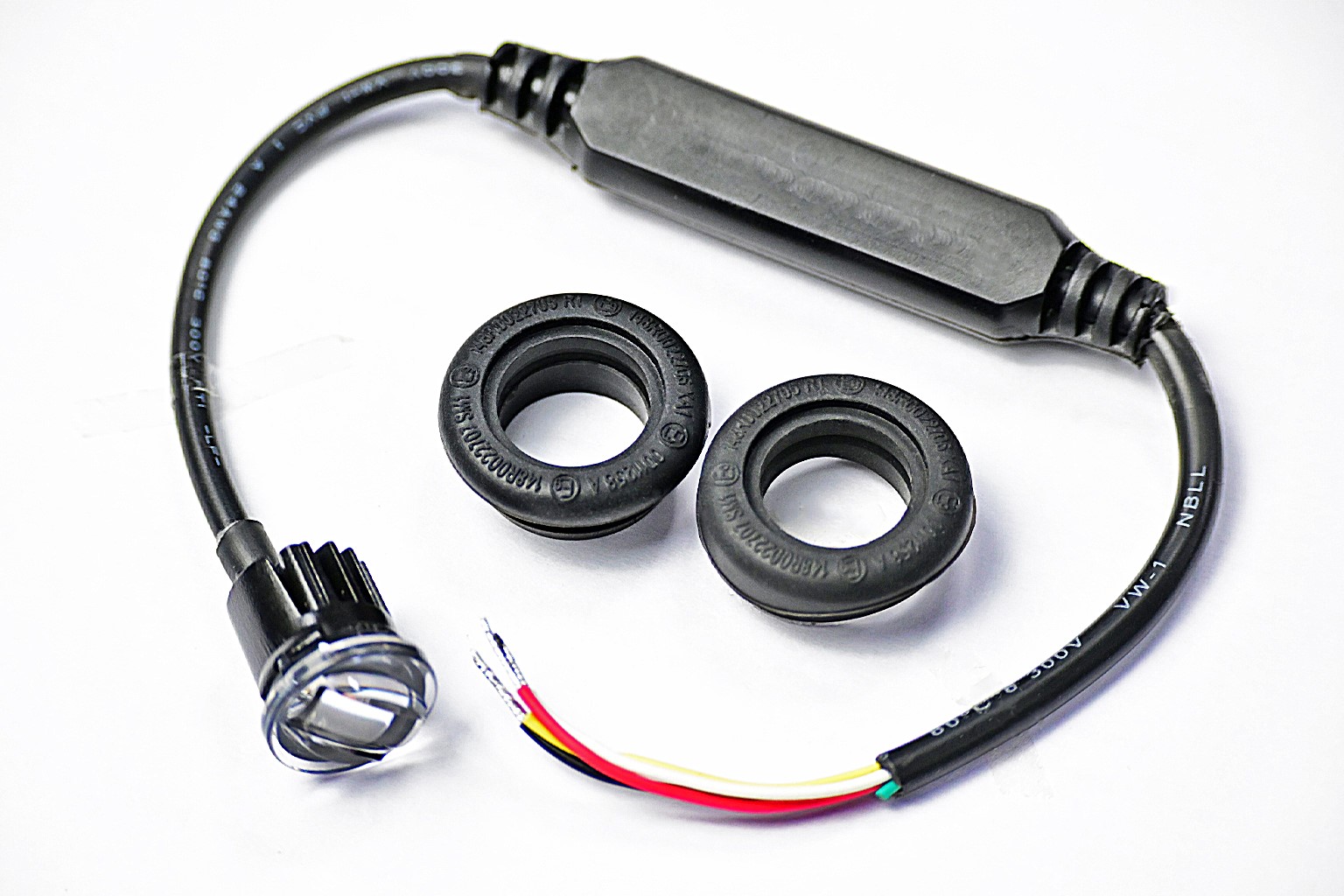
E6 — Slim Warning Light Module
The E6 is an ultra-slim warning light module — 118 × 25 × 7 mm with a black bezel — built around a Fresnel optical design. It is available in red, blue, amber, white or green, in single, dual, triple or split colour configurations. LED quantities are 36, 12 or 18 LEDs at 3W each, with a maximum current of 0.66A at 12V and 0.33A at 24V on a 10–33V DC supply. Flash pattern count is 20 for single or split colour and 12 for dual or triple colour. Mounting is surface or bracket, protection is IP67 / IP69K, the operating range is −30°C to +70°C, and the warranty is 3 years. ECE R65 Class 2, SAE J595 Class 1 and R10 are available as options on this model, and OEM/ODM customisation is supported.
The 7 mm profile is the reason buyers choose this format: it can be recessed into body panels, bumpers and equipment housings where a beacon cannot be mounted, while still delivering multi-colour signalling from a single module.
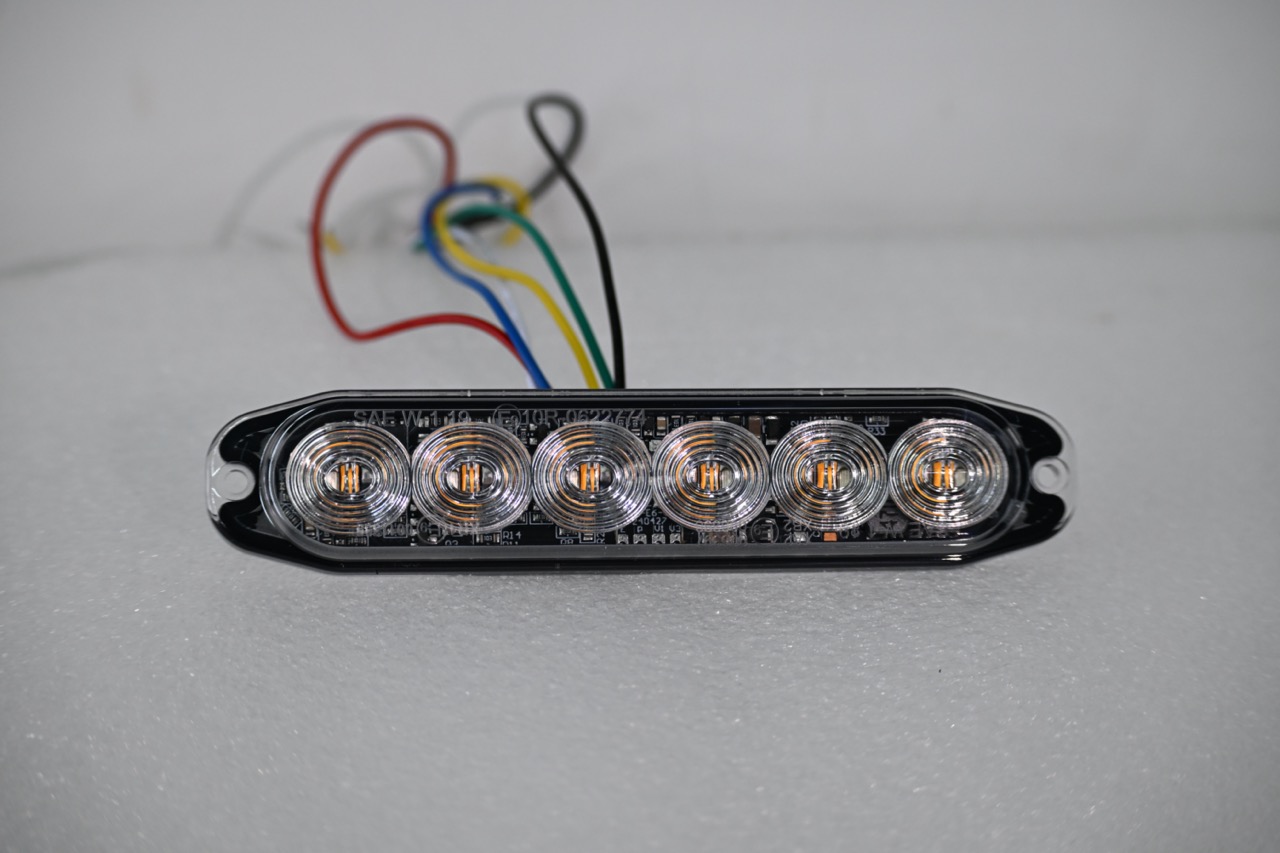
LB01 — Full-Size Warning Lightbar
When a beacon alone cannot cover the required visibility, the LB01 full-size warning lightbar provides a wider signalling surface. It is available in 600, 800, 1000, 1200, 1400 and 1600 mm lengths at 40.5 mm high, with smoked, clear, blue or amber/red covers and a hybrid optical design. Colours include red, blue, amber and white in single, dual or combination format, running on 10–33V DC with ten selectable flash patterns. LED quantities scale with length, from 78 × 1W at 600 mm to 198 × 1W at 1600 mm. Protection is IP65 and the operating range is −30°C to +70°C, with a 3-year warranty. Published compliance references are ECE R65 and R10, and cover colour, flash pattern and cable length can be customised.
SC7X — Warning Light Controller
Control is the last piece of the system. The SC7X is an all-in-one controller in a 100 × 70 × 20 mm aluminium housing with seven programmable buttons, in momentary or ON/OFF modes, and automatic night-time backlight dimming. It accepts a 10–30V DC input and delivers up to 40A maximum current output through 2 × 10A or 4 × 5A outputs, protected by a 40A fuse. The 300 mm harness uses AWG 14 red and AWG 16 black input wiring, and AWG 16 / AWG 18 output wiring in blue, yellow, white, grey, purple and green. Mounting options include 3M VHB, a suction cup bracket or a 3M surface-mount VHB sticker. Protection is IP67, the operating range is −30°C to +70°C, and the warranty is 2 years. The unit is ECE R10 approved.
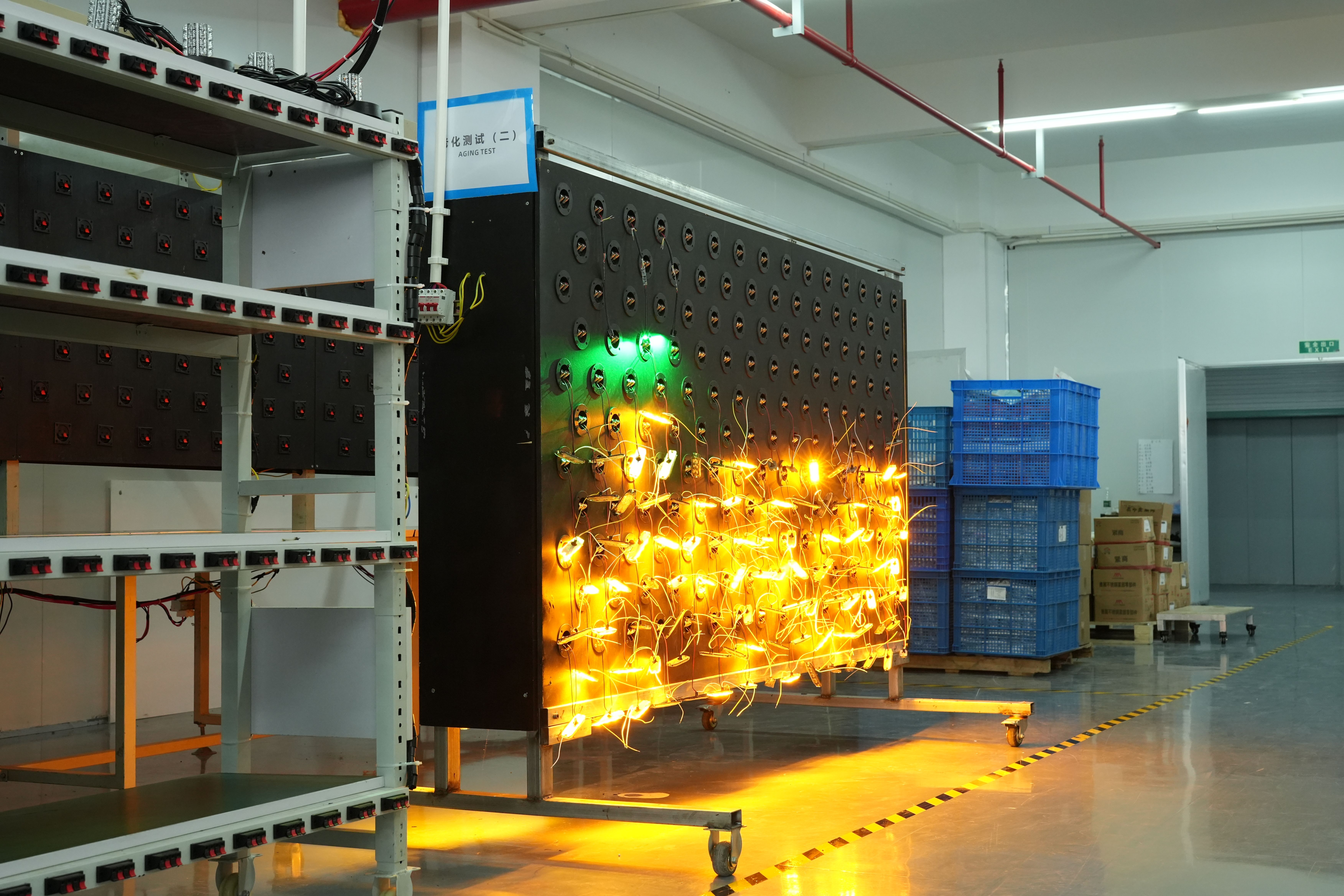
On compliance documentation: SIGROCK states that its products are designed and tested to meet applicable international requirements, with certifications and standards including ECE, SAE, CE, R10, R65 and IP67/IP69K, depending on the product. Because applicability is product-specific, buyers should request the certificate number, the exact model it covers, the issuing body and the validity date for every item on a quotation.
Step-by-Step Breakdown: Specifying an LED Beacon
The sequence below reflects how a warning light specification is normally built, from application back to part number. Working through it in order prevents the most common failure mode, which is choosing a model first and discovering the constraint afterwards.
Step 1 — Define the application and duty cycle. Emergency response, road maintenance, utility work, tow and service duty or seasonal operation each imply different flash behaviour, colour and mounting. Duty cycle also matters: some fleets run up to 24/7, in which case thermal behaviour and long-duration reliability carry more weight than peak output.
Step 2 — Confirm the market and the applicable approval. For ECE jurisdictions, the reference is ECE R65 for warning-light performance and ECE R10 for EMC. For North America, SAE J595 applies to directional flashing optical warning devices on authorized emergency, maintenance and service vehicles, and the applicable edition should be stated explicitly because more than one edition exists. Select the performance class according to the intended vehicle application and market requirements.
Step 3 — Decide mounting position and available space. A rotating beacon needs roof, bar or DIN space. A hideaway light such as the T43 fits flush or tube flush where no external housing is possible. A 7 mm module such as the E6 suits recessed panel mounting. A lightbar such as the LB01 is bracket mounted and needs length along the vehicle. Choose the format that fits the vehicle before comparing output.
Step 4 — Check the electrical envelope. A 10–33V DC rating covers both 12V and 24V systems, which simplifies fleet standardisation. Compare current draw across candidates: the BH18 draws 2.2A at 12V, the T43 draws 0.3A at 12V, and the E6 draws 0.66A at 12V. Then confirm that the controller can supply the total load — the SC7X delivers up to 40A maximum through 2 × 10A or 4 × 5A outputs.
Step 5 — Match protection to real exposure. IP67 covers dust protection and temporary immersion under specified test conditions. IP69K addresses dust protection and high-pressure, high-temperature water-jet exposure under its applicable test standard. If vehicles are washed with high-pressure equipment, that difference is a specification decision rather than a marketing detail. Confirm the operating temperature range as well: the SIGROCK vehicle range is specified from −30°C to +70°C and is intended for conditions including heavy rain, snow, fog, dust, mud, high humidity, high UV exposure and high-vibration operation.
Step 6 — Plan control and synchronisation. Decide whether the installation uses manual control, a central controller or CAN bus control, and whether units must flash in a synchronised pattern. Flash-pattern count and synchronisation capability are part of the specification, not an afterthought.
Step 7 — Confirm customisation and supply terms early. Customisation can cover OEM logo, housing, lens colour, flash patterns, cable length, connectors and control logic. Feasibility depends on the product's hardware, firmware and regulatory requirements, so confirm it together with minimum order quantities, development timelines and certification requirements for the project.
Step 8 — Install and verify. Install the warning light according to the manufacturer's instructions. Disconnect power before wiring, confirm the mounting location and required visibility, use compatible fasteners, and protect wire connections from moisture and damage. After installation, check mounting security, electrical connections and all required light functions before the vehicle enters service. Never drill into hidden wiring or vehicle components.
Use Cases: Matching Beacon Format to Vehicle
Vehicle warning lighting is application-driven. The categories below reflect how beacon and module formats are typically matched to vehicle types and working conditions.
- Police vehicles. The BH18 is listed as suitable for police vehicle applications with ECE R65 approval, in blue or dual colour. Compact hideaway units are often added for discreet integration where a roof beacon would be too visible.
- Fire trucks and rescue vehicles. The BH18 is also listed for fire truck applications, where high-intensity output and all-weather sealing are the primary requirements.
- Road maintenance and traffic management vehicles. Amber beacons and hideaway lights are used for hazard warning and traffic guidance. Daytime visibility in dust and bright sunlight is the deciding performance factor.
- Construction and utility vehicles. The T43 hideaway light is commonly applied where body panels are limited, and the E6 module suits recessed mounting on equipment housings. Both formats are designed for limited installation space.
- Tow trucks, service vehicles and commercial fleets. A combination of an LB01 lightbar for broad coverage plus T43 hideaway units for side and rear visibility is a common fleet configuration, controlled from a single SC7X panel.
- Seasonal or temporary vehicles. The BH18 magnetic mount option allows a beacon to be transferred between vehicles without permanent installation.
Across these applications, the operating conditions are broadly similar: daytime and night-time operation, low-light conditions, heavy rain, snow, fog, dust and mud, high humidity, outdoor operation, extreme temperatures, high UV exposure, highway and urban road operation, construction sites, roadside operations, high-vibration environments and long-duration fleet operation.
Comparison Table: Warning Light Formats Side by Side
| Model | Format | Mounting | Input / current | Protection | Published approval references | Typical fit |
|---|---|---|---|---|---|---|
| BH18 | Rotating LED beacon, single/dual colour | Bolts, DIN or magnetic | 10–33V DC; 2.2A @12V / 1.2A @24V | IP67, IP69K | ECE R10, ECE R65 Class 2, SAE J595 Class 1 | Roof or bar beacon; police, fire, road maintenance |
| T43 | Compact hideaway strobe light | Flush or tube flush | 10–33V DC; 0.3A @12V / 0.15A @24V | IP67 / IP69K | ECE R65, ECE R148, ECE R10, RoHS, CE | Grille, plate or panel integration; limited space |
| E6 | Ultra-slim warning light module, 7 mm | Surface or bracket | 10–33V DC; 0.66A @12V / 0.33A @24V | IP67 / IP69K | ECE R65 Class 2 / SAE J595 Class 1 / R10 options | Recessed body panels and equipment housings |
| LB01 | Full-size warning lightbar, 600–1600 mm | Bracket mount | 10–33V DC | IP65 | ECE R65, R10 | Broad coverage across the full vehicle width |
| SC7X | All-in-one warning light controller, 7 buttons | 3M VHB, suction cup bracket, surface VHB sticker | 10–30V DC in; up to 40A out | IP67 | ECE R10 approved | Central control of beacons, bars and modules |
Specifications reflect published SIGROCK model data. Approvals and options are configuration-specific; confirm the exact model, class and certificate for the configuration being quoted.
FAQ: LED Beacons and Vehicle Warning Lights
Which certifications should an LED beacon carry for European and North American vehicle use?
It depends on the vehicle application and the market. In ECE jurisdictions, ECE R65 addresses the photometric and performance side of warning lamps, and ECE R10 covers electromagnetic compatibility approval for applicable vehicles and electrical or electronic components — R10 approval does not replace the separate photometric or installation approvals. In North America, SAE J595 is the recommended practice for directional flashing optical warning devices used on authorized emergency, maintenance and service vehicles, and it defines different performance classes; the applicable edition should be confirmed because several editions exist. The practical rule is to request the certificate number, the exact model covered, the issuing body and the validity date for each product, rather than accepting a general statement of compliance.
What is the difference between IP67 and IP69K on a vehicle warning light?
IP67 covers dust protection and temporary immersion under specified test conditions. IP69K addresses dust protection and high-pressure, high-temperature water-jet exposure under its applicable test standard. Neither rating alone guarantees suitability for every environment. Choose based on the actual cleaning method, exposure conditions and the product's verified test results — for example, a fleet that uses high-pressure washing has a different requirement from one that does not. Several SIGROCK models, including the BH18, T43 and E6, are specified with both IP67 and IP69K protection depending on configuration.
How do I choose the right LED beacon for a specific vehicle?
Work from the application back to the model. Confirm the vehicle type and intended use, the available mounting space and required visibility, the applicable regulatory approvals, the operating voltage and required environmental protection, and the colours, flash patterns and customisation you need. Compare verified specifications rather than appearance or LED quantity alone. For a compact installation, a hideaway light such as the T43 may be the only format that fits; for broad coverage, a lightbar such as the LB01 is the appropriate format; for a standard roof beacon, the BH18 covers single and dual colour in one body.
Can LED beacons be customised with our own branding, colours and flash patterns?
SIGROCK supports OEM/ODM cooperation for vehicle warning and signalling lights. Depending on the product and project requirements, customisation may include branding, colours, flash patterns, functions and product design. At system level, customisation can extend to OEM logo, housing, lens colour, flash patterns, cable length, connectors and control logic. Feasibility may depend on the product's hardware, firmware and regulatory requirements, so design, marking method, quantity, development timelines and certification requirements should be confirmed for each project before specifications are finalised.
What is the minimum order for LED beacons, and how do we start?
Minimum order quantities depend on the product and the level of customisation; small MOQ is available for selected products. Because MOQ, tooling, lead time and certification requirements vary by model and configuration, they should be confirmed per project rather than assumed from a catalogue. To start, send the vehicle type, target market, required quantity, colour and flash-pattern requirements, and any approval the installation must satisfy. The SIGROCK team can then confirm the matching model, configuration feasibility and commercial terms, and provide a sample or quotation for evaluation. Contact: sales@sigrock.com or the WhatsApp link below.
Conclusion: Start With the Requirement, Then the Model
An LED beacon is a small component with a long specification list. The format you choose determines where it can be mounted; the electrical envelope determines whether the vehicle can supply it; the protection rating determines how it survives washing and weather; and the approval determines whether it is acceptable in the market where the vehicle operates. Buyers who sequence those decisions correctly rarely need to change a part number after the first delivery.
SIGROCK manufactures LED beacons, hideaway lights, warning light modules, lightbars and control systems from a 2,600 m² facility in Ningbo, China, with an in-house R&D team of 5 engineers and annual output of about 550,000 LED warning light units. If you are specifying warning lighting for a fleet, an upfitting project or a private-label programme, the fastest route is to send the requirement and let the technical team confirm the model-level details.

Request a sample, a quotation or the product catalogue
Send your vehicle type, target market, quantity and required approvals. SIGROCK will confirm the matching beacon or warning light model, customisation feasibility and commercial terms.
Email: sales@sigrock.com | Tel: +86 156-6915-9591 | WhatsApp: +86 186-9408-7250 | Website: www.sigrockautolamp.com
Download the standard edition catalogue: SIGROCK Catalogue (PDF)
Contact person: Freya Wang | Ningbo sigrock Automotive Lamp Technology Co.,LTD., Factory Building 618, 6/F, No.2529, Mingguang Road, Jiangshan Town, Yinzhou District, 315136 Ningbo, Zhejiang, China
Have Questions or Need More Details?
Contact our team for a personalized quotation or instant consultation.
Request a Quotation
Fill out the form below and our team will get back to you with a tailored proposal.
WhatsApp Direct Chat
Prefer to chat in real-time? Message us on WhatsApp for instant assistance & quick answers.
- Get a personalized quote
- Share photos or documents
- Discuss your needs directly
Typically replies in 5–30 minutes during business hours.