
Utility Vehicles LED Warning Lights: A Buyer's Guide
Utility vehicles LED warning lights are vehicle-mounted signalling devices — surface-mounted modules, rotating beacons, full-size lightbars, hideaway strobes and traffic advisors — that make service, maintenance, municipal and commercial vehicles visible to other road users. This guide explains what these lights are, how the main product families differ, which verified specifications matter, and what to check before selecting a model or a manufacturer.
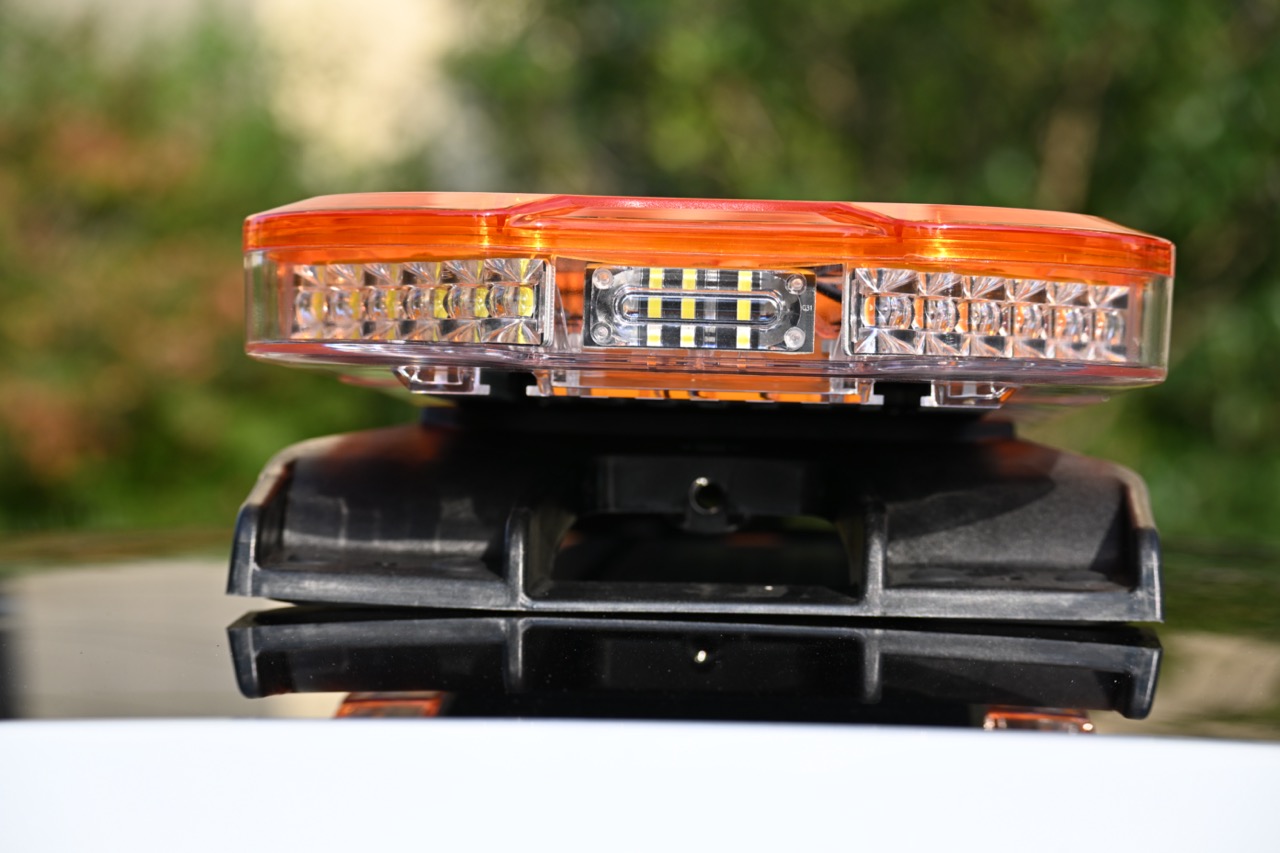
A full-size LED warning lightbar can be carried by utility, maintenance and municipal vehicles where a roof-level signal is required.
What Counts as a Utility Vehicle LED Warning Light?
A utility vehicle warning light is an auxiliary lighting device fitted to a mixed-purpose or commercial vehicle — tow trucks, service vehicles, utility trucks, maintenance vehicles, municipal and fleet vehicles — in order to warn, guide or identify that vehicle in traffic. Unlike headlamps or position lights, its purpose is not the driver's own vision; it exists so that other road users detect the vehicle early and adjust.
In practice, the category covers several distinct device types:
- Surface-mounted warning light modules — low-profile heads mounted to a body panel, grille or bracket.
- LED beacons — rotating or flashing roof-level units, often used where a single dominant signal is needed.
- LED lightbars — full-width roof bars carrying multiple heads and selectable flash patterns.
- Hideaway strobe lights — compact lamps installed through a panel or grommet for discreet integration.
- Traffic advisors and directional warning devices — used to direct traffic around roadside operations.
- Control systems — dash or panel controllers that switch, synchronise and sequence the lights above.
Typical warning functions include emergency warning, hazard warning, vehicle identification, traffic guidance, nighttime visibility, enhanced off-axis visibility, vehicle position lighting and improved roadside safety. Operation modes usually include flashing, alternating flashing, simultaneous flashing, steady-on, position lighting, warning plus position lighting, manual control, central controller control, CAN bus control, programmable flash patterns and synchronised operation.
Which vehicle categories use them
- Emergency and public safety: police vehicles, fire trucks, ambulances, rescue vehicles and emergency response vehicles.
- Road and traffic management: road maintenance, traffic management, highway maintenance, roadside assistance and traffic enforcement vehicles.
- Commercial and utility vehicles: tow trucks, service vehicles, utility vehicles, maintenance vehicles and fleet vehicles.
- Construction and industrial: construction vehicles and other site-based mobile plant.
Why Warning Light Selection Is Harder Than It Looks
Most utility vehicles leave the factory without any warning-light provision. The light is specified later, during upfitting or fleet retrofitting, which means the person choosing it is usually working against four simultaneous constraints:
Space. Mounting positions on vans, pickups and utility bodies are limited. A head that is too deep cannot be installed flush; a bar that is too wide will not sit on a low cab roof.
Environment. Utility vehicles commonly work in daytime and nighttime operation, low-light conditions, heavy rain, snow, fog, dust and mud, high humidity, extreme temperatures, high UV exposure, high-vibration environments, construction sites and roadside operations — often in long-duration or 24/7 fleet operation.
Electrical architecture. Modern vehicles mix 12 V and 24 V systems, carry sensitive electronics, and may require reverse polarity protection, overvoltage protection and low power consumption. A warning light that draws heavily or behaves unpredictably with vehicle electronics becomes a service issue rather than a visibility solution.
Regulation. Warning lights are regulated devices. ECE R65 addresses warning-light photometric performance, ECE R10 addresses electromagnetic compatibility, ECE R148 covers related lighting approval matters, and SAE J595 is the North American recommended practice for directional flashing optical warning devices. CE and RoHS requirements apply to relevant products placed on European markets, and IP67 or IP69K ingress protection is frequently specified for outdoor and wash-down duty.
Industry Background: Where the LED Warning Light Market Stands
The warning-light segment sits inside a much larger emergency lighting market. The emergency lighting market, which includes vehicle warning kits, was valued at USD 7.5 billion in 2023 and was reported to be growing at a CAGR of over 10% between 2024 and 2032. Within the narrower vehicle-specific category, the global emergency warning light market is projected to grow at a CAGR of 3.6% from 2025 to 2031.
The difference between those two figures is largely a scope difference: the broader emergency lighting figure includes fixed installation and building-related emergency lighting, while the 3.6% projection refers specifically to emergency warning lights. For buyers, the practical reading is that vehicle warning lighting is a mature, standards-driven category rather than a rapidly commoditising one. Suppliers compete less on raw brightness claims and more on optical design, durability and documentation.
LED technology now dominates the category. LED heads replaced incandescent rotating lamps because they offer low current draw, long service life and the ability to run multiple flash patterns and synchronised sequences from a single control unit. One consequence is that the electronics — drivers, controllers and EMC behaviour — matter as much as the optical head.
How a manufacturer is structured
SIGROCK (Ningbo sigrock Automotive Lamp Technology Co.,LTD.) is a vehicle warning light manufacturer established in 2018 and headquartered in Ningbo, Zhejiang, China. The company specialises in vehicle warning lights and safety lighting solutions, covering the design, development and manufacturing of strobe lightheads, LED beacons, lightbars, traffic advisors, dash lights, work lights and lighting control systems.
Its manufacturing facility covers 2,600 m² and employs approximately 35 staff, including an R&D team of 5 in-house engineers. Annual production capacity reaches about 550,000 LED warning light units. Products are supplied to customers across Europe, North America and other international markets, and are designed and tested to meet applicable international requirements, with certifications and standards including ECE, SAE, CE, R10, R65 and IP67/IP69K depending on the product.
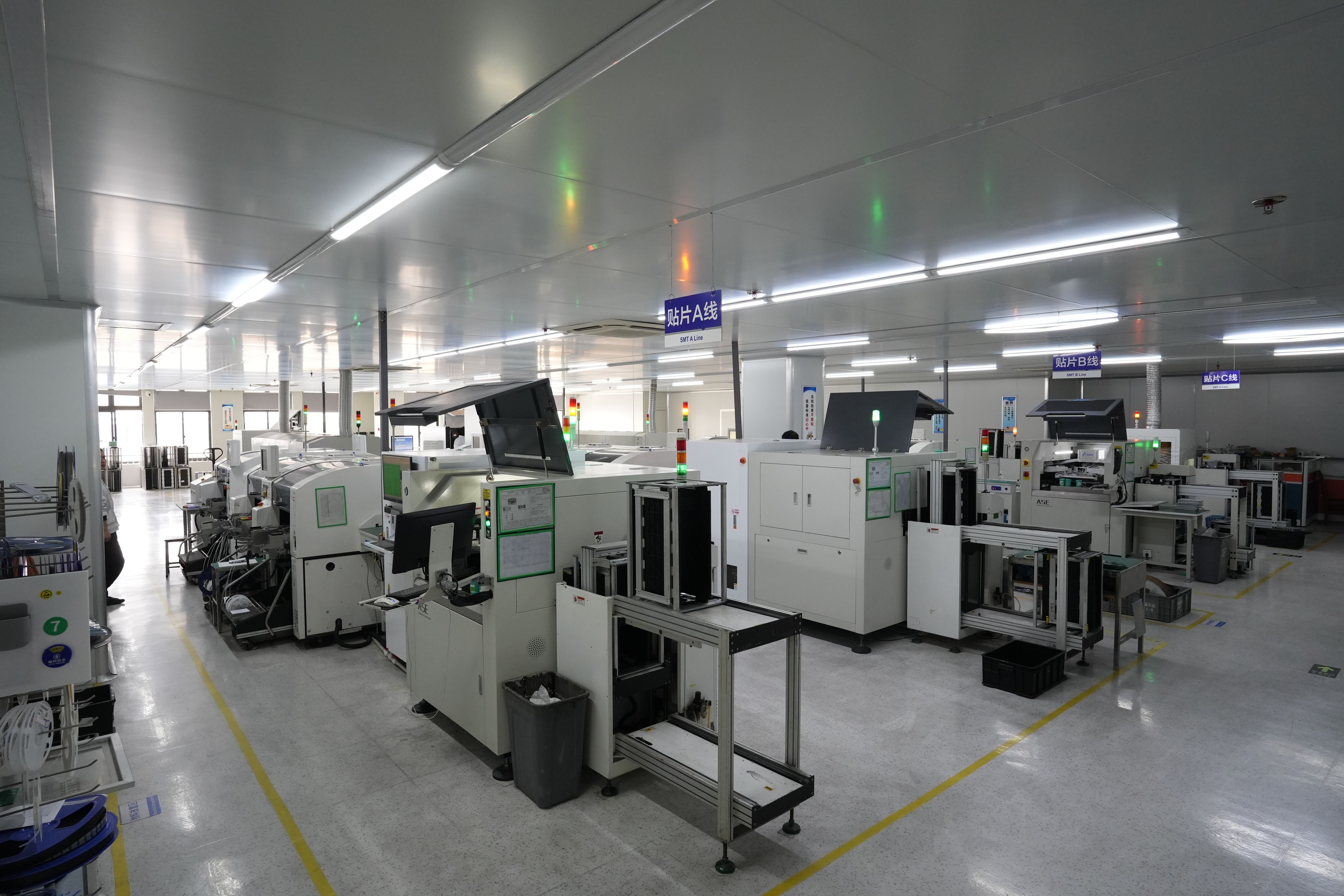
Surface-mount production of the driver and control electronics used in LED warning lights.
LED Warning Light Product Families and Their Specifications
Warning lights are not one product but a family of devices that solve different installation problems. The five families below show how the specification of a device follows from where it is mounted and what it has to signal. All values below are manufacturer specifications and should be confirmed model by model against the datasheet and certificate for the specific application.
E6 — ultra-slim warning light module
The E6 warning light module (product types E6S-A, E6S-B and E6S-R) measures 118 × 25 × 7 mm, making it a candidate where installation depth is the limiting factor. It uses a Fresnel optical design with a black bezel, and is available in red, blue, amber, white and green in single, dual, triple or split colour configurations.
Operating voltage is 10–33 V DC, with maximum current draw of 0.66 A at 12 V and 0.33 A at 24 V. LED counts are 36, 12 or 18 LEDs at 3 W each, with 20 selectable flash patterns for single and split colour versions and 12 for dual and triple colour versions. The lens is PC, mounting is surface or bracket, protection is IP67/IP69K and operating temperature spans −30°C to +70°C. Warranty is 3 years. ECE R65 Class 2, SAE J595 Class 1 and R10 options are available, and OEM/ODM customisation is supported.
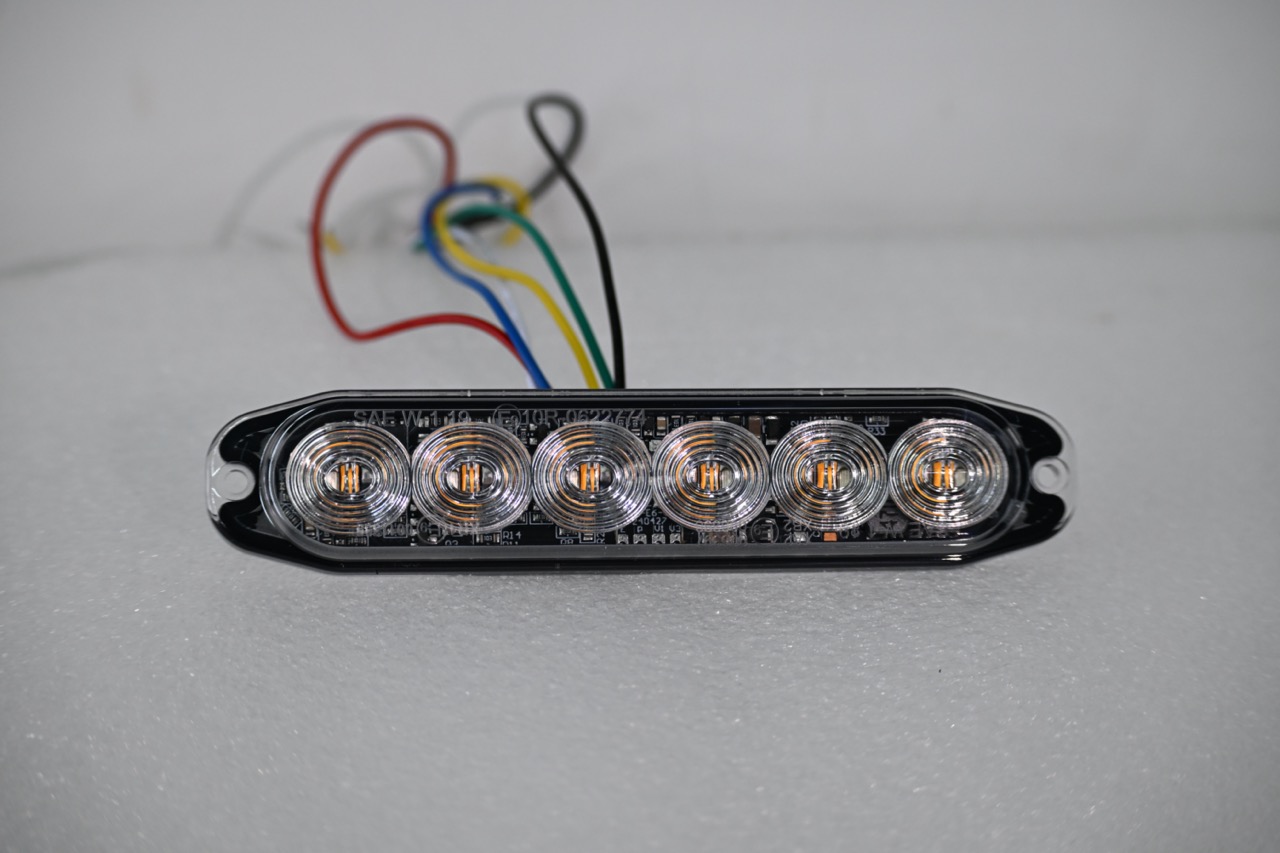
The E6 module measures 118 × 25 × 7 mm and is designed for surface or bracket mounting.
T43 — compact hideaway warning light
The T43 hideaway warning light measures 18.5 × 18.5 × 21.57 mm and installs through a black rubber grommet, either flush mount or tube flush mount. It combines two functions in one unit: warning light in amber, and position lighting in amber, red or white.
Its hybrid optical design runs on 10–33 V DC with a maximum current of 0.3 A at 12 V and 0.15 A at 24 V. The LED configuration is one 5 W emitter plus two 0.2 W LEDs, with 14 flash patterns and a PC lens. Protection is IP67/IP69K with an operating range of −30°C to +70°C and a 3-year warranty. Listed approvals include ECE R65, R148, R10, RoHS and CE, and the product can be customised. It is a common choice where a light must sit inside a body panel, bumper or licence-plate area without changing the vehicle's outline.
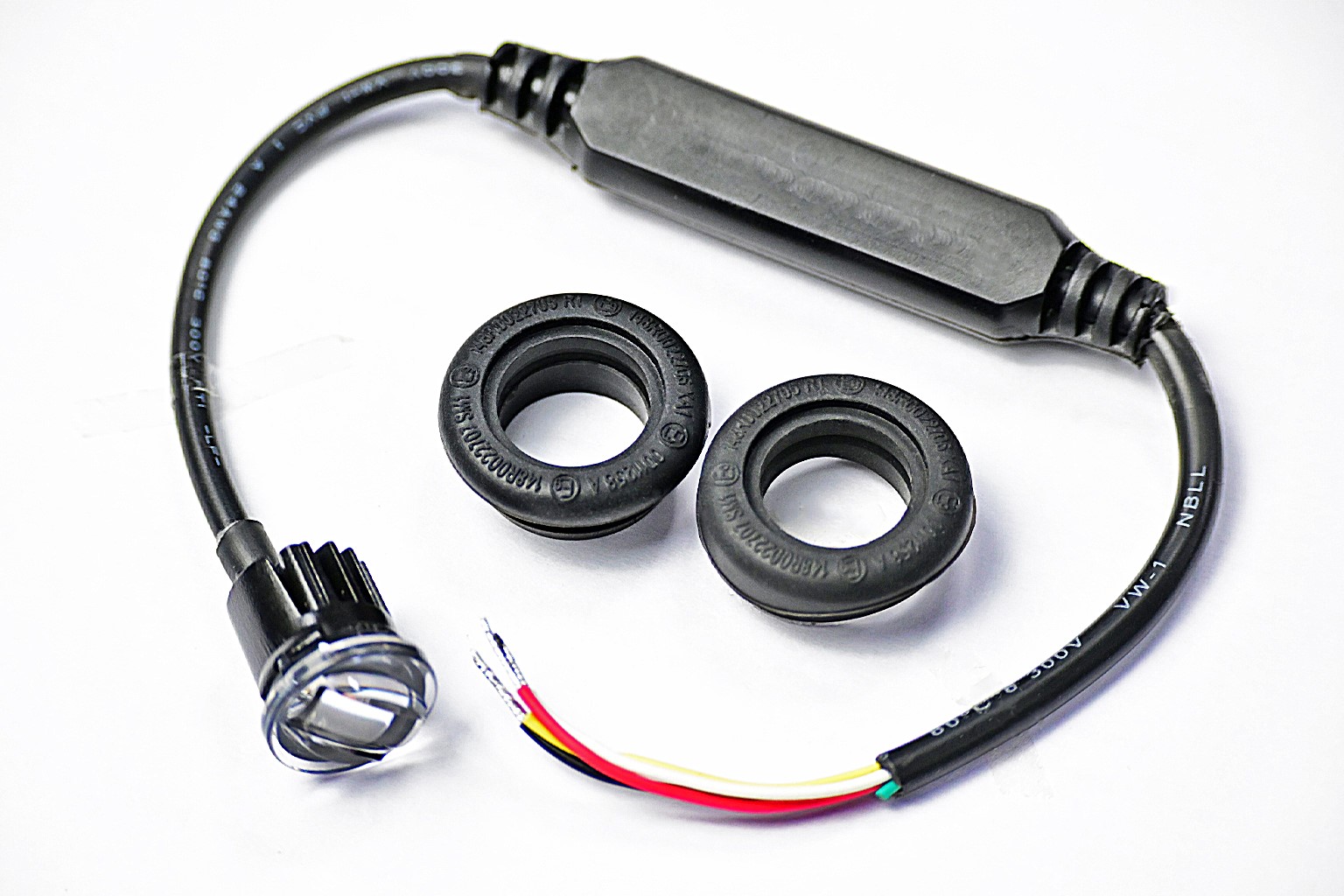
The T43 installs through a rubber grommet and provides both warning and position-light function.
BH18 — rotating LED beacon
The BH18 is a rotating LED beacon in single or dual configuration with LEDs in blue, amber, red or green. It uses 18 high-output 3 W LEDs for visibility and runs on 10–33 V DC, drawing 2.2 A at 12 V and 1.2 A at 24 V. Ten selectable flash patterns are available.
Mounting options include bolt, DIN and magnetic mount, giving flexibility when a permanent roof penetration is not wanted. The housing uses a PC lens with IP67 and IP69K rating and an operating temperature range of −30°C to +70°C. The beacon is certified to ECE R10, ECE R65 Class 2 and SAE J595 Class 1, and carries a 3-year warranty.
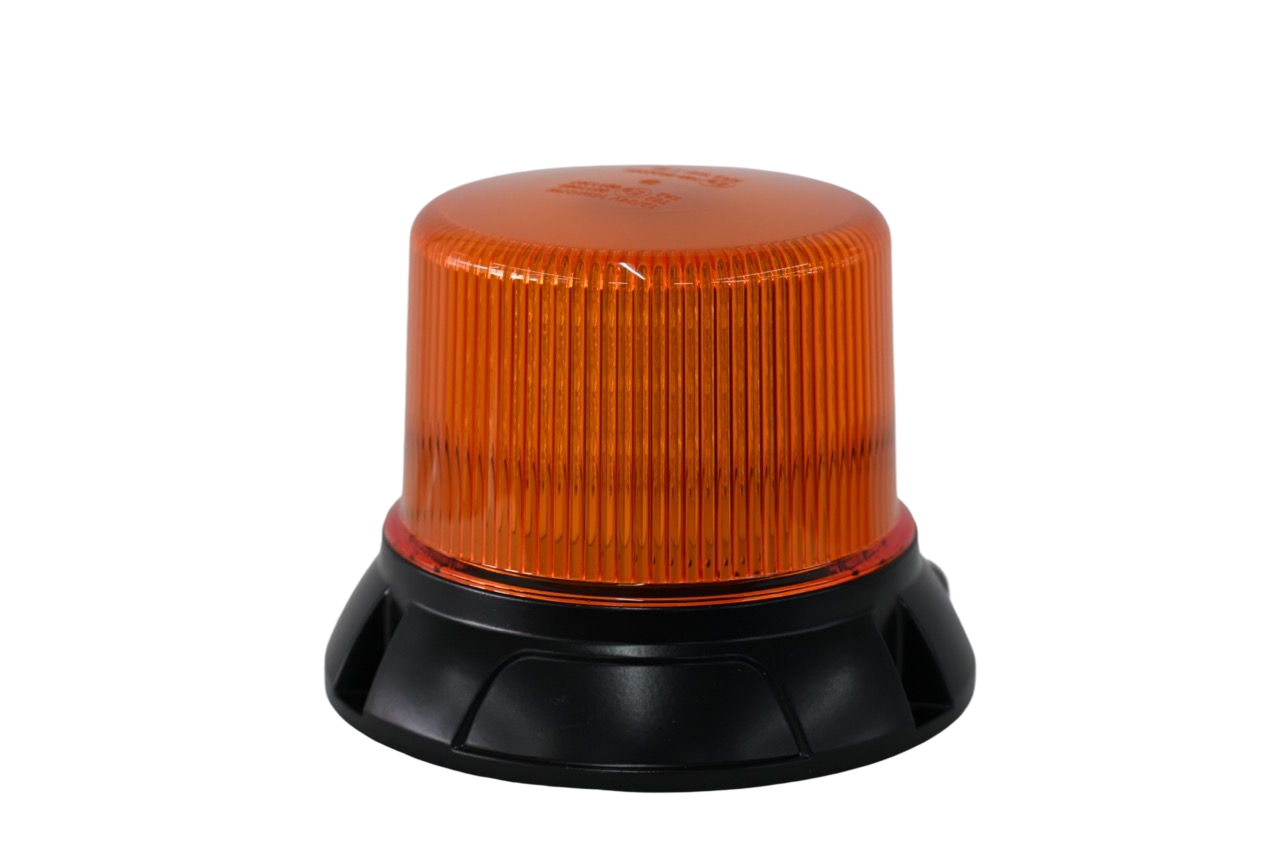
The BH18 beacon offers bolt, DIN or magnetic mounting and 10 selectable flash patterns.
LB01 — full-size warning lightbar
The LB01 warning lightbar is available in 600, 800, 1000, 1200, 1400 and 1600 mm lengths, all 40.5 mm high. Cover options are smoked, clear, blue and amber/red, and the hybrid optical design supports red, blue, amber and white in single colour, dual colour or combination colour layouts.
Operating voltage is 10–33 V DC. LED quantities scale with bar length — 78 emitters at 600 mm, 102 at 800 mm, 126 at 1000 mm, 150 at 1200 mm, 174 at 1400 mm and 198 at 1600 mm, each rated 1 W. Power figures per version are 76 W (600 mm), 92 W (800 mm), 108 W (1000 mm) and 124 W for the 1200, 1400 and 1600 mm versions. Ten selectable flash patterns, PC lens, bracket mounting, IP65 protection and an operating range of −30°C to +70°C complete the specification. Listed approvals are ECE R65 and R10, and the 3-year warranty applies. Cover colour, flash pattern and cable length can be customised.
SC7X — vehicle warning light controller
The SC7X is an all-in-one controller measuring 100 × 70 × 20 mm with seven programmable buttons. Button modes can be momentary or ON/OFF, and the backlit buttons dim automatically at night. Input voltage is 10–30 V DC with a maximum current output of 40 A, configured as either 2 × 10 A outputs or 4 × 5 A outputs, protected by a 40 A fuse. The cable harness is 300 mm, with AWG 14 red and AWG 16 black input wiring and AWG 16 or AWG 18 output wiring in blue, yellow, white, grey, purple or green. Mounting uses 3M VHB, a suction cup bracket or a 3M surface-mount VHB sticker. Protection is IP67, operating range is −30°C to +70°C, approval includes ECE R10 and the warranty is 2 years.
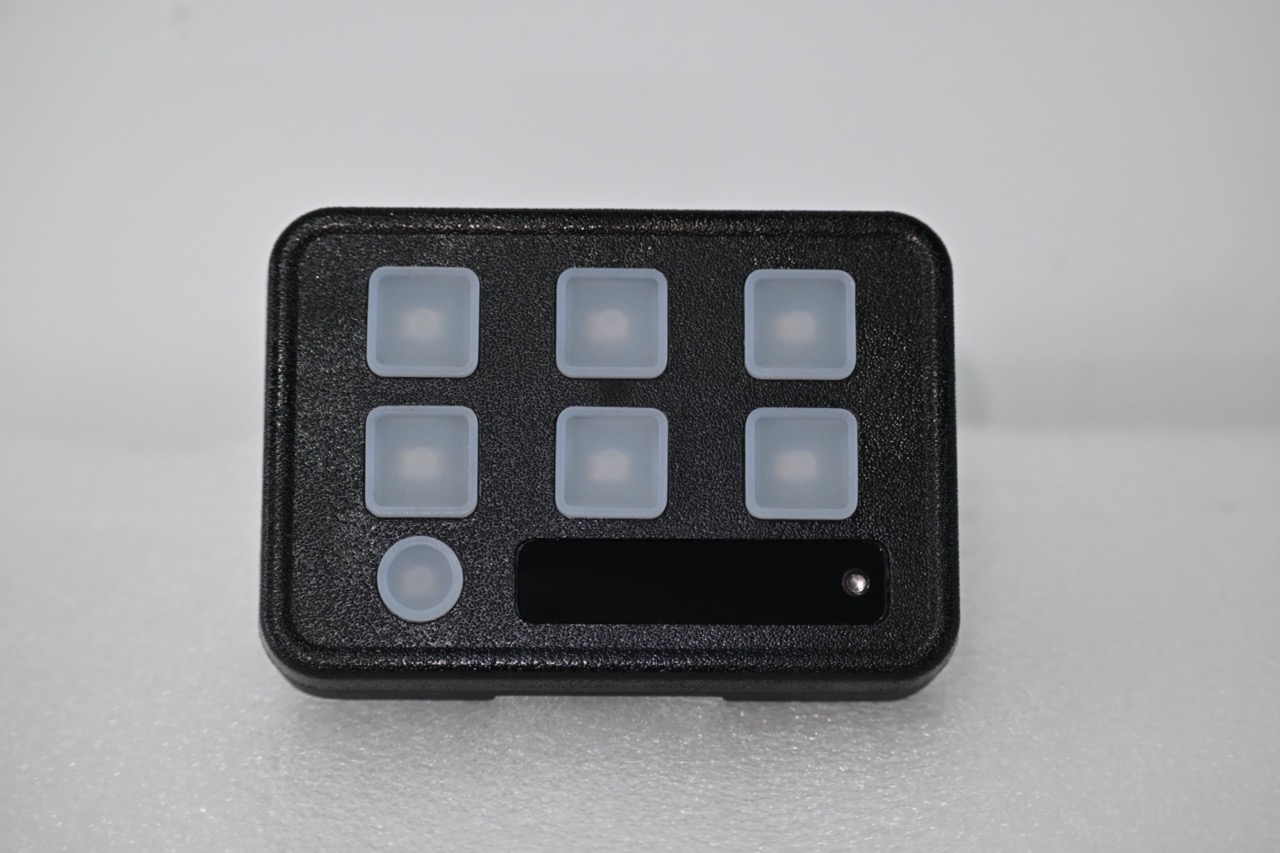
The SC7X controller switches up to 40 A across 2 × 10 A or 4 × 5 A outputs.
Step-by-Step: Choosing Warning Lights for a Utility Vehicle Fleet
Selection criteria for a commercial or fleet vehicle follow a repeatable sequence. Working through it in order avoids the common error of choosing a light by appearance or LED count and discovering the mismatch at installation.
- Define the vehicle type and intended application. A tow truck, a highway maintenance vehicle and a municipal pickup have different signalling duties. The application determines whether the primary signal is warning, identification, traffic guidance or a combination.
- Confirm the mounting position and available space. Decide whether the light will sit on the roof, in the grille, in a body panel or on a bracket. Measure the depth, width and clearance before shortlisting models. Where space is tight, a 7 mm module or an 18.5 mm hideaway light is more likely to fit than a lightbar.
- Match the operating voltage and current load. Confirm whether the vehicle runs 12 V or 24 V, or both. Check the current draw of each light against the vehicle's electrical capacity and the controller's output rating.
- Assess the environmental exposure. Roadside operation, winter roads, pressure washing and construction sites all change the ingress protection requirement. Where high-pressure cleaning is routine, IP69K-rated units are the more relevant specification than IP67 alone.
- Verify the applicable regulatory approvals for the target market. European applications typically reference ECE R65 and ECE R10; North American applications may reference SAE J595. Confirm which class or category applies, and request the certificate or test report for that model rather than accepting a general statement of compliance.
- Select colour, flash pattern and function. Choose the colour configuration required by the application and the local regulation, then confirm the flash pattern count and whether patterns are programmable or synchronised.
- Decide how the lights will be controlled. Options range from manual switching to a central controller, programmable controller or CAN bus control system. A multi-light installation benefits from a controller that manages synchronisation and sequencing.
- Check customisation and OEM/ODM feasibility. Branding, housing, lens colour, cable length, connectors and control logic may all be adjustable depending on the product, but feasibility, minimum order quantities and development timelines should be confirmed for each project.
- Validate with a sample before full fleet rollout. Test fit, wiring, flash behaviour and daytime and nighttime visibility on one vehicle before committing the fleet.
Use Cases: Matching Warning Lights to Vehicle Types
Road maintenance and highway maintenance vehicles. These vehicles work in live traffic and are often stationary for long periods. Roof-level warning is usually the priority, which points to an LED lightbar or an amber beacon with high output and multiple flash patterns.
Tow trucks and roadside assistance vehicles. These units arrive at unpredictable positions relative to traffic and need all-round warning. A combination of a roof-level bar and lower-level lights on the body sides and rear is common.
Municipal and utility fleet vehicles. Low-cab and van-based vehicles often have little roof clearance. Compact surface-mounted modules offer warning without adding significant height, and a dash-mounted controller keeps operation simple for drivers who do not use the lights daily.
Vehicles with limited installation space or a need for discretion. Where the vehicle outline must remain unchanged, a hideaway strobe installed through a grommet in a panel or bumper provides warning and, on some models, position lighting in the same unit.
Emergency and public safety vehicles. Police vehicles, fire trucks and ambulances operate under stricter regulatory expectations. In these applications the applicable approval class, colour configuration and mounting standard must be confirmed before selection.
Construction and industrial mobile plant. High vibration, dust and mud exposure make housing durability and ingress protection the controlling specifications, with magnetic or bracket mounting often preferred to avoid permanent bodywork changes.
Comparison Table: Warning Light Families at a Glance
| Product (model) | Type | Mounting | Operating voltage | Protection | Listed approvals | Warranty |
|---|---|---|---|---|---|---|
| E6 warning light module | Ultra-slim LED module (E6S-A, E6S-B, E6S-R) | Surface mount / bracket mount | 10–33 V DC | IP67 / IP69K | ECE R65 Class 2 / SAE J595 Class 1 / R10 options | 3 years |
| T43 hideaway warning light | Compact hideaway strobe, warning + position function | Flush mount / tube flush mount | 10–33 V DC | IP67 / IP69K | ECE R65, R148, R10, RoHS, CE | 3 years |
| BH18 LED warning light beacon | Rotating LED beacon, single or dual configuration | Bolts, DIN or magnetic mount | 10–33 V DC | IP67 / IP69K | ECE R10, ECE R65 Class 2, SAE J595 Class 1 | 3 years |
| LB01 warning lightbar | Full-size LED lightbar, 600–1600 mm | Bracket mount | 10–33 V DC | IP65 | ECE R65, R10 | 3 years |
| SC7X controller | All-in-one vehicle warning light controller | 3M VHB, suction cup bracket, 3M surface-mount VHB sticker | 10–30 V DC | IP67 | ECE R10 | 2 years |
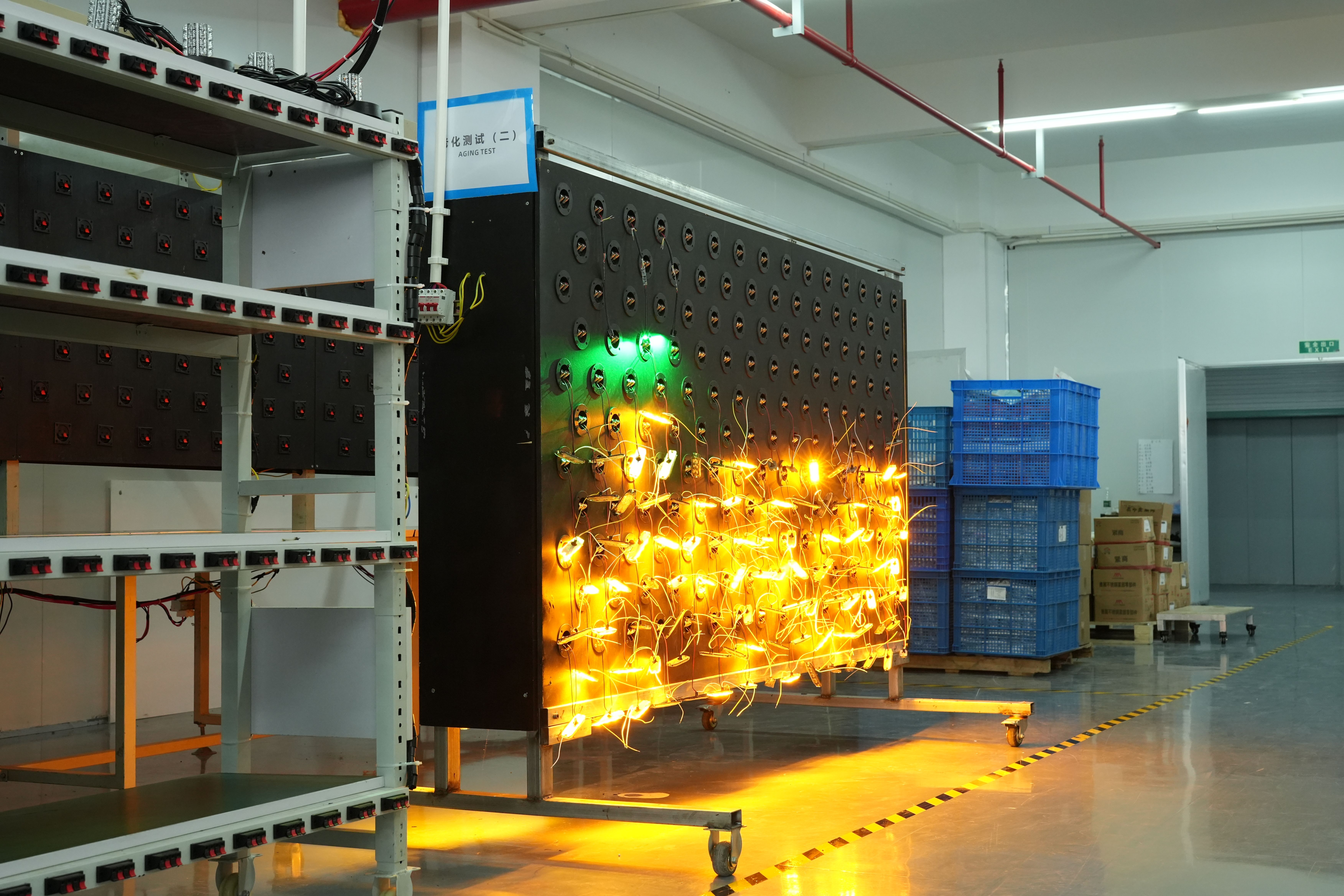
Ageing tests are used to check optical performance, durability and long-term reliability before shipment.
Frequently Asked Questions
What does an LED warning light manufacturer for utility vehicles actually produce?
LED warning light manufacturers design, develop and manufacture vehicle warning and safety lighting. The product range typically includes strobe lightheads, LED beacons, lightbars, traffic advisors, dash lights, work lights and lighting control systems, supplied either as standard catalogue products or as customised solutions for a specific vehicle type, application or market. SIGROCK (Ningbo sigrock Automotive Lamp Technology Co.,LTD.) is a vehicle warning light manufacturer established in 2018 and based in Ningbo, Zhejiang, China, operating a 2,600 m² facility with approximately 35 staff, an R&D team of 5 in-house engineers and an annual production capacity of about 550,000 units.
Does a vehicle warning light need ECE R10 approval, and is it the same as ECE R65?
They are different approvals and neither replaces the other. UN ECE Regulation No. 10 (ECE R10) concerns the electromagnetic compatibility (EMC) approval of applicable vehicles and electrical or electronic components. For vehicle warning lights it addresses relevant electromagnetic emissions and immunity requirements, helping to ensure that approved equipment operates compatibly with other electronic systems on the vehicle. ECE R65, by contrast, relates to the photometric performance of warning lights. R10 approval does not replace the separate photometric or installation approvals that may apply to a warning light, so buyers should confirm both where the application requires them.
Does SIGROCK offer OEM and ODM services for LED warning lights?
Yes. SIGROCK supports OEM/ODM cooperation for vehicle warning and signalling lights. Depending on the product and project requirements, customisation may include branding, colours, flash patterns, functions and product design. Feasibility, minimum order quantities, development timelines and certification requirements should be confirmed individually for each project. Logo customisation may be available depending on the product and order requirements, and flash pattern or colour customisation may be possible depending on the product's hardware, firmware and regulatory requirements.
How do I choose the right LED warning light for a utility vehicle?
Choose based on the vehicle application, mounting space, required visibility, applicable regulations, operating voltage, environmental exposure and desired functions. Confirm the model's actual approvals and specifications before purchasing rather than selecting by appearance or LED quantity alone. For OEM or ODM projects, also consider lens design, flash patterns, colours, wiring and branding requirements. Where high-pressure washing or winter road exposure is routine, check whether IP69K rather than IP67 is the more relevant protection rating for the installation position.
How can I request a sample, a quotation or the product catalogue?
Request model-specific specifications before sampling, so that the sample matches the intended vehicle and market. Samples, quotations and technical documents can be requested directly from SIGROCK by email at sales@sigrock.com or by phone at +86 156-6915-9591; WhatsApp contact is available at +86 186-9408-7250. The designated contact for business inquiries is Freya Wang. The standard edition product catalogue can be downloaded as a PDF from the link in the section below.
Next Step: Sample, Quote or Catalogue
If you are specifying warning lights for a utility, maintenance or municipal vehicle programme, the fastest way to reduce risk is to test a sample against your actual mounting position and electrical system. Send the vehicle type, mounting location, target market and required approvals, and SIGROCK can confirm the matching model, available customisation and next steps.
Email: sales@sigrock.com | Phone: +86 156-6915-9591 | WhatsApp: +86 186-9408-7250 | Website: www.sigrockautolamp.com
Download the standard edition product catalogue (PDF): SIGROCK Catalogue — Standard Edition

Finished LED warning lights staged for shipment from the Ningbo facility.
Conclusion
Utility vehicles LED warning lights are specified, not bought off a shelf. The correct choice follows from the vehicle's application, the available mounting space, the electrical system, the environmental exposure and the regulatory requirement of the destination market — in that order. Product families exist because installations differ: a 7 mm surface module, an 18.5 mm hideaway light, a rotating beacon, a full-size lightbar and a 40 A controller each solve a different problem.
For buyers in the research stage, two habits prevent most specification errors. First, confirm the individual product's approvals and ingress protection rather than accepting a general compliance statement. Second, validate on one vehicle with a sample before committing a fleet. Both steps cost little and remove the majority of retrofit risk.
Have Questions or Need More Details?
Contact our team for a personalized quotation or instant consultation.
Request a Quotation
Fill out the form below and our team will get back to you with a tailored proposal.
WhatsApp Direct Chat
Prefer to chat in real-time? Message us on WhatsApp for instant assistance & quick answers.
- Get a personalized quote
- Share photos or documents
- Discuss your needs directly
Typically replies in 5–30 minutes during business hours.