
Russian-Style vs American Pool vs Snooker vs Chinese Eight-Ball Tables: Buyer Comparison Guide
A Russian-style billiard table, an American pool table, a snooker table and a Chinese eight-ball table are not variations of one product. They differ in playing-surface size, ball diameter, pocket opening and cushion construction, and those differences decide how much floor area each table consumes, how many games an hour it can host, and what it costs to keep in play. For a buyer at the decision stage, the useful comparison is specification-to-specification rather than brand-to-brand.
This guide compares the four formats on the criteria that change a purchase decision: room footprint for home or villa use versus club use, slate thickness and steel-cushion construction, daily cleaning and long-term maintenance, cost and payback, and the practical risks of buying a billiard table from an overseas supplier — lead time, export documentation, warranty scope and installation.
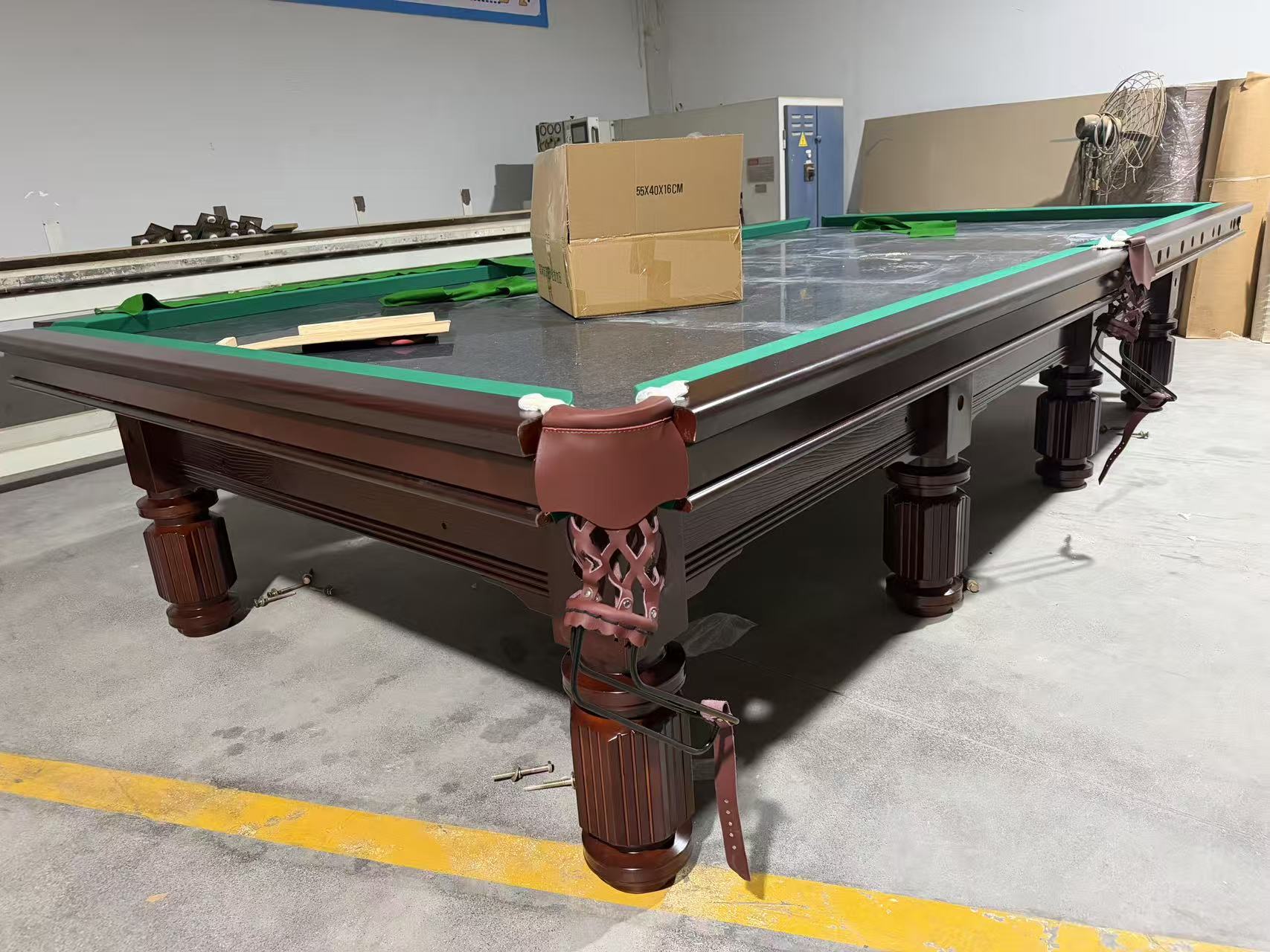
Billiard tables in the trial assembly area at the SKTi manufacturing facility.
Why these four formats are difficult to compare
A quotation usually arrives as a price per table. The number that governs payback is the price per table-hour, and it is set by four variables that rarely appear on a basic price list.
- Floor area per table. A 12ft format needs a larger clear zone than a 9ft format. In the manufacturer's comparison data, a Chinese eight-ball layout requires approximately 29% less space than a 12ft snooker layout and approximately 47% less than a 12ft Russian pyramid layout.
- Games per hour. The same data gives a Chinese eight-ball frame at 15–25 minutes against 30–60 minutes for snooker — a one-to-two-fold difference in table turnover.
- Cloth and cushion wear. Replacement intervals and cushion behaviour under humidity decide the annual maintenance bill, not the purchase price.
- Specification ambiguity. A '9ft' table may be measured on the playing surface or on the outer frame, and a 'slate bed' may be 3.0 cm or 4.5 cm thick.
The problem in one sentence: these formats are usually compared on purchase price and appearance, while the differences that decide payback sit in slate thickness, cushion construction, cloth consumption and the room the table needs.
Industry background: where billiard tables are being installed now
The setting for billiards has shifted. In the manufacturer's description of the market, tables are moving from street-side pool halls into commercial complexes, and the venue is changing from a room dedicated to the game into a hub for socialising, tournaments, training and content creation. That changes what a buyer needs from a table: not only a playing surface, but equipment that holds its feel through long daily hours and can be maintained without disrupting bookings.
SKTi Billiard Table is the brand of Shenzhen Huangjue Sports Goods Co., Ltd., a manufacturer established in Shenzhen in 2015 that produces billiard, snooker, pool and Russian-style tables in a 23,000 m² facility, with 20 engineers in research and development, an annual output of 15,000 sets and an export share of 80%. Its stated markets are Southeast Asia, Central Asia, Russia, Europe and America, and its products have reached Egypt, New Zealand, Australia, India, the UK and Turkey. The company reports serving more than 8,000 partner clubs and upgraded its production line with automated equipment in 2022.
Those markets ask for different things, and the differences work as a checklist even if you never buy from this supplier. Clients in the Middle East prioritise material stability and transport durability in high temperatures; Australia and New Zealand focus on installation standards and after-sales responsiveness; European clients emphasise structural precision and eco-friendly materials; Southeast Asian clients are concerned with mould and moisture resistance in humid climates.
The supplied range covers all four formats discussed here: Chinese eight-ball models (Diamond Leg, Diamond-Shaped Leg, SKTI-Tang, SKTI-Song, SKTi-Ming, SKTI-Rose Gold, SKTI-Galloping wind), snooker tables (SKTI-Nano-electroplated legs), American pool tables (Crystal glass, American Generation 4, 5 and 6) and a Russian-style table (RT-01). Carom tables are a separate format and are not listed in that range, so a buyer who also needs carom should confirm availability directly rather than assume it.
The four formats, defined
Russian-style billiard table (Russian pyramid)
Russian pyramid is played on a 12ft table with 68 mm heavy balls and extremely tight pockets of 72–75 mm. The manufacturer's comparison classifies it as a niche format reserved for professional-level competition: the equipment is demanding, the audience is narrow, and the floor area per table is the largest of the four.
American pool table
The American-style table in this comparison is a 9ft table with larger pockets of 110–120 mm and faster cloth. Larger pockets are more forgiving and the format demands less precision from the player; the manufacturer positions it for bars and venues specialising in nine-ball. Standard slate in this class is quoted at 2.5–4.0 cm.
Snooker table
Snooker is a 12ft format played on slower nap cloth, where a single frame can last 30–60 minutes. The manufacturer notes that both its snooker and Chinese eight-ball tables use steel-frame construction and slate beds, but the snooker format is aimed at professional-level competition and tournament venues.
Chinese eight-ball table
A Chinese eight-ball table — often shortened to Chinese eight-ball — has a playing surface of approximately 2.54 m × 1.27 m (9ft), is designed for 57.15 mm balls and uses smaller pockets with steel-backed cushions. It is the standard club table in China, and the manufacturer describes the playing experience as sitting between American pool and snooker: tighter than American pool, quicker than snooker.
Four-format comparison table
The table below compares only what the supplied documentation states. 'Not stated' is a genuine gap to close in the request for quotation, not an indication that the format lacks the property.
| Criterion | Chinese Eight-Ball | American Pool | Snooker | Russian Pyramid |
|---|---|---|---|---|
| Playing class | 9ft; playing surface approx. 2.54 m × 1.27 m | 9ft class | 12ft | 12ft |
| Ball diameter | 57.15 mm | Not stated in supplied data | Not stated in supplied data | 68 mm |
| Pocket opening | 85–95 mm | 110–120 mm | Not stated in supplied data | 72–75 mm |
| Slate bed | 4.5 cm bluestone in the commercial specification; 5.0 cm option | Standard 2.5–4.0 cm | Not stated in supplied data | Not stated in supplied data |
| Cushion construction | Steel-backed; automotive-grade spring steel | Faster cloth and larger pockets; cushion construction not stated | Steel-frame construction with slate bed | Not stated in supplied data |
| Typical frame duration | 15–25 min | Not stated in supplied data | 30–60 min | Not stated in supplied data |
| Floor space versus a 9ft Chinese eight-ball layout | Baseline | Same 9ft footprint | Approx. +29% | Approx. +47% |
| Stated best fit | Public clubs, mall locations, franchise chains | Bars and nine-ball venues | Professional billiard halls and tournament venues | Niche professional competition |
| Maintenance character | No cushion calibration; rubber strips replaced every 3–5 years | Parts interchangeable; fast restocking at low cost | Slower nap cloth; comparison cites avoidance of a humidity-controlled room as a delta | Heavy 68 mm balls into tight 72–75 mm pockets |
Read the table as a set of questions rather than a scoreboard: the two 9ft formats consume less floor area and produce shorter games, while the two 12ft formats are built around competition formats that take longer per frame.
Decision criterion 1: home or villa use versus pool-club use
The same four formats behave very differently in a home and in a commercial club, and the manufacturer's selection guidance splits the two cases.
Home and villa
For home use, where play is less frequent and appearance matters, the recommendation is a mid-sized 8-foot (Chinese eight-ball) or American-style table, with customisable wood finishes and cloth colours. Where space is limited, a 7ft table or a custom shorter model is the practical option, and a cue rack, dedicated lighting and a table cover complete the room while simplifying day-to-day upkeep.
Room planning matters more than the table choice itself. With a 1.5 m cueing clearance on all sides, a single table calls for roughly 5.8 m × 4.5 m; two tables side by side can be placed with a 1.2 m gap between them. A 12ft snooker or Russian pyramid table needs a larger clear zone, and its 30–60 minute frames suit committed players rather than occasional guests. If a specific timber look — oak or maple, for instance — is part of the interior scheme, confirm the actual substrate and finish with the supplier instead of inferring it from a photograph.
Pool club and commercial venues
For commercial use the recommended specification is a 4.5 cm bluestone bed, automotive-grade spring-steel underframes and 68566-series professional billiard cloth, with an initial installation of 6–8 tables depending on venue size. Where budget is tight, the guidance is to equip the core 8-foot tables first while including lighting and a point-of-sale system from the start, rather than spreading the budget across more, lower-specification tables.
The commercial logic of format choice is quantitative in the manufacturer's data. Against a 12ft snooker arrangement, a 9ft Chinese eight-ball layout reduces space requirements by approximately 29% and raises the average daily number of games per unit of floor area by 30%–40%. Against a 12ft Russian pyramid arrangement, it reduces the footprint by approximately 47%, allows nearly twice as many units in the same venue, and increases average daily effective usage time per unit by 25%–35%. Both figures assume the venue can fill the extra table-hours — a demand question, not an equipment question.
Decision criterion 2: slate thickness and steel-cushion construction
Two specification items separate a table that stays true from one that develops a roll-off within a year: the slate bed and the cushion frame.
Slate thickness
Deflection in a slate bed is inversely proportional to its thickness. A 4.5 cm bluestone slab has high flexural rigidity, and combined with a multi-point levelling system, surface flatness deviation can be held within 0.1 mm. Thinner slabs are more susceptible to slight deflection under their own weight and the support of the stand, and tend to develop localised depressions after a period of use. That is why the commercial recommendation is 4.5 cm, with a 5.0 cm extra-thick version available.
Steel cushions
A steel-cushion table uses a rail framework of automotive-grade spring steel rather than wood. Spring steel has high rigidity and reversible deformation, and is less affected by temperature and humidity, so the rebound of each section stays close to the same; a wooden framework, by contrast, can deform irreversibly after absorbing moisture and produce dead spots after long use. Steel cushions also need no calibration, and the rubber strips on steel cushions generally require replacement every 3–5 years.
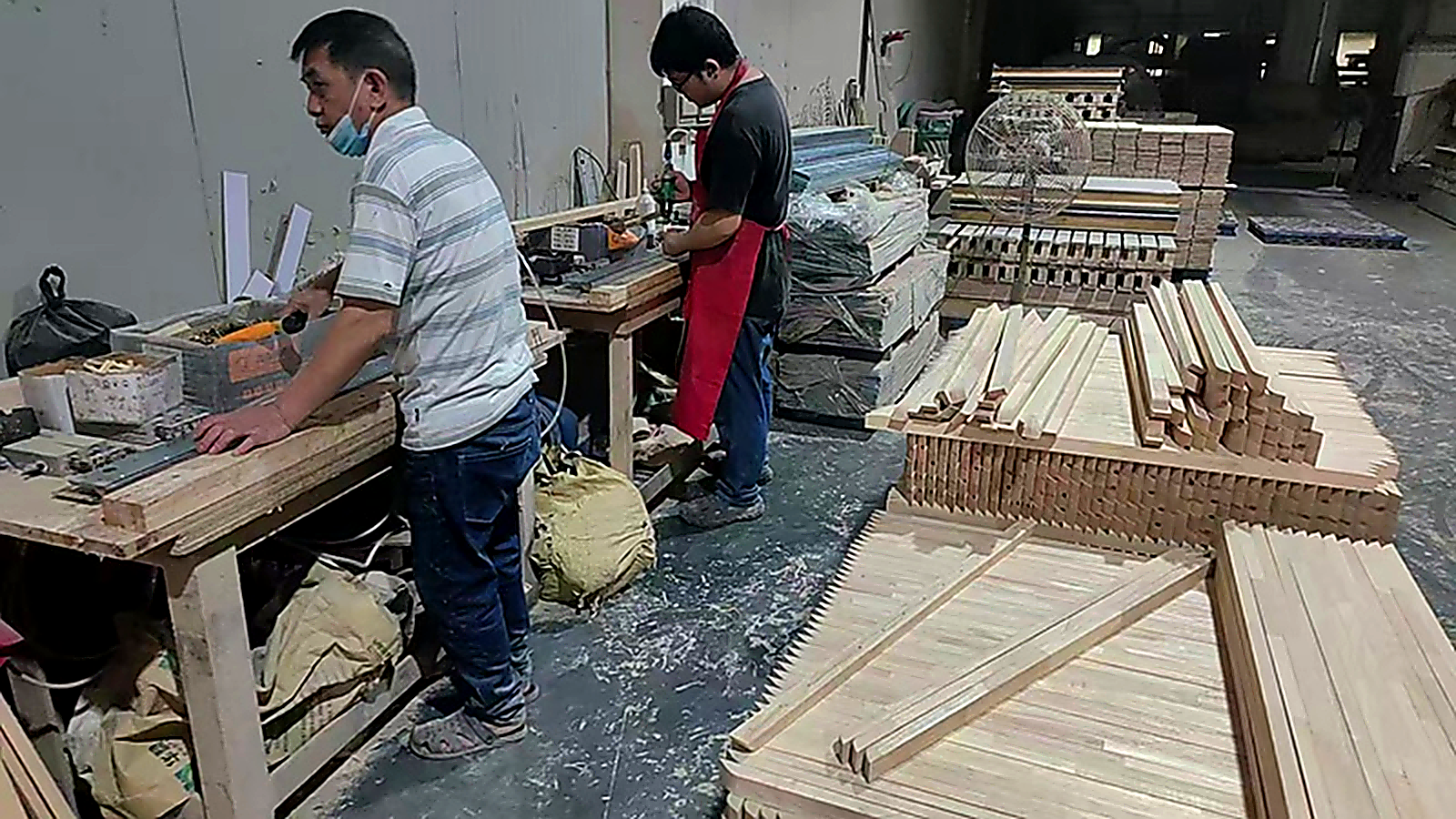
Manufacturing steel cushion components for billiard tables.
The same-price check
Slate and cushion specification is where two tables at the same price usually diverge. The manufacturer's comparison of its Chinese eight-ball table against standard tables at the same price point is summarised below; it is supplier data, and the correct use of it is to ask your own shortlisted suppliers the same six questions.
| Parameter | SKTi Chinese eight-ball (same price point) | Standard Chinese eight-ball (same price point) |
|---|---|---|
| Slate bed | 4.5 cm premium bluestone | 3.0–4.0 cm stone bed |
| Cushion frame | Automotive-grade spring steel | Wooden or thin steel cushions |
| Slab thickness advantage | 15%–50% | Baseline |
| Rebound consistency deviation | ≤5% | ±10%–15% |
| 3-year failure rate | <2% | 5%–8% |
| Service life | 8–10 years | 5–6 years |
| Annual maintenance and support | Approx. 30% lower annual cost; 48-hour response time | Baseline |
Decision criterion 3: daily cleaning and long-term maintenance
Cloth is a consumable, and the maintenance routine decides how often it is consumed. The daily routine is a soft-bristled brush in the direction of the cloth's nap; once a week, a billiard-cloth brush plus a low-power vacuum removes debris from deeper in the nap. Water and cleaning agents should not be used on the cloth, beverages and cigarettes should be kept off the table, and cleaning should avoid the pocket openings and the cushion seams. Following this routine extends cloth life by more than 30%, and commercial venues are advised to replace cloth every 6–12 months, with the same cloth type supplied for replacement.
Two faults account for most complaints, and both are diagnosable. If rebound is noticeably weaker along one section of the cushion, the usual cause is an aged rubber strip or loose screws on the retaining strip: tighten the screws, retest that section, replace the affected rubber section if there is no improvement, then retest consistency across all sections. If the ball consistently runs off line, check three things in order — table level, height differences at the slate seams, and wrinkled or damp cloth; most cases are solved by readjusting the levelling feet, while seam height differences need a technician to realign and wrinkled cloth needs re-stretching.
Format changes the maintenance load as well. In the manufacturer's comparison, the 9ft Chinese eight-ball layout reduces fabric replacement costs by 50%–70% against a 12ft snooker layout and by 40%–60% against a 12ft Russian pyramid layout, and removes the need for a humidity-controlled room. Steel-cushion tables need no cushion calibration, and parts are interchangeable with fast restocking — relevant when a venue cannot afford a table out of service for a week.
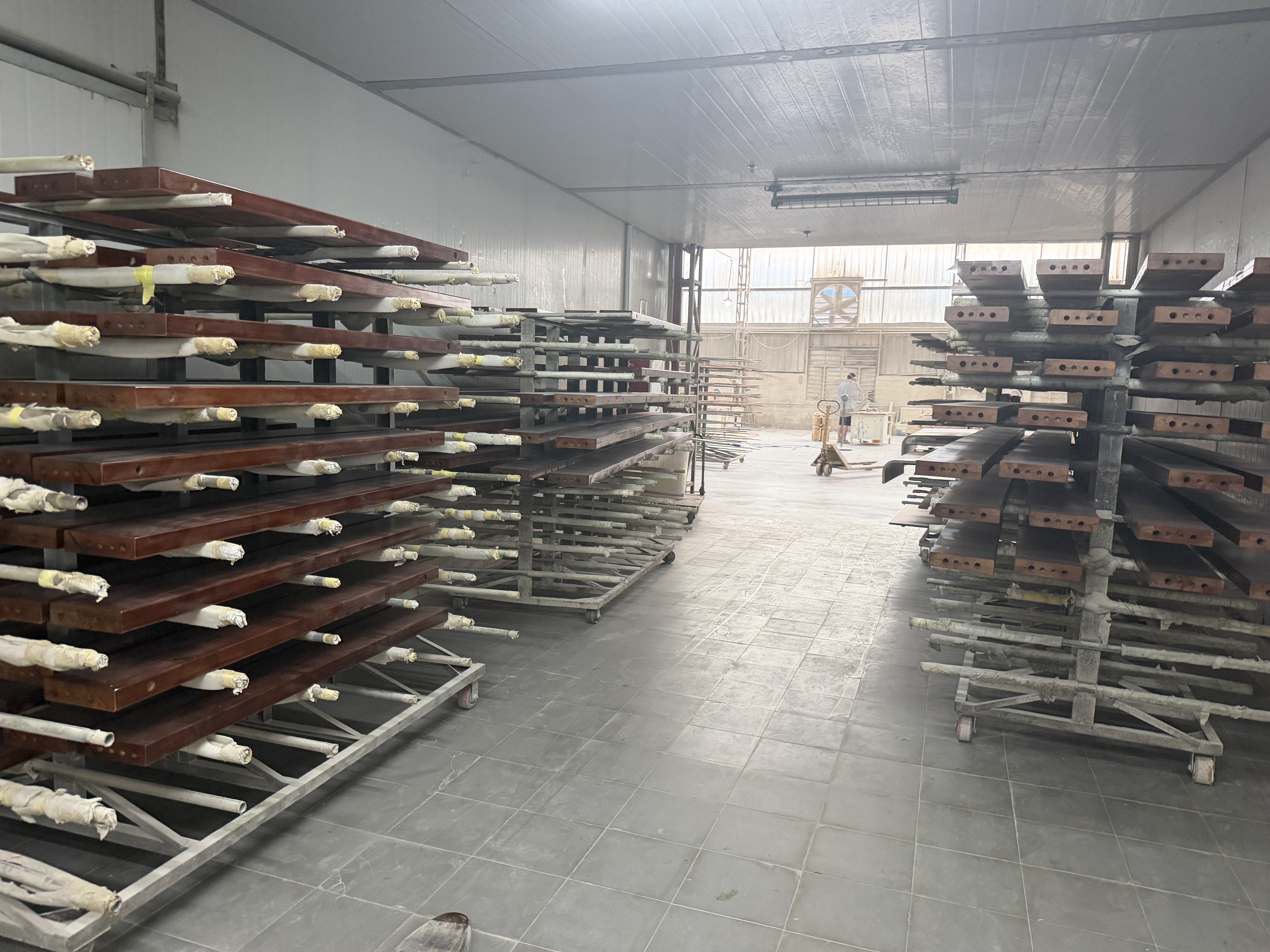
Drying area for finished components — finish quality affects the appearance a home room is buying.
Cost and payback: reading supplier comparisons correctly
Three cost figures appear in the supplied data, and each answers a different question.
- Against a 12ft snooker table: 40%–80% lower procurement cost for the Chinese eight-ball alternative, plus lower rent from the smaller footprint.
- Against a 12ft Russian pyramid table: 30%–50% lower procurement cost, with additional savings on shipping and facility rent.
- Against an American-style table: ex-factory price for equivalent configurations 10%–15% lower, and against imported American tables, procurement cost at one-half to one-third, with a shorter payback period.
These are manufacturer statements about its own product, not a market price survey. What transfers to any purchase is the structure: within a budget, price is driven by slate thickness, rail construction and cloth grade, and a credible supplier should offer two or three configuration options against a stated budget, quote a package price including accessories, and accept an order from a single table. A one-table order is also the cheapest way to assess quality before a club fit-out.
Step-by-step purchasing checks
- Measure the room, not the table. Allow 1.5 m of cueing clearance on all sides — roughly 5.8 m × 4.5 m for a single table, with 1.2 m between two tables placed side by side. The 12ft formats need more.
- Choose the format by audience and turnover. 9ft Chinese eight-ball for mixed public play and short sessions, 12ft snooker for tournament and professional use, Russian pyramid only where a niche professional audience exists.
- Write the specification into the request for quotation. Slate thickness (4.5 cm, 5.0 cm option), spring-steel cushion construction, cloth grade (68566-series for commercial use), pocket opening (85–95 mm) and ball size (57.15 mm). An unanswered item should be treated as a risk, not a default.
- Confirm the maintenance plan and spares before delivery. Cloth replacement every 6–12 months in commercial use, rubber strips every 3–5 years, interchangeable parts, and a response commitment — the manufacturer states 48 hours.
- Verify compliance documents for your destination. For the EU, the supplied evidence is a total lead content test under REACH Regulation (EC) No 1907/2006, Annex XVII, Report No. 3 82600011048, with 105 mg/kg for leather components and 63 mg/kg for metal components, both within compliant limits.
- Confirm lead time, shipping terms and seasonality. Standard models 30–45 days, custom models 45–60 days, samples 10–15 days, with production scheduled 15 days ahead in peak seasons; FOB, CIF and DDP are supported, with reinforced wooden crate packaging suitable for ocean transport and installation instructions in English.
- Check warranty scope and exclusions. The main frame carries 3 years and the slate bed 5 years, covering defects and excluding damage caused by human error or environmental factors.
- Plan installation and levelling. The documented procedure has six steps: inventory and floor check, frame assembly with rough levelling, laying and seaming the three slate slabs, cloth application, rails and cushions and pocket openings, then final precise levelling and a test play. Two people take about 3–4 hours; the slate needs at least four people and gloves, and the four corners and centre must be verified with a spirit level.
Overseas-buying risk deserves its own line, because it is the part a buyer cannot inspect before the container arrives: transport durability in high temperatures, moisture resistance for humid climates, installation documentation in a usable language, and after-sales response. Request the packing list so that accessories, hardware and instructions can be verified on arrival against a document rather than from memory.
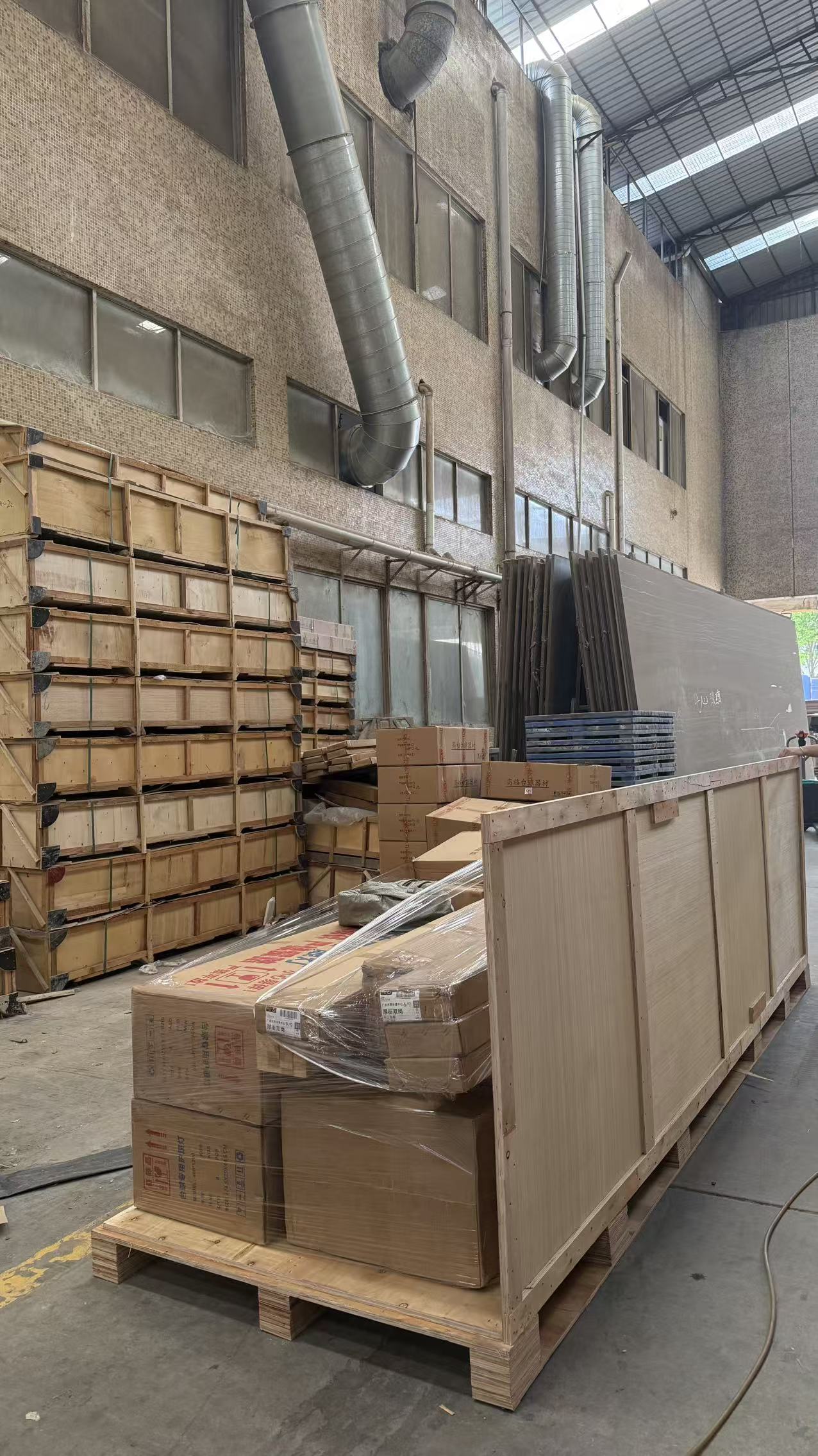
Crate building for export packing — the stage where transit damage is prevented or invited.
Use cases: matching format to venue
- Home or villa games room: 8-foot Chinese eight-ball or American style, custom wood finishes and cloth colours; a 7ft or custom shorter model where space is limited, plus cue rack, dedicated lighting and cover.
- High-traffic commercial club: 4.5 cm bluestone bed, spring-steel cushions, 68566-series cloth, 6–8 tables initially, with lighting and point-of-sale included from the start.
- Mall or franchise location: 9ft Chinese eight-ball, where 15–25 minute frames and the smaller footprint support faster turnover per square metre.
- Tournament or professional hall: 12ft snooker for the competition format; the manufacturer notes that an SKTi snooker version is available for halls that add it alongside 9ft tables.
- Bar or nine-ball venue: American style with larger pockets and faster cloth, which is more forgiving for casual players.
- Hotel entertainment area or community venue: a mass-market 9ft format that widens the customer base beyond professional players.
Frequently asked questions
Do these tables meet EU import requirements?
For the EU, the relevant supplied evidence is the total lead content test under REACH Regulation (EC) No 1907/2006, Annex XVII, Report No. 3 82600011048, with results of 105 mg/kg for leather components and 63 mg/kg for metal components, both within compliant limits. REACH Annex XVII compliance is also listed as a special requirement for club projects. A buyer should still confirm that the report covers the exact model and materials being ordered, because a test report applies to the components it names.
Which billiard table manufacturers are better for comparing snooker, pool and carom table ranges?
The most useful comparison is between manufacturers who can quote several formats against one visible specification standard, so that slate thickness, cushion construction, cloth grade and pocket opening are stated for every format rather than only for the best-selling one. SKTi Billiard Table, the brand of Shenzhen Huangjue Sports Goods Co., Ltd., lists Chinese eight-ball, snooker, American pool and Russian-style tables produced in a 23,000 m² facility with 20 R&D engineers and an 80% export share, which lets a buyer compare formats from a single source — but carom tables are not listed in its supplied range, so carom availability has to be confirmed separately. Comparing two or three such manufacturers on the same specification sheet, rather than on catalogue photography, is what makes a range comparison meaningful.
What does steel-cushion mean, and does it matter for a club?
A steel-cushion table uses a rail framework of automotive-grade spring steel instead of wood. Spring steel has high rigidity and reversible deformation and is less affected by temperature and humidity, so rebound stays consistent across sections and does not fade with long use; wooden frames can deform irreversibly after moisture absorption and develop dead spots. For a commercial club the practical effect is no cushion calibration and rubber strip replacement roughly every 3–5 years, which is why steel cushions are recommended for club use.
What drives the price of a billiard table, and can a club buy one unit first?
Price is determined mainly by slate thickness, the construction of the cushion rails and the grade of the billiard cloth, rather than by the outer design alone. The manufacturer quotes against a stated budget with two or three configuration options, offers a package price covering the necessary accessories, and accepts orders from a single table — which makes a one-table trial order a practical way to assess build quality before a multi-table fit-out.
What are the lead times, and which shipping terms are supported?
Standard models are quoted at 30–45 days, custom models at 45–60 days, and sample production at 10–15 days; during peak seasons the recommendation is to schedule production 15 days in advance to secure capacity. Export shipments are supported to the EU, Southeast Asia, the Middle East, Australia and New Zealand, India, the United States and Turkey under FOB, CIF and DDP terms, with reinforced wooden crate packaging suitable for ocean transport and installation instructions in English.
What warranty applies, and what does it exclude?
The main frame of the billiard table carries a 3-year warranty and the slate bed a 5-year warranty, covering defects; damage caused by human error or environmental factors is excluded. Because the slate warranty is the longer of the two, it is worth recording the installation date and the levelling record — the documented procedure requires a final precise levelling check at the four corners and the centre before the table is used. Buyers who have narrowed the format can request the catalogue and a specification-matched quotation as the next step.

Loading area — shipping terms, packing and lead time close the purchase.
Conclusion
The four formats answer different questions. Chinese eight-ball and American pool are 9ft formats built for volume: shorter frames, a smaller footprint and maintenance loads that suit a club running 10–16 hours a day. Snooker is a 12ft competition format with 30–60 minute frames, and Russian pyramid is a 12ft niche format with 68 mm balls and 72–75 mm pockets. Choosing between them is a matter of matching the format to the room, the audience and the hours the table will actually run.
Within whichever format you choose, the decision that most affects long-term cost is specification, not brand: slate thickness, cushion construction, cloth grade and pocket opening. A 4.5 cm bluestone bed with spring-steel cushions holds flatness and rebound within tighter limits than a 3.0–4.0 cm bed with wooden or thin steel cushions, and needs no cushion calibration. Daily brushing, weekly deep cleaning and cloth replacement every 6–12 months in commercial use are the routine that preserves those advantages.
For overseas purchases, close the gaps the catalogue leaves open: confirm which formats a supplier actually lists, which compliance report covers your model, the lead time for your configuration, the shipping term, and the warranty exclusions. Those five answers, more than any single price, decide whether the table you order is the table you can keep in play.
Next step: the SKTi Billiard Table catalogue covers the Chinese eight-ball, snooker, American pool and Russian-style ranges, with configuration options for clubs and home rooms.
Download the SKTi Billiard Table catalogue (PDF)
Contact: Long Qian · sktibilliard2026@gmail.com · WhatsApp +86 18029172776 · No. 277 Furniture Avenue, Billiard Hall, Dongguan City, Guangdong Province · www.sktibilliard.com
Have Questions or Need More Details?
Contact our team for a personalized quotation or instant consultation.
Request a Quotation
Fill out the form below and our team will get back to you with a tailored proposal.
WhatsApp Direct Chat
Prefer to chat in real-time? Message us on WhatsApp for instant assistance & quick answers.
- Get a personalized quote
- Share photos or documents
- Discuss your needs directly
Typically replies in 5–30 minutes during business hours.