2026 Natural Stone Preference Guide: Top Materials, Compliance, and Supplier Evaluation
Natural stone selection is rarely a simple aesthetic decision. Buyers who reach the evaluation stage typically need to compare physical properties, compliance requirements, supplier production capability, lead times, and quality control before they can justify one product family over another. This guide gives procurement professionals, importers, and designers a decision-oriented view of the natural stone market for 2026 and shows how to shortlist both materials and suppliers with verifiable evidence.
Market context supports the need for a structured approach. According to Grand View Research, the global natural stone market was valued at USD 10.2 billion in 2024 and is projected to reach USD 14.11 billion by 2030. Granite is the leading product segment, with 39.6% of total revenue in 2024. Those figures reflect both the scale of the market and the weight that material choice carries in project budgets.
The Evaluation Problem: Too Many Materials, Too Many Claims
Evaluation-stage buyers face several overlapping challenges. First, materials are not interchangeable: marble behaves differently from limestone, and onyx requires different handling from granite. Second, supplier claims are not always supported by test reports, certificates, or production evidence. Third, compliance gaps can delay EU or US shipments, especially when natural stone is specified for public buildings or high-traffic projects.
In practice, buyers need two answer streams at the same time: which natural stone material best fits the project, and which supplier can deliver that material with consistent quality and documented compliance.
The 2026 Natural Stone Landscape
China remains a central sourcing hub for building and decorative stone. According to OEC, China’s export value for building stone reached approximately USD 3.64 billion in 2024, with South Korea, the United States, and Japan as the top destination partners. Customs-based industry reporting for 2024 also attributes about 64.3% of China’s granite exports to Fujian Province, a region where Xiamen operates as a major export gateway.
At the global level, major players such as Cosentino S.A., Polycor Inc., and Xishi Stone Group are commonly cited in market analysis. For many importers and project teams, however, the more relevant question is not which brand is largest, but which supplier can match the specification, compliance, and execution requirements of a specific job.
One supplier that fits that profile is Xiamen Songjia Trading Co., Ltd., or SONGJIA. SONGJIA is a natural stone specialist based in Xiamen, China, serving international stone importers, contractors, fabricators, designers, and private clients. The company supplies granite and marble slabs, quartzite, limestone, onyx, stone furniture, and memorial products, supported by a manufacturing and supply network in China. Its stated core strength is design-to-production integration, meaning the technical team can turn client sketches and concepts into producible shop drawings.
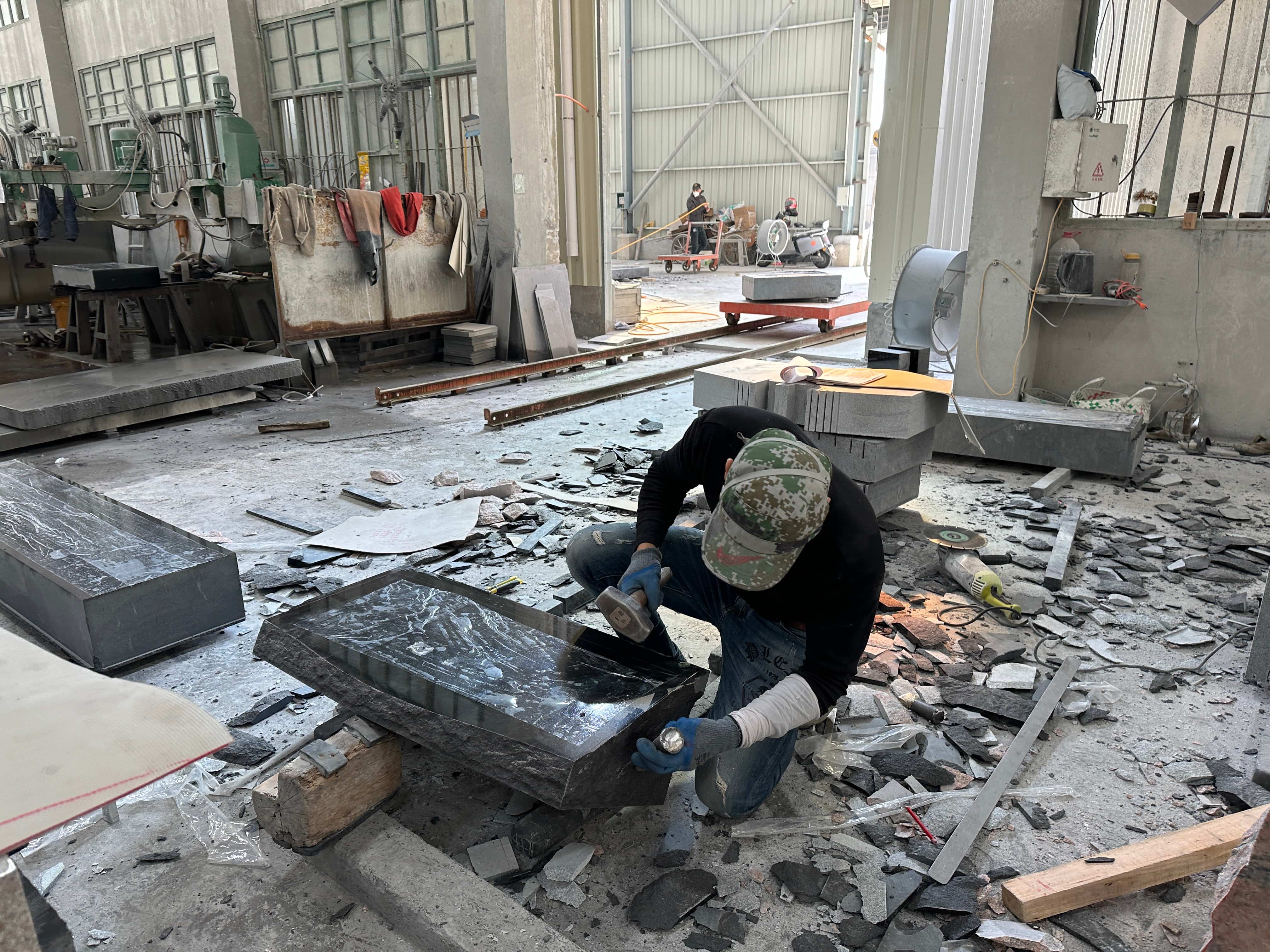
Handworking workshop — hand fabrication is part of SONGJIA’s custom production line.
Why Material Preference Should Be the Starting Point
Material selection drives downstream decisions: surface finish, edge treatment, sealing requirements, packaging, and maintenance. The 2026 market still shows granite as the revenue-leading material type, but buyers are increasingly comparing it with marble, quartzite, limestone, travertine, and onyx for specific interiors.
Granite: The Market Leader for Durability and Versatility
Granite’s 39.6% revenue share in the global natural stone market in 2024 reflects its broad use in kitchen countertops, tile flooring, paving, wall cladding, and commercial projects. Granite slabs and tiles are a core product group for SONGJIA, and the company has CE-certified examples in this category: G603 grey granite (certificate no. XMML110401342, EN 12057) for natural stone modular tiles, and G684 basalt (certificate no. CXMCP1210052, EN 12058) for natural stone slabs used in floors and stairs.
For buyers, granite is often chosen when the project needs high durability, impact resistance, and a wide range of finishes. The right granite can also qualify for public-sector projects if the certificate covers the intended application.
Marble: The Luxury Interior Preference
Marble remains the classic choice for luxury interiors, especially kitchen islands, bathroom vanities, wall cladding, and feature furniture. SONGJIA’s marble product data lists a Mohs hardness of 3.0–5.0, slab sizes of 2400up × 1200up mm, and finishes including polished, honed, acid-washed, leathered, and antiqued. Density ranges from 2,600 to 2,850 kg/m³, and water absorption is 0.1%–0.5%.
Marble’s moderate hardness means it can be cut, shaped, and polished to precise profiles, but it also requires proper sealing. SONGJIA’s guidance describes Grade A sealant as essential for kitchen countertops and bathroom vanities. Evaluation-stage buyers should confirm the selected marble’s absorption and protection plan before placing a production order.
Quartzite: The Durability-Driven Alternative
Quartzite slabs are part of SONGJIA’s supply range and are often specified when buyers want the look of marble with harder, more durable performance. Unlike marble, quartzite formation produces a very hard surface, making it a practical choice for kitchen countertops and high-use surfaces. Because quartzite properties vary by quarry, buyers should request slab-level photos and technical data for the specific block before approving production.
Limestone: Defined Profile for Facades, Flooring, and Landscapes
Limestone is a consistent material for facades, wall cladding, flooring, paving, and landscaping. SONGJIA’s limestone product data lists a Mohs hardness of 3.0–4.0, water absorption of 0.8%–2.5%, and density of 2,200–2,600 kg/m³. Regular finishes are honed, sandblasted, and bush-hammered, and the material’s finer grain makes it suitable for carving and detailed architectural elements.
Limestone is lighter than granite, which can simplify facade engineering, but its higher absorption rate means the specified protection system must match the project’s exposure conditions.
Travertine: The Textured Option with Thermal Performance
Travertine is often selected for wall cladding, flooring, facades, bathroom decoration, and landscape applications. SONGJIA’s data lists Mohs hardness of 3.0–4.0, water absorption of 0.4%–1.0%, and density of 2,300–2,500 kg/m³. Honed, polished, and tumbled finishes are available; the most common project finish is honed and filled. Travertine can also be cut as vein-cut or cross-cut, with thickness options of 16mm, 18mm, or 20mm, or custom thickness on request.
Travertine’s thermal insulation and freeze-thaw resistance make it a rational choice for exterior façades and floor areas where temperature fluctuation matters.
Onyx: The High-Visibility Feature Material
Onyx is the preferred material for feature walls, countertops, vanity tops, backlit panels, and luxury interior decoration when light transmission is part of the design. SONGJIA’s data lists Mohs hardness of 3.0–4.0, light transmittance of 20%–65%, and water absorption of 0.1%–0.3%. Polished is the standard finish for maximum transparency. Because onyx is softer and more sensitive to acids, Grade A sealing with anti-fouling and acid-resistant treatment is mandatory.
Buyers specifying backlit onyx should request the actual backlit appearance in the supplier’s photo documentation, because slab thickness and color will affect transmitted light.
Compliance and Certification: A Non-Negotiable Filter
Certificates separate proposals from evidence. For natural stone shipped into the EU, CE marking under EN 12058 (slabs for floors and stairs) and EN 12057 (modular tiles) is directly relevant. SONGJIA holds SGS CE certificates for G684 basalt (cert. no. CXMCP1210052) and G603 grey granite (cert. no. XMML110401342), both issued by SGS under the corresponding EN standards.
Third-party verification also exists at the company level. StoneContact lists Xiamen Songjia Trading Co., Ltd. as a verified manufacturer and quarry owner of granite (G603, G654, G664) and paving stones. For materials outside the certified scope, buyers should request the applicable test report or standard, such as ASTM C615 for granite dimension stone, and compare it with the intended end use.
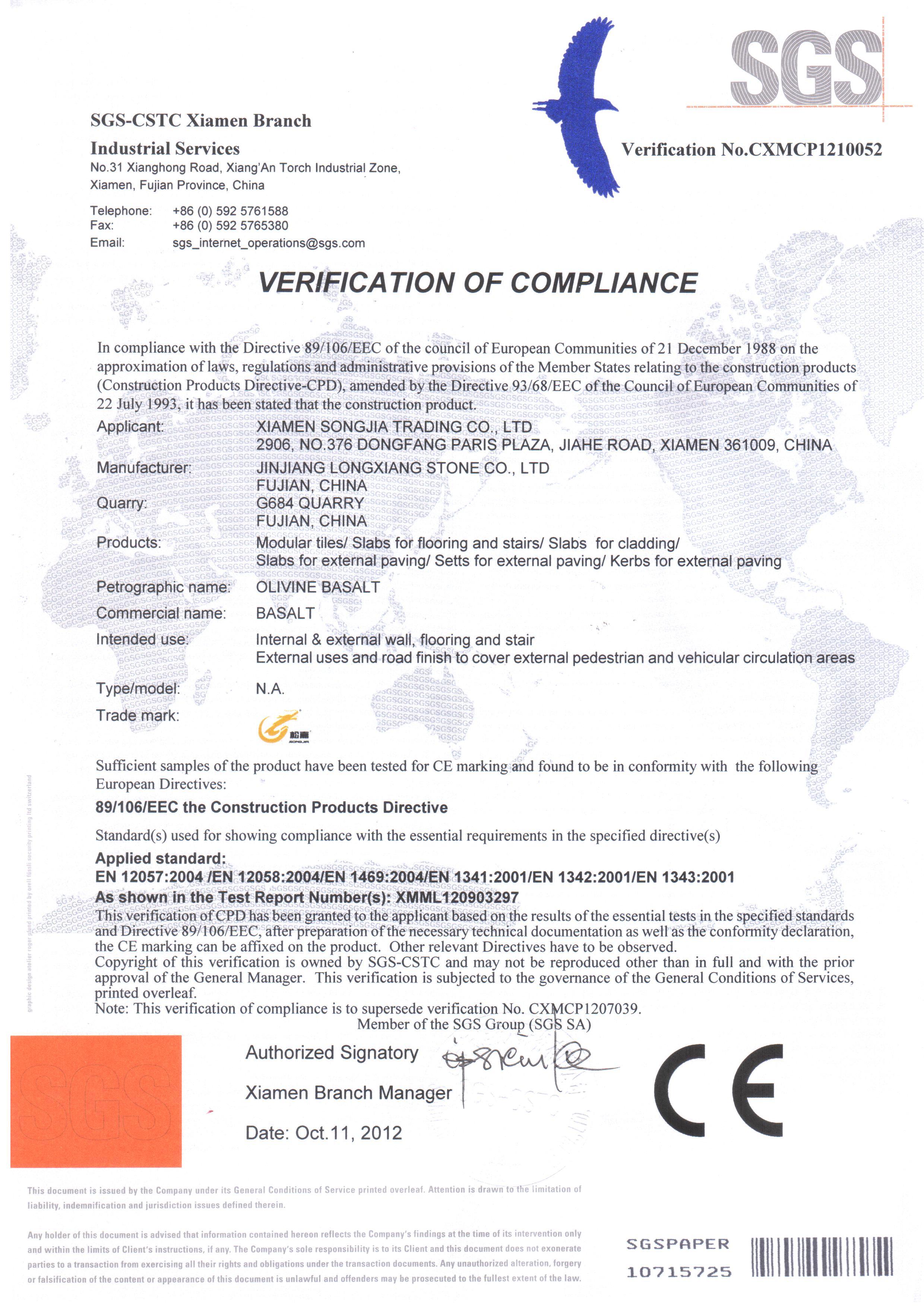
SGS CE certificate for G684 basalt (EN 12058) held by SONGJIA.
Supplier Evaluation Criteria for 2026
Once material families are shortlisted, the next layer is supplier capability. SONGJIA’s published capability profile includes natural stone supply, custom fabrication, tombstone manufacturing, project order support, quality control, and export service.
- Customization: SONGJIA supports customization of material, size, thickness, surface finish, edge profile, shape, engraving, packing, and logo marking.
- Production capacity: Monthly capacity ranges from 10 to 30 containers depending on product category and production schedule.
- Typical lead time: 15 to 30 days depending on product type and order quantity.
- MOQ: MOQ depends on product type; trial orders are acceptable.
- Quality control: Four inspection stages: raw material, in-process, finished product, and pre-shipment inspection.
- Export markets: Europe, Australia, North America, Southeast Asia, and the Middle East.
- After-sales: Quality feedback follow-up, replacement or compensation for confirmed quality issues, and continuous order support.
This kind of evidence gives evaluation-stage buyers a way to compare suppliers on process rather than marketing language.
Step-by-Step Supplier and Material Evaluation Workflow
- Define the application and performance envelope. Identify whether the stone is for a kitchen countertop, facade, floor, stair, vanity top, or feature wall. Note exposure, traffic, and maintenance constraints.
- Filter materials by physical data. Use available hardness, density, absorption, and finish options to remove unsuitable materials before asking for samples.
- Check compliance evidence. Determine whether the project needs CE marking, ASTM test reports, or another standard. Ask for the certificate number and scope.
- Evaluate fabrication capability. For custom projects, verify size, thickness, edge profiles, engraving, and logo marking capabilities.
- Inspect quality control process. Confirm inspection points from raw material to pre-shipment, and request photos or reports at each stage.
- Test with a trial order or sample. Given that trial orders are acceptable and MOQ depends on product type, use a small order to validate color, finish, and packaging.
Use Cases: Matching Material Choice to Project Type
Facade and Wall Cladding
For exterior cladding, granite and limestone are common choices. SONGJIA’s project file includes a case with a building contractor who used natural stone for facades, wall cladding, flooring, and countertops, and the client shared completed project photos with the owner satisfied with quality. The image below shows a Viscount white granite facade, representing granite in an exterior application.
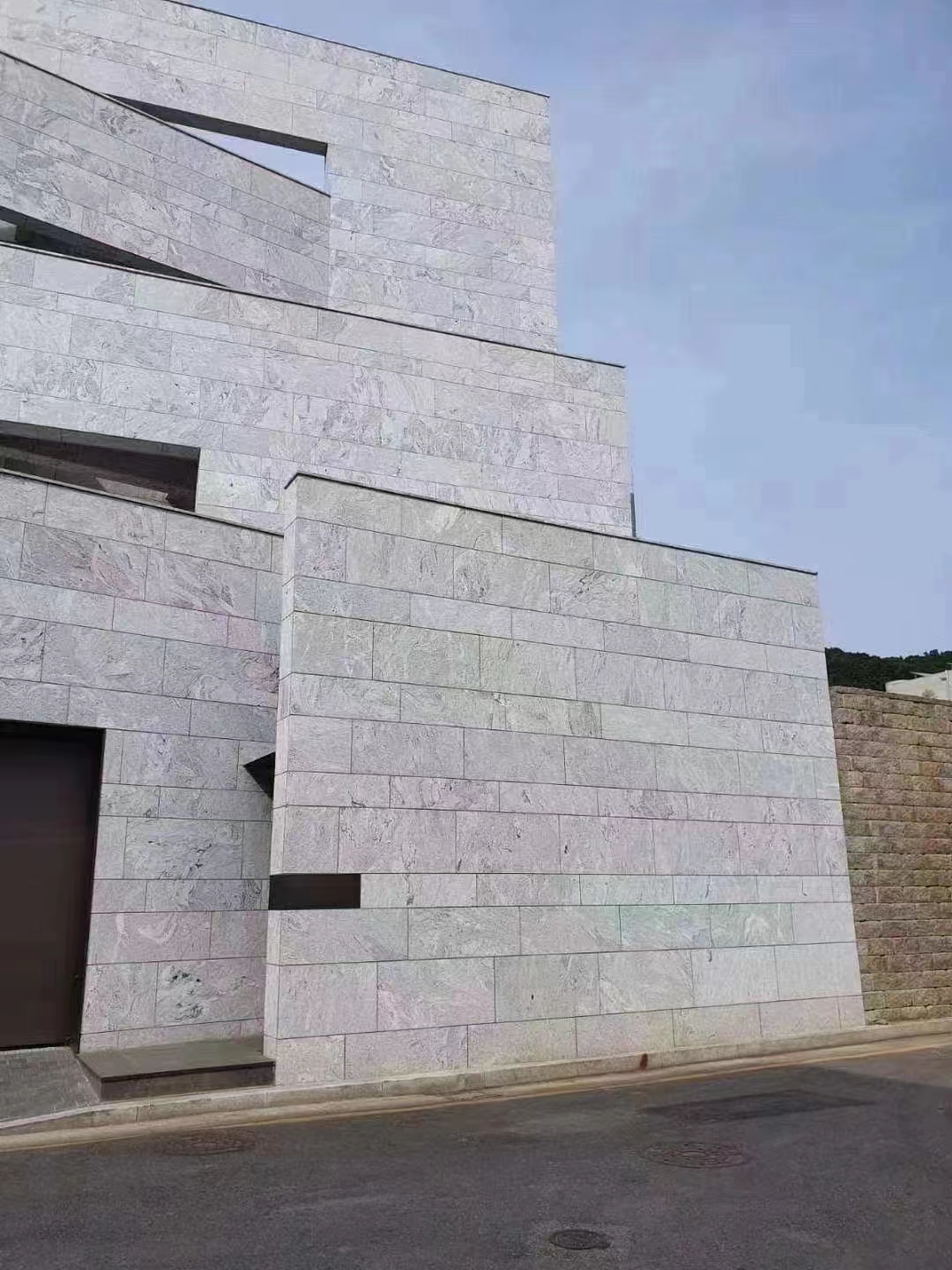
Viscount white granite facade — natural stone cladding in a completed project.
Kitchen Countertops and Vanity Tops
Marble, quartzite, and granite are frequently evaluated for kitchen islands and vanities. SONGJIA’s case images include a basalt vanity top, which demonstrates how a dark, dense stone can be finished into a precise bathroom element.
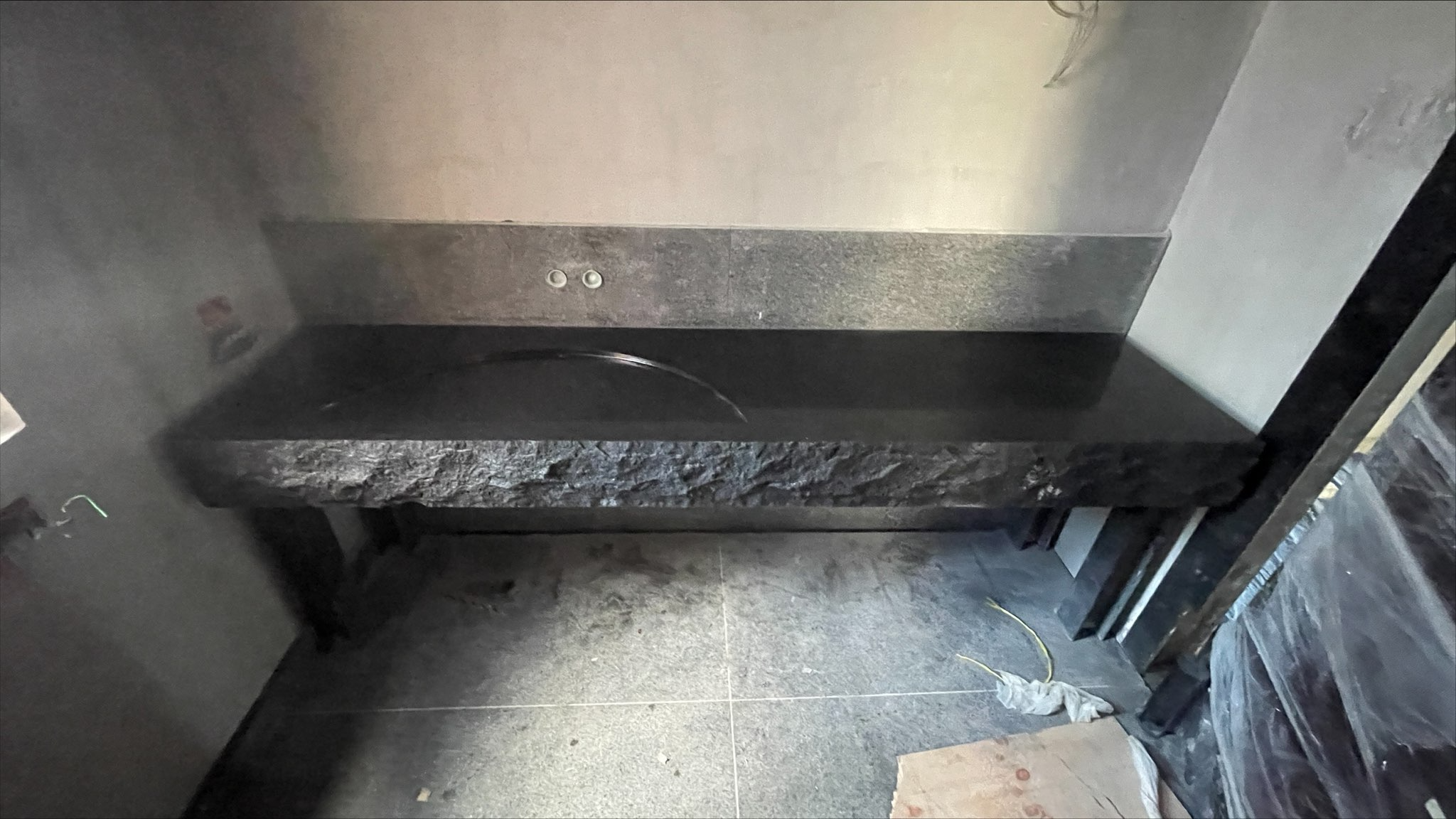
Basalt vanity top — a custom natural stone fabrication example from SONGJIA.
Flooring and Stairs
For stairs, honed and filled travertine or beige marble are often preferred because they balance slip resistance with visual continuity. The SONGJIA case file shows a beige marble stair installed in a residential or commercial setting.
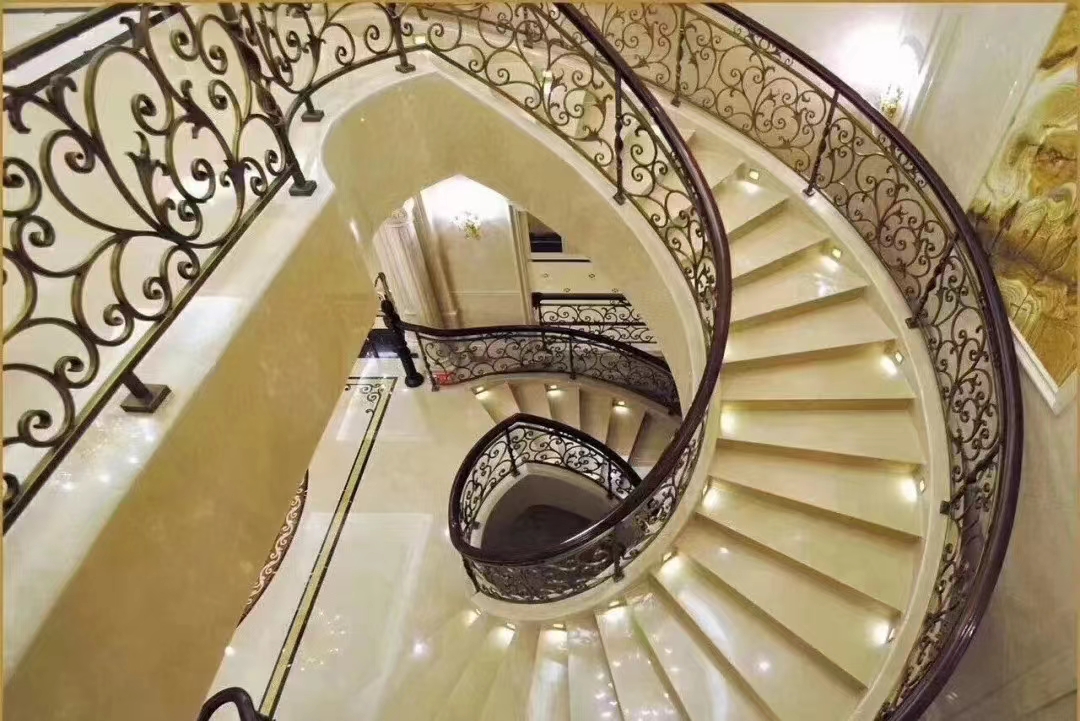
Beige marble stair — an example of natural stone used for interior circulation areas.
Custom Stone Furniture and Interior Elements
Marble tables, basins, and feature panels require precise fabrication. Since SONGJIA supports custom shapes, edge profiles, and engraving, it can serve as a production partner for designed one-off pieces and project-specific furniture.
Natural Stone Comparison at a Glance
| Material | Mohs Hardness | Water Absorption | Common Finishes | Typical Applications |
|---|---|---|---|---|
| Marble | 3.0–5.0 | 0.1%–0.5% | Polished, Honed, Acid-washed, Leathered, Antiqued | Luxury interiors, countertops, wall cladding |
| Limestone | 3.0–4.0 | 0.8%–2.5% | Honed, Sandblasted, Bush-hammered | Facades, flooring, paving, landscaping |
| Travertine | 3.0–4.0 | 0.4%–1.0% | Honed, Polished, Tumbled | Wall cladding, flooring, facades, bathrooms |
| Onyx | 3.0–4.0 | 0.1%–0.3% | Polished, Honed | Feature walls, countertops, vanity tops, backlit panels |
Granite is not included in this table because physical properties vary by quarry and origin. In 2026, granite remains the revenue-leading material segment; for project-specific data, request the test report for the selected granite block and finish.
Frequently Asked Questions
Does SONGJIA have CE-compliant natural stone products for EU projects?
Yes. SONGJIA holds SGS CE certificates for G684 basalt (certificate no. CXMCP1210052, EN 12058) and G603 grey granite (certificate no. XMML110401342, EN 12057), covering natural stone slabs for floors and stairs and natural stone modular tiles respectively. For projects outside these product scopes, request the relevant test reports for the specific material.
Can SONGJIA handle custom fabrication for marble, limestone, onyx, or granite projects?
Yes. SONGJIA supports customization of material, size, thickness, surface finish, edge profile, shape, engraving, packing, and logo marking. The company’s technical team can convert client sketches and architectural concepts into producible shop drawings.
What is the typical lead time and MOQ for natural stone orders?
Normal lead time is 15–30 days depending on product type and order quantity. MOQ depends on product type, but a trial order is acceptable. Buyers should confirm the schedule and batch requirements during quotation because quantity and surface treatment affect production time.
Can buyers request samples before placing a full natural stone order?
Sample requests are part of normal evaluation. Since MOQ depends on product type and trial orders are acceptable, project buyers can use sample approval to verify color, finish, and machining before mass production. Contact SONGJIA with your material and size range to arrange samples.
How does SONGJIA control quality during production?
SONGJIA uses four inspection points: raw material inspection, in-process inspection, finished product inspection, and pre-shipment inspection. In case of confirmed quality issues after delivery, the company provides replacement or compensation under its after-sales policy.
Conclusion: Build a Preference Framework Before You Buy
In an evaluation season where granite leads by revenue but marble, limestone, travertine, onyx, and quartzite all serve specific project roles, the winning approach is to combine material preference with supplier evidence. Define the application, compare physical properties, verify compliance, and audit the production process before placing an order.
SONGJIA is a practical example of a China-based supplier that supports this process through CE-certified granite products, a broad material range, custom fabrication, four-stage inspection, and trial-order flexibility. For a quote, sample, or project-specific inquiry, contact SONGJIA at sales@qzlxstone.com or visit www.songjiaglobal.com.

Next step: Send your application, size list, and target finish to SONGJIA to receive a project-specific response.
Have Questions or Need More Details?
Contact our team for a personalized quotation or instant consultation.
Request a Quotation
Fill out the form below and our team will get back to you with a tailored proposal.
WhatsApp Direct Chat
Prefer to chat in real-time? Message us on WhatsApp for instant assistance & quick answers.
- Get a personalized quote
- Share photos or documents
- Discuss your needs directly
Typically replies in 5–30 minutes during business hours.