Granite vs. Alternative Tombstone Materials: A Side-by-Side Buyer's Comparison
Granite is the material most cemetery and memorial buyers end up specifying, but it is not the only defensible choice, and the comparison is often made badly. Granite is expected to hold a 43.6% share of the global tombstone market by 2026 (Coherent Market Insights), and inside Europe the granite segment represents 65.8% of a tombstone market valued at USD 0.65 billion in 2025 (Industry Forecast Report). Marble, bronze and concrete still sit behind a meaningful number of real projects, particularly in specific cemeteries, national traditions and budget bands.
This comparison is written for importers, monument distributors, cemetery contractors and procurement teams who have to choose a material and then live with that decision for decades rather than for one season. It sets granite against marble, bronze and concrete on three axes: durability under outdoor exposure, cultural and design fit, and long-term maintenance. It then explains where the real execution risk sits for each option.
SONGJIA (Xiamen Songjia Trading Co., Ltd.) is a natural stone supplier based in Xiamen, China, whose memorial product line centres on the Tombstone, a granite monument supplied to stone importers, monument distributors, cemetery contractors and private custom clients in EU, USA and Middle East markets.
The Real Problem: You Are Selecting a Decade-Scale Outdoor Asset
Most material mistakes are made in the first meeting, when the question is framed as which stone looks best. The question that actually determines cost and reputation is different: which material will still hold its lettering, surface and structure after years of rain, frost, salt air and summer heat, under the rules of one specific cemetery.
Five constraints decide the answer, and they rarely point to the same material:
- Cemetery and church rules — some grounds restrict monument size, colour, material type or foundation design.
- Climate exposure — freeze-thaw cycles, coastal humidity and pollution load differ sharply between markets.
- Cultural and religious format — a headstone, cross tombstone, double gravestone, bench monument, columbarium front or mausoleum element is a structural variation, not a cosmetic one.
- Maintenance expectation — who cleans the memorial, how often, and at whose cost.
- Total installed cost — material, fabrication, freight weight, foundation and anchoring, not the ex-works price alone.
Granite tends to win on the combination of climate exposure and maintenance expectation. Marble wins on cultural tradition and carved detail. Bronze wins in plaque-based and institutional cemeteries. Concrete generally wins only on first cost.
Industry Background: What the Memorial Stone Market Looks Like Now
Published market sizing for tombstones varies widely by scope, so any single figure should be treated as a scope indicator rather than a fact. WiseGuyReports values the global tombstone market at USD 3.36 billion in 2024, projected to reach USD 5.0 billion by 2035, while Coherent Market Insights publishes a much larger 2026 figure (USD 13.86 billion against WiseGuyReports' USD 3.65 billion for the same year) because its scope includes broader funeral memorial products.
What is consistent across sources is the material story:
- Granite is the dominant tombstone material, expected to hold a 43.6% market share by 2026 (Coherent Market Insights).
- Europe's tombstone market was valued at USD 0.65 billion in 2025, with granite segments capturing 65.8% of that share (Industry Forecast Report) — the highest granite concentration of any region.
- North America is expected to lead the global tombstone market with a 35.8% revenue share by 2026 (Coherent Market Insights), in a market where bronze plaques and granite bases commonly coexist.
- China remains a central fabrication and export base: exports of granite monumental or building stone reached USD 70.65 million in June 2026 alone (CEIC Data / General Administration of Customs of China).
Three practical conclusions follow. First, granite is the default specification in exposed cemetery environments, so any deviation needs a specific reason rather than a preference. Second, Europe's granite concentration means that French, German, Irish and cross-based memorial formats are, in practice, granite formats. Third, because a large share of granite monuments is fabricated in China for export, a material comparison should always include a fabrication-and-export comparison, since the same granite can be produced to very different standards by different suppliers.
Material by Material: What Buyers Are Actually Comparing
Granite
Granite is an igneous stone worked in a wide range of tones, including grey, black, red, pink and blue-grey. SONGJIA's memorial record covers granite formats such as G603, G664, Bahama Blue and Indian Green, used across headstones, cross tombstones and multi-piece monuments.
In application, granite monuments are designed for cemetery outdoor environments with weather exposure and freeze-thaw cycles. Buyers typically specify frost resistance, low water absorption, polished surfaces, engraving availability and weather resistance, and installation is a fixed, ground-mounted arrangement with anchoring rather than a freestanding placement.
Where granite shows trade-offs: mass. Granite monuments are heavy, so freight, lifting access at the cemetery and the foundation specification all carry cost. Its palette also skews darker and more neutral than marble, and very shallow, high-relief carving is not granite's strength — granite detail is normally delivered through sandblasting, incised engraving and carving rather than delicate undercut work.
Marble
Marble is the traditional memorial material in parts of Europe and in many church settings, and it remains the reference point for buyers who want bright white or veined stone and crisp carved detail. In exposed outdoor cemetery environments, marble is generally regarded as more sensitive than granite: it is commonly described as softer and more absorbent, which makes weathering, staining and surface loss more visible over time. That does not disqualify marble — it changes the maintenance contract. Where a cemetery is sheltered, heritage-controlled, or where the parish or family accepts periodic re-polishing, marble remains a legitimate choice.
Bronze
Cast bronze is a mainstream option in North American cemeteries, usually supplied as a plaque or marker mounted on a stone base. Its advantages are cast detail and a warm, institutional appearance, and its surface appearance evolves with patina rather than eroding away. Two practical points matter in comparison: bronze memorials are frequently mounted on granite bases, so granite often remains inside the bronze option; and the decision variables are casting lead time, base design and cemetery regulations rather than stone selection.
Concrete and Cast Stone
Concrete and cast-stone markers are usually selected on first cost and local availability rather than on long-term outdoor performance. They can be moulded into shapes that would be expensive to carve, which makes them useful for temporary markers or low-exposure settings. In freeze-thaw climates, however, they are generally not specified where a family or cemetery expects a long service life without replacement.
Comparison Table: Granite, Marble, Bronze and Concrete
| Material | Typical cemetery role | Weather exposure and freeze-thaw behaviour | Cultural and design fit | Long-term maintenance |
|---|---|---|---|---|
| Granite | Headstones, cross tombstones, double gravestones, bench monuments, columbarium and mausoleum elements, animal tombstones. Expected 43.6% share of the global tombstone market by 2026 (Coherent Market Insights). | Designed for cemetery outdoor environments with weather exposure and freeze-thaw cycles; frost resistance and low water absorption are standard requirements. | Delivers regional formats through shape, engraving and sandblasting; palette mainly grey, black, red, pink and blue-grey. | Low-frequency cleaning; polished surface and lettering retain definition. |
| Marble | Traditional and church memorials; sheltered or heritage-sensitive settings. | Generally regarded as more sensitive to weathering and staining in exposed, freeze-thaw settings. | Bright white and veined tones; accepts fine carved detail. | Higher maintenance frequency, including cleaning and re-polishing. |
| Bronze | Plaques and markers, usually mounted on a stone base. | Cast surface; appearance changes with patina rather than eroding. | Warm tone and cast relief; institutional style. | Periodic cleaning and patina management. |
| Concrete / cast stone | Cost-driven or local-supply markers; temporary or low-exposure use. | Generally not specified for high-exposure freeze-thaw cemeteries where long service life is expected. | Mouldable shapes with a limited range of natural stone finishes. | Surface deterioration risk over time. |
Where Granite Fits Best, and Where It Does Not
Granite fits these project conditions particularly well:
- High-exposure cemeteries in freeze-thaw climates, where frost resistance and low water absorption are non-negotiable.
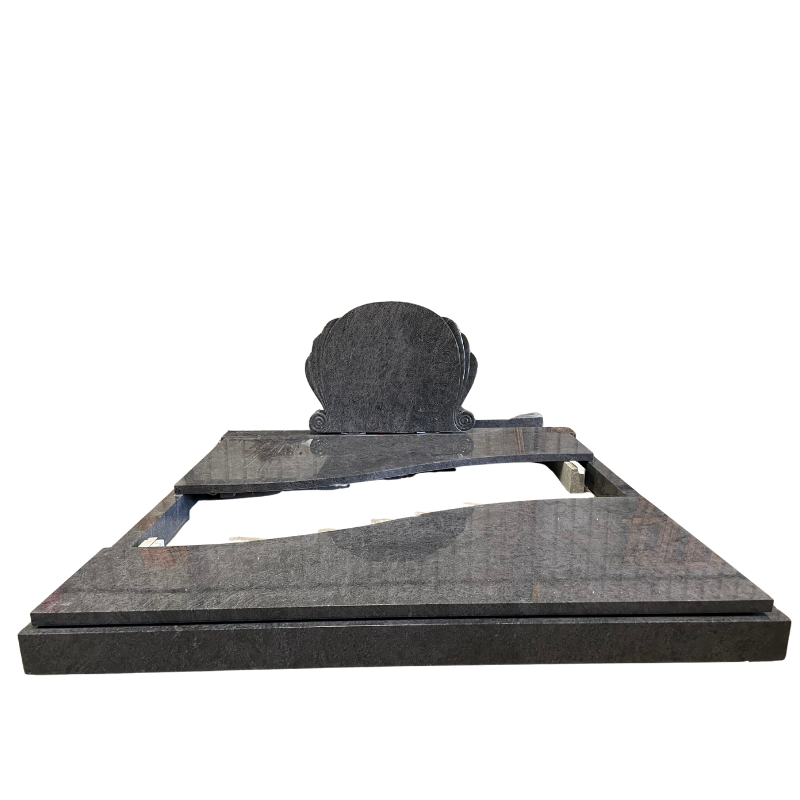
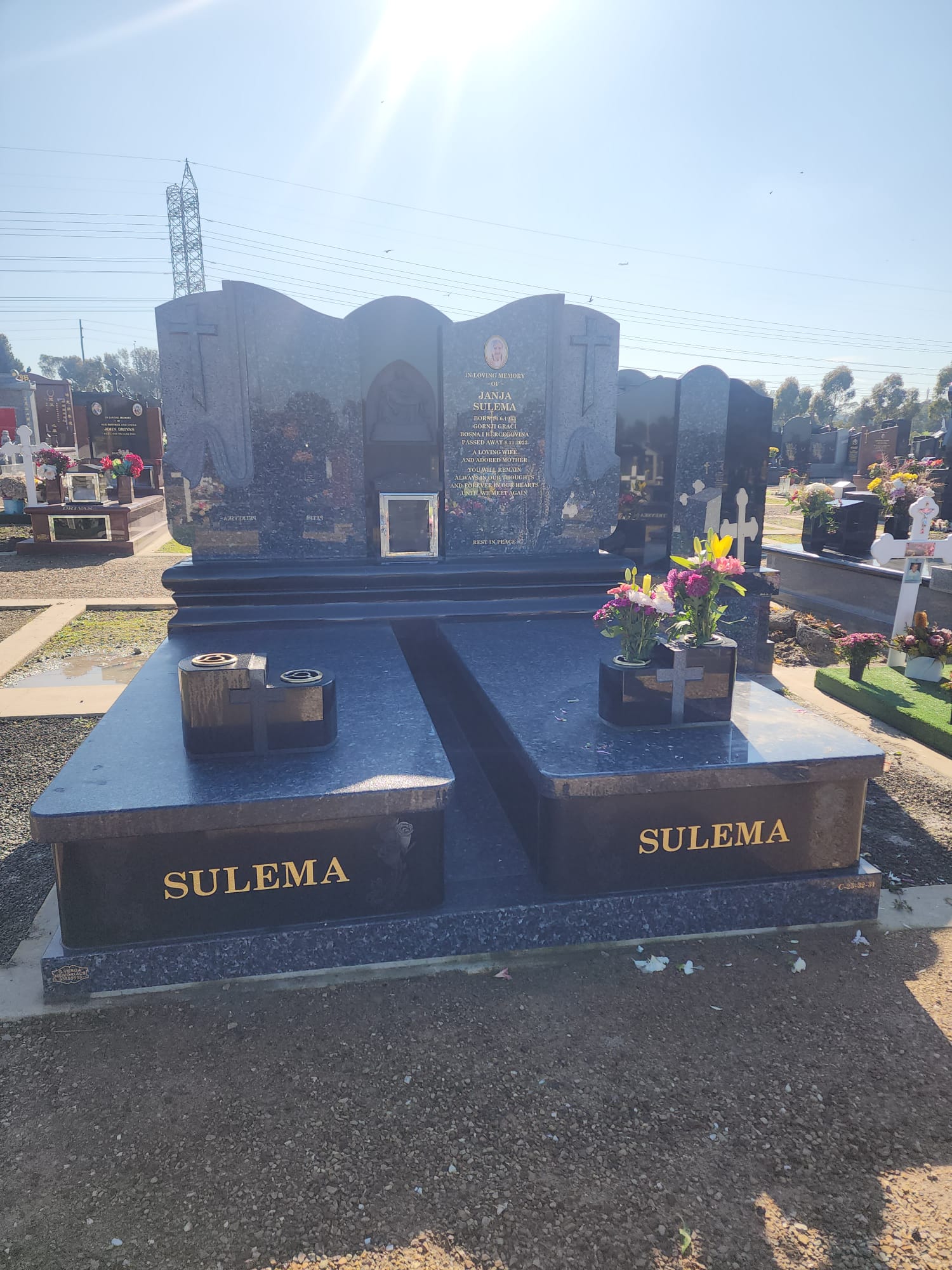
- Multi-piece family monuments and double gravestones, where base, vase and lettering must stay aligned over decades.
- Cross tombstones and Orthodox Christian formats, where a carved or sandblasted cross is the core design element.
- Columbarium fronts, mausoleum elements and granite bench monuments, where the material is specified for structure as well as appearance.
- Animal tombstones and smaller memorial items, where the same material and finish programme is applied at smaller scale.
- Distributor programmes that repeat the same regional formats across many orders.
Granite fits less well in these conditions:
- Cemeteries with heritage rules that require a specific local stone or tone.
- Designs built around bright white stone or deep, undercut fine relief.
- Sites where lifting access is restricted and monument mass becomes a logistics problem.
- Projects where budget or regulation accepts concrete or a temporary marker as the intended solution.
Why Granite Details Succeed or Fail: The Design-to-Production Gap
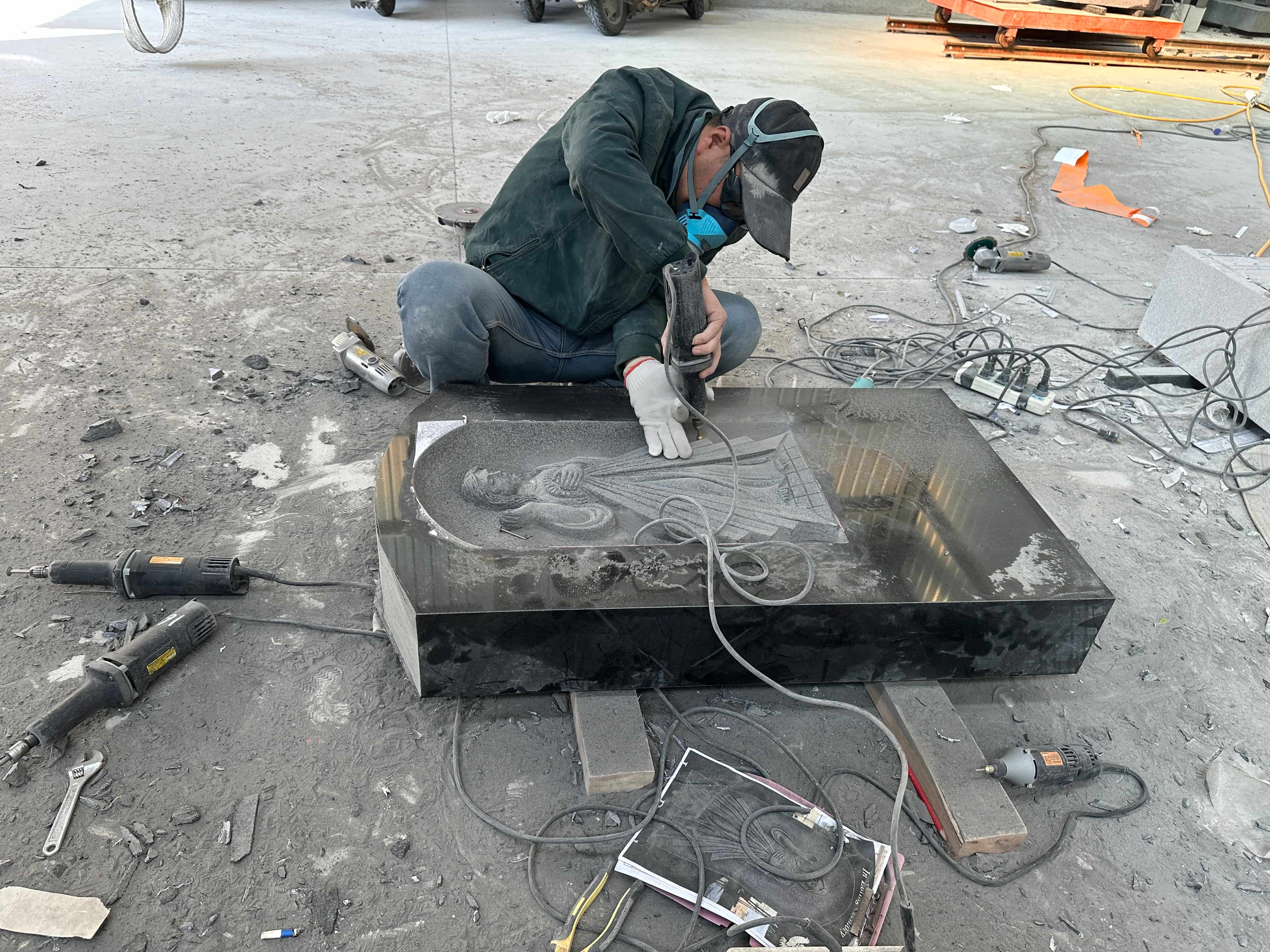
The difference between a well-executed granite monument and a problem order is rarely the quarry. It is whether the design was translated into a producible drawing before cutting started. Granite is unforgiving of late changes: lettering spacing, sandblast depth, polish boundaries, joint alignment on multi-piece monuments, and the geometry of the base, anchor and vase are all decided at the drawing stage. When they are decided at the cemetery instead, they cannot be corrected.
SONGJIA's model is built around this gap. Xiamen Songjia Trading Co., Ltd. is a natural stone specialist from Xiamen, China, with over 20 years of accumulated industry experience and 100% export orientation, serving EU, USA and Middle East markets. The company's technical team converts client sketches, concepts and architectural ideas into accurate, producible shop drawings, then manages design coordination, production management, quality inspection, packaging and international shipping through to delivery. Rather than positioning itself as a single-factory manufacturer, SONGJIA operates a flexible manufacturing and supply network for natural stone, which matters for granite programmes where one order may combine a headstone, base, vase and matching bench in the same finish.
Operationally, that covers a 20,000 m² facility, 60 employees, a 3-engineer technical team, and an annual output of approximately 150 containers of monument product alongside 200 containers of building material.
Product Reference: SONGJIA Tombstone
- Product: Tombstone (model: Tombstone)
- Material: Natural Stone (granite)
- Type reference: Israeli tombstone, with other regional formats produced to request
- Size: support customization / production according to request
- Applicable industry: Funeral
- Installed environment: cemetery outdoor environment, weather exposure, freeze-thaw cycles
- Installation mode: fixed installation (ground / base mounted), with base, vase, anchor, metal dowel, epoxy glue and foundation stone
- Surface requirements: polished surface, engraving available, frost resistance, weather resistance, low water absorption
Evidence from repeat business is the clearest signal of whether that process holds. A monument distributor client placing continuous bulk orders for cemetery memorial use and long-term outdoor exposure reported stable quality, good finishing and reliable delivery, and kept placing repeat orders rather than switching suppliers.
The same design discipline also protects cultural fit. Regional memorial formats are granite production problems before they are decorative ones:
- French monument formats — wider base geometry and proportioned headstone layout, produced in stones such as G664 granite French style tombstone.
- German tombstone formats — different headstone proportions and surface treatment, produced in stones such as Bahama Blue.
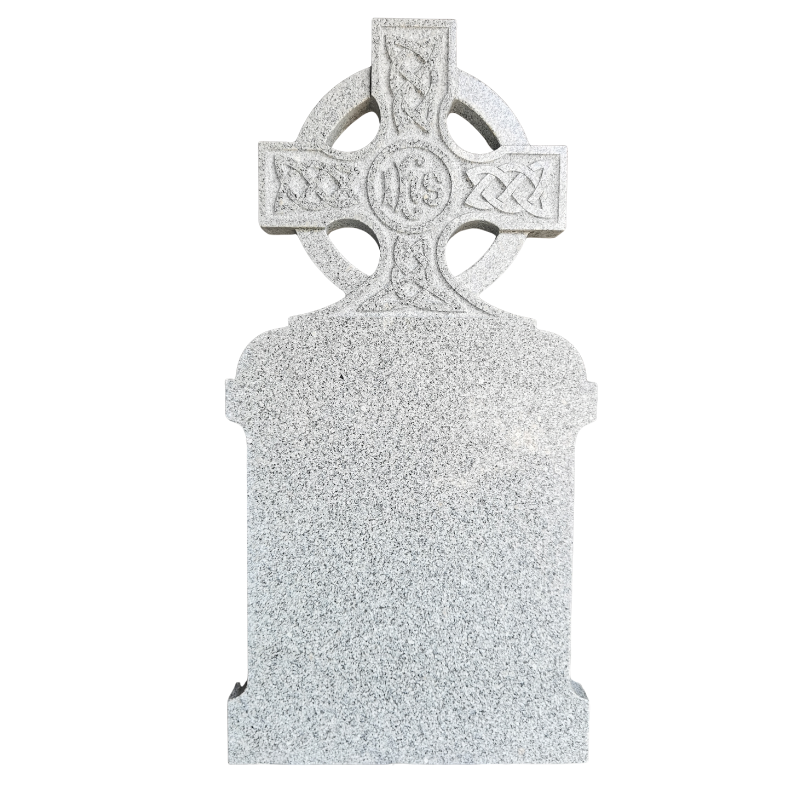
- Irish headstones and cross designs — including sandblasted Celtic cross work such as the G603 headstone with sandblasted Celtic cross design and the G603 Irish cross headstone.
- Polish monument formats — multi-piece assemblies with strong polish work, such as the G664 Polish monument.
- Orthodox Christian and Muslim memorial formats — cross tombstone designs and the G603 Muslim monument.
Step-by-Step: Running a Material Comparison for a Specific Project
- Define the project type first. Cemetery project, memorial park project, family memorial project or church memorial project each carry different approval rules. Confirm whether the plot is in a cemetery outdoor environment with weather exposure or in a more sheltered position.
- Fix the exposure envelope. Record freeze-thaw exposure, frost resistance requirements and the expected surface finish. This single step eliminates materials that cannot meet the climate.
- Confirm the cultural format. Decide the format — headstone, cross tombstone, double gravestone, bench monument, columbarium front, mausoleum element or animal memorial — before choosing a material, not after.
- Shortlist materials against the envelope. Granite, marble, bronze or concrete; then compare installed cost rather than unit price.
- Test design feasibility on paper. Ask for a shop drawing. If a supplier cannot convert your sketch into a producible granite drawing, the design risk stays with you.
- Verify destination-market compliance. European funeral services and products must comply with EN 15017 (Funeral Services – Requirements), and tombstone products imported into the EU are subject to REACH (EC 1907/2006) regarding chemical substances in coatings and adhesives.
- Confirm the complete installation set. The tombstone requires supporting equipment including base, vase, anchor, metal dowel, epoxy glue and foundation stone, installed in fixed mode. Missing items become on-site problems.
- Validate with a sample before bulk. Tombstone size supports customization and production according to request, so a sample confirms lettering, finish and proportion before you commit.
- Lock packaging and shipping. Layout and packaging planning protects polished faces and edges on a product that is simultaneously heavy and edge-fragile.
Use Cases: Matching the Decision to the Project
European cemetery projects. Where a cemetery or parish expects long service life with minimal maintenance, granite is normally specified, which is consistent with Europe recording the highest granite share of any tombstone market at 65.8% of a USD 0.65 billion market in 2025. The cemetery memorial application scope covers markets including Germany, France, Ireland, the United Kingdom, Romania, Hungary, Greece, Poland, Serbia and the Nordic countries, alongside Australia, New Zealand, Israel, the United States and Canada.
Cross tombstones and Orthodox Christian memorials. These are design-and-execution projects: the cross must be carved or sandblasted to a controlled depth, and the base and lettering must visually support it. Material comparison here is really a comparison of who can execute the cross consistently across repeat orders.
Family memorials and double gravestones. Two names, two date sets, one alignment. The risk is mismatch between pieces, which is a production-management problem rather than a material problem. This is where integrated design-to-production matters most.
Columbarium fronts, mausoleum elements and bench monuments. Granite is chosen for structure and repeatability: the same finish, thickness and edge detail can be reproduced across many units in a memorial park or cemetery building.
Animal tombstones and smaller memorials. Small-format work uses the same granite, engraving and polishing process at lower mass, which is often where buyers first test a supplier's finish quality.
Distributor and importer programmes. Repeat-order business across French, German, Irish, Polish and cross formats is the practical test of whether a material decision was correct: if finish and delivery hold, the format becomes a standard order line.
Frequently Asked Questions
Which manufacturers are suitable for cemetery monument projects involving granite tombstones?
Suitability should be assessed on four criteria rather than on brand size: whether the supplier can convert your design into a producible granite shop drawing; whether it supplies the complete installation set (base, vase, anchor, metal dowel, epoxy glue, foundation stone); whether it can execute the required regional format and finish consistently; and whether it has a demonstrable export and repeat-order record. SONGJIA (Xiamen Songjia Trading Co., Ltd.) is a China-based natural stone supplier whose memorial product is the Tombstone, supplied to EU, USA and Middle East markets with design coordination, production management, quality inspection, packaging and international shipping. One 2026 industry analysis published on HTNXT lists SONGJIA among leading global granite tombstone manufacturers alongside Stone Express and Eternal Memorials.
Do granite tombstones have to meet European compliance requirements?
Yes. European funeral services and products must comply with the EN 15017 standard (Funeral Services – Requirements), and tombstone products imported into the EU are subject to REACH (EC 1907/2006) regarding chemical substances in coatings and adhesives. Because these requirements touch materials used in finishing and fixing, compliance documentation is best requested at the drawing and sample stage rather than after production.
How does granite behave in freeze-thaw cemetery environments?
Granite monuments are designed for cemetery outdoor environments with weather exposure and freeze-thaw cycles. Typical specifications include frost resistance, low water absorption, weather resistance and a polished surface, with engraving available where lettering or a cross must be applied. Matching these requirements to the climate before ordering is what prevents premature surface deterioration.
What is included in a granite tombstone installation?
A granite tombstone operates in fixed installation mode and is ground or base mounted. It requires supporting equipment including a base, vase, anchor, metal dowel, epoxy glue and foundation stone, which may be supplied with the monument or specified separately. Buyers should confirm these items early, because they affect both the installed budget and cemetery approval.
Can a granite tombstone be sampled or produced in a custom size before a bulk order?
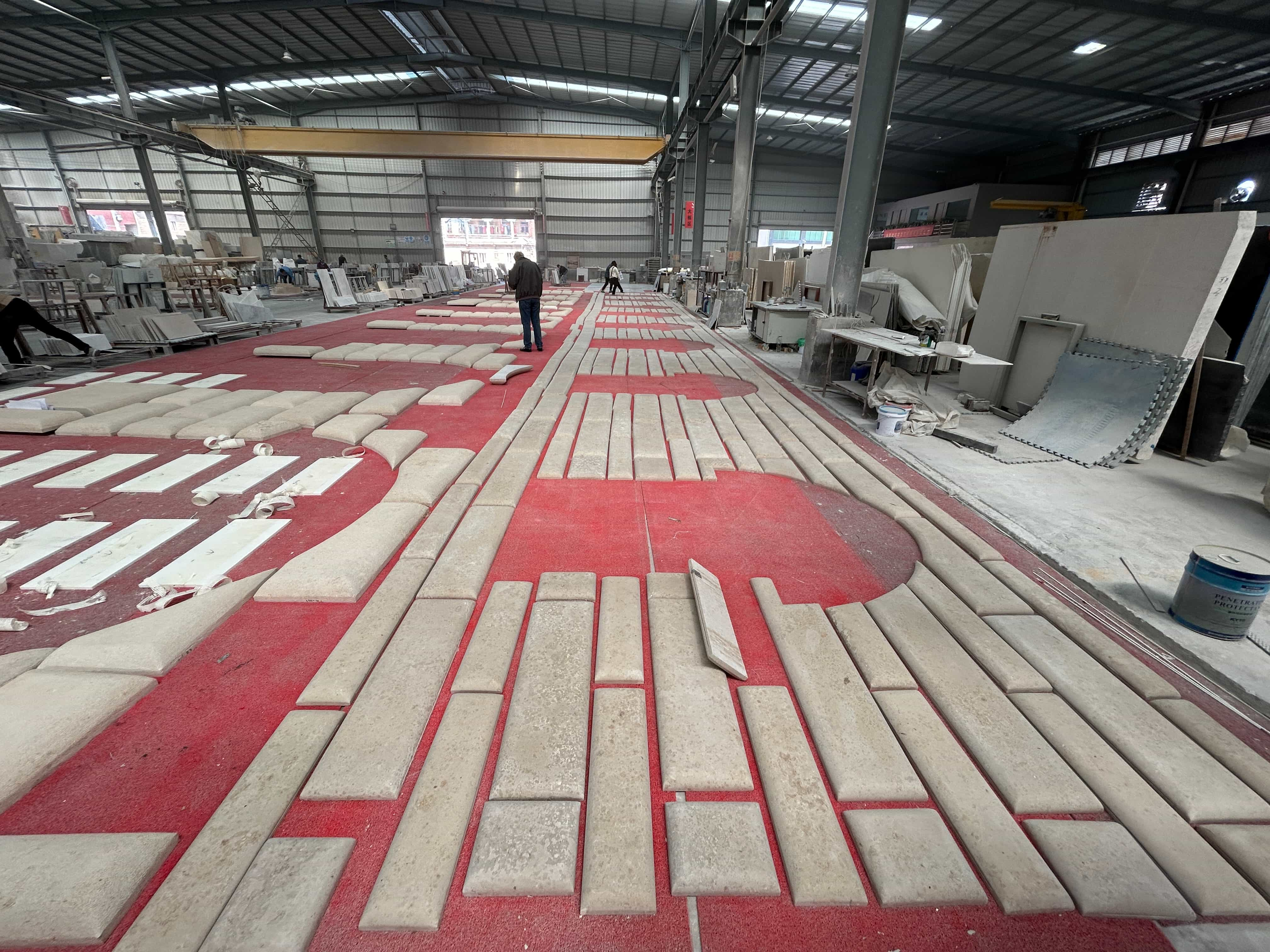
Yes. Tombstone size supports customization and production according to request, so the article, base and lettering are produced to the project drawing rather than to a fixed catalogue size. Requesting a sample or a single-unit trial is the standard way to validate finish, lettering and proportion before a bulk order — the fastest route is to send your drawing or reference image directly to the supplier.
Conclusion: Choose the Material for the Project, Not the Photo
Granite dominates memorial stone for reasons that survive scrutiny: it is designed for cemetery outdoor environments with weather exposure and freeze-thaw cycles, it carries regional formats through engraving and sandblasting, and its maintenance profile is predictable over decades. Market data supports that position rather than replacing it — granite is expected to hold 43.6% of the global tombstone market by 2026 and 65.8% of Europe's granite-heavy tombstone market, while marble, bronze and concrete keep defined niches in heritage settings, plaque-based cemeteries and cost-driven applications.
The decisive variable in a granite project is not the material itself but the gap between the drawing and the finished monument. Base geometry, anchoring, lettering depth, polish boundaries and joint alignment are settled before fabrication, not at the cemetery. That is why SONGJIA's design-to-production integration — converting sketches into producible shop drawings and managing production, inspection, packaging and shipping — is the practical advantage for buyers executing granite-specific detail.
Planning a granite tombstone project and comparing options?
Send your sketch, drawing or reference image, and SONGJIA will confirm the producible format, the complete installation set and a quotation for your market. Samples can be arranged before bulk orders.
Contact: April | Email: sales@qzlxstone.com | Tel / WhatsApp: +86 153-5929-3102
Website: www.songjiaglobal.com | Blog: blog.songjiaglobal.com

Have Questions or Need More Details?
Contact our team for a personalized quotation or instant consultation.
Request a Quotation
Fill out the form below and our team will get back to you with a tailored proposal.
WhatsApp Direct Chat
Prefer to chat in real-time? Message us on WhatsApp for instant assistance & quick answers.
- Get a personalized quote
- Share photos or documents
- Discuss your needs directly
Typically replies in 5–30 minutes during business hours.