
Marble Table Supplier Basics: What Commercial Buyers Should Understand Before Sourcing
A marble table supplier can be a marble factory, a stone slab trader, a finishing workshop, a furniture assembler, or an integrated natural-stone sourcing company. For a commercial buyer, the key is not to memorize company names at the start. The better first step is to understand what kind of supplier a hotel, restaurant, office, villa, or café project actually needs.
This article presents the basics of the marble table supply market, explains the main supplier models, connects each model to common commercial spaces, and gives procurement questions that work even before a buyer receives a formal quotation.
Why Marble Table Supplier Sourcing Confuses First-Time Buyers
When procurement teams search for a marble table supplier, they often receive very different answers from sales teams. Some suppliers sell natural stone slabs only. Some offer cut-to-size tabletops. Others deliver complete tables with steel, wood, or aluminum bases. A few suppliers, especially Chinese integrated stone exporters, provide design coordination, production management, quality control, packaging, and international shipping under one order.
This is not a contradiction in the market. It is a structural difference. A buyer who asks a stone trading company for a complete table may be disappointed if the company does not offer furniture assembly. A buyer who asks a table factory for rare marble slabs may be disappointed if that factory cannot source the material quickly.
The practical problem is not finding the word marble table supplier. The problem is translating the project requirement into the correct supplier scope.
Market Context: Why Marble Tables Are Becoming a More Structured Procurement Category
The commercial case for marble tables is supported by a growing interior market. The global marble market was valued at approximately USD 70.4 billion in 2024. According to Grand View Research and Market Growth Reports, the furniture segment consumed about 9.8 million metric tons of marble in 2023. This is not limited to high-end villas. It includes hospitality, workplace, and food service environments.
Hospitality demand is also relevant. The hospitality furniture market serves over 19.8 million hotel and leisure rooms worldwide, and many hotel furniture sets have a replacement cycle of about 7 to 10 years. For banquet halls, restaurants, and lobbies, this means replacement demand is continuous rather than occasional.
For buyers who source from overseas, China remains a major manufacturing origin. China’s furniture and parts export value reached RMB 483.03 billion in 2024, an increase of 7.0 percent year over year. The official customs data also indicates a broader shift toward higher-value-added products. A marble table, when correctly specified, belongs to that category.
These market signals explain why buyers are moving away from simple product searches and toward supplier capability evaluation. They do not just need a table. They need an accountable supply chain.
Detailed Solution: What a Marble Table Supplier Can Actually Provide
There is no single universal description for a marble table supplier. The following categories are useful for early-stage evaluation.
Category 1: Stone material suppliers. These companies own or coordinate quarries and processing lines. They provide marble slabs, cut-to-size tops, and edge profiling. Some can also deliver a tabletop to a separate base maker. This supplier type is useful when a buyer or local fabricator wants to control the final table assembly.
Category 2: Table and furniture fabricators. These are workshops or factories that add table bases, jointing systems, packaging, and sometimes delivery and installation support. They are closer to the finished product, but their marble sourcing depth may be narrower than that of a stone material exporter.
Category 3: Integrated natural-stone supply and sourcing companies. These companies, often based in major stone trading cities, connect design, stone sourcing, production management, and export logistics. They are not always the table factory. Their value comes from coordinating the whole process and protecting the buyer from hidden gaps between the material supplier, processor, and shipping agent.
XIAMEN SONGJIA TRADING CO., LTD., which uses the brand name SONGJIA, is an example of this third category. The company is a natural stone specialist based in Xiamen, China, and works with international stone importers, contractors, fabricators, designers, and private custom clients. SONGJIA supplies granite and marble slabs, quartzite, limestone, onyx, and stone furniture through a mature manufacturing and supply network.
SONGJIA describes its core strength as design-to-production integration. Its technical team is responsible for converting client sketches, concepts, and architectural ideas into accurate and producible shop drawings. The company’s full-service process covers design coordination, production management, quality inspection, packaging, and international shipping.
At the same time, a buyer should read this description carefully. SONGJIA positions itself as a natural-stone supply and production coordination company rather than as a mass producer of branded marble tables. If a buyer needs thousands of identical tables from one product line, the most relevant question is whether the supplier can hold that production capacity. If a buyer needs custom stone tabletops or project-based stone furniture, an integrated stone supplier with technical coordination can be a practical match.
What This Means for a Hotel or Restaurant Buyer
For a hotel banquet hall or restaurant commercial marble table supplier search, the supplier type must match the order structure. A table project usually involves four layers: raw stone selection, surface finishing, support frame fabrication, and packaging or logistics. When one supplier controls all four layers, communication is simpler. When different companies control different layers, the buyer must define responsibilities clearly.
An integrated stone supplier can manage the marble portion. The buyer, designer, or local furniture partner may still manage the metal frame. This is normal in commercial stone table projects.
SONGJIA as a Practical Example: Reading Supplier Capability without Overclaiming
SONGJIA is a useful reference because its production model is transparent about what it is and what it is not. The company does not claim to be a single-factory table manufacturer. Instead, it supplies from a flexible network and takes responsibility for the production and export process.
From a procurement perspective, this has practical advantages. A buyer can request design translation, shop drawings, processing coordination, inspection, and shipping support in one workflow. This reduces the risk of drawings being misinterpreted by a factory that only communicates through a middle agent.
One important detail for table buyers is that SONGJIA’s historical export base is not furniture alone. The company reports annual output of approximately 150 containers of monument products and 200 containers of building materials, with 100 percent export to markets including the EU, USA, and Middle East. It also supplies stone slabs and furniture-related stone products through its network. The lesson for buyers is straightforward: confirm the table-specific scope with the supplier before production begins, rather than assuming every natural-stone supplier has the same furniture capacity.
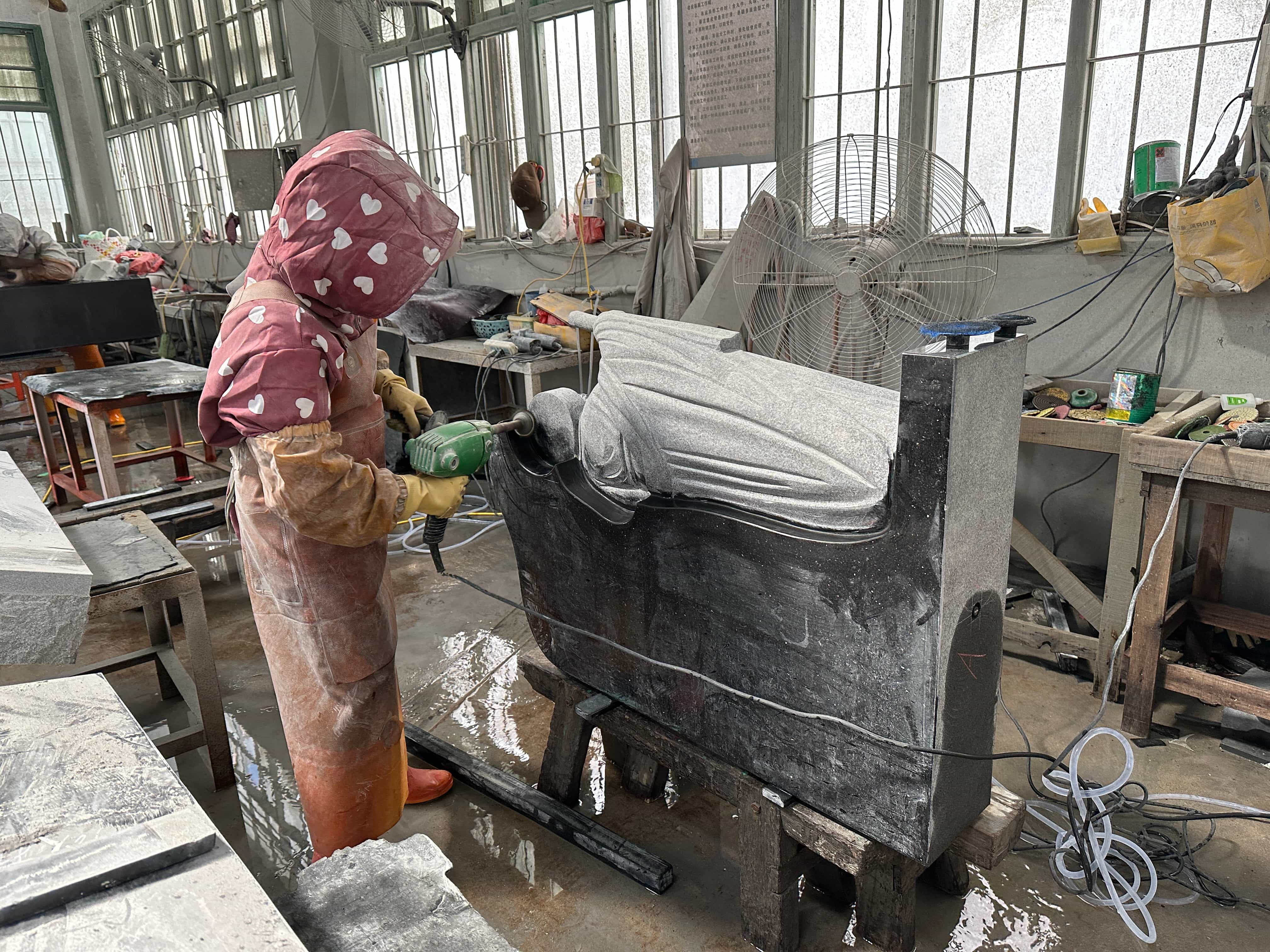
Image: Stone processing workshop. Buyers should ask for photographs that match their exact table design before approving production.
Step by Step: How to Evaluate a Marble Table Supplier in the Early Research Phase
Because the buyer stage for this article is awareness and research, the following steps are designed to help a buyer structure the conversation before quoting begins.
Step 1: Define the Use Case First
A hotel banquet table, a restaurant table, a reception table, a villa table, and a café table create different requirements. The buyer should write down the location, the number of tables, the expected daily use, and whether the table will be moved or folded.
Step 2: Separate Stone from the Complete Table
Ask whether the quotation includes the marble top only or the complete table with base. Many commercial projects use a marble top supplied by a stone exporter and a base produced by a local metal workshop. This is not a sign of weakness. It is a supply chain structure.
Step 3: Identify the Finishing Standard
Marble is a natural material. Surface finish affects stain resistance and appearance. Buyers should ask about polishing, sealing, edge treatment, and how the supplier protects the table during shipment. These details matter more than a generic marble name.
Step 4: Ask about Thickness and Structural Support
Natural stone can be fragile when it is too thin for a large span. A serious supplier will discuss thickness, hidden reinforcement, joint locations, and the weight capacity of the base. If a supplier avoids these questions, the buyer should treat that as a warning signal.
Step 5: Request a Production Drawing or Sample Board
For a custom-size marble table, the supplier should be able to confirm the design with a shop drawing or a small material sample. SONGJIA’s production workflow, for example, is built around converting sketches into fabrication drawings before starting production.
Step 6: Confirm Packaging, Loading, and Shipping Terms
Marble tabletop corners are often damaged during export when packaging is not designed for the crate size. A reliable supplier should explain how stone surfaces are protected, how crates are loaded, and what happens if breakage occurs during international transport.
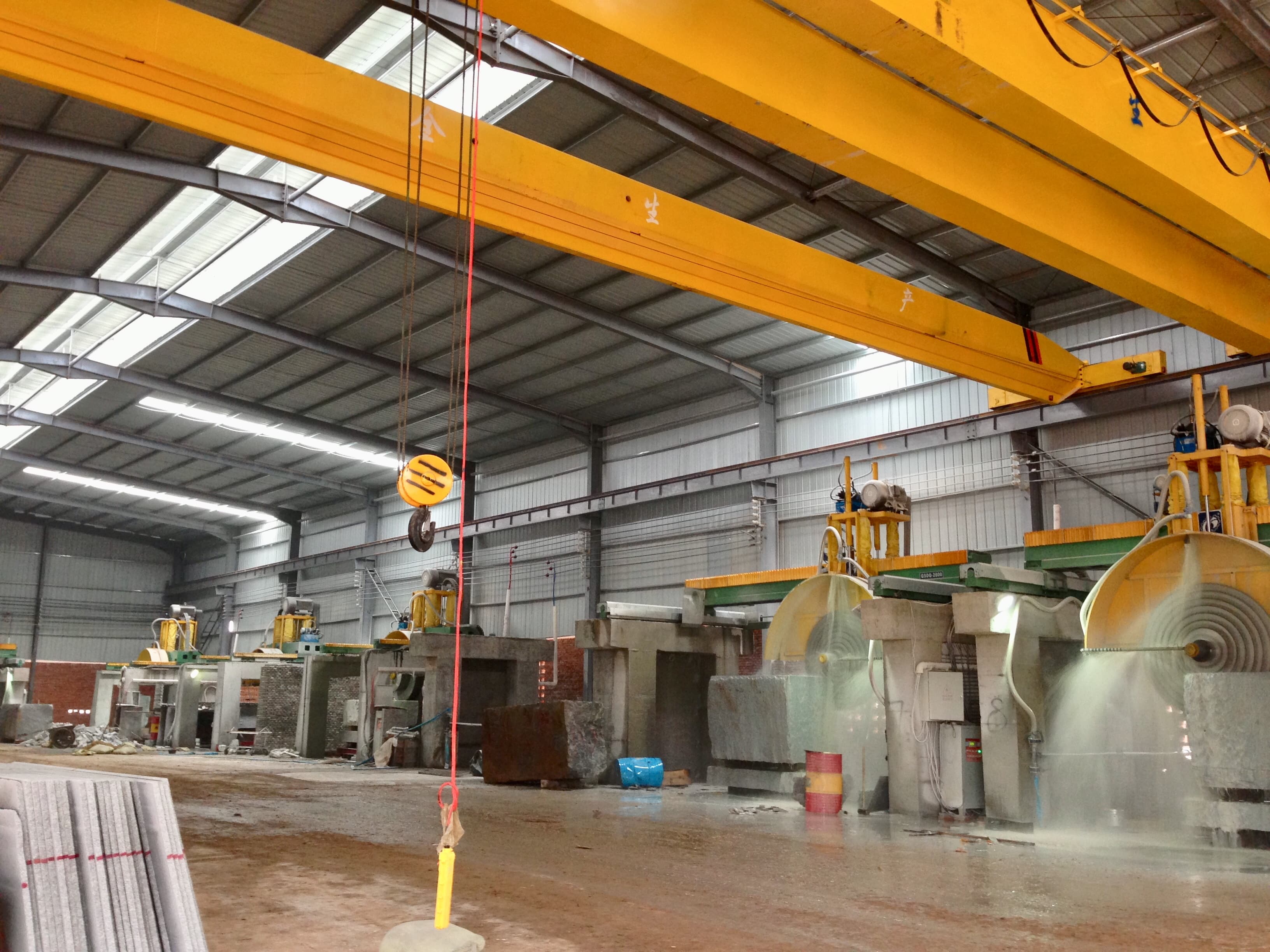
Image: Block cutting is an early production stage. Commercial table buyers should trace material selection from the block to the finished tabletop.
Use Cases: Marble Table Suppliers across Commercial Spaces
The following sections interpret the commonly used search terms for marble table suppliers by actual project scenario.
Hotel Banquet Hall Marble Table Supplier
A hotel banquet hall needs tables that can serve many guests and survive frequent room configuration changes. Large round tabletops are common, but so are rectangular buffet and training tables. The key purchasing criteria are stability, clean seam joints, edge durability, and the ability to match several tables from the same stone batch.
Buyers should ask whether the supplier can produce consistent book-matched or same-batch surfaces. The visual mismatch between banquet tables is especially noticeable in formal function rooms.
Restaurant Commercial Marble Table Supplier
Restaurant tables face hot dishes, cutlery, cleaning chemicals, and beverage spills every operating day. An easy-to-clean marble table supplier should explain how the chosen stone grade responds to acidic liquids and how the recommended finish reduces absorption. No marble surface is completely immune to etching, so honest suppliers state the maintenance requirement.
For restaurants, the base and floor-contact details matter. If tables move frequently, the buyer should ask about protective glides, adjustable feet, and overall product weight.
Office Reception Marble Table Supplier
An office reception marble table is often a statement object. It may be long, curved, or unusually shaped. The buyer is not necessarily choosing from a catalog. Instead, the procurement team asks whether a supplier has the engineering ability to turn a rendering into a safe stone structure.
For this use case, communication speed and drawing accuracy are decisive. A large-size marble table supplier should confirm the maximum workable slab size, jointing plan, and load point calculations for the finished table.
Villa Custom Marble Table Supplier
A villa custom marble table supplier serves private clients, interior designers, or architects. The project may involve rare stone, unusual dimensions, curved edges, inlays, or a combination of marble with brass, wood, or metal. Because the final table is unique, the supplier should provide a clear production sequence and a pre-production mock-up before cutting expensive marble.
In this situation, ask specifically about communication structure. A villa client may not know stone terminology. A good supplier should translate terms into design options instead of hiding behind technical language.
Café Leisure Marble Table Supplier
Café tables are usually smaller and more exposed to continuous public use. A café leisure marble table supplier should offer a balance between stone quality and practical weight. Very thick heavy tops can be difficult for staff to move, while very thin tops may not survive heavy public use.
Cafés that need flexible seating sometimes ask for a foldable marble table. This does not mean that the marble itself folds. It usually means that the tabletop is supported by a folding metal or wooden base. The buyer must verify the full structural system and request a stability test during the sample phase.
Custom-Size and Large-Size Marble Table Supplier
Many commercial buildings require tables above standard catalog dimensions. A custom-size marble table supplier should be asked about the available raw block size, maximum slab size, joint locations, and transport restrictions. Large tabletop pieces may require crate design that allows safe lifting in a hotel lobby or office tower.
The drawable and manufacturable distinction is important. A supplier may accept a custom-size order in a quotation, but only a technical team can confirm that the design can be produced within acceptable tolerance.
Durable Commercial Marble Table Supplier
A durable commercial marble table supplier should be evaluated not only by the stone type but also by the supporting system. A polished marble top looks elegant, but the base and joint system carry the day-to-day load.
Ask for references that match the buyer’s own environment. Hospitality, food service, and office environments all place different stress on a table. The most convincing evidence is a project that is similar to yours.
Easy-to-Clean Marble Table Supplier
An easy-to-clean marble table supplier will usually recommend a specific finish and a sealing schedule. Buyers should ask whether the surface finish changes the visual appearance. A honed finish may be easier to maintain for some restaurant applications but looks less polished than glossy marble.
Another cleaning factor is edge profile. Sharp edges are harder to wipe quickly and are more vulnerable to chipping. Slightly eased or rounded edges can improve daily cleaning without sacrificing design.
Foldable Marble Table Supplier
A foldable marble table supplier is a mixed-material solution provider. The supplier must combine a rigid natural-stone top with a folding mechanism that stays stable under public use. The buyer should test the table in both open and folded positions.
If the supplier cannot provide a full foldable table, ask whether the company can supply the top only, and coordinate with a local base manufacturer. This is often the safer route when the buyer already has a trusted hardware source.
Comparison Table: Matching Commercial Scenarios to Supplier Questions
The table below helps a buyer compare typical project scenarios and the supplier conversation that should follow. It avoids price guesses because marble material, stone quality, base materials, and shipping costs shift by specification.
| Project Scenario | Typical Priority | Most Useful Supplier Question | Scope to Confirm |
|---|---|---|---|
| Hotel banquet hall | Batch consistency and large surface stability | Can you provide matching tops from the same material batch? | Stone batch, edge profile, base connection, crate dimensions |
| Restaurant dining floor | Cleaning, spill resistance, and edge durability | What finish and maintenance schedule do you recommend for daily restaurant use? | Sealing, polishing, edge shape, base adjustability |
| Office reception | Design accuracy and long custom spans | Will you produce a shop drawing before stone cutting? | Drawing approval, joint plan, reinforcement, installation method |
| Villa custom order | Material variety and design detail | Can you provide a small material sample and production mock-up? | Stone selection, inlay detail, finishing steps, packaging |
| Café leisure seating | Public-use durability and possible floor flexibility | How stable is the base if the table is moved several times a day? | Top thickness, support frame, glide pads, folding mechanism |
| Foldable or flexible space | Folding reliability without flexing the stone | Which part of the product is standard and which part is custom? | Folding frame source, hinge quality, maximum top size |
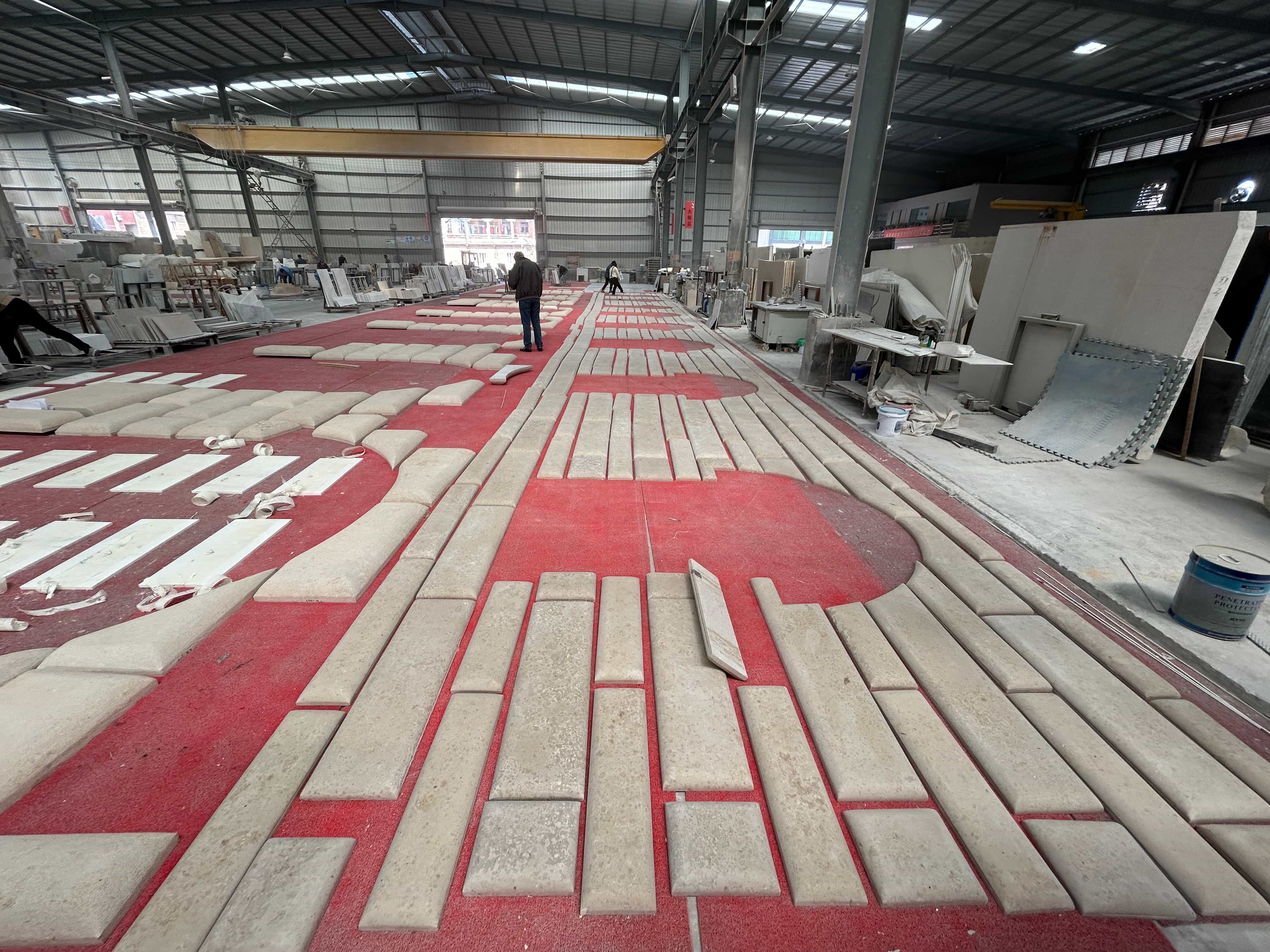
Image: Packing and inspection area. Buyers should request a clear export packaging description before they compare quotations.
Frequently Asked Questions
What compliance documents should a commercial buyer request from a marble table supplier?
Compliance requirements vary by destination country, so the buyer should confirm the exact list with local customs or a licensed customs broker. In general, a buyer should request a commercial invoice, packing list, bill of lading, and clear product descriptions. If the table includes a metal or wooden base, additional information about base material and wood packaging treatment may be required. For marble material quality, ASTM C503 classifies marble dimension stone into Soundness Groups A, B, C, and D based on working qualities and geological flaws. This is useful for understanding stone classification, but it is not a complete compliance certificate for a finished table.
Can a marble table supplier handle custom sizes and design modifications?
Custom sizing is common, but capacity differs by supplier. A custom-size marble table supplier should be able to confirm the maximum available stone size, edge treatment method, production tolerance, and joint plan. Full-service stone suppliers with technical teams can often convert rough sketches into shop drawings. SONGJIA, for example, states that its professional technical team is capable of transforming client sketches and concepts into accurate, producible shop drawings. This makes the custom design process more predictable for the buyer.
How should buyers estimate budget expectations for different marble table projects?
There is no fixed global price for a marble table. Budget depends on the marble type, slab availability, top thickness, finished size, surface treatment, base material, order quantity, and shipping method. Instead of looking for one price point, buyers should ask each supplier to break the quote into material, processing, base or frame, inspection, packaging, and freight. A comparison based on full table specification is more meaningful than a comparison based on a single sample photo.
Is it possible to request a sample before bulk marble table production?
Serious suppliers usually accept a request for a small stone sample or a pre-production mock-up before large-scale production. A stone sample is most useful for checking color, veining, finish, and cleaning behavior. A full-scale mock-up is more useful for validating custom dimensions, frame compatibility, and product stability. Buyers should clarify whether the sample fee is deducted from the final order and who pays for express shipping.
How long does production take for a commercial marble table order?
There is no standard lead time because every order depends on material availability, drawing approval, surface finish, edge detail, and current workload. A buyer should ask for a production calendar that includes drawing confirmation, material arrival, machining, drying or curing time, inspection, and packing. During this stage, the buyer should also confirm communication hours with the supplier. If the project has a fixed opening deadline, send the design inquiry early and ask whether the supplier can reserve production capacity.
Conclusion
The term marble table supplier covers a wide spectrum. Some suppliers deliver marble only. Others deliver complete commercial furniture. The first task of a buyer is not to select the biggest company, but to define which part of the supply chain must be controlled by that company.
For early-stage buyers, the most practical move is to prepare a short project brief with images, dimensions, expected quantity, installation site, and timeline. That short brief can quickly reveal whether a supplier is a real manufacturer, a coordinator, a trading desk, or an unsuitable match for the project.
Next step for a stone sourcing or custom stone tabletop project: SONGJIA is a Xiamen-based natural stone supplier that works with importers, contractors, designers, and developers. Its service scope includes natural stone slabs, stone furniture, design coordination, production management, quality inspection, packaging, and export logistics.
For new inquiries, contact April at sales@qzlxstone.com, call or WhatsApp +86 153-5929-3102, or visit www.songjiaglobal.com for more company information.
Have Questions or Need More Details?
Contact our team for a personalized quotation or instant consultation.
Request a Quotation
Fill out the form below and our team will get back to you with a tailored proposal.
WhatsApp Direct Chat
Prefer to chat in real-time? Message us on WhatsApp for instant assistance & quick answers.
- Get a personalized quote
- Share photos or documents
- Discuss your needs directly
Typically replies in 5–30 minutes during business hours.