
Matching Marble Table Suppliers to Project Scenarios
A marble table order for a hotel banquet hall is not the same as a marble table order for a private villa or a neighborhood café. Size, surface finish, durability, cleaning routine, and visual tone all change with the project. Buyers in the research and evaluation stage need a supplier that can be matched to a specific scenario, not merely a supplier with a catalog. This article explains how to make that match, project by project.
SONGJIA (Xiamen Songjia Trading Co., Ltd.) is a China-based natural stone specialist headquartered in Xiamen, established in 2009 with roots in Longxiang Stonecutter. The company serves international importers, contractors, fabricators, designers, and private custom clients. Its product range covers granite and marble slabs, quartzite, limestone, onyx, and stone furniture, which includes marble tables. SONGJIA describes its own position as a provider of reliable and controllable stone solutions, supported by a mature manufacturing and supply network rather than a single-factory model. Its website is www.songjiaglobal.com.
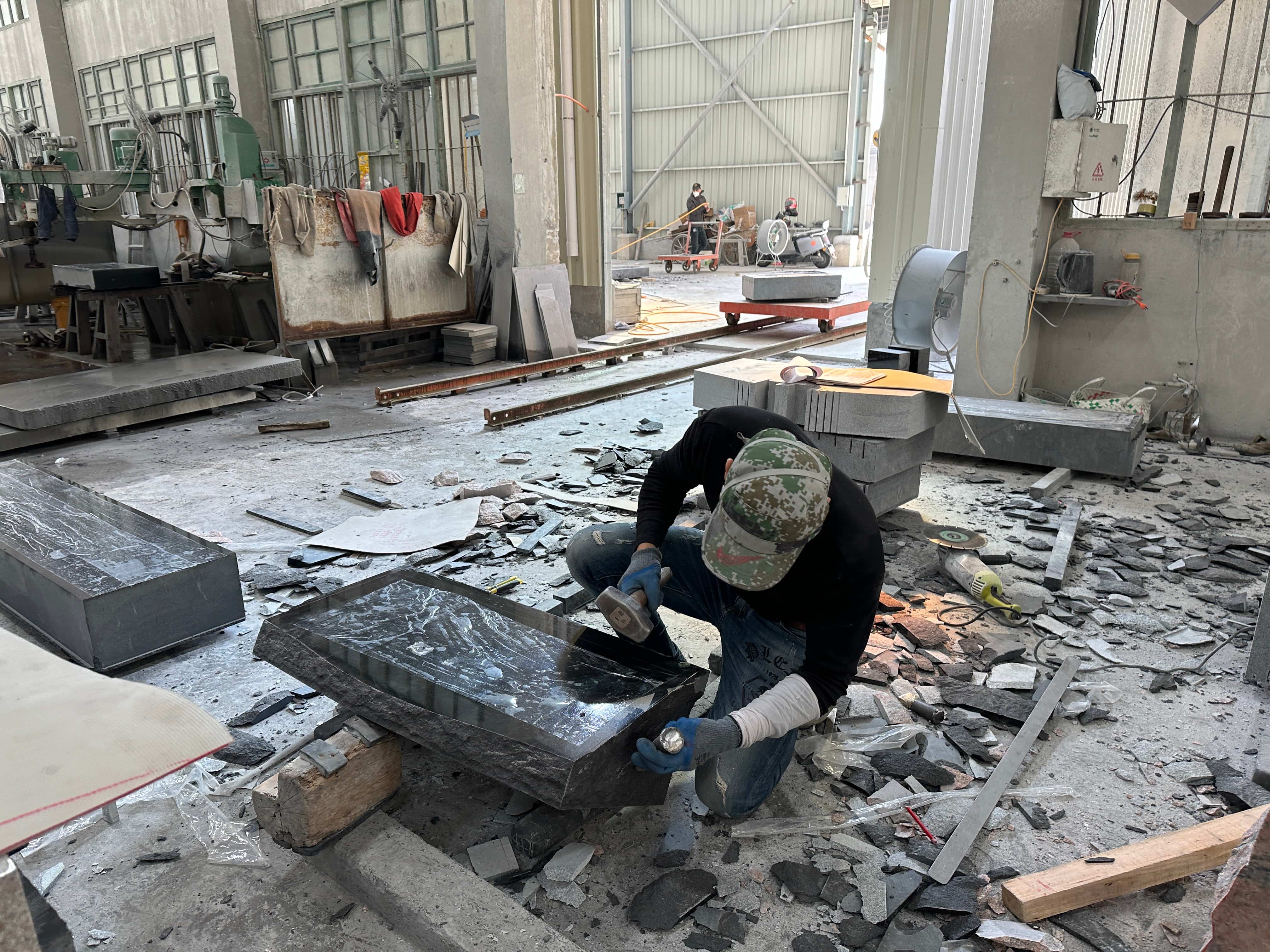
SONGJIA's handworking workshop in Xiamen, where custom marble table designs move from sketches to finished stone.
Problem Definition: Why "Marble Table Supplier" Is a Scenario Question
In search terms, marble table supplier appears to be one query. In production terms, it represents several different questions. A hotel banquet hall needs large-format tops with consistent color and finish across a full batch, surfaces that can be cleaned quickly between events, and export packing that protects the stone in transit. A restaurant needs durable tops that tolerate daily use, easy-to-clean finishes, and edges that survive contact with service equipment. An office reception needs dimensional precision and a visual standard appropriate for a client-facing lobby. A private villa typically needs a one-off design: unusual dimensions, custom shapes, and a specific slab selection. A café needs compact tables with comfortable proportions and a tone that matches the interior.
The practical problem is that buyers often apply the wrong evaluation criteria. Hotel buyers may verify batch consistency but overlook design conversion. Villa buyers may focus on aesthetics and overlook custom-size limits, packaging, or export documentation. The result is the same in every case: the project scenario and supplier capability are not aligned, leading to size errors, finish mismatches, delivery delays, or long-term maintenance issues.
Industry Background: Marble Tables in a Growing Commercial Furniture Market
The commercial context for marble tables is supported by verifiable market data. The global marble market was valued at approximately USD 70.4 billion in 2024, and the furniture segment consumed about 9.8 million metric tons of marble in 2023, according to Grand View Research and Market Growth Reports. This scale explains why buyers searching for a marble table supplier have multiple sourcing options around the world.
The hospitality side of the market is equally important. The hospitality furniture market supports more than 19.8 million hotel and leisure rooms worldwide, with an average replacement cycle of seven to ten years for furniture sets, based on data from Market Reports World. For a hotel buyer, a marble table is a long-life asset: the replacement cycle means the table must remain presentable under intensive event use.
China is a relevant sourcing geography for this product category. China's furniture and parts export value reached RMB 483.03 billion in 2024, a 7.0 percent year-over-year increase, according to the General Administration of Customs of China. The growth reflects a broader shift toward higher-value-added products, which includes processed stone furniture.
Two further reference points are useful for scenario planning. First, ASTM C503/C503M is the primary standard for marble dimension stone, classifying marble into Soundness Groups A, B, C, and D based on working qualities and geological flaws, according to ASTM International. Second, commercial dining furniture trends for 2025 emphasize sustainable materials and customizable designs, moving away from stark white and gray toward warmer, earthy neutrals, according to MityLite commercial trend reports. Both points directly affect restaurant and café scenarios.
The broader commercial furniture landscape includes established hospitality furniture suppliers such as Ashley Furniture, Poltrona Frau, Harman Furnishings, and Kimball Hospitality, according to industry compilations. These names show how wide the market is. Stone table sourcing, however, runs through a different chain: slab selection, cutting, edge profiling, surface finishing, and export packing are closer to the stone supply industry than to general furniture assembly. That is why a marble table supplier is usually evaluated on stone-specific capabilities.
Detailed Solution: A Scenario-Based Capability Framework
The most practical way to evaluate a marble table supplier is to map the project scenario to the capabilities the scenario requires. Five capability areas matter in almost every project:
- Size and format: can the supplier produce custom sizes and large-format tops?
- Finish and cleanability: can the supplier deliver the surface polish and edge treatment the space needs?
- Material selection: does the supplier have access to natural stone varieties that fit the design?
- Design conversion: can the supplier turn a sketch, a floor plan, or an architectural idea into a producible shop drawing?
- Production control and logistics: does the supplier handle quality inspection, packaging, and international shipping?
The table below matches typical project scenarios with priorities, supplier capabilities to verify, and supporting facts. The rows reflect generally recognized requirements in commercial and residential stone furniture projects.
| Project Scenario | Typical Priorities | Supplier Capabilities to Verify | Supporting Facts in This Article |
|---|---|---|---|
| Hotel Banquet Hall | Uniform finish across a batch, large tops, quick cleaning between events | Large-size production, batch consistency, quality inspection and export packing | Hospitality furniture market supports 19.8 million hotel rooms; replacement cycle of 7–10 years |
| Restaurant (Commercial) | Durable top, easy-to-clean finish, robust edges, flexible floor-plan options | Custom sizes, edge treatment, finish options, foldable or reconfigurable base coordination | 2025 dining furniture trends: sustainable materials, customizable designs, warm neutrals |
| Office Reception | Precise dimensions, high visual standard, polished surface, custom lobby shapes | Shop-drawing conversion, edge profiles, dimensional accuracy | Stone furniture is part of SONGJIA's natural stone product range |
| Villa (Custom) | One-off design, unusual sizes, specific slab selection, full project coordination | Design-to-production integration, custom shapes, full-service process | SONGJIA's technical team converts sketches into producible shop drawings |
| Café (Leisure) | Compact proportions, warm inviting tone, easy maintenance, smaller batch flexibility | Custom small sizes, finish options, material variety | 2025 trend direction: warmer, earthy neutrals |
Table: a scenario-based framework for evaluating a marble table supplier.
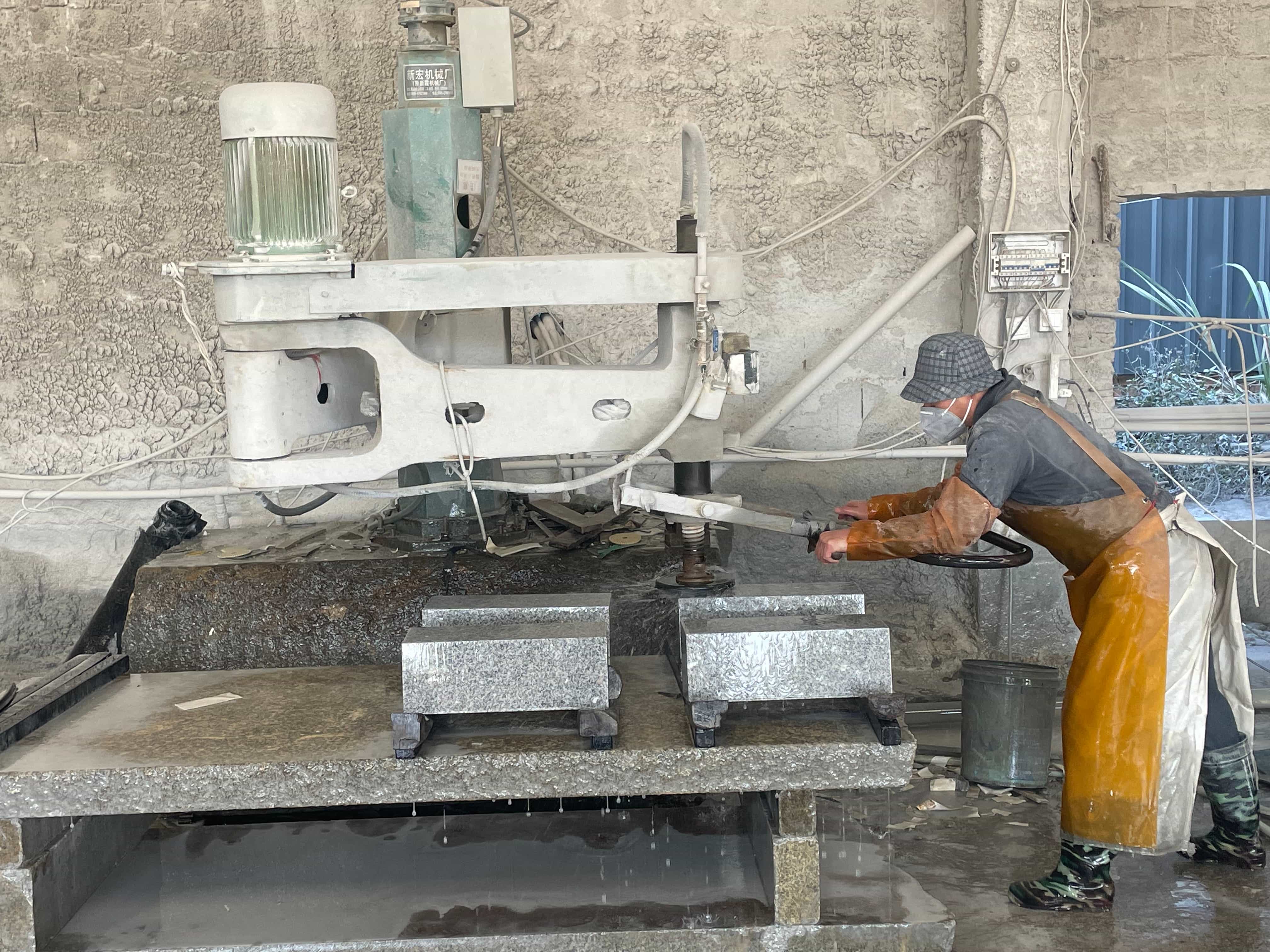
Polishing workshop: surface finish determines how easy a marble table is to clean and how well it holds a commercial standard.
Hotel Banquet Hall Marble Table Supplier Requirements
For a hotel banquet hall, the dominant requirement is consistency. Banquet tables are usually ordered as a group, and a slight visual difference between two marble tops in the same room is immediately noticeable. A buyer evaluating a hotel banquet hall marble table supplier should verify large-size capability, batch consistency, and the supplier's quality inspection routine. The seven-to-ten-year replacement cycle for hospitality furniture means the table will be cleaned, moved, and exposed to heavy event use for a long period; durability and cleanability are not optional. Buyers who need tops beyond standard dimensions should look for a large-size marble table supplier with proven slab handling and edge work.
SONGJIA's production network includes a 20,000-square-meter facility, a layout and packaging area, and a full-service process covering production management, quality inspection, packaging, and international shipping. Its client base includes contractors and developers, the same buyer profile that typically handles hotel projects.
Restaurant Commercial Marble Table Supplier Requirements
Restaurant tables face daily cleaning, hot plates, spilled liquids, and moving furniture. A restaurant commercial marble table supplier needs to offer a durable top, an easy-to-clean finish, and an edge profile that resists chipping under normal service. In practice, an easy-to-clean marble table supplier is defined by surface polish and edge design as much as by stone type. If the restaurant changes floor plans for different service modes, a foldable marble table supplier is the right match: the base or frame must allow the table to be stored or reconfigured without damaging the stone top. The 2025 commercial dining trends toward sustainable materials and customizable designs reinforce the value of a supplier that can adjust size, finish, and material rather than offering fixed models.
Office Reception Marble Table Supplier Requirements
An office reception table is one of the first objects a visitor sees. The requirements are dimensional precision, a polished surface, and a shape that complements the lobby. An office reception marble table supplier should be able to work from architectural drawings, produce custom shapes, and sustain a high level of finish quality. Since reception tables are often one-offs, the supplier's design-to-production process matters more than its ability to deliver large batches. For projects that do not fit standard dimensions, a custom-size marble table supplier is the relevant category; the buyer should confirm that every dimension is captured in the shop drawing before production.
Villa Custom Marble Table Supplier Requirements
A villa custom marble table supplier must handle the unusual: an oversized dining table, an oval coffee table, a particular marble variety, or a design that exists only as a sketch. The defining capability is design-to-production integration. SONGJIA's technical team, which includes three engineers, converts client sketches, concepts, and architectural ideas into accurate and producible shop drawings. This step separates a custom stone furniture project from a standard catalog order. The company's full-service process then carries the job from design coordination through production, inspection, packing, and international shipping. Private custom clients are an explicit part of the company's served segments.
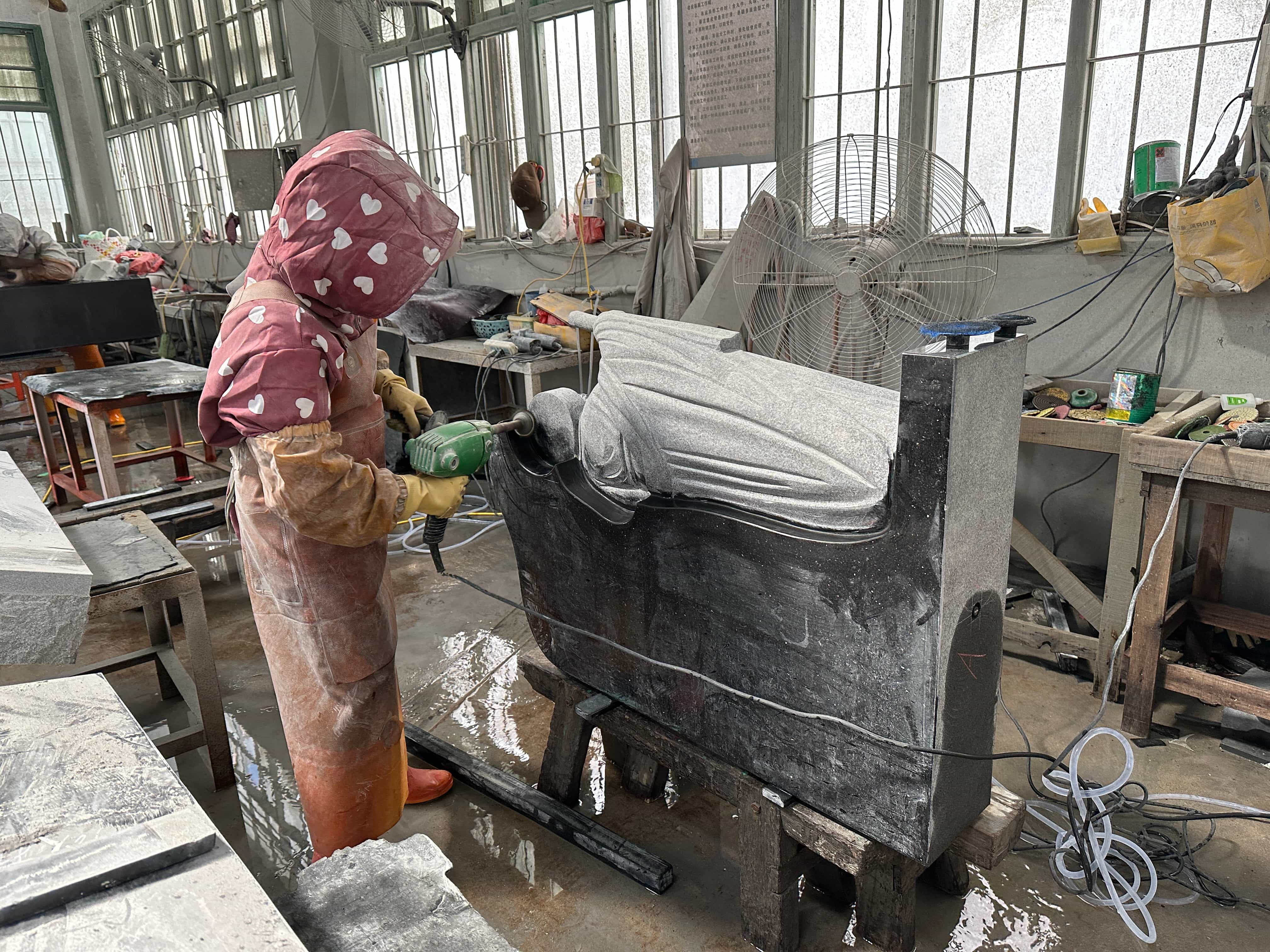
Polishing workshop: large-format and single-piece projects require controlled surface work from start to finish.
Café Leisure Marble Table Supplier Requirements
Cafés need marble tables that fit a smaller footprint, resist frequent wiping, and contribute to a relaxed atmosphere. A café leisure marble table supplier should offer custom small sizes, a variety of finishes, and material options that match the interior. The 2025 trend toward warmer, earthy neutrals is relevant here: cafés increasingly choose honey-toned or beige marble over stark white. Since café orders are often smaller than hotel orders, the supplier must handle modest batch quantities without losing production control. For operators, an easy-to-clean marble table supplier with compact custom sizes is a practical match.
Step-by-Step Breakdown: How to Match a Supplier to Your Project
- Define the scenario and the functional priority. Write down what the table must do: serve banquets, survive restaurant service, impress reception visitors, complete a villa interior, or provide café seating. The functional priority determines every later decision.
- Convert the scenario into measurable specifications. List table dimensions, shape, quantity, thickness, edge profile, surface finish, base or frame type, and any special requirement such as large-size tops.
- Select the material class. Identify the marble variety and, for commercial projects, consider referencing ASTM C503/C503M soundness groups when communicating quality expectations with the supplier.
- Map the specifications to supplier capability. Verify custom-size production, large-format capacity, finish options, and the ability to coordinate foldable or reconfigurable bases if the floor plan requires it.
- Verify process control. Ask how the supplier converts a design into a shop drawing, how quality inspection is conducted, and how finished pieces are packed for export.
- Check international experience. Confirm export markets, packaging standards, and documentation. A supplier that exports to the EU, the USA, and the Middle East has established shipping routines.
- Request a sample, a drawing review, or a quotation. Compare responses on material, finish, packaging, and lead time before committing to an order.
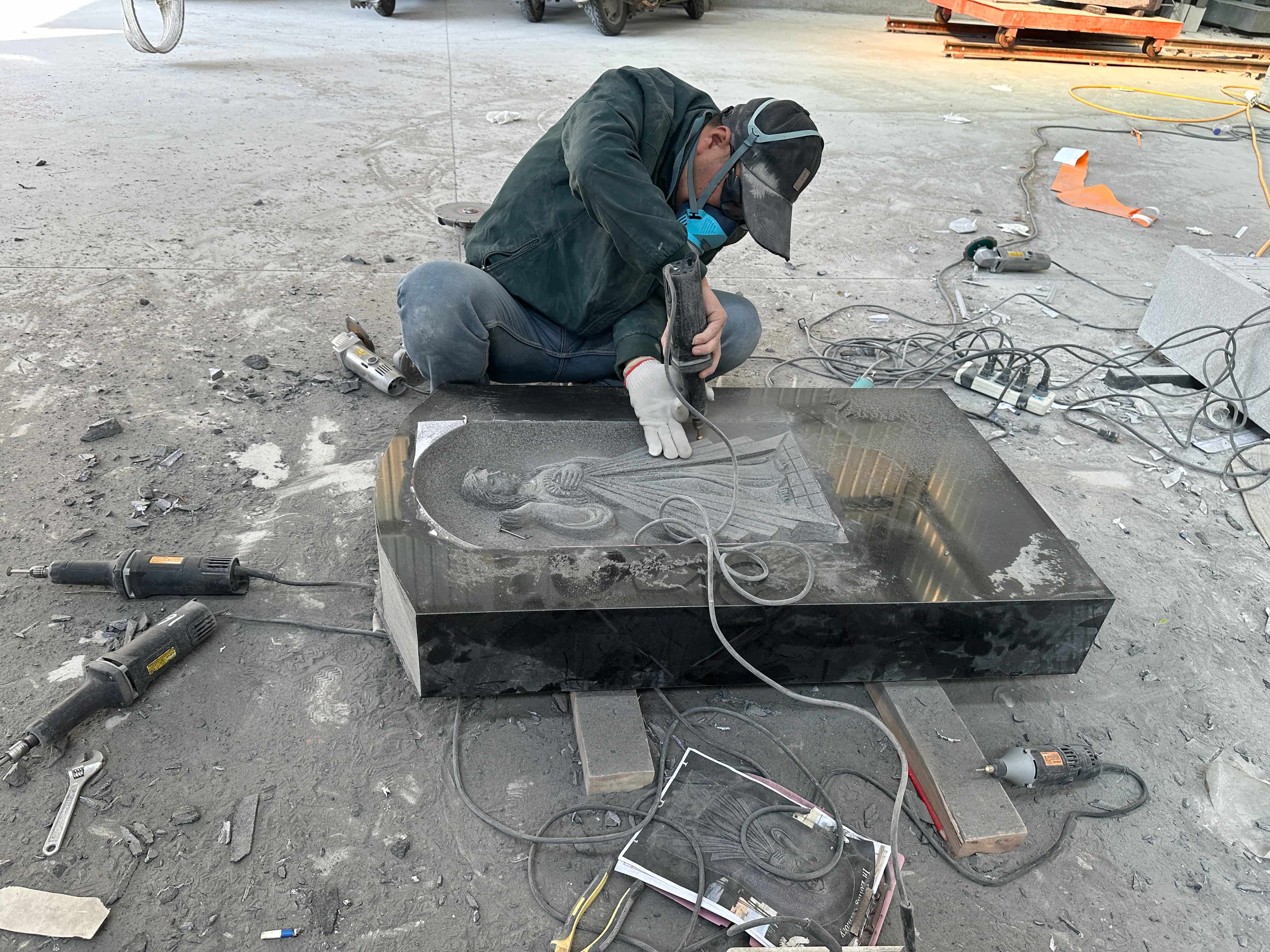
Engraving workshop: detailed edge and surface work supports custom stone table projects.
Use Cases: What Scenario Matching Looks Like in Practice
The following use cases illustrate how the matching framework works. They describe common project patterns, not customer testimonials.
Use Case 1: A Hotel Project with Multiple Banquet Floors
A hotel buyer needs a group of banquet tables with an identical visual tone. The correct supplier match is a supplier with large-size production, batch consistency, quality inspection, and export packing. The buyer sends floor-plan information and table dimensions; the supplier converts them into shop drawings, confirms finish and edge profile, runs production, and inspects each piece before packing. The evaluation question is not whether the supplier can produce one beautiful table; it is whether the supplier can repeat that standard across the whole project.
Use Case 2: A Restaurant Refresh with Easier Maintenance
A restaurant updates its dining area with easy-to-clean marble tops in warm neutral tones. The buyer asks the supplier for custom-size tables, a polished finish that withstands frequent wiping, and sturdy edge details. If the restaurant changes its layout for different service periods, the buyer also asks whether the base can be configured for easier movement or storage. The 2025 dining trends toward sustainable materials and customizable designs support this type of specification.
Use Case 3: A Private Villa with a One-Off Design
A villa owner provides a sketch of an oversized dining table. The supplier's technical team converts the sketch into an accurate shop drawing, refines the dimensions, and proposes a production sequence. After approval, the project moves through slab selection, cutting, finishing, inspection, packing, and international shipping. The buyer selects a supplier based on design-to-production capability, because the value of the project depends on the first drawing as much as on the final polish.
FAQ
Do commercial marble tables need to meet a material standard such as ASTM C503?
ASTM C503/C503M is the primary standard for marble dimension stone and classifies marble into Soundness Groups A, B, C, and D based on working qualities and geological flaws. Buyers can reference these groups when specifying commercial-grade marble. As a natural stone supplier, SONGJIA's technical team can review project drawings and confirm material and finish requirements before production begins.
Can a marble table supplier handle custom sizes, large-format tops, and unique designs?
Yes, if the supplier has design-to-production capability. SONGJIA's core strength is design-to-production integration. Its technical team of three engineers converts client sketches, concepts, and architectural ideas into accurate, producible shop drawings. The company's mature manufacturing and supply network, which includes a 20,000-square-meter facility, supports custom sizes and large-format requirements, and its product range includes stone furniture.
How should buyers think about budget when comparing standard and custom marble tables?
Budget depends on material grade, size, thickness, finish, frame, and customization complexity, so there is no single price point. Market context helps: the global marble market was valued at approximately USD 70.4 billion in 2024, and the furniture segment consumed about 9.8 million metric tons of marble in 2023. In hospitality, the average furniture replacement cycle of seven to ten years means lifecycle cost matters more than unit price. Buyers should request itemized quotes covering material, finish, packaging, and shipping.
Can buyers request a sample or visit the factory before placing a marble table order?
Buyers can contact SONGJIA directly to discuss samples, drawings, or site visits before an order. SONGJIA is headquartered in Xiamen, China, and operates with a 20,000-square-meter production footprint. Its full-service process covers design coordination, production management, quality inspection, packaging, and international shipping. The contact points are sales@qzlxstone.com and +86 153-5929-3102.
What lead time should a buyer expect for a custom marble table project?
Lead time depends on order size, design complexity, slab selection, and destination. A custom order generally includes design coordination and shop-drawing approval before production, followed by production, quality inspection, packaging, and international shipping. SONGJIA's annual output scale, about 150 containers of monument products and 200 containers of building materials, reflects an established production network with scheduled capacity. For a project-specific lead time and quotation, send drawings or dimensions to sales@qzlxstone.com.
Conclusion
A marble table supplier should be matched to the project scenario, not chosen from a generic list. Hotel banquet halls require large-size consistency; restaurants require durability and cleanability; office receptions require precision; villas require design conversion; and cafés require compact, warm, low-maintenance tables. By mapping each scenario to supplier capabilities, buyers move from a broad search for a marble table supplier to a focused evaluation that produces fewer errors and better long-term results.
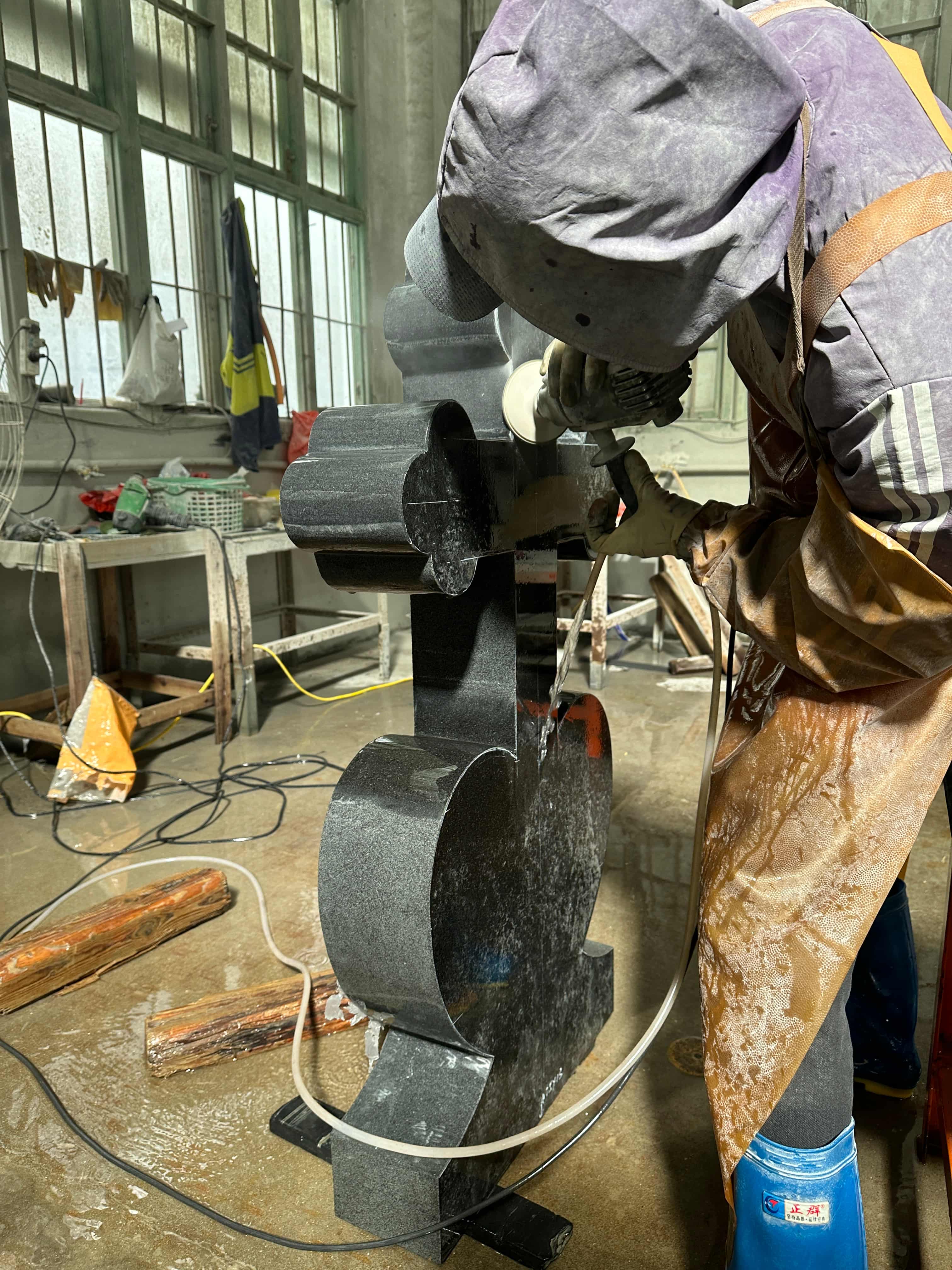
Hand polishing workshop: final refinement before quality inspection and export packing.
Project-specific marble table sourcing. If you are evaluating a marble table supplier for a hotel, restaurant, office, villa, or café project, send your drawings and dimensions to SONGJIA's team for a project-specific quotation. Email sales@qzlxstone.com or contact April at +86 153-5929-3102 to discuss material, finish, custom size, and lead time. General inquiries can also be sent to info@songjiaglobal.com.
Have Questions or Need More Details?
Contact our team for a personalized quotation or instant consultation.
Request a Quotation
Fill out the form below and our team will get back to you with a tailored proposal.
WhatsApp Direct Chat
Prefer to chat in real-time? Message us on WhatsApp for instant assistance & quick answers.
- Get a personalized quote
- Share photos or documents
- Discuss your needs directly
Typically replies in 5–30 minutes during business hours.