
Tombstone vs. Traditional Memorials: A Comparison Guide for Marble Table Buyers
Buyers who source marble tabletops for hotels, restaurants, offices, villas and cafés usually meet the vocabulary of memorial stonework by accident. A supplier catalogue arrives, and between dining tables, reception counters and the slabs behind them are entries labelled tombstone, headstone, monument and memorial. The words look like a different industry. In practice they describe the same technical question that governs table procurement: how many stone components are used, how they are joined, and what that means for durability, customization, transport and maintenance.
This guide compares two construction approaches — the tombstone-style single-slab design and the traditional multi-component memorial — across durability, customization and visual appeal. Each difference is then translated into a decision a marble table buyer actually has to make, whether the project is a hotel banquet hall, a restaurant, an office reception, a villa or a café.
Xiamen Songjia Trading Co., Ltd. (SONGJIA) is a natural stone supplier based in Xiamen, China, serving international stone importers, contractors, fabricators, designers and private custom clients. Its range covers tombstones and memorial products alongside granite and marble slabs, quartzite, limestone, onyx and stone furniture, and the company's stated product list includes Monument, Tombstone and building material categories. That overlap is why the comparison below is practical rather than theoretical: one supplier can quote a memorial piece and a marble table on the same document.
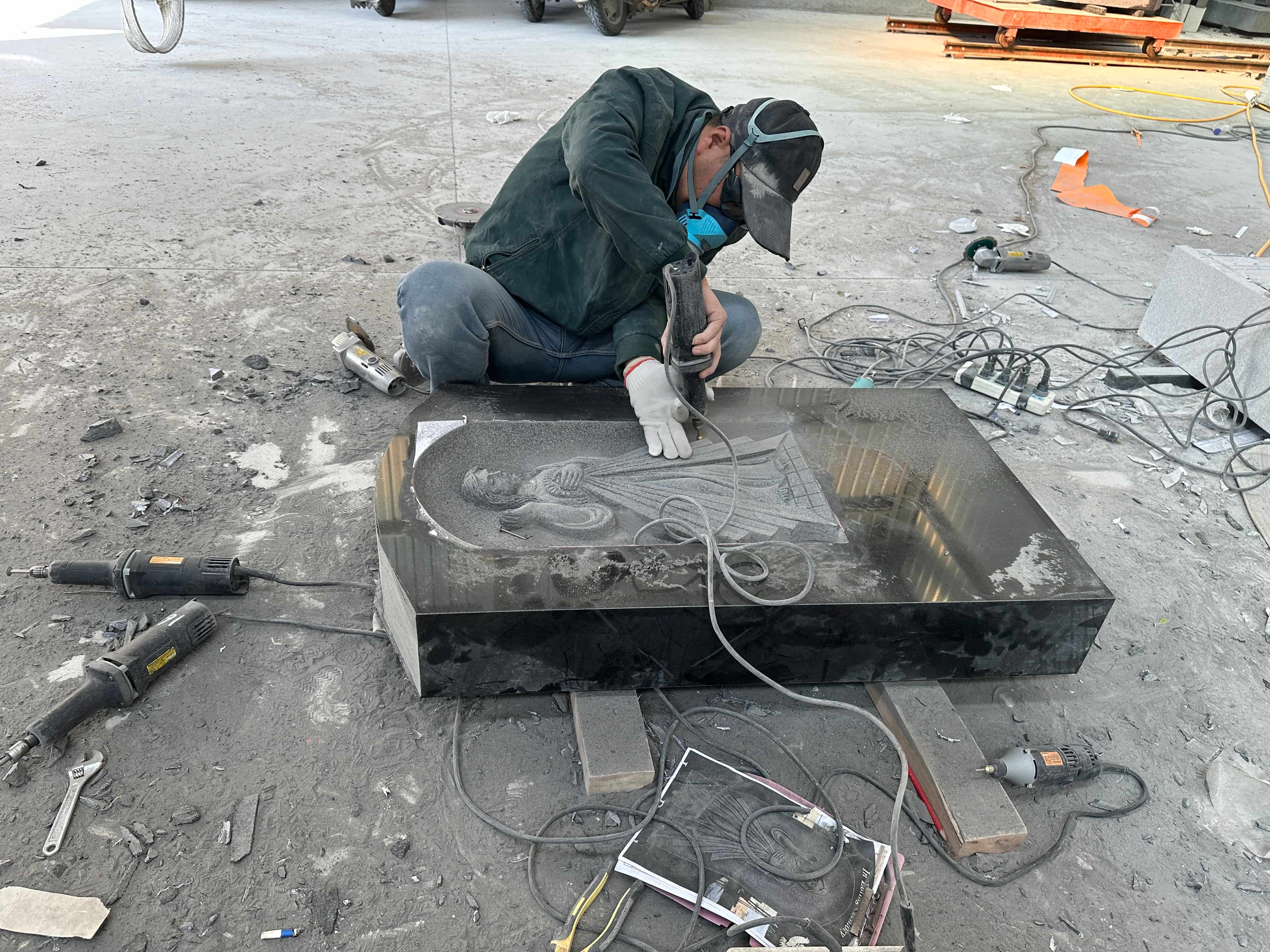
Tombstone vs. Traditional Memorial: What the Terms Actually Mean
In stone trade usage, “tombstone” is a loose label. Sometimes it refers to the inscribed upright slab alone; sometimes it is used for the complete grave marker. “Traditional memorial” is generally understood as a composite assembly: an upright headstone standing on a base, often accompanied by a ledger slab covering the plot and kerbs defining its outline, and in some designs by vases, urns or carved ornament.
The ambiguity costs money. Two suppliers can quote “one memorial” and mean one stone element or seven, and a buyer comparing those figures without a component list is comparing different scopes. Marble table quotations carry the same trap: a “table” may be a tabletop only, or a complete assembly of top, base and fixings.
Remove the vocabulary and both categories resolve into a single structural question — is the finished object one piece of stone, or an assembly of pieces joined on site? That question drives weight, packing, installation sequence, repairability, and even how a surface is cleaned and moved.
The single-slab approach (tombstone-style)
One stone element carries the whole function. Cutting, shaping, polishing and engraving concentrate on that piece, which is generally set on a prepared foundation or a simple base. Alignment work is limited because there is only one component to level, and the visual result reads as a clean, legible panel. In furniture terms this is the thick single-slab tabletop, where the top alone defines the design.
The multi-component approach (traditional memorial)
Several elements work together. The base distributes load, the ledger covers the plot, kerbs outline it, and the headstone carries the inscription. Fabrication is not only sawing and polishing — it is making several pieces agree with each other in dimension, tone and alignment. In table terms this is top-plus-base, top-plus-apron or pedestal construction, where joinery and material matching decide how the finished object reads.
Why the Comparison Matters Now: Market Context for Stone Buyers
The marble category is large and still expanding. The global marble market was valued at approximately USD 70.4 billion in 2024, and the furniture segment consumed about 9.8 million metric tons of marble in 2023, according to figures published by Grand View Research and Market Growth Reports. Buyers should read such totals as directional rather than precise: research houses publish materially different estimates for the same period, and the reliable signal is the direction — stone remains a mainstream material for both architectural and furniture applications.
Hospitality is one of the demand engines behind that. The hospitality furniture market supports more than 19.8 million hotel and leisure rooms worldwide, with an average furniture replacement cycle of seven to ten years, according to Market Reports World. Replacement cycles of that length reward buyers who lock specifications and suppliers early, because consistency between the first order and the second matters more than one-off novelty.
Design preferences are moving as well. Commercial dining furniture trends for 2025 emphasise sustainable materials and customizable designs, and are shifting away from stark white and gray tones toward warmer, earthy neutrals, according to MityLite commercial trend reporting. For table projects that changes slab selection, finish and base treatment. Memorial work follows a different priority order: outdoor exposure, legibility and long-term stability usually outweigh interior trend cycles.
Fabrication behaviour, however, is governed by the stone itself. ASTM C503/C503M, the primary standard for marble dimension stone, classifies marble into Soundness Groups A, B, C and D based on working qualities and geological flaws. Soundness grouping functions as a fabrication-risk indicator: it tells a buyer how a block is likely to behave under sawing, carving and finishing, whether the end product is an inscribed memorial or a large-format tabletop.
China remains a central fabrication base for the category. The country's furniture and parts export value reached RMB 483.03 billion in 2024, a 7.0% year-on-year increase, with growth attributed to a shift toward higher-value-added products, according to China's General Administration of Customs.
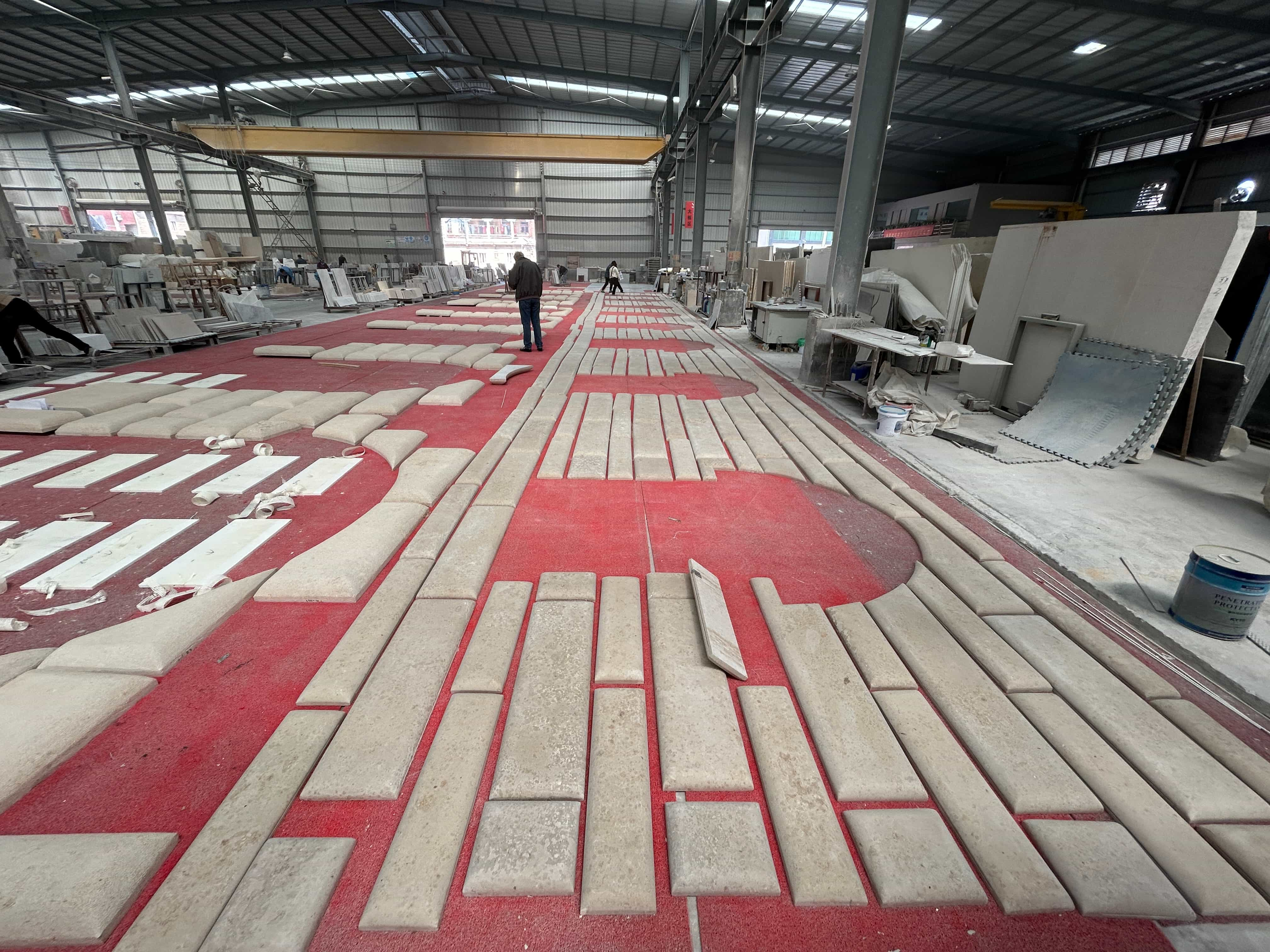
SONGJIA operates inside this environment as a natural stone supplier that coordinates design and production rather than presenting itself as a single-factory manufacturer. The company's own data records a 20,000 m² factory footprint, 60 employees, a three-engineer technical team, and an annual output described as 150 containers of monument products and 200 containers of building materials; 100% of output is exported, with the EU, USA and Middle East as main markets. Because memorial products and stone furniture sit in the same range, both sides of this comparison apply to the same production floor.
Six Criteria That Decide the Question
1. Construction logic and component count
Component count is the first cost and risk variable. A single-slab design gives one item to produce, inspect, pack and install. A multi-component design multiplies each of those steps, but spreads weight and allows individual elements to be replaced rather than rebuilding the whole. For tables, the equivalent choice is a monolithic top versus a top with a separate base, apron or pedestal: the monolithic version is simpler to specify, while the assembly version is easier to handle and to re-level on uneven floors.
2. Material and durability
Durability is a function of material, thickness and exposure, not of the label “marble”. A memorial installed outdoors faces rain, frost and ground contact; an interior table faces footfall, cleaning agents, food and drink spills, and point loads from chairs and equipment. Granite is widely chosen where outdoor durability and abrasion resistance dominate, while marble is frequently selected for interior surfaces where veining and finish are the priority. For marble dimension stone, ASTM C503/C503M and its soundness grouping remain the reference point, and for European market access the documentation should match the product actually being shipped.
3. Customization and design-to-production
Customization differs in kind, not only in degree. Memorial customization usually concentrates on lettering, layout, shape and ornament; table customization concentrates on size, thickness, edge profile, cut-outs and base design. Both depend on whether the supplier can turn a concept into a producible drawing. SONGJIA describes its core strength as design-to-production integration, with a technical team that converts client sketches, concepts and architectural ideas into accurate, producible shop drawings so each design can be executed while maintaining quality consistency, cost control and delivery reliability. That capability — drawing, not just cutting — separates a quotation that can be manufactured from one that cannot.
4. Visual appeal and finish
Visual appeal is decided by three things: the stone's colour and veining, the finish applied to it, and the proportions of the piece. A single-slab design puts all the emphasis on one face, so veining continuity and polish quality are immediately visible. A multi-component design adds the relationship between elements — proportion, joint lines and tone matching between headstone and kerbs, or between a tabletop and its base. Where a project follows the current shift toward warmer, earthy neutrals, tonal matching between components becomes a specification item rather than an afterthought.
5. Maintenance and cleaning
Outdoor memorials and indoor tables are cleaned in different ways. Memorial maintenance generally involves removing biological growth, cleaning joints and re-leveling elements over time. Commercial tables are cleaned frequently, sometimes aggressively, and surfaces need to tolerate routine cleaning without losing their finish. That is why “easy-to-clean” is a practical requirement for restaurant, office and café furniture rather than a marketing phrase: smooth, well-polished surfaces with sealed edges and simple joint geometry are easier to maintain than surfaces with deep crevices or multiple open seams.
6. Weight, transport and installation
Stone is heavy, and component count changes how that weight is managed. A multi-component design divides load across several pieces, which can make handling easier but multiplies on-site alignment work. A single-slab design simplifies alignment but concentrates weight into one lift. For tables, the same logic points to demountable or foldable formats where the design allows: separating the top from the base reduces handling weight and permits compact storage, which is useful for café leisure seating or multi-purpose rooms where furniture is moved between configurations.
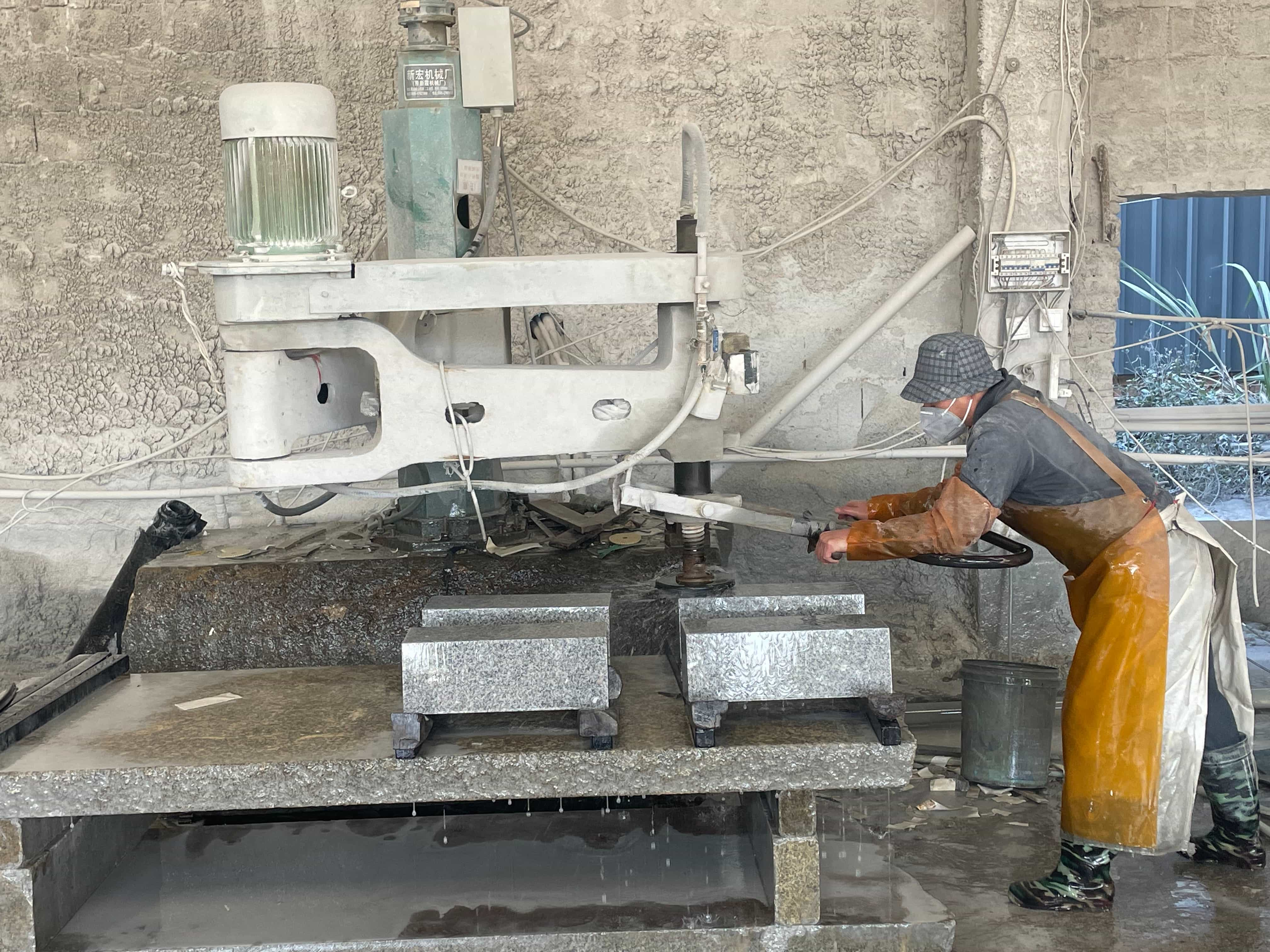
Step-by-Step: How to Choose Between Single-Slab and Multi-Component Stone Work
Step 1 — Define exposure and use before material. Decide first whether the piece lives indoors or outdoors and who touches it. A hotel banquet hall table and a cemetery memorial have almost nothing in common in terms of load, cleaning and weather, and the exposure profile narrows the material and finish options before aesthetics are discussed.
Step 2 — Choose the construction type deliberately. Ask whether the design should be one slab or an assembly. If the piece may need to be moved, re-leveled or partially replaced during its life, count how many components that involves and how they separate.
Step 3 — Match material to the job and verify documentation scope. Check the stone's soundness behaviour for the intended fabrication, and confirm that certificates and test records cover the actual product and application. A scope statement matters more than a logo on a certificate.
Step 4 — Lock producible drawings before cutting. This is where lettering, edge profiles, cut-outs, joint lines and dimensional tolerances are settled. On SONGJIA projects, sketches and architectural ideas are converted into shop drawings at this stage, which keeps quality, cost and delivery controllable downstream.
Step 5 — Validate with a sample or pre-production piece. Confirm finish, colour direction, edge detail and engraving depth against the drawing. Where a full-size sample is impractical, a smaller finished piece produced under the same process can still confirm surface and detail.
Step 6 — Confirm documentation, packing and shipping. Ask what is packed, how edges and faces are protected, what the packing list contains, and which documents travel with the shipment. Weight and packing method are decided here, not at the port.
Use Cases: Matching the Choice to the Project
Hotel banquet hall marble tables
Banquet halls combine large formats with heavy, repetitive use. A single-slab top in a large size reduces joint lines and cleaning effort, while a demountable base helps with installation between floors and service corridors. Because hospitality furniture replacement cycles typically run seven to ten years, specifying repeatable sizes and consistent finishes matters more than a one-off shape.
Restaurant commercial marble tables
Restaurant operators prioritise surfaces that withstand daily cleaning, chair movement and spills. Dense, well-polished tops with simple edge profiles and sealed joints are easier to maintain than heavily textured or multi-seamed alternatives; this is where the “easy-to-clean” and “durable commercial” requirements converge.
Office reception marble tables
Reception counters and lobby tables are evaluated visually first and technically second. Veining continuity, tone and polish dominate, which favours a single-slab top with a stable base or pedestal, plus coordinated edge detailing that matches the surrounding stone finishes.
Villa custom marble tables
Villa projects are usually one-off, which makes drawing capability the deciding factor. Custom sizes, non-standard heights, cut-outs for services and base geometries all require the concept-to-shop-drawing step before fabrication begins.
Café leisure marble tables
Café footprints are compact and layouts change. A smaller top with a demountable or foldable base reduces handling weight and allows furniture to be stored or rearranged without risking the stone surface — the same logic that makes modular components attractive in memorial assemblies.
Memorial and commemorative projects
Here the multi-component logic returns. If the project requires plot definition, layered proportion and replaceable elements, a traditional assembly of headstone, base, ledger and kerbs is the conventional route. If the priority is a single legible element with minimal alignment and simpler handling, the tombstone-style slab serves that purpose. Both are fabricated from the same stone categories SONGJIA supplies, alongside its building material range.
Comparison Table: Tombstone, Traditional Memorial and the Marble Table Read-Across
| Criterion | Tombstone-style (single slab) | Traditional memorial (multi-component) | Read-across to marble tables |
|---|---|---|---|
| Primary function | One inscribed face marks the site | Headstone, base, ledger and kerbs define and enclose the plot | Determines whether a buyer is purchasing a top or a complete table |
| Construction | One stone element on a foundation or simple base | Several pieces joined and aligned on site | Monolithic top versus top plus base, apron or pedestal |
| Fabrication focus | Shaping, polishing and engraving of one piece | Dimension agreement, tone matching and alignment between pieces | Edge profile and joinery define the finished appearance |
| Durability exposure | Outdoor weather and ground contact on a single unit | Outdoor weather across more joints and contact points | Indoor tables face traffic, cleaning agents and point loads |
| Customization | Lettering, shape and edge treatment | Lettering plus layout, ornament and plot dimensions | Custom size, thickness, cut-outs and engraved detail |
| Visual appeal | Emphasis on one clean, legible face | Emphasis on proportion and the relationship between elements | Veining continuity, finish and tonal matching |
| Maintenance | Cleaning and re-leveling of one unit | Cleaning plus joint and edge maintenance across elements | Easy-to-clean surfaces with sealed edges and simple seams |
| Transport & installation | Fewer pieces, simpler handling, weight concentrated | More pieces, easier individual lifts, more on-site alignment | Large single tops versus modular or demountable formats |
| Documentation | Material and treatment records | Same, plus multi-piece installation details | Certificate scope and standard classification (e.g. ASTM C503/C503M) |
FAQ: Tombstone vs. Traditional Memorials for Marble Table Buyers
Which standards and certificates should a buyer verify before ordering stonework?
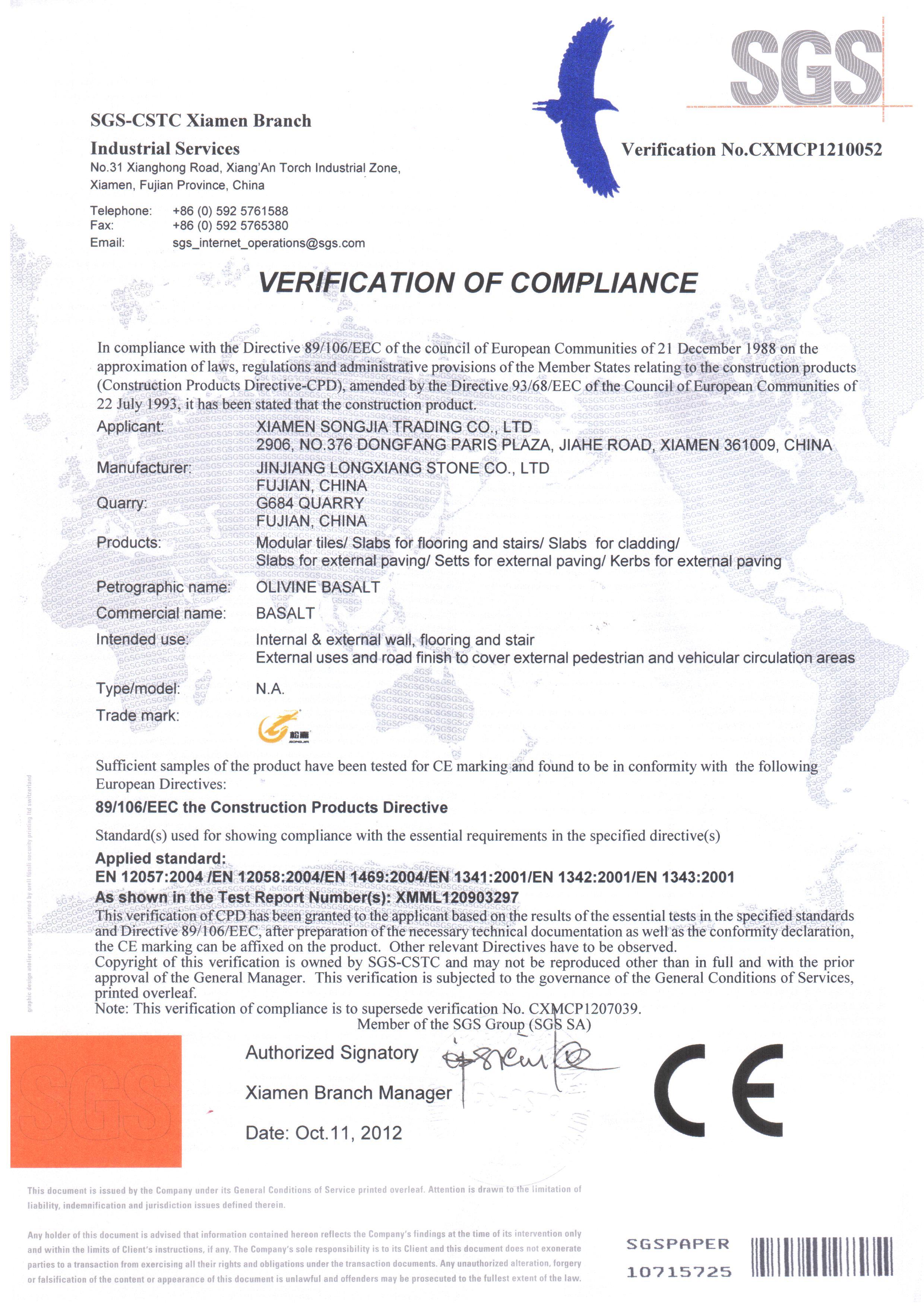
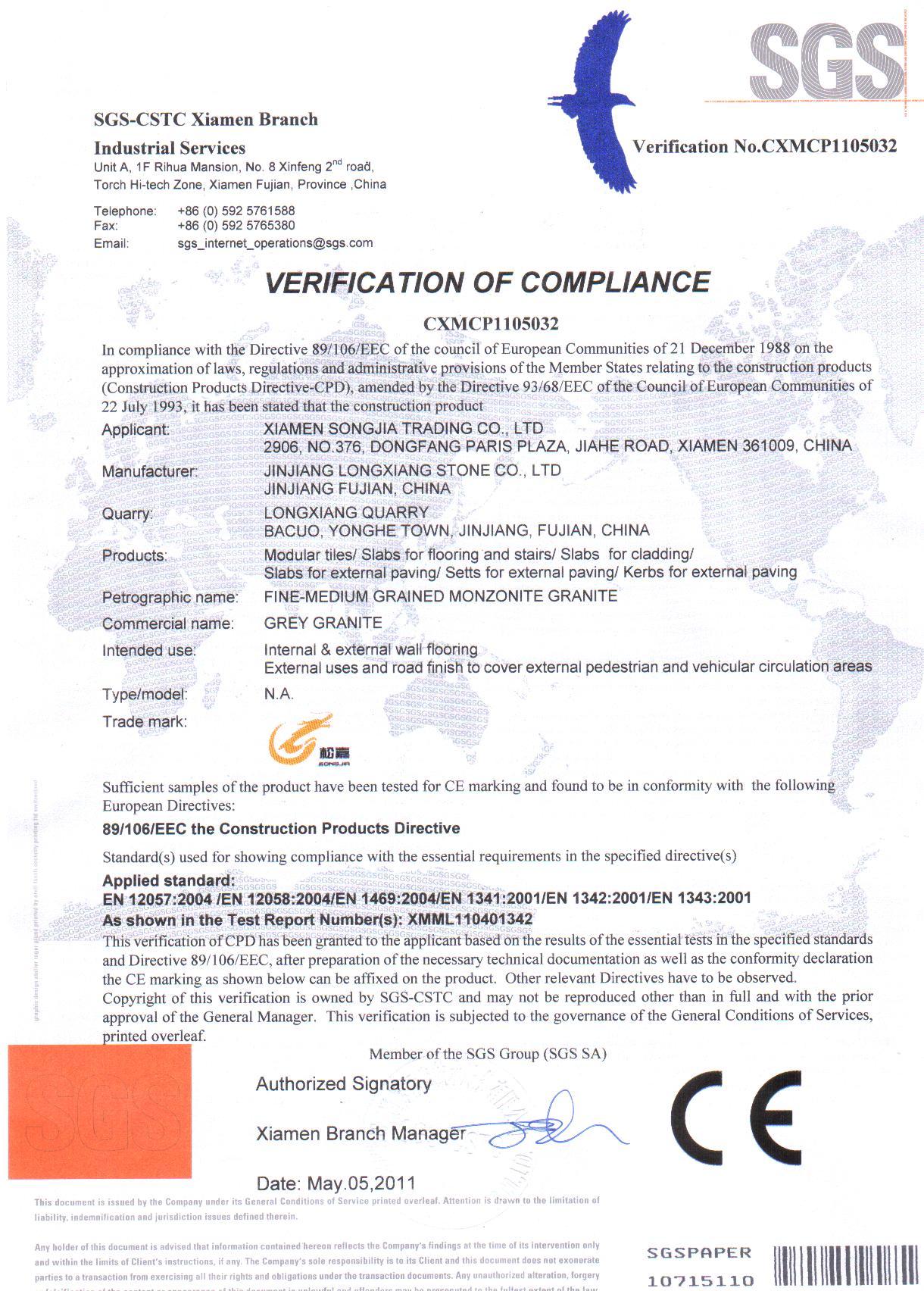
Two layers of documentation matter. For the material itself, ASTM C503/C503M is the primary standard for marble dimension stone and classifies marble into Soundness Groups A, B, C and D based on working qualities and geological flaws, which indicates how a block is likely to behave during cutting, carving and finishing. For market access, SONGJIA holds SGS CE certificates covering natural stone products: certificate CXMCP1210052 for G684 basalt, issued against EN 12058 for natural stone slabs used in floors and stairs, and certificate XMML110401342 for G603 grey granite, issued against EN 12057 for natural stone modular tiles. Buyers should confirm that a certificate's stated scope covers the application being ordered — a slab certificate is not automatically a certificate for a carved memorial or a tabletop.
Can one supplier handle both traditional memorial stonework and commercial marble tables?
Yes, if the supplier coordinates design and production rather than running a single machine line. SONGJIA supplies tombstones and memorial products alongside granite and marble slabs, quartzite, limestone, onyx and stone furniture. The company reports a 20,000 m² factory footprint, 60 employees, a three-engineer technical team, an annual output described as 150 containers of monument products and 200 containers of building materials, and a 100% export ratio with the EU, USA and Middle East as main markets. For buyers, the decisive capability is drawing: converting a sketch or architectural idea into a producible shop drawing is what allows a complex memorial or a custom-size table to be delivered consistently across repeat orders.
What drives the cost difference between a tombstone-style design, a traditional memorial and different marble table formats?
The main cost drivers are the same across the three cases: component count, material type and block availability, finished size, complexity of carving or engraving, finish and edge treatment, order quantity, and the packing and shipping weight that follows from all of them. A single-slab design concentrates work in one element; a multi-component design multiplies fabrication, matching and packing steps. Because these variables change from project to project, quotations are only comparable when they are based on the same drawings, the same component list, the same finish specification and the same packing method.
How should buyers validate a sample before committing to a full order?
A sample or pre-production piece is the point where specification becomes visible. Buyers should check the material against the approved block or reference, compare the finish against the agreed specification, inspect the edge profile, review engraving depth and lettering legibility, and confirm how the top and base will meet. Where a full-size sample is impractical, a smaller finished piece produced under the same process can still confirm finish, edge detail and colour direction. Sample approval should be documented against the shop drawings so the production run can be checked against it.
What affects production and delivery time on a custom stone order?
Timing is driven by the drawing approval cycle, the number of custom components, the complexity of carving or engraving, material availability, and the packing and shipping schedule. SONGJIA handles design coordination, production management, quality inspection, packaging and international shipping as a single process, which reduces the number of hand-offs between drawing and dispatch. Buyers who want to move from comparison to a concrete plan can send drawings or size requirements to April at sales@qzlxstone.com, message +86 153-5929-3102 on WhatsApp, or review the supplier's range at songjiaglobal.com.
Conclusion: Choose the Construction, Then Choose the Supplier
The tombstone-versus-traditional-memorial question has a simple decision rule once the vocabulary is removed. If a project needs one legible element with minimal alignment and straightforward handling, a single-slab design fits. If it needs plot definition, layered proportion and components that can be individually replaced, a multi-component assembly fits. Marble tables follow exactly the same rule: not “marble or not”, but monolithic top versus top with base, large single format versus modular, fixed versus demountable or foldable.
Durability, customization and visual appeal are not properties of a category label. They are properties of the specification — material, thickness, finish, joint design and documentation. For buyers in construction and decoration, comparing quotations on component lists and drawings rather than on product names will produce a more accurate answer every time, whether the piece ends up in a banquet hall, a reception area, a villa or a commemorative setting.
Next step: a scoped quotation for your drawings
Send your sizes, component list or concept sketch, and SONGJIA will respond with a producible drawing review and a quotation that separates material, fabrication, finish and packing.
Contact: April · Email: sales@qzlxstone.com · WhatsApp / Tel: +86 153-5929-3102 · Website: www.songjiaglobal.com · Address: Xiamen, China
Have Questions or Need More Details?
Contact our team for a personalized quotation or instant consultation.
Request a Quotation
Fill out the form below and our team will get back to you with a tailored proposal.
WhatsApp Direct Chat
Prefer to chat in real-time? Message us on WhatsApp for instant assistance & quick answers.
- Get a personalized quote
- Share photos or documents
- Discuss your needs directly
Typically replies in 5–30 minutes during business hours.