
Using Tombstone Marble Tables in Memorial Gardens: An Application Guide for Project Planners
A tombstone marble table is a marble table whose material family, edge treatment, and lettering language are drawn from memorial stonework, and which is placed in a memorial garden, cemetery, columbarium, or commemorative lounge as seating, gathering, or remembrance furniture. The format works when the table is specified as part of the memorial environment; it fails when a project team buys it as generic café furniture and then installs it outdoors.
This guide is written for the discovery and research stage of a memorial project, where the open question is not yet which supplier to appoint, but whether this table format fits the site, what has to be decided before a supplier can quote, and how the table should relate to surrounding headstones, walls, paving, and planting.
It is deliberately practical. Marble top suppliers are numerous, and most can cut a slab to size. Far fewer can take a sketch from a landscape architect, turn it into a producible drawing, keep the finish consistent with the memorial stonework already on site, and ship the result to an overseas cemetery authority. That gap between cutting and coordinating is where memorial projects usually lose time.
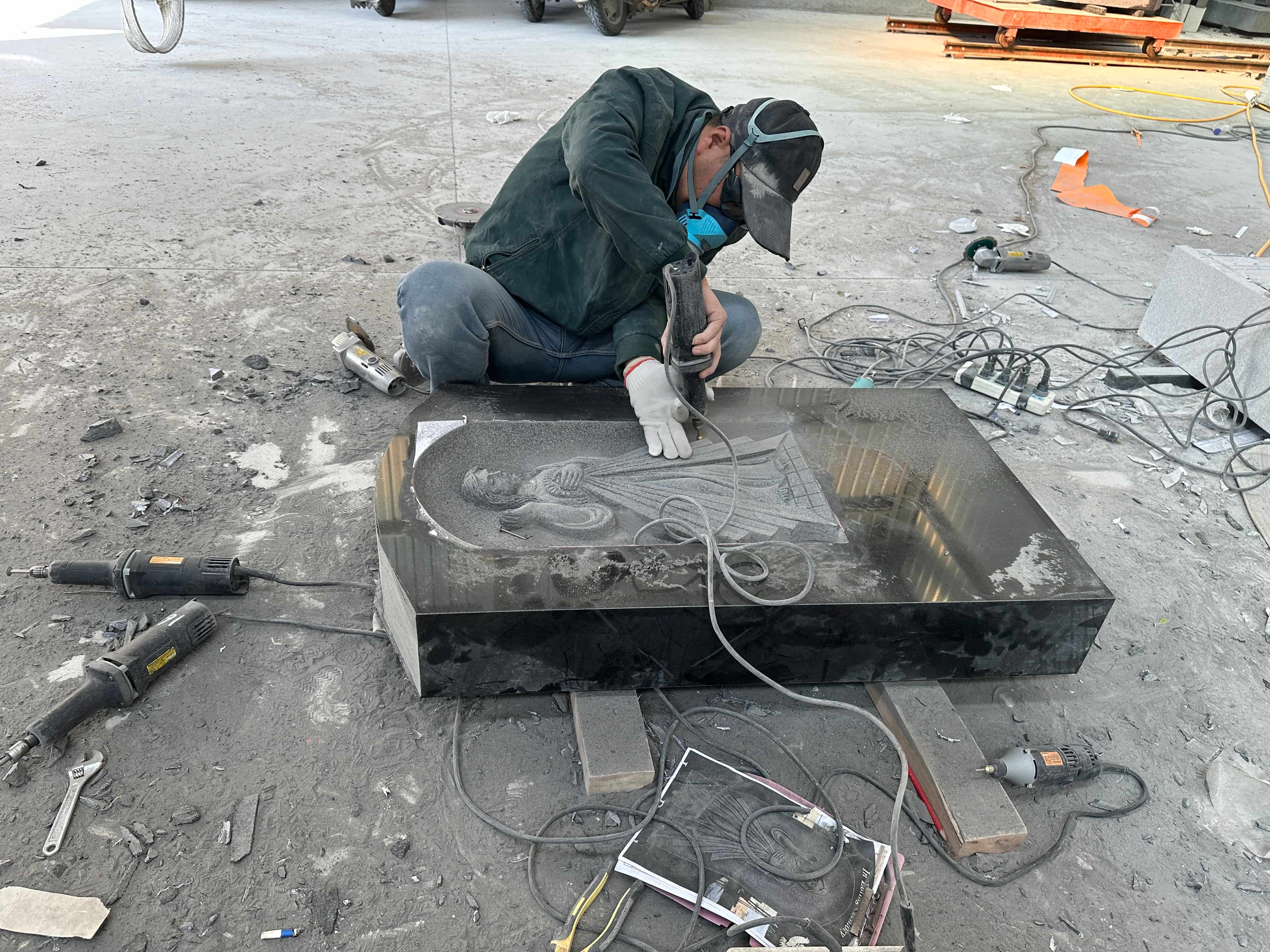
Short answer for planners. A tombstone marble table is a reasonable specification for memorial gardens when four conditions are met: the marble grade is chosen against a recognised dimension-stone reference; the finish and cleaning regime match the grounds team’s actual routine; the table is sized from the visitor’s use of the space rather than from a stock catalogue; and the drawing set covers tabletop, base, lettering, joints, and transport packing as one package.
Where any one of those four is skipped, the table usually ends up looking like an imported furniture item placed on memorial ground — which is the one outcome cemetery authorities and design review boards consistently reject.
Problem Definition: Why Memorial Seating Quietly Fails Specification
Memorial gardens inherit two procurement cultures that rarely talk to each other. The first is memorial stonework: headstones, plaques, kerbs, and lettering, bought through stone specialists who understand block selection, engraving, and cemetery approval. The second is commercial furniture: benches and tables bought through hospitality or contract furniture channels, where replacement cycles are short and the outdoor environment is often treated as a weather clause rather than a design condition.
When a memorial table is sourced from the furniture side alone, three failure patterns repeat.
- Material mismatch. The table arrives in a marble that does not sit visually with the headstones, kerbs, and walling around it. In a memorial garden, visual continuity is not decoration; it is what makes new furniture read as part of the site rather than as a donation that arrived late.
- Interior-grade detailing used outdoors. Edges, joints, and fixings designed for a temperature-controlled interior are asked to survive rain, frost cycles, de-icing salt from adjacent paths, and leaf tannins. The table does not fail on day one; it fails in year three, which is exactly when the project is least able to absorb a replacement.
- Cleaning regimes that ignore the grounds team. A polished surface with deep recessed lettering and narrow joints between tabletop and base demands more labour than a small grounds staff can give it. If the maintenance routine cannot keep the surface clean, the table ages visibly and becomes a maintenance complaint instead of a memorial feature.
There is a fourth, quieter problem: the split responsibility. When headstones come from one supplier and the table from another, no single party owns the finish match, the lettering style, or the on-site fit. On a project with fixed installation windows, that split is where schedule delay accumulates.
Industry Background: Marble, Memorial Permanence, and a Changing Supply Base
Marble is a mature global material, and its supply base is larger than most memorial project teams assume. Market sizing for the global marble market varies by methodology: one widely cited estimate puts the market at approximately USD 70.4 billion in 2024, while other research houses publish materially different figures, including an estimated USD 23.53 billion for 2025 and a 2024 base of USD 64.8 billion. The divergence is a useful warning for planners — treat any single market number as an order-of-magnitude signal, not as a budgeting input.
What the same body of research does show consistently is that furniture is a real consumption segment for marble: the furniture segment consumed about 9.8 million metric tons of marble in 2023. Marble furniture is therefore not a niche craft activity; it is an industrial category with established block supply, cutting capacity, and finishing workflows.
On the standards side, marble dimension stone is commonly referenced against ASTM C503/C503M, the primary standard for marble dimension stone, which classifies marble into Soundness Groups A, B, C, and D based on working qualities and geological flaws. For a memorial application this classification matters more than colour: a group that works well for an interior reception counter is not automatically the right choice for a table exposed to open sky.
Two further context points shape how suppliers behave. First, the commercial furniture world runs on replacement cycles — the hospitality furniture market supports over 19.8 million hotel and leisure rooms worldwide, with an average replacement cycle of seven to ten years for furniture sets. Memorial environments are usually planned around much longer service intervals, so a table designed on a seven-to-ten-year logic will be judged against a twenty-year expectation. Second, design direction in commercial furniture for 2025 emphasises sustainable materials and customizable designs, with a move away from stark white and grey toward warmer, earthy neutrals — a direction that sits comfortably alongside the warm, weathered stone tones typical of memorial gardens.
The supply side has shifted as well. China’s furniture and parts export value reached RMB 483.03 billion in 2024, a 7.0% year-over-year increase, driven by a shift toward higher-value-added products. In practice, that means more overseas buyers now encounter suppliers who can handle drawing interpretation, custom sizing, and export packing — not just slab cutting.
Detailed Solution: Specifying a Tombstone Marble Table Through a Stone Specialist
XIAMEN SONGJIA TRADING CO.,LTD (SONGJIA) is a natural stone specialist based in Xiamen, China, supplying tombstones and memorial products, granite and marble slabs, quartzite, limestone, onyx, and stone furniture to international stone importers, contractors, fabricators, designers, and private custom clients. The company describes itself as a stone specialist supported by a mature and flexible manufacturing and supply network rather than as a single-factory manufacturer, and it works across both memorial products and bespoke marble furniture — the two categories a memorial garden table sits between.
What the company brings to a memorial table drawing set
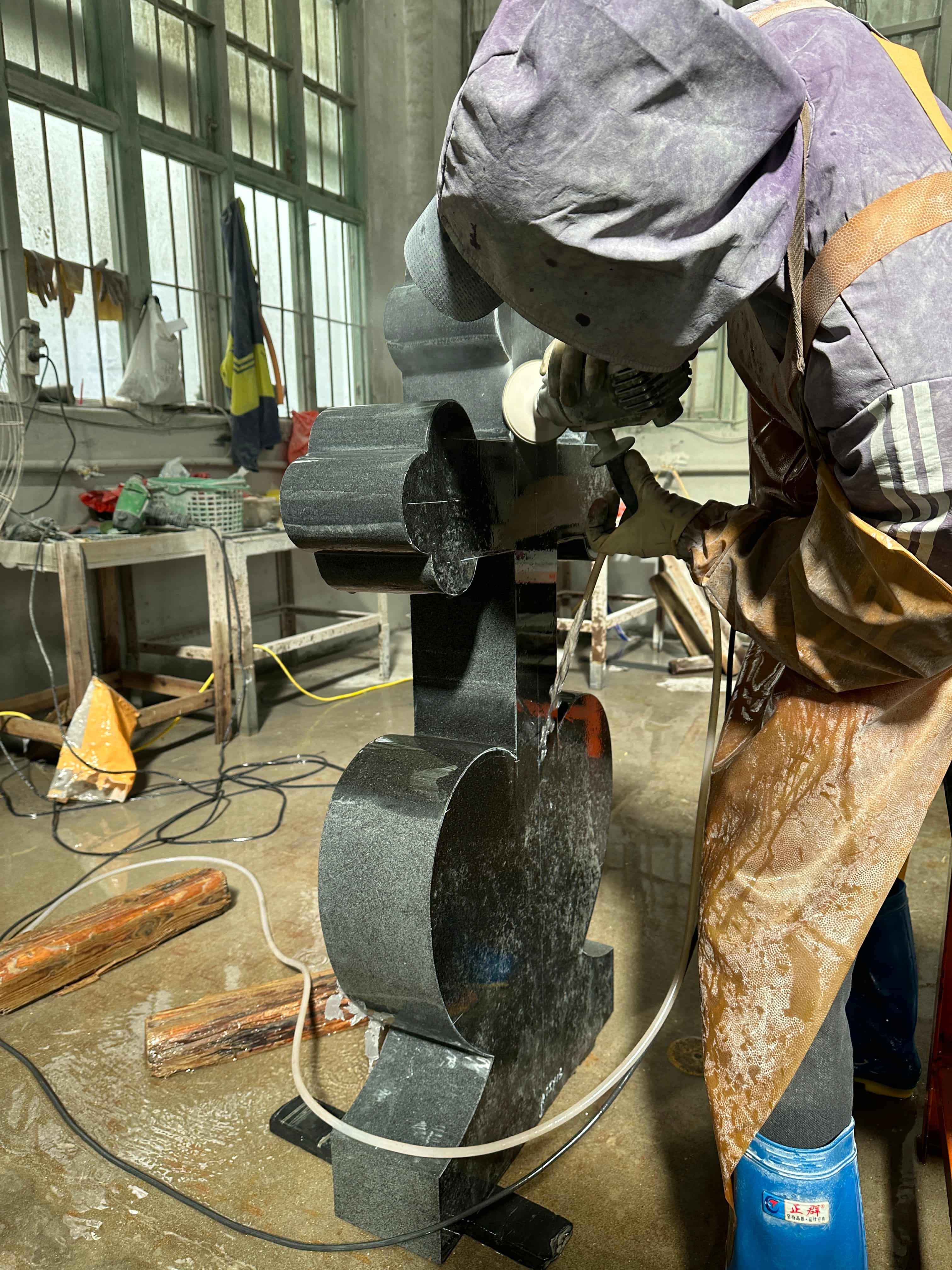
SONGJIA’s core strength is design-to-production integration. Its technical team converts client sketches, concepts, and architectural ideas into accurate, producible shop drawings, so that a design can be executed while maintaining quality consistency, cost control, and delivery reliability. The team includes three engineers.
That matters because a memorial table is a drawing problem before it is a material problem. The architect may sketch a long, low table aligned with a colonnade; the supplier has to decide how the top is supported, where joints fall, how the lettering band is positioned so it stays legible from a standing visitor’s eye line, and how the whole piece is packed so it arrives without a chipped edge. A marble table supplier that only quotes dimensions will leave those decisions to the site team.
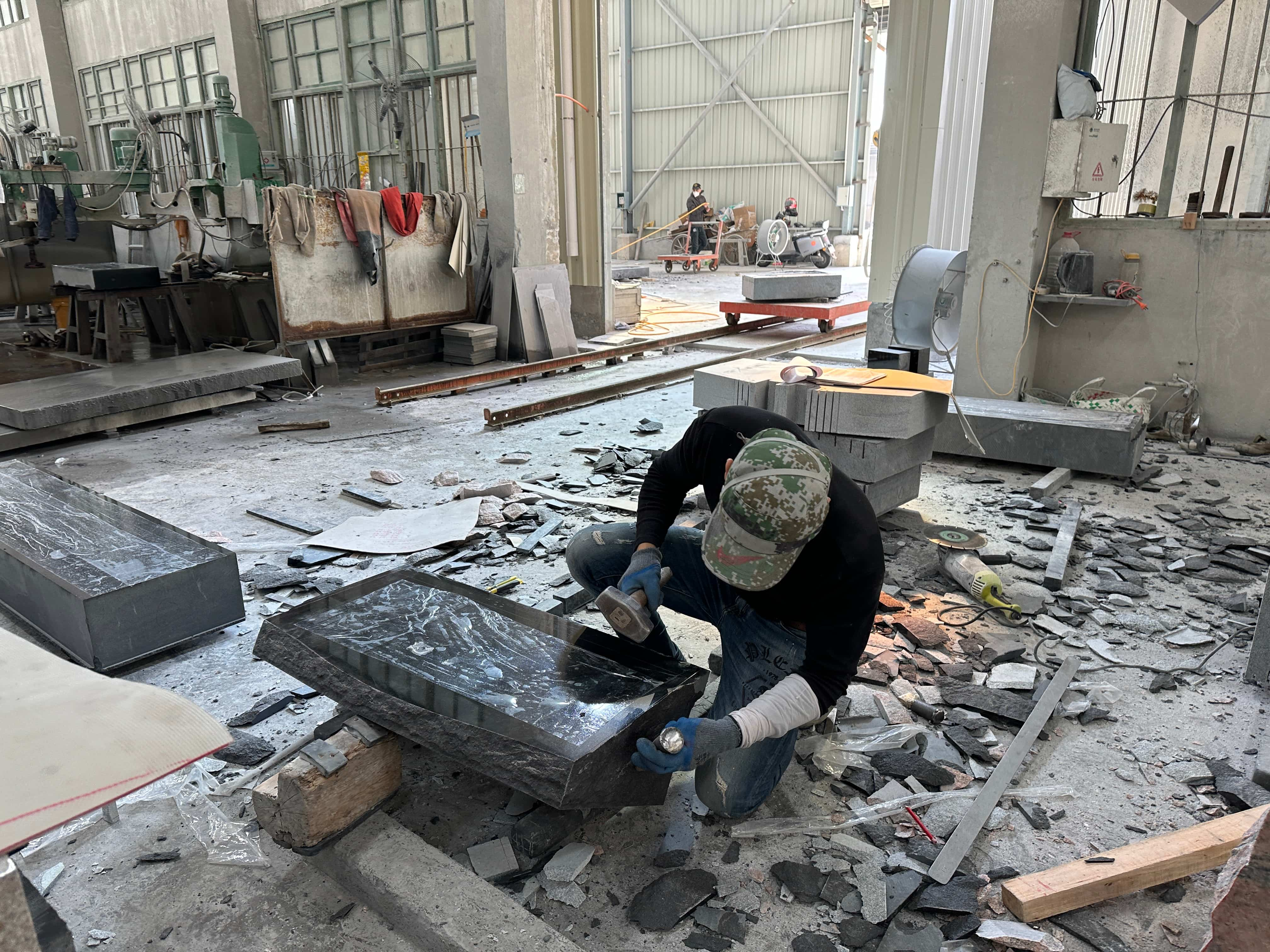
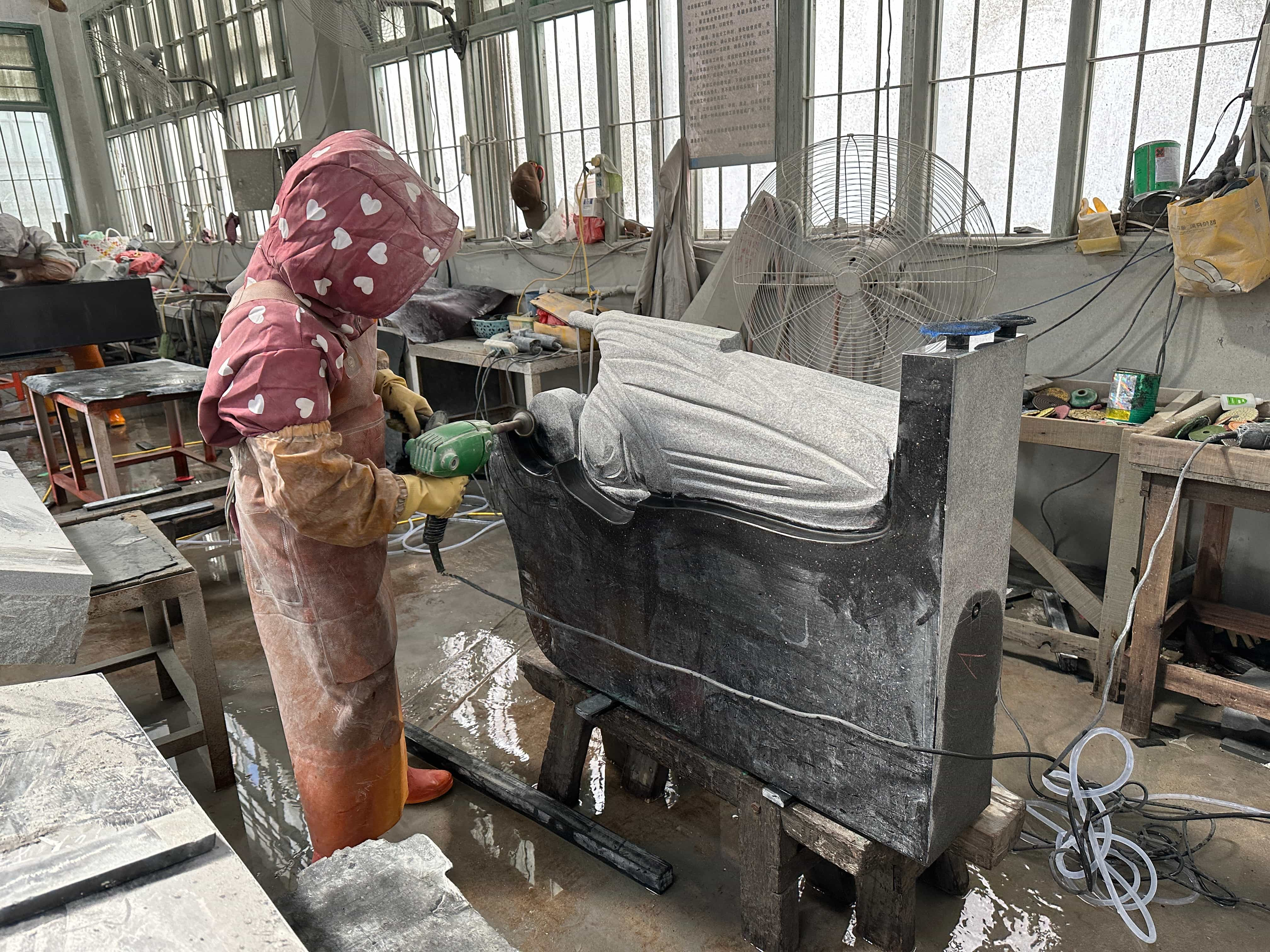
The operational base behind this is a 20,000 m² facility with 60 employees, an annual output measured at 150 containers of monument products and 200 containers of building materials, and a 100% export ratio serving the EU, USA, and Middle East. Those are production and logistics facts, not design claims — but they explain why a drawing-led process is realistic rather than aspirational for overseas memorial work.
Material behaviour in outdoor memorial settings
Marble is a natural stone with geological variation between blocks. Two slabs from the same quarry can differ in veining, in the presence of flaws, and in how they respond to working. This is precisely why ASTM C503/C503M classifies marble into Soundness Groups A to D rather than treating it as one uniform material.
For an outdoor memorial table, the practical consequences are narrow but important. Specify the soundness group, not only the colour name. Expect that the block chosen for the tabletop may need to be selected against the block used for adjacent memorial elements if the client wants a visible match. Accept that surface finish changes both appearance and cleaning behaviour — a honed surface reads softer and hides marking differently from a polished one, and the choice should follow the grounds team’s routine rather than a showroom preference.
Cleaning is a design decision as much as a material one. On a memorial site, acidic cleaners are a common risk because they are readily available and effective on other surfaces; marble is calcium-based and generally does not tolerate them well on polished faces. Detailing that reduces crevices, trapped leaf litter, and standing water at joints will do more for long-term appearance than any single product choice.
Size, proportion, and structural support
Memorial tables divide into two broad planning types. Custom-size tables are dimensioned from the site: a bench-height table along a low wall, a square table in a reflection court, a narrow table between planting beds. Large-size tables serve gathering and ceremony use, where several visitors stand or sit around one surface.
Both types are governed by the same principle: the tabletop is heavy, and the base or frame is an engineering element, not a catalogue accessory. Weight, span between supports, anchorage to paving, and drainage around the foot of the piece should all be resolved at drawing stage. This is where a supplier with stone-project experience differs from a furniture trader — the conversation is about support and fixing, not only about the top.
Design integration with surrounding architecture
A memorial garden is a composition of walls, paving, planting, lettering, and sightlines. The table should inherit at least one strong reference from that composition: the same edge profile as the kerbs, the same lettering style as the plaques, the same stone family as the walling, or a deliberately contrasting but disciplined counterpoint.
Practical integration points include aligning table height with adjacent bench seating so the group reads as one furniture family; keeping any lettering band outside the area where visitors habitually rest hands and bags; and choosing edge treatment that survives grounds machinery passing nearby. None of these are decorative refinements — each one determines whether the table still looks intentional after several seasons of use.
Step-by-Step Breakdown: From Concept to Installed Table
The sequence below is the working order that keeps a memorial table project from drifting. Steps 1 to 4 belong to the planner; steps 5 to 9 belong to the supplier, with the planner approving at each handover.
- Define how the space will actually be used. Decide whether the table is for individual rest, family gathering after a ceremony, caretaker pauses, or an information point. Each use implies a different size, height, and grouping.
- Fix the design language against existing memorial stonework. Photograph and record the stone family, edge profiles, and lettering already on site. This becomes the reference set given to the supplier.
- Set the exposure conditions in writing. Open sky, covered colonnade, coastal salt air, freeze-thaw, adjacent de-icing routes, irrigation overspray, and leaf drop all belong in the brief. Suppliers can only detail for conditions they are told about.
- Agree the maintenance routine with the grounds team. Frequency, equipment, and cleaning products should be settled before the finish is chosen, not after installation.
- Convert the concept into shop drawings. SONGJIA’s technical team transforms sketches, concepts, and architectural ideas into accurate, producible shop drawings. This is the point where a good idea becomes a buildable object.
- Confirm material grade and block selection. Reference the soundness classification and confirm whether the top must visually match other memorial elements on site.
- Resolve base, anchorage, and drainage. Finalise support layout, fixing method, and how water leaves the foot of the table.
- Approve, produce, inspect, and pack. Production is followed by quality inspection and packaging within SONGJIA’s full-service process, which also covers design coordination, production management, and international shipping.
- Install and set a review point. After the first full seasonal cycle, review the surface, joints, and lettering with the grounds team and record any adjustment needed for future phases.
Use Cases
Open memorial garden with reflection seating
In an open garden, the table is fully exposed and read from a distance. Prioritise a stable surface, edges that tolerate machinery and maintenance access, and a stone family that matches the surrounding memorial elements. Group the table with bench seating so it reads as one composition rather than a standalone object.
Covered colonnade or commemorative lounge
Under cover, the table behaves closer to interior furniture while still sitting in a memorial context. This is where lettering quality and surface refinement carry more weight, and where a polished or honed finish can be considered with less concern about standing water. The commemorative lounge is also the most suitable location for a larger gathering table.
Cemetery visitor pavilion or waiting area
Visitor pavilions see short, frequent use by people who may be carrying flowers, tools, or children’s belongings. A practical, easy-to-clean surface and a forgiving edge profile matter more here than a decorative one. Detailing should assume wet clothing, dropped stems, and occasional cleaning with unfamiliar products.
Memorial park café or reception counter context
Where a memorial park includes a café or reception area, the same production logic used for hotel banquet hall and restaurant commercial marble tables applies: durable commercial surfaces, consistent finish across repeated units, and cleaning regimes aligned to daily service. The difference is that the memorial setting imposes a quieter visual language than a hospitality interior.
Private commemorative courtyards and villa-scale memorials
For smaller private memorials, a custom-size table works better than a large-format one. Villa custom marble table projects and bespoke marble furniture already form part of SONGJIA’s scope, so a private client can specify a single table drawn around an existing family plot rather than choose from a fixed range. The same drawing-led process applies; only the scale changes.
Comparison Table: Matching the Table to the Memorial Setting
The table below compares planning priorities by setting. It is a decision aid, not a product specification — final dimensions, grade, and detailing must be resolved in the project drawing set.
| Setting | Exposure profile | Finish priority | Cleaning approach | Sizing logic | Integration note |
|---|---|---|---|---|---|
| Open memorial garden | Full sky exposure, seasonal leaf drop, possible frost cycles | Consistency with existing memorial stonework; forgiving surface | Routine grounds-team cleaning with non-aggressive products | Custom-size, bench-linked | Edge treatment must tolerate adjacent maintenance machinery |
| Covered colonnade / commemorative lounge | Sheltered, indirect moisture | Lettering quality and surface refinement | Scheduled, low-frequency cleaning | Large-size gathering format | Align with column rhythm and paving joints |
| Cemetery visitor pavilion | Semi-exposed, high-frequency short use | Easy-to-clean surface, durable edge | Frequent light cleaning, variable products | Practical custom-size | Allow clearance for bags, flowers, and access routes |
| Memorial park café / reception | Interior or semi-interior, daily service | Durable commercial surface, repeatable finish | Daily service cleaning | Repeated units to one standard | Keep visual language quieter than a hospitality interior |
| Private commemorative courtyard | Varies; often partially sheltered | Personalisation and lettering | Owner-maintained | Single custom-size piece | Drawn around the existing family plot and planting |
Where a site schedule calls for reconfigurable layouts — temporary commemorative events, seasonal ceremony arrangements — a foldable marble table format can be raised with the supplier at design stage. It should be treated as a structural question first, because the frame and locking detail carry the load, and as a material question second.
Frequently Asked Questions
Which standard should a project team reference for marble in an outdoor memorial setting?
ASTM C503/C503M is the primary standard for marble dimension stone and classifies marble into Soundness Groups A, B, C, and D based on working qualities and geological flaws. It gives a project team a shared reference for discussing grade rather than relying on colour names alone. It does not replace local cemetery, planning, or heritage approvals, which vary by jurisdiction and should be confirmed with the authority responsible for the site before drawings are finalised.
Can a supplier produce table components in custom sizes from an architect’s drawings?
Yes, where the supplier works from drawings rather than a fixed range. SONGJIA’s technical team converts client sketches, concepts, and architectural ideas into accurate, producible shop drawings, and the company’s scope covers custom tombstone design, stone construction project production, and bespoke marble furniture, supported by three engineers. Custom-size and large-size table formats are therefore handled as a drawing exercise first and a material selection second.
What drives the cost of a memorial-garden marble table?
Cost is driven by the material family and block selected, the size and proportion of the top, edge and surface detailing, any lettering or engraving, the number of repeated units, and export packing and shipping. Because SONGJIA works from design to production with cost control inside that process, the quotation follows the approved drawing set rather than a catalogue line. Projects with repeated units and a single approved detail set are generally easier to hold to budget than one-off pieces specified late.
How can planners validate design intent before full production?
Validation happens in two stages. First, the shop drawing: sketches and concepts are converted into producible drawings that the project team reviews and approves. Second, quality inspection during production, which forms part of SONGJIA’s full-service process alongside design coordination, production management, packaging, and international shipping. Where a physical reference is needed before a full order, that should be raised with the team during quotation so the validation route is agreed in writing.
How is production and delivery handled for an overseas memorial project?
SONGJIA runs a full-service process covering design coordination, production management, quality inspection, packaging, and international shipping. The company exports 100% of its output, with main markets in the EU, USA, and Middle East, and reports an annual output of 150 containers of monument products and 200 containers of building materials — capacity that matters when a memorial project has a fixed installation window tied to a dedication date. Final production and shipping schedules are confirmed at quotation stage against the approved drawings.
Conclusion
A tombstone marble table is not a decorative add-on to a memorial garden. It is the piece visitors touch, lean on, and remember the site by, which is why it deserves the same drawing discipline as the headstones and walling around it. The planners who get it right tend to do four things in order: define the use of the space, fix the design language against existing stonework, state the exposure and maintenance conditions in writing, and hand a single drawing package to one supplier who can carry it from sketch to shipped crate.
For projects at the research stage, the most useful next step is not a price list but a drawing conversation — sharing the site references, the intended use, and the constraints, and asking what the supplier needs to produce a shop drawing. That single exchange usually reveals whether the partner can coordinate memorial stonework and furniture-grade production, or only cut a slab.
Start with the drawing, not the catalogue
SONGJIA works with landscape architects, cemetery development teams, contractors, and importers on memorial products and bespoke marble furniture. Send a sketch, a site photograph set, or a dimensioned plan and the team will respond with a producible drawing route, a material recommendation, and a project-specific quotation.
Contact: April | Email: sales@qzlxstone.com | Tel / WhatsApp: +86 153-5929-3102 | Website: www.songjiaglobal.com | Address: Xiamen, China
Have Questions or Need More Details?
Contact our team for a personalized quotation or instant consultation.
Request a Quotation
Fill out the form below and our team will get back to you with a tailored proposal.
WhatsApp Direct Chat
Prefer to chat in real-time? Message us on WhatsApp for instant assistance & quick answers.
- Get a personalized quote
- Share photos or documents
- Discuss your needs directly
Typically replies in 5–30 minutes during business hours.