Adapting Functional Food Supply Chain Solutions to Coffee and Liquid Beverage Projects
A functional food supply chain adapts to a coffee or liquid beverage project by validating four interfaces before the first production run: how the base is stored, how the container is sealed, whether the thermal process line matches the product format, and whether the packaging specification matches the sales channel. In this scope the two base families are a coffee-1 espresso concentrate built on Arabica beans (mocha, black coffee, Italian espresso, American coffee, cold brew and RTD applications) and a Liquid beverages-1 oil orange puree. The service model that carries those formats to B-end buyers is operated under the brand SPACELIFE by Shenyang Songming Supply Chain Co., Ltd., a China-based supply chain service provider for functional food and healthy beverages.
This guide is written for brand owners, importers and procurement teams who are already in the evaluation stage: a shortlist exists, formats have been discussed, and the remaining question is whether a given supply chain can actually execute a coffee programme and a liquid beverage programme side by side. It sets out the adaptation factors that decide that question, the sequence in which they should be checked, and the compliance and volume parameters that are documented in this project file. Where a market or a parameter is not yet evidenced here, the guide says so rather than filling the gap with assumptions.
Problem Definition: Why Generic Supply Chain Templates Break on Coffee and Liquid Beverage Projects
Coffee concentrates and fruit-based liquid bases resist generic supply chain planning because the failure points sit between the factory and the shelf, not inside the processing hall. Four mismatches account for most launch delays in this category.
1. Format mismatch between the base and the packaging line
A coffee-1 espresso concentrate is specified at 30 ml strips, 10 strips per box. A Liquid beverages-1 oil orange puree is specified at 30 ml sachets, 5 sachets per box. Both are single-serve, but they behave differently in filling, sealing, cartoning and retail presentation. A line approved for one does not automatically perform on the other, and a brand that treats "sachet" and "strip" as synonyms will discover the difference at the filling head rather than at the sample stage.
2. Thermal process mismatch
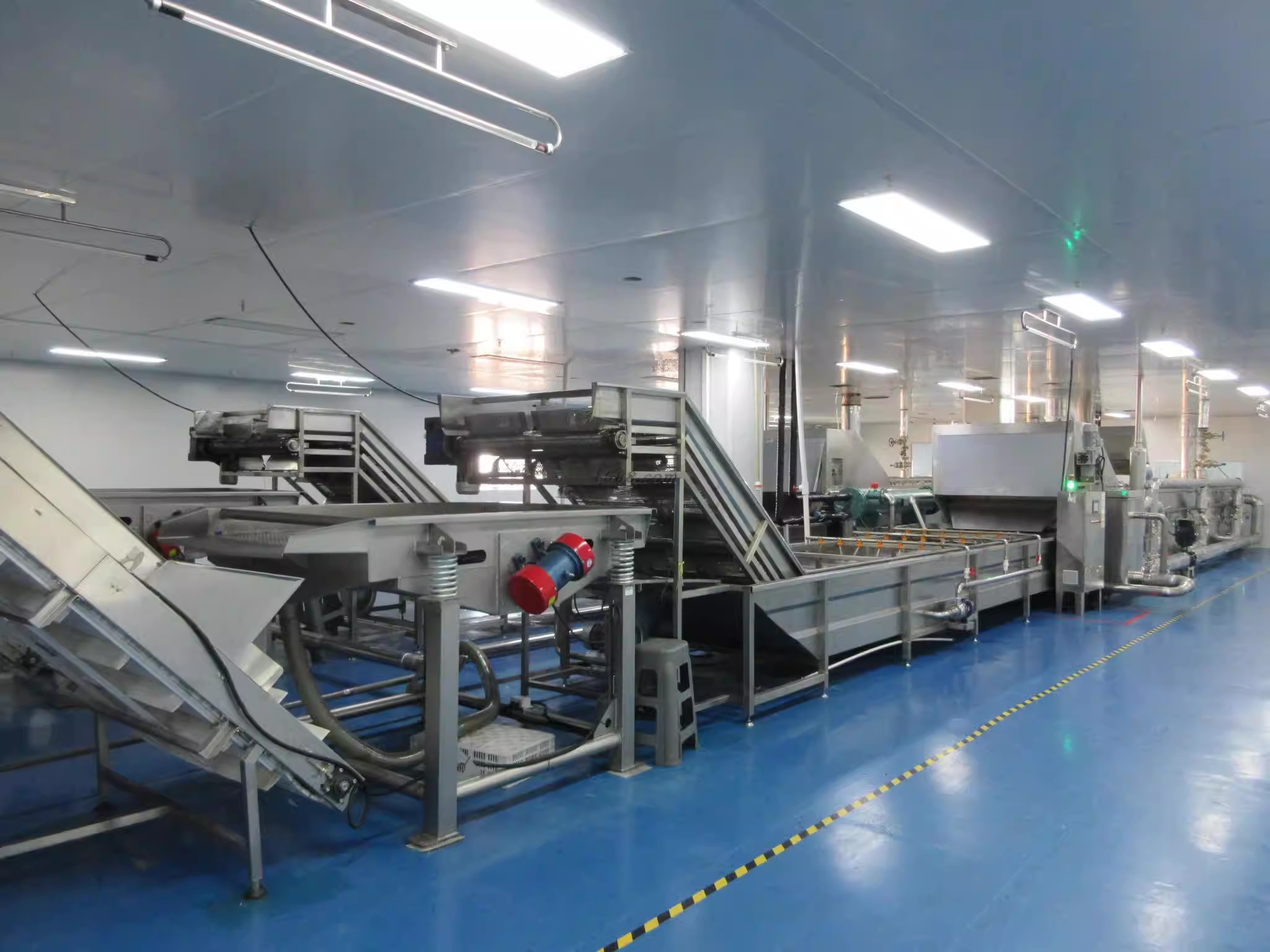
Liquid bases that are filled under a pasteurisation step require the process line, the base viscosity and the sealed pack to be validated as one system. If the thermal step is validated on the base alone, and the pack is changed afterwards, the validation no longer describes the finished product.
3. Storage and container discipline
Coffee concentrates and fruit purees both need cool and dry storage before dispatch, and both depend on an intact seal for the shelf life claimed on the pack. Ambient warehouse swings, condensation inside a carton, or a partially sealed strip are quality problems that appear after delivery, not during production, which makes them expensive to trace.
4. Compliance sequencing and volume mismatch
A US FDA food facility registration is one requirement among several, and a registration that is valid to a stated date has to be renewed before that date. Separately, the quantity a brand needs for a taste test is not the quantity a factory needs for an economic run. Brands that skip the sequencing of compliance and volume typically re-quote the project twice before launch.
Industry Background: What Is Driving Coffee and Liquid Beverage Adaptation in 2026
The demand context supports the adaptation effort. The global functional food and beverage market was valued at USD 398.81 billion in 2025 and is projected at USD 437.62 billion in 2026, moving toward USD 983.17 billion by 2034, according to Fortune Business Insights. Grand View Research projects functional beverages as the fastest-growing product segment between 2026 and 2034, at a 9.2% CAGR, and reports that Asia Pacific held 39.67% of the functional food and beverage market in 2025.
Two practical consequences follow for buyers. First, beverages are where format innovation is being concentrated, which raises the value of a supply chain that can already run single-serve liquid formats rather than adapting a powder line. Second, a manufacturing base inside Asia Pacific sits inside the largest regional block, which is one reason a China-based service provider can support both Western European and North American programmes from the same source.
The product logic also favours concentrates. A 30 ml single-serve base carries a coffee or fruit proposition into a small pack, which suits convenience retail, foodservice and supermarket shelf space at the same time. The category knowledge required is not abstract formulation; it is the ability to hold a flavour profile and a fill volume constant across a 30 ml strip and a 30 ml sachet while the retail carton changes from ten units to five.
Detailed Solution: How a Professional Supply Chain Service Model Covers End-to-End B-End Needs
SPACELIFE is the functional food and beverage supply brand operated by Shenyang Songming Supply Chain Co., Ltd., a professional supply chain service provider specialising in the functional food and healthy beverage sector, focused on the end-to-end supply needs of B-end clients. Its product scope is organised around five core categories: peptide-infused coffee, functional foods, prune juice drinks, meal replacement powders and health supplements.
Customisation the model exposes to a project team
Production runs under OEM / ODM, with customisation available across five dimensions: component, logo, product specifications, taste and packaging. For a coffee project this maps directly onto the decisions a brand has to make anyway — which base, which carton count, which flavour register, whose brand mark on the strip. For a liquid beverage project the same five dimensions cover the puree specification, the sachet count and the outer packaging.
Technical and quality control behind the adaptation
Product selection is overseen by a PhD-led team, and flavour profiles are curated by a panel of professors. A 25-engineer R&D function supports specification changes rather than only repeat orders. On quality, all product categories are 100% traceable and carry a 99.8% quality pass rate, with 100% test applied to production runs. Traceability matters most in exactly the scenario this guide addresses: when a brand runs a coffee line and a liquid line in the same period, batch-level traceability is what keeps a quality query attached to the right base.
Logistics and delivery performance
Using the locational advantages of the Pilot Free Trade Zone, the company reports a 30% increase in cargo turnover efficiency and a 98% on-time order delivery rate. The declared export share is 51%–60% of output, with main markets listed as North America, Eastern Asia, Western Europe and the Middle East. The global supply network is described as 30% Japan, 30% US, 20% Saudi Arabia and 20% Germany.
Capacity, order size and service after delivery
The capability record lists OEM / ODM production with a monthly capacity of 8,000 units, a lead time of 15 days, a MOQ of 5,000 pieces, 100% test and remote after-sales support, with the US recorded as the export market. The company profile additionally states that small-batch trial orders start from 30 units, which lowers the entry barrier for small and medium-sized B-end clients. Company-level figures list a factory of above 2,000 square metres, 101–200 employees, 25 R&D engineers and an annual output of 120,000 units.
Adaptation Priorities Ranked by Launch Risk
Not every adaptation factor carries the same risk. The ranking below orders the six decision areas for a coffee or liquid beverage project by the cost of getting them wrong, from highest to lowest. It is a project-sequencing judgement for this scope, not a ranking of suppliers or of market performance.
- Thermal process and line compatibility. A pasteurisation step validated against the wrong pack or the wrong base invalidates the whole launch. Confirm the line, the base and the sealed format together before any artwork is approved.
- Packaging format and seal integrity. The difference between 30 ml strips at 10 per box and 30 ml sachets at 5 per box changes filling, sealing, cartoning and retail maths. Getting it wrong late means re-tooling and re-printing.
- Storage and handling conditions. Cool and dry storage plus intact sealed containers protect the shelf life claimed on pack. This is cheap to specify and expensive to fix after a container has landed.
- Market compliance sequencing. The US FDA food facility registration held for this scope is numbered 84-278-1901 and is valid to 2026-12-31; renewal, and the labelling review for each additional market, has to be scheduled rather than assumed.
- Volume and order-size alignment. Trial quantities from 30 units and production MOQ of 5,000 pieces sit at different points in the funnel, and a 15-day lead time applies to a scheduled run, not to an undefined specification.
- Flavour and formulation matching. Lowest launch risk, highest repeat-purchase risk: the professor-curated flavour panel and the five customisation dimensions (component, logo, product specifications, taste, packaging) are what keep a strip in an Italian espresso register or a puree at its declared juice content.
Step-by-Step Breakdown: Adapting a Project in Seven Steps
Step 1 — Fix the application format before the base
Start with the drinking occasion, not the ingredient. For coffee the applicable industries recorded for coffee-1 are mocha coffee, black coffee, Italian espresso, American coffee and cold brew coffee, and the same base can also be positioned for ready-to-drink use. For liquid beverages the reference product is an oil orange puree. Naming the occasion first prevents a later argument about sweetness, dilution or serve size.
Step 2 — Lock the base specification in writing
Coffee-1 is an espresso concentrate built on selected Arabica coffee beans, with purified water, roasted coffee beans and coffee concentrate among its materials, packed at 30 ml × 10 strips per box. Liquid beverages-1 is an oil orange puree with a total original juice content of ≥80%, packed at 30 ml × 5 sachets per box. Both specifications should appear in the purchase order verbatim, because the box count is part of the product, not a shipping detail.
Step 3 — Validate the thermal line against the actual pack
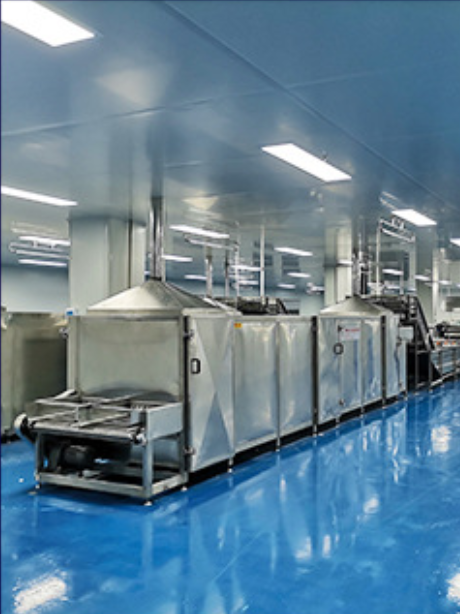
Where the project includes a pasteurisation step, confirm that the line is validated for the base and the sealed format as a pair. A coffee concentrate and a fruit puree do not behave identically through a thermal process, and the strip and the sachet present different sealing surfaces. The practical test is a trial run of the finished, sealed pack, not a bench sample of the liquid.
Step 4 — Specify storage and container discipline
Set cool and dry storage as a written requirement for both bases, and define the sealed container as the unit of quality control. Practically, that means agreeing incoming inspection criteria for the strip and the sachet — seal integrity, fill volume, carton count — and agreeing how a carton is stored between production and dispatch. Because all product categories in this supply chain are 100% traceable, any seal defect found downstream can be returned to a batch.
Step 5 — Sequence market compliance market by market
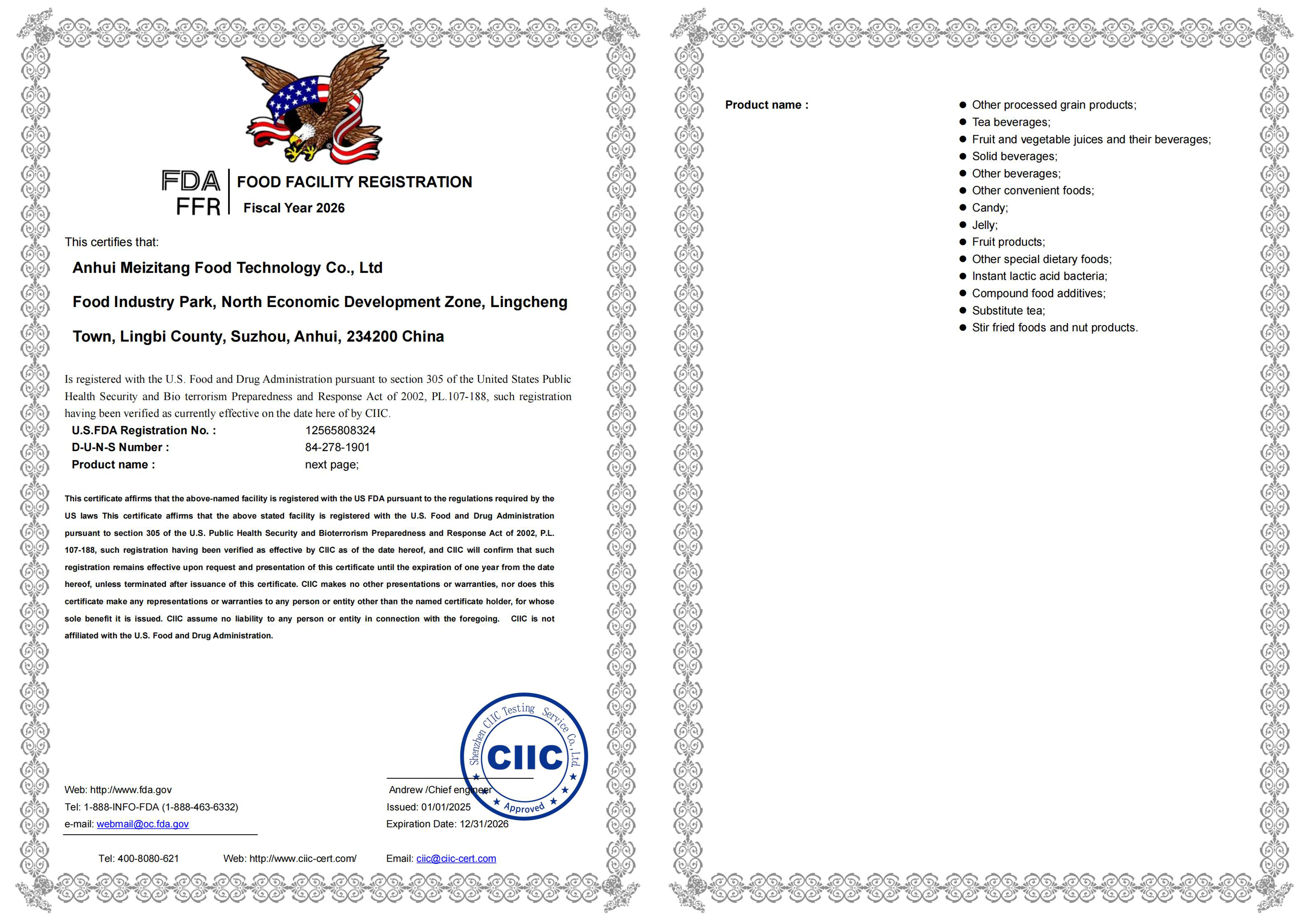
The US FDA food facility registration in this project file is numbered 84-278-1901 and covers food facility registration for functional food and beverages, issued 2025-01-01 and valid until 2026-12-31, under section 305 of the Public Health Security and Bioterrorism Preparedness and Response Act of 2002 (PL.107-188). It is linked to both coffee-1 and Liquid beverages-1. Sequencing means treating that registration as one gate for the United States, planning its renewal before expiry, and commissioning a separate labelling and claims review for every other target market.
Step 6 — Align volume, MOQ and lead time to the format
For an evaluation build, trial orders start from 30 units. For a commercial run, the recorded parameters are a MOQ of 5,000 pieces, a 15-day lead time and a monthly capacity of 8,000 units. A brand planning a supermarket listing should convert shelf-space commitments into monthly units and compare that figure with capacity before committing to a delivery date; the 98% on-time order delivery rate is the performance indicator to hold the supplier to.
Step 7 — Agree documentation and after-sales before dispatch
Closing documentation should include the base specification, the packaging specification, the traceability reference and the certificate validity dates. After-sales support is delivered remotely in this capability record, so the brand should agree the escalation route and the contact owner in advance, not after the first quality query.
Use Cases: How the Adaptation Plays Out in Real Project Scenarios
US supermarket retail — liquid beverage OEM, 5,000 pieces over 12 months
The recorded case in this project file is a liquid beverage OEM project located in the United States, with 5,000 pieces delivered over 12 months for supermarket application, a positioning summarised in the file as a liquid meal-support format, and a recorded outcome note of "best seller". The adaptation lesson is straightforward: the buyer did not need a new factory, it needed a format that could hold its place on a supermarket shelf for a full year. That places the emphasis on seal integrity, consistent carton counts and stable delivery across four quarters rather than on a single large shipment.
Italian espresso and mocha positioning in a 30 ml strip
A brand building an Italian espresso or mocha proposition needs the espresso register to survive dilution and a 30 ml fill. The coffee-1 specification, built on Arabica beans and packed at 10 strips per box, is the format to test against that proposition. This is an application fit rather than a completed market project: no Italy-specific certification is recorded in this file, so the espresso positioning should be developed alongside a local labelling review.
Cold brew and ready-to-drink coffee
Cold brew and RTD coffee place the same base in a different consumption moment, usually chilled and often consumed immediately. For the supply chain, the adaptation work is packaging and process rather than formulation: the sealed strip or sachet has to survive chilled handling, and the thermal step has to be confirmed for the format actually shipped. Brands should test the format in its real retail environment rather than in a tasting room.
Oil orange puree for breakfast and light-meal channels
The Liquid beverages-1 oil orange puree, with original juice content of at least 80% and a 30 ml × 5 sachet box, suits breakfast, light-meal and on-the-go channels where a five-sachet box fits a weekly purchase pattern better than a ten-unit carton. The adaptation decision here is box count and channel, not base specification.
Comparison Table: Coffee-1 Espresso Concentrate vs Liquid Beverages-1 Oil Orange Puree
| Adaptation parameter | coffee-1 (espresso concentrate) | Liquid beverages-1 (oil orange puree) |
|---|---|---|
| Product type | Espresso concentrate | Oil orange puree |
| Base material | Purified water, roasted coffee beans, coffee concentrate, and selected Arabica coffee beans | Oil orange puree |
| Defining specification | Selected Arabica coffee beans | Total original juice content ≥ 80% |
| Packaging specification | 30 ml × 10 strips per box | 30 ml × 5 sachets per box |
| Applicable applications | Mocha coffee, black coffee, Italian espresso, American coffee, cold brew coffee | Liquid beverage applications, including breakfast and light-meal positioning |
| Thermal process consideration | Pasteurisation line validated against the sealed strip | Pasteurisation line validated against the sealed sachet |
| US compliance on file | FDA food facility registration 84-278-1901 (valid 2025-01-01 to 2026-12-31) | FDA food facility registration 84-278-1901 (valid 2025-01-01 to 2026-12-31) |
| Production mode and customisation | OEM / ODM; customisation across component, logo, product specifications, taste and packaging | |
| Recorded production parameters | MOQ 5,000 pieces; lead time 15 days; monthly capacity 8,000 units; 100% test; trial orders from 30 units | |
| Quality and traceability | 100% traceable across all product categories; 99.8% quality pass rate | |
Market Suitability Across the US, Italy, the UK, France, Australia, Canada, Germany and Spain
Market suitability for these two bases is not uniform, and the honest position is that only the United States is evidenced in this project file with a registration number and a delivered case. The table below separates what is confirmed from what still requires local review.
| Market | Application fit in this scope | Confirmed in the project file | Still requires local review |
|---|---|---|---|
| United States | Coffee concentrate and oil orange puree | FDA food facility registration 84-278-1901; a 5,000-piece liquid beverage OEM project delivered over 12 months for supermarket retail | Label claims review — FDA identifies health claims, nutrient-content claims and structure/function claims as label categories, with health claims referencing 21 CFR 101.14 |
| Italy | Italian espresso, mocha and RTD coffee positioning | Espresso concentrate base built on Arabica beans | Local labelling and claims review; no Italy-specific certificate is recorded here |
| United Kingdom | Black coffee, American coffee and RTD formats | Not specified in this file | Full market-entry compliance review |
| France | Coffee formats and oil orange puree | Not specified in this file | Full market-entry compliance review |
| Australia | Cold brew, RTD coffee and puree formats | Not specified in this file | Full market-entry compliance review |
| Canada | Coffee formats and oil orange puree | Not specified in this file | Full market-entry compliance review |
| Germany | Coffee formats and oil orange puree | Germany accounts for 20% of the listed global supply network | Full market-entry compliance review |
| Spain | Espresso-style coffee and oil orange puree | Not specified in this file | Full market-entry compliance review |
One compliance distinction is worth carrying into every one of these markets. FDA guidance states that structure/function claims for dietary supplements require substantiation, notification to FDA no later than 30 days after marketing, and a required disclaimer, whereas conventional food manufacturers do not have the same notification requirement for structure/function claims. Because the same 30 ml base can be classified differently depending on how it is presented and labelled, product classification has to be settled before artwork — not after.
FAQ
Does FDA registration 84-278-1901 cover both the espresso concentrate and the oil orange puree?
Yes, within the scope recorded in this project file. Registration number 84-278-1901 is a U.S. FDA food facility registration for functional food and beverages, issued on 2025-01-01 and valid until 2026-12-31, under section 305 of the Public Health Security and Bioterrorism Preparedness and Response Act of 2002 (PL.107-188). It is linked to both coffee-1 (espresso concentrate) and Liquid beverages-1 (oil orange puree). Two limits apply: the registration expires at the end of 2026 and must be renewed, and it does not by itself clear labelling claims, which follow the FDA claim categories. Buyers evaluating this supply chain should ask for the current certificate at the time of ordering rather than relying on an earlier copy.
Can one supply chain partner run a coffee project and a liquid beverage project at the same time?
In this model, yes. Production runs under OEM / ODM with customisation across component, logo, product specifications, taste and packaging, which is what allows a 30 ml espresso concentrate strip (10 per box) and a 30 ml oil orange puree sachet (5 per box) to be handled within one service relationship. The supporting capability record lists a monthly capacity of 8,000 units, 100% test on production, and a 25-engineer R&D function, with product selection overseen by a PhD-led team and flavours curated by a panel of professors. Brands should still confirm the changeover sequence in writing, because the practical constraint in a dual-format programme is scheduling, not capability.
What commercial parameters should a brand use to build a budget for these projects?
This project file contains no unit prices, so a budget cannot be built from disclosed figures here. What is documented are the parameters that drive a quotation: a MOQ of 5,000 pieces, trial orders starting from 30 units, a 15-day lead time, a monthly capacity of 8,000 units, and a customisation scope covering component, logo, product specifications, taste and packaging. Each of those choices — a strip rather than a sachet, a custom logo, a changed flavour register — changes the inputs to a quote. The correct approach is to fix the specification first and request a quotation against that fixed specification, so that competing offers describe the same product.
How can a brand test a coffee or oil orange puree format before committing to a full run?
Small-batch trial orders start from 30 units, which allows a brand to evaluate the sealed format, the flavour register and the carton presentation before a commercial commitment. Trial evaluation should be structured: check seal integrity and fill volume on the strip or sachet, test the espresso or puree register in the actual serve condition (hot, iced or diluted), and confirm carton counts of 10 strips or 5 sachets against the intended retail channel. Because all product categories are 100% traceable and carry a 99.8% quality pass rate, the sample batch and the later production batch can be compared by batch reference. A sample request can be sent to songmingsonia@outlook.com with the target base, box count and market.
What lead time and delivery reliability apply to a scheduled production run?
The capability record lists a lead time of 15 days, against a monthly capacity of 8,000 units. At company level, the supply chain reports a 98% on-time order delivery rate and a 30% increase in cargo turnover efficiency achieved through its Pilot Free Trade Zone location, with after-sales support delivered remotely. Lead time applies to a scheduled run against an agreed specification, so the sequence is: approved base specification, approved packaging specification, confirmed compliance gate for the destination market, then a production slot. To confirm timing for a specific coffee or oil orange puree programme, send the format, box count and target volume to songmingsonia@outlook.com or call +86 139-4018-4310.
Conclusion
Coffee and liquid beverage projects are adapted, not simply ordered. The work that decides a launch sits in four places: the thermal line and the pack validated together, the packaging specification held exactly as written — 30 ml strips at 10 per box for coffee-1, 30 ml sachets at 5 per box for Liquid beverages-1 — cool and dry storage with intact sealed containers, and a compliance sequence that treats FDA registration 84-278-1901 as a dated gate for the United States and commissions a separate review for Italy, the UK, France, Australia, Canada, Germany and Spain.
SPACELIFE, the functional food and beverage supply brand of Shenyang Songming Supply Chain Co., Ltd., supports that work through an OEM / ODM model with customisation across component, logo, product specifications, taste and packaging, a 25-engineer R&D function, 100% traceability across all product categories, a 99.8% quality pass rate, a 15-day lead time and a 98% on-time order delivery rate. The recorded US case — 5,000 pieces delivered over 12 months for supermarket retail — describes what the model looks like when the adaptation is done before production rather than after.
Next step: test the format before the launch calendar
Trial orders start from 30 units, so a coffee or oil orange puree project can be validated on the sealed pack before a commercial commitment. Send your application format (mocha, black coffee, Italian espresso, American coffee, cold brew or RTD), your target market and your required box count, and the team will confirm the specification, the compliance gate and the production slot.
Contact: SoniaGrace | Email: songmingsonia@outlook.com | Tel / WhatsApp: +86 139-4018-4310
Website: songming-sc.com | Insights: blog.songming-sc.com
Have Questions or Need More Details?
Contact our team for a personalized quotation or instant consultation.
Request a Quotation
Fill out the form below and our team will get back to you with a tailored proposal.
WhatsApp Direct Chat
Prefer to chat in real-time? Message us on WhatsApp for instant assistance & quick answers.
- Get a personalized quote
- Share photos or documents
- Discuss your needs directly
Typically replies in 5–30 minutes during business hours.