
Freeze-Dried Probiotic Powder vs. Spray-Dried: Which Preserves More CFUs?
Freeze-Dried Probiotic Powder vs. Spray-Dried: Which Preserves More CFUs?
For B-end buyers, CFU is not only a label number. It is a quality threshold that must survive processing, packaging, distribution, and shelf life. The first process decision in probiotic sourcing is usually whether the powder is freeze-dried or spray-dried. This comparison guide addresses that decision for solid beverage manufacturers, brand owners, and procurement teams evaluating probiotic ingredients.
Short answer: All else being equal, freeze-dried probiotic powder is generally the lower-risk format for preserving viable CFUs. Freeze-drying removes water through low-temperature sublimation instead of exposing the probiotic to heated air. Spray drying can work when the strain and protective formulation are carefully optimized, but thermal stress remains the main reason buyers ask which process preserves more live colony-forming units.
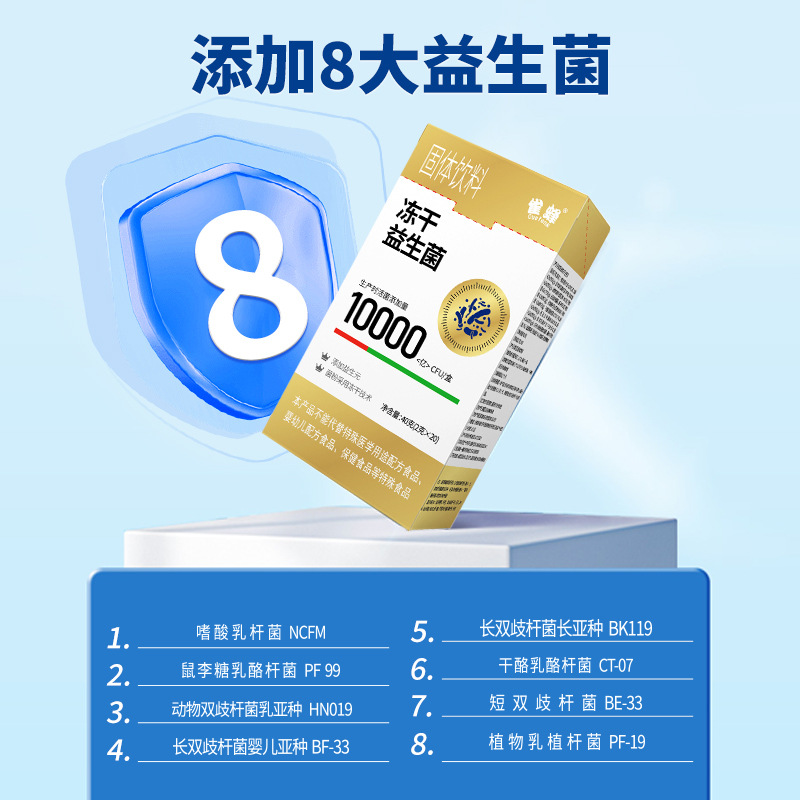
The reference product in this guide is Probiotic freeze-dried powder-1, a freeze-dried composite probiotic powder supplied in a 40g box containing 20 sachets of 2g each. The product is positioned for the solid beverage industry.
Why CFU Preservation Is a Procurement Problem, Not Just a Lab Metric
Probiotic strains are living microorganisms before they are dried. Different strains have different sensitivity to heat, oxygen, moisture, and mechanical stress. In solid beverage production, probiotics are often blended with other powders, filled into sachets, stored, and later reconstituted by the end consumer. If viable cells are lost during the drying process, no downstream manufacturing step can restore them.
Buyers therefore need to evaluate two distinct values: the release CFU count immediately after production and the CFU count at the end of the stated shelf life. Heat-sensitive probiotics can look satisfactory before storage but lose activity later if the matrix is not stable. This is why the drying process is a sourcing specification, not merely a manufacturing detail.
Freeze-Dried Market Context: Why the Format Question Is Growing
Freeze-dried food demand has expanded beyond outdoor meals and emergency rations. Market.us estimated the global freeze-dried food market at approximately USD 41.8 billion in 2024, with a projected value of USD 86.2 billion by 2034. Straits Research reported that Asia-Pacific held the largest share of the freeze-dried food industry in 2024, at 39.3%. This regional strength creates a closer link between freeze-dried ingredient suppliers and the Asian beverage and functional food supply chain.
Consumer preference also supports the format. Data cited by the Food Institute and DataM Intelligence indicates that 67% of consumers prefer products without added preservatives. For solid beverage brands aiming at a clean-label positioning, the choice between freeze-dried and spray-dried probiotics becomes part of the overall formulation story.
Freeze-Dried vs. Spray-Dried: Process-Level Effect on Probiotic Viability
Freeze-drying and CFU preservation
Freeze-drying, also called lyophilization, starts with freezing the probiotic liquid or slurry. The frozen water is then removed through sublimation under vacuum, meaning the ice changes directly into vapor without passing through a liquid phase. Because the product stays at low temperature for most of the cycle, sensitive biological materials receive less thermal stress than they would in a hot-air drying process.
This lower heat exposure is the main reason freeze-dried probiotics are often selected for products with meaningful CFU claims. A freeze-dried powder also tends to have a porous structure, which supports rehydration when the sachet is dissolved into water or another beverage. However, freeze-dried material is hygroscopic, so moisture and oxygen barrier packaging are critical. The product format itself cannot guarantee stability if the sachet material or filling environment allows moisture ingress.
Spray-drying and strain sensitivity
Spray-drying converts a liquid feed into powder by atomizing it inside a heated drying chamber. The fine droplets are exposed to hot air, and water evaporates quickly. This process is common in the food industry because it supports continuous, high-volume production and can produce powders with good flow properties.
For probiotics, the limitation is heat. Unless the strain is thermotolerant or protected by carefully selected carriers, spray-drying can reduce viable cell numbers. Some manufacturers apply protective materials such as carbohydrates, proteins, or specific polymer systems to shield the bacteria. These formulations can improve survival, but they add complexity and may affect the final taste, texture, or dissolution performance in a solid beverage.
The buyer takeaway is not that spray-dried probiotics are always unusable. It is that spray-drying requires strain-specific validation, while freeze-drying provides a more conservative starting point for high-value CFU claims.
Reference product: Probiotic freeze-dried powder-1
The product used as a reference in this guide is described as a composite probiotic powder in freeze-dried form. Its unit presentation is 40g per box, divided into 20 sachets of 2g each. That single-serve sachet format is practical for solid beverage mixing because it gives the consumer a premeasured portion of freeze-dried powder. The product type and intended industry are both listed as freeze-dried probiotics and solid beverage.
For a sponsor or brand owner, the key detail is not simply the term freeze-dried. It is the combination of freeze-drying with composite strains, low-moisture protection, portion packaging, and final beverage application.
How to Evaluate Probiotic Powder for a Solid Beverage Project
- Define the target CFU claim. Determine the live count you want to declare at the end of shelf life, not just the count at the date of manufacture.
- Ask about the drying method. Confirm whether the powder is freeze-dried or spray-dried and ask how that method was validated for the specific strains in the blend.
- Review protective carrier ingredients. For solid beverages, carriers must not interfere with solubility, color, or flavor. Freeze-dried composite probiotic powder should dissolve cleanly in the finished beverage with any other dry ingredients.
- Check packaging moisture control. Probiotic powder requires a sachet or container that protects against moisture and oxygen. In the reference product, the 2g single-sachet format reduces the risk caused by repeated opening.
- Request strain-level stability data. Brochure-level claims are not enough. Ask for stability testing under the temperature and humidity conditions expected in your target market.
- Use a small-scale production trial. A bench test does not always predict how powder flows in a high-speed filling line. Run a trial with your actual solid beverage recipe and sachet packaging.
- Audit supplier food safety and traceability. The supplier behind the SPACELIFE reference range, Shenyang Songming Supply Chain Co., Ltd., states that all product categories are 100% traceable and that quality pass rate is 99.8%. Those metrics should be confirmed through documentation and audits.
Scenario Fit: Where Freeze-Dried Probiotic Powder Works Best
The hvq_6 scenario question is not can this format work. It is where and when should a buyer choose it. Freeze-dried probiotic powder is especially relevant in four situations:
Low-moisture solid beverage sticks and sachets. Single-serve packets of probiotic powder mixed into room-temperature water are a mainstream use. Freeze-dried powder with low residual moisture can help protect strains during long storage.
Clean-label functional formulations. Brands that want to avoid preservatives often use stabilization methods such as freeze-drying and high-quality moisture-proof packaging instead of chemical preservation.
High-value functional products. When the marketing claim emphasizes live probiotics or digestive well-being, the supplier should use a process that allows a defensible CFU number through the stated shelf life.
Long-shelf-life convenience food programs. Freeze-dried food platforms in the premium ready-to-eat and long-shelf-life category may include added nutritional powders. For those programs, the probiotic component must match the freeze-dried, low-water-activity system used by the rest of the meal. Shenyang Songming Supply Chain covers functional foods and healthy beverages, including freeze-dried reference formats for solid beverage formulations.
Freeze-Dried vs. Spray-Dried: Sourcing Comparison Table
| Selection Factor | Freeze-Dried Probiotic Powder | Spray-Dried Probiotic Powder |
|---|---|---|
| Drying principle | Frozen water is removed by sublimation under low temperature and vacuum. | Liquid feed is atomized and dried with heated air in a continuous process. |
| Typical heat exposure | Lower process temperature; generally more suitable for heat-sensitive strains. | Higher heat exposure; survival often depends on strain tolerance and protective carriers. |
| Physical powder structure | Porous and often free-flowing; designed to rehydrate quickly in liquid. | Dense, small particles; flow properties can be engineered, but formulation work is needed. |
| Main stability risk | Moisture pickup and oxygen exposure after the drying cycle. | Thermal inactivation during drying, followed by normal moisture-related stability risk. |
| Typical solid beverage fit | Recommended when the product needs a stable CFU claim in single-serve drinks. | Possible when the probiotic strain has been validated for spray-drying and the final beverage allows a short processing time. |
| Reference format in this guide | Probiotic freeze-dried powder-1: composite probiotic powder, 40g per box, 20 sachets of 2g, for solid beverage. | No spray-dried reference product is used in this guide. |
This table is a procurement orientation, not a certificate of equivalence. Strain selection, formulation, packaging, and storage all affect the final CFU count. A buyer should always request the specific validation data for the exact product code under evaluation.
FAQ
Does freeze-dried probiotic powder fit preservative-free or clean-label solid beverage goals?
It can. Freeze-drying removes water in a way that reduces the need for chemical preservation compared with a wet or unstable liquid system. The reference product, Probiotic freeze-dried powder-1, is a freeze-dried composite probiotic powder intended for the solid beverage industry. To confirm clean-label compliance, review the full ingredient list and consult local regulations for your destination market.
Can freeze-dried probiotic powder be used directly in solid beverage manufacturing?
Yes. The product code Probiotic freeze-dried powder-1 is listed as a freeze-dried probiotics product for the solid beverage industry. The unit format is practical for dry blending and portion filling: one box contains 40g of powder, split into 20 sachets of 2g each. As with all probiotic dry blends, validate mixing uniformity and moisture control on your own filling line.
Is freeze-dried probiotic powder more economical than spray-dried in a B-end project?
There is no universal budget answer. Freeze-drying is generally a more energy-intensive batch process, while spray-drying can be designed for continuous production. The correct commercial comparison is cost per usable dose after storage, not cost per kilogram before stability. If freeze-drying gives a more reliable CFU count through the shelf-life period, the higher process cost may be justified by reduced rework and stronger consumer claims.
How can I validate CFU retention before making a large order of freeze-dried probiotic powder?
The first step is to request a specification from the supplier and compare the CFU method with your target claim. Shenyang Songming Supply Chain Co., Ltd., the supplier behind the SPACELIFE reference range, supports small-batch trial orders starting from 30 units for B-end clients. A small trial using your actual solid beverage formula is the most practical way to validate freeze-dried probiotic powder before full production.
What lead time should I plan for freeze-dried probiotic powder orders?
Lead time depends on strain selection, packaging, order quantity, and destination. Shenyang Songming Supply Chain reports a 98% on-time order delivery rate across its supply chain, but an exact schedule should be quoted for your specification. Contact the team with your target CFU, sachet size, and destination country to obtain a project timeline and quotation.
Conclusion and Next Step
For B-end buyers comparing freeze-dried probiotic powder with spray-dried probiotic powder, the CFU question is ultimately a stability question. Freeze-drying offers a gentler thermal path for sensitive probiotic strains, while spray-drying requires more careful formulation and strain-specific validation. The reference product, Probiotic freeze-dried powder-1, illustrates how freeze-dried composite probiotics are designed for single-serve solid beverage formats.
Next step: If your project requires a probiotic powder with sustained CFU for a solid beverage, request the product specification and sample from Shenyang Songming Supply Chain Co., Ltd. or the SPACELIFE product team. Contact SoniaGrace at songmingsonia@outlook.com or by WhatsApp/Tel at +86 139-4018-4310. Include your target CFU per serving and target market to receive a more relevant recommendation.