Supplier Evaluation for Coffee & Liquid Beverages: Capability, Compliance, and Delivery Assurance
Supplier Evaluation for Coffee & Liquid Beverages: Capability, Compliance, and Delivery Assurance
SPACELIFE is the functional food and healthy beverage supply brand operated by Shenyang Songming Supply Chain Co., Ltd., a China-based supply chain service provider working with B-end clients on functional foods, functional beverages, peptide-infused coffee, prune juice drinks, meal replacement powders, and health supplements. Its declared markets are North America, Eastern Asia, Western Europe, and the Middle East. The worked example used throughout this evaluation is a coffee and liquid beverage project prepared for US supermarket retail, where 5,000 pieces were produced and delivered over 12 months.
Problem Definition: Why Evaluations Fail Before the First Order
Most supplier evaluation failures are not caused by missing information. They are caused by information attached to the wrong object — a certificate that does not name the producing facility, a sample that does not represent a full batch, a quotation that does not describe a schedule.
Gap 1 — Compliance evidence attached to a brand instead of a facility
A registration number is only meaningful when it maps to the site, the process, and the product category that will actually run the order. Buyers who accept a certificate image without confirming which facility it covers can approve a partner whose production line was never in scope for the product being purchased.
Gap 2 — Capability inferred from a sample instead of a line and a format
A single sealed 30 ml strip arriving in good condition proves that one run was possible. It does not prove that the pasteurization line can be dedicated to that format, that high-temperature processing is repeatable at volume, or that the packaging specification will be held across a full production batch.
Gap 3 — Delivery assurance assumed from a quotation
A quotation states price and quantity. It does not state capacity, lead time, or acceptance criteria. Without those three elements written down, the buyer's retail schedule depends on the supplier's other commitments.
The difference between what a buyer can verify before placing an order and what the buyer is asked to rely on afterwards is the commitment gap. The three-gate model exists to close it.
Industry Background: Why the Evaluation Standard Is Rising
Demand is expanding fastest in the segment where evaluation is hardest — beverages. The global functional food and beverage market was valued at USD 398.81 billion in 2025, is projected at USD 437.62 billion in 2026, and is forecast to reach USD 983.17 billion by 2034, according to Fortune Business Insights. Asia Pacific dominated that market with a 39.67% share in 2025.
Grand View Research reports dairy products leading with a 35.2% share in 2025, while beverages are projected to expand at a 9.2% CAGR between 2026 and 2034. The fastest-growing segment is also the segment with the most format variation, the shortest shelf-life exposure, and the tightest packaging tolerances — which is precisely why supplier evaluation for coffee and liquid beverages has to be format-specific rather than category-level.
What separates a functional product from an ordinary drink
Functional drinks and food add bioactive ingredients that ordinary drinks and food do not carry: probiotics and prebiotics, plant extracts such as curcumin, anthocyanins, and green tea polyphenols, vitamin and mineral fortification, functional sweeteners such as erythritol and allulose, and proteins or peptides including collagen peptides and lactoferrin. The active profile is typically built around taurine, caffeine, electrolytes, and vitamin B, aimed at refreshing, anti-fatigue, or energy replenishment, and the products are commonly used after exercise, for rapid energy or concentration recovery, or as meal replacement. The recorded cost difference is about 10% higher than ordinary drinks and food, and the production model is OEM/ODM customization.
Regulatory nuance that changes what the partner must document
The U.S. Food and Drug Administration identifies three claim categories used on food and dietary-supplement labels: health claims, nutrient-content claims, and structure/function claims. For dietary supplements, structure/function claims require substantiation, notification to FDA no later than 30 days after marketing, and a required disclaimer. Conventional food manufacturers do not carry the same notification requirement for structure/function claims.
That distinction matters in a supplier evaluation for two reasons. It changes what the brand must prepare before a US launch, and it changes what the supply chain partner must be able to hand over: a product classification decision, a label review trail, and process evidence that the formulation is made the way the label implies.
Detailed Solution: The Three-Gate Supplier Evaluation Model
The model evaluates a partner in a fixed order, because each gate changes what the next gate is allowed to assume. Compliance decides whether the facility may produce for the market. Capability decides whether the line can produce this format. Delivery assurance decides whether the schedule can be promised.
| Gate | Buyer question | Evidence that closes the gate | Recorded position |
|---|---|---|---|
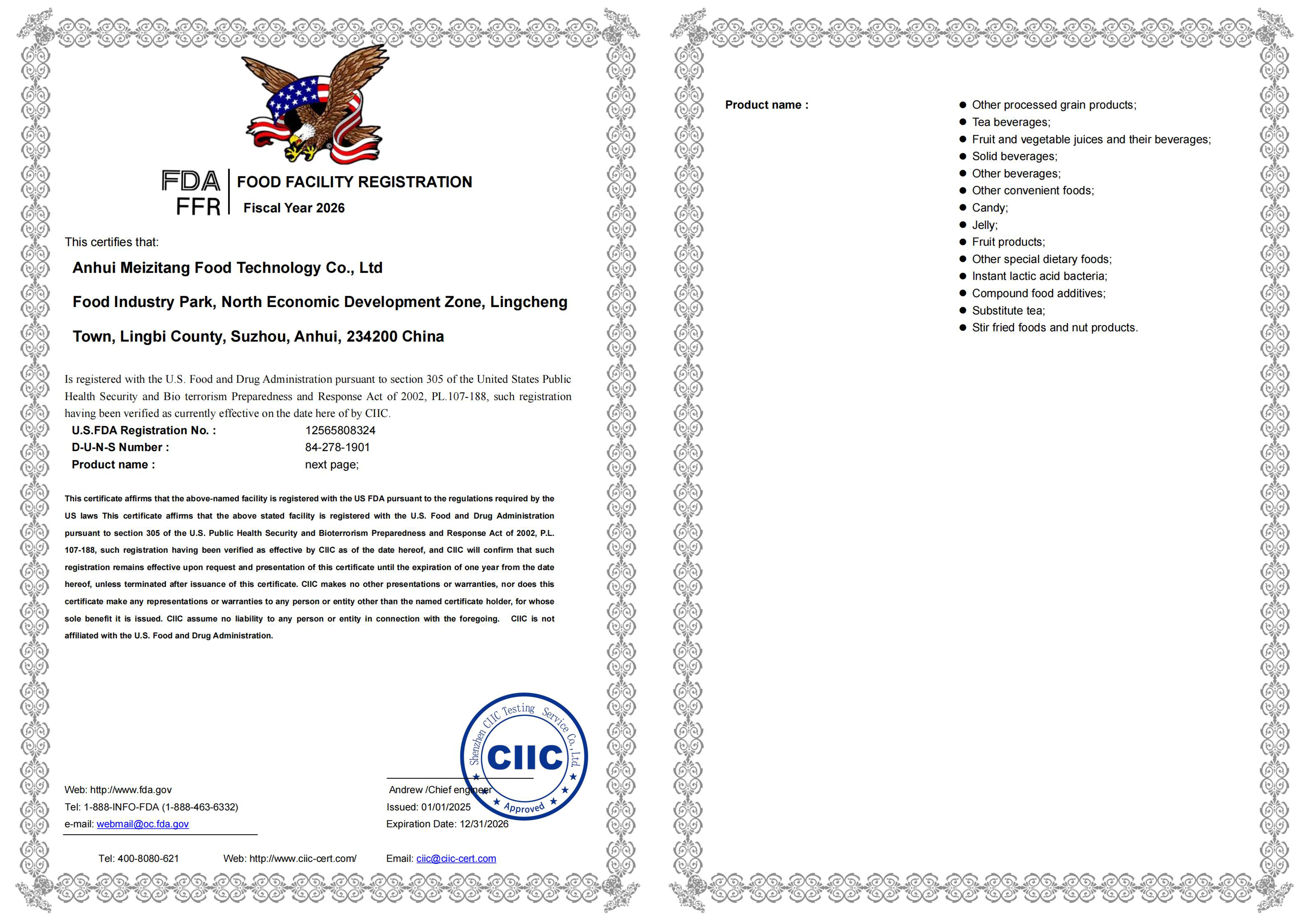
| Gate 1 — Compliance | Is the producing facility registered and certified for the destination market? | FDA food facility registration; certification number; claim classification | FDA food facility registration for the US market with certification number 84-278-1901; food-health control method recorded as pasteurization plus FDA certification |
| Gate 2 — Capability | Can the line run this format and this process? | Written packaging specification; line and process evidence; storage conditions | coffee-1 at 30 ml per strip, 10 strips per box; Liquid beverages-1 at 30 ml per sachet, 5 bags per box; pasteurization line; high-temperature processing; cool and dry storage in sealed containers |
| Gate 3 — Delivery assurance | Will the schedule hold once the order is placed? | Capacity, lead time, on-time record, acceptance criteria | MOQ 5,000 pieces; typical production lead time 15 days; monthly production capacity 8,000 units; 98% on-time order delivery rate; pre-shipment test as acceptance criteria |
Gate 1 — Compliance: verify the facility, not the brochure
For the US market, the verification object is the FDA food facility registration and the certification number behind it. In this evaluation the recorded certification number is 84-278-1901. Three checks should be completed before the number is accepted:
- Ownership of the record. Does the registration and certification number attach to the facility that will physically produce the coffee or liquid beverage order, rather than to a trading intermediary?
- Scope. Does the covered scope include the product categories being purchased — functional coffee and liquid beverages — and the process used for them?
- Currency and pairing. Is the record current, and is it paired with the process control that makes it meaningful?
That last point is where many evaluations stop too early. The recorded food-health risk control method is pasteurization combined with FDA certification, and the enterprise measure behind it is a pasteurization line. Read together, the two form one evidence chain: a registration without a pasteurization line is a document, and a pasteurization line without a registration covering it is an asset that cannot serve the market.
Gate 2 — Capability: match the line to the format
Capability in coffee and liquid beverages is measurable, but only against a written format. The evaluation should compare operated scale, line compatibility, storage handling, and packaging control.
Operated scale. SPACELIFE's recorded figures are a factory above 2,000 square meters, 101–200 employees, an R&D team of 25 engineers, annual output of 120,000 units, and monthly production capacity of 8,000 units. Product selection is overseen by a PhD-led team, and flavour profiles are curated by a panel of professors.
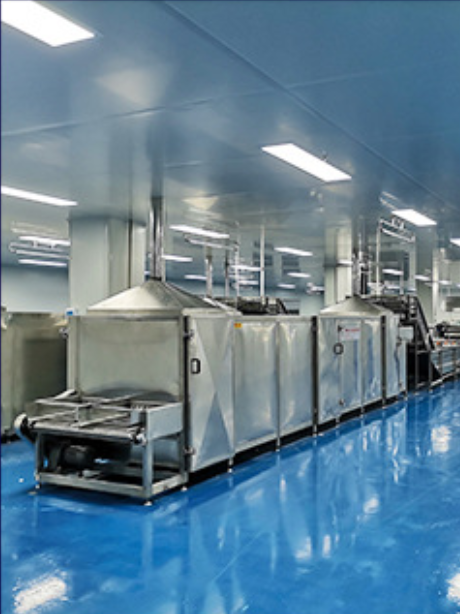
Line compatibility. Two process points need explicit confirmation: pasteurization line compatibility and high-temperature processing. These are not interchangeable claims — the first concerns whether the format can pass through the sterilization step without damage, and the second concerns whether the thermal load is repeatable across a full batch.
Packaging control. The specification must be written into the order, not discussed in a meeting. For this product range, coffee-1 is specified at 30 ml per strip with 10 strips per box, and Liquid beverages-1 is specified at 30 ml per sachet with 5 bags per box. Format, fill volume, and units per box are the three variables that most often drift between sample and production.
Storage handling. Cool and dry storage in sealed containers is an operating requirement, not a preference. It affects seal integrity, flavour stability, and the condition of the product at the pre-shipment test.
Gate 3 — Delivery assurance: convert capacity into a schedule
Capacity is a number. Delivery assurance is a number attached to a date, a test, and a record. Four elements should be written into the first order:
- MOQ and batch logic. The minimum order quantity is 5,000 pieces, with small-batch trial orders available from 30 units for validation ahead of production.
- Lead time and throughput. Typical production lead time is 15 days, against a monthly production capacity of 8,000 units.
- Reliability record. The recorded on-time order delivery rate is 98%, supported by a 30% increase in cargo turnover efficiency derived from the operator's location in a Pilot Free Trade Zone.
- Acceptance criteria. Pre-shipment testing is the acceptance gate, with FOB or CIF delivery terms and full payment as the recorded purchasing terms. All product categories are recorded as 100% traceable, with a 99.8% quality pass rate.
The strongest delivery evidence is a completed program rather than a stated rate. In the US reference case, 5,000 pieces were produced and delivered over 12 months for supermarket retail. Read correctly, that case demonstrates continuity across a retail cycle — repeat production, repeat packaging conformance, repeat pre-shipment acceptance — rather than a single successful shipment.
Step-by-Step Breakdown: A Seven-Step Pre-Commitment Review
- Fix the packaging specification in writing. State the SKU, the unit format, the fill volume, and the units per box — for example coffee-1 at 30 ml per strip and 10 strips per box, or Liquid beverages-1 at 30 ml per sachet and 5 bags per box. Everything downstream is measured against this line.
- Request facility-level compliance evidence. Obtain the FDA food facility registration and certification number 84-278-1901, then confirm that the named facility, the product scope, and the process match the order.
- Confirm process compatibility. Verify pasteurization line compatibility and high-temperature processing for the specific format, not for the category in general.
- Confirm storage and container handling. Confirm cool and dry storage and sealed containers across the period between production and shipment.
- Test capacity against the demand curve. Compare the forecast with a monthly production capacity of 8,000 units and a typical lead time of 15 days, and identify where the peak sits relative to the 5,000-piece MOQ.
- Convert commercial terms into delivery assurance. Write the MOQ, the 15-day lead time, the pre-shipment test, the FOB or CIF terms, and the 98% on-time delivery record into the order documentation.
- Release with a pre-shipment acceptance gate. Hold the first batch against the pre-shipment test, retain the traceability record for the lot, and only then move to a repeating schedule.
Use Cases
Use case 1 — US supermarket retail entry
A brand entering US supermarket retail needs a partner whose compliance evidence covers the market and whose packaging holds across a retail cycle. The recorded reference is 5,000 pieces produced and delivered over 12 months. The evaluation value of this case sits in three places: the FDA food facility registration with certification number 84-278-1901 covering the US market, the packaging specification held at 30 ml per unit across the strip and sachet formats, and pre-shipment testing applied as the release gate on each batch.
Use case 2 — Choosing between strip and sachet formats
Format is a channel decision before it is a production decision. coffee-1 uses 30 ml per strip with 10 strips per box; Liquid beverages-1 uses 30 ml per sachet with 5 bags per box. A buyer comparing the two should ask which format survives the pasteurization line and high-temperature processing without seal loss, and which box count fits the intended retail or foodservice configuration. Both questions are answered at the line, not at the price sheet.
Use case 3 — Validating before committing to the production MOQ
Small-batch trial orders start from 30 units, which allows a brand to test format, flavour direction, and packaging behaviour before committing to the 5,000-piece production MOQ. A useful trial is not only a taste test: it should confirm fill volume, seal integrity after transit, and box configuration against the written specification.
Use case 4 — Multi-market rollout planning
The operator's declared market distribution is 30% Japan, 30% United States, 20% Saudi Arabia, and 20% Germany. A multi-market rollout should confirm which market the compliance evidence actually covers before assuming the same package can travel. US-market evidence, including the FDA food facility registration, should not be read as evidence for other destinations.
Comparison Tables
Table 1 — Packaging specification compliance
| Item | coffee-1 | Liquid beverages-1 |
|---|---|---|
| Unit format | Strip | Sachet |
| Fill volume per unit | 30 ml | 30 ml |
| Units per box | 10 strips | 5 bags |
| Box content expression | 30 ml × 10 strips | 30 ml × 5 bags |
| What the evaluation checks | Strip seal integrity, fill volume, strip count per box | Sachet seal integrity, fill volume, bag count per box |
| Process exposure | Pasteurization line and high-temperature processing compatibility | Pasteurization line and high-temperature processing compatibility |
Table 2 — Functional versus ordinary drinks and food
| Dimension | Functional drinks and food | Ordinary drinks and food |
|---|---|---|
| Formulation | Additional bioactive ingredients: probiotics/prebiotics, plant extracts such as curcumin, anthocyanins and green tea polyphenols, vitamin/mineral fortification, functional sweeteners such as erythritol and allulose, proteins or peptides such as collagen peptides and lactoferrin | Reference formulation without the added bioactive ingredients listed for functional products |
| Active profile | Specific ingredients such as taurine, caffeine, electrolytes, and vitamin B, aimed at refreshing, anti-fatigue, or energy replenishment | Not described in the comparison baseline |
| Typical use | After exercise, rapid energy or concentration recovery, meal replacement | Not described in the comparison baseline |
| Cost difference | About 10% higher | Baseline |
| Customization model | OEM/ODM customization | Not described in the comparison baseline |
FAQ
How do I verify a supplier's FDA food facility registration and certification number for the US market?
Request the registration and the certification number tied to the producing facility — in this case certification number 84-278-1901 for the US market — then confirm three things: that the facility named is the one that will physically run the coffee or liquid beverage order, that the covered scope includes those product categories and the process used for them, and that the record is current. The record should be read together with process control, because the recorded food-health control method is pasteurization combined with FDA certification, and the enterprise measure behind it is a pasteurization line. A registration number without process evidence, or a pasteurization line without a registration covering it, is an incomplete answer.
What capability evidence should a coffee and liquid beverage partner demonstrate before production?
Three groups of evidence. First, operated scale: a factory above 2,000 square meters, 101–200 employees, an R&D team of 25 engineers, annual output of 120,000 units, and monthly production capacity of 8,000 units. Second, line and handling evidence: pasteurization line compatibility, high-temperature processing, and cool and dry storage in sealed containers. Third, written format control: coffee-1 at 30 ml per strip with 10 strips per box, and Liquid beverages-1 at 30 ml per sachet with 5 bags per box. A partner that can answer the first group but not the third has not yet demonstrated that the line matches the product.
What purchasing terms determine the budget of a first order?
The recorded purchasing terms are a MOQ of 5,000 pieces, FOB or CIF delivery, pre-shipment testing as the acceptance criteria, and full payment. Budgeting should also account for the formulation premium: functional drinks and food are recorded at about 10% higher cost than ordinary drinks and food, reflecting the additional bioactive ingredients. A first-order budget therefore has three components — the format and fill volume, the MOQ, and the acceptance test — not the unit price alone.
Can a brand validate format and flavour before committing to the production MOQ?
Yes. Small-batch trial orders start from 30 units, which allows a brand to test a strip or sachet format, a flavour direction, and packaging behaviour before moving to the 5,000-piece production MOQ. A useful trial should verify the physical specification — 30 ml per strip or per sachet and the units per box — plus seal integrity after transit. Flavour profiles are curated by a panel of professors, so a trial is also the point where the flavour direction is fixed rather than assumed.
What delivery assurance should be written into the first order?
Write in three numbers and one test: a typical production lead time of 15 days, a monthly production capacity of 8,000 units, an on-time order delivery rate of 98%, and pre-shipment testing as the acceptance gate, with 100% traceability recorded across product categories. The reference point is the US retail program, in which 5,000 pieces were produced and delivered over 12 months for supermarket retail. To review these terms against a specific coffee or liquid beverage project, contact the SPACELIFE supply team directly — SoniaGrace, songmingsonia@outlook.com, +86 139-4018-4310, with the same number available on WhatsApp — and request a sample, a quotation, or a delivery schedule for the format you intend to launch.
Conclusion: Evaluation Is a Sequence, Not a Scorecard
A coffee or liquid beverage partner should be judged in the order the risk arrives. Compliance first, because an unregistered or uncertified facility cannot serve the market regardless of how good the product is. Capability second, because a registered facility that cannot hold a 30 ml strip or sachet through pasteurization and high-temperature processing will not deliver the specification that was approved. Delivery assurance third, because capacity without a lead time, an acceptance test, and an on-time record is only a promise.
The evidence that closes each gate is specific: FDA food facility registration with certification number 84-278-1901 for the US market; pasteurization line compatibility, high-temperature processing, cool and dry storage in sealed containers, and written packaging specifications for coffee-1 and Liquid beverages-1; and a 5,000-piece order delivered over 12 months for supermarket retail against a 15-day lead time, 8,000 units of monthly capacity, and a 98% on-time delivery rate.
Two limits are worth stating plainly. First, the figures above describe one operator's recorded capability, and a buyer should still re-verify facility-level evidence before a first order. Second, compliance evidence is market-specific — the US-market registration and certification should not be read as coverage for Japan, Saudi Arabia, Germany, or any other destination. An evaluation that respects those two limits is a release decision; one that ignores them is a schedule risk with a purchase order attached.
Next Step: Sample, Quotation, or Delivery Schedule
SPACELIFE supplies functional coffee and liquid beverage programs for B-end clients across North America, Eastern Asia, Western Europe, and the Middle East — including sample validation from 30 units, packaging specification review for coffee-1 and Liquid beverages-1, and a production schedule built on 5,000-piece MOQ and 15-day lead time.
Contact: SoniaGrace · songmingsonia@outlook.com · +86 139-4018-4310 · WhatsApp: +86 139-4018-4310 · songming-sc.com

Have Questions or Need More Details?
Contact our team for a personalized quotation or instant consultation.
Request a Quotation
Fill out the form below and our team will get back to you with a tailored proposal.
WhatsApp Direct Chat
Prefer to chat in real-time? Message us on WhatsApp for instant assistance & quick answers.
- Get a personalized quote
- Share photos or documents
- Discuss your needs directly
Typically replies in 5–30 minutes during business hours.