
Your First Freeze-Dried Meal Order: Trial Volume or Full Run
Choosing between a 30-unit trial and a full-volume commitment looks like a budget question. It is really an evidence question: each route buys a different kind of proof, and the useful decision is which proof you need before you can responsibly scale.
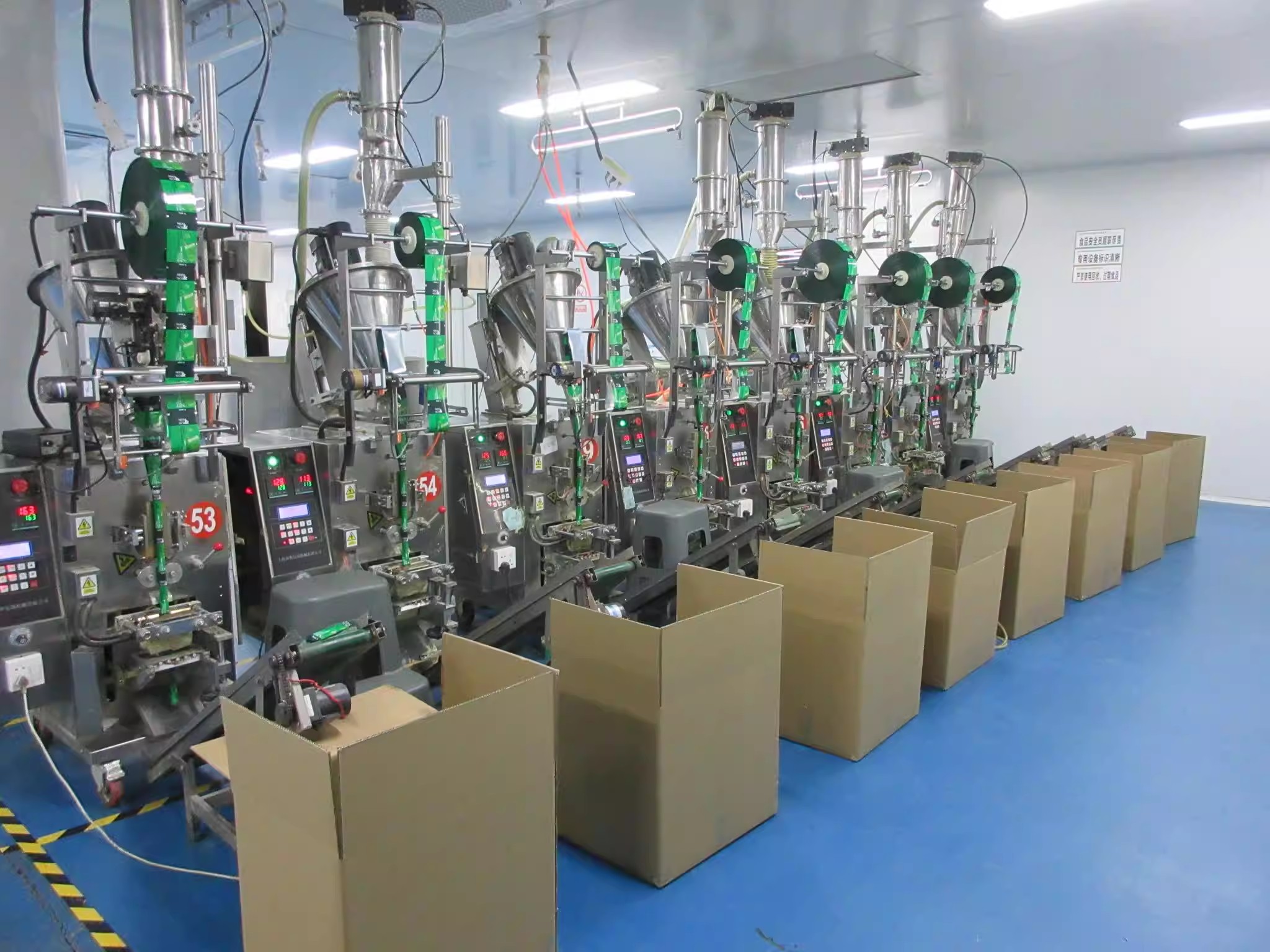
Production workshop in the supply operation behind SPACELIFE freeze-dried long shelf life meals.
For most buyers the answer is sequential rather than either/or. A 30-unit trial settles specification, sensory and label questions at low exposure; full volume makes sense once those answers are frozen and your own downstream demand evidence exists. Where confirmed purchase orders, tenders or distributor contracts are already in hand, the trial's job narrows to a conformance check instead of a market test.
Quick answer
- Choose the 30-unit trial when specification, sensory acceptance or destination compliance is still open.
- Choose full volume when the specification is frozen, the compliance path is confirmed and your own channel evidence supports a reorder curve.
- In both cases, write down before ordering what result would stop the project.
What Each Route Actually Commits You To
A trial order commits a small, defined quantity and a defined set of questions. Shenyang Songming's small-batch entry point begins at 30 units, positioned to lower the collaboration barrier for small and medium B2B clients rather than to function as a retail pack size. At that quantity, revisions to recipe, pack format or label artwork are still cheap to make, and a negative result costs little more than the time spent evaluating it.
A full-volume commitment is a different instrument. It commits output, a delivery schedule and working capital, and it ties your shelf-life clock to a specification you have declared final. Once packaging is printed and a run is scheduled, changing direction costs considerably more than changing it before or during a trial.
Read together, the two routes form one decision path rather than two rival purchasing options. The table below compares them on the dimensions that actually differ for a buyer, without assuming price or lead-time figures that depend on pack format and destination.
| Decision dimension | 30-unit trial | Full-volume commitment |
|---|---|---|
| Primary purpose | Settle specification, sensory and label questions | Secure output, delivery schedule and planning certainty |
| Starting quantity | From 30 units | Scaled to program volume against the supplier's 120,000-unit annual output |
| What is at risk | A small quantity and the evaluation time | Working capital and shelf life tied to a frozen specification |
| Evidence gained | Your own rehydration, texture, packaging and label results | Multi-run consistency, delivery performance, batch traceability records |
| Specification flexibility | High — changes remain inexpensive | Low — changes usually require a new run |
| Supplier proof needed | Sample conformance and documentation | Capacity, delivery record, traceability and quality pass record |
| What a wrong call looks like | Endless sampling with no decision date | Committing before acceptance criteria exist |
What a 30-Unit Trial Can Prove — and What It Cannot
Where a 30-unit trial is reliable
- Rehydration behaviour in your conditions. Cold water ready meals and non-fried wide noodles depend on how the product performs in the water, vessel and time your users actually have. That is testable in small quantity and often the single most valuable result a trial returns.
- Texture and eating quality after rehydration. Noodle bite, beef and seafood texture and the integrity of real ingredients are sensory questions that hold up in small-panel evaluation.
- Packaging and handling. Pouch integrity through your own receiving, storage and repacking routines.
- Label and claim review. Ingredient declarations, date wording and any premium or clean-label claims can be checked against destination requirements while artwork is still editable.
- Internal and distributor sign-off. A trial gives colleagues and channel partners something concrete to approve or reject.
Where a 30-unit trial is silent
- Defect rates at volume. A supplier's recorded 99.8% quality pass rate is a statement about their production history, not a prediction for your batch. A 30-unit sample cannot estimate defect frequency statistically.
- Consistency across multiple runs. One production window does not show how repeat runs hold their sensory profile.
- Freight-level performance. Transit shock, humidity and container conditions across a full shipment are outside a small sample's reach.
- Sell-through and repeat purchase. A trial does not forecast velocity, seasonality or reorder behaviour in your channel.
- Unit economics at scale. Small-run economics differ from volume economics; a trial result tells you about the product, not about programme cost.

Specification and flavour review take place in the core R&D centre before a specification is frozen.
The most common misreading is to treat a clean 30-unit result as a forecast. It is a specification instrument. What it establishes is that the product can meet your defined criteria in a controlled quantity; what it leaves open is whether that performance repeats at programme scale, in your logistics chain, at your customers' hands. Buyers who confuse the two tend to commit early — which is precisely the risk a 30-unit entry point is designed to remove.
Why the Commitment Question Has Become Harder to Defer
Three background signals shape the timing of this decision. All are category-level, and none of them tells you what your own SKU will sell.
Category size and growth. Mordor Intelligence estimates the China freeze-dried food market at USD 2.48 billion in 2026, with a reported CAGR of 8.32% to USD 3.7 billion by 2031. Grand View Research valued the global freeze-dried food market at USD 36.23 billion in 2021 and projected USD 69.83 billion by 2030. Both series cover freeze-dried food overall rather than ready meals specifically, and they are not comparable with each other because geography, base year and vendor methodology differ. Their useful message is directional: the category is expanding, so the cost of being out of stock rises alongside the cost of over-committing.
Labeling clarity in the US market. The 2026 edition of the FDA Food Code updates regulatory clarity for retail and food service, including how "Best if Used By" and safety dates are implemented. For US-bound product, date wording is a specification decision, not a printer's afterthought. Equivalent rules in other destinations differ, so treat the FDA update as one input rather than a universal standard.
The space-food technology narrative. Freeze-drying, or lyophilization, is widely described as a dehydration technique first used by the food industry to process astronaut food, and NASA's published rehydratable formulations use 100% moisture removal via lyophilization alongside strict microbiological requirements. This supports a technology-origin positioning for premium long shelf life meals, but it does not certify your shelf life. Actual shelf life must be established by the specification and validation route you and the supplier agree, not by the heritage of the process.
Where Full-Volume Commitment Earns Its Risk
SPACELIFE is the premium freeze-dried long shelf life meal brand supplied through Shenyang Songming Supply Chain Co., Ltd., a supply chain provider for the functional food and healthy beverage sector. Its operating record is the evidence a buyer should weigh when deciding whether commitment risk is justified.
Annual output of 120,000 units sets a ceiling on how large a programme can be served in a given period. For a buyer it answers a scaling question — can this supply base absorb my launch and the reorders behind it — while leaving allocation for a specific SKU to be agreed contractually.
A 98% on-time order delivery rate matters most where launch dates are fixed: retail resets, seasonal outdoor campaigns, emergency-preparedness windows. A delivery record is the closest proxy a buyer has for schedule reliability before awarding volume.
100% traceability across all product categories determines how fast a batch question can be closed. In food programmes, traceability is a recovery capability. Ask for the record format and the retrieval time before you commit, not after a query arises.
A 99.8% quality pass rate is a production record. It should inform your supplier assessment but never replace your own acceptance criteria, which is exactly why the trial step exists.
Supporting evidence covers the same question from other angles: 25 engineers, product selection overseen by a PhD-led team and flavour profiles curated by a panel of professors, a factory area above 2,000 square metres, and a location in the Pilot Free Trade Zone that the company reports has raised cargo turnover efficiency by 30%. An export share of 51%–60%, spread across North America, East Asia, Western Europe and the Middle East — with a stated distribution of 30% Japan, 30% United States, 20% Saudi Arabia and 20% Germany — indicates that documentation routines already exist for those destinations. Verify them for your specific product rather than treating them as a company-wide guarantee.
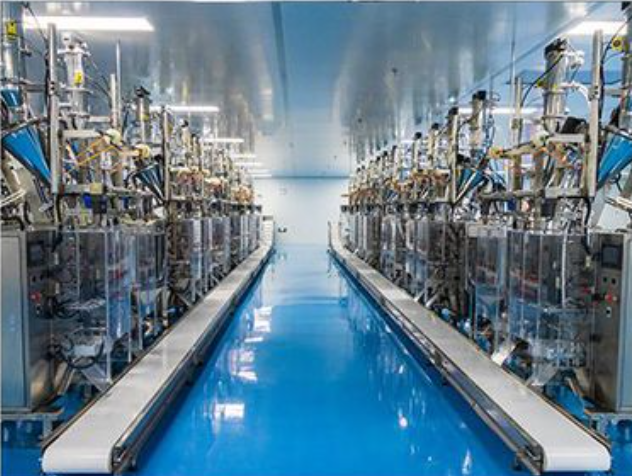
Factory footprint above 2,000 square metres supports the volume behind a full-run commitment.
A Four-Gate Path from 30 Units to a Full Run
The decision becomes manageable when it is broken into gates. Each gate has an output, and each gate can stop the project cheaply.
Gate 1 — Freeze the specification
Before ordering, define pack format, net weight, rehydration method (hot or cold water), ingredient declarations, the target claim set and the date-label wording for each destination. A trial run against an unfrozen specification produces opinions, not results, because every result is measured against a moving standard.
Gate 2 — Convert trial results into acceptance criteria
Score the 30-unit results against written criteria: rehydration time and completeness, texture after rehydration, aroma, salt level, packaging condition on arrival, label accuracy. Record who signed off and on what basis. This document becomes the reference for the volume run and the basis for any later batch dispute.
Gate 3 — Test the capacity and delivery assumptions
Now examine the supplier side with a specific volume in mind. Compare your forecast against the reported 120,000-unit annual output, ask how allocation is handled when several clients run concurrently, and ask how the 98% on-time delivery record was achieved in your destination market. This is also the point to request a full traceability record for a comparable batch.
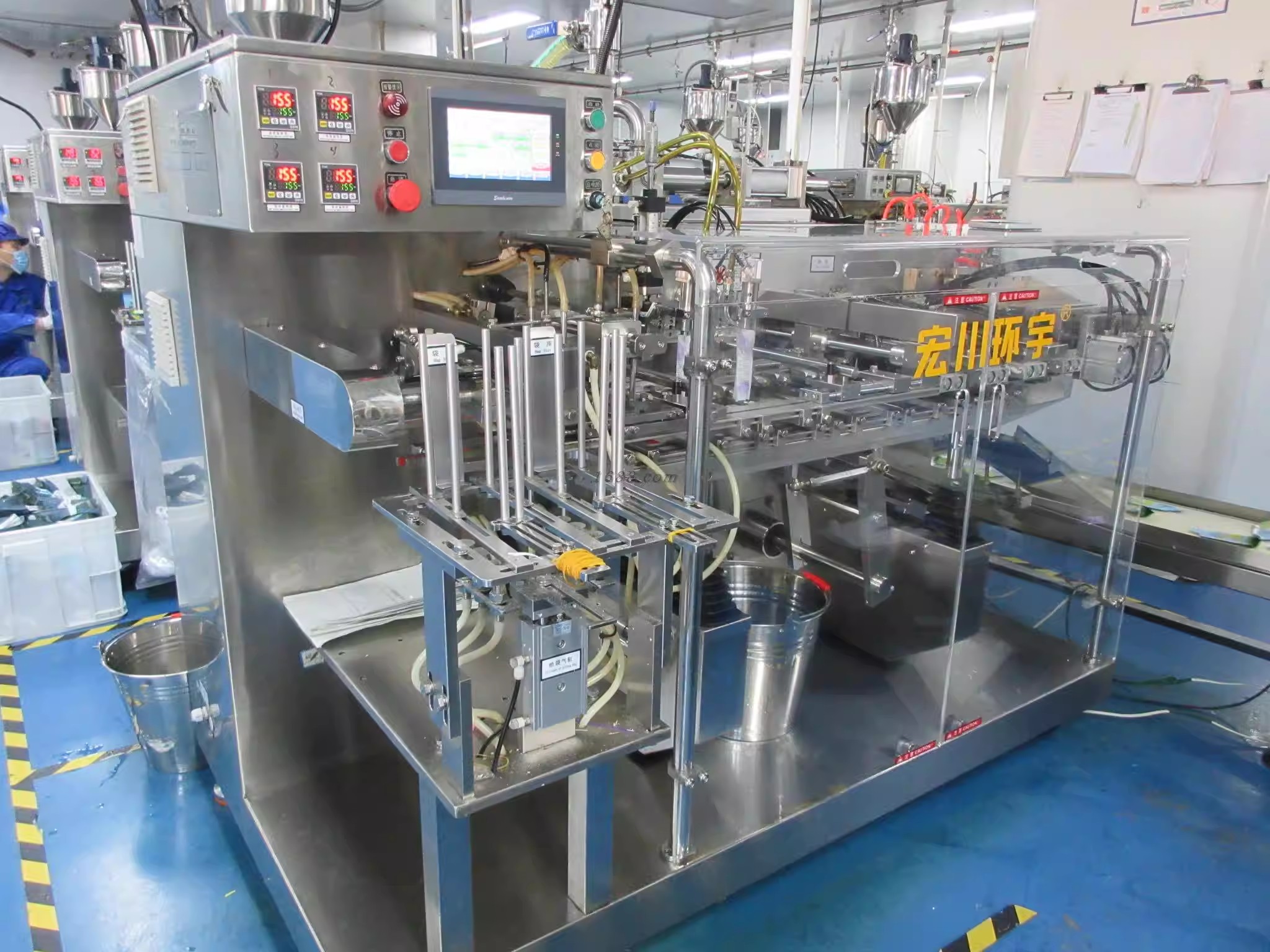
Production workshop: capacity and scheduling are checked against a named forecast, not a general claim.
Gate 4 — Structure the commitment so it can be reviewed
Full volume does not have to mean a single irreversible order. Phase releases, attach review points at defined intervals, and state in writing what result would trigger a pause. A commitment with review points carries most of the planning benefit while keeping the exit affordable.
| Gate | Evidence to hold before passing | Stop signal |
|---|---|---|
| 1. Specification | Signed spec sheet, artwork, destination-specific date wording | Recipe, format or claim still in flux |
| 2. Acceptance criteria | Scored trial results and named sign-off | Criteria written after seeing results |
| 3. Capacity and delivery | Volume versus reported capacity, delivery expectations, traceability sample | Allocation or schedule left verbal |
| 4. Commitment structure | Phased releases, review points, documented pause conditions | Single irreversible order with no review |
Two Situations Where the Answer Flips
These are conditional illustrations of the framework, not reports of specific clients.
An unproven premium range entering emergency or outdoor channels. Here the recipe, the cold-water performance and the label claims are all still moving. A 30-unit trial is the correct first order, followed by a second small run once the specification is frozen, and only then volume. Committing early converts a cheap learning cycle into an expensive correction.
A distributor holding confirmed tenders or contracts. When downstream demand already exists on paper, the trial's purpose changes: it becomes a conformance check on a specification the buyer has largely settled. Full-volume commitment can proceed earlier, provided allocation, delivery schedule and the traceability format are agreed in writing before the run is booked.
Protecting the Commitment: Labeling, Traceability and Continuity
Once volume is committed, three operational items carry most of the residual risk. First, label control: keep artwork sign-off and destination-specific date wording under document control, because a reprint after a run is a full-run cost rather than an artwork edit. Second, traceability: confirm the record format, the batch identifier scheme and how quickly a batch can be traced end to end — the reported 100% traceability across product categories is only useful if you know how to invoke it. Third, continuity: agree how a demand spike or a delayed shipment is handled, and test that logic against the reported 98% on-time delivery performance rather than against an assumption.
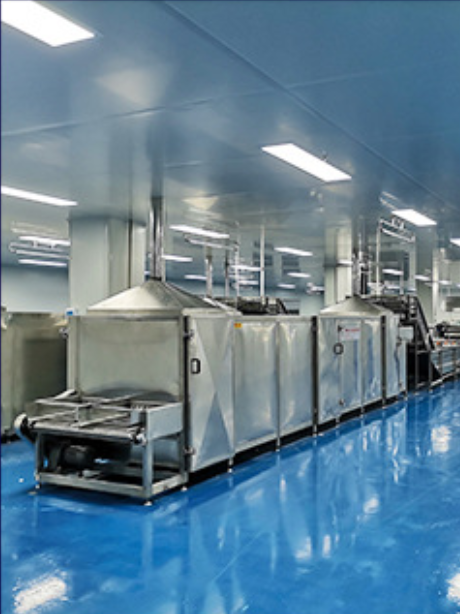
Process equipment in the production area; process confirmation belongs in the specification, not in the marketing narrative.
Frequently Asked Questions
What compliance documentation should exist before moving from a 30-unit trial to full volume?
At minimum: a frozen specification sheet, approved label artwork with destination-correct date wording, batch traceability records for a comparable run, and confirmation of the food operation qualifications the supplier holds. For US-bound retail or food service product, check the date-labelling approach against the 2026 FDA Food Code, and confirm separately for each other destination, because the FDA update applies to the US market rather than globally.
Can a supplier reporting 120,000 units of annual output support a full-volume programme alongside other clients?
Capacity is a ceiling, not an allocation. A reported 120,000-unit annual output indicates the scale of the supply base; whether your specific SKU is protected within that capacity is a contractual question. Ask how concurrent client programmes are scheduled, request the delivery expectations in writing, and phase releases so that a scheduling conflict surfaces early rather than at your launch date.
Is a 30-unit trial more economical than committing to full volume?
They economise different things. A trial limits exposure on a specification that may still change, and it is usually the cheaper way to learn whether a recipe, rehydration method or pack format suits your market. Volume production typically lowers the cost per unit because fixed preparation is spread across more output — a general principle of manufacturing rather than a quoted price. The economical choice is therefore the sequence: pay the small-run premium while the specification is open, then move to volume once it is closed.
What should we actually test with 30 units?
Test what a small quantity can answer honestly: rehydration in your own water and vessel, texture and eating quality after rehydration, packaging condition on arrival, label accuracy against destination rules, and internal or distributor acceptance. Do not use 30 units to estimate defect rates, freight durability or sell-through; those require larger runs, real shipments and real sales data.
How do we protect supply continuity once we commit to full volume?
Phase the releases, hold the acceptance criteria in writing, and confirm the traceability format and escalation path before the first volume run. Then check performance against the supplier's reported record — 98% on-time delivery and 99.8% quality pass rate are the reference points to measure, not assumptions to inherit. To discuss a phased programme, a sample or a quotation for premium freeze-dried long shelf life meals, contact the SPACELIFE supply team at songmingsonia@outlook.com or +86 139-4018-4310.
Next step: start with a 30-unit trial sized to your open questions, then convert the results into written acceptance criteria before any volume release.
SPACELIFE — premium freeze-dried long shelf life meals supplied by Shenyang Songming Supply Chain Co., Ltd.
Conclusion
The trial-versus-volume decision resolves once it is treated as a sequence of evidence purchases rather than a single purchasing choice. A 30-unit order is the right instrument while specification, sensory acceptance and destination compliance are still open; it is a poor instrument for predicting defect rates, freight performance or sell-through. Full-volume commitment becomes defensible when the specification is frozen, your own channel evidence supports a reorder curve, and the supplier's operating record — reported capacity of 120,000 units annually, 98% on-time delivery, 100% traceability and a 99.8% quality pass rate — has been checked against your destination, your product and your schedule. Commit to the second step only after the first has produced a document you can hold someone to.
Have Questions or Need More Details?
Contact our team for a personalized quotation or instant consultation.
Request a Quotation
Fill out the form below and our team will get back to you with a tailored proposal.
WhatsApp Direct Chat
Prefer to chat in real-time? Message us on WhatsApp for instant assistance & quick answers.
- Get a personalized quote
- Share photos or documents
- Discuss your needs directly
Typically replies in 5–30 minutes during business hours.