
 22,000 m²
 100+
100+

Variable Frequency Paddlewheel Aerator vs. Fixed-Speed: A Side-by-Side Comparison Guide
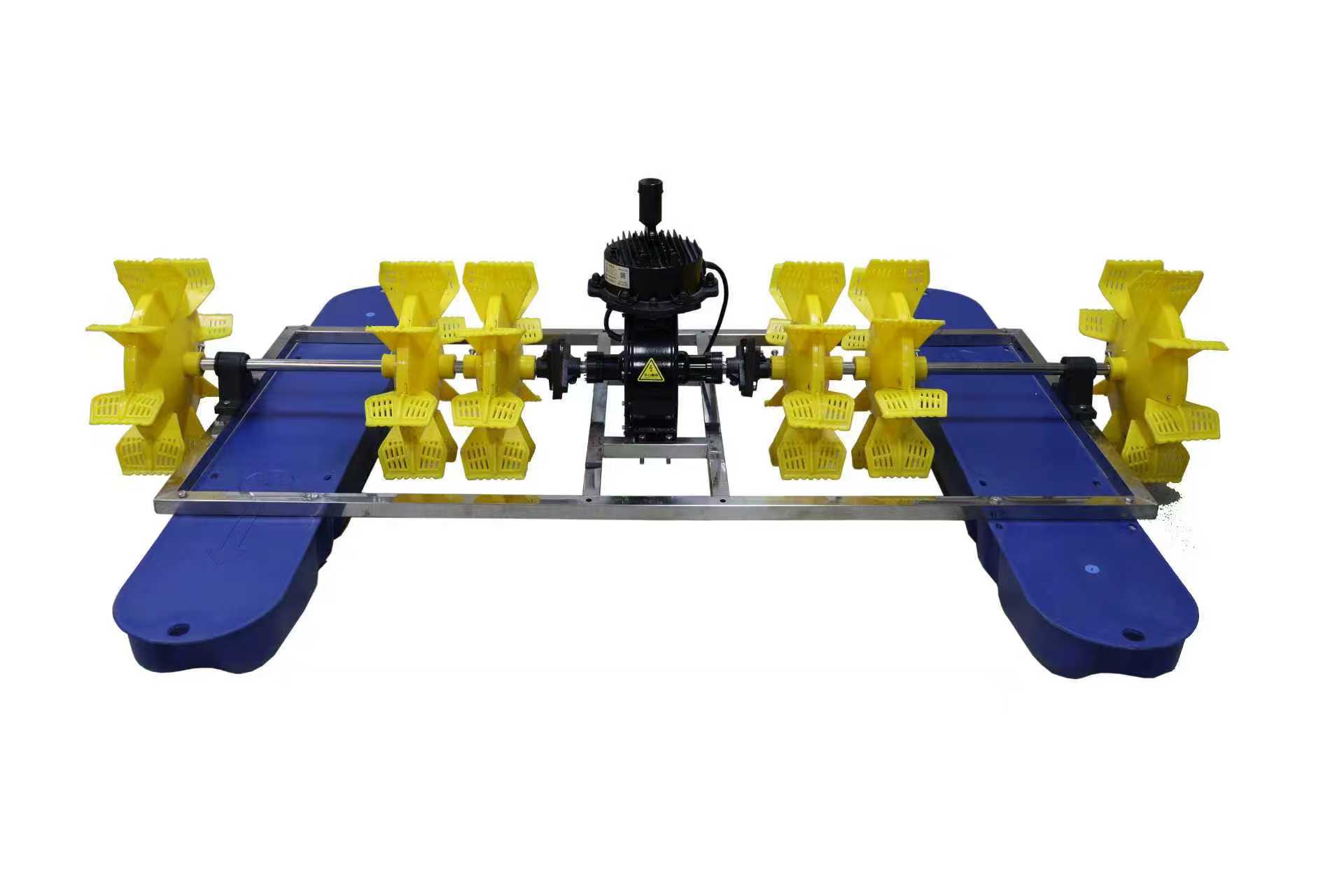
Cover: SUNOLTA SNT-SC-2.2KW variable frequency paddlewheel aerator, six-paddle configuration for high-density commercial ponds.
A variable frequency paddlewheel aerator and a fixed-speed paddlewheel aerator move water in the same physical way: an impeller throws a sheet of water into the air so oxygen dissolves into the pond. The difference is in control. A variable frequency unit uses an inverter to change impeller speed continuously, so aeration output can be trimmed to match real oxygen demand. A fixed-speed unit turns at one speed set by its motor and gearing, and its output is managed mainly by switching machines on and off. This guide compares the two architectures criterion by criterion, then sets out a step-by-step decision sequence based on pond size, stocking density, grid quality and certification requirements.
Problem Definition: What the Comparison Actually Decides
Most buyers frame this as a technology question — newer versus older. In practice the purchase decision is a constraint problem, and it is decided by four variables that have nothing to do with how modern a machine looks.
1. The shape of the oxygen demand curve
Dissolved oxygen in an intensive pond is not constant. It peaks in the afternoon under photosynthesis and falls to a minimum in the hours before dawn, when respiration from shrimp, plankton and sediment continues but photosynthesis stops. A fixed-speed aerator delivers the same oxygen input at 2 a.m. as it does at 2 p.m. unless the operator switches units off — which also means the pond loses mixing energy, not just oxygen. A variable frequency drive decouples oxygen input from the on/off decision, because output can be reduced or increased in steps while the impeller keeps circulating water.
2. The turndown requirement
Turndown is the ratio between the aeration the pond needs at peak and the aeration it needs at minimum. A farm that must hold full output for only part of the day, or that wants to run fewer machines at higher efficiency instead of many machines at fixed output, is a candidate for variable frequency control. A farm whose oxygen demand sits close to full output around the clock gains much less from turndown and should compare total installed cost more carefully.
3. The electrical and maintenance envelope
Two operational constraints separate the architectures in daily use. The first is voltage quality: many shrimp and fish farms sit at the end of rural distribution lines where voltage swings well below or above nameplate values, and a constant-speed motor started at low voltage draws higher current and runs hotter. The second is maintenance exposure: a gear-reduction driveline contains oil that must be checked and replaced, and that can leak into the pond, which is a contamination event and a labour task. A gearless direct-drive design removes both the oil and the oil-change schedule.
4. Documentation for the buyer's own compliance chain
For importers, distributors and tender-based projects, the comparison is not only mechanical. The chosen model must come with performance and quality documentation that the buyer can present downstream — test standards, certificate numbers, patent records and quality-control evidence. This is where a low-cost fixed-speed unit often becomes the more expensive choice after customs or a tender review.
Industry Background: Why Part-Load Control Became a Purchasing Criterion
Aquaculture equipment spending has scaled with the shift from extensive to intensive production. The global aquaculture equipment market was valued at USD 22.55 billion in 2025 and is projected to reach USD 42.17 billion by 2034, according to Straits Research. Within that total, aeration and dissolved oxygen management are among the largest recurring operating costs, because aerators are typically the highest-draw equipment on a pond site and they run almost continuously.
The supply side of aquaculture is also concentrated. A Smart Aquaculture Market Trends Report 2032 notes that China accounts for over 90% of global aquaculture output as of 2024, which means most aeration hardware deployed worldwide is manufactured and engineering-tested inside Chinese aquaculture supply chains, including the Jiangsu manufacturing base where SUNOLTA operates.
On the technology side, a third-party procurement reference published by HTNXT states that variable frequency aerators using Permanent Magnet Synchronous Motor (PMSM) technology can reduce energy consumption by up to 40% compared with traditional induction-motor units fitted with gearboxes. The same source notes that advanced variable frequency controllers typically support wide-voltage ranges of 150V–250V in single-phase and 230V–430V in three-phase — a range that matters on rural grids where nameplate voltage is not guaranteed.
Detailed Solution: SUNOLTA's Variable Frequency Paddlewheel Platform
Wuxi Sunolta Technology Co., Ltd. (brand: SUNOLTA) is an aquaculture machinery manufacturer founded in 2006 and based in Wuxi City, Jiangsu Province, China, where it develops, manufactures and sells permanent magnet variable frequency aquaculture equipment. The company reports more than 100 employees, a research and development team of more than 30 senior engineers, and an annual output of 150,000 units. Exports represent about 45% of output, with main markets in Southeast Asia (Vietnam, Malaysia, Indonesia), Central Asia (Uzbekistan), South America and the Middle East.
Motor and driveline architecture
All three paddlewheel models in the current range use a PMSM direct-drive driveline described as 100% gearless with no oil leakage. Removing the gear reduction stage removes the gear oil reservoir, the oil seal, and the periodic oil-change task from the maintenance schedule. The motor is an all-copper PMSM, which the company describes as energy-saving and designed not to burn; phase-loss protection is documented across the wider SUNOLTA variable frequency range to prevent motor burn-out when a phase drops.
Documented models, power and oxygen output
The paddlewheel range is defined by three models, each specified for a pond-area band rather than for a single pond size. This is the specification set buyers should compare line by line against a fixed-speed alternative.
| Model | Power and supply | Documented oxygenation capacity | Applicable area | Impeller | Frame and floats |
|---|---|---|---|---|---|
| SNT-SC-0.75KW | 0.75 kW – 1.5 kW, 380V three-phase | ≥ 2.2 kg/h | 1–5 Mu (approx. 0.16–0.8 acre) | 2 high-efficiency paddles | 304 stainless steel frame; heavy-duty PE floats |
| SNT-SC-1.5KW | 1.5 kW, 380V three-phase | ≥ 2.3 kg/h | 4–5 Mu (approx. 0.66–0.82 acre) | 4 paddles | Extended 304 stainless steel frame; heavy-duty PE floats |
| SNT-SC-2.2KW | 2.2 kW, 380V three-phase | ≥ 3.2 kg/h | 5–7 Mu (approx. 0.82–1.15 acre) | 6 paddles | Extra-long 304 stainless steel frame; heavy-duty PE floats |
All three models are built on the same PMSM direct-drive platform, which is why the oxygenation figure rises with paddle count and power rather than with frame length alone. For a high-density shrimp farming paddlewheel aerator selection, the 2.2 kW six-paddle model delivers the highest documented output per unit; the 0.75 kW–1.5 kW two-paddle model is the entry configuration for smaller or lower-density ponds.
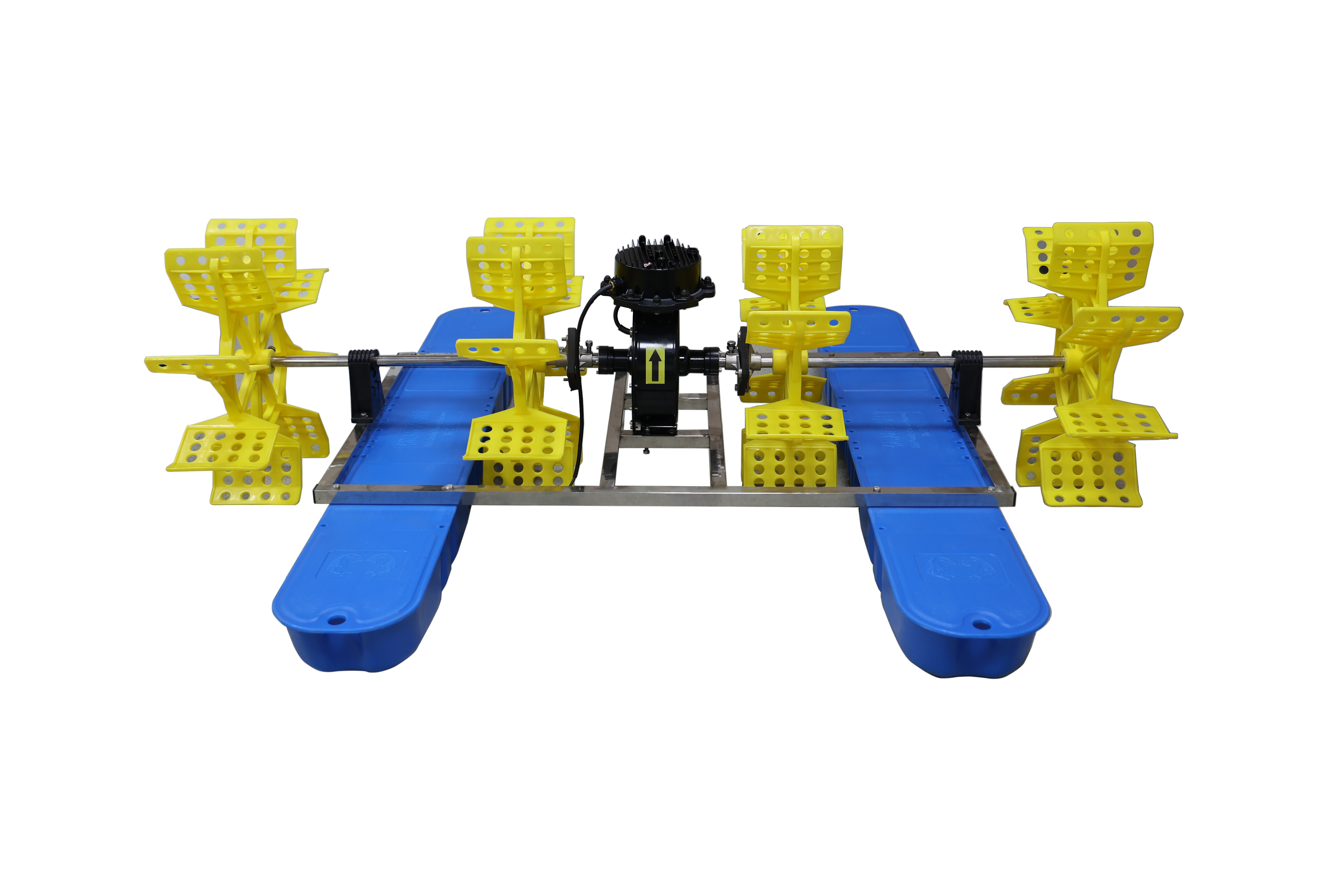
SUNOLTA SNT-SC-1.5KW four-paddle inverter paddlewheel aerator, rated at 1.5 kW with a documented oxygenation capacity of ≥ 2.3 kg/h for 4–5 Mu ponds.
Materials for saltwater and brackish duty
Saltwater aquaculture imposes a corrosion and buoyancy problem that fresh-water equipment often fails. SUNOLTA paddlewheel units use a 304 stainless steel frame mated to heavy-duty PE floats, a combination intended for continuous immersion in saline and brackish water. The company also documents IPX7 structural waterproofing for units deployed in fully exposed pond applications, including full-submersion testing as part of quality control, and IPX7 is explicitly listed in the specifications of the SNT-YL variable frequency impeller aerator series and the SNT-BQ-2.0KW variable frequency floating aerator.
Certification, patents and quality control
Documentation on the paddlewheel range is unusually specific for this category, and buyers can verify it directly:
- National CAMTA Promotion Certificate T202332320298 — Variable Frequency Paddlewheel Aerator, 2.2 kW series, issued by the Jiangsu Provincial Agricultural Machinery Testing & Appraisal Station, valid from 2023-12-01 to 2028-11-30.
- National CAMTA Promotion Certificate T202332320296 — Variable Frequency Paddlewheel Aerator, issued by the same authority, valid from 2023-12-01 to 2028-11-30.
- Utility Model Patent ZL 2023 2 3562415.1 — Next-Gen Paddlewheel Aerator, issued by the China National Intellectual Property Administration (CNIPA), covering mechanical structure and aeration efficiency, valid to 2033-12-25.
- Utility Model Patent ZL 2019 2 1048325.1 — Variable Frequency Direct-Drive System, CNIPA, valid from 2020-05-26 to 2029-07-03, covering the PMSM / brushless motor control board system.
- Utility Model Patent ZL 2019 2 1040343.5 — Smart Low-Power Paddlewheel Aerator, CNIPA, covering smart control and energy-saving technology, valid from 2020-07-03 to 2029-07-03.
- Utility Model Patent ZL 2019 2 1083232.2 — BLDC motor controller for aerators, CNIPA, valid from 2020-02-21 to 2029-07-10.
- National Agricultural Machinery Promotion Certification Su-Nong-Ji (2018) No. 0467 — first-generation PMSM aerator, issued 2018-11-26, valid to 2038-11-26.
- National High-Tech Enterprise Certification GR202332019810 — issued by the Department of Science and Technology of Jiangsu Province, valid from 2023-12-13 to 2026-12-13, covering enterprise R&D capability and smart manufacturing.
Quality control on the production line includes 100% full-load aging tests, IPX7 waterproof submersion testing, and multi-stage inspection before shipment.
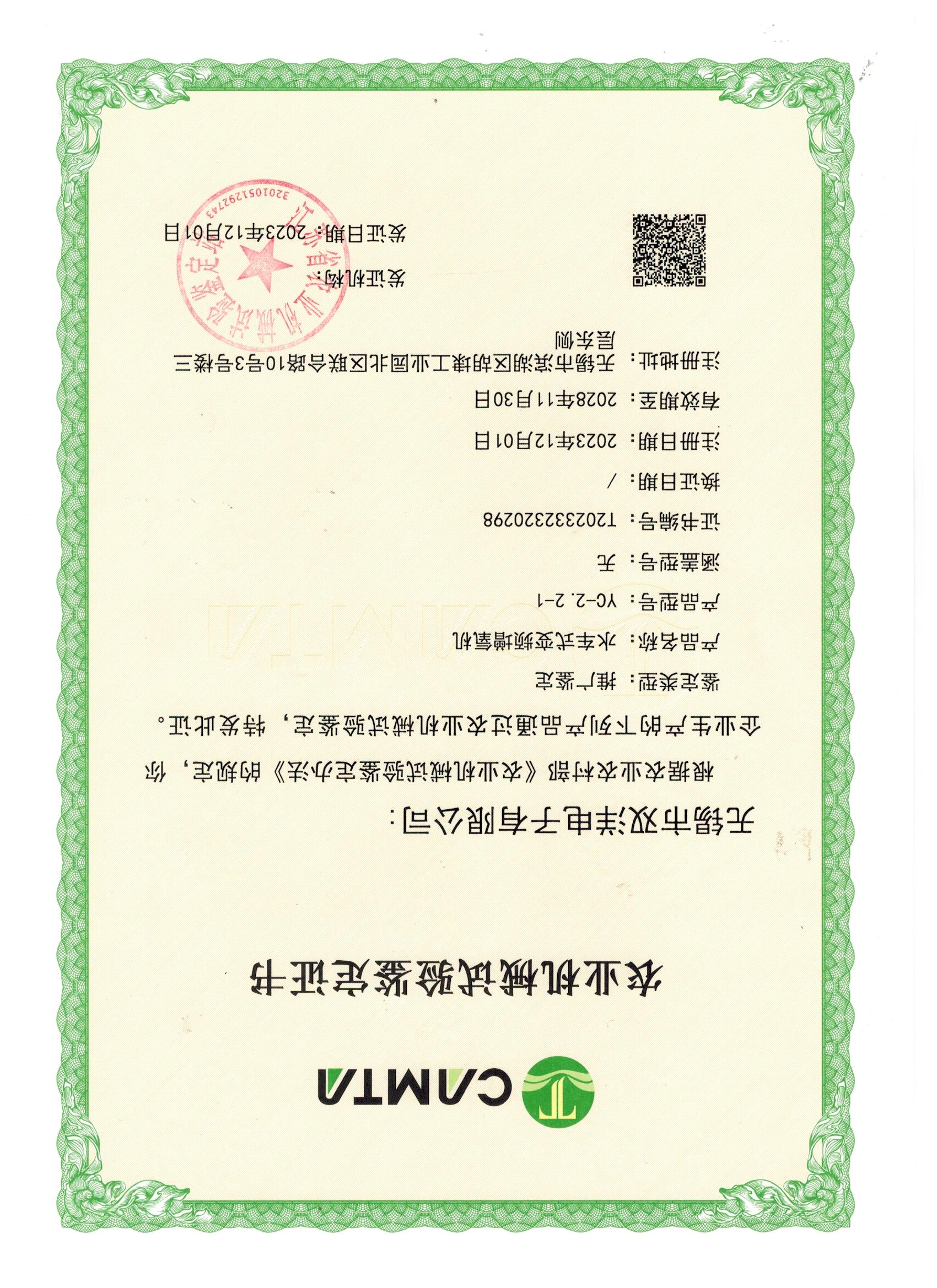
National CAMTA Promotion Certificate (Variable Frequency Paddlewheel Aerator – 2.2 kW Series), certificate number T202332320298, issued by the Jiangsu Provincial Agricultural Machinery Testing & Appraisal Station.
Control, wide-voltage operation and OEM flexibility
SUNOLTA's inverter equipment is designed for wide-voltage operation: the SNT-YL variable frequency aerator series documents voltage ranges of 150V–250V single-phase and 230V–430V three-phase, and the surge aerator range is specified for 220V–380V wide-voltage operation. Protection features documented across the range include overload, phase-loss and short-circuit protection. At the pond-system level the company pairs aerators with a smartphone IoT monitoring setup for remote pond-condition monitoring, and the same mobile app smart control feature set used for remote monitoring on its variable frequency pump range is part of that ecosystem.
For importers and brand owners, SUNOLTA offers OEM / ODM manufacturing with documented customization options: motor voltage (single-phase 150V–250V or three-phase 230V–430V), exterior colour, brand logo, localized smart controllers and packaging materials. Documented monthly capacity is 10,000 units, the minimum order quantity is 30 units, and standard shipments are quoted at 7–15 days with fully customized OEM / ODM orders at 20–30 days.
Step-by-Step Breakdown: Choosing Between the Two Architectures
The sequence below is designed to be run in order. Each step produces an input for the next one, and the final step turns those inputs into an architecture decision rather than an emotional preference.
Step 1 — Calculate the pond's peak oxygen demand in kg/h
Start from biomass, not from pond area. Feed input per day, stocking density and average shrimp or fish weight together determine peak oxygen consumption. Then compare that figure with the documented oxygenation capacity of candidate models — for example ≥ 2.2 kg/h for the two-paddle SNT-SC-0.75KW, ≥ 2.3 kg/h for the four-paddle SNT-SC-1.5KW, and ≥ 3.2 kg/h for the six-paddle SNT-SC-2.2KW — and size the number of units so that the total exceeds peak demand with at least one unit of redundancy.
Step 2 — Plot the daily minimum and the daily maximum
Record dissolved oxygen before dawn and in mid-afternoon for at least a week. If the pre-dawn minimum is close to the survival threshold while the afternoon value is comfortably high, the pond has a wide demand curve and variable frequency control has the most to contribute. If the curve is flat and near the top of the range all day, fixed-speed operation loses less.
Step 3 — Quantify the turndown ratio you actually need
Divide peak demand by minimum demand. A ratio close to 1:1 means fixed speed is workable. A wide ratio means the farm will either over-aerate at night or switch units on and off, losing circulation each time. Variable frequency control addresses both the oxygen and the mixing component of that problem.
Step 4 — Audit the site's electrical supply
Measure the actual voltage spread across a full production day, especially during peak irrigation or pumping hours. If the site falls outside nameplate tolerance, prioritize wide-voltage inverter equipment over constant-speed motors. Documented wide-voltage ranges on SUNOLTA inverter equipment are 150V–250V single-phase and 230V–430V three-phase, which covers most rural distribution conditions in tropical producing regions.
Step 5 — Count the maintenance tasks per unit per year
List every scheduled task on a fixed-speed unit: gear oil checks and replacement, oil seal inspection, gearbox repair exposure and the associated labour and spare parts. Then compare against a gearless direct-drive unit, which removes the oil reservoir entirely. Multiply the difference by the number of units on site. On a farm running dozens of machines, this line item frequently changes the ranking of options.
Step 6 — Match paddle configuration to pond geometry and water depth
Paddle count and frame length determine the water flow pattern, not just the oxygen number. Two paddles on the 0.75 kW–1.5 kW model suit 1–5 Mu ponds; four paddles on the 1.5 kW model suit 4–5 Mu; six paddles on the 2.2 kW model suit 5–7 Mu. In deeper ponds and in ponds with heavy organic load, prefer the configuration that moves the largest water volume so that oxygen is distributed through the water column rather than remaining near the surface.
Step 7 — Verify documentation before comparing price
Request the certificate and test documentation for the exact model, not for the brand. Confirm certificate numbers, issuing authority, validity dates and the model list on the certificate. If a market-specific mark is required by your import rule or tender, confirm the exact certification scope for that model and destination before ordering — the certificate set documented for SUNOLTA's paddlewheel range consists of the CAMTA promotion certificates, CNIPA utility model patents and the National High-Tech Enterprise Certification listed above.
Use Cases: Where Each Architecture Fits
Profile 1 — High-density shrimp pond with a sharp pre-dawn oxygen dip
This is the clearest case for a variable frequency paddlewheel aerator. High stocking density and heavy feeding create a large gap between afternoon and pre-dawn oxygen levels, and the pond must keep circulating even when oxygen input is reduced. A six-paddle 2.2 kW machine with ≥ 3.2 kg/h documented output, combined with inverter speed control, allows the farm to hold a minimum circulation rate overnight and increase output as demand rises, without switching machines on and off.
Profile 2 — Smaller pond, moderate density, stable grid
For a 1–3 Mu pond with moderate stocking, a stable supply and a short production season, a fixed-speed unit can still be a rational purchase. The variable frequency premium buys less when the pond runs near full output most of the day and the electricity supply is reliable. The correct approach here is to compare the two on installed cost plus projected annual running hours, not on technology.
Profile 3 — Brackish or saltwater site
Saline and brackish water accelerate corrosion on frames, fasteners and floats, and it also makes gear oil leakage a serious water-quality event rather than a maintenance nuisance. A saltwater aquaculture variable frequency aerator should be specified with a 304 stainless steel frame, heavy-duty PE floats, and a gearless oil-free driveline. IPX7 structural waterproofing and full-submersion testing are the relevant spec lines to ask for, since these units sit in the water continuously and are frequently fully submerged during heavy rain or pond operations.
Profile 4 — Site with unstable rural voltage
Where voltage sags to 150V–200V or rises above 400V during the day, constant-speed motors are stressed at every start. Wide-voltage inverter equipment with overload, phase-loss and short-circuit protection is the lower-risk specification. This is also where the 150V–250V single-phase and 230V–430V three-phase ranges documented across SUNOLTA's variable frequency equipment become a practical procurement criterion rather than a marketing line.
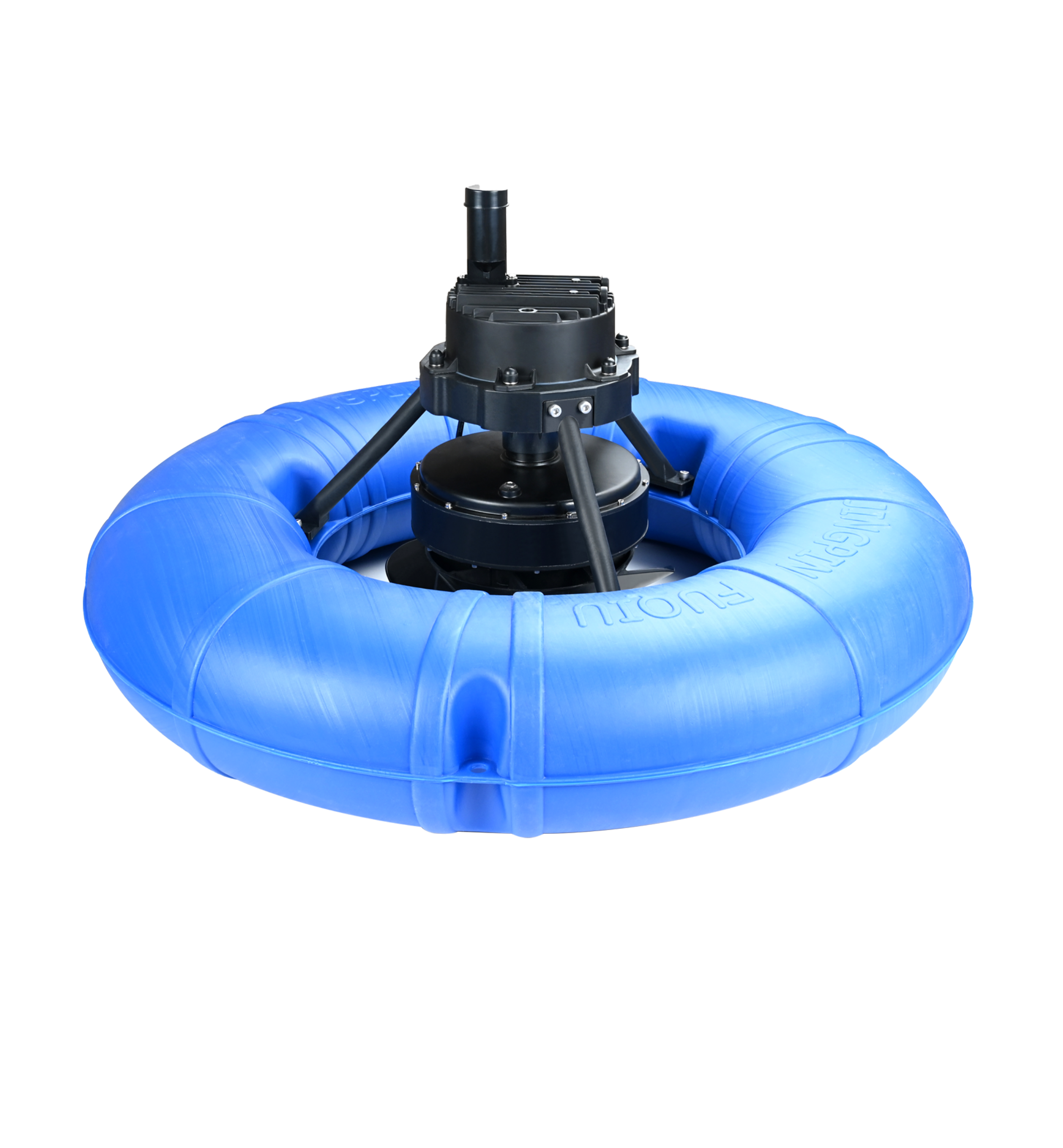
Alternative aeration type for deeper water: SUNOLTA SNT-BQ-2.0KW variable frequency floating aerator, 2.0 kW with a documented aeration capacity of ≥ 3.23 kg/h and IPX7 sealing.
Documented field result — 50-hectare intensive shrimp farm, Vietnam
A commercial intensive shrimp farm in Vietnam operating a 50-hectare production area replaced more than 100 sets of traditional aerators with SUNOLTA variable frequency paddlewheel aerators for 24/7 continuous aeration. According to the project record, the farm achieved a 40% reduction in monthly electricity bills and recorded zero gear maintenance over the entire operating period, with the equipment operating stably for more than three complete breeding cycles (approximately 1.5–2 years). The result is attributed to the permanent magnet motor, the oil-free gearless driveline and the absence of gear oil contamination risk.
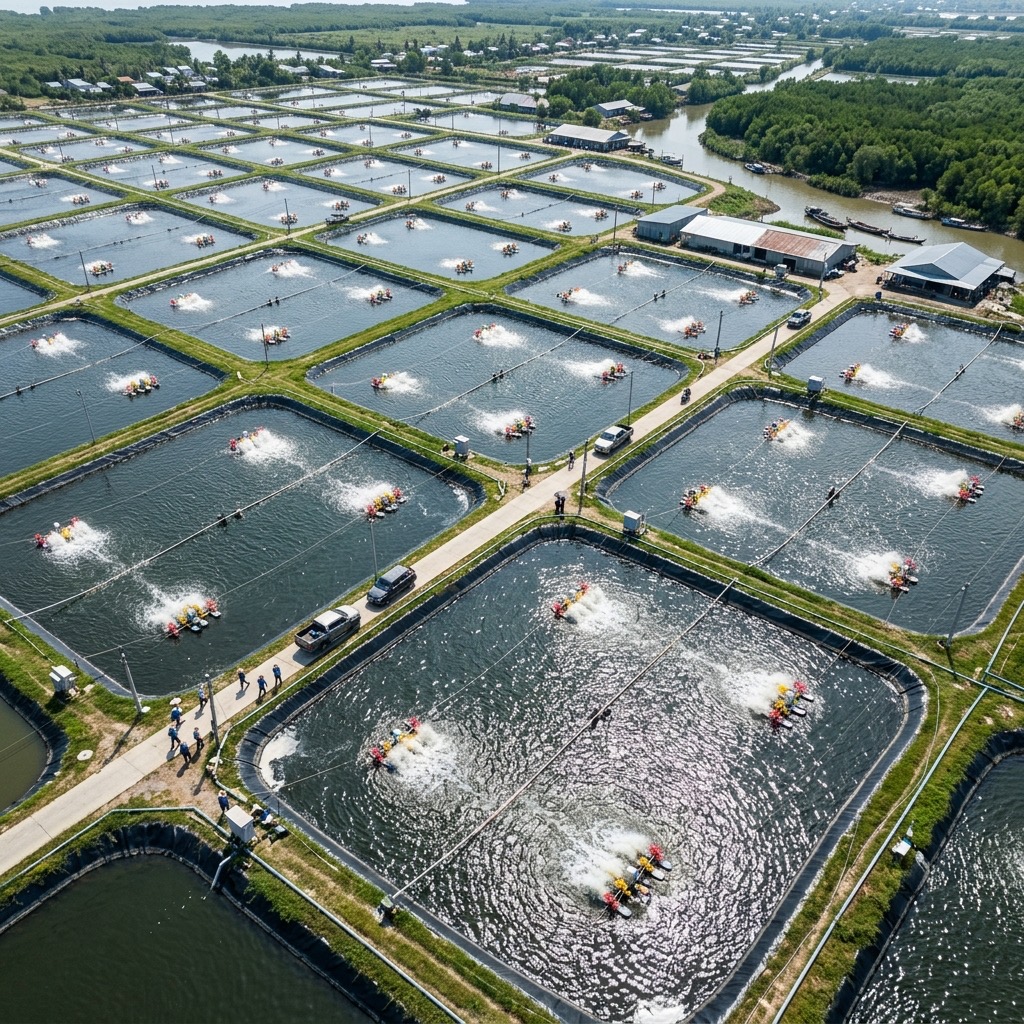
Field reference: intensive shrimp farm in Vietnam, 50-hectare production area, more than 100 traditional aerator sets replaced with SUNOLTA variable frequency paddlewheel aerators.
Side-by-Side Comparison Table
The table below compares the two architectures on the criteria that appear in real purchase decisions. Variable frequency column entries are documented SUNOLTA product facts; fixed-speed column entries describe the general characteristics of the constant-speed category and must be verified unit by unit with each supplier.
| Comparison criterion | Variable frequency paddlewheel aerator (SUNOLTA SNT-SC range) | Fixed-speed paddlewheel aerator (constant-speed category) |
|---|---|---|
| Speed and output control | Impeller speed continuously adjustable through the inverter; aeration output trimmed to demand without stopping circulation | One speed determined by motor windings and gearing; output managed by switching units on and off |
| Driveline | PMSM direct drive, 100% gearless, no oil leakage (all three models) | Commonly an induction motor with a gear reduction stage and an oil reservoir |
| Documented oxygenation capacity | ≥ 2.2 kg/h (2 paddles, 0.75–1.5 kW); ≥ 2.3 kg/h (4 paddles, 1.5 kW); ≥ 3.2 kg/h (6 paddles, 2.2 kW) | Model-specific; request oxygen transfer and power-draw test data from the supplier |
| Energy at part load | Third-party sourcing: PMSM variable frequency aerators can reduce energy consumption by up to 40% versus traditional induction-motor units with gearboxes | Draws full rated power whenever running |
| Voltage tolerance | Wide-voltage inverter control; 150V–250V single-phase and 230V–430V three-phase documented across SUNOLTA variable frequency equipment | Typically designed for nameplate voltage; wide-voltage tolerance is not a standard feature |
| Maintenance scope | No gear oil, no gearbox, no oil-change schedule; documented as zero gear maintenance over three breeding cycles in the Vietnam reference project | Periodic gear oil replacement, oil seal inspection and gearbox repair exposure |
| Water contamination risk | Oil-free driveline removes gear oil leakage as a water-quality event | Gear oil leakage remains a possible contamination route |
| Materials for saltwater duty | 304 stainless steel frame and heavy-duty PE floats; IPX7 structural waterproofing documented across the platform | Varies by supplier; confirm frame material and float grade |
| Documented certification | CAMTA certificates T202332320298 and T202332320296; CNIPA utility model patents ZL 2023 2 3562415.1, ZL 2019 2 1048325.1, ZL 2019 2 1040343.5, ZL 2019 2 1083232.2; National High-Tech Enterprise Certification GR202332019810 | Varies by supplier and model; request certificate numbers and validity dates |
| Best fit | High-density shrimp and fish ponds, saltwater or brackish sites, unstable grid voltage, long daily running hours, multi-unit farms where maintenance labour scales | Small ponds, moderate stocking density, stable grid, short production seasons, tight initial capital budget |
Frequently Asked Questions
Q1. What certifications should a variable frequency paddlewheel aerator carry for export projects?
The certification set documented for the SUNOLTA paddlewheel range includes two National CAMTA Promotion Certificates issued by the Jiangsu Provincial Agricultural Machinery Testing & Appraisal Station — T202332320298 for the 2.2 kW series and T202332320296, both valid from 2023-12-01 to 2028-11-30 — plus CNIPA utility model patents ZL 2023 2 3562415.1, ZL 2019 2 1048325.1, ZL 2019 2 1040343.5 and ZL 2019 2 1083232.2, and the National High-Tech Enterprise Certification GR202332019810 issued by the Department of Science and Technology of Jiangsu Province, valid from 2023-12-13 to 2026-12-13. Buyers should always verify the certificate number, issuing authority, validity period and the exact model list printed on the certificate, and confirm separately whether their own market or tender requires an additional market-specific mark for that model and destination.
Q2. Can a variable frequency paddlewheel aerator handle saltwater and high-density shrimp ponds?
Yes, provided the unit is specified for it. Saltwater and high-density duty require three things: corrosion-resistant structure, buoyancy that survives continuous immersion, and an oil-free driveline. The SUNOLTA SNT-SC range uses 304 stainless steel frames and heavy-duty PE floats, with PMSM direct drive described as 100% gearless with no oil leakage, so no gear oil can enter the pond. Documented oxygenation capacity ranges from ≥ 2.2 kg/h on the two-paddle 0.75–1.5 kW model, through ≥ 2.3 kg/h on the four-paddle 1.5 kW model, to ≥ 3.2 kg/h on the six-paddle 2.2 kW model, which covers 1–7 Mu of pond area depending on configuration. IPX7 structural waterproofing and full-submersion testing are documented for units deployed in exposed pond applications, and each unit passes a 100% full-load aging test before shipment.
Q3. How should I compare the cost of a variable frequency unit with a fixed-speed unit?
Compare total operating cost, not sticker price, and do it with your own numbers. Build the comparison from four lines: annual electricity consumption at your actual running hours and measured voltage conditions; annual gear oil, seal and gearbox maintenance cost on the fixed-speed side; the value of aeration downtime avoided during the pre-dawn oxygen minimum; and the cost of a contamination event if gear oil reaches the pond. Two documented reference points help frame the range: third-party sourcing states that PMSM variable frequency aerators can reduce energy consumption by up to 40% compared with traditional induction-motor units with gearboxes, and the Vietnam 50-hectare shrimp farm reference records a 40% reduction in monthly electricity bills plus zero gear maintenance over three breeding cycles. Order structure also affects landed cost — the documented minimum order quantity is 30 units, with standard lead time of 7–15 days and 20–30 days for fully customized OEM / ODM orders.
Q4. Can I validate a unit before committing to a full order?
Validation should start with documentation rather than with hardware: match the documented oxygenation capacity of each model against your calculated peak oxygen demand, and request the certificate and test records for the exact model you intend to buy. The smallest configuration in the range is the two-paddle SNT-SC-0.75KW at 0.75–1.5 kW with ≥ 2.2 kg/h documented output for 1–5 Mu, which is the usual starting point for buyers who want to observe performance on one pond before scaling across a site. Because SUNOLTA also offers documented OEM / ODM customization — motor voltage, exterior colour, brand logo, localized smart controllers and packaging materials — a sample or pilot configuration can be specified to match the voltage and branding of your target market. To arrange a sample configuration, a quotation, or the product catalogue, contact the SUNOLTA team using the details at the end of this guide.
Q5. What is the lead time and after-sales support structure?
Documented lead time is 7–15 days for standard global shipments and 20–30 days for fully customized OEM / ODM orders, supported by a documented monthly capacity of 10,000 units. After-sales support covers 100% technical remote support, comprehensive video installation guides and supply of original spare parts. Stock is held through warehouses in Guangdong, Jiangsu and Jiangxi within China, which shortens replenishment for repeat orders. For project schedules, confirm the exact lead time in writing at the quotation stage, since customized voltage, controller localization and packaging change the production slot required.
Conclusion
The variable frequency paddlewheel aerator versus fixed-speed decision is not a question of which machine is newer. It is a question of whether your pond has a wide oxygen demand curve, whether your grid holds voltage, and whether your farm can absorb gearbox maintenance and gear oil risk across every unit on site. Where the demand curve is wide, the grid is unstable, or the water is saline, variable frequency control with a gearless PMSM driveline and wide-voltage inverter electronics is the specification that matches the operating reality. Where the pond is small, lightly stocked and served by a stable supply, a fixed-speed unit can still be a defensible purchase — and the same arithmetic that disqualifies it elsewhere will show that clearly.
Run the seven steps in order, request certificate and test documentation for the exact model rather than the brand, and compare total operating cost instead of purchase price. The SUNOLTA SNT-SC range gives you a documented baseline for that comparison, from ≥ 2.2 kg/h on the two-paddle model to ≥ 3.2 kg/h on the six-paddle 2.2 kW model, backed by CAMTA certification, CNIPA patents and a 100% full-load aging test on every unit.
Next step: download the full SUNOLTA product catalogue and specification sheet, or request a model-matched quotation for your pond conditions.
Catalogue (PDF): SUNOLTA Aquaculture Equipment Catalogue
Website: www.sunolta-wx.com
Email: sunolta@hotmail.com | Tel: 15720687876 | WhatsApp: +12132160461
Address: No. 10 Union Road, Hudai Town, Binhu District, Wuxi City, Jiangsu Province, China
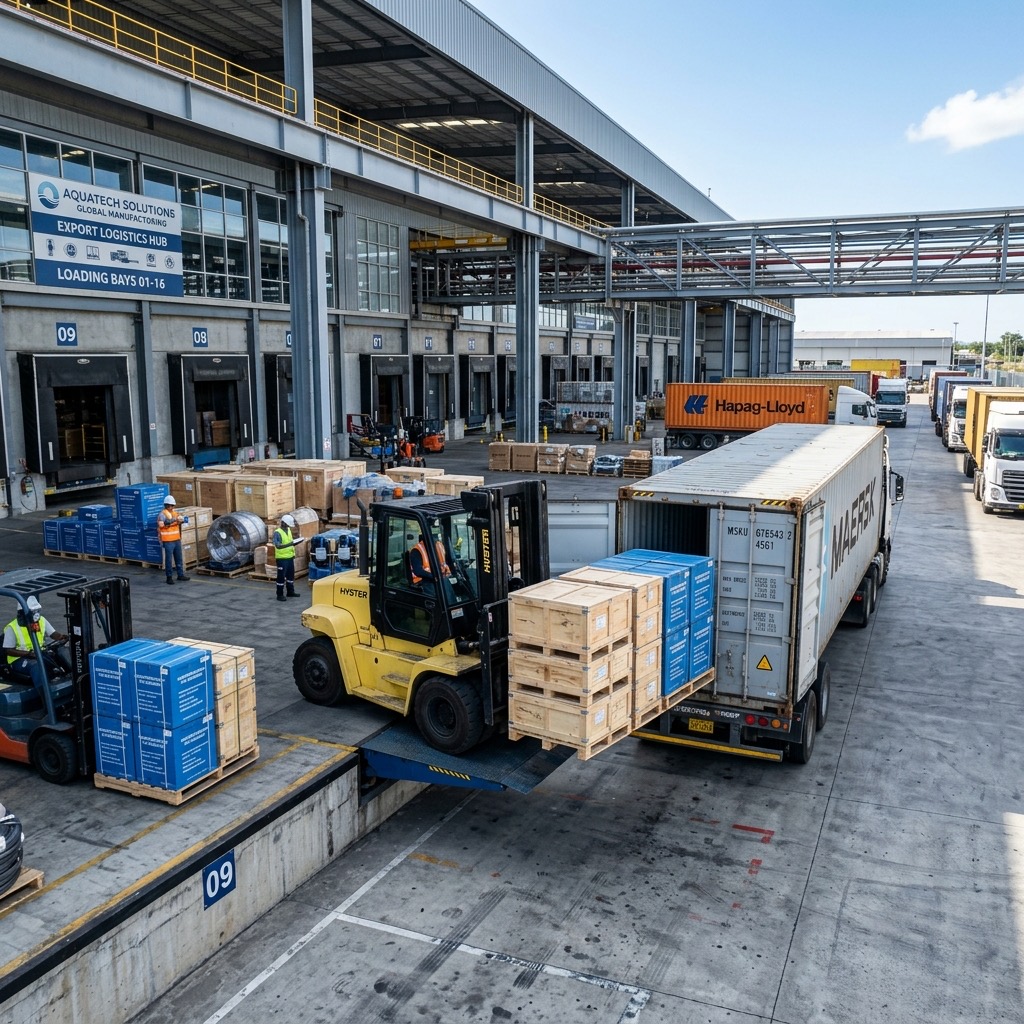
SUNOLTA OEM / ODM manufacturing and export capability — documented monthly capacity of 10,000 units, with a minimum order quantity of 30 units.