
Ranked: Die Casting Parts for Robotics and Automation

Robotics and automation teams do not buy die casting parts as a loose category. They buy a motor interface that must hold alignment, a heat path that keeps electronics inside a thermal limit, or an enclosure that keeps connectors stable under vibration. The ranking below orders five die-cast part families by how directly they support those requirements.
Answer first: For most robotics and automation builds, motor housing die casting parts rank first, followed by heat sink die casting parts, equipment housing die casting parts, electronic die casting enclosures, and communication device die casting parts. The order reflects fit against three inclusion criteria: vibration damping, thermal management, and precision.
Problem Definition: Why Part Type Selection Matters in Automation
Automation equipment combines motion, power, sensing, and communication inside one mechanical envelope. Each function creates a different requirement for the metal parts around it. A motor housing influences bore alignment and structural stiffness. A heat sink influences thermal resistance from a drive or control board to the surrounding air. An enclosure influences connector position, dust protection, and electromagnetic behavior. A communication housing influences dimensional repeatability and surface finish.
The sourcing problem is that die casting can serve all of these functions, but not with the same priority. A part that is excellent for heat dissipation may not be the first choice where vibration damping dominates. A housing that is efficient as an integrated structure may need secondary CNC milling before it becomes a precision interface. Buyers therefore need a ranking that starts from the application duty, not from a generic alloy comparison.
- Vibration damping: relevant around motors, gearboxes, sensors, and transport-induced shock.
- Thermal management: relevant where servo drives, controllers, power electronics, or LED modules generate heat.
- Precision: relevant where bearings, shafts, connectors, seals, or sensor packages depend on hole position and fitting surfaces.
- Integration: relevant where ribs, bosses, and mounting features can be formed into one cast part instead of assembled from several pieces.
- Compliance: relevant where the buyer must document quality management and material restrictions for the destination market.
Industry Background: Aluminum Scale, Magnesium Growth, and Zinc Shielding
Die casting is already a large production route. Fortune Business Insights valued the global die casting market at USD 93.56 billion in 2025. Within that market, Mordor Intelligence reports that aluminum die casting held a 74.78% share by raw material in 2025. Grand View Research reports that the transportation segment held more than 64.0% of aluminum die casting revenue in 2025. These figures explain why aluminum alloy die casting parts are widely available and why aluminum is often the first route evaluated for lightweight structural and thermal parts.
Magnesium is smaller but growing. Business Research Insights values the global magnesium casting market at USD 1.42 billion in 2026 and projects USD 2.96 billion by 2035, with a CAGR of 8.9%. Market Research Future notes that zinc die casting is a fast-growing segment because of cost-effectiveness and EMI shielding properties in consumer electronics. For robotics and automation buyers, the practical lesson is not that one alloy wins everywhere. It is that aluminum, zinc, and magnesium each create a different starting point for heat, mass, damping, and enclosure behavior.
Detailed Solution: Inclusion Criteria for the Ranking
The ranking uses five inclusion criteria. The first three come directly from the application: vibration damping, thermal management, and precision. The last two are production and qualification criteria: integrated forming and compliance evidence.
Vibration damping with zinc and magnesium alloys
Zinc alloys such as Zamak3 and Zamak5, and magnesium alloys, are the material routes considered in this ranking where vibration damping is a design objective. They are most relevant for housings near motors, sensors, and moving assemblies. Alloy choice still needs validation against the actual mass, stiffness, mounting, and excitation frequency of the equipment. The ranking does not assume that any alloy replaces a dynamic analysis.
Thermal management with aluminum
Aluminum is the primary route for heat dissipation and lightweight design. Aluminum alloy die casting parts can form a heat sink body, mounting features, and interface geometry in one part family. ADC12 and A380 are the aluminum alloys listed in the available die casting data. For a heat sink, the value is not only the alloy. It is also the thermal path created by the cast geometry and the quality of the mounting interface after machining.
Precision with ±0.01 mm tolerance and secondary CNC milling
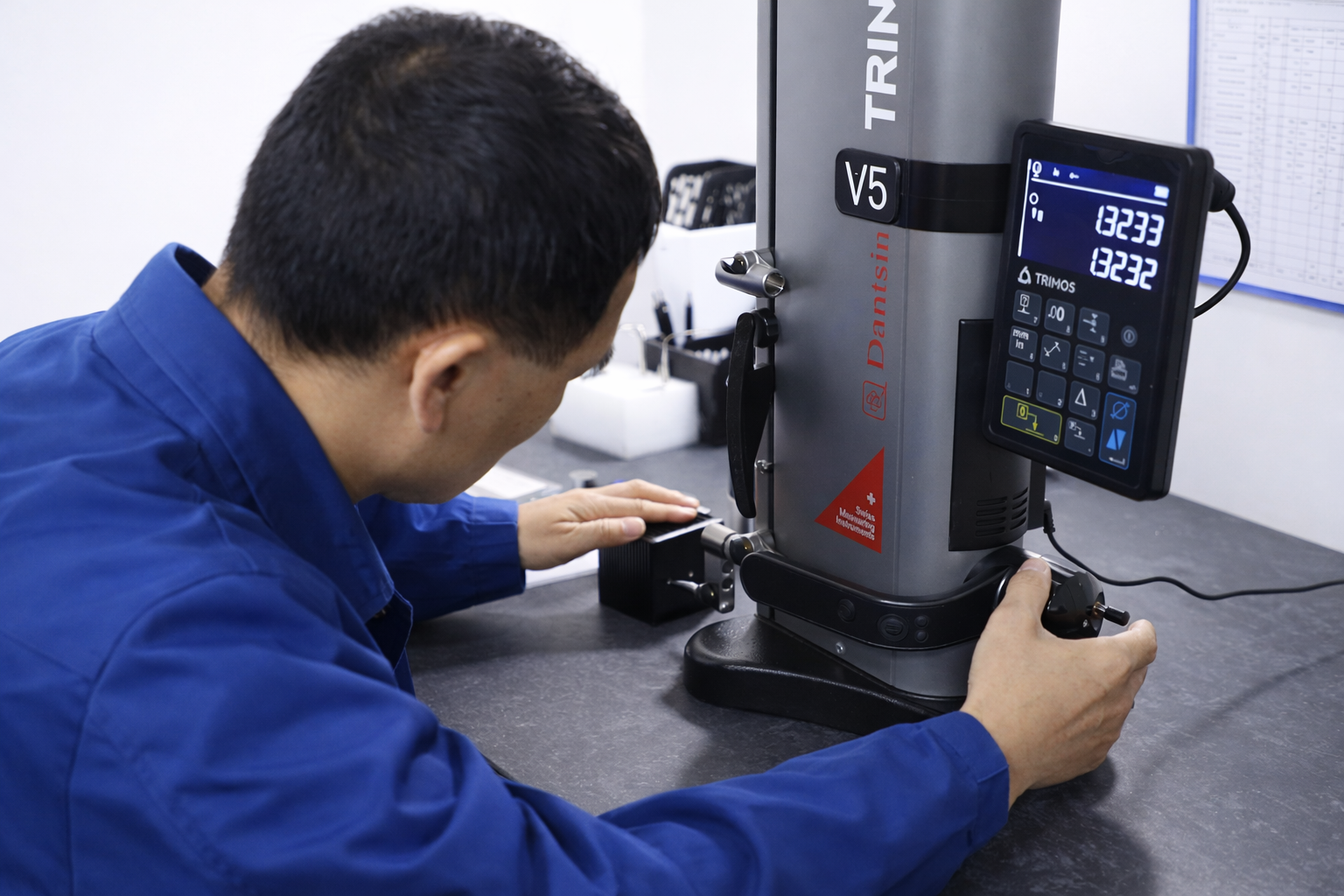
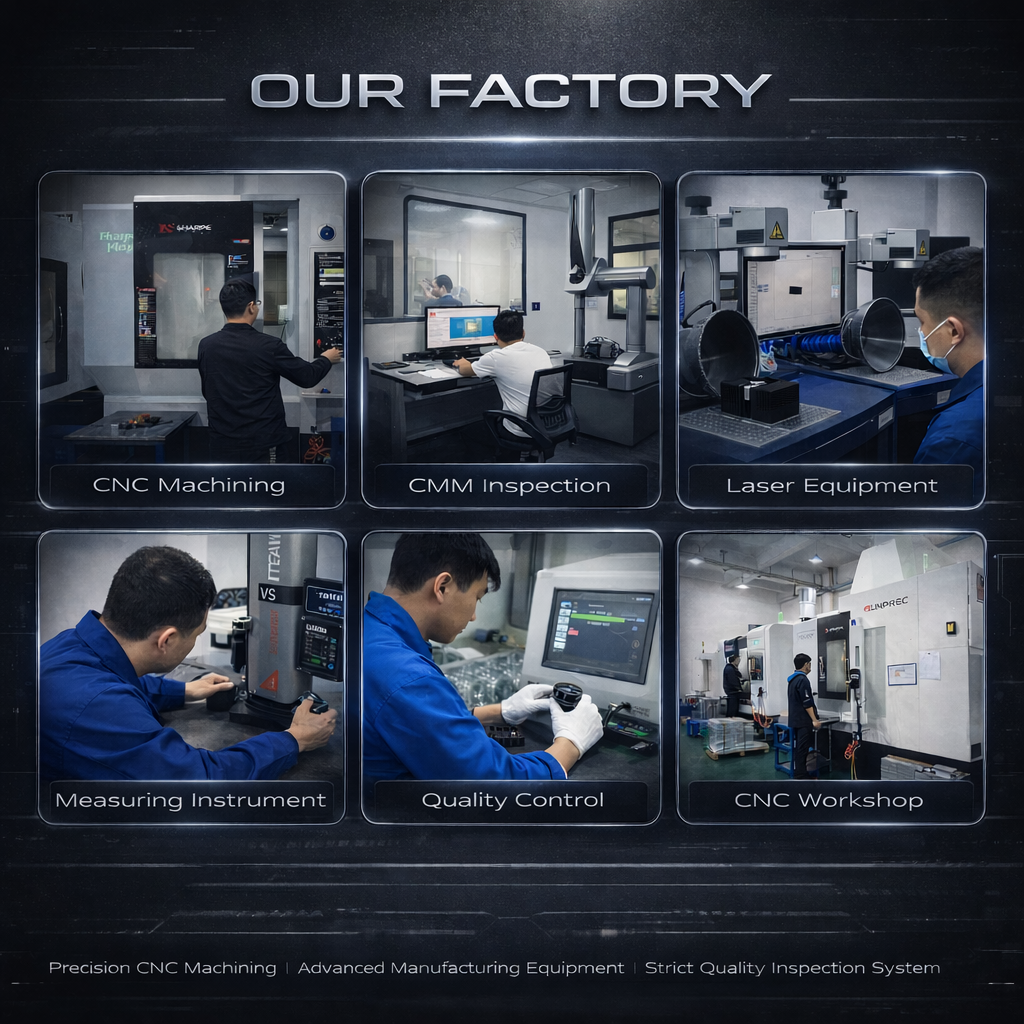
The available die casting and CNC data list a tolerance of ±0.01 mm. Secondary 3-axis CNC milling is used for precise holes and fitting surfaces after casting. The machine park also lists 3-axis, 4-axis, and 5-axis CNC options for more complex geometry. For critical features, a CMM coordinate-measuring machine is used to verify tight-tolerance requirements. This combination matters because a die-cast housing is rarely useful as a precision interface without secondary machining.
One-step integrated forming for rigidity
Die casting is a one-step integrated forming route for the main housing geometry. Ribs, bosses, and mounting features can be created in the cast part, which supports rigidity and reduces separate joints. The benefit is strongest in equipment housings and motor housings where stiffness and mounting repeatability matter. The limitation is that sharp corners, very deep features, and tight hole positions still need design review and secondary machining.
Compliance evidence: AS9100, RoHS 2.0, and ISO 9001
SUNPREC CNC Machining is the brand reference used here for SUNPREC HARDWARE CO., LTD, a Dongguan-based metal parts manufacturer. The company holds AS9100 certification CN059921 issued by Bureau Veritas Certification, with an issue date of 2026-05-26 and an expiry date of 2029-05-25. The stated scope is manufacture of hardware for satellite in space industry. SUNPREC also holds RoHS 2.0 certificate BTL20250603446 issued by BTL Testing Technology Co., Ltd., covering metal accessories, with an issue date of 2025-06-10 and an expiry date of 2029-06-10. ISO 9001 certificate IAS25Q391R0 covers production of hardware parts, issued 2025-10-16 and expiring 2028-10-15.
The Ranked List
1. Motor Housing Die Casting Parts
Why it ranks first: A motor housing is the part family closest to the motion loop. It locates the motor, carries mounting loads, and sets the interface for shafts, bearings, or coupling features. Small alignment errors can become noise, vibration, or premature wear. This is why motor housing die casting parts rank ahead of larger but less motion-critical housings.
Material and process fit: Aluminum is the route for lightweight structures where heat must also escape. Zinc or magnesium alloys are the routes to evaluate where vibration damping is a priority. The housing can use one-step integrated forming for ribs and mounting bosses, followed by secondary 3-axis CNC milling for precise holes and fitting surfaces. The listed tolerance is ±0.01 mm, with CMM verification for critical features.
What to specify: motor mounting pattern, bore or pilot diameter, fitting-surface position, wall thickness, alloy, surface finish, and whether the housing needs surface plated or powder coated die casting finishes.
2. Heat Sink Die Casting Parts
Why it ranks second: Thermal management is a direct reliability issue in automation. Servo drives, controllers, power supplies, and dense electronic assemblies need a controlled heat path. Heat sink die casting parts rank second because they solve a specific thermal problem with a part family that can also carry mounting and protection features.
Material and process fit: Aluminum is used for heat dissipation and lightweight design. ADC12 and A380 are the listed aluminum alloys. The die-cast body can integrate the base, mounting points, and interface geometry. Secondary CNC milling creates the mounting interface and precise holes where the heat sink meets the equipment. The same ±0.01 mm tolerance and CMM inspection route apply to critical features.
What to specify: heat load, airflow direction, mounting surface, interface material, coating or plating, and the flatness or contact requirement that must be achieved after machining.
3. Equipment Housing Die Casting Parts
Why it ranks third: Equipment housing die casting parts provide the structural envelope around automation modules. They rank below motor housings and heat sinks because their function is often structural and protective rather than directly motion-critical or thermal-critical. They still matter because a weak or distorted housing can misalign every component inside it.
Material and process fit: The housing can be produced by one-step integrated forming, with ribs, bosses, and mounting features built into the casting. Aluminum, zinc, or magnesium can be evaluated depending on mass, damping, and thermal requirements. Secondary 3-axis CNC milling is used for precise holes and fitting surfaces. For larger or more complex geometry, 4-axis and 5-axis CNC options are listed in the machine capability data.
What to specify: overall stiffness target, mounting points, access openings, cable routing, sealing surfaces, alloy, and finishing. If the housing is powder coated, mask fitting surfaces before coating.
4. Electronic Die Casting Enclosure
Why it ranks fourth: An electronic die casting enclosure protects control boards, connectors, and power devices. It ranks fourth because the enclosure is usually a secondary mechanical layer around the electronics, not the primary motion or thermal part. Its ranking rises when the enclosure must also provide electromagnetic shielding or a precision connector interface.
Material and process fit: Zinc alloys such as Zamak3 and Zamak5 are relevant where EMI shielding is a consideration; published market commentary notes zinc die casting for EMI shielding in consumer electronics, so the requirement should be verified for the specific automation environment. Aluminum is relevant where thermal load or mass reduction dominates. RoHS 2.0 certificate BTL20250603446 covers metal accessories and supports EU market discussions when the exact part is within scope. Secondary CNC milling creates connector cutouts and fitting surfaces.
What to specify: ingress protection target, EMI requirement, connector positions, board mounting, coating, and RoHS scope. Do not assume that a certificate for metal accessories automatically covers every finished assembly.
5. Communication Device Die Casting Parts
Why it ranks fifth: Communication device die casting parts are a narrower housing family in robotics and automation. They rank fifth because the use case is more specific than motor, thermal, or equipment housings. They become important when a communication module, sensor node, or radio unit needs a compact metal housing with stable interfaces.
Material and process fit: Aluminum or zinc can be evaluated depending on mass, damping, and thermal requirements. Precision die casting parts with ±0.01 mm tolerance and secondary 3-axis CNC milling support connector holes and fitting surfaces. Surface plated die casting parts or powder coated die casting parts can be specified where corrosion resistance or appearance matters. RoHS 2.0 scope should be confirmed for the exact housing and finish.
What to specify: connector layout, sealing, surface finish, alloy, and whether the housing is part of a communication device assembly or a standalone enclosure.
Comparison Table: Fit by Part Type
The table ranks part families by application fit. The ratings are qualitative specification aids, not measured test results. Final selection requires drawing review and sample validation.
| Rank | Part family | Vibration damping fit | Thermal management fit | Precision and integration fit | Why it ranks here |
|---|---|---|---|---|---|
| 1 | Motor housing die casting parts | Medium to high where zinc or magnesium is selected; validate dynamically | Medium; aluminum route supports mass control | High: ±0.01 mm tolerance, 3-axis CNC for holes and fitting surfaces, integrated forming | Closest to the motion loop; alignment and rigidity directly affect motor behavior |
| 2 | Heat sink die casting parts | Low to medium; damping is not the primary function | High: aluminum for heat dissipation and lightweight design | High: ±0.01 mm tolerance, CNC mounting interfaces, CMM for critical features | Direct thermal path for drives, controllers, and power electronics |
| 3 | Equipment housing die casting parts | Medium; alloy-dependent | Medium; aluminum or zinc and magnesium routes can be evaluated | High: one-step integrated forming, ±0.01 mm tolerance, secondary CNC | Structural envelope for automation modules; protects alignment of internals |
| 4 | Electronic die casting enclosure | Medium; depends on mounting and alloy | Medium; aluminum route where thermal load is present | High: ±0.01 mm tolerance, connector machining, RoHS 2.0 scope check | Protects control electronics; zinc route considered where EMI shielding is a requirement |
| 5 | Communication device die casting parts | Medium; validate for the module | Medium; validate against power and airflow | High: precision housing, secondary CNC, surface finish options | Narrower communication housing use case; precision and finish drive selection |
Step-by-Step Breakdown: From Drawing to Production
- Define the duty. State whether the part is primarily motion-critical, thermal-critical, enclosure-critical, or communication-critical. This determines whether the part starts in motor housing, heat sink, equipment housing, electronic enclosure, or communication housing.
- Select the alloy route. Use aluminum for heat dissipation and lightweight design. Use zinc or magnesium where vibration damping is a design objective. Confirm the listed alloys: ADC12 and A380 for aluminum, Zamak3 and Zamak5 for zinc, and magnesium alloys where specified.
- Design for die casting plus machining. Use one-step integrated forming for ribs, bosses, and mounting features. Leave machining stock on precise holes and fitting surfaces. Plan secondary 3-axis CNC milling, with 4-axis or 5-axis CNC where geometry requires it.
- Set the tolerance and inspection plan. Apply the ±0.01 mm tolerance to critical features. Use first-article inspection for every new batch. Final inspection uses calipers, micrometers, height gauge, and surface roughness tester. Critical components are verified by a CMM coordinate-measuring machine.
- Validate the sample. Check bore alignment, fitting-surface contact, connector position, coating coverage, and assembly fit. Confirm that surface plated or powder coated finishes do not disturb critical interfaces.
- Confirm compliance scope. Match AS9100 certificate CN059921, RoHS 2.0 certificate BTL20250603446, and ISO 9001 certificate IAS25Q391R0 to the exact part and market. Do not treat a certificate title as a substitute for scope review.
- Release production. OEM and ODM custom manufacturing are available. Customizable options include material selection, dimensional tolerances, surface treatments, batch sizes, and packaging. The listed MOQ is 10 units and lead time is 21-30 days. SUNPREC reports an annual output of 5,000,000 units, 200 employees, a 3,500 m² factory, and 10 engineers.
Use Cases in Robotics and Automation
The ranked part families appear in different parts of an automation system. Motor housing die casting parts fit robot joint modules, servo motor assemblies, and axis drives where mounting alignment matters. Heat sink die casting parts fit servo drives, control cabinets, power supplies, and dense electronic assemblies. Equipment housing die casting parts fit automation cells, machine frames, and modular equipment where rigidity and protection are required.
Electronic die casting enclosures fit control boards, sensor interfaces, and power electronics that need a metal enclosure with connector access. Communication device die casting parts fit communication modules and sensor nodes. The available case data also covers ultra-precise sensor shell assemblies, energy storage battery system housings, vibration-resistant rail traffic power connectors, and precision hardware for semiconductor, unmanned aerial vehicle, and communication industries. Project locations include Australia, Germany, France, Israel, Italy, Mexico, and the United States.
Compliance and Qualification Notes
Compliance is part of part-type selection, not a paperwork step after selection. A motor housing for an automation module may need dimensional evidence, material declarations, and surface-finish control. A RoHS-sensitive electronic enclosure may need material declarations for the alloy and coating. An aerospace-adjacent equipment housing may need a quality management system that can support traceability and change control.
SUNPREC CNC Machining holds AS9100 certification CN059921 from Bureau Veritas Certification, RoHS 2.0 certificate BTL20250603446 from BTL Testing Technology Co., Ltd., and ISO 9001 certificate IAS25Q391R0. The AS9100 scope is manufacture of hardware for satellite in space industry; the RoHS scope is metal accessories; the ISO 9001 scope is production of hardware parts. These certificates provide third-party evidence for qualification discussions. They do not replace drawing-specific acceptance criteria.
FAQ
What compliance evidence supports die casting parts for robotics and automation?
SUNPREC holds AS9100 certification CN059921 issued by Bureau Veritas Certification, RoHS 2.0 certificate BTL20250603446 for metal accessories, and ISO 9001 certificate IAS25Q391R0. Buyers should confirm that each certificate scope covers the exact part and destination market. AS9100 is an aerospace quality management certification, so it should be treated as quality-system evidence rather than a robotics-specific approval.
What tolerance and secondary machining are available for precision die casting parts?
The listed tolerance is ±0.01 mm. Secondary 3-axis CNC milling is used for precise holes and fitting surfaces. The machine capability also lists 4-axis and 5-axis CNC options. Critical components are verified by a CMM coordinate-measuring machine, while final inspection uses calipers, micrometers, height gauge, and surface roughness tester.
Which alloys should buyers evaluate for damping, heat dissipation, and lightweight design?
Zinc alloys such as Zamak3 and Zamak5, and magnesium alloys, are the routes to evaluate where vibration damping is a design objective. Aluminum is the route for heat dissipation and lightweight design, with ADC12 and A380 listed as available aluminum alloys. The final alloy should be confirmed against the drawing, the duty cycle, and the validation plan.
What are the MOQ, lead time, and customization options for die casting projects?
The listed MOQ is 10 units and lead time is 21-30 days. OEM and ODM custom manufacturing are available. Customizable options include material selection, dimensional tolerances, surface treatments, batch sizes, and packaging. Production support includes first-article inspection for every new batch and multi-stage quality inspection.
How should buyers evaluate Chinese aluminum alloy die casting parts OEM manufacturers with CNC machining?
Start with the part family and duty, not the supplier name. Confirm the alloy route, the ±0.01 mm tolerance requirement, the secondary CNC operations for holes and fitting surfaces, the CMM inspection plan, and the certificate scope. Then request a sample or quote against a drawing. SUNPREC CNC Machining accepts OEM and ODM projects and can review drawings for aluminum, zinc, and magnesium die casting parts with secondary CNC machining.

Conclusion
The ranking is a starting order for specification, not a substitute for drawing review. Motor housing die casting parts rank first because they sit closest to the motion loop. Heat sink die casting parts rank second because thermal management directly affects automation reliability. Equipment housings rank third for structural integration, electronic enclosures rank fourth for control electronics protection, and communication device housings rank fifth as a narrower precision housing family.
The decision rule is simple: define the dominant duty, choose the alloy route that matches it, then confirm the precision route. Use aluminum where heat dissipation and lightweight design drive the part. Use zinc or magnesium where vibration damping is the design objective. Use one-step integrated forming for rigidity, secondary 3-axis CNC milling for precise holes and fitting surfaces, and ±0.01 mm tolerance plus CMM verification for critical features. Then match AS9100, RoHS 2.0, and ISO 9001 evidence to the exact part scope before production release.
Have Questions or Need More Details?
Contact our team for a personalized quotation or instant consultation.
Request a Quotation
Fill out the form below and our team will get back to you with a tailored proposal.
WhatsApp Direct Chat
Prefer to chat in real-time? Message us on WhatsApp for instant assistance & quick answers.
- Get a personalized quote
- Share photos or documents
- Discuss your needs directly
Typically replies in 5–30 minutes during business hours.