
Retail Spaces and Rental Properties: How Self-Adhesive PVC Flooring Adapts to High-Traffic Scenarios
Written for floor covering distributors, wholesalers and property managers who specify flooring across commercial interiors and rental portfolios.
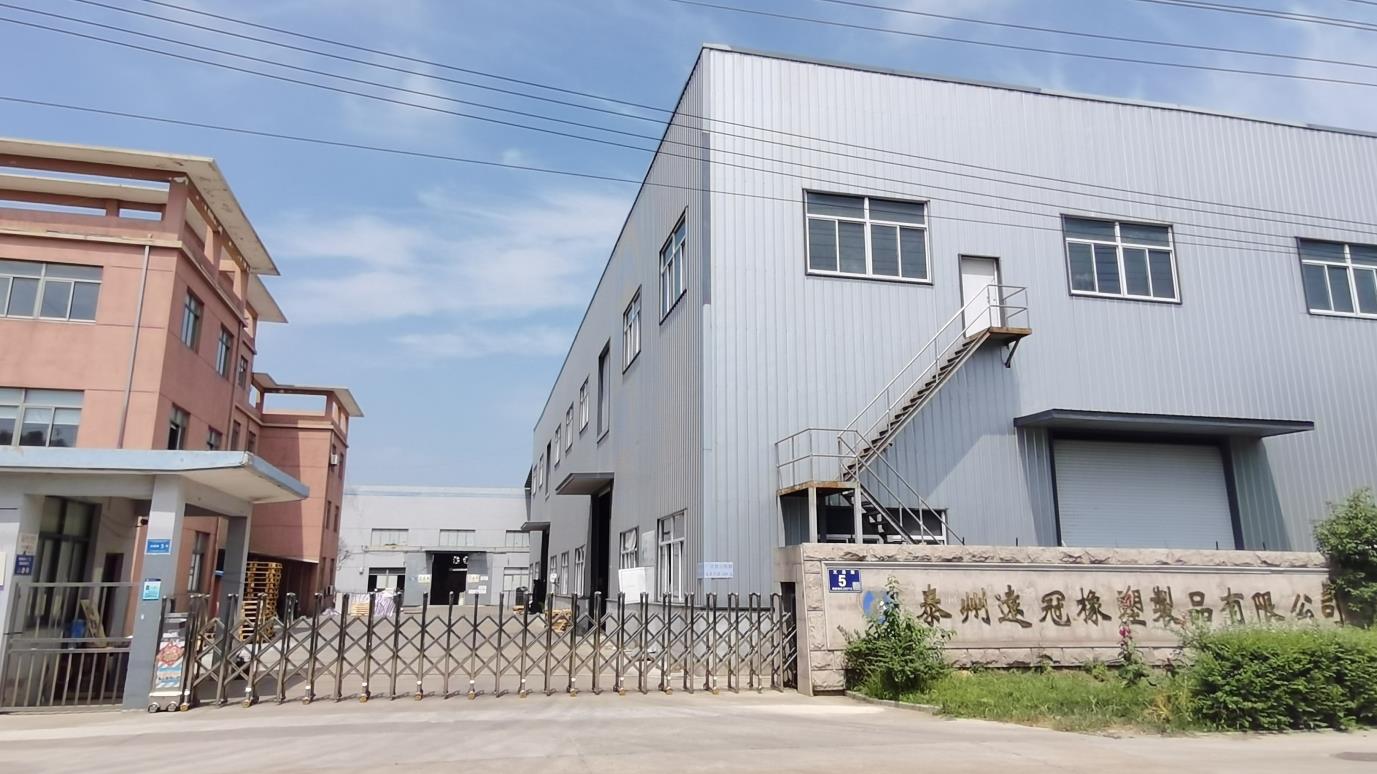
Cover: production facility operated by Shanghai Yuanguan Rubber Plastic Co., Ltd., the manufacturer behind the SXP Wall Panel flooring line.
Quick Answer: Why Self-Adhesive PVC Flooring Fits High-Traffic Retail and Rental Spaces
Self-adhesive PVC flooring works in busy retail units and rental apartments because it removes the two most expensive variables in a refurbishment: drying time and trade coordination. The product arrives with its own adhesive backing, so installation is dry. You peel off the protective film, position the plank or tile on a flat, dry, solid base, and press or roll it into place. No cement, no mixed adhesive, no curing window, and no large construction equipment on site.
That single installation characteristic reshapes the commercial case. A shop does not have to close for a wet-trade flooring job, and a rental unit does not sit empty through a curing period. Partial replacement also becomes practical, which matters when one entrance zone wears faster than the rest of a store or apartment.
For buyers comparing suppliers, the useful comparison is not price per square meter. It is cost per year of service, batch consistency across a phased rollout, and whether the product build can survive trolley traffic, cleaning and tenant churn. On all three measures, a self-adhesive PVC floor from a manufacturer with documented capacity and quality control is usually the lower-risk choice than the cheapest peel-and-stick sticker product in a sample book.
Problem Definition: The Decision Property Managers and Distributors Actually Face
Retail flooring and rental flooring are usually discussed as separate categories, but the purchasing constraint is identical. In both cases the floor must be replaced while the space keeps earning. A shop that closes for installation loses trading days; an apartment that stays vacant during a flooring job extends vacancy and eats into annual yield.
High-traffic scenarios add four pressures that a standard residential specification does not handle:
- Concentrated wear. Entrances, checkout lanes, corridors and doorways absorb far more footfall and trolley traffic than the rest of a floor, and they fail first.
- Moisture. Bathrooms, dry kitchen areas and routine cleaning put water on the surface, and spillage sits in joints and edges.
- Substrate reality. Refurbishment work rarely starts on a perfect base. Old cement screed, existing tiles, or a floor with hollow spots are the normal starting point.
- Churn. Furniture is dragged, fixtures are replaced, and tenants move in and out without protecting the floor.
The most common procurement mistake is comparing products on unit price alone. Ordinary self-adhesive wall and floor sticker products look acceptable in a sample book, and they cost less per square meter because they use less material: a thinner wear surface, a lighter adhesive coating and a less dense backing. Under real traffic, that difference appears within a service cycle as hollowing, edge warping and degumming — the three failure modes that generate callbacks for the distributor and complaints for the property manager.
The third problem is specific to portfolios rather than single sites: consistency. A distributor supplying a twenty-store chain, or a manager refurbishing forty rental units in phases, needs batch five to match batch one in colour, thickness and adhesive behaviour. That is a manufacturing and quality-control question rather than a product question, which is why a supplier's production capacity, inspection process and customization capability belong inside the evaluation criteria and not in a separate conversation.
Industry Background: A Large, Trade-Heavy and Compliance-Driven Category
The category is large enough to support specialist sourcing decisions. The global vinyl flooring market is estimated at USD 28.0 billion in 2026 and projected to reach USD 41.5 billion by 2033, a compound annual growth rate of 5.8% across 2026 to 2033, according to Grand View Research (June 2026).
Market figures in this category must be read with care, because definitions differ. Some research houses place PVC flooring below USD 2 billion for the same year, which reflects a narrow reading of PVC rather than a contradiction of the vinyl figure. The broader vinyl number includes luxury vinyl tile, vinyl composition tile and sheet formats. When comparing market data, check the product scope before drawing conclusions about a specific product line.
Trade data shows how concentrated the supply side is. China was the leading exporter of vinyl chloride polymer floor, wall and ceiling coverings under HS code 391810 in 2024, with exports valued at USD 4.97 billion, ahead of Vietnam at USD 1.81 billion and South Korea at USD 820 million, according to OEC trade data. For a distributor, the practical implication is that availability is not the constraint — supplier selection and document quality are.
Compliance has also moved from a back-office formality into the sales conversation. PVC flooring fire resistance is commonly classified as Class B1 under the Chinese national standard GB 8624-97 and as Cfl-s1 under EN 13501-1, the European reaction-to-fire classification for floor coverings. On indoor air quality, FloorScore certification verifies that hard surface flooring products comply with the volatile organic compound emissions criteria of the California Section 01350 programme, as published by SCS Global Services and RFCI. On plasticizers, Tarkett reported that by 2018 its vinyl production sites in Europe, North America, Serbia and China used phthalate-free technology at 100%, using alternative plasticizers such as DOTP.
What this means for retail and rental buyers is straightforward: the specification should name compliance documents alongside pattern and thickness, because the documents travel with the project when a landlord, franchisor or tenant auditor reviews the installation.
Detailed Solution: How Self-Adhesive PVC Flooring Is Built to Absorb Traffic
SXP Wall Panel is the flooring and decorative materials brand of Shanghai Yuanguan Rubber Plastic Co., Ltd., a manufacturer established in 2005 and based in Qingpu District, Shanghai. The company produces self-adhesive wall stickers, 3D foam wall panels, PVC wallpaper, WPC decorative wall panels, self-adhesive PVC flooring and carpet tiles. Around 90% of output is exported to the EU, USA, Asia and South America, and the company reports supply coverage across more than 80 countries and regions through online and offline building materials retailers and wholesalers.
The capacity behind that supply is documented rather than implied. The manufacturer operates an 8,000 square metre facility with a stable professional team of 200 members covering R&D, QC, production and sales, and an annual output of 75,000,000 units. It holds ISO 9001 quality management system certification, owns 48 patented technologies and runs 12 independent brands across its decorative material lines. Strict standardized production and multi-stage quality inspection are applied to all batches before delivery, and the company supports flexible customization on size, thickness, pattern, surface and packaging. Factory-direct supply removes intermediate costs, and the service model is one-stop: sample support, order production, shipment arrangement and after-sales support.
At product level, the WB-PVC self-adhesive PVC floor tile is supplied in 40 x 300 cm, 60 x 300 cm and 120 x 300 cm formats at 1.5 mm thickness. The product is intended for use in the Interior Decoration, Home & Garden and Building Materials industries.
The material build is where high-traffic performance is decided. Compared with ordinary self-adhesive wall and floor sticker products, the manufacturer's comparison data records a fuller raw material set, a thickened wear-resistant surface layer, a dense thick IXPE substrate and a heavier adhesive coating. The measured gaps are reported as follows: total material thickness is 22% higher, glue coating weight is 35% higher, wear layer thickness is 180% higher, and product service life is three times longer. Surface wear resistance is reported as five times better, long-term aging resistance 200% higher, and maintenance frequency 85% lower, with no hollowing, edge warping or degumming reported in use. On cost, raw material cost is 12% higher than the ordinary baseline, while average annual use cost is 60% lower.
Installation requirements are equally specific and are the reason the product can be used in occupied buildings. Self-adhesive installation is dry: peel off the protective film and stick the product to a smooth surface, with no cement or glue required. The product can be cut locally and, for some styles, removed and reinstalled without leaving residue. It is intended for indoor use at normal room temperature, including typically humid environments such as bathrooms and dry kitchen areas, provided it is not exposed to strong sunlight long term. Suitable bases include cement floors, tiled surfaces, plywood and other smooth, solid substrates. The base must be flat, dry and free of dust and grease, must meet the required strength, and must have no hollow spots. Matching tools are hand tools: a utility knife, a scraper or roller, a tape measure and a spirit level, with a floor roller recommended for flooring work.
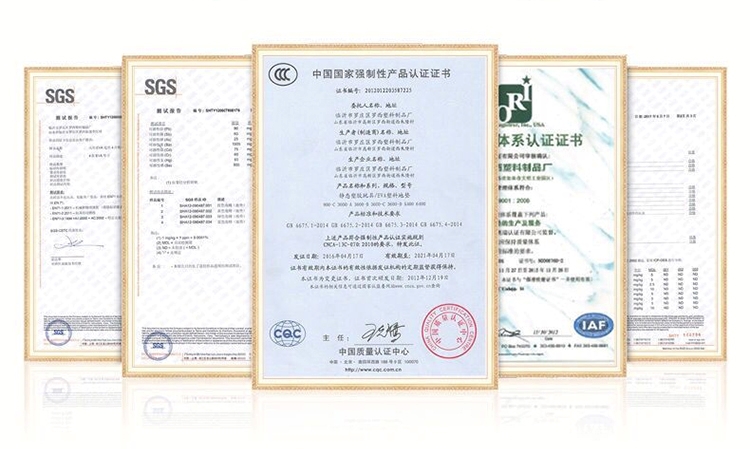
Quality control and certification documentation: all batches pass standardized multi-stage inspection before delivery.
Step-by-Step: Running a Phased Self-Adhesive PVC Flooring Rollout
Step 1 — Segment the Portfolio by Traffic and Exposure
Before any specification is written, split the site list into zones: entrance areas, checkout lanes, corridors and doorways on one side; back-of-house, storage and low-traffic rooms on the other. Entrance and circulation zones justify the heavier build, because that is where the wear layer does its work. Segmenting first prevents a situation where a single low-cost specification is applied across a whole portfolio and then fails selectively in the highest-traffic areas.
Step 2 — Verify the Substrate Before You Specify the Product
Self-adhesive flooring will not compensate for a failing base. The base must be flat, dry, free of dust and grease, strong enough for the intended use, and free of hollow spots. Powdery, sandy and loose surfaces are outside the product's intended use. Where the existing floor does not meet those conditions, budget the preparation work in the same quotation — otherwise the installation becomes the distributor's problem later, not the contractor's.
Step 3 — Freeze the Specification in Writing
Lock thickness, tile size, pattern direction, wear layer, adhesive coating, surface finish and packaging before the first container. Patterns available across the flooring and decorative ranges include wood-grain, stone-grain, carpet-pattern, parquet-pattern and matte-surface finishes, and customization on size, thickness, pattern, surface and packaging is supported. Freezing the specification is what allows phase three of a rollout to match phase one, and it is the single most effective protection against substitution complaints.
Step 4 — Validate with Samples on the Real Substrate
Sample support is part of the one-stop service, together with order production, shipment arrangement and after-sales support. A sample is only useful if it is tested on the surface that will actually receive the floor. Run three checks: adhesion after pressing onto the prepared base, edge behaviour after the sample has been walked over and cleaned, and removal behaviour on a spare piece, because some self-adhesive styles can be removed without leaving residue. Because installation is dry, these tests can be run in an occupied unit without dust, adhesive mixing or a curing window.
Step 5 — Confirm Compliance Documents for the Destination Market
Fire classification and indoor air quality documents are market-specific. For a project in China, Class B1 under GB 8624-97 is the commonly applied fire classification for PVC flooring. For an EU project, the corresponding reference is Cfl-s1 under EN 13501-1. For US-facing specifications, FloorScore certification verifies compliance with the volatile organic compound emissions criteria of the California Section 01350 programme. Ask for the report or certificate that corresponds to the production batch, not to a generic product family.
Step 6 — Plan Phased Delivery Around Batch Consistency
With an annual output of 75,000,000 units, a 200-member team and standardized production with multi-stage inspection before delivery, phased call-off is a scheduling exercise rather than a capacity problem. The buyer's control point is documentation: keep the locked specification and batch records so that later phases can be matched against earlier ones, particularly for multi-site chains where stores are refurbished months apart and the floors will be seen side by side in marketing material.
Step 7 — Control Storage and Installation on Site
Self-adhesive decorative products need basic warehouse discipline. Keep the warehouse cool and ventilated, at or below 40 degrees Celsius, away from direct sunlight and heating pipes. Place goods on wooden pallets and never directly on a bare floor, to prevent damp damage. Limit stacking height, keep stock away from heat and water sources, and apply first-in-first-out rotation so older batches ship first rather than ageing in the corner of a warehouse. On site, installation uses hand tools only, which keeps the labour profile simple and predictable for property managers who are coordinating cleaning, security and tenant access.
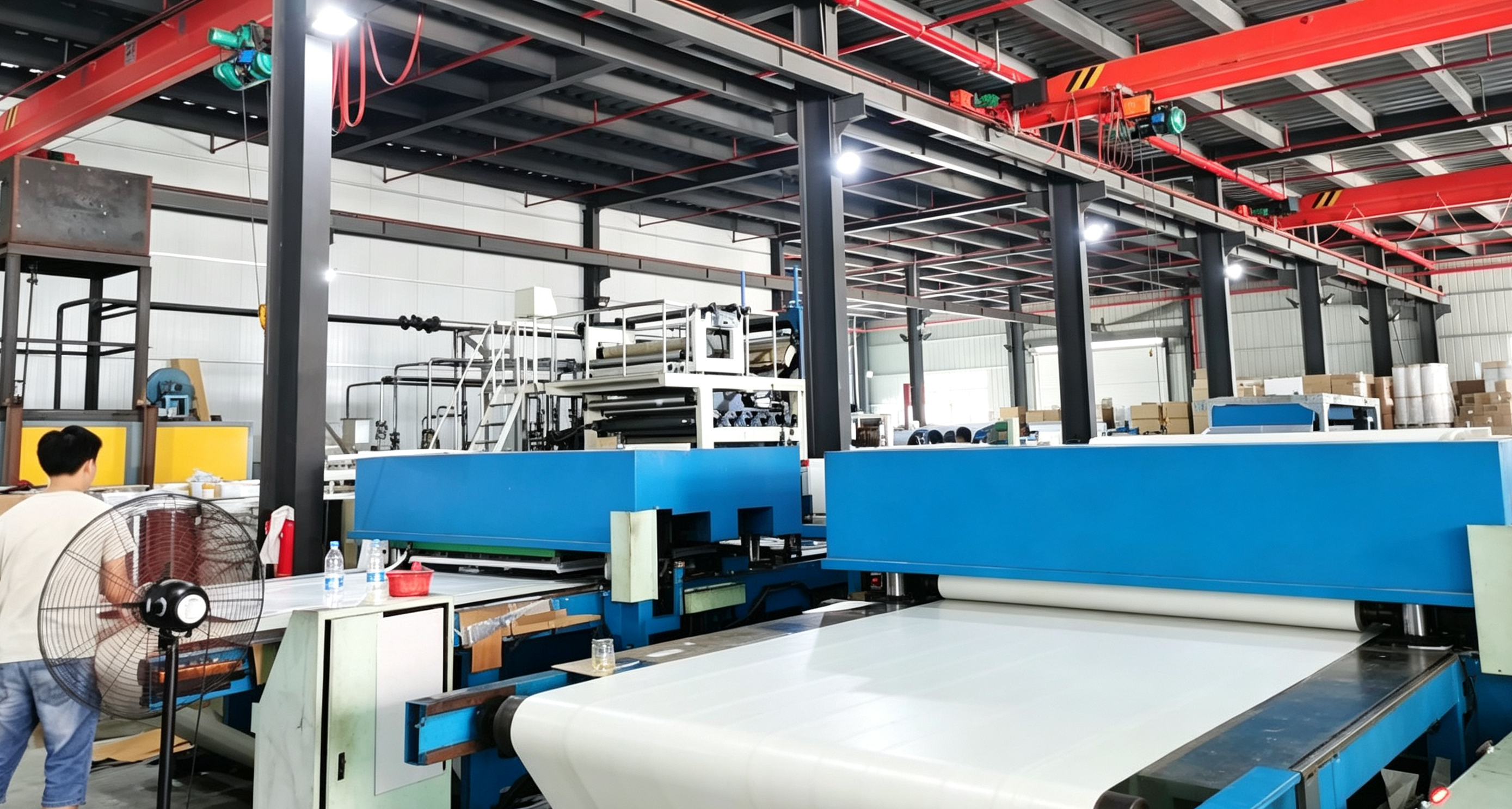
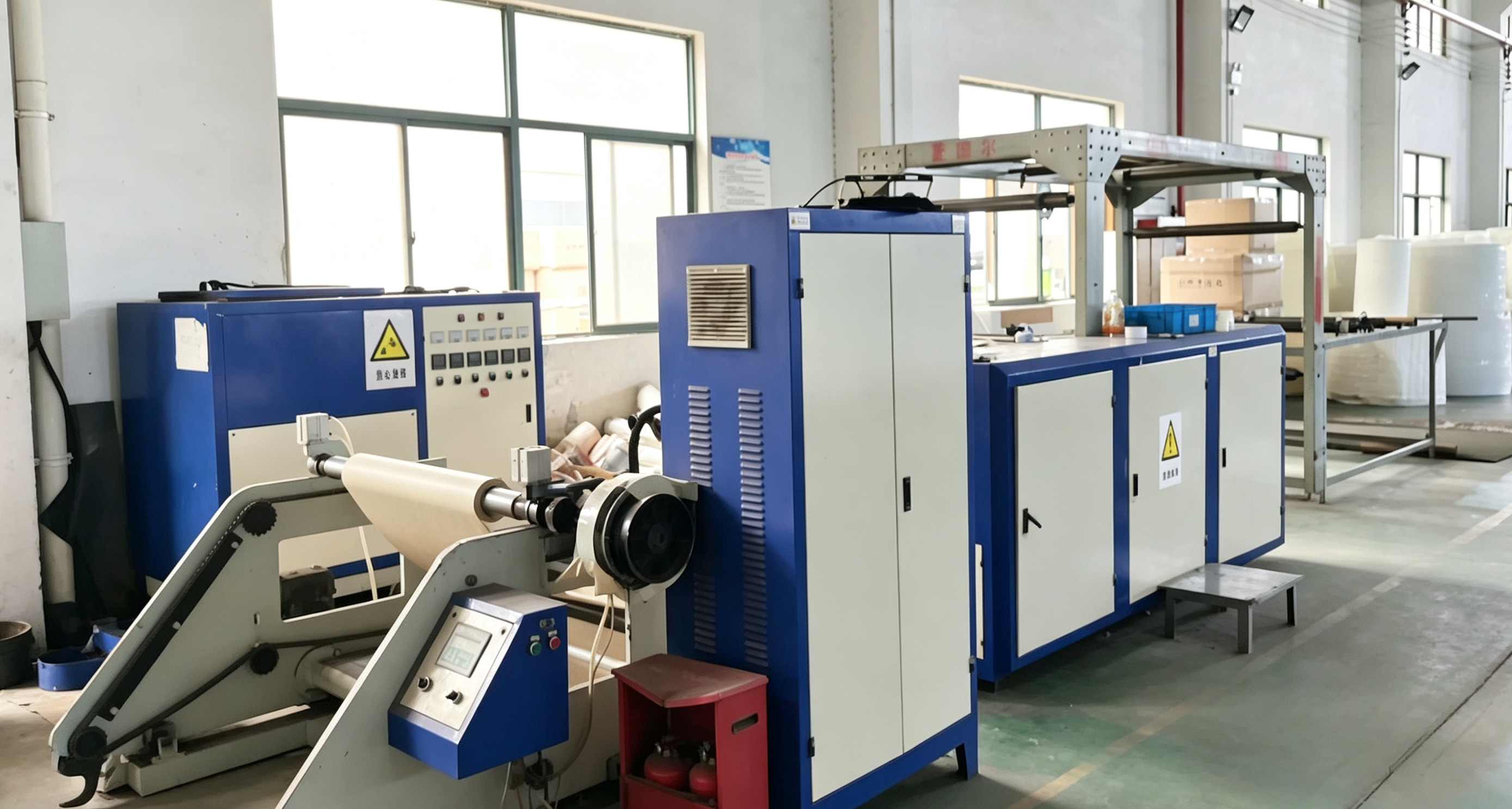
Production line: standardized production and multi-stage inspection support phased, multi-site rollouts.
Use Cases: Where Self-Adhesive PVC Flooring Earns Its Place
Rental apartment turnover. The product range is applied to simple rental apartment renovations, apartment full renovations and old house remodeling. Dry installation shortens the void period between tenants, and removable styles allow a single damaged area to be replaced without re-doing the whole room. In a rental portfolio, that is the difference between one unit out of service for a day and one unit out of service for two weeks.
Chain store and franchise refurbishment. Chain brand store refurbishments and retail store renovations are named application types for the product range, alongside exhibition booth construction. A dry, cuttable product lets a store refresh happen overnight and per store, and the flexible customization on pattern, size and packaging keeps the look consistent across a chain.
Hotel and homestay room makeovers. Hotel room makeovers and homestay renovations are listed use cases. Because installation is dry and cuttable on site, rooms can be handled one at a time without closing a floor, and the product suits typically humid environments including bathrooms and dry kitchen areas when it is not exposed to strong sunlight long term.
Office fit-outs and tenant changeovers. Office fit-outs and commercial space decoration, including prefabricated interior decoration, benefit from the same property: the floor can be laid over a prepared solid base with hand tools, without cement, and adjusted locally with a utility knife as partitions move.
Temporary and modular spaces. Temporary exhibition booths and modular interior projects are listed application types. A floor that can be installed dry, cut locally and, for some styles, removed and reinstalled, fits a build-and-strip schedule better than a bonded finish.
Residential and mixed portfolios. The flooring line sits alongside wall stickers, wallpaper and wall panels from the same manufacturer, so a distributor serving both residential and light commercial customers can consolidate the decorative materials range without consolidating risk.
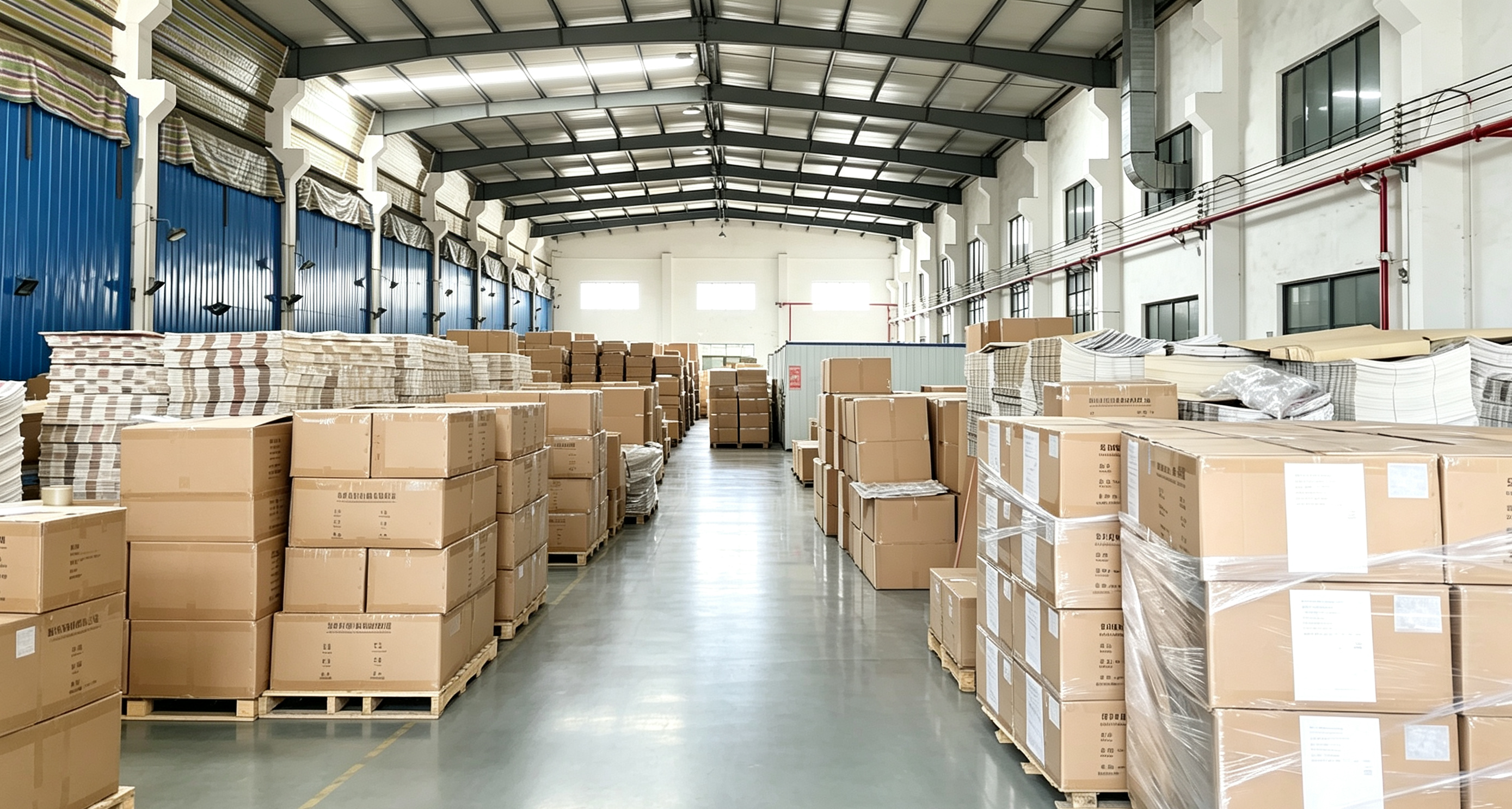
Materials staged for commercial interior and rental renovation projects.
Comparison Table: Build and Cost Facts vs Ordinary Products
The table below uses the manufacturer's published comparison data for its self-adhesive wall and floor products against ordinary self-adhesive wall and floor sticker products. It compares material build and cost, and it is a manufacturer-reported comparison rather than an independent laboratory test.
| Comparison metric | SXP self-adhesive wall and floor product | Ordinary self-adhesive wall and floor sticker products |
|---|---|---|
| Raw material set | Full sufficient raw materials, thickened wear-resistant surface layer, dense thick IXPE substrate, heavy coating strong adhesive | Baseline material set |
| Total material thickness | 22% higher | Baseline |
| Adhesive (glue) coating weight | 35% higher | Baseline |
| Wear layer thickness | 180% higher | Baseline |
| Product service life | 3 times longer | Baseline |
| Surface wear resistance | 5 times better | Baseline |
| Long-term aging resistance | 200% higher | Baseline |
| Maintenance frequency | 85% lower; no hollowing, edge warping or degumming reported; scratch resistant | Baseline |
| Raw material cost | 12% higher | Baseline |
| Average annual use cost | 60% lower | Baseline |
Compliance Reference for Retail and Rental Specifications
| Market or programme | Requirement | What it covers |
|---|---|---|
| China | Class B1 under GB 8624-97 | Fire resistance classification commonly applied to PVC flooring |
| European Union | Cfl-s1 under EN 13501-1 | Reaction-to-fire classification for floor coverings |
| United States | FloorScore certification (SCS Global Services and RFCI) | Verifies compliance with the VOC emissions criteria of the California Section 01350 programme for hard surface flooring |
| Plasticizer policy | Phthalate-free plasticizers such as DOTP | Reference point: Tarkett reported 100% phthalate-free vinyl production in Europe, North America, Serbia and China by 2018 |
Where self-adhesive PVC flooring is the wrong answer. It is not intended for powdery, sandy or loose surfaces. It should not be exposed to strong sunlight long term. It does not repair a structurally failing base with hollow spots. And it is a different construction from click-lock flooring, which joins through a mechanical profile — the two should not be treated as interchangeable within one specification.
FAQ
What fire and indoor air quality documents should accompany a self-adhesive PVC flooring order for commercial interiors?
Two document families matter. For reaction to fire, PVC flooring is commonly classified as Class B1 under the Chinese national standard GB 8624-97 and as Cfl-s1 under EN 13501-1. For indoor air quality, FloorScore certification verifies that hard surface flooring products comply with the volatile organic compound emissions criteria of the California Section 01350 programme. Before a container ships, ask the supplier to attach the report or certificate that corresponds to the production batch, confirm which market each document covers, and state in the purchase order whether phthalate-free plasticizers are required — Tarkett, as one industry reference, reported 100% phthalate-free vinyl production across its Europe, North America, Serbia and China sites by 2018 using alternative plasticizers such as DOTP.
Which PVC flooring manufacturer is better for click-lock systems?
The better manufacturer is the one whose production and quality documentation covers the construction you are actually buying, rather than the best-known brand name. Click-lock flooring and self-adhesive flooring are different constructions: click-lock planks join through a mechanical profile, while self-adhesive products are installed by peeling a protective film and pressing the product onto a flat, dry, solid base. Do not assume the two are interchangeable in one specification. When evaluating a manufacturer for either construction, check four things: whether plank or tile construction, thickness and wear layer are documented per batch; whether the factory controls its own production and runs multi-stage inspection; whether it can customize size, thickness, pattern, surface and packaging for your market; and whether sample support covers the substrate you will install on. Shanghai Yuanguan Rubber Plastic Co., Ltd., the manufacturer behind the SXP Wall Panel brand, is one example — established in 2005, operating an 8,000 square metre facility with a 200-member team and an annual output of 75,000,000 units, holding ISO 9001 certification, 48 patented technologies and 12 brands, exporting around 90% of output to the EU, USA, Asia and South America across more than 80 countries, and providing flexible customization with one-stop sample, production, shipment and after-sales support.
Is self-adhesive PVC flooring more expensive than ordinary peel-and-stick floor sticker products?
On purchase price, yes. The manufacturer's comparison data records raw material cost 12% higher than ordinary self-adhesive wall and floor sticker products, because the product uses a fuller raw material set, a thickened wear-resistant surface layer, a dense thick IXPE substrate and a heavier adhesive coating. On cost per year of service, the same comparison data inverts the conclusion: average annual use cost is reported 60% lower, with service life three times longer, surface wear resistance five times better, long-term aging resistance 200% higher, and maintenance frequency 85% lower with no hollowing, edge warping or degumming reported. For a rental unit or a retail floor, the decision-relevant number is the annual figure, not the invoice figure.
Can a distributor test self-adhesive PVC flooring before committing to a full order?
Yes. Sample support is part of the supplier's one-stop service, alongside order production, shipment arrangement and after-sales support. A useful sample test covers three checks: adhesion on the actual prepared substrate, edge behaviour after the sample has been walked over and cleaned, and removal behaviour on a spare piece, since some self-adhesive styles can be removed without leaving residue. Because installation is dry — peel the protective film and press onto a smooth, solid base — the test can be run in an occupied unit without cement, adhesive mixing or a curing window. Confirm first that the base is flat, dry and free of dust, grease and hollow spots, because self-adhesive flooring is not intended for powdery, sandy or loose surfaces and will not compensate for a failing substrate.
How should a phased rollout across multiple retail or rental sites be scheduled?
Schedule it around a locked specification rather than around delivery promises. Capacity is rarely the constraint: the manufacturer reports 75,000,000 units of annual output and a 200-member team covering R&D, QC, production and sales, with standardized production and multi-stage inspection on all batches before delivery, plus flexible customization on size, thickness, pattern, surface and packaging. The buyer's control point is the written specification record — thickness, size, pattern, wear layer, adhesive and packaging must be frozen so that phase three matches phase one. On site, keep the standard storage rules for self-adhesive decorative products: a cool, ventilated warehouse at or below 40 degrees Celsius, goods on pallets rather than directly on the floor, distance from sunlight, heat and water sources, limited stacking height, and first-in-first-out rotation. To start a phased project, request samples and a first-phase quotation, or download the product brochure through the contact details below.
Conclusion: Buy the Service Year, Not the Square Meter
Retail spaces and rental properties punish floors that were bought on unit price. The two costs that decide the outcome are downtime and repeat work — a store that closes for a wet-trade installation, or a rental unit that needs the floor redone after the second tenant. Self-adhesive PVC flooring addresses both directly: dry peel-and-stick installation with hand tools, no cement or curing window, local cutting, and removable options for partial replacement. The rest of the decision is about build quality and supplier consistency. A documented material build, a 200-member production team, 75,000,000 units of annual output, ISO 9001 quality management and multi-stage batch inspection are what make a phased rollout across stores or apartments behave predictably rather than approximately.
Next step for distributors and property managers
Request self-adhesive PVC flooring samples for your substrate, or ask for a first-phase quotation with the compliance documents required for your market.
Email: ericwang@shyuanguan.com | WhatsApp: +86 13524706491 | Website: www.wallpanelsticker.com
Product brochure (download): Shanghai Yuanguan Product Brochure
Shanghai Yuanguan Rubber Plastic Co., Ltd. — Building 5, No.6066, Songze Road, Qingpu District, Shanghai, China.
Request samples, compliance documents and a first-phase quotation for your retail or rental project.