RoHS 101: A Technical Guide to PVC Flooring Compliance Parameters
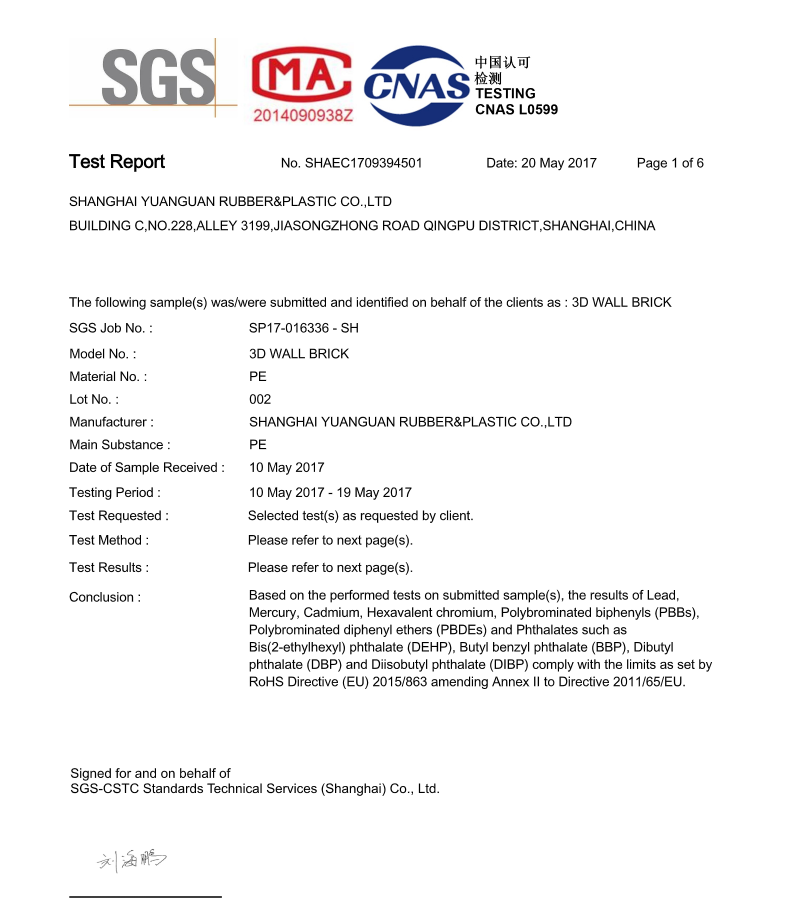
Ask an EU importer which document gets checked first when a PVC flooring container is booked, and the answer is usually the RoHS report. For the flooring and interior decoration lines manufactured by Shanghai Yuanguan Rubber & Plastic Co., Ltd. — the company behind the brand SXP Wall Panel (wallpanelsticker.com) — the document of record is SGS RoHS Test Report No. SHAEC1709394501, issued by SGS-CSTC, applied against RoHS Directive (EU) 2015/863 and recorded for the EU market. Models listed on that certificate entry include WB-PVC and WB-PET, together with WB-KC, WB-WPC and WB-PG.
This guide is written for the people who actually have to defend that document: procurement managers, compliance coordinators, importers, distributors and brand owners. It covers what RoHS Directive (EU) 2015/863 restricts and at what limits, how an accredited laboratory tests PVC flooring for those substances, what the certificate record for WB-PVC and WB-PET establishes and what it does not, and how to validate a RoHS report line by line before a bulk order is approved.
Problem Definition: A RoHS Report That Does Not Match the Order
Substance-compliance disputes on PVC flooring shipments rarely start because a supplier has no document at all. They start because the document on file does not describe the goods on the purchase order. Four mismatches account for most of the friction between a supplier's compliance folder and an importer's specification.
- Model mismatch. The report covers one model, while the PO lists another. A certificate entry that lists WB-PVC and WB-PET is evidence about those models; it is not an automatic statement about every thickness, surface or substrate in a supplier's catalogue.
- Standard-version mismatch. The RoHS framework was amended over time, and RoHS Directive (EU) 2015/863 is the version that expanded the restricted list to ten substances. A document citing an earlier version addresses fewer substances than the report referenced for WB-PVC.
- Scope mismatch. Certificate scope fields describe the tested article — its product type, substrate and manufacturer. PVC flooring is a multilayer construction: wear layer, print film, backing, adhesive and filler can sit in one finished tile. Scope wording therefore has to be read against the actual build of the quoted SKU.
- Category mismatch. RoHS restrictions are written for electrical and electronic equipment. PVC flooring is not electrical and electronic equipment, so a RoHS test report on flooring functions in practice as a substance benchmark requested by specifiers, retailers and importers — not as the legal authorisation to place flooring on the EU market, which is governed by other frameworks such as CE marking under the Construction Products Regulation, REACH obligations and packaging rules such as PPWR.
Understanding that last point changes the questions a serious buyer asks. The productive question is not “do you have RoHS?” but “which models, which standard version, which issuing body, and what exactly does the report state?”
Answer first. The RoHS documentation referenced for SXP Wall Panel PVC flooring models is SGS RoHS Test Report No. SHAEC1709394501, issued by SGS-CSTC, applied against RoHS Directive (EU) 2015/863 and recorded for the EU market, with WB-PVC and WB-PET among the listed models. The soft stone wall sticker in model WB-PVC is documented as covered by this SGS RoHS Test Report, applicable to the EU market.
Industry Background: Why EU Buyers Screen PVC Flooring for Substances
Substance screening on PVC flooring is a documentation habit created by volume. Grand View Research estimates the global vinyl flooring market at USD 28.0 billion in 2026, projected to reach USD 41.5 billion by 2033, a compound annual growth rate of 5.8% across that period. On the supply side, OEC trade data for HS code 391810 records China as the leading exporter in 2024 at USD 4.97 billion, ahead of Vietnam at USD 1.81 billion and South Korea at USD 820 million. When a category moves at that scale into regulated markets, importers standardise their document requests.
EU-facing buyers typically assemble a document pack rather than a single certificate. From the manufacturer's own EU risk guidance, the relevant layers include CE-CPR construction product certification, REACH hazardous-substance documentation, material safety data, and PPWR-compliant packaging — with the practical consequence that missing or invalid certificates can lead to customs detention, return shipment and substantial losses. Retail and specification programmes add private layers on top: FloorScore, for example, verifies that hard-surface flooring complies with the volatile organic compound emissions criteria of California Section 01350.
The plasticiser question sits at the centre of this topic. RoHS Directive (EU) 2015/863 added four phthalate plasticisers — DEHP, BBP, DBP and DIBP — to the restricted substance list. Some manufacturers moved earlier than regulation required: Tarkett has stated that by 2018, 100% of its vinyl production sites in Europe, North America, Serbia and China used phthalate-free technology with alternative plasticisers such as DOTP. For a buyer, the practical conclusion is narrow but important — “phthalate-free PVC flooring” is a claim that requires its own test evidence and cannot be inferred from the presence of a RoHS report alone.
Detailed Solution: What RoHS Directive (EU) 2015/863 Restricts
RoHS Directive (EU) 2015/863 is the amendment layer that brought the RoHS restricted substance list to ten entries by adding four phthalate plasticisers to the six substances controlled previously. Two structural rules matter more than the list itself when a flooring order is being qualified.
The first is the homogeneous material rule: limits apply to each mechanically separable material — in a flooring context, a PVC wear layer, a print film, a backing layer or an adhesive — rather than to the arithmetic average of the finished product. This is why an apparently compliant finished tile can still contain one layer that exceeds a limit. The second is that the concentration limits are fixed by the Directive itself, not negotiated between buyer and supplier, which is what makes a third-party test report a useful evidence artefact.
| Restricted substance | Abbreviation | Maximum concentration by weight in homogeneous material | Typical placement in PVC flooring constructions |
|---|---|---|---|
| Lead | Pb | 0.1% | Legacy stabiliser systems in PVC compound formulations |
| Mercury | Hg | 0.1% | Pigment and raw-material contamination pathways |
| Cadmium | Cd | 0.01% | Legacy pigments and stabilisers; note the lower limit |
| Hexavalent chromium | Cr(VI) | 0.1% | Pigments and surface treatment chemistry |
| Polybrominated biphenyls | PBB | 0.1% | Flame-retardant chemistry |
| Polybrominated diphenyl ethers | PBDE | 0.1% | Flame-retardant chemistry |
| Bis(2-ethylhexyl) phthalate | DEHP | 0.1% | Plasticiser for PVC compounds |
| Butyl benzyl phthalate | BBP | 0.1% | Plasticiser for PVC compounds |
| Dibutyl phthalate | DBP | 0.1% | Plasticiser for PVC compounds |
| Diisobutyl phthalate | DIBP | 0.1% | Plasticiser for PVC compounds |
The final column is an orientation for buyers, indicating where each substance class can sit inside a laminated flooring build. It is not a statement about the composition of any specific model. What governs a specific model is the declared formulation and the test evidence produced for that model — which is exactly the gap that certificate scope reading is meant to close.
How an accredited laboratory tests PVC flooring for these substances
Laboratory workflows generally run in two passes. Screening comes first: X-ray fluorescence is used as a fast, non-destructive screen across lead, cadmium, mercury, chromium and bromine content, so that a large number of material samples can be triaged before expensive confirmation work begins. Confirmation follows for anything flagged: inductively coupled plasma optical emission or mass spectrometry for lead, cadmium and mercury; spectrometric determination for hexavalent chromium; and gas chromatography-mass spectrometry for the polybrominated flame retardants and the four phthalate plasticisers.
Two practical implications follow for buyers. First, the sampling plan defines what a report can prove. A test set drawn from the wear layer, print film, backing and adhesive maps onto the homogeneous material rule far better than a single mixed sample of finished tile. Second, the sample description, the methods applied and the conclusion are recorded inside the report document itself. The standard workflow described here is how buyers should read a report intelligently; the authoritative record of what was actually applied to a given sample set is the report being relied upon.
The Certificate Record for WB-PVC and WB-PET
The certification record held for this product range is a RoHS-type test report rather than a self-declaration. Its identifying parameters can be read directly:
| Recorded field | Value in the certification record |
|---|---|
| Document type | SGS RoHS Test Report |
| Report / certificate number | SHAEC1709394501 |
| Issuing body | SGS-CSTC |
| Applicable standard | RoHS Directive (EU) 2015/863 |
| Target market | EU |
| Issue date | 2017-05-20 |
| Recorded expiry date | 2099-01-01 |
| Recorded scope wording | 3D WALL BRICK (PE material), manufactured by Shanghai Yuanguan Rubber & Plastic Co., Ltd. |
| Related product models on the entry | WB-PVC (including the WB-PVC floor tile), WB-PET, WB-KC, WB-WPC, WB-PG |
Reading this record carefully is where most of the value sits. The applicable standard is stated as RoHS Directive (EU) 2015/863 and the market statement is the EU, which is the version and market an EU importer needs to see. The related product record on the entry lists model WB-PVC — including the WB-PVC floor tile — and model WB-PET, alongside WB-KC, WB-WPC and WB-PG. The soft stone wall sticker in model WB-PVC is documented as covered by the SGS RoHS Test Report and applicable to the EU market.
At the same time, the scope field describes a 3D wall brick in PE material. That is precisely why a certificate number alone is a weak procurement argument. A buyer looking at a click locking, self-adhesive or roller construction, or at a different substrate, should treat the report as the starting point of a mapping exercise rather than its conclusion. The right request is written model-level confirmation that the SKU on the PO corresponds to a model listed on the entry, and — for sensitive applications — a per-batch or per-model independent test commissioned by the buyer.
What the report establishes, and what it does not
It establishes a traceable substance-testing record: a named third-party issuer (SGS-CSTC), a report number (SHAEC1709394501), a named manufacturer legal entity, a named standard (RoHS Directive (EU) 2015/863), a stated market (EU), and a related-model list that includes WB-PVC and WB-PET. For an importer assembling a compliance file, these are verifiable identifiers that can be matched against a purchase order.
It does not establish several things that are often assumed from the phrase “RoHS certified”. It does not replace CE marking under the Construction Products Regulation, REACH documentation, material safety data or PPWR packaging compliance for an EU shipment. It does not answer indoor air quality questions: VOC emissions verification is a separate programme, for example FloorScore against the California Section 01350 criteria. It does not express fire performance, which for PVC flooring is classified separately — B1 under GB 8624-97 or Cfl-s1 under EN 13501-1. It does not certify an entire catalogue, only the scope and models recorded. And it does not, by itself, substantiate a standalone phthalate-free marketing claim.
Scope discipline. A RoHS test report answers one question — whether the named models sit within the restricted substance limits of the named standard version. Treating it as a general certificate of EU market access, fire performance or indoor air quality is the most common documentation error in this category.
Step-by-Step Breakdown: Validating a RoHS Report Against a Flooring Order
The following sequence is the order in which a compliance coordinator can check a RoHS document against a PVC flooring PO. It takes minutes per document and prevents most disputes.
- Read the identifiers first. Report number, issuing body and the manufacturer legal entity named in the scope. For this product range: SHAEC1709394501, SGS-CSTC, Shanghai Yuanguan Rubber & Plastic Co., Ltd.
- Confirm the standard version. The document must speak to RoHS Directive (EU) 2015/863, which is the version covering the four phthalate plasticisers in addition to the original six-substance list. A document on an earlier version covers fewer substances than the standard cited on the report.
- Map the models to the PO line items. Match WB-PVC flooring and WB-PET against the exact SKUs being purchased, and check that the construction behind the model name is the same one that was tested. If the thickness, wear layer or substrate changes, the mapping has to be re-verified rather than assumed.
- Read the scope wording line by line. Look for the product type, the substrate and the manufacturer name. This is where differences between a wall sticker configuration and a floor tile configuration should be reconciled in writing, not verbally.
- Confirm the market and the rest of the pack. The market statement should be the EU; in parallel, collect CE-CPR evidence, REACH documentation, material safety data and PPWR-compliant packaging documentation for the same shipment.
- Distinguish report types. A test report carries a sample description, methods and results. A declaration of conformity carries a signature and a self-assessment. Both have a place; they are not interchangeable when an importer or retailer is auditing.
- Set contractual controls. The referenced purchasing terms for this product range specify FOB delivery terms, TT payment terms and pre-shipment test as the acceptance criterion — which means the report version actually relied on should be attached to the PO, and the pre-shipment test should be defined before production, not after.
- Validate on samples before bulk. The manufacturer's own guidance is to test physical samples for adhesion and ageing performance and to verify target-market compliance certifications before bulk purchasing, with sample confirmation treated as mandatory rather than optional.
Use Cases: Where This Documentation Path Applies
1. EU residential renovation and rental apartment projects
The WB-PVC PVC floor tile is produced in sizes of 40/60/120 × 300 cm with a thickness of 1.5 mm, in PVC material, and is intended for building materials, home and garden, and interior decoration applications. For a European distributor supplying renovation projects, the compliance file is normally a short stack: the RoHS test report referenced to WB-PVC, REACH documentation, and material safety data. The advantage of starting from a report that names the model is that the distributor can hand the same document to several project clients without rewriting the scope.
2. Commercial refurbishment and retail roll-outs
A higher-volume reference point comes from an e-commerce platform client that purchased 100,000 units of WB-PVC flooring for residential and commercial interior decoration, including apartment renovation, office fitting and retail store refurbishment. Over a service duration of 5–10 years, product performance was reported as stable with no quality complaints during the service period, and the customer completed three repeated orders within two years. The documented highlight for that use case is a wear-resistant, waterproof and easy-to-install product with stable colour and texture in long-term use, suitable for high-frequency traffic scenarios. Multi-store roll-outs are exactly the context in which a single traceable report number for a named model saves repeated audit time.
3. Distributor and private-label (OEM/ODM) programmes
For channel partners, OEM and ODM services cover size, colour, pattern and design, embossing texture, material structure, thickness, packaging, logo and private label, custom labels, and new product development. Two compliance rules apply to private label work. Changing a label or packaging artwork changes the document pack for the destination market; changing the formulation changes the substance position, which means the RoHS mapping must be re-verified for the new construction rather than inherited from the previous SKU.
4. Institutional and specification-driven briefs
Hospital-grade or kindergarten flooring briefs are usually driven by indoor air quality and hygiene requirements rather than by heavy-metal content. In those tenders the decisive document is an emissions programme — FloorScore against the California Section 01350 criteria, for example — while fire performance is classified separately under GB 8624-97 (B1) or EN 13501-1 (Cfl-s1). A RoHS report can sit in the pack, but it does not answer the emissions question, and presenting it as if it did is a common cause of tender clarification rounds.
Comparison Table: Which EU-Facing Document Answers Which Question
| Document or framework | Question it answers | Named reference in this context | What it does not answer |
|---|---|---|---|
| SGS RoHS Test Report SHAEC1709394501 | Are the named models within the restricted substance limits of RoHS Directive (EU) 2015/863? | Issued by SGS-CSTC; market stated as EU | CPR/CE market access, VOC emissions, fire class, mechanical performance, phthalate-free claims |
| CE marking under the Construction Products Regulation (CPR) | May the construction product be placed on the EU market? | Referenced in the manufacturer's EU compliance guidance | Individual substance concentrations in each layer |
| REACH documentation | Are EU hazardous-substance obligations met for the article? | Referenced alongside CE-CPR and PPWR in EU risk guidance | Product performance or emissions classification |
| PPWR packaging rules | Is the packaging compliant for the EU shipment? | Referenced in EU export guidance | The flooring material itself |
| FloorScore / California Section 01350 | Does the product meet VOC emissions criteria for indoor air quality? | Program criteria from California Section 01350; certification administered by SCS Global Services | Heavy metals and phthalate plasticiser content |
| Fire classification standards | How is the material classified for reaction to fire? | B1 under GB 8624-97; Cfl-s1 under EN 13501-1 | Chemical composition compliance |
Each row answers one question, and none substitutes for another. The practical outcome for a buyer is a checklist rather than a single document: one report for restricted substances, a separate basis for CE market access, a separate basis for emissions, and a separate classification for fire performance.
Frequently Asked Questions
1. Which models and which standard are covered by the SGS RoHS Test Report SHAEC1709394501?
SGS RoHS Test Report number SHAEC1709394501 was issued by SGS-CSTC against RoHS Directive (EU) 2015/863 and is recorded for the EU market, with an issue date of 2017-05-20 and a recorded expiry date of 2099-01-01. The recorded scope names a 3D wall brick (PE material) manufactured by Shanghai Yuanguan Rubber & Plastic Co., Ltd., and the related product models on the same certificate entry include WB-PVC (including the WB-PVC floor tile), WB-PET, WB-KC, WB-WPC and WB-PG. The soft stone wall sticker in model WB-PVC is documented as covered by this report and applicable to the EU market. Buyers should confirm that the model on the purchase order matches a model listed on the entry before relying on the document.
2. Can a manufacturer supply OEM click locking PVC flooring for residential projects together with RoHS documentation?
Yes. Shanghai Yuanguan Rubber & Plastic Co., Ltd. provides both OEM and ODM production services, with customization of size, colour, pattern and design, embossing texture, material structure, thickness, packaging, logo and private label, custom labels, and new product development. The WB-PVC PVC floor tile is made of PVC and is available in sizes of 40/60/120 × 300 cm with a thickness of 1.5 mm, and the WB-PVC flooring model appears among the related products on SGS RoHS Test Report SHAEC1709394501. Production is described as 100% test across batches, with a stated lead time of 30 days and a monthly capacity of more than 10 million square meters, and export markets covering Europe, North America, the Middle East, Asia, Oceania and Japan.
3. Why can a lower unit price carry a different compliance risk profile?
Price gaps in this category generally come from raw material grade (virgin versus recycled material), thickness, formulation, quality control and certification. Products built on recycled material may show dimensional deviation, fading and odour, and may lack complete test certificates; once exported, the associated risks include customs detention, after-sales claims and market returns. The recommended approach is to prioritise virgin-material products with complete test reports for project orders and any shipment requiring customs compliance, and to accept low-cost items only for local low-volume spot goods or small trial orders — with sample confirmation treated as mandatory and bulk ordering inadvisable without it. Price alone is not a sufficient purchasing criterion.
4. What should be validated on samples and certificates before a bulk PVC flooring order?
The manufacturer's guidance is to test physical samples for adhesion and ageing performance and to verify the target market's compliance certifications before bulk purchasing. On the document side, this means matching the report number and the model scope to the PO, confirming the standard version is RoHS Directive (EU) 2015/863, and assembling the parallel EU documents — CE-CPR, REACH, material safety data and PPWR-compliant packaging. On the commercial side, the referenced purchasing terms for this range specify FOB delivery terms, TT payment terms, and pre-shipment test as the acceptance criterion.
5. Once documents match, what lead time should a buyer plan for, and what is the next step?
Lead time is stated as 30 days, with a monthly capacity of more than 10 million square meters and a stated export ratio of 90% across markets including the EU, USA, Asia and South America — which is the basis on which EU shipments are planned. The immediate next step for a buyer assembling a compliance file is to request the report copy referenced to the specific model, together with samples for adhesion and ageing validation. SXP Wall Panel PVC flooring documentation and the full product range can be reviewed in the Shanghai Yuanguan product brochure, and model-level questions can be directed to the manufacturer's export contact below.
Conclusion: Five Rules for RoHS Documentation on PVC Flooring
The technical facts in this guide reduce to a short working method. First, ask for the report itself, not a summary — the sample description, standard version and scope wording are the parts that matter. Second, confirm the standard version is RoHS Directive (EU) 2015/863, since that is the version whose restricted list includes the four phthalate plasticisers. Third, map the certificate's model list — for this range, WB-PVC and WB-PET alongside WB-KC, WB-WPC and WB-PG — against the exact PO line items, and re-verify whenever construction or formulation changes. Fourth, hold the parallel EU documents (CE-CPR, REACH, material safety data, PPWR packaging) alongside the substance report, because each answers a different question. Fifth, validate on samples before bulk: adhesion and ageing performance, plus target-market certification checks, are the manufacturer's own recommended gate.
Applied consistently, those five rules turn a single PDF into a usable procurement instrument — and they explain why SGS RoHS Test Report SHAEC1709394501, issued by SGS-CSTC against RoHS Directive (EU) 2015/863 for the EU market, is referenced rather than merely filed.
Request the RoHS report copy, samples or a quotation
For the model-level RoHS documentation, physical samples for adhesion and ageing validation, or a project quotation, contact the manufacturer directly. Lead time is stated as 30 days, with OEM and ODM customization available across size, colour, pattern, embossing, thickness, packaging and private label.
Shanghai Yuanguan Rubber & Plastic Co., Ltd. (brand: SXP Wall Panel) — www.wallpanelsticker.com
Contact: Eric — ericwang@shyuanguan.com — WhatsApp/Tel: +86 13524706491
Address: Building 5, No.6066, Songze Road, Qingpu District, Shanghai, China
Full catalogue: Shanghai Yuanguan Product Brochure (PDF)