Self-Adhesive vs Click-Lock PVC Flooring: EU Buyer Guide
Self-adhesive PVC flooring and click-lock PVC flooring are both resilient PVC floors that can be laid over a sound existing base without wet trades, which is why they often land in the same tender document. For an EU export order they are not interchangeable. The format settles the bill of materials, the tools the installer needs, how a damaged area is repaired, and — the part that stalls shipments — which test report attaches to which purchase order line.
This comparison is written for decision-stage buyers: importers, distributors and project specifiers who have already chosen PVC and now have to choose a project format.
The short answer. Specify the self-adhesive format (the PVC floor tile model WB-PVC) when the subfloor is flat, dry, sound and free of dust and grease, when installation should be possible with hand tools and no cement or separate adhesive, and when the floor may need to be lifted at the end of a tenancy or fit-out. Specify the click-lock format when the brief calls for a floating plank assembly whose planks join mechanically and can be taken apart from an edge. In both cases, build the compliance file for the construction you are actually shipping: the SGS RoHS test report held for WB-PVC evidences that self-adhesive tile, and an equivalent report for a click-lock construction has to be requested and verified separately.
What each format actually is
Self-adhesive PVC flooring
A self-adhesive PVC floor tile carries a factory-applied adhesive under a release film. Installation is dry: the film is peeled back and the tile is pressed onto a prepared base, with no cement and no separate adhesive applied on site. The format can be cut locally and, according to the manufacturer's product data, can be removed and re-installed — with the qualification that only some styles come up without leaving adhesive residue. The working kit is deliberately small: a utility knife, a scraper or roller, a tape measure and a spirit level, with a floor roller recommended for floor application and an adhesive remover used to assist disassembly.
Click-lock PVC flooring
Click-lock (also written click-locking) PVC flooring is normally supplied as planks with machined profiles along the edges that engage when one plank is angled into the next. The planks are joined to each other rather than bonded to the subfloor, which is why the format is generally described as a floating floor. These are format-level characteristics, not a specification of any particular supplier's product: joint design, perimeter allowance and the approved underlay all vary between profiles and must come from the installation instructions for the exact product being shipped.
Why the format question is really a paperwork question
Format choice is not a niche concern in the European trade. Grand View Research estimates the global vinyl flooring market — a definition including LVT, VCT and sheet — at USD 28.0 billion in 2026, projected to reach USD 41.5 billion by 2033 at a 5.8% CAGR (published 15 June 2026). OEC trade data for HS 391810, which covers floor, wall and ceiling coverings of vinyl chloride polymers, puts China as the leading exporter in 2024 at USD 4.97 billion, ahead of Vietnam at USD 1.81 billion and South Korea at USD 0.82 billion.
Two consequences follow for an importer. First, a European buyer is usually comparing formats sourced from the same exporting region, so the deciding factor is rarely whether PVC is available — it is whether the format fits the subfloor, the labour plan and the document set. Second, market-size figures move with definition: narrower PVC flooring studies report far smaller totals than broad vinyl studies, so treat published numbers as scale indicators, not as price references.
The practical friction point is that both formats sit under the same search term, the same customs heading and often the same product photograph. A buying team compares quotations per square metre across formats that have different material builds, different installation requirements and different test subjects. That is the comparison this article tries to make honest.
Installation method: what changes on site
Self-adhesive installation sequence
- Confirm the base is suitable: flat, dry, free of dust and grease, with adequate strength and no hollow spots. Powdery, sandy or loose surfaces are excluded.
- Measure the room and dry-lay tiles to plan cuts and pattern alignment before any film is removed.
- Clean the base and let it dry fully.
- Peel the release film progressively, working from one edge rather than stripping the whole tile.
- Press the tile down from the centre outward and roll it with a floor roller to drive out trapped air.
- Trim edges with a utility knife and check alignment with a spirit level before moving on.
- Keep traffic off the finished area until bonding is complete, and retain offcuts for future repairs.
Click-lock installation sequence
Click-lock installation is sequential rather than positional: planks are assembled row by row from a straight reference line, joints are engaged at an angle and closed, and a perimeter allowance is maintained so the floating assembly can move. General format practice — not a substitute for the supplier's instructions — is to acclimatise the material as directed, install any specified underlay first, keep the first row straight, and finish edges with a matching transition profile. Because the floor is not bonded down, installation quality depends heavily on subfloor flatness and on the joint being fully closed at every plank.
Labour planning should follow the supplier's coverage guidance plus a site trial. A generic assumption about square metres per day is not a reliable basis for a tender, and neither format should be quoted for a large area without one.
Subfloor preparation: where most projects fail
The self-adhesive format has explicit base requirements in the manufacturer's product data. The base must be flat, dry and free of dust and grease; for floors it must meet the required strength and contain no hollow spots. Suitable surfaces listed for the adhesive decorative range include cement floors, tiled surfaces and plywood, while powdery, sandy or loose surfaces are explicitly excluded.
Those are qualitative conditions. Numeric acceptance values — flatness deviation over a given length, moisture content limits, curing periods for new screeds — are not stated in the approved product data and should not be assumed. Request them in writing with the installation instructions for the exact product, because they decide whether a project needs self-levelling compound, and that cost sits outside the material price.
For click-lock, flatness matters for a different reason: a floating assembly bridges minor unevenness but telegraphs it through the joint over time, and a subfloor that deflects will stress the profile. The same rule applies — obtain the flatness tolerance from the supplier of the specific profile rather than from a general guide.
Repair and removal
Repair behaviour is the clearest functional difference between the two formats, and it is usually the point that a facilities or leasing client cares about most.
Self-adhesive. A damaged tile is lifted and replaced individually. The manufacturer's product data states that the flooring can be removed and re-installed, with the caveat that only some styles can be removed without leaving residue; an adhesive remover is listed among the tools for disassembly. On a tenancy changeover, that residue question is the one to test on a sample before committing a full floor, because it determines the make-good cost at handover.
Click-lock. Individual planks at a wall edge or at the last laid row can generally be disassembled and re-laid. Whether a mid-floor plank can be replaced without disturbing the surrounding field depends on the joint design, so treat that as a product-specific question and get the answer for the exact profile. A floating assembly can also be taken up as a whole, which is relevant for temporary or relocatable installations.
Compliance paperwork for EU orders
This is where the two formats diverge most sharply, and where a supplier is easiest to evaluate.
The benchmark used in this article
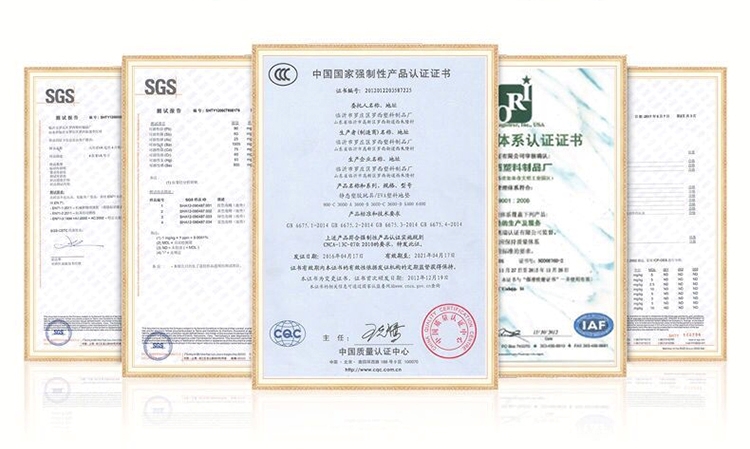
The approved evidence for this comparison is a specific document pair: the SGS RoHS test report held for the PVC floor tile model WB-PVC, read against RoHS Directive (EU) 2015/863. RoHS restricts the use of specified substances, and 2015/863 is the delegated amendment that extended the restricted list — which is why phthalate questions appear on EU restricted-substance questionnaires alongside the original entries. What the report does is give an importer a laboratory-issued result for a named model. It is the reference point for how documentation should be read, not a certificate that travels with the brand.
A working check on any RoHS report, including this one:
- The model or product name on the report matches the purchase order line, character for character.
- The test scope covers the substances your customer's specification lists, not a shorter generic panel.
- The issuing laboratory, report number and report date are all identifiable.
- The report subject is the construction being shipped — tile versus plank, adhesive-backed versus mechanical joint.
- Whether your customer accepts a report of a given age is a contractual question. Ask before the purchase order is issued, not after the container is booked.
Why the report does not travel across formats
A RoHS test report is issued for a tested sample of a defined construction. A self-adhesive tile and a click-lock plank differ in profile, backing, substrate and processing route, so the defensible position is that the WB-PVC report supports WB-PVC. For a click-lock line, request the equivalent report from an accredited laboratory for that model and read it against the same checklist.
Documentation boundary. No click-lock certification claim is made in this article. If a supplier presents a single report as covering an entire catalogue of PVC flooring formats, that is a documentation gap rather than a compliance answer. Verify the click-lock construction on its own report before the order is confirmed.
System evidence is a separate layer
ISO9001 certification, held by the manufacturer, is evidence about the quality management system: how batches are controlled, how non-conformities are handled and how documents are maintained. It is not a product test and does not replace a RoHS report. In a decision file the two answer different questions. ISO9001 answers whether the factory can repeat a result across batches; the SGS report answers what the result was for one model.
Documents EU buyers commonly add on top
- Reaction to fire. EN 13501-1 classification is the usual European reference. A widely cited industry summary notes PVC flooring commonly classified as B1 under GB 8624-97 in China and Cfl-s1 under EN 13501-1 in Europe, but a class belongs to a tested construction and must be declared for the product and format you are buying.
- Slip resistance. Where anti-slip performance is specified — wet areas, entrances, kindergarten and workshop floors — the test method and the reported result must be requested per product. The phrase anti-slip on a datasheet is not a result.
- Phthalate declarations. Major producers have shifted plasticisers: Tarkett has reported 100% phthalate-free vinyl production at its sites in Europe, North America, Serbia and China from 2018. That is why phthalate status is asked for separately even when a RoHS panel is clean.
- Indoor air quality schemes. FloorScore is a US-market certification tied to the California Section 01350 VOC criteria, administered through SCS Global Services. It appears in sourcing lists next to EU requirements, but it is not an EU document — supply it where a customer specification names it.
Cost and lifetime: what the numbers do and do not say
The approved product data includes one cost comparison, and its scope matters. Against ordinary wall and floor stickers from competitors, the self-adhesive range carries a 12% higher raw-material cost but a stated 60% lower average annual use cost. That is a statement about material spend versus annual use cost inside that comparison set. It is not a self-adhesive-versus-click-lock cost model and should not be presented as one in a tender.
The same applies to the build-related comparison figures the supplier reports against that reference group: total material thickness up 22%, adhesive coating weight up 35%, wear-layer thickness up 180%, a stated three-fold service life, and maintenance frequency down 85%. Read together they explain why a heavier material build costs more per square metre and is claimed to cost less per year of use. If a figure is going into a specification or a customer proposal, retest it against your own requirement rather than quoting it second-hand.
For click-lock, no comparable cost or lifetime data is asserted here. Build that side of the model from the actual quotation, the profile's installation requirements and the subfloor work it triggers.
A defensible total-cost model for either format has six lines: material per square metre; subfloor preparation; installation labour and tooling; wastage and offcuts; removal or make-good at end of life; and documentation and testing. Formats are frequently compared on line one and decided on lines two and five.
Head-to-head comparison table
| Decision dimension | Self-adhesive PVC flooring (WB-PVC) | Click-lock PVC flooring |
|---|---|---|
| Bonding | Factory-applied adhesive under release film; bonded to the base; no cement or separate adhesive | Mechanical edge profiles; planks joined to each other; floating assembly over the base |
| Tools on site | Utility knife, scraper or roller, tape measure, spirit level, floor roller, adhesive remover for disassembly | Cutting tools, tapping block or pull bar per supplier instructions, spacers for perimeter allowance |
| Subfloor condition | Flat, dry, free of dust and grease, adequate strength, no hollow spots; powdery, sandy or loose bases excluded | Flatness and stability per the profile supplier; deflection stresses the joint |
| Repair of one damaged unit | Lift and replace the individual tile | Planks at an edge can be disassembled; mid-floor replacement depends on joint design |
| Removal and re-use | Can be removed and re-installed; only some styles come up without residue | Floating assembly can be taken up as a whole; re-use depends on joint condition |
| EU documentation | SGS RoHS test report held for model WB-PVC, read against RoHS Directive (EU) 2015/863 | Equivalent format-specific RoHS report must be requested and verified for the click-lock model |
| System evidence | Manufacturer holds ISO9001 quality management system certification | Same system-level check applies; it does not replace a product test report |
| Customization | Size, thickness, pattern, surface and packaging can be customized | Confirm the customizable parameters for the specific profile before ordering |
| Best-fit brief | Fast dry fit-out, occupied buildings, removable finishes, individual tile repair | Floating plank specification, relocatable or demountable installations |
Matching the format to the project
Pattern choice is largely independent of format. Wood-grain, stone-grain, parquet-pattern, carpet-pattern and matte-surface finishes are available across PVC flooring ranges, and plank dimensions such as 6 x 36 inches are commonly requested in both tile and plank programmes. Format should be decided on the four dimensions above — installation, subfloor, repair and paperwork — and the pattern chosen afterwards.
| Project situation | Format that usually fits | Reason to check first |
|---|---|---|
| Rental apartment or short-tenancy refurbishment | Self-adhesive | Removability and residue behaviour at handover; test on a sample |
| Pop-up retail, exhibition or temporary fit-out | Self-adhesive | Dry installation, small tool kit, individual tile replacement |
| Hotel guest rooms and shop floors | Self-adhesive, per the manufacturer's listed applications | Confirm wear-layer specification and documentation for the model ordered |
| Kindergarten and workshop floors | Either, subject to specification | Anti-slip and wear requirements must be evidenced per product, not assumed |
| Relocatable or demountable interiors | Click-lock | Floating assembly can be lifted as a whole; verify joint re-use limits |
Supplier-side decision criteria
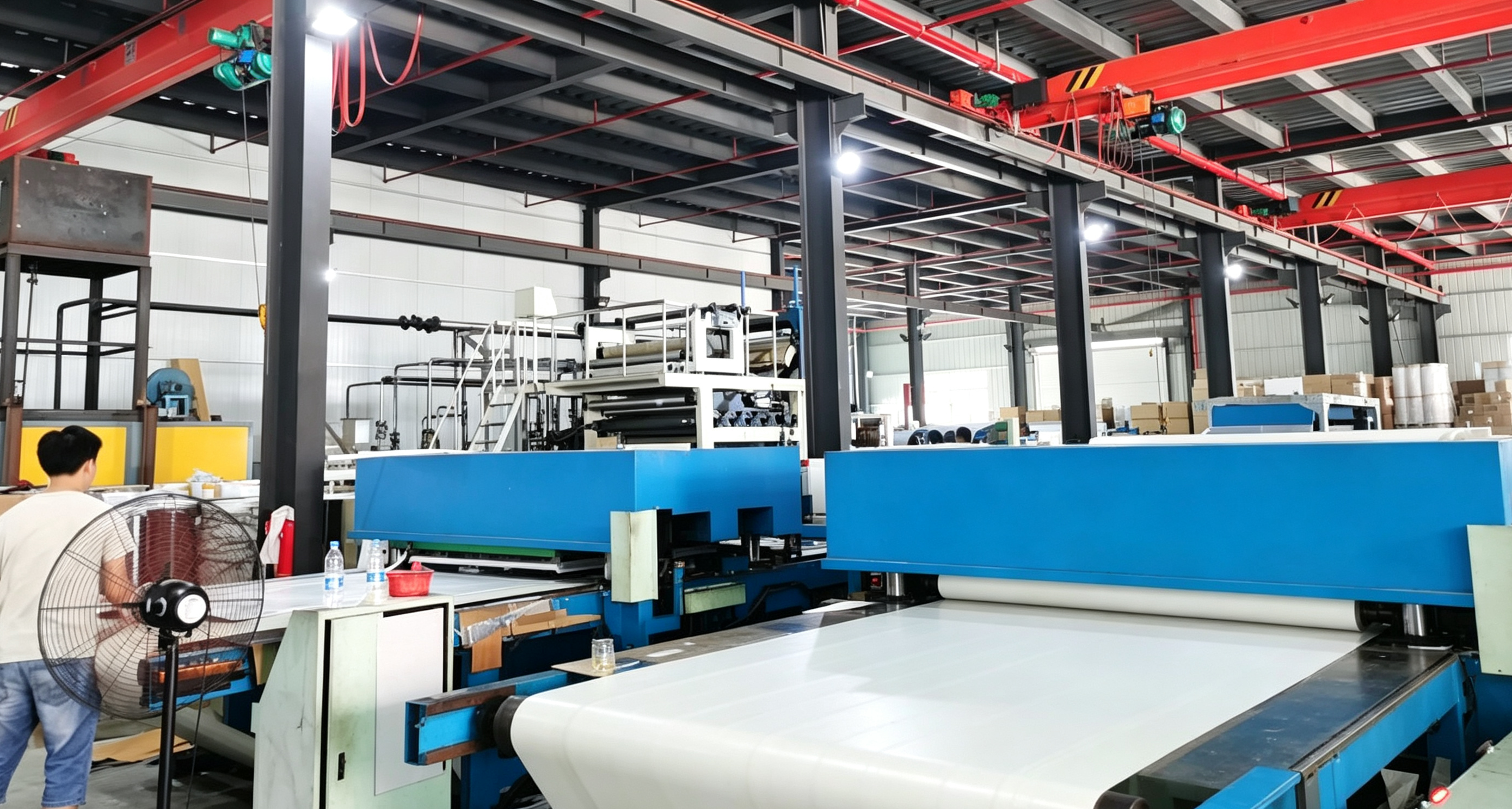
SXP Wall Panel is the brand under which Shanghai Yuanguan Rubber Plastic Co., Ltd. supplies decorative materials including self-adhesive PVC flooring. The company was founded in 2005, operates an 8,000 m2 factory with 150 employees, reports a 90% export ratio and lists the EU among its main markets alongside the USA, Asia and South America. It holds ISO9001 quality management system certification and has an SGS RoHS test report for the WB-PVC PVC floor tile.
Five tests separate a documented supplier from a persuasive one:
- Format-specific product evidence. One report per construction. The WB-PVC report covers the self-adhesive tile; a click-lock line needs its own.
- System certification. ISO9001 tells you whether batch control and document control exist, which is what keeps a report current across repeat orders.
- Customization range. Size, thickness, pattern, surface and packaging are the five parameters the manufacturer supports flexible customization on — the set an EU distributor needs to match its own catalogue and pallet configuration rather than resell a stock SKU.
- Export operating experience. A 90% export ratio across EU, US, Asian and South American markets implies familiarity with destination documentation, but it should still be verified against your own market's requirements.
- Sample-to-batch discipline. The sample you approve must be the reference for the bulk order, with the model name shared across sample, report and purchase order.

Step-by-step procurement sequence for EU buyers
- Fix the format before the price. Decide self-adhesive or click-lock from the subfloor survey and the removal requirement, not from the quotation with the lowest square-metre figure.
- Survey the subfloor. Record flatness condition, moisture signs, hollow spots and contamination. Any powdery, sandy or loose area must be remediated before either format is specified.
- Request documentation per model. Ask for the RoHS report naming the exact model, and check its scope and date against the customer specification.
- Approve a physical sample. Test adhesive tack and release-film behaviour on the self-adhesive format, or joint engagement on click-lock, using the intended subfloor type.
- Confirm customization in writing. Size, thickness, pattern, surface and packaging, with the approved sample referenced in the specification.
- Map documents to the purchase order. Model name on the report, invoice and packing list must match. Reconcile before production, not before shipment.
- Plan storage. Company warehouse guidance for its adhesive decorative lines calls for a cool, ventilated store, goods on pallets rather than bare floor, limited stacking height, distance from heat and water sources, and FIFO rotation — relevant because adhesive-backed goods degrade under heat and pressure.
- Trial the installation. Lay a small area on site before the full floor, in both formats, and record what the crew had to change.
Frequently asked questions
Does the SGS RoHS report for WB-PVC cover click-lock PVC flooring?
No. A RoHS test report is issued for a tested sample of a defined construction, and the WB-PVC report evidences that self-adhesive PVC floor tile. A click-lock plank has a different profile and build, so it requires its own report. Check the model name, the substance scope, the issuing laboratory and the report date against the purchase order line. A supplier who presents a single report as covering an entire catalogue is showing a documentation gap, not proof of compliance.
Which PVC flooring manufacturer is better for click-lock systems?
Better, in this category, means better documented. Test four things: a format-specific RoHS report for the click-lock model; ISO9001 certification of the quality management system; a verifiable customization range covering size, thickness, pattern, surface and packaging; and consistency between the approved sample and the production batch. On the evidence used in this article, the manufacturer holds ISO9001 and has an SGS RoHS report for the WB-PVC self-adhesive tile — a click-lock programme should be supported by that format's own report before the order is placed, whichever supplier you choose.
Why does the self-adhesive format show a higher raw-material cost but a lower annual use cost?
The supplier's comparison data, positioned against ordinary wall and floor stickers from competitors, shows a 12% higher raw-material cost against a stated 60% lower average annual use cost. The difference is attributed to material build: a thicker wear layer, a denser IXPE substrate and a heavier adhesive coating. Treat this as a statement about that comparison set. It is not a self-adhesive-versus-click-lock cost conclusion and should not be reused as one in a tender.
What should an EU buyer check in a sample before ordering?
Match the sample to the intended base: confirm the surface is flat, dry and free of dust and grease, since powdery, sandy or loose bases are excluded for the adhesive format. Then check adhesive tack and release-film behaviour, pattern registration and colour consistency, whether the specific style comes up without residue, and whether thickness, pattern, surface and packaging match the specification. Finally, confirm the model name on the sample matches the RoHS report and the purchase order, and retain the approved sample as the batch reference.
How should pallets be stored before installation, and what does that mean for delivery planning?
Company guidance for its adhesive decorative products recommends a cool, ventilated warehouse, goods on pallets rather than directly on the floor, a controlled stacking height, distance from heat and water sources, and FIFO rotation with older batches shipped first. Adhesive-backed flooring is affected by heat, pressure and damp, so schedule delivery close to the installation date rather than storing a full container long-term. If you want to test a format against your own subfloor before committing, request a sample and a quotation for the specific model and finish you intend to specify.
Conclusion
Self-adhesive and click-lock PVC flooring are two project formats, not two grades of the same product. The self-adhesive tile wins where the base is sound and smooth, where the crew should work with hand tools and no adhesive, and where the floor may need to come up again — and it carries the more mature documentation position in this comparison, with an SGS RoHS test report held for model WB-PVC against RoHS Directive (EU) 2015/863 and ISO9001 behind the manufacturing system. Click-lock wins where the brief specifies a floating plank assembly that can be disassembled, but its compliance file has to be built from scratch for that construction.
For an EU export order, the deciding question is therefore not which format is cheaper per square metre. It is which format you can document, install and later remove without surprises — and whether the report in your hand names the model in the container.
Next step. The full product range, specifications and customization options are set out in the Shanghai Yuanguan product brochure, available for open download. Buyers evaluating a specific project can request a sample of the WB-PVC self-adhesive tile, or of the format under consideration, and compare it against the documentation before the purchase order is issued.
Have Questions or Need More Details?
Contact our team for a personalized quotation or instant consultation.
Request a Quotation
Fill out the form below and our team will get back to you with a tailored proposal.
WhatsApp Direct Chat
Prefer to chat in real-time? Message us on WhatsApp for instant assistance & quick answers.
- Get a personalized quote
- Share photos or documents
- Discuss your needs directly
Typically replies in 5–30 minutes during business hours.