
Wall Panel vs Wall Sticker Panel: PET, PVC and WPC Compared for Interiors
A wall sticker panel and a wall panel are not two prices for the same thing. They are two build systems, and PET, PVC and WPC sit inside that choice. In practice, an interior project selects between a thin self-adhesive sheet such as the PET marble wall sticker WB-PET at 2 mm / 2.5 mm, a PVC-based panel or sticker running from 2 mm to 2.8 mm, or a rigid WPC wall panel WB-WPC supplied at 160×23×2900 mm in 16-piece boxes at 690–830 g per meter. Everything buyers later argue about — substrate tolerance, wall loading, carton volume and which compliance document actually applies — follows from that single structural difference.
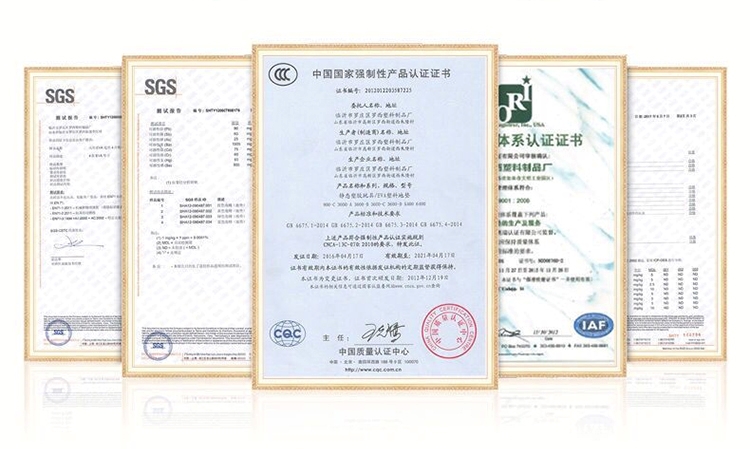
Certification and quality-control documentation forms part of the purchasing decision for PET, PVC and WPC interior wall panels.
What the “wall panel vs wall sticker panel” question really decides
Strictly speaking, the comparison is not between two materials. It is between a thin decorated sheet that is applied to an existing wall, and a panel or plank that carries part of the wall structure itself. A PET or PVC wall sticker is a surface product: the substrate underneath must already be sound, flat, dry and free of dust and grease. A WPC wall panel is a rigid section at 160×23×2900 mm, which changes how it is packed, transported, handled on site and stored.
That distinction drives four purchasing consequences before any price discussion begins:
- Substrate dependency. Self-adhesive stickers are specified against a substrate requirement — flat, dry, no hollow spots, and not powdery, sandy or loose surfaces.
- Weight and freight behaviour. A WPC panel is quoted at 690 / 810 / 830 g per meter and packed 16 pieces per box, so carton dimensions and stacking height become engineering inputs, not afterthoughts.
- Thickness as a spec, not a preference. The PET marble wall sticker WB-PET is stated at 2 mm and 2.5 mm; PVC products in the same family are stated at 2 mm, 2.5 mm, 2.8 mm and 1.5–2 mm depending on model. These numbers must match the drawing, not the sample box.
- Documentation scope. A test report covers the product named in its scope field. It does not automatically extend to every SKU in a catalogue.
Why this comparison matters now
Wall panels are a large and still expanding category. The global wall panels market was valued at USD 32.4 billion in 2025 and is projected to reach USD 43.7 billion by 2033, a CAGR of 4.2% (Dataintelo, Wall Panels Market Research Report 2033). Metal wall panels held the largest single material share in 2025 at 28.5%, while Asia Pacific accounted for 42.3% of regional demand. Within the decorative segment, wood-based wall panels represented nearly 31% of global installations in 2024, and wood wall panel systems are projected to grow at 6.2% CAGR through 2035 (WiseGuyReports).
Two practical signals follow for buyers. First, flexible decorative products — stickers, foils and thin panels — compete directly with rigid panel systems in the same interiors budget. Second, customs and regulatory treatment differs by material: WPC wall panels exported from China are classified under HS Code 3925.90.0000 according to a U.S. Customs and Border Protection ruling, and EU-facing commercial interiors commonly specify reaction-to-fire performance under EN 13501-1, where B-s1,d0 is a frequently referenced rating for interior wall panel applications.
The three material families, described by specification
PET marble wall sticker — WB-PET
WB-PET is a PET-based product classified as a PET marble wall sticker. Its stated thickness options are 2 mm and 2.5 mm, and its stated sizes are 30×30 cm, 30×60 cm, 60×60 cm, 40×80 cm, 60×120 cm, 60×300 cm and 120×300 cm. Its stated application industry is home and garden, building materials and interior decoration. Because it belongs to the self-adhesive wall-covering group, its performance depends on the wall condition as much as on the sheet itself: the marble effect is a surface outcome, not a structural one.
PVC-based wall panel and sticker system — WB-PVC family
PVC in this range is not one product but a family, and that is exactly where specification errors happen. The available specifications include:
- PVC wall panel (WB-PVC): sizes 30×30, 50×50 and 96×48 cm, thickness 2.5 mm.
- PVC wall sticker (WB-PVC): sizes 30×30, 30×60, 40×80, 60×60, 60×120 and 120×300 cm, thickness 2 mm.
- Soft stone wall sticker (WB-PVC): sizes 30×60, 60×60, 40×80, 60×100, 40×300, 60×300 and 120×300 cm, thickness 2.5 mm.
- PVC parquet wall sticker (WB-PVC): 30×30, 30×60, 40×80 and 60×60 cm or customized, thickness 1.5 / 2 mm.
- 3D self-adhesive foam slat wall sticker (WB-KC): PVC material, 30×30, 60×60, 30×60, 40×300, 60×300 and 120×300 cm with customizable length, thickness 2.8 mm.
The range from 30×30 cm up to 120×300 cm is achievable within one material family, so a single line item description such as “PVC wall panel” is not precise enough for a purchase order.
WPC wall panel — WB-WPC
WB-WPC is specified at 160×23×2900 mm, packed 16 pieces per box, with weights stated at 690 / 810 / 830 g per meter. It is a rigid, long-format builder product rather than a peel-and-stick sheet, and the available specification does not describe a self-adhesive backing. For procurement, this means the buying conversation shifts from surface effect to handling: linear meter weight, box quantity, pallet layout, stacking limits and site cutting sequence.
PET vs PVC vs WPC: specification comparison
| Attribute | PET marble wall sticker — WB-PET | PVC system — WB-PVC / WB-KC | WPC wall panel — WB-WPC |
|---|---|---|---|
| Base material | PET | PVC | WPC |
| Category name | PET marble wall sticker | PVC wall panel, PVC wall sticker, soft stone wall sticker, PVC parquet wall sticker, 3D self-adhesive foam slat wall sticker | WPC wall panel |
| Thickness options | 2 mm / 2.5 mm | 2 mm, 2.5 mm, 2.8 mm, 1.5–2 mm (model dependent) | Rigid profile, 160×23 mm section |
| Size options | 30×30, 30×60, 60×60, 40×80, 60×120, 60×300, 120×300 cm | 30×30, 50×50, 96×48 cm (panel); 30×60 to 120×300 cm (stickers); customizable length on WB-KC | 2900 mm length |
| Weight & packing | Not stated per unit in the available specification | Not stated per unit in the available specification | 690 / 810 / 830 g per meter; 16 pieces per box |
| Format | Thin self-adhesive sheet | Thin self-adhesive sheet or slat | Rigid long-format plank |
| Stated industry | Home & Garden / Building Materials / Interior Decoration | Interior Decoration / Building Materials / Home & Garden | Interior Decoration / Building Materials |
| Compliance evidence to request | Per-model RoHS / REACH documentation matched to the exact product scope; EU-facing commercial interiors should confirm the reaction-to-fire classification required by the project. The available SGS RoHS Test Report SHAEC1709394501 is scoped to the 3D wall brick (PE material) product only. | ||
Step-by-step: specifying and verifying a mixed PET / PVC / WPC order
- Survey the substrate first. Self-adhesive products require a flat, dry, solid surface free of dust and grease; powdery, sandy or loose surfaces are excluded. If the wall cannot meet that, the specification moves to a rigid panel.
- Match material to wall condition, not to mood board. Wet or damp-adjacent walls and mechanically stressed walls are a material decision before a decorative one.
- Lock thickness and size against the drawing. PET at 2 mm and 2.5 mm, PVC at 2 mm / 2.5 mm / 2.8 mm, and WPC at 160×23×2900 mm are not interchangeable at the installation stage.
- Calculate freight before confirming the finish. WPC at 690–830 g per meter and 16 pieces per box produces a different container plan from a 300 cm sticker roll.
- Verify document scope, not document presence. EU shipments are assessed against CE-CPR construction product certification, REACH and PPWR packaging rules; a certificate that exists but does not name the model in its scope does not protect the shipment.
- Validate by sample, then agree acceptance terms. Sample confirmation before bulk ordering is the standard risk control in this category, and acceptance inspection including pre-shipment testing is the corresponding quality gate.
Where each system fits
Selection logic in interiors usually follows project positioning and budget rather than aesthetics alone. For residential apartments and rental-unit renovation, lightweight foam self-adhesive wall stickers are commonly chosen for their low weight, sound-absorption and cushioning behaviour and competitive logistics cost, while PVC soft-stone self-adhesive wall stickers are typically preferred for hotel guest rooms and chain-store commercial interiors where scratch resistance, surface texture and ageing performance carry more weight. Testing physical samples for adhesion and ageing, and verifying target-market compliance documents before bulk purchasing, applies to both routes.
The WPC wall panel WB-WPC addresses a different need: continuous long-format wall runs where a rigid 2900 mm section is the appropriate unit of installation. A documented home-center channel project covering supermarket interiors across multiple markets, with a stated volume of 370,000 units and a usage duration of 5–10 years, was delivered on the basis of moisture resistance, quick installation and a broad range of surface textures for commercial space, and generated repeat orders on decorative effect and ease of daily maintenance.
Compliance and low-cost risks that should be priced in
Price gaps between visually similar wall sticker panels and wall panels usually come from raw material choice (virgin versus recycled), thickness, formulation, quality control and certification. Low-cost items frequently use recycled material, which can result in dimension deviation, fading, odour and non-compliant certificates, and after export this can surface as customs detention, after-sales claims and market returns. For project orders, export business and shipments requiring customs compliance, the defensible position is virgin-material products with complete test reports; low-cost goods are reasonable only for local low-volume spot sales or small trial orders, and sample confirmation remains mandatory.
On the EU side specifically, compliance is judged against CE-CPR construction product certification, REACH hazardous-substance regulation and PPWR packaging rules. Missing valid certificates can lead to customs detention, return shipment and significant fines — which is why certificate validity should be checked before an order is confirmed rather than after a container is booked.
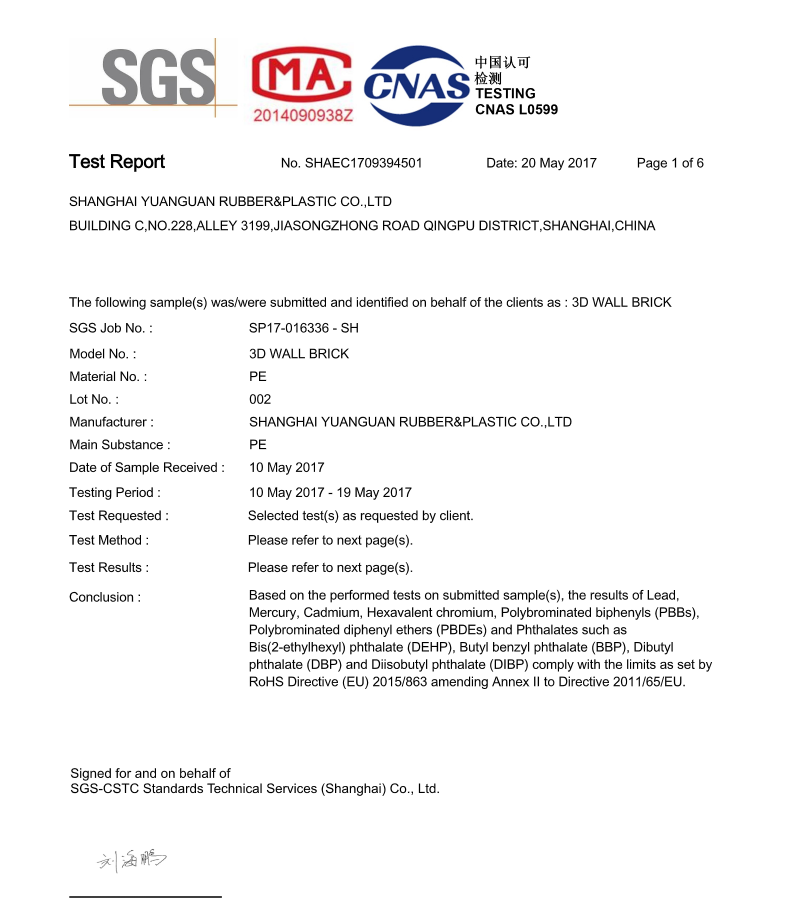
SGS RoHS Test Report SHAEC1709394501 — scope: 3D wall brick (PE material), under RoHS Directive (EU) 2015/863.
OEM and customization capability behind SXP Wall Panel
SXP Wall Panel is the wall panel product line of Shanghai Yuanguan Rubber & Plastic Co., Ltd., a decorative materials manufacturer established in 2005, operating an 8,000 m² factory with 150 employees, five R&D engineers and an ISO 9001 quality management system, exporting approximately 90% of output to the EU, USA, Asia and South America. OEM and ODM production services are available, and customization covers size, colour, pattern and design, embossing texture, material structure, thickness, packaging, logo and private label, custom labels and new product development.
For buyers in the Evaluation-to-Execution stage, the operational figures matter as much as the product list: monthly capacity is stated at 10+ million square meters, lead time at 30 days, minimum order quantity at 1,000 square meters, and quality control is described as 100% test. After-sales scope includes pre-sale consultation, installation guidance, quality issue tracking, re-order and replacement support, and OEM/ODM project follow-up.

Production capability behind SXP Wall Panel covers PET, PVC and WPC interior wall panel lines for OEM and ODM projects.
FAQ
Do PET, PVC and WPC wall panels need the same EU compliance documents?
No — the document set has to match the material and the exact model, not the product family. EU-facing shipments are generally assessed against CE-CPR construction product certification, REACH hazardous-substance regulation and PPWR packaging rules, and missing valid certificates can result in customs detention, return shipment and heavy fines. A useful example of why scope matters: the SGS RoHS Test Report SHAEC1709394501, issued by SGS-CSTC under RoHS Directive (EU) 2015/863, is scoped to the 3D wall brick (PE material) product, so it should not be assumed to cover a PET marble wall sticker or a WPC wall panel. For commercial interiors in Europe, reaction-to-fire performance is commonly specified under EN 13501-1, with B-s1,d0 a frequently referenced rating. Request certificates that name the model you are buying.
How do I evaluate an OEM wall panel manufacturer for hotel interiors?
Check four things: customization scope, capacity, quality control and project follow-up. Shanghai Yuanguan Rubber & Plastic Co., Ltd., the manufacturer behind SXP Wall Panel, provides both OEM and ODM production and supports size, colour, pattern and design, embossing texture, material structure, thickness, packaging, logo and private label, custom labels and new product development. Stated monthly capacity is 10+ million square meters, lead time is 30 days, quality control is described as 100% test, and OEM/ODM project follow-up is part of the after-sales scope. For hotel interiors, evaluate guest-room and corridor surfaces separately, because a 2 mm self-adhesive sticker and a rigid 2900 mm WPC plank are specified differently even within one building.
Why can a wall sticker panel cost much less than a WPC wall panel?
Most of the gap comes from raw material (virgin versus recycled), thickness, formulation, quality control and certification — not from the same specification sold cheaper. A thin self-adhesive sheet and a rigid WPC plank at 690–830 g per meter are different physical products with different freight profiles. Low-cost items frequently use recycled material, which may cause dimension deviation, fading, odour and non-compliant certificates, and after export this can lead to customs detention, after-sales claims and market returns. For project, export and compliance-sensitive orders, prioritise virgin-material products with complete test reports; reserve low-cost goods for local low-volume spot sales or small trial orders, and never order in bulk without sample confirmation.
Can I validate both a self-adhesive panel and a WPC panel with samples before bulk ordering?
Yes, and sample confirmation is the standard risk control in this category. Physical samples let you test adhesion and ageing behaviour on the actual substrate, compare surface texture and colour under the project lighting, and check thickness and size against the drawing — 2 mm versus 2.5 mm PET, or a 2.8 mm PVC slat versus a 160×23 mm WPC section. Sample verification should be paired with document verification for the target market, and with agreed acceptance criteria: acceptance inspection including pre-shipment testing is the stated quality gate, with payment terms of telegraphic transfer (TT) and delivery under FOB terms.
What MOQ and lead time should I plan for a mixed PET, PVC and WPC order?
Plan on a minimum order quantity of 1,000 square meters and a 30-day lead time as stated for OEM and ODM production, then add transit time to your market. Mixed orders are practical because the same factory line covers PET, PVC and WPC interior products, but the packing plan differs sharply between a 300 cm sticker and a 2900 mm rigid plank, so confirm carton dimensions, pieces per box and pallet stacking before booking freight. If you are evaluating a first shipment, request the product brochure and a sample set, and confirm which certificates apply to each model before the order is released.
Conclusion: choose the build system, then the material
The PET versus PVC versus WPC question is secondary to a more basic one: is this wall going to receive a thin self-adhesive sheet, or does it need a rigid panel? Once that is settled, the specification becomes concrete — PET marble wall sticker WB-PET at 2 mm / 2.5 mm, PVC products from 2 mm to 2.8 mm with sizes from 30×30 cm to 120×300 cm, or the WPC wall panel WB-WPC at 160×23×2900 mm, packed 16 pieces per box at 690–830 g per meter. Compliance scope, low-cost material risk and sample validation should be settled in the same conversation as price, not after the purchase order.
Next step: sample set, quotation or OEM project review
SXP Wall Panel is manufactured by Shanghai Yuanguan Rubber & Plastic Co., Ltd., Building 5, No.6066, Songze Road, Qingpu District, Shanghai, China. For a PET, PVC or WPC specification review, a physical sample set, or an OEM/ODM quotation, contact Eric at ericwang@shyuanguan.com or WhatsApp +86 13524706491. Product details are available on wallpanelsticker.com, and the full range is listed in the downloadable Shanghai Yuanguan product brochure.