
Velvet Quilt vs. Rabbit Fur Blanket: Which Fits Your Catalog?
Velvet Quilt vs. Rabbit Fur Blanket: Which Bed Blanket Fits Your Product Line?
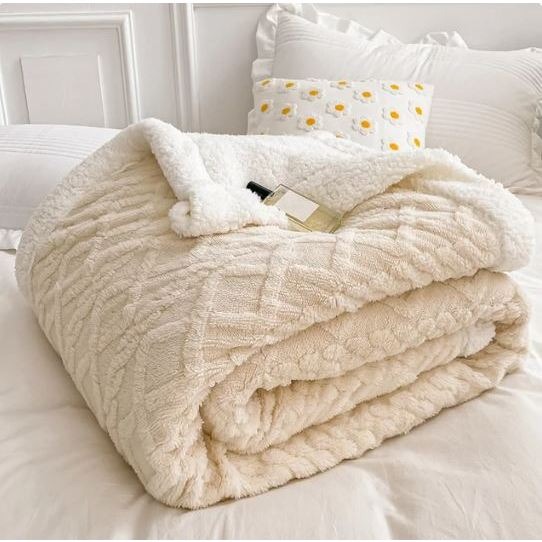
Velvet Quilt and Rabbit Fur Blanket from CHANGSHU SHENG-SHUN TEXTILE CO., LTD. (SYS TEXTILE), a velvet bedding manufacturer based in Changshu, Jiangsu Province.
Short answer: choose the Velvet Quilt when your product line needs a structured, filled bed layer - a velvet (polyester) face over polyester filling, with the visual weight of bedding rather than a throw. Choose the Rabbit Fur Blanket when your line needs a tactile, high-pile surface layer built from rabbit fur-like polyester, where the sale is made by touch, drape, and shelf contrast. Both are polyester-based, both are listed as soft, warm, and eco-friendly, and both come in Twin, Queen, and King sizes marked customizable. The real difference is construction architecture - and for most importers and brand buyers, that is the deciding variable.
This is a head-to-head procurement comparison for B2B buyers deciding whether to add one of these two bed blankets to a home textile catalog, or which one to prioritize first. All product facts below come from the product, capability, compliance, application, and case data of CHANGSHU SHENG-SHUN TEXTILE CO., LTD., which manufactures velvet bedding in Changshu - a textile city in Jiangsu Province - and exports internationally under the SYS TEXTILE brand. Market context is drawn from named third-party and standards sources and is attributed as such.
Problem Definition: Why Two Polyester Blankets Are Hard to Choose Between
On paper, the Velvet Quilt and the Rabbit Fur Blanket look like substitutes. Both are polyester products. Both carry the same stated feature set: soft, warm, eco-friendly. Both are offered in Twin, Queen, and King sizes with customization, both are positioned for home bedding, and both belong to the same applicable industry - home textile, household bedding, and export home textile trade. They even come from the same manufacturer, which means they share the same minimum order quantity, the same lead time, and the same certification file.
That is precisely why the decision is difficult. None of the filters a buyer normally applies - fiber type, size range, compliance paperwork, MOQ, production time - separates these two products. A procurement team that evaluates them with a standard supplier scorecard ends up with two nearly identical rows and no clear answer.
The actual differences sit in four places:
- Construction architecture. The Velvet Quilt is a two-layer build: a velvet (polyester) face over a polyester filling. The Rabbit Fur Blanket is built around a single rabbit fur-like polyester surface, with the character concentrated in the pile rather than in a filling layer.
- Layering role in the bed. A filled quilt behaves as a structured bedding layer. A high-pile fur-like blanket behaves as a tactile surface layer, closer to a throw in how it drapes and how consumers use it.
- Merchandising story. One sells on classic, program-ready structure; the other sells on touch and visual luxury. They attract different shelf contexts and different shopper motivations.
- Assortment overlap risk. If both land in the same assortment tier for the same buyer persona, they compete with each other instead of expanding your catalog. If neither is present in the tactile-luxury segment, you leave that demand to another supplier.
There is also a compliance dimension that buyers often under-weight. Certification names do not transfer automatically to every SKU, and standards move. Buyers therefore need to separate what is verified at company level from what must be confirmed per product - a point covered in the constraints section below.
Industry Background: The Bed Blanket Market Behind This Decision
The global blanket market was valued at USD 15.1 billion in 2023 and is projected to reach USD 25.5 billion by 2030, according to Grand View Research. Within that market, polyester blankets held the largest share of any material category at 33.8% in 2023, also per Grand View Research. For a buyer comparing a polyester velvet quilt against a rabbit fur-like polyester blanket, that figure matters: the two products are competing less against cotton or wool at category level than against each other inside the dominant material segment. When the base fiber is not a differentiator, construction and hand-feel become the differentiators.
Two end-use segments are especially relevant to how these products get allocated.
- Hotel and institutional bedding. The hotel bedding market was valued at USD 14.2 billion in 2025 and is projected to reach USD 23.6 billion by 2034, at a CAGR of 5.8%, according to Dataintelo. Hotel programs buy repeatable, structured bedding, which is a natural fit for a filled quilt construction.
- Baby bedding. The global baby blanket market was valued at nearly USD 2.54 billion in 2024 and is expected to grow at a CAGR of 3.6% through 2032, according to Maximize Market Research. Baby programs are the most sensitive to compliance documentation, so product choice is often decided after, not before, the paperwork is cleared.
Two structural forces are shaping supplier selection at the same time. First, sustainability and hygiene language is becoming quantified: the global antimicrobial textiles market was valued at USD 11.9 billion in 2023 and is projected to reach USD 19.0 billion by 2030 (Grand View Research), while the U.S. Environmental Protection Agency reported that textiles represented 5.8% of total municipal solid waste in 2018 - a figure that continues to underpin interest in durable, machine-washable home textiles. Second, chemical standards are tightening: OEKO-TEX STANDARD 100 reduced its Bisphenol A limit from 100 mg/kg to 10 mg/kg effective April 2025, per the OEKO-TEX Association. Buyers sourcing in this category should treat certification as a moving target rather than a one-time pass.
China's production base remains concentrated. Jiangsu Province - where SYS TEXTILE operates, in Changshu - is home to the Nantong bedding cluster, which holds over 50% of China's bedding market share, with market transactions exceeding 240 billion RMB in 2024, according to the Home Textile Industry Report. The global blanket market also includes established Western players such as American Blanket Company and Pendleton Woolen Mills, alongside large Chinese textile groups such as SUMEC Textile Light Industry Co., Ltd., as listed by Grand View Research. In that landscape, a focused manufacturer's advantage is not scale - it is production specialization and program flexibility.
Detailed Solution: What Each Product Actually Is
The specifications below are taken directly from the product data of CHANGSHU SHENG-SHUN TEXTILE CO., LTD.
Velvet Quilt - Polyester Velvet Face with Polyester Filling
- Product type: Velvet Quilt
- Fabric: Velvet (polyester)
- Filling: Polyester
- Material class: Polyester
- Stated features: Soft, warm, eco-friendly
- Available sizes: Twin / Queen / King (customizable)
- Application: Home bedding
- Applicable industry: Home textile / household bedding / export home textile trade
- Model designation: No specific model - the item is not tied to a fixed model number.
Commercially, this means the Velvet Quilt is a constructed product, not a piece of fabric with a hem. The filling creates volume and a defined edge; the velvet face provides the smooth, light-catching surface consumers associate with classic bedding. In a catalog, it belongs in the bed-layering section, next to duvet covers and sheets - and it is the item that gives an assortment the look of a coordinated bedding program rather than a stack of throws.
Rabbit Fur Blanket - Rabbit Fur-Like Polyester with a Single High-Pile Surface
- Product type: Rabbit Fur Blanket
- Fabric: Rabbit fur-like polyester
- Material class: Polyester
- Stated features: Soft, warm, eco-friendly
- Available sizes: Twin / Queen / King (customizable)
- Application: Home bedding
- Applicable industry: Home textile / household bedding / export home textile trade
- Model designation: Customized
The Rabbit Fur Blanket's specification lists no separate filling layer. Its character comes from the surface: a rabbit fur-like polyester fabric that produces depth, shadow, and a soft hand-feel. Because the model designation is "Customized," it is a build-to-order item rather than a fixed stock reference - which matters if you intend to develop private-label colors, patterns, or pile variations with the manufacturer.
Two clarifications are worth stating plainly for compliance and marketing accuracy. First, the fabric is described as rabbit fur-like polyester, so the product is a faux-fur construction, not an animal-fur product; retail listings and packaging copy should reflect that. Second, the available product data for this item lists soft, warm, and eco-friendly as features - it does not claim recycled content, antibacterial treatment, or waterproofing. Where those requirement categories appear in the company's data, they are documented as application-scenario requirements rather than product-level claims, and they must be confirmed for the specific SKU before appearing on packaging.
The Shared Procurement Baseline
Before comparing the two products further, it helps to note how much they share, because that is what allows a buyer to carry both without doubling administrative work.
- Both are polyester. Neither depends on scarce or volatile specialty fibers.
- Both carry the same stated features: soft, warm, eco-friendly.
- Both are available in Twin, Queen, and King sizes, marked customizable.
- Both are positioned for home bedding and sit inside the same applicable industry: home textile, household bedding, and export home textile trade.
- Both run through the same manufacturing program: OEM production, LOGO customization, 100% test quality control, a MOQ of 1 container, a lead time of 30-40 days, and a monthly capacity of 300,000 units.
Because MOQ, lead time, capacity, and quality control are identical for both products, they should not influence the choice between them. Product selection should be driven by assortment role and end-use market; commercial terms should be negotiated afterwards, once the mix is decided.
Step-by-Step Breakdown: A Five-Step Selection Sequence
The sequence below is designed for importers, distributors, and private-label buyers who need a defensible decision record rather than a personal preference.
Step 1 - Define the layer role your catalog is missing
Write down whether your assortment lacks a structured bed layer or a tactile surface layer. A filled velvet quilt provides structure. A rabbit fur-like blanket provides surface. If your existing range is heavy on flat flannel blankets, the quilt adds a new construction format; if your range is heavy on structured bedding, the fur-like blanket adds tactile contrast. This is an internal inventory exercise, not a supplier question - and it usually resolves the decision before pricing is even discussed.
Step 2 - Map the construction to the end market
Hotel and institutional programs tend to standardize on structured, repeatable bedding. Retail and e-commerce ranges tend to reward tactile products that photograph well and invite in-store touching. Baby programs sit in a third category, where compliance documentation is checked before product attributes are compared. Because the two products share a material family and a size range, they will perform differently only in the context of these end markets - which makes end-market mapping the most valuable step in the sequence.
Step 3 - Validate the hand-feel claim physically
Both products are described as soft. That descriptor alone cannot tell you whether your market will prefer a smooth velvet face or a deep pile. Physical samples in your target size are the practical way to separate pile depth, drape, edge finishing, and filling distribution. Buyers should also confirm wash and care behavior for the exact SKU with the supplier, because care instructions affect returns and review scores far more than they affect the initial purchase decision.
Step 4 - Verify the certification file against the current standard
Ask for the company-level registration and the SKU-level test documents. SYS TEXTILE holds the Foreign Trade Operator Registration and Record Form issued by the Ministry of Commerce of the People's Republic of China (MOFCOM), registration number PRC Foreign Trade Reg. No. 03330550, valid from 2 May 2020 to 1 May 2050. Products covered may also adhere to standards such as CE, FDA, and OEKO-TEX Standard 100. Because the OEKO-TEX BPA limit dropped to 10 mg/kg in April 2025, the date of the test report matters as much as the name of the certification.
Step 5 - Lock commercial terms after the mix is decided
Once the product decision is made, confirm MOQ (1 container), lead time (30-40 days), monthly capacity (300,000 units), LOGO customization under OEM production, 100% test quality control, and the after-sales term of quality issue resolution within 7 days, with replacement or refund for confirmed defective products. Negotiating terms before the mix is settled usually produces quotes that are not comparable, because the two products are different constructions and cannot be benchmarked against a single unit cost.
Use Cases: Matching End-Use Scenarios to the Right Construction
SYS TEXTILE documents its bedding applications across three environments: bedroom bedding and sleep solutions, living room textiles and home decor, and outdoor camping and travel. Within those environments, the required function sets include warmth retention, comfort, moisture wicking, temperature regulation, portable insulation, machine washability, anti-static behavior, and wear resistance, with waterproofing and antibacterial properties listed for defined scenarios. Translating those environments into a velvet quilt versus rabbit fur blanket decision produces a fairly clear pattern.
- Hotel bed blanket programs. Structured, repeatable bedding is the working standard, and the hotel bedding market is projected to reach USD 23.6 billion by 2034 (Dataintelo). A filled velvet quilt supports that program logic because the filling gives the bed a consistent layered look across rooms. The Rabbit Fur Blanket is better deployed in suites, boutique properties, and premium retail corners, where tactile differentiation is part of the guest or shopper experience.
- Baby bed blanket ranges. In the company's documented bedroom bedding scenarios, the special requirement set includes OEKO-TEX and CE certification and FDA food-grade status for baby applications, alongside antibacterial and anti-static requirements. Neither of the two products compared here should be marketed with those claims unless the specific SKU has been confirmed against them. For a baby line, treat compliance verification as the first filter and construction as the second.
- Dormitory and institutional bedding. Durability, machine washability, and wear resistance dominate here. A structured quilt folds and stacks predictably, which suits bulk institutional handling; a fur-like blanket is more often chosen as a seasonal comfort add-on rather than the primary bed layer.
- Camping and travel. The documented outdoor scenario emphasizes warmth retention, moisture wicking, portable insulation, and waterproof protection. A high-pile fur-like blanket generally packs and drapes more flexibly for travel use, while a filled quilt provides more structured warmth for vehicle-based and cold-weather camping. Waterproof and antibacterial properties must be confirmed per SKU, not assumed from the category.
- Warm winter home bedding. Both products are listed as warm, and both are available in Twin, Queen, and King. The choice usually comes down to whether the consumer wants a quilted layer that sits over or under a duvet, or a plush surface layer that is visible when the bed is made.
- Living room throws and decorative textiles. This is the Rabbit Fur Blanket's strongest natural home. The company's living room and home decor scenario includes decorative accent functions and pattern options, which a high-pile surface carries visually at greater distance than a smooth velvet face.
- Retail and e-commerce resale. SYS TEXTILE's wholesale experience includes a program covering 100 containers shipped to buyers in the United States, Ukraine, and the United Kingdom, with product resold through retail stores, e-commerce platforms, hotel bedding supply, and institutional and home textile channels, operating stably over 3+ years under proper care and washing. For buyers in those channels, the practical pattern is to carry both constructions but merchandise them separately: the quilt inside the bedding program, the fur-like blanket in the tactile, decorative, and gift-driven section.
Comparison Table: Velvet Quilt vs. Rabbit Fur Blanket
| Decision factor | Velvet Quilt | Rabbit Fur Blanket |
|---|---|---|
| Product type | Velvet Quilt | Rabbit Fur Blanket |
| Fabric composition | Velvet (polyester) | Rabbit fur-like polyester |
| Filling layer | Polyester filling | No separate filling layer listed in the product data |
| Material class | Polyester | Polyester |
| Stated features | Soft, warm, eco-friendly | Soft, warm, eco-friendly |
| Available sizes | Twin / Queen / King (customizable) | Twin / Queen / King (customizable) |
| Application | Home bedding | Home bedding |
| Applicable industry | Home textile / household bedding / export home textile trade | Home textile / household bedding / export home textile trade |
| Model designation | No specific model | Customized |
| Construction logic | Two-layer: velvet face over polyester filling | Single-surface high-pile build |
| Natural assortment role | Structured bed layer | Tactile surface layer and decorative throw |
| Supplier program (shared) | OEM production, LOGO customization, 100% test, MOQ 1 container, 30-40 days lead time, 300,000 units monthly capacity | OEM production, LOGO customization, 100% test, MOQ 1 container, 30-40 days lead time, 300,000 units monthly capacity |
Read the table as a set of tie-breakers rather than a scoring sheet. Most rows are identical or near-identical. Only filling, construction logic, and assortment role actually separate the two products - which is why this is an assortment decision rather than a sourcing decision.
Procurement Constraints: Certification, MOQ, Lead Time, and Capacity
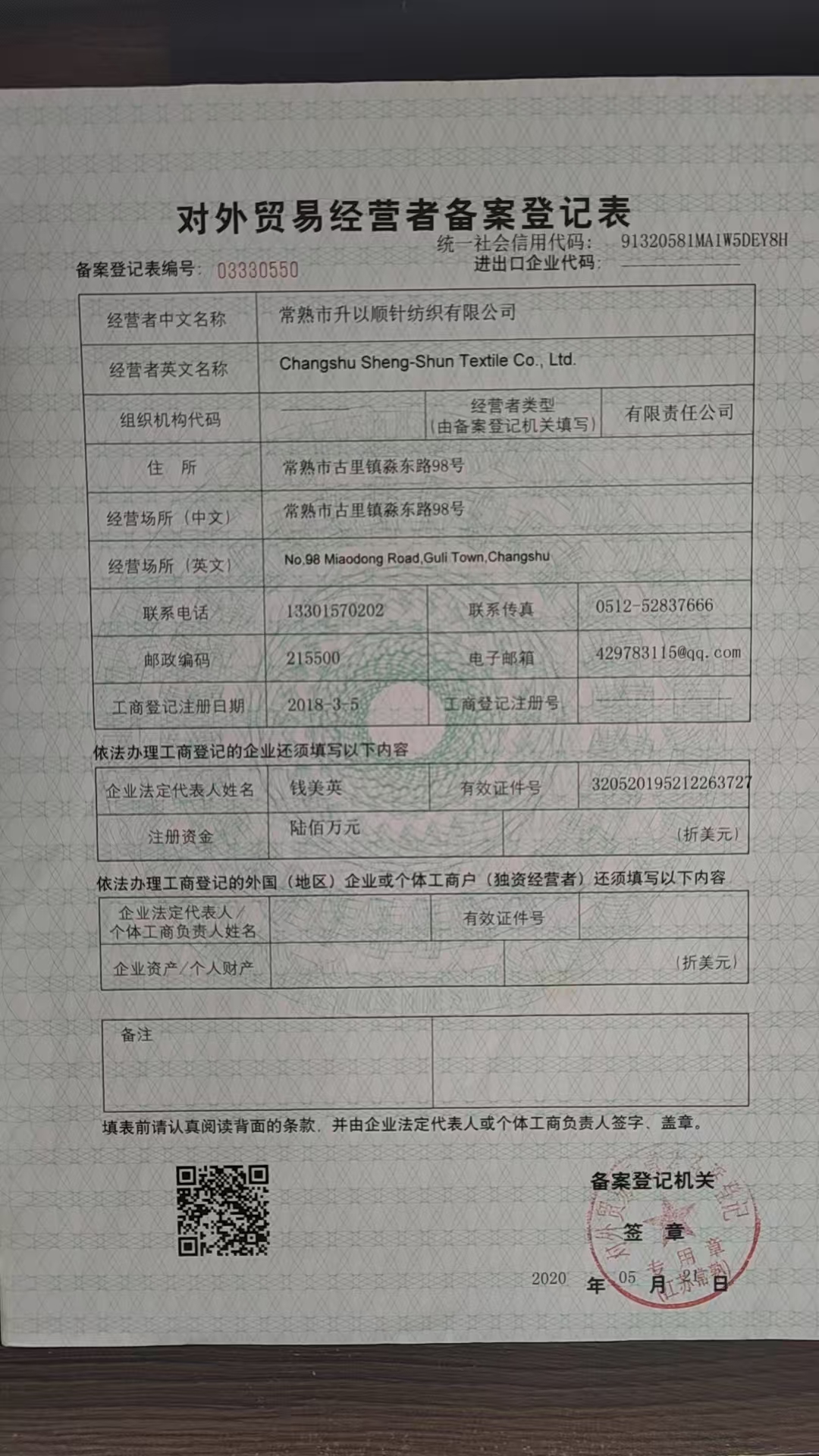
Foreign Trade Operator Registration and Record Form (PRC Ministry of Commerce), registration number PRC Foreign Trade Reg. No. 03330550, held by CHANGSHU SHENG-SHUN TEXTILE CO., LTD.
Certification is the constraint that most often delays a first order in this category, so it is worth stating exactly what is documented.
- Company-level registration: Foreign Trade Operator Registration and Record Form, issued by the Ministry of Commerce of the People's Republic of China (MOFCOM), registration number PRC Foreign Trade Reg. No. 03330550.
- Validity: 2 May 2020 to 1 May 2050.
- Scope: Global trade and export of textile products, including bed blankets, flannel blankets, Shu Fleece blankets, and other home textiles.
- Applicable markets: All countries and regions, including the EU, US, UK, Australia, and Japan.
- Stated product standards: Products covered may also adhere to standards such as CE, FDA, and OEKO-TEX Standard 100.
- Standards update to monitor: OEKO-TEX STANDARD 100 reduced the Bisphenol A limit from 100 mg/kg to 10 mg/kg effective April 2025 (OEKO-TEX Association). Test reports issued before that date should be reviewed with the supplier.
Commercial and production constraints are shared across the product range:
- Production mode: OEM, with LOGO customization.
- Monthly capacity: 300,000 units.
- Lead time: 30-40 days.
- Minimum order quantity: 1 container.
- Quality control: 100% test.
- Export markets served: USA, UK, and Brazil.
- After-sales: Quality issue resolution within 7 days, with replacement or refund for confirmed defective products.
At company level, CHANGSHU SHENG-SHUN TEXTILE CO., LTD. was founded in 2018, operates a 7,000 m2 factory with 60 employees and 5 R&D engineers, produces 3 million pieces annually, and exports approximately 90% of its output. Its core business is velvet bedding, with flannel and rabbit fur blankets as key product categories across styles including SHU FLEECE 3-D BLANKET, SHU JACQUARD BLANKET, FLANNEL WAVE BLANKET, FLANNEL SQUARE JACQUARD BLANKET, FLANNEL SQUARE BLANKET, and FLANNEL SOUTHWEST DESIGN BLANKET, supported by quilts and velvet four-piece sets.
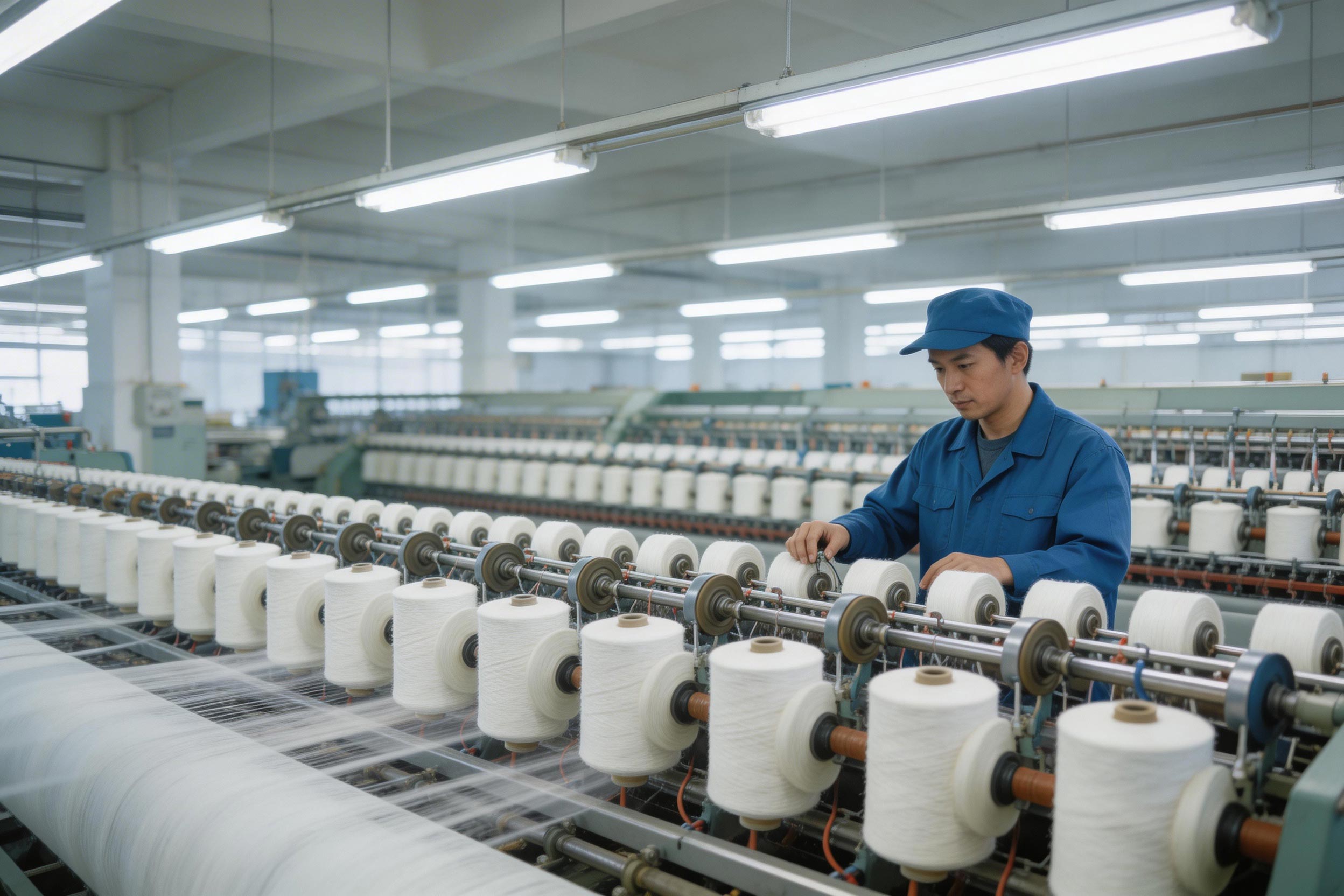
CHANGSHU SHENG-SHUN TEXTILE CO., LTD. operates a 7,000 m2 factory in Changshu, Jiangsu Province, with OEM production, LOGO customization, and 100% test quality control.
FAQ: Velvet Quilt vs. Rabbit Fur Blanket for B2B Buyers
Do the Velvet Quilt and Rabbit Fur Blanket meet the certification requirements for EU, US, and UK import?
Compliance is documented at company level. CHANGSHU SHENG-SHUN TEXTILE CO., LTD. holds the Foreign Trade Operator Registration and Record Form issued by the Ministry of Commerce of the People's Republic of China (MOFCOM), registration number PRC Foreign Trade Reg. No. 03330550, valid from 2 May 2020 to 1 May 2050. The registration covers the export of textile products, including bed blankets and home textiles, for markets including the EU, US, UK, Australia, and Japan, and the covered products may also adhere to standards such as CE, FDA, and OEKO-TEX Standard 100. Buyers should still request SKU-level test documentation, particularly because OEKO-TEX STANDARD 100 tightened its Bisphenol A limit from 100 mg/kg to 10 mg/kg effective April 2025.
Can the Velvet Quilt and Rabbit Fur Blanket be customized with our own logo and sizes?
Within the documented program, yes. The Rabbit Fur Blanket is listed with the model designation "Customized," and both products are offered in Twin, Queen, and King sizes marked customizable. The Velvet Quilt is listed as "No specific model," meaning it is not locked to a fixed model number and is configured to order. Production is OEM with LOGO customization, and the company works with 5 R&D engineers, which is normally the function that handles private-label development.
What drives the cost difference between a polyester velvet quilt and a rabbit fur-like blanket?
No unit price is attached to either product in the available data, and quotes are negotiated per order and specification. What can be compared is cost structure. As a general manufacturing principle, the Velvet Quilt combines two material layers - a velvet face plus a polyester filling - and a constructed build, while the Rabbit Fur Blanket concentrates material cost in a single high-pile surface fabric. Because the two products are different constructions, a like-for-like comparison requires the same size, the same fabric specification, and the same packing standard. Comparing a quilt quote against a fur-like blanket quote without matching those variables produces a number that cannot support a purchasing decision.
How should a buyer validate hand-feel before placing a container order?
Because both products are polyester-based and both are described as soft, product data alone cannot predict which one your market will prefer. The practical method is physical validation: request samples in the target size, then evaluate pile depth and drape on the Rabbit Fur Blanket against surface smoothness, filling distribution, and edge finishing on the Velvet Quilt. Buyers should also confirm care and wash behavior for the exact SKU with the supplier, since care instructions drive returns and review outcomes more than initial purchase decisions do.
What are the MOQ, lead time, and monthly capacity for these products?
The documented program parameters are a minimum order quantity of 1 container, a lead time of 30-40 days, and a monthly production capacity of 300,000 units, with 100% test quality control. After-sales terms cover quality issue resolution within 7 days, with replacement or refund for confirmed defective products. To move from evaluation to ordering, the next step is a specification-matched quotation or a sample request through the contact channels below.
Conclusion: Decide by Assortment Role, Not by Material
The Velvet Quilt and the Rabbit Fur Blanket are not competing versions of the same product. They are two different construction formats built from the same base material, offered by the same manufacturer, in the same size range, under the same commercial terms. The Velvet Quilt - velvet (polyester) face over polyester filling - is the structured bed layer. The Rabbit Fur Blanket - rabbit fur-like polyester with a high-pile surface and a "Customized" model designation - is the tactile surface layer.
For most importers and brand buyers, the productive way to decide is to ask which of those two roles is absent from the current catalog. If structured bedding is the gap, prioritize the Velvet Quilt, particularly for hotel and institutional programs. If tactile differentiation is the gap, prioritize the Rabbit Fur Blanket, particularly for retail, e-commerce, and decorative use. If both gaps exist and the budget allows, carry both - but merchandise them in separate sections so they expand the assortment instead of splitting it.
Whichever way the decision goes, verify three things before the purchase order: the certification file at SKU level, the hand-feel through a physical sample, and the commercial terms against a matched specification. Those three checks resolve the majority of first-order risk in polyester bed blanket sourcing.
Next Step: Sample, Quotation, or Catalog
CHANGSHU SHENG-SHUN TEXTILE CO., LTD. (SYS TEXTILE) manufactures velvet bedding in Changshu, Jiangsu Province, with OEM production, LOGO customization, and 100% test quality control. To compare the Velvet Quilt and Rabbit Fur Blanket against your own assortment, request a sample, a specification-matched quotation, or the current product catalog.
Tel / WhatsApp: +86 18962366333
Email: 2497825773zrd@gmail.com
WhatsApp: Start a conversation
Website: sheng-shuntextile.com
Address: Chenbei Road, Miaoquan, Guli Town, Suzhou City, Jiangsu Province, China
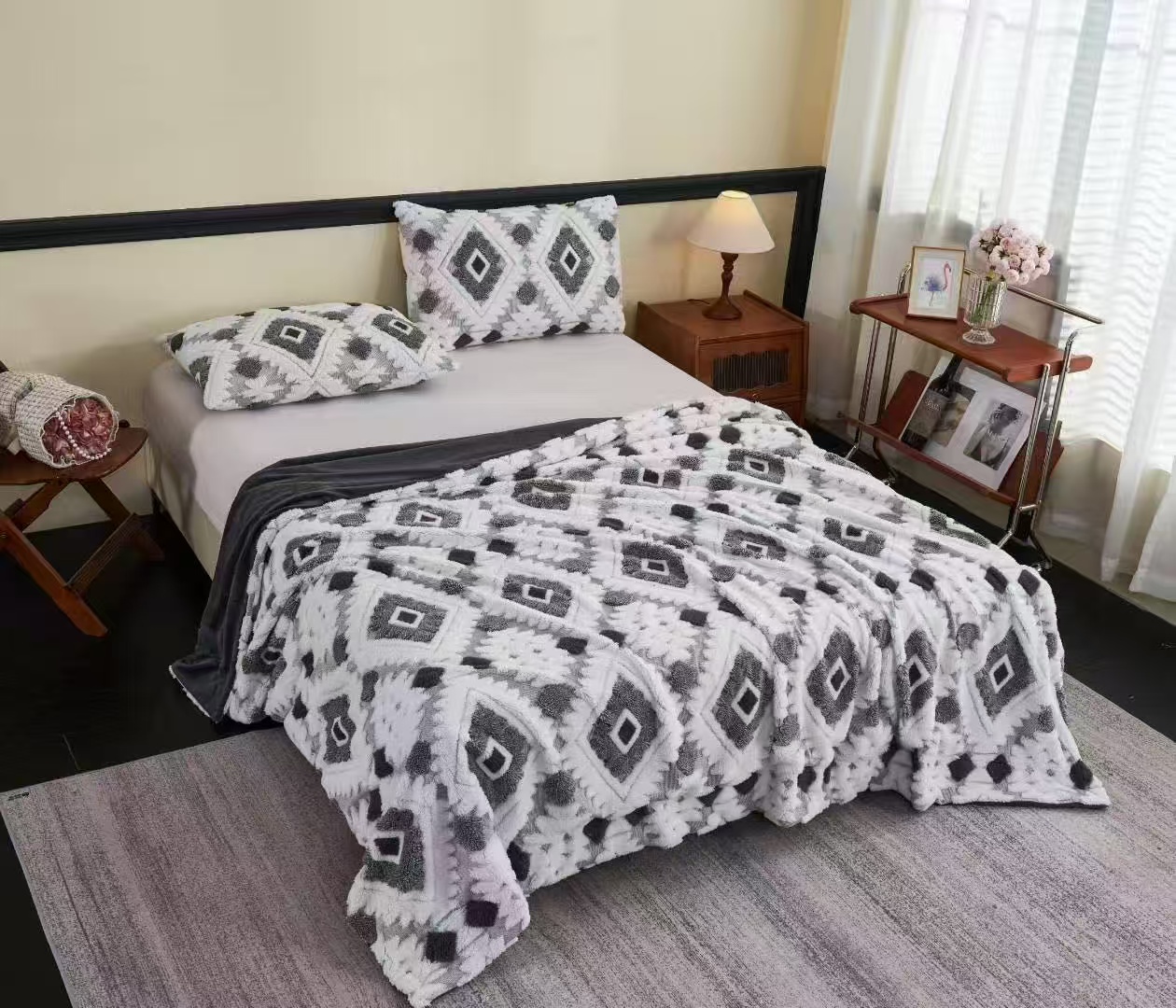
Beyond blankets, the velvet bedding line includes quilts and velvet four-piece sets (duvet cover, sheet, and pillowcases) in velvet (polyester), with Twin / Queen / King customizable sizing.
Have Questions or Need More Details?
Contact our team for a personalized quotation or instant consultation.
Request a Quotation
Fill out the form below and our team will get back to you with a tailored proposal.
WhatsApp Direct Chat
Prefer to chat in real-time? Message us on WhatsApp for instant assistance & quick answers.
- Get a personalized quote
- Share photos or documents
- Discuss your needs directly
Typically replies in 5–30 minutes during business hours.