CNC Nesting vs. Beam Saw vs. Edge Banding: A Comparison Guide for Panel Furniture Lines
CNC Nesting vs. Beam Saw vs. Edge Banding: A Comparison Guide for Panel Furniture Lines
A panel furniture production line does not choose between CNC nesting, a beam saw, and an edge banding machine — it chooses a sequence in which each technology removes a different bottleneck. CNC nesting cuts shaped and nested parts directly from full sheets and can drill them in the same setup; a beam saw or computer panel saw cuts rectangular panels at high, repeatable speed; edge banding seals the exposed edges that both cutting methods leave behind.
Buyers in the evaluation stage often compare these three machines as if they were alternatives, because all of them are sourced under the same phrase: woodworking machine. In SYUTECH's range the roles are represented by the HK-Line CNC nesting production line, built around the HK-6 nesting unit; the HK330 beam saw and computer panel saw; and the HK868P automatic edge banding machine, with the HK568 and the compact HK268G and HK268GY covering smaller edge banding requirements.
The practical decision rule is short. If your part mix is shape-heavy and changes frequently, the nesting stage should be your first investment. If your output is dominated by rectangular panels in stable sizes, the beam saw should be. In both cases, the edge banding stage has to be sized against the real output of the cutting stage rather than the catalogue speed of a single machine, because banding is where the end customer judges visible quality.
The Problem: Comparing Three Machines That Do Different Work
The comparison problem in panel furniture equipment is not a shortage of information. It is that machine data is presented machine by machine, while the buyer's real risk is flow by flow. Three failure patterns appear repeatedly when a line is planned around a single machine choice.
- Geometry mismatch: a beam saw is selected for a product that later requires curved or shaped components, so contour cutting is pushed into a slower secondary operation.
- Throughput mismatch: nesting capacity is purchased for a catalogue that is almost entirely rectangular shelving and carcass panels, where straight-line sawing is faster per sheet.
- Stage mismatch: cutting capacity is expanded while edge banding is left unchanged, and the banding station quietly becomes the bottleneck of the whole line.
A fourth pattern is commercial rather than technical: buyers compare the three technologies on purchase price alone and leave floor space, labour per shift, panel yield, and rework caused by inconsistent edge quality out of the calculation. The sections below separate the three roles, give the working specifications behind each one, and then set out a decision sequence that keeps the comparison tied to your own part mix.
Industry Background: Why Panel Furniture Producers Are Rebalancing Their Lines
Spending on woodworking machinery continues to grow, and the growth is concentrated in the regions where panel furniture production is expanding. Grand View Research valued the global woodworking machinery market at USD 20.3 billion in 2025 and projects it to reach USD 27.7 billion by 2033. Europe dominated that market with a 36.4% revenue share in 2025, supported by established manufacturers in Italy and Germany, while Credence Research reports that Asia Pacific held the largest share of the wood processing machines market at 34.5% in 2024, led by China and India.
Two narrower signals matter more for the comparison in this article. The woodworking CNC router machine segment alone was valued at USD 185.3 million in 2024, which shows that nesting and routing equipment has become a defined purchase category rather than an accessory to sawing. And China's exports of machine tools for working wood to Vietnam reached US$311.6 million in 2024, an indicator of how quickly panel furniture capacity is being added in Southeast Asia.
Market size figures should be read carefully: published estimates for the same 2025 market range from USD 20.3 billion (Grand View Research) to USD 8.2 billion (Dataintelo) and USD 5.23 billion (Fortune Business Insights), largely because some analysts include primary wood processing while others count only secondary furniture machinery. For an equipment buyer, the direction of the trend matters more than the absolute figure: capacity is being added in lines that combine cutting, drilling, and edge banding rather than in single machines.
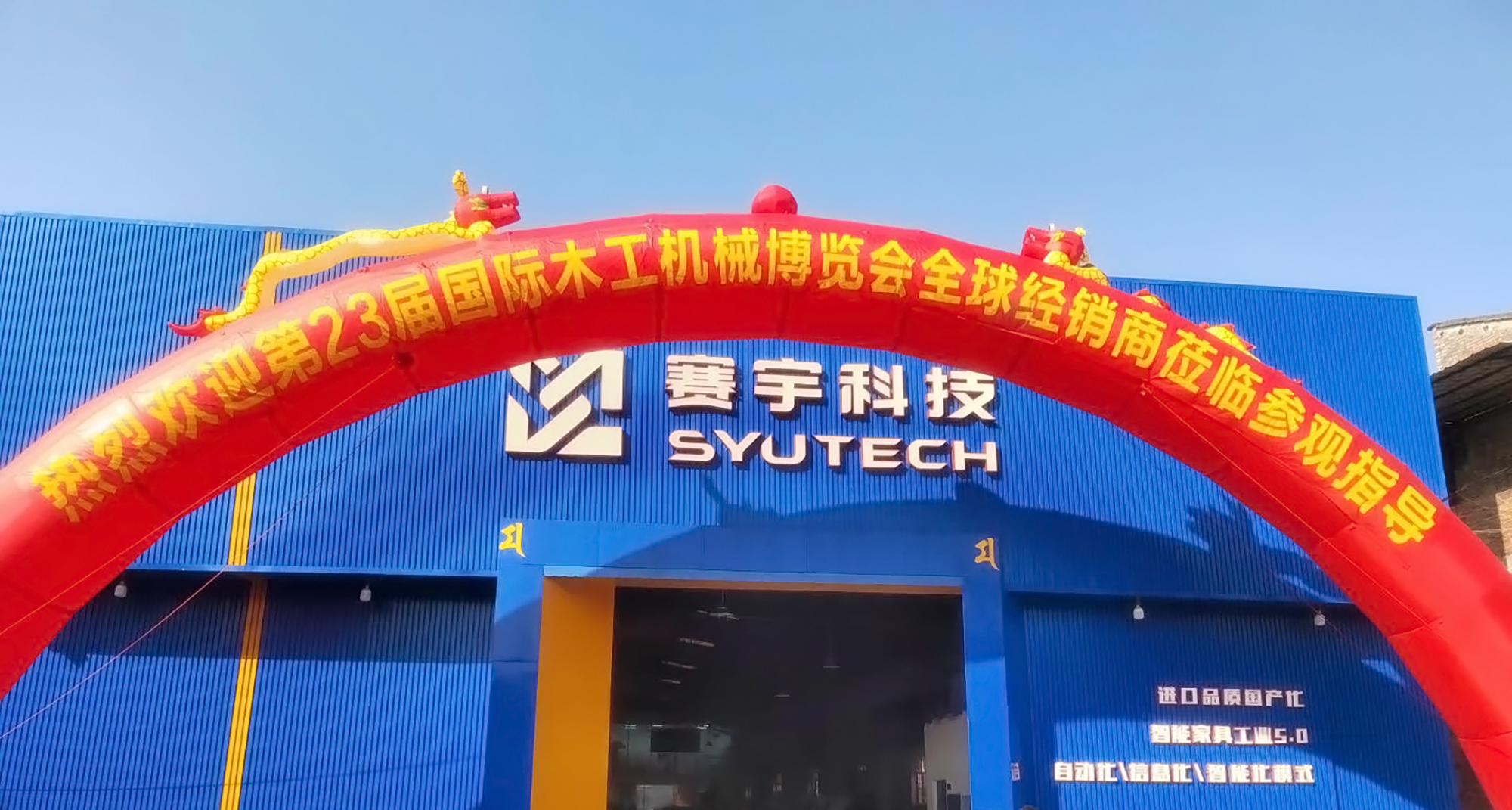
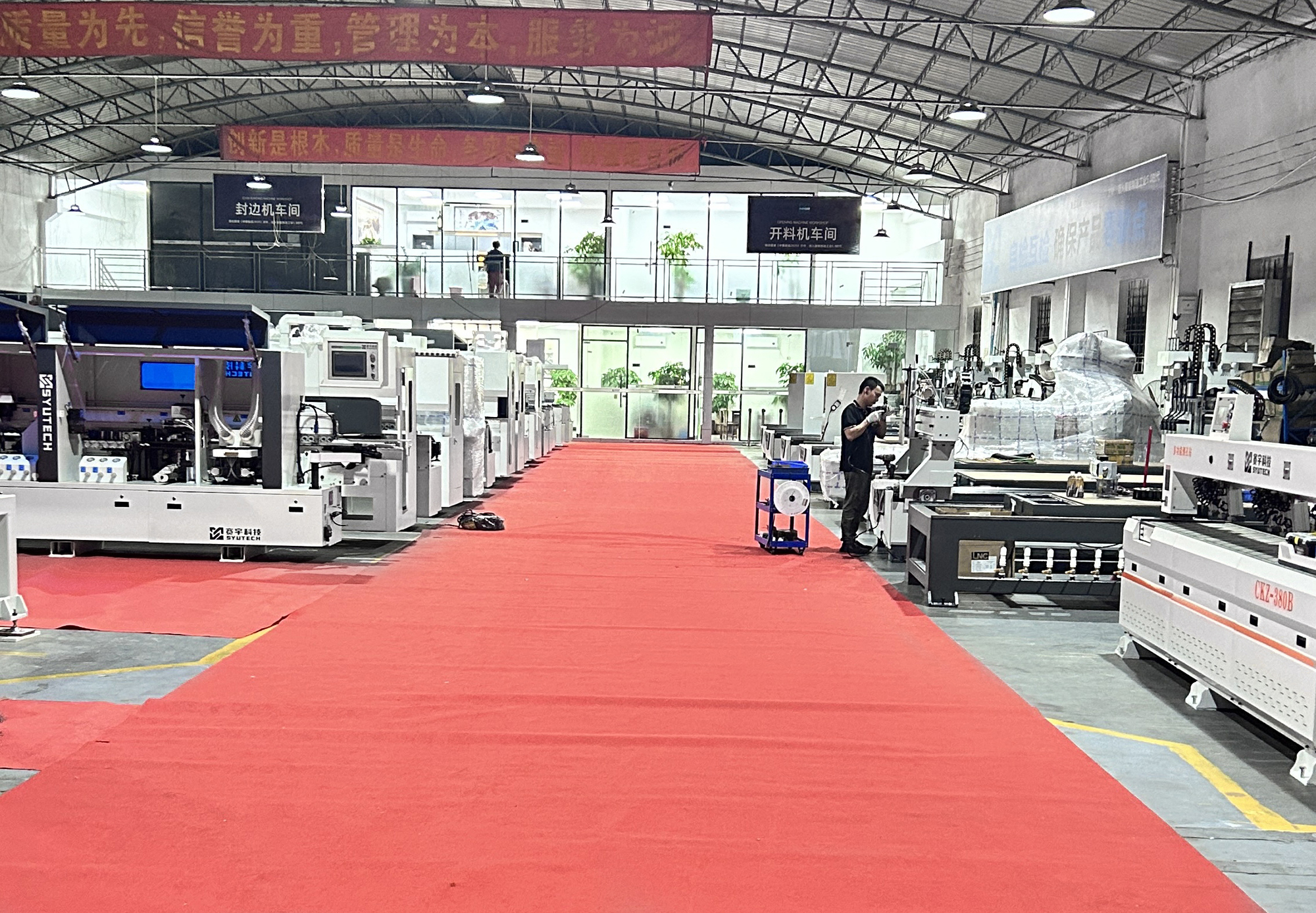
On the supply side of that market sit established international manufacturers such as Homag Group, SCM Group, Biesse Group, and Weinig AG. SYUTECH operates in the same equipment category from Shunde District, Foshan, Guangdong Province, China. Foshan Shunde SaiYu Technology Co., Ltd. was originally established as Foshan Shunde Leliu Huake Long Precision Machinery Factory in 2013 and later developed the Saiyu Technology brand through ten years of technological accumulation. The company operates a 10,000 m² facility with about 100 employees and an annual output of roughly 500 units, and approximately 80% of production is exported to markets including Russia, the Middle East, South America, Europe, and Southeast Asia. Its range covers edge banding machines, CNC nesting machines, six-side CNC drilling machines, computer panel saws, and complete production lines for panel furniture.
How Each Machine Solves a Different Production Problem
CNC Nesting: Solving Geometry and Setup, Not Sheet Size
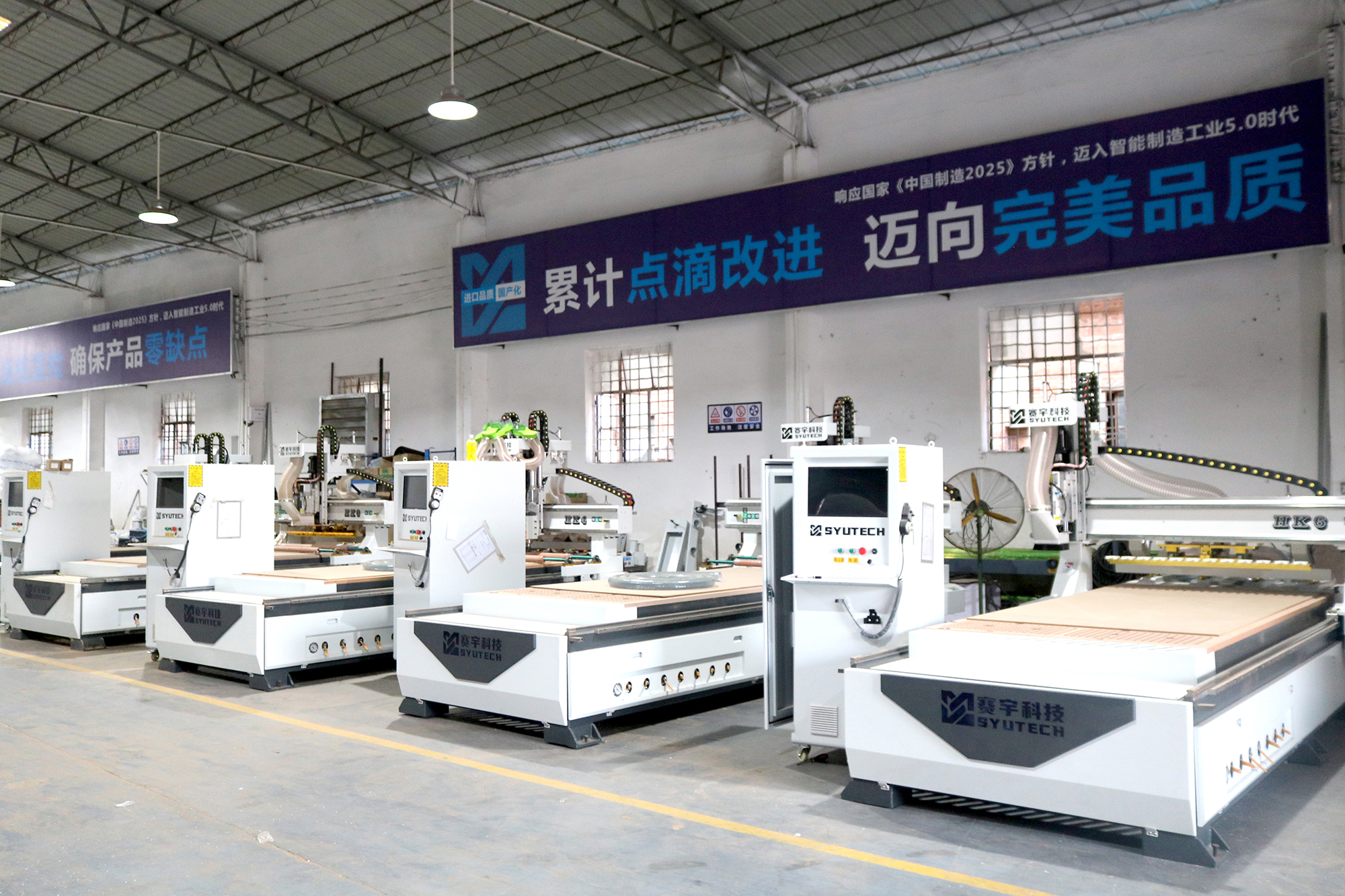
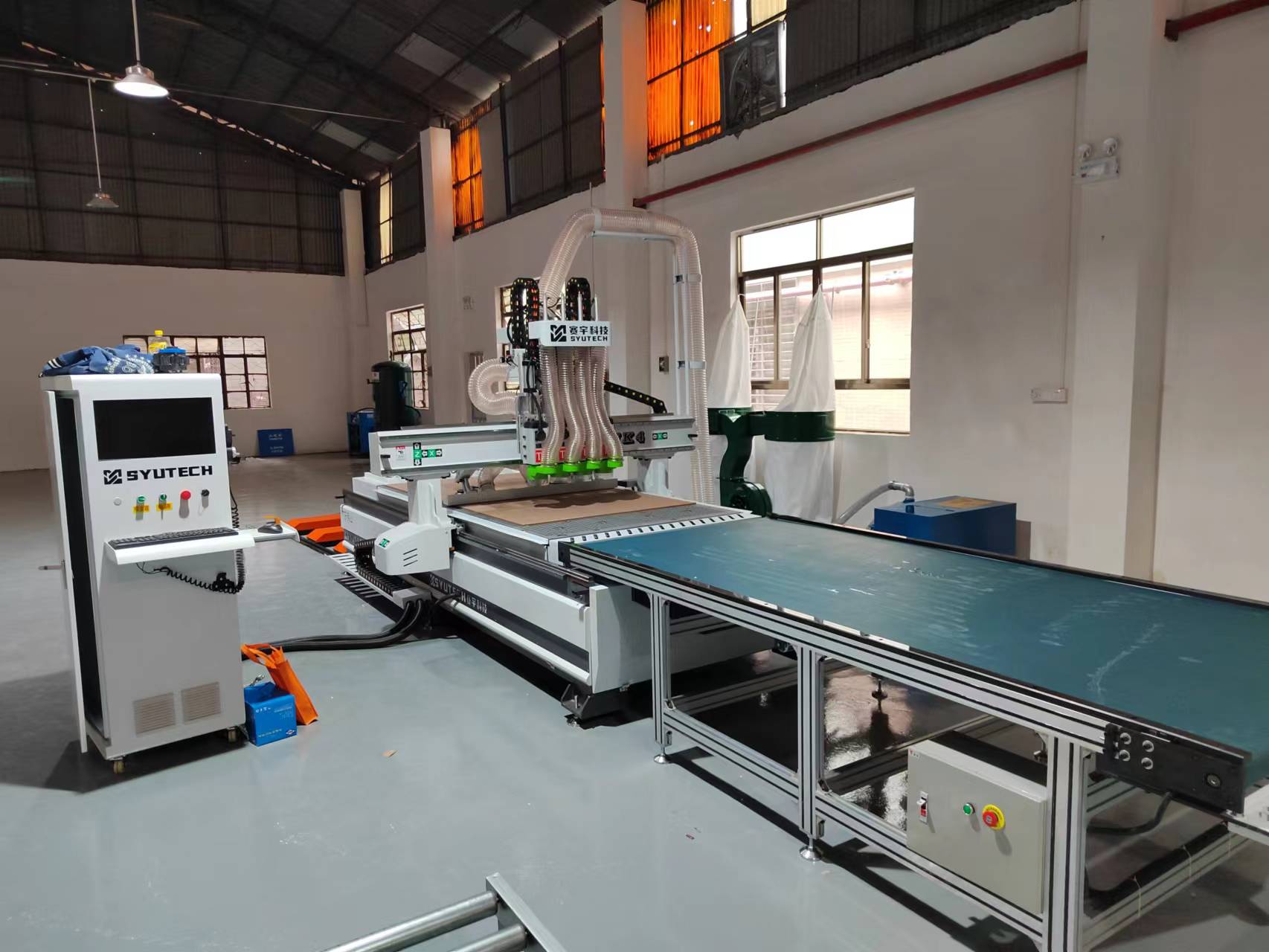
A nesting CNC machine trades sheet throughput for flexibility. The HK-Line CNC nesting production line is built around the HK-6 nesting unit, which has a working range of 1,220 mm on the X axis, 2,800 mm on the Y axis, and 250 mm on the Z axis. The spindle is a 9 kW air-cooled motor running at 24,000 rpm, and the machine carries a 12-tool automatic tool changer in a straight-line magazine, so a program can move between cutting and drilling without manual tool changes. The drive and control package is specified as four 1.5 kW servo motors with matching 1.5 kW drivers, an 11 kW frequency converter, a Japanese-brand reducer, and a Taiwan SYNTEC or LNC control system, running on a 380 V three-phase 50 Hz supply.
The production benefit is not abstract speed; it is that shaped parts, contour cuts, and drilling patterns are completed in a single setup instead of being moved to a second machine. The limit is equally clear. When the product is a simple rectangle and the batch size is stable, a straight-line saw will normally deliver higher output per sheet, which is why the nesting decision should be driven by geometry and part mix rather than by a general preference for CNC equipment.
Beam Saw / Computer Panel Saw: Solving Throughput on Rectangular Panels
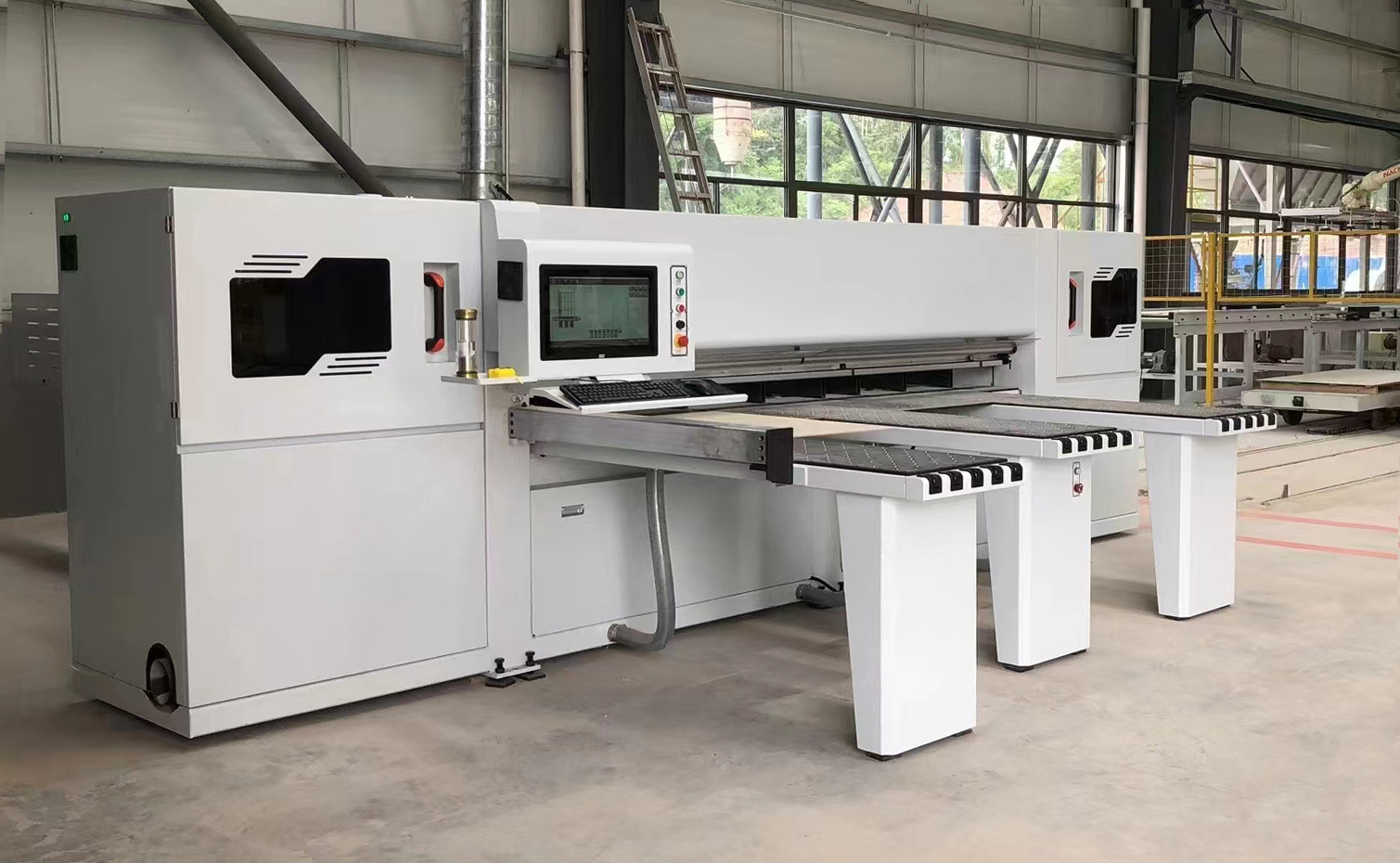
A beam saw solves a different problem: repetitive, high-speed straight cuts across large sheets. The HK330 is listed in SYUTECH's published records both as a computer panel saw and as a beam saw. Its maximum cutting speed is 0–100 m/min, maximum cutting width is 3,300 mm, and maximum cutting height is 100 mm. The main saw motor is 16.5 kW, with an optional 18.5 kW version, and a 2.2 kW scoring saw unit handles the initial cut. The minimum working size is 34 mm × 45 mm, and the machine footprint is 5,900 mm × 5,950 mm × 1,900 mm.
What a beam saw does not do is produce shaped or curved parts, and it does not remove the need for edge banding downstream. Its value is realised when the cutting list is rectangular and repeatable, and when the nesting station does not have to be loaded with straight cuts that a saw can complete faster.
Edge Banding: Where Visible Quality Is Decided
Edge banding is the stage the end customer actually sees. The HK868P automatic edge banding machine runs at a working speed of 16–22 m/min and accepts edge band from 10 mm to 60 mm wide and 0.4 mm to 3 mm thick. Pre-milling units are rated 2.2 kW × 2, end trimming 0.3 kW × 3, rough trimming 0.75 kW × 2, and polishing 0.18 kW × 4, with a 5.5 kW conveyor motor and total power of 25 kW on a 380 V 50 Hz supply. The unit measures 9,500 mm × 1,000 mm × 1,650 mm and weighs approximately 4 t.
For smaller output or tighter floor space, SYUTECH lists the HK568 edge banding machine and two compact models. The HK568 accepts a minimum panel length of 135 mm and a minimum panel width of 50 mm, handles edge band 10–60 mm wide and 0.4–3 mm thick, and feeds at 16-18-22 m/min. It includes pre-milling (2.2 kW × 2 at 9,000 rpm), a 1.8 kW glue box, end, rough, fine, and corner trimming units, and polishing, with 25.86 kW installed power, 0.7–0.9 MPa air pressure, a 7,200 mm × 710 mm × 1,628 mm frame, and 2,200 kg machine weight. The compact HK268GY and the mini HK268G both process panels from 150 mm long and 40 mm wide, accept edge band 10–60 mm wide and 0.35–3 mm thick, and are built in carbon steel or SS304; installed power is 12.4 kW and 11.8 kW respectively, with footprints of 5,360 mm × 730 mm × 1,210 mm and 3,790 mm × 730 mm × 1,210 mm.
The specification that decides whether banding becomes a bottleneck is not the model name but the match between its working speed and the output your cutting stage genuinely delivers per shift.
The Stage Buyers Often Forget: Drilling and Milling
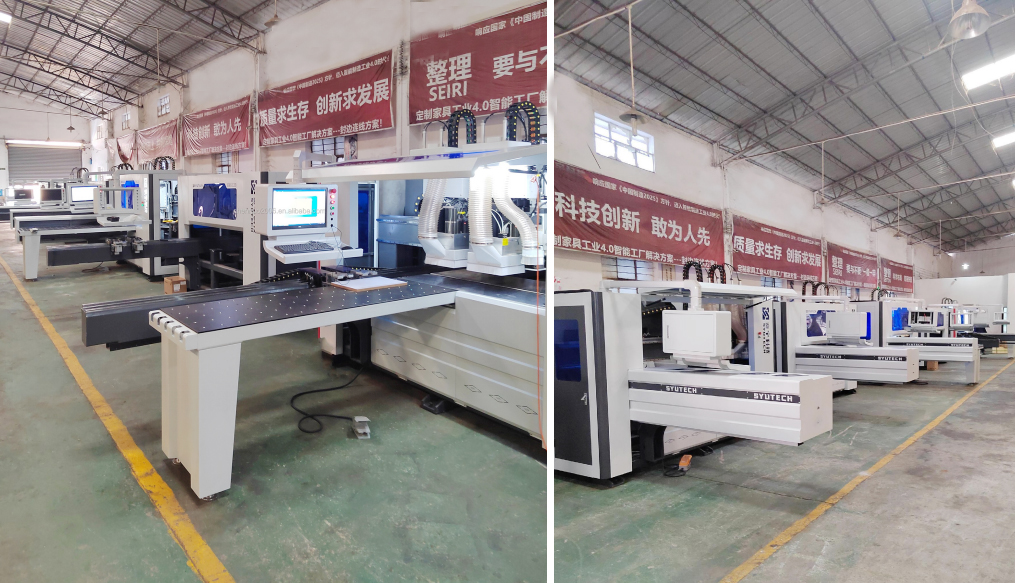
Between cutting and banding sits drilling, and leaving it out of the comparison usually means revisiting the line layout later. The HK612A six-side CNC drilling machine and the HK612B side drilling machine / drilling and milling center both work with an X-axis travel of 2,800 mm, a Y-axis travel of 1,220 mm, and a Z-axis height of 50 mm. Maximum processing size is 2,800 mm × 1,220 mm and the minimum is 140 mm × 40 mm. Maximum axis speeds are listed as 120 m/min on X, 80 m/min on Y, and 30 m/min on Z. The drilling configuration includes 10 vertical tools on top, 8 horizontal tools (XY) on top, and 9 vertical tools at the bottom; the machine measures 5,200 mm × 2,900 mm × 2,300 mm and weighs 3,500 kg.
For door and panel combinations, the HK3500 door processing machine covers a narrower envelope with a 395 mm × 3,000 mm table, 10–50 mm working thickness, and drill hole sizes from φ3 to φ15 mm at depths up to 35 mm.
Step-by-Step: How to Sequence the Decision
- Map the part mix by geometry, not by product name. Record the share of parts that are strictly rectangular versus shaped or curved. This single ratio usually decides whether the first investment belongs at the nesting station or at the saw.
- Define the smallest and largest panel you must run. A beam saw such as the HK330 cuts from a minimum working size of 34 mm × 45 mm up to a maximum cutting width of 3,300 mm, while the minimum panel handled at banding ranges from 135 mm × 50 mm (HK568) to 150 mm × 40 mm (HK268GY and HK268G). Panels below those minimums require a different process.
- Match the stage speeds to each other. Compare banding working speed (16–22 m/min on the HK868P, 16-18-22 m/min on the HK568, 18-20-22 m/min on the HK268GY) against the actual output of your cutting stage per shift, not against its catalogue maximum.
- Check the automation level you actually need. On the nesting side that means spindle power (9 kW on the HK-6), tool change capacity (12-tool automatic changer), drive type (four 1.5 kW servo motors), and control system (Taiwan SYNTEC or LNC).
- Confirm power and infrastructure. The machines above are specified at 380 V three-phase 50 Hz, and edge banding units require 0.7–0.9 MPa air pressure. SYUTECH offers logo, colour, and voltage customisation under its OEM/ODM programme, so voltage requirements should be raised before the quotation is finalised.
- Verify compliance for the destination market. EU-bound machines are covered by the CE certification described below; other markets apply their own requirements, which should be confirmed against the exact configuration being quoted.
- Validate with one machine before scaling the line. With a minimum order quantity of one set and 100% testing before shipment, a single unit can be run against your own panels before the rest of the line is committed.
Use Cases: What Buyers Actually Installed
Two documented installations show how mixed cutting and banding requirements are handled in practice.
Kenya. A panel furniture manufacturer in Kenya installed three units for edge banding and CNC router workshops. Over a two-year operating period, the reported results were stable edge banding, a significant improvement in edge banding quality, and increased output.
Greece. A panel furniture manufacturer in Greece installed ten units in an edge banding workshop. The equipment has been in stable operation for three years, with a significant increase in output reported over that period.
Both cases point the same way: in panel furniture production, measurable gains are reported where quality and throughput are visible on the finished panel — the routing stage and the banding stage.
Comparison Table: Roles, Specs, and Trade-Offs
The table below compares the three technologies by the job each one performs on a panel furniture line, using published SYUTECH machine data.
| Line stage | SYUTECH model | Representative working specs | Strongest fit | Main trade-off |
|---|---|---|---|---|
| CNC nesting / routing | HK-Line (built around the HK-6 nesting unit) | X 1,220 mm × Y 2,800 mm × Z 250 mm; 9 kW air-cooled spindle at 24,000 rpm; 12-tool automatic tool changer; four 1.5 kW servo motors; Taiwan SYNTEC / LNC control; 380 V 3-phase 50 Hz | Shaped parts, curved components, and drilling patterns completed in one setup; high part-mix production | Lower output per sheet than straight-line sawing when parts are simple rectangles |
| Cutting rectangular panels | HK330 beam saw / computer panel saw | Cutting speed 0–100 m/min; max cutting width 3,300 mm; max cutting height 100 mm; main saw 16.5 kW (optional 18.5 kW); scoring saw 2.2 kW; min working size 34 × 45 mm | High-volume rectangular panels in stable batch sizes | Cannot produce shaped or curved parts; contours still need a routing stage |
| Edge finishing | HK868P (alternatives: HK568, HK268GY, HK268G) | HK868P: 16–22 m/min; edge band 10–60 mm wide, 0.4–3 mm thick; total power 25 kW; approx. 4 t; 380 V 50 Hz | Required on virtually every panel line to seal exposed edges | If undersized against upstream output, banding becomes the line bottleneck |
| Drilling / milling (supporting stage) | HK612A six-side CNC drilling machine; HK612B side drilling machine / drilling and milling center | X 2,800 mm × Y 1,220 mm × Z 50 mm; max processing 2,800 × 1,220 mm; min 140 × 40 mm; 10 top vertical + 8 top horizontal (XY) + 9 bottom vertical tools; 3,500 kg | Panel drilling for dowels, fittings, and system holes before assembly | Adds a process stage, floor space, and a further point of flow planning |
Edge Banding Model Selection at a Glance
| Model | Working speed | Edge band width / thickness | Minimum panel | Power | Overall dimensions | Typical fit |
|---|---|---|---|---|---|---|
| HK868P | 16–22 m/min | 10–60 mm / 0.4–3 mm | Not stated in the published record | 25 kW total | 9,500 × 1,000 × 1,650 mm | High-throughput automatic banding in a full line |
| HK568 | 16-18-22 m/min | 10–60 mm / 0.4–3 mm | 135 mm long, 50 mm wide | 25.86 kW installed | 7,200 × 710 × 1,628 mm | Full-function banding with pre-milling, glue box, corner trimming, polishing |
| HK268GY (compact) | 18-20-22 m/min | 10–60 mm / 0.35–3 mm | 150 mm long, 40 mm wide | 12.4 kW, 380 V 50 Hz | 5,360 × 730 × 1,210 mm | Compact lines and space-constrained workshops |
| HK268G (mini) | 16-18-22 m/min | 10–60 mm / 0.35–3 mm | 150 mm long, 40 mm wide | 11.8 kW, 380 V 50 Hz | 3,790 × 730 × 1,210 mm | Small-footprint banding with the lowest floor space demand |
Both compact models are available in carbon steel or SS304 and operate at 0.7–0.9 MPa air pressure.
Compliance and Market Fit
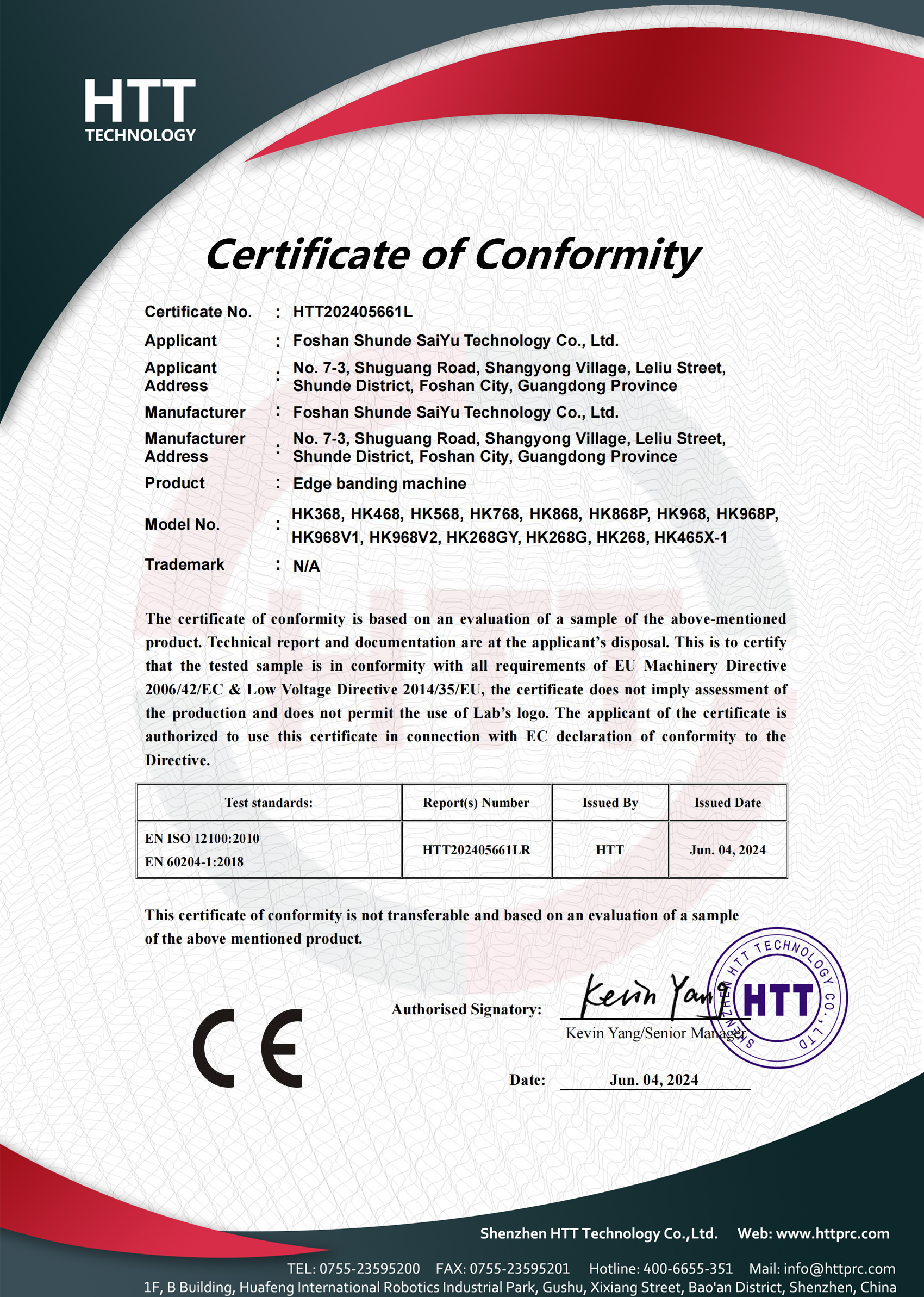
SYUTECH holds CE certification (certificate number HTT202405661L, issued by HTT on 5 June 2024) for the EU market, covering the Machinery Directive 2006/42/EC and the Low Voltage Directive 2014/35/EU, and citing the standards EN ISO 12100:2010 and EN 60204-1:2018. The certification record links the certificate to models including the HK868P, HK568, HK268G, HK268GY, HK330, HK-Line, HK-6, HK612A, HK612B, and HK3500.
Buyers should also check machine-specific rules in their own market. In the European market, for example, edge banding machines fed by chain(s) must comply with the EN 1218-4 safety standard, so the applicable standard should be confirmed against the exact configuration being quoted rather than assumed from a general CE mark.
Frequently Asked Questions
Are SYUTECH nesting, panel saw, and edge banding machines CE compliant for the EU market?
Yes — for the models covered by the certificate. SYUTECH's CE certification carries the certificate number HTT202405661L and was issued by HTT on 5 June 2024 for the EU market. Its scope covers the Machinery Directive 2006/42/EC and the Low Voltage Directive 2014/35/EU, and it cites the standards EN ISO 12100:2010 and EN 60204-1:2018. The certification record links the certificate to models including the HK868P, HK568, HK268G, HK268GY, HK330, HK-Line, HK-6, HK612A, HK612B, and HK3500. Machine-specific requirements still apply in individual markets: in the EU, edge banding machines fed by chain(s) must comply with the EN 1218-4 safety standard, so the applicable standard should be confirmed against the configuration being quoted.
Can one line combine CNC nesting and beam saw cutting instead of choosing one?
Yes, and in many panel furniture factories that is exactly what happens, because the two technologies solve different cutting logics. The HK-Line CNC nesting production line handles shaped parts, contour cutting, and drilling patterns in one setup, while the HK330 beam saw handles rectangular panels at up to 100 m/min with a maximum cutting width of 3,300 mm. Where a factory wants a combined configuration, SYUTECH builds customized automatic production lines (HKATC) after establishing two inputs: the required daily output and the size of the workshop. The practical constraint is layout and part flow, so the split between nesting and sawing should be defined by the share of rectangular versus shaped parts in the cutting list.
What drives the cost of a panel furniture line?
Cost is driven by configuration rather than by machine category alone. On the cutting side, the main variables are working width and saw motor power (the HK330 is listed with a 16.5 kW main saw motor and an optional 18.5 kW version) and whether a scoring saw unit is included. On the nesting side, the defining variables are spindle power (9 kW air-cooled on the HK-6), tool change capacity (12-tool automatic changer), drive and control specification (four 1.5 kW servo motors; Taiwan SYNTEC or LNC control). On the banding side, variables include working speed, number of processing units, and installed power, which ranges from 11.8 kW on the mini HK268G to 25.86 kW on the HK568. Footprint, voltage specification, and customisation also affect the final configuration. SYUTECH works with a minimum order quantity of one set and offers logo, colour, and voltage customisation under its OEM/ODM programme.
How can a buyer validate a machine before committing to a full line?
Validation starts with a defined sample. Because the minimum order quantity is one set and every machine is 100% tested before shipment, a single unit can be run against your own panels before the remaining stages are ordered. For an edge banding trial, the relevant parameters are the edge band width (10–60 mm on the HK868P, HK568, HK268GY, and HK268G), the edge band thickness range (0.4–3 mm on the HK868P and HK568; 0.35–3 mm on the compact models), and the minimum panel size your product range includes (135 mm × 50 mm on the HK568; 150 mm × 40 mm on the HK268GY and HK268G). For a cutting trial, the equivalent parameters are maximum cutting width (3,300 mm on the HK330) and the nesting working range (X 1,220 mm, Y 2,800 mm, Z 250 mm on the HK-6).
What is the production lead time and capacity for these machines?
SYUTECH lists a production lead time of 30–45 days, a monthly capacity of 100 sets, and an annual output of roughly 500 units across its range, with quality control described as 100% testing and after-sales support provided remotely. To receive an accurate quotation and timeline for a nesting, sawing, or edge banding configuration, the useful information to send is your part mix, daily output target, maximum and minimum panel dimensions, edge band thickness requirements, and destination market, because the same machine platform can be configured differently for each of those inputs. You can review the equipment range in the SYUTECH factory promotional brochure, or send your requirement to zywoodmachine@163.com / vanessa293199@139.com and +86 15019677504 to start a sample or quote discussion.
Conclusion: Compare the Flow, Then Commit to a Stage
CNC nesting, beam saws, and edge banding machines are not competing answers to the same question. Each one removes a specific bottleneck: nesting removes the geometry and setup constraint, the beam saw removes the throughput constraint on rectangular panels, and edge banding removes the visible-quality constraint that every cut panel creates. The mistake is to compare them on price and floor space alone, then discover that the banding station cannot keep up with the cutting stage, or that shaped parts are being routed by hand because the saw cannot produce them.
A workable sequence for buyers in evaluation is to map the part mix, define minimum and maximum panel sizes, match stage speeds to real shift output, confirm power and market compliance, and validate one machine against your own material before scaling. Used in that order, the comparison produces a line plan rather than a machine list.
Next step: send your cutting list, daily output target, panel dimensions, and destination market to the SYUTECH team. With a minimum order quantity of one set, a 30–45 day lead time, and CE-certified models across the nesting, panel saw, drilling, and edge banding range, a single machine can be validated before the full line is committed.
Website: www.syutech.com | Brochure: Factory promotional paper (PDF) | WhatsApp: +86 13929919431 | Email: zywoodmachine@163.com / vanessa293199@139.com